94 Brazilian Journal of Physics, vol. 38, no. 1, March, 2008
Dependence of the Crossover Exponent with the Diffusion Rate
in the Generalized Contact Process Model
W. G. Dantas∗ and M. J. de Oliveira†
Universidade de S˜ao Paulo, Caixa Postal 66318 05315-970 S˜ao Paulo, SP, Brazil
J. F. Stilck‡
Instituto de F´ısica, Universidade Federal Fluminense, 24210-340, Niter ´oi, RJ, Brazil
Received on 17 December, 2007
We study how the crossover exponent,φ, between the directed percolation (DP) and compact directed per-colation (CDP) behaves as a function of the diffusion rate in a model that generalizes the contact process. Our conclusions are based in results pointed by perturbative series expansions and numerical simulations, and are consistent with a valueφ=2 for finite diffusion rates andφ=1 in the limit of infinite diffusion rate.
Keywords: Phase transitions; Absorbing states; Crossover exponents; Diffusion process
I. INTRODUCTION
The research of the critical properties of nonequilibrium systems that undergo a phase transition between an active and an absorbing phase has been increasing in the last decade [1, 2]. Although many aspects of these transitions already have been well established in the literature [3], the absence of a general theory for such systems leads to many open ques-tions. These questions, in general, only can be answered par-tially and these answers are obtained, among other approaches through numerical simulations, a very useful tool in this task [4], and perturbative series expansions [5, 6], a powerful tech-nique that, in some situations, may lead to good numerical precision of the estimates for critical properties.
One main challenge in this field is determine, as precise is possible, a separation scheme of the models with the same critical properties or, using other words, determine the univer-sality classes for these phase transitions [7]. Although we do not have a systematic way to accomplish this task, one conclu-sion that seems to be correct is that all systems with a scalar order parameter, local interactions and without conservation laws belong to the same universality class called as Directed Percolation (DP) class. This statement is known as DP con-jecture [8]. The vast majority of the models which exhibit a phase transition between an active and absorbing state belong to this class, indicating that it is very robust. Thus, it is impor-tant to study different models and determine their universality class and it is essential to use approaches that permit us to es-timate, as precisely as possible, the critical exponents for each model.
In a recent paper, we estimated the crossover exponent be-tween the DP and DCP classes [9]. Using the perturbative supercritical series expansion formalism, proposed by Dick-man and Jensen [5], we obtain a very precise estimates for this exponent in a generalized contact process (CP) model,
∗Electronic address:[email protected]
†Electronic address:[email protected] ‡Electronic address:[email protected]
which lead us to conjecture that φ=2, in accordance with upper bound estimates [10] and simulational results for the Domany-Kinzel cellular automaton [11], which may indicate that this exponent is the same for similar models with paralell and sequencial updates. However, in an extended version of the generalized model (including a diffusion process) we were not be able to determine the behavior of the crossover expo-nentφas a function of the diffusion rate in the limit of high diffusion rate [12]. Our results show only that, in a region of weak diffusion, the crossover exponent still isφ=2. In this work, using numerical simulations to estimate this exponent we expect answer the question if the crossover between the DP and CDP classes changes with the diffusion rate.
This work is organized as follows. In section II, we present the model and discuss mean-field and perturbative series re-sults of the reference [12]. In section III we describe the nu-merical simulational scheme and show the new results that we obtained through it. Finally, conclusions and perspectives may be found in section IV.
II. MODEL
In a one-dimensional lattice with periodic boundary condi-tions each site is empty or occupied by one particle. Thus, a configuration of the system at timetis given by the vector
|η=|η1,η2, ...,ηN, where ηi=0,1 if the site is empty or occupied, respectively. The markovian evolution of the sys-tem is given by the following rules:
• We choose, randomly, a sitei.
• If this site is empty, then it becomes occupied with a transition rate equal topan/2, wherenis the number of the particles in the first neighbor sites ofi.
W. G. Dantas, M. J. de Oliveira, and J. F. Stilck 95
• If the siteiis occupied, it may become empty by two processes:
1. Spontaneously, independently of its neighbor-hood, with ratepc.
•
→ ◦
p
c2. Through contact with first neighbor empty sites with a ratepb(2−n)/2.
◦ • ◦
→ ◦ ◦ ◦
pb
• Finally, we have a diffusive process for the particles, occurring with a rate ˜D.
•◦
→ ◦•
D
˜
We define the parameters in such way that pa+pb+pc=1 and 0<D˜<∞. For convenience, we will discuss our results in the space(pa,pc,D˜). This model reduces to the CP model with diffusion if we putpb=0 and to the voter model or linear Glauber model at zero temperature forpa=pbandpc=0. In the first case we have exponents that belongs to the DP uni-versality class and in the last case the phase transition belongs to the CDP universality class. Thus, in the neighborhood of pc=0, we have a crossover between these classes.
For a certain fixed value of the diffusion rate, the behavior of the any stationary density close to the multicritical point, should be given by the scaling form,
g(∆pa,∆pc,D˜)∼∆p eg(D˜)
a F
∆pc
|∆pa|φ(D˜)
, (1)
where∆pa=pa−1/2,∆pc=pc,eg(D˜)is a critical exponent related with the densitygandφ(D˜)is the crossover exponent. The scaling functionF(z)is singular at a valuez0(D˜)of its
ar-gument, which corresponds to the critical line for a certain dif-fusion rate value, ˜D. Using the scaling form (1), we obtain that the critical line is asymptotically given bypc=z0(D˜)∆p
φ(D˜)
a . In a recent study [12], we have derived solutions for the cluster dynamics approximation in the one-, two- and three-site level. In the first case (simple mean-field approximation) the critical line is pa=1/2, independently of the diffusion rate. Thus, the crossover exponent in this approximation is
φ=0. In the two-site level, we have a solution that shows three values of this exponent: φ=2, if ˜D=0,φ=1, if 0<
˜
D<∞andφ=0 for the infinite diffusion rate. Finally, in the three-site level of mean-field approximation, we obtain only a numerical estimate of the critical line. In this calculation, at sufficiently small diffusion rates, the crossover exponent value isφ≈2 but, in an intermediate region of the diffusion rate, a slight deviation to smaller values appears, converging
toφ≈1 at high diffusion rates. It is probable that, in mean-field approximations of higher order, the interval of values of
˜
Dfor whichφ≈2 grows.
On the other hand, in the same work, a perturbative series approach furnishesφ=2, at least up to ˜D≈0.3. Unfortu-nately, we were not able to determine the crossover exponent values for larger diffusion rates. Therefore, it would be inter-esting to use a numerical simulational approach to investigate how the crossover exponent behaves as a function of the dif-fusion rate, paricularly for large values of this rate.
III. NUMERICAL SIMULATIONS
In order to reach higher values of the diffusion rate and de-termine the behavior of the crossover exponent we use time-dependent numerical simulations for the model. These sim-ulations are carried out using a single seed in a lattice with N=10000 sites and periodic boundary conditions to avoid finite-size effects. The simulation is done for discrete time, and may be described by the following steps:
1. A list of all sites occupied by particles is stored, and at each time step one of them is chosen randomly. 2. Once the site is chosen, a random number p uniformly
distributed in the interval [0, 1] is generated, if p< D=D˜/(1+D˜)a pair hole-particle of first neighbors is switched, if possible. Otherwise, we choose a reac-tion: creation or annihilation. With a probabilitypaan empty site, in one of the first neighbors, is occupied, if possible. Otherwise, a particle at the chosen site will be annihilated either through the spontaneous or through the autocatalytic process.
3. To define the process switching a particle to a hole, an-other random numberqis generated. Ifq<pc/(1−pa) the change is spontaneous, otherwise it will happen with a probability proportional to the number of empty sites in first neighbors of the chosen site.
4. The time interval associated with the steps above isdt= 1/NA, whereNAis the number of the sites occupied by particles before the step. The process is repeated until either a maximum number of stepsnmax is attained or the absorbing stateNA=0 is reached.
5. Several runs are done and mean values are calculated as functions of time.
96 Brazilian Journal of Physics, vol. 38, no. 1, March, 2008
0 0.05 0.1 0.15 0.2
p
c 0.5
0.55 0.6 0.65 0.7 0.75 0.8
pa
D = 0 D = 0.1 D = 0.2 D = 0.3 D = 0.5 D = 0.7 D = 0.8 D = 0.9 D = 0.93 D = 0.95 D = 0.97 D = 0.98 D = 0.99
0 0.2 0.4 0.6 0.8 1
0 0.5 1 1.5 2 2.5 3
FIG. 1: Critical line and crossover exponents estimated in the three-site level mean-field approach (forD=D˜/(1+D˜)fixed). At small diffusion rate, the crossover exponent isφ≈2.
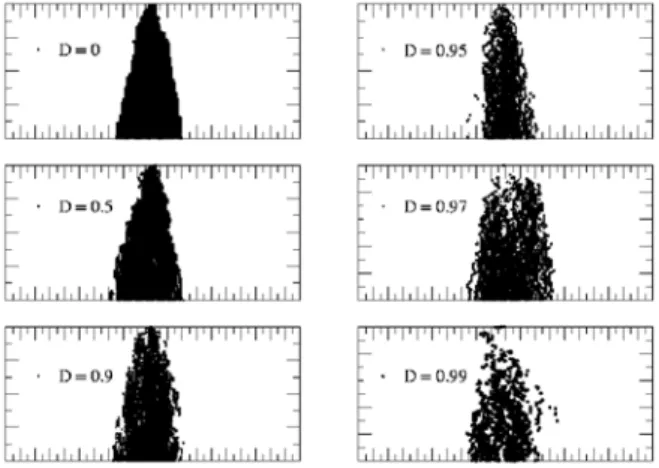
FIG. 2: Spreading of particles with a single seed as initial condition. The time arrow points down and this behavior is obtained for pc=
0.02 andpa>pca.
Our results suggest that the crossover exponent is φ=2 up to D≈0.9, with decreasing estimates at higher diffusion rates. Although, we believe that this behavior is a numerical
artifact due to an imprecision estimate of the critical points at this region, indicating a trend to vanishingφin the infinite diffusion rate limit. Therefore, our results seems indicate that the crossover exponent between the DP and CDP universality classes in the generalized contact process is
φ=
0 if D=1 2 otherwise.
The change in the crossover exponent value seems be re-lated to the disapearance of compact clusters of particles. The compact clusters are a signature of the CDP behavior. In the Fig. (2) we show that these clusters are no longer present when the diffusion rate is large.
We do not have a rigorous argument to relate the loss of the compact cluster to the change of the crossover exponent. It would be interesting study in a similar model if this apparent connection is correct.
IV. CONCLUSIONS
In this work we study how the diffusion rate affects the crossover exponent between the DP and CDP universality classes. In a preliminar work [12], using perturbative series approach, we determine the valueφ≈2 up to D≈0.3 and due to limitations in the series derivation, we were not able to reach larger values for the diffusion rate.
However, the numerical simulation approach allows us to obtain estimates for the crossover exponent in a region closer to the limit where the diffusion rate diverges. Our results sug-gested that the crossover exponent isφ=2 for all finite dif-fusion rates andφ=0 at infinte diffusion rate, recovering the simple mean-field result, as expected. Besides, the change of the crossover exponent value in the infinite diffusion rate limit could be related to the loss of compact clusters of parti-cles, although this cannot be proven by our results, but only suggested.
In a future work, we intend to realize quasi-stationary sim-ulations, according the Oliveira and Dickman scheme [14], trying to obtain better results for the region withD>0.9.
Acknowledgement
W.G. Dantas acknowledges the financial support from Fundac¸˜ao de Amparo `a Pesquisa do Estado de S˜ao Paulo (FAPESP) under Grant No. 05/04459-1 and JFS acknowl-edges funding by project PRONEX-CNPq-FAPERJ/171.168-2003.
[1] J. Marro and R. Dickman,Nonequilibrium Phase Transitions in Lattice Models (Cambridge University Press, Cambridge, 1999)
[2] K. A. Takeuchi, M. Kuroda, H. Chat´e and M. Sano, cond-mat/0706.4151(2007).
[3] H. Hinrichsen, Adv. Phys.,49, 815 (2000).
W. G. Dantas, M. J. de Oliveira, and J. F. Stilck 97
[8] H. K. Janssen, Z. Phys. B,42, 151 (1981); P. Grassberger, Z. Phys. B,47, 365 (1982).
[9] W.G. Dantas and J.F. Stilck, J. Phys. A,38, 5841 (2005.) [10] T. M. Liggett, Ann. Appl. Probab.xx, yy (1994).
[11] A. Yu. Tretyakov, N. Inui, M. Katori, and H. Tsukahara, cond-mat/9509061(1995).
[12] W.G. Dantas and J.F. Stilck, J. Stat. Mech.,06, P06019 (2007.) [13] M. E. Fisher and R. M. Kerr, Phys. Rev. Lett.32, 667 (1977). [14] M.M. de Oliveira and R. Dickman, Phys. Rev. E,71, 016129