Overseas Investment Patterns:
A Case Study of The Strategic Practices of
Emerging Chinese Gold Mining Companies
ZHANG Yuan
Thesis submitted as partial requirement for the conferral of the degree of
Doctor of Management
Supervisor:
Prof. Sandro Mendonca, ISCTE Business School, Department of Economics
Co-supervisor:
Prof. Du Yifei, University of Electronic Science and Technology of China, Department of Economy and Management
O
V
E
RSE
A
S I
N
V
E
ST
ME
N
T
PATT
E
RN
S
: A C
A
SE
ST
U
D
Y
O
F T
H
E
ST
RA
T
E
G
IC
PRA
CT
ICE
S
O
F E
M
E
RG
IN
G
C
H
IN
E
SE
GO
L
D
MI
N
IN
G
CO
MPA
N
IE
S
ZHAN
G
Yua
n
va
Overseas Investment Patterns:
A Case Study of The Strategic Practices of
Emerging Chinese Gold Mining Companies
ZHANG Yuan
Thesis submitted as partial requirement for the conferral of the degree of
Doctor of Management
Jury:
Presidente Professor Álvaro Augusto da Rosa Doutora XIAO Wen, Professora Associada da UESTC
Doutor Vítor Ferreira, Professor Associado e Director da Business School do Instituto Politécnico de Leiria
Doutor Nuno Crespo, Professor Auxiliar do ISEG
Doutor Sandro Mendonça supervisor, Professor Auxiliar, ISCTE-IUL
Statement of honor
Submission of Doctor’s dissertation or project work or doctoral thesis
I the undersigned state on my honor that:
- The work submitted herewith is original and of my exclusive authorship and that I have indicated all the sources used.
- I give my permission for my work to be put through Safe Assign plagiarism detection tool. - I am familiar with the ISCTE-IUL Student Disciplinary Regulations and the ISCTE-IUL
Code of Academic Conduct.
- I am aware that plagiarism, self-plagiarism or copying constitutes an academic violation.
Full name ZHANG Yuan _ Course Doctor of Management _ Student number 59617 _ Email address [email protected] _ Personal email address _ Telephone number 15259257797 _
ISCTE-IUL, 17/03/2016
Abstract
This dissertation explores the overseas investment pattern of the Chinese gold mining industry. We focus on the case of Zijin Mining Group Ltd. This company has taken a leading role in the internalisation of the Chinese sector and its shareholding structure, being partially state-owned, is distinctwhen compared with its domestic peers. We use a “case study” approach to test whether the “Uppsala model” provides an appropriate analytical framework for accounting and explaining the outward expansion movement of such a company from an emerging economy. We address two main research questions: a) how have Chinese gold mining companies been conducting overseas investment? And b) why have these strategies performed the way they have been. We conduct an extensive literature review and move on to carry out an analysis drawing on a rich array of primary resourcesto understand the internationalization process of Zijin. We document a number of project-cases and take an in-depth examination of Zijin’s mining investment. We identify gaps between the Uppsala model and the development of its resource theories such as evolutionary theories of the firm, and evolutionary economics. Understanding the fundamental mechanisms behind trajectories of adaptations to foreign environments is a crucial task. In the context of the emerging Chinese gold industry we find that firm-specific and path-dependent knowledge is a causal determinant of performance in overseas investment processes. Our findings are relevant to the design of context-sensitive strategies by participants in movements of outward investment, and especially to managers of emerging Chinese gold companies which are influenced by state policy and exploring new roads to the overseas market.
Key-words: Chinese gold mining companies, overseas investment, Uppsala model JEL: F63, M16, O54
Resumo
Esta tese explora o padrão de investimento estrangeiro na indústria chinesa de mineração de ouro. Explora-se o caso da empresa Zijin Mining Group, Ltd. Esta empresa tem tido um papel de liderança na internacionalização da indústria chinesa e sua estrutura accionista, parcialmente estatal, é diferente em comparação com outras empresas. A investigação emprega uma abordagem de “estudo de caso” para apurar se o “modelo de Uppsala” fornece um quadro analítico apropriado para explicar o movimento de expansão externa de uma empresa de uma economia emergente. Abordamos duas principais questões de investigação: a) como é que esta empresa de mineração de ouro da China fez investimentos no exterior?,e b) porque razão essas estratégias são realizadas na forma como o são. Realizamos uma extensa revisão da literatura e procedemos a uma análise com base numa ampla gama de fontes primárias para compreender o processo de internacionalização da Zijin. Documentamos uma série de projetos de casos e assinalamos uma apreciação do processo de investimento de Zijin Mining que revela diferenças com o modelo de Uppsala mas, que alternativamente, mostra sintonias com os novos desenvolvimentos das teorias baseadas nos ecursos, tais como a família das teorias evolucionistas da empresa. A compreensão dos mecanismos fundamentais por trás das trajetórias das adaptações a ambientes estrangeiros é uma tarefa crucial. No contexto da emergente indústria chinesa de ouro argumentamos que o conhecimento específico à empresa, que é dependente do seu percurso histórico, é um determinante causal do seu desempenho em processos de investimento no exterior. Os nossos resultados são relevantes para a concepção de estratégias sensíveis ao contexto por parte de participantes em movimentos de investimento directo estrangeiro e, especialmente, potencialmente informativos para gestores de empresas de ouro que são influenciadas pela política estatal de países emergentes e que tentam explorar novos caminhos em mercados geograficamente distantes.
Palavras-chave: empresas chinesas de mineração de ouro, investimento externo, modelo de
Uppsala
Acknowledgements
While writing this dissertation some people provided their help and I will not forget. Therefore, my deepest gratitude goes first and foremost to my supervisor Professor Sandro Mendonca and Professor Yifei Du. Their instructive advice and useful suggestions made me stay on the right track. I deeply admire their serious scientific attitude and rigorous scholarship.
I also want to express my heartfelt gratitude to team members of doctoral programme of international management, especially Professor Virginia Trigo and Professor Wen Xiao, who provided their consistent and illuminating instruction during my working process.
I am in particular thankful to my employer, Zijin mining group, which provided access to the necessary data to conduct the research.
I am also thankfull to a number of Latin American experts who shared their knowledge and provided their constructive advice. I thank Professor Roberto Villa-Boas, researcher at the Center for Mineral Technology for the Brazilian Ministry of Science, Tecnology and Innovation. I thank Dr. Helga Chulepin, Public Relations Manager at Uruguay of Zamin, a Chinese iron ore mining company with assets in South America.
Last, but not least, I want to acknowledge my beloved family who gave me a strong will and faith of sure success.
Contents
Chapter 1: Introduction ... 1
1.1 Introduction ... 1
1.2 Background and motivation... 2
1.3 Analytical framework ... 4
1.4 Research methodology ... 7
1.5 Findings, value, and contribution of the research project ... 8
1.6 Overview of the dissertation ... 9
Chapter 2: Literature Review ... 11
2.1 Introduction ... 11
2.2 Paradigms and modes of evolutionary explanation ... 12
2.2.1 Kuhnian way to explain growth and change in knowledge ... 12
2.2.2 Advances and challenges in explanations of the firm and its internationalization ... 13
2.3 Evolutionary theorising ... 14
2.3.1 Foundations of evolutionary economics ... 14
2.3.2 Key evolutionary concepts ... 15
2.3.3 Remaining limitations ... 18
2.4 Theory of the firm ... 18
2.4.1 Origins and key concepts ... 18
2.4.2 Resources, knowledge and dynamic capabilities ... 20
2.4.3 Remaining gaps and difficulties ... 24
2.5 Business internationalisation ... 25
2.5.1 The original Uppsala model ... 25
2.5.2 Amendments and revisions of the Uppsala model ... 28
2.5.3 Theoretical gaps in the Uppsala model ... 30
2.6 Conclusion ... 35
Chapter 3: Research methods ... 37
3.1 Introduction ... 37
3.2 Case study ... 37
3.2.2 The nature of case study research... 38
3.2.3 Zijin as research target ... 39
3.2.4 The path of Zijin ... 45
3.2.5 Procedures for implementing the case study ... 47
3.3 Data collection ... 48
3.4 Data analysis ... 49
3.5 Quality of the research design ... 52
3.6 Strengths and limitations of the research ... 52
3.7 Conclusion ... 53
Chapter 4: Case study ... 55
4.1 Introduction ... 55
4.2 Domestic expansion of Zijin... 55
4.2.1 Overview of domestic acquisition by Zijin ... 55
4.2.2 Investment characteristics (core category A1) ... 58
4.2.3 Psychic distance (core category A2) ... 59
4.2.4 Market knowledge (core category A3) ... 61
4.2.5 Industry’s characteristics (core category B1) ... 64
4.2.6 Influence of state policy (core category B2) ... 66
4.2.7 Influence of entrepreneur based on enterprise culture and strategy (core category B3). ... 68
4.2.8Dynamic capabilities (core category B4) ... 71
4.2.9 Capability paradox factors (core category B5) ... 73
4.3 International expansion of Zijin ... 74
4.3.1 Overview of overseasinvestment by Zijin ... 74
4.3.2 Investment characteristics (core category A1) ... 75
4.3.3 Psychic distance (core category A2) ... 79
4.3.4 Market knowledge (core category A3) ... 81
4.3.5 Industry’s characteristics (core category B 1) ... 82
4.3.6 Influence of state policy related to shareholding of the firm (core category B2) ... 84
4.3.7 Influence of entrepreneur based on enterprise culture and strategy (core category B3) ... .86
4.3.9 Capability paradox factors (core category B5) ... 90
4.4 Uppsala model as frame of analysis ... 91
4.4.1 Comparison between domestic and international expansion of Zijin ... 91
4.4.2 Inapplicability of U model in Zijin’s case ... 93
4.4.3 U+ model originated from Zijin’s case ... 94
4.4.4 Possible managerial implication of U + model ... 95
4.5 Conclusion ... 97 4.5.1 Coding explanation ... 97 4.5.2 Summary of cases ... 98 4.5.3 U+ model ... 98 Chapter 5: Conclusions ... 101 5.1 Summary ... 101 5.2 Findings ... 102
5.2.1 Research questions and general findings ... 102
5.2.2 Domestic and overseas path of Zijin ... 104
5.2.3 Uppsala+ model... 105
5.3 Contributions ... 106
5.3.1 Adding more research context ... 106
5.3.2 Development of the U model related framework ... 107
5.3.3 Introduction of a new idea ... 108
5.3.4 Provision of predictive tools ... 108
5.4 Limitations of the research ... 109
5.5 New directions for future research ... 110
Bibliography ...111
Appendix 1: Summary of HR information of overseas division ... 125
Appendix 2: Major Global Gold Districts ... 129
List of Tables
Table 3 - 1 Profit 2012-2014 of four biggest gold production companies in China ... 40
Table 3 - 2 Gold productions 2012-2014 of four biggest gold production companies in China ... 40
Table 3 - 3 Summary of Zijin’s overseas investment ... 43
Table 3 - 4 Summary of Zijin’s history ... 46
Table 3 - 5 List of documents used to amass information about Zijin ... 49
Table 3 - 6 Coding rules ... 51
Table 4 - 1 Summary of domestic investment ... 57
Table 4 - 2 Brief of employees of domestic investment department ... 62
Table 4 - 3 Acquisitions of gold reserves and resources by year 2004-2013 ... 65
Table 4 - 4 Summary of Zijin’s overseas investment ... 74
Table 4 - 5 Summary of investment methods of overseas acquisition ... 76
Table 4 - 6 Geological location of oversees acquisition ... 77
Table 4 - 7 Risk of countries where Zijin has invested ... 78
Table 4 - 8 Summary of overseas investment size ... 78
Table 4 - 9 Psychic distance of investment target countries ... 80
Table 4 - 10 Gold reserve ranking (tons) ... 83
Table 4 - 11 Problem analysis of acquired projects by Zijin ... 89
List of Figures
Figure 2 - 1 Summary of revolutionary process in a paradigm perspective. ... 13
Figure 2 - 2 The Basic Mechanism of Internationalization ... 25
Figure 2 - 3 Development path of theory of the firm and Uppsala model ... 287
Figure 3 - 1 Shareholding structure of Zijin of 2013 ... 41
Figure 3 - 2 Investment of Shandong gold 2004-2013 ... 42
Figure 3 - 3 Investment of China gold 2004-2013 ... 42
Figure 4 - 1 Geological location of investment ... 58
Figure 4 - 2 Investment dynamics (size in million dollars) ... 59
Figure 4 – 3 Discovery of gold reserves by exploration 1999-2013 ... 65
Figure 4 - 4 Shareholding structure of Zijin of 2013 ... 68
Figure 4 - 5 Relation between dynamic capacities and paradox factors in domestic market ... 73
Figure 4 - 6 Trend-line of overseas investment size ... 79
Figure 4 - 7 Psychic distance of invest target countries ... 80
Figure 4 - 8 Trend line of overseas investment size ... 84
Figure 4 - 9 Relation between dynamic capabilities and paradox factors in overseas market ... 91
Figure 4 - 10 Summary of U+ model ... 94
List of Abbreviations
ECGMCs Emerging Chinese Gold Mining Companies
Chapter 1: Introduction
1.1 Introduction
The objective of the dissertation is to analyse the internationalization practices of emerging Chinese gold mining companies (ECGMCs). We investigate the internationalization process of a leading ECGMCs from the perspective of evolutionary theory, in particular the dynamic capabilities view of the firm. On the basis of this theoretical background we appraise how the Uppsala model, which is a theory about how firms progress in their internationalisation process. We do this by providing an appreciative, context-based account of a case study: the outward investment movement of a company like Zijin Mining Group Ltd.
Our research over the overseas investment patterns of Zijin seeks to answer two questions. First, how have Chinese gold companies been conducting overseas investment? Second, why have these strategies performed the way they have been?
Explanations of internationalisation processes, especially the Uppsala model, have mostly developed from the angle of limited geographical areas. Notwithstanding, we depart from this existing analytical tool and try extending in two ways:
a) by considering an emerging developing country that has for the past years been on the
foreign direct investment emitting side, rather than on the receiving side.
b) by supplementing the existing range of case studies with a leading example from the gold
mining field.
The case study approach is the main research methodology of this paper: it will focus on Zijin Mining Group Ltd. (Zijin, for short). Following Yin’s (2004) definitions and distinctions of case study methodology, it will be a longitudinal, single case, single level, and embedded study. In other words, we cover the history of one company that we happen to know from the inside.
On the basis of detailed empirical knowledge and access to internal sources we find this case to be a significant instance from the point of view of the theory. In particular, we find that Zijin’s case substantially is at variance with Uppsala model in its overseas investment features, namely
in its investment location, investment method, investment strength, etc. Through Zijin we find that the internationalization process of ECGMCs is similar to their domestic pattern due to path dependence and features such fixed appetite of method, fixed appetite of location, and non-gradual increase of investment size. The pattern is the interact result between capability paradox factors and dynamic capabilities, influenced by entrepreneur factors, under the context of state policy and industry influence. Moreover, past experience is no good guide beyond the initial local context and that the companies need to nurture an ability to learn (“dynamic capabilities”) as they internationalize.
1.2 Background and motivation
With the rapid development of the Chinese economy, from 2003 to 2011, output of Chinese mining industry has increased from 88.9 billion dollars to 930 billion dollars (Chen et al., 2015), the supply of gold increased from less than 200 tons in 1994 to about 600 tons in 2013 (see Figure A2 of the appendix) and ECGMCs like Zijin and Shandong gold have begun to acquire mining projects in overseas markets. Thus, emerging markets are no longer passive recipients of economic initiatives from abroad: companies from these countries have started to be themselves active agents of globalisation.
What is more, any light the Uppsala model can cast over these internationalisation phenomena may have practical implications. Johanson and Vahlne (1990: 11) explained that:
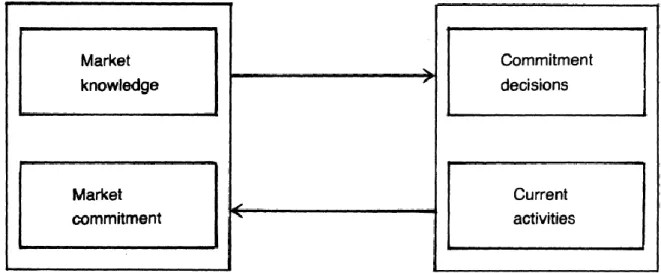
“The internationalization of the firm is seen as a process in which the enterprise gradually increases its international involvement. This process evolves in an interplay between the development of knowledge about foreign markets and operations on one hand and an increasing commitment of resources to foreign markets on the other.”
Given that the commodities business has figured high in the connections that China has begun developing with economies from the southern hemisphere it makes sense to investigate a sector like the gold business. At the same time some of ECGMCs such as Zijin mining, and Zhaojin mining have transformed themselves into internationally big players (Xia and Zhou, 2015).
Hence, our potential finding may be of interest for a variety of stakeholder, namely, for actors from the private realms (corporate decision makers, engineering experts, market analysts,
etc.) and public (export promotion agencies, business regulators, sectored institutions, etc.) As China officially is set to invest heavily abroad into complex heavy projects under the “One Belt, One Road” initiative, new international management expertise will be on demand. After all, resource industry is also a focus of the strategy. According to “Vision and Actions on Jointly Building Silk Road Economic Belt and 21st Century Maritime Silk Road” issued by the National Development and Reform Commission, Ministry of Foreign Affairs, and Ministry of Commerce of the People’s Republic of China, cooperation in the exploration and development of coal, oil, gas, metal minerals and other conventional energy sources should be increased.
The learning process of leading ECGMCs can yield relevant knowledge as to how and why one specific business as a whole is venturing abroad. This experience of a particular company (Zijin) in a particular branch of the mining industry (gold) in a variety of foreign theatres of operation (developing economies in Africa and South America) may be difficult to extrapolate but is surely an important illustrative instance of the new “going out” trend. ECGMCs are a particular group of business units with the special background of rapidly growing country, the largest developing country and the most dynamic emerging country in the world. Moreover, gold mining companies are significantly different from manufacturing and service firms, and suitability of related theories on mining is open to further research.
As such, the objective of this Dissertation is to analyse and appraise the strategic practice of ECGMCs of overseas investment patterns. This study will be based on the Uppsala model and controlled through theoretical sources such as evolutionary economics.
The Uppsala model has mostly developed from the angle of limited geological areas such as Sweden and other developed countries and the expectations stemming from it may be at variance with evidence of coming out from emerging-developing markets interactions. However, armed with latest theoretical tools of evolutionary economics and theory of the firm, we want to explore new internationalisation dynamics from integrated understanding framework, based but not necessarily bound by the classic Uppsala model.
It is also important to refer to what remains outside our scope of analysis. Non-mining companies, non-China based companies and non-gold companies also need an internationalization tool or pattern to enter into the overseas market. This lies in the backdrop of our analysis but is not our focus, although our finding may bring new context to this broad
picture.
1.3 Analytical framework
In this Dissertation, three layers of theories within an integrated theoretical framework are discussed. Among the three theories, evolutionary economics provides economics foundation (a wider level of understanding), the “dynamic capabilities” concept (DCs) provides firm-level instruction, and the Uppsala model provides a narrower level of explanation of the internationalisation process at stake.
Economics is the first level of the framework. Zhu and Dong (2011) point out that Uppsala model is one kind of FDI theory (foreign direct investment theory) which belongs to economics. In this sense, Uppsala model is still a component of economics. Within the scope of economics, based on research of some scholars (Madsen and Servias, 1997; Moen and Servais, 2002;
Manalova, 2003; Vahlne et al., 2011), evolutionary economics may be the important economics
sources of internationalization process research and so it may be the appropriate economics to analyse Uppsala model. For example, Manalova (2003) argue that internationalization process is evolutionary. Madsen and Servias (1997) further indicate that evolutionary economics may be one of the most “promising theoretical avenues” in terms of internationalization process research. Vahlne et al. (2011) put forward that the Uppsala model should be put in a context as opposed to a neo –classical type market. It means that neo-classical type economics may not be appropriate to be adopted as economics source for Uppsala model. Vahlne and Johanson (2013) argue that Uppsala paradigm is a tool by which we are out to explain how the individual MNE (multinational enterprises) evolves over time. Vahlne and Johanson (2013) also think that dynamic capabilities are grounded in the resource-based view, and are a key concept within evolutionary economics.
In this sense, evolutionary economics is a top level concept and dynamic capabilities/ resource –based view is middle level concept. Accordingly, Uppsala model is a bottom or more basic level concept. So, it is safe to say that evolutionary economics may be the important economics sources and tool to study internalization process or further amendment of Uppsala model. Thus, evolutionary economics needs to be reviewed and discussed.
In chronological order, the theoretical development path of evolutionary economics is from Schumpeter to Nelson & Winter (Langlois and Everett, 1994; Kelm, 1997; Hodgson, 2004) and focus of future research is on achieving mélange of hierarchies of explanation and how to conduct explanation in industry and individual firms (Yang, 2008; Jia, 2013; Dollimore and Hodgson, 2014). Definition and ontology are two key issues of evolutionary economics. Different economists provide different definition for the term, evolution economics. Foss (1994) argues that evolutionary economics explores creation and dissemination of knowledge in the economy and resulting structure change. Hodgson (1999) put forward three standards to define it, namely: ontological criteria (acceptance of genuine novelty as a key characteristic of the real economy), methodological criteria (against the reductionism of taking representative agents as unit of analysis) and epistemological criteria (adoption of the biology metaphor as tool for understanding the economy, but in a not uncritical way). For Geoffrey Hodgsonthis stance is construed as his famous NEAR evolutionary economics (Novelty-Embracing and Anti-Reductionist). Foster and Metcalfe (2001) and Jia (2004) also agree with this stance.
The theory of the firm is the second level of the framework and “dynamic capabilities” theory is direct and latest theoretical tool within the theoretical system of theories of firms. Basic theories of firms from evolutionary perspective include theory by Schumpeter (1934), theory by Penrose (1959) and evolutionary theory of Nelson and Winter (1982). Based on these theories, the understanding of the firm evolved through two routes, i.e. the first one is “resource-based view”/“dynamic capability” view that takes resources, especially knowledge, as the cornerstone of what is a firm (see Gu and Ding, 2009; Wu and Liu, 2011) and the second one is the Austrian economics route based on the Schumpeterian notion of the creative individual actor and his focus on entrepreneurs (Wang and Ahmed, 2007).
Referring to theoretical gaps in the theory of the firm, Priem and Butler (2001), and Wu and Liu (2011) indicate that, although RBV (resource-based view) and its related theories have an origin of evolutionary economics, most of their research is static/equilibrium research oriented.In this sense, dynamic methodology should be adopted and this is why dynamic capabilities theory has been paid attention by researchers. But, DCs also has its theoretical boundaries, for example, environmental conditions and types and size of firms (Ting Kuei Kuo, 2012).
Uppsala model is the basic tool for understanding internationalization and the bottom theory in the framework. Johanson and Vahlne (1977) analysed the characteristics of internationalization
process and they found that internationalization is the result of gradual decision of firms. Uppsala Model is originally based on Swedish firms’ experience, and the two researchers identified four different steps of entering an overseas market, which is subject to company’s market knowledge. Besides the staged process of internationalization, they put forward the concept of “psychic distance” think that firms tend to expend in a psychic nearby country. This model is also called IPT theory (internationalization process theory), i.e. process theory of internationalization (Xiao and Chen, 2008). In terms of research state of Uppsala model, some researchers such as Bilkey and Tesar (1977), Cavusigil (1980), Czinkota (1982) Root (1987) focus on process oriented research and others such as Kogut and Singh (1988) and Barkema et al. (1996) focus on psychic distance research. Besides focus on process and psychic distance, researchers also conducted research from the perspective of social network of firms (Arenius, 2002; Jensen, 2003; Prashantham and Young, 2004) and innovation (Oviatt and McDougall, 1994).
With respect to the conceptual underpinning of the Uppsala model, its scope of application and the role of learning are still issues which need further exploration. For example, some scholars (Moen and Servais, 2002; Bengtsson, 2004; Zhu and Dong, 2011) are sceptical about its limited application to the early stage of firms’ internationalization. They say the more does work well for advanced stages of internationalisation. Other scholars such as Dicht et al. (1984) argue that Uppsala model researchers tend to oversimplify extremely complex internationalization process. In this view internationalisation processes of different firms can hardly be made to fit only one model. Turnbull (1987) and Andersen (1993) both think that such oversimplications are risk or even completely wrong. Moreover, the overlap between internationalization and entrepreneurship is the focus of other body of academic research. Bengtsson (2004) put forward that when founder of firms are persons with an overseas background this will help firms to earn experience: this type of knowledge makes firms moving faster in the road of internationalization. But, research of entrepreneurship is not the focus of traditional Uppsala model. Acquisition dynamics is also outside of the research scope of traditional Uppsala model (Forsgren, 1990).
1.4 Research methodology
The case study is the main research method of this paper and its focus is on Zijin Mining Co. Ltd. According to Yin’s (1984, 1994, 2001), Leonard-Barton (1992) and Pratt (2009), the case study is an appropriate method to deal with how and why issues. Moreover, Zijin mining is a special case in a peculiar background, i.e. a rapidly developing company from a rapidly developing country. A case study is useful for studying this sort of salient circumstances (Pattern 1990). The topic of the dissertation is in line with the definition of case. It is a bounded system and there is certain behaviour pattern in the system. Last, but not least, this research is also an in depth and in process research, which is appropriate to the research topic, internationalization (Forsman et al., 2002).
In this case study research validity is paid attention to. Internal validity is a paramount quality criteria. According to Merriam (1988), Patton (1990), and Yin (2001), triangulation, peer examination, member checking, researcher prejudice avoidance and constant observation, should be considered as five main strategies to secure the internal validity. With respect to this dissertation, triangulation is the key tool. More explicitly speaking, different information collection methods will be used (method triangulation), different information resource will be examined (resource triangulation), different theories will be adopted to analyse information (theory triangulation). But, while there is only one researcher and analytical triangulation is difficult, peer examination can make a compliment to some degree. With respect to this dissertation, according to Le Compte et al. (1993), background of research examples such as society, culture and economics, value independence, validity of information, characteristics of research examples should be examined. However, due to the nature of single case study, it is very difficult to improve external validity, or validity to peers of the example firm. In terms of reliability, according to Merriam (1988), triangulation and improvement of researcher’s ability can be considered as the two useful tools. Moreover, instrument and protocol crafting, and database construction is also useful to secure the reliability.
Zijin is an appropriate example for the case study, with respect to its position in world gold mining industry, characteristics of shareholdings, long overseas development history, and convenience of access of the author to required information. According to the World Gold
Council (2013), Zijin is one of the leading gold producers in China. Shareholding of Zijin is very special and it is a partially state owned company. In other word, it is characterized by state owned company and private company. Zijin has over 10 years of history in overseas development and there are 16 cases which can be analysed. The list of countries includes Australia, Myanmar, Canada, Peru, Tajikistan, Mongolia, etc. This gives the author incomparable advantages in comparison with outsider researchers. To some degree, the author is not just an insider researcher for the research, but is part of the sources himself.
1.5 Findings, value, and contribution of the research project
The overseas investment pattern of ECGMCs includes two questions: how and why, i.e. How have Chinese gold companies been conducting overseas investment? And, why have these strategies performed the way they have been?
We find that, with respect to extant research, Uppsala model, features disconnection between ontology and methodology which is against the understanding framework in the Kuhnian sense. Moreover, development of Uppsala model did not keep up with the development pace of its theoretical sources such as evolutionary economics and theory of the firm.
As far as the example of the case study (Zijin) is concerned, Uppsala model is not applicable, as graduality cannot be seen in Zijin’s case. Zijin did not invest in overseas market gradually, on the contratry, it invested periodically. Zijin’s overseas investment is like its domestic investment due to path dependence. Moreover, its investment method is fixed as acquistion and it has fixed style for target areas and it is a new pattern. We name it as “Uppsala+” model (or “U+” model for short).
Uppsala model has mostly developed from angle of non-mining industries in limited geological areas. Notwithstanding, we depart from this existing perspective and tried extending in two ways: a) by adding the dimension of an emerging developing country that has been a source of Uppsala model rather than being on the receiving side, b) by supplementing the existing range of case studies with examples from the gold mining field. We discovered that the Uppsala model is not applicable to the case in the gold mining filed with a background of emerging developing country and an amendment of Uppsala model is summarized, which can be seen as a contribution to the extant study, in terms of theoretical development of internationalization. In addition, with
respect to practical application, Zijin’s behaviour summary or the new pattern is meaningful to its domestic peers, as China government is pushing them to conduct overseas investment.
1.6 Overview of the dissertation
This dissertation includes five chapters, covering this introductory chapter, literature review, research methods, case study, and conclusion. Chapter 2 offers an integrated theoretical framework in the Kuhnian sense by analysis of evolutionary economics, the resource/capability-based theory of the firm and the Uppsala model. In Chapter 3 the background of the case is introduced, and the process of data collection and analysis is discussed. In Chapter 4 grounded theory is adopted as the major stance from which to conduct the case study. Here eight core categories are identified, and then new five core categories are grouped. These five new categories can explain accurately the limits of Uppsala model in the case of Zijin and underpin “Uppsala+” model (or “U+” model). Finally, Chapter 5 rounds up the findings, contributions and limitations of the study.
Chapter 2: Literature Review
2.1 Introduction
In this chapter an integrated theoretical framework is offered for research of internationalization phenomena of firms. Theoretical and analytical perspectives are drawn from evolutionary economics, the resource/capability-based theory of the firm and the Uppsala model (U model).
Based on research of some scholars (Madsen and Servais, 1997; Moen and Servais, 2002; Manalova, 2003; Cantwell et al., 2010; Vahlne et al., 2011), evolutionary economics may be the important economics source of internationalization process research and so it may be the appropriate economics to analyse the internationalization of firm strategy and development of Uppsala model. In this sense, evolutionary economics can provide an underpinning to internationalization challenges a higher-level theoretical background. This perspective leads one to assume that learning by actors is a trial-and-error process that is subject to intense feedback from the specific selective environment they find themselves to be operating in. Strategies that work in on context do not necessarily are the best fit in other, more distant settings. The ability to learn from evolving experience and adapt to different success criteria is, therefore, crucial for organisational survival and growth.
With respect to firm dynamics, the resource-based view (RBV) provides an operational set of concepts and propositions that understand firms’ choices in terms of knowledge assets and adaptation to different market environments. Following the pioneering work by Edith Penrose authors such as Kor and Mahoney (2004) and Bengtsson (2004), also regard this approach as a guide for understating corporate paths to internationalisation. Indeed, referring to the Penrosian research stream, Pitellis and Verbeeke (2007: 139) have suggested that “the internationally transferability of knowledge is a strategic management challenge that calls for a separate field of inquiry”.
Finally, in our project, the Uppsala model will provide the basic and mainstream theoretical tool for considering internationalization processes (Bengtsson, 2004; Zhang, 2008). That is, it
provided the guiding research device to explore business internationalisation as the specific inquiry that is of concern to our thesis. Notwithstanding, the Uppsala model has limitations and gaps that are necessary to be made clear in the context of this dissertation.
2.2 Paradigms and modes of evolutionary explanation
2.2.1 Kuhnian way to explain growth and change in knowledge
As far as the theoretical background is concerned, evolutionary economics is the most general source from which we try to understand the internationalization of firms (Madsen and Servais, 1997; Moen and Servais, 2002; Vahlne et al., 2011). RBC is an evolutionary-friendly theory of the firm provides theoretical that helps to understand how knowledge is leveraged to allow the company to adapt and grow (Kor and Mahoney, 2004; Bengtsson, 2004). They make a theoretical chain. To understand this chain, an integrated theoretical tool or a general theory is needed to analyse them from a perspective of framework and history.
Kuhn’s concept of paradigm is appropriate to play this role. Although Kuhn (1962) indicates that use of paradigms in social science is still a unsettled issue, later on Kuhn (1981) shows that the term paradigm is plastic and it may be used for any person or any discipline. Kuhn (1981) further explicitly pointed out that research of social science is still in the pre-paradigm stage. Laudan (1977) believed that something akin to paradigms exist in the social sciences. Li and Chen (2006) and Zhang (2010) also indicate that paradigm theory has been widely applied in the field of social science. Indeed, Dosi (1982) famously used the paradigm framework in economics to unpack and understand the evolutionary dynamics of technologies.
The paradigm concept is, in fact, a “foundational statement of the evolutionary economics perspective” (Nightingale et al., 2008: 467). Kuhn (1962) originally referred to a paradigm a language pattern or a template of solutions that certain discipline research seeks to develop. It is a discipline tradition and analysis pattern in certain discipline based on certain philosophy. Paradigm is a conceptual framework recognized by scientific (or technological) community which aims to observe, explain and interact with the reality (Kuhn, 1970).
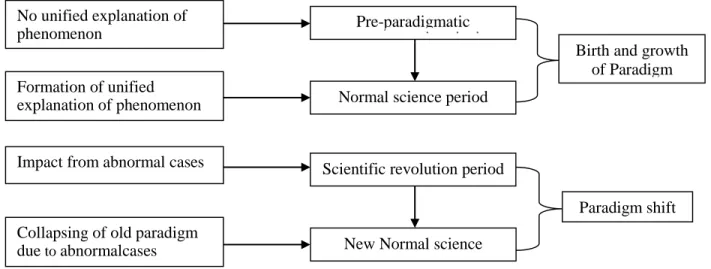
Kuhn (1970) defined the process of knowledge evolution in four steps. First, a pre-paradigmatic period during which there is no united explanation to reality among communities of
learners. Then, a normal scientific period emerges, during which a consensus among a knowledge community is formed. However, scientific revolutionary period erupts during which it is difficult for paradigm to provide persuadable explanation to challenging abnormal cases. In time, the scientific community manages to adjust its assumptions and methods and new normal scientific period starts.Figure 2-1 illustrates the four steps.
Source: elaborations on Kuhn (1970)
2.2.2 Advances and challenges in explanations of the firm and its internationalization
As discussed in previous section, Kuhnian analysis has been applied to social science research itself. Kuhn (1981) pointed out that research of social science is still in the pre-paradigm stage. When applied to the field of evolutionary economics itself the concept of paradigm has been deemed to be very productive (Nightingale et al., 2008). Foster and Metcalfe (2001), for instance, indicate that there are some key internal problems which are still left unsolved in the field of evolutionary economics. One issue has been the whole area of the theory of the firm. With respect to the theory of the firm, Priem and Butler (2001), and Wu and Liu (2011) argue that although resource-based view and its related theories of firms has a connection to evolutionary economics, most of research is still static/equilibrium oriented.
From the point of view of the evolutionary school of thought Nightingale et al. (2008) nonetheless see significant progress in the theory of the firm. Nightingale et al. (2008) has argued that the recent progress in the theory of the firm is itself evidence of a transformation taking place in the very foundation of social sciences. According to the author, the new evolutionary theories
Figure 2-1: Summary of revolutionary process in a paradigm perspective.
New Normal science No unified explanation of
phenomenon
Impact from abnormal cases
Pre-paradigmatic
periodpepeiperiod
Scientific revolution period Normal science period
Collapsing of old paradigm due to abnormalcases Formation of unified explanation of phenomenon
Paradigm shift Birth and growth
of the firm show that the theoretical assumptions about productive organisations call into question the role of knowledge to explain diversity and differential performance in markets. In fact, and still following Nightingale et al. (2008), the internal cognitive structure of builds from hierarchy of assumptions that are in part derived from experience in different businesses and markets. So, the new evolutionary literature on the firm (resource/capability-based research) rather than being exotic new stream of research aimed at challenging more orthodox and established theories (like the neoclassic theory of the firm) has in fact contributed to unite the current analysis of the firm in both economics and management (see Nightingale et al., 2008: 481).
If we consider internationalisation as a selection event for firms we have here a test for the evolutionary view of the firm. The Uppsala model faces challenges on this respect. For example, scholars disagree among another on application scope of Uppsala model (Dicht et al., 1984; Turnbull, 1987; Andersen, 1993; Bengtsson, 2004; Zhu and Dong, 2011). Researchers have begun to think about taking into account more variables such as relationships and networks (Coviello and Munro, 1995; Uzzi, 1997; Johanson and Vahlne, 2009) and risk (Tykesson and Alserud, 2011), strategy (Oviatt and McDougall, 1994; Welch and Lawrence, 1996).So, it is safe to say that internationalization research is still in pre-paradigmatic period and that a more integrated frame of analysis is needed.
2.3 Evolutionary theorising
2.3.1 Foundations of evolutionary economics
Lin (2004) indicates that there should be an evolutionary economics mode of explanation which is behind key modern economic phenomena. Madsen and Servais (1997), Moen and Servais (2002), and Vahlne et al. (2011) all argue that evolutionary economics may be useful to explain the internationalization of firms from different angles. So, there is theoretical support for taking this as a general background for the topic of this dissertation. However, what is evolutionary economics should be made clear.
As far as the history is concerned, Zenburg (2002) made a characterisation of economics that, although there is a risk of over simplification, economics can be divided into two groups,
Newtonian (mechanistic metaphor) type economics and biology type economics. Marshall (1961) had already put forward a view that the “Mecca” of economics is economic biology, rather than economic mechanics; he referred to the former as more complex and dynamic. In fact, the mainstream economics is often criticized by its equilibrium methods by a number of researchers (Kapp, 1968; Blatt, 1983; Swaney and Premus, 1983; Brunner, 1984; Robert, 1985; Clark and Juma, 1987; Saviotti and Metcalfe, 1991; Silverberg, 1992; Saviotti and Mani, 1993; Leydesdorff and Besselaar, 1994; Whalen, 1996; Yang, 2006). Evolutionary economics has grown as a paradigm in the social sciences and Hodgson (2007) argues that evolutionary economics may become the mainstream economics in the future. In this dissertation, evolutionary economics is regarded as the appropriate economics worldview to describe the economy and the source of explanatory devices to deal with specific economic issues.
In chronological order, the theoretical development path of evolutionary economics is as follows: from Schumpeter to Nelson and Winter (Langlois and Everett, 1994; Kelm, 1997; Hodgson, 2004; Yang, 2008). While its trajectory in more or less clear different economists provide different definitions for the term, evolutionary economics. Foss (1994) argues that evolutionary economics explores creation and dissemination of knowledge and the resulting structural change. Saviotti and Mani (1993) said that modern evolutionary economics is a complex of biology, non-equilibrium thermodynamics, and enterprise theory and bounded rationality. Hodgson (1999) put forward three standards to define it, namely: ontological criteria (acceptance novelty in a theory), methodological criteria (non- reductionist theorising or no) and metaphorical criteria (adoption of Darwinian or biological language, however adapted to the economic object of analysis). To Hodgson evolutionary economics is NEAR, i.e.
Novelty-Embracing and Anti-Reductionist. In this study, we adopt the general definition of Hodgson.
2.3.2 Key evolutionary concepts
After outlining evolutionary economics, it is necessary to clarify some concepts. According to Yang (2006), key concepts or assumptions of evolutionary economics include appropriateness of “generalized Darwinism”, “population thinking/hierarchical views”, “satisficing”, “path dependence”, etc.
Silva and Teixeira (2006) state that specific characteristics of evolution are still a puzzling issue. Some disputes originate from differences at the ontology or philosophy levels. Some
scholars (Hodgson, 2010; Hodgson and Knudsen, 2010; Deng, 2011; Wang, 2012) argue that the philosophical evolutionism is generalizable although other scholars criticize it to every domain (Smith, 2009). Some other scholars even want to adopt self-organization theory to replace Darwinism (Witt, 1997), which is criticized by Hodgeon who insists Darwinism (Jia, 2005). Generalized Darwinism indicates that, Darwinism is not only applicable in biology domain, but also useful in social science domain or any open system (Yang, 2006). Although Generalized Darwinism also recognizes the big difference between biology and economics, it states that variation and selection can be applied both in economics and biology (Yang, 2008). Our research assumes that concepts such as these can indeed be applied to the analysis of economy, namely firm investment in foreign territories.
Population thinking and hierarchical views and are both important terms for evolutionary economics. Hodgson (1999) suggest that the world may be seen as an integrated hierarchical structure. Every layer has dual nature. In terms of the layer itself, it is a whole, but at the same time, it is part of the other layer. It should be noted that every layer is not the sum of its component layer. Based on Hodgson’s findings, Dopfer (2004) argues that, there exists simultaneously upwards and downwards causation and feedbackrelationship. Population thinking is similar to the hierarchy view and points out that actors should be analytically placed in an interrelated dynamic system or group of individuals. The aim is to analyse the dynamics of interactivity between individuals in the group. It is the counterpart term of typological thinking of mainstream economics which regards variance as deviation from ideal world and the distortion caused by temporary interventional force (Jia, 2004).The core of both notions is the principle of “emergence”. This principle indicates that lower layer constitutes material high layer units of analysis, but, at the same time, novelty occurs at the more general level entities cannot be linearly inferred from the lower levels. Due to novelty or creation, sum of parts is not equal to the whole of individuals and the former cannot be explained by the latter. This perspective causes this thesis to be cautionary when extrapolating lessons to the industry level from case study evidence
Satisficing behaviour is opposed to optimization. The assumption is that, when individuals are not satisfied, they continue searching for superior solutions. If the possibility of achieving the original target is low, individuals tend to lower the standards of satisfaction and suboptimum is the practical option. But when individuals find satisfactory results by searching, their appetite for satisfaction is higher accordingly (Witt 2001; Yu, 2013). The satisficing hypothesis was put
forward by Herbert Simon and applied by James March and colleagues to the behavioural theory of the firm (Hodgson, 1999, 2004). Evolutionary economics accepts this view and the justification is that the creation of novelty cannot be achieved once and for all and the specific outcomes cannot be predicted either. And so decision-making is a process and not an isolated choice event (Yu, 2013). For our thesis this implies that strategy-making in the real business world is not a simple question of right and wrong, but a discovery process that is marred by radical uncertainty and that progress builds on past experience but is not necessarily predictable from it.
Time is also an important term. Robinson (1962) explains time in the following way: history advances towards unknown future from past which has gone forever. Bergson (2000) and Ebner (2003) also hold a similar view. Winter and Nelson (1992) see economic development a process in which the situation of a certain period results from the opportunity distribution of situations in the previous period. In this way, the economic phenomenon is time conditioned. Furthermore, Ebner (2003) further indicates that it is not only time conditioned but also area conditioned. David (1985, 2001) encapsulated these insights with the concept of “path dependence”, which has origins from evolutionary economics (Lee and Silke, 2015) and is based on research of technology history analysis (Nelson and Winter, 1982) and habit evolution.
Liebowitz and Magolis (2000: 981) proposed a definition of path dependence: “Most generally, path dependence means that where we go next depends not only on where we are now, but also upon where we have been. History matters.” In other word, the concept assumes that history is crucial to understand final outcomes. The past is held to matter, but in specific ways. Development is subject to small historical accidents and these occasional random factors impact dynamic systems through feedback mechanisms (Arthur, 1989; Cao and Xi, 2008). This may lock-in particular states of affairs that are not necessarily the most efficient (North, 1997). These assumptions are crucial for us because, as Johanson and Vahlne (1977) showed for international business studies, present comments and current activities not only condition present performance but also impact future knowledge assets and market positions.
2.3.3 Remaining limitations
With respect to theoretical gaps, Dopfer (2004) indicates that, opinions vary on methodology and research interests of evolutionary economics. Silva and Teixeira (2006) even argue that specific characteristics of evolution are still a puzzling issue. Foster and Metcalfe (2005) submit that the existence of internal problems should be considered as a potential for further development of evolutionary economics. Yang (2008) indicates that the two main problems are vague wording and lack of a totally finished research paradigm. Hodgson (2007) also support this view but he argues evolutionary thought can still achieve a higher level of generality. In terms of research targets, Liu (2005) points out that research interested have shifted from industry to individual firms. It means that the micro level has become a more sophisticated area though the application of evolutionary economic theory. Thus, to this area of analysis we now turn. In addition, as a top level theory, evolutionary economics is not systemized well and it may directly leads to the some theoretical problems of the whole framework, such as maturity and logic.
2.4 Theory of the firm
2.4.1 Origins and key concepts
RBV, which is based on Penrose’s theory, is credited as a direct theoretical source in the development of the Uppsala model (Bengtsson, 2004; Kor and Mahoney, 2004). Thus, analysis of RBV and, especially, developments of its related theories of the firm are helpful to identify the development trends (and gaps) of the Uppsala model. In other word, theory of the firm provides a broader explanation or theoretical underpinning to the Uppsala model. In the Uppsala model the firm is the carrier of the internationalisation process and the specific methods of internationalisation are in turn trajectories for firms to acquire and sustain competition. So, what is a firm and what is the nature of competitiveness of firms are crucial issues to be reviewed.
Based on research of Hu and Liu (2014), and Zhao (2014), it can be said that the theory of the firm experienced same development path as economics, from equilibrium to evolution, from static analysis to dynamic analysis, and from external focus to internal focus. Following Gu and Ding (2009) and Li et al. (2011) we can say that early inspirations for the evolutionary theory of
the firm are Marshall (internal resources that have to be combined to achieve production) and Schumpeter (the essence of economic activity is innovative effort) and modern basic building blocks are Penrose (it is not resources by themselves but what are the services the firm is able to extract from resources) and Nelson and Winter and (firms are repositories of knowledge and learning platforms). Based on these four pillars the theory of the firm evolved through two approaches. The first one is the research stream from the resource-based view (RBV) to the dynamic capability (Gu and Ding, 2009; Wu and Liu, 2011). On the other hand, although we are not to deepen this strand in this thesis, there is the Austrian school which emphasises discovery taking place with open-ended market processes and refers to entrepreneurship as a process of continuous creation of rents and economic profit (Lewin and Phelan, 2000).
According to Marshall (1920) there is division of labour among industries and division of labour inside the firm between internal departments. As Marshal himself put in his book Industry
and Trade he was concerned not with pure economics but with “industrial technique” and
“business organisation”. He was emphasising knowledge as a core factor of production and that knowledge of the firm was more than the skills of the workers in it.
Schumpeter (1934) also points out that the enterprise is a combination of factors of production. By making new combinations “creative destruction” can operate through firms. Equilibrium of economy is interrupted frequently by economic development, and firms are implicated in the new knowledge producing activities that disturb the economic process. This consideration about the purpose of firms in the capitalistic system makers Schumpeter a key contributor to the modern understanding of firms (Zhang, 1993).
Penrose (1959) argue that firm is a management organization and it is a combination of resources such as human resources and other resources. If we say Schumpeter escaped from the influence of mainstream economics we can say that Penrose provided the operational basis of evolutionary theory of firm understanding. Internal resources are the ultimate engine of firm development but management is the spark. In her analytical frame at firms generate economic value not by merely possessing resources; the key is the knowledge of how to deploy them effectively and take advantage of them by growing in the same line of business and diversifying though new product applications (Kor and Mahoney, 2004).
which is a combination of internal procedures and recurrent methods of organising which simultaneously save on bounded rationality and solve technical problems that have value from the point of view of potential customers. These evolutionary authors emphasise that routines are repository of knowledge but that mutations occur in routines that make the firm as a whole evolve and master new techniques of production and come up with new kinds of products. Transformation, adjustment, and learning are what keep companies competitive, not knowledge
per se.
2.4.2 Resources, knowledge and dynamic capabilities
RBV originates from the research on firm-specific abilities. This research stems from the research of Lippman and Rumelt (1982), was further developed by Wernerfelt (1984, 1995), and peaked through the research of Barney (1986a, 1986b, 1991) and Peteraf (1993). The birth of RBV is a departure in the nature of explanations of enterprise competition and competitiveness (Zhou and Xiang, 2008). This approach shifted the locus of explanation from external factors to internal factors (Xiong and Xiong, 2014).
Lippman and Rumelt (1982) were the first scholars to articulate a RBV. He argues that difference of enterprise performance results from certain special abilities that were difficult to imitate. The work by Wernerfelt (1984) further escaped the hurdle of analysis from product angle and emphasised the importance of internal resources themselves. To these he assigned the causal powers in the maintenance of competitive advantage. This author agrees with the view that internal accumulation of resources and knowledge are the forces by which the firm gain excess earnings or rents (Liu, 2002).
Based on the view of Wernerfelt, Barney (1991), in turn, developed the theory more systematically. He argues that a firm’s bundle of resources must be valuable, rare, imperfectly imitable and appropriately organised in order to be source of a sustained competitive advantage. In his famous VRIO approach:
“Valuable” means that resources can be accounted as a measure to identify opportunities and deal with dangers;
“Rare” means that the key resources are scarce, they cannot be owned by majority of firms at low cost;
“Imperfectly imitable” means that the competitors cannot get the resources by purchasing, so dependence on historical circumstances and social complexity make the resource base of the firm quite unique;
“Organisation” means that the assets need active coordination and to be geared to strategic goals to make an economic impact.
So, what are resources? A resource is the basic concept of RBV and it means the firms’ physical and HR resources, tangible and intangible resources,controlled proprietary assets and capabilities, organisational processes and characteristics, information and knowledge, etc. (Hall, 1992; Hafeez et al., 2002). They are the infrastructure for the execution of strategy and the basis for improvements in efficiency and profit. The VRIO criteria mean the firm has a source of a sustained competitive advantage (Barney, 1991).
And what are capabilities? For Winter (2000) “capabilities” represent a repository of historical experiences and organizational learning. Prahalad and Hamel (1990), and Leonard (1992) argue that “core competences” that distinguish a corporation from competition. Leonard (1992) defines “core capabilities” as a combination of operations by which competition advantage can be identified and achieved. Following this account four dimensions are of note: they exist at the employee level, they are embedded in technological systems, they are directed by management system, and they are related to value and rules.
And how can resources and capabilities be contrasted understood? Wu and Liu (2011) distinguish between capabilities and resources: capabilities are the skills by which resources are used to complete activities and are rooted in processes and practices; whereas resources are the basic unitand capabilities are how these units are connected to generate competitive advantage. As Schreyogg and Kliesh-Eberl (2007: 914) synthesise:
“There seems to be a consensus that a capability does not represent a single resource in the concert of other resources such as financial assets, technology, or manpower, but rather a distinctive and superior way of allocating resources.”
So, capabilities are knowledge about the ways to allocate resources. Then, what are firms in this knowledge perspective? Firms come out has combination of intangible resource, namely knowledge (Gu and Ding, 2009). Allee (1997) proposed that competitive advantage can be identified by use of unique knowledge and operational capabilities in making efficient production
companies. Zollo and Winter (2002) take firm capabilities as the result of the co-evolution of accumulation of “tacit knowledge” (embodied in people) and explicit knowledge (explicit and codified information that can be proprietary). In particular, “tacit knowledge” is the type of characteristic that yields heterogeneity and differential positions in the market (Nonaka, 1994). In this regard, the enterprise can be regarded an organisation that creates conditions so that more individuals integrate their unique knowledge assets into a body of collective integrated knowledge (Grant, 1996). The knowledge perspective provides a relatively appropriate answer to question of how firms maintain their competitive level. At the same time explains this perspective sheds light on how firms grow in different ways with different organisational cultures rooted in recurrent practice and embedded into particular individuals (Conner and Prahalad, 1996).
In sum, the development of this research about the firm allows the original theory of Penrose to be completed and re-interpreted. Penrose (1959) conducted a detailed analysis that knowledge can be taken to articulate a specific relationship between resources, capabilities and knowledge. She believed that resources of firms are the basis of enterprising capabilitiesand she can be read to have proposed a resource-based business growth path: resources help generating productive service and this knowledge expansion (including managerial knowledge) is whatpromotes the growth of the firm itself.
However, there may be a darker side to the sources of competitive strength. Leonard-Barton (1992), for instance, considered capabilities from an alternative angle. With core capabilities complemented can become “core rigidities”. That is to say, strengths can become too dominant and hold the organisation too stiff if the environment changes and ends up favouring other capabilities. Psychological commitment and path dependence lock-in are cognitive and organisation traps since previous investments, decisions and routines resulted in recurring growth become out of sync with the selective environment (Schreyogg and Eberl, 2007). Fast changing contexts, where innovation and adaptiveness are paramount, can transform strengths in weaknesses given their inertia and immobility.
If “static” capabilities may not be suitable for dynamic environments then it is pertinent to review the new developments of the theory of firm literature. Hence, the “dynamic capability” comes forth, which can be seen as an extension of the RBV research. RBV originally did not explain how to make use of specific resources to achieve competition advantage in dynamic
environments but the dynamic capability was developed to solve this problem (Diao and Li, 2014).
Teece et al. (1997: 516) were the first to pose the definition of dynamic capabilities: “A firm’s dynamic capabilities are the firm’s capability to integrate, build and reconfigure internal and external competencies to address rapidly changing environments.”
As Bernstein and Barret (2001) emphasis other definition broadly complement this one by employment related terms such as processes and routines. Oneinstance ishighlighted by Eisenhardt and Martin (2000: 1107) who define dynamic capabilities as the firm’s ‘‘processes to integrate, reconfigure, gain and release resources – to match and even create market change.’’ Another version is emphasised by Zollo and Winter (2002: 340) who moreover define them as ‘‘a learned and stable pattern of collective activity through which the organization systematically generates and modifies its operating routines in pursuit of improved effectiveness.” Moreover, Zahra el al. (2006) defines dynamic capabilities as a firm’s constantly learned problem-solving practiced in a intermittently stable and explosive pattern of collective activity in connection with an evolving environment, through which the company creates and modifies its routines based on its internal or external resources.All in all, most of scholars propose that dynamic capabilities are abilities to use resources creatively to respond to changing circumstances (Helfat, 1997; Teece et al., 1997; Zahra and Gorge, 2002; Zahra et al., 2006; Winter, 2003; Li and Liu, 2014). To be short, dynamic capabilities are processes to create and adopt, modify and allocate knowledge and routines to address its challenging environment.
Except to discussion on definitions of dynamic capabilities, scholars deconstruct dynamic capabilities from different angles. Teece (2007) put forward three factors: positons, paths and processes, which will bring firms sustainable advantages. It should be noticed that these three are not dimensions of dynamic capability, rather they are influencing factors: “position” actually refers to internal resources and external relations with related parties; “process” refers to routines and the way things are done in the firm; “paths” refer to organisational learning trajectories. A system or process that can monitor the internal and external environment to provide information to support for execution of strategy is needed to “dynamise” capabilities of firms (Schreyogg and Eberl, 2007).