Luísa do Amaral Camargo
Foreign exchange interventions through
currency swaps in Brazil: an empirical study of
the effects on the spot exchange rate
Brasília, DF, Brasil
Julho de 2019
Luísa do Amaral Camargo
Foreign exchange interventions through currency swaps
in Brazil: an empirical study of the effects on the spot
exchange rate
Dissertação apresentada como requisito par-cial para a obtenção do título de Mestre em Economia pela Universidade de Brasília sob a orientação do Prof. Dr. Roberto de Goes Ellery Júnior.
Universidade de Brasília Campus Darcy Ribeiro Departamento de Economia
Brasília, DF, Brasil
Julho de 2019
Abstract
In different episodes in 2018, the Central Bank of Brazil (BCB) announced official in-terventions in foreign exchange market. The BCB used as core intervention strategy the traditional foreign exchange swap contracts, which consist of currency forwards that settle in BRL and provide hedging to agents without reducing directly foreign exchange reserves. Even though these operations are akin to sterilized interventions, whose mech-anism of impact on exchange rates is not as clear as in non-sterilized cases, the existing literature for Brazilian case provides evidence to the fact that currency swaps offerings announcements can impact the USD/BRL exchange rate returns. However, the results found vary and studies present different conclusions regarding the existence of impacts and their magnitude. In the present work, hourly data for the period between 11/30/2017 and 10/18/2018 is used in order to estimate impacts of new and rolling traditional cur-rency swap contracts offerings announced by the BCB on the USD/BRL returns. For the estimation, a GARCH(1,1) is adopted as benchmark model. Results suggest that new swap contracts announcements have an immediate appreciation impact on the BRL, reducing the USD/BRL exchange rate in 15 basis points (-0.15%) for each US$ 1 billion in contracts. Rolling swap contracts announcements do not present significant effects. The results are validated after the performance of a series of robustness tests and the estimation of a reaction function of the Central Bank which accounts for any endogeneity issue that could invalidate estimates obtained.
Keywords: Brazil; Derivatives; Sterilized Foreign Exchange Interventions; Currency
Resumo
Em diversos episódios no ano de 2018, o Banco Central do Brasil (BCB) anunciou inter-venções oficiais no mercado de câmbio. Nesse contexto, o uso de swaps cambiais do tipo tradicional constituiu um mecanismo fundamental de intervenção do BCB, uma vez que esses contratos são liquidados em moeda doméstica (BRL) e proveem cobertura cambial aos agentes sem a redução direta das reservas internacionais. Apesar de essas operações serem como formas esterilizadas de intervenção cambial, cujo mecanismo de impacto na taxa de câmbio não é tão claro quanto no caso de intervenções não esterilizadas, trabal-hos existentes na literatura para o caso brasileiro apontam evidências de que anúncios de ofertas de swaps cambiais do BCB podem impactar os retornos da taxa de câmbio USD/BRL. Entretanto, os resultados encontrados em diversas abordagens variam em re-lação à existência de efeitos de fato e à sua magnitude. No presente trabalho, dados em frequência horária para o período de 30/11/2017 a 18/10/2018 são utilizados para a estimação dos impactos dos anúncios de ofertas de contratos de swaps cambiais novos e de rolagem, do tipo tradicional, nos retornos da taxa de câmbio USD/BRL. Um modelo GARCH(1,1) é adotado para a estimação. Os resultados obtidos sugerem que os anúncios de novos contratos têm um efeito imediato de apreciação na moeda brasileira, causando uma redução de 15 pontos base (-0.15%) na taxa de câmbio USD/BRL para cada US$ 1 bilhão em contratos. Os anúncios de contratos de rolagem, porém, não apresentam impactos significantes. Esses resultados são validados por meio da realização de testes de robustez e da estimação de uma função reação do Banco Central como forma de incorpo-rar qualquer efeito de endogeneidade que pudesse invalidar as estimativas encontradas.
Palavras-chave: Brasil; Derivativos; Intervenções Cambiais Esterilizadas; Swaps
Contents
Contents . . . . 4
List of Figures . . . . 5
List of Tables . . . . 6
1 INTRODUCTION . . . . 7
2 STERILIZED FOREIGN EXCHANGE INTERVENTIONS: THEO-RETICAL ISSUES . . . . 9
2.1 The channels of influence: portfolio balance, signalling and coordi-nation effects . . . 10
3 STERILIZED FOREIGN EXCHANGE INTERVENTIONS: EMPIR-ICAL EVIDENCE . . . 19
3.1 The case of Brazil . . . 23
4 DATA . . . 34
5 METHODOLOGY AND ESTIMATION RESULTS . . . 39
5.1 ARCH(𝑞) Models . . . 40
5.2 GARCH(𝑝, 𝑞) Models . . . 41
5.3 Descriptive Statistics of the USD/BRL Exchange Rate Returns. . . 43
5.4 A GARCH Model for the USD/BRL Exchange Rate . . . 45
5.5 GARCH(1,1) Estimation Results . . . 48
5.6 Robustness Checks . . . 55
5.7 Endogeneity Issues . . . 58
6 CONCLUSION . . . 62
List of Figures
Figure 1 – Interventions of the Central Bank of Brazil through USD Transactions. Source: BCB. . . 26
Figure 2 – Foreign Exchange Swap Contracts Balance of the Central Bank of Brazil. Source: BCB. . . 27
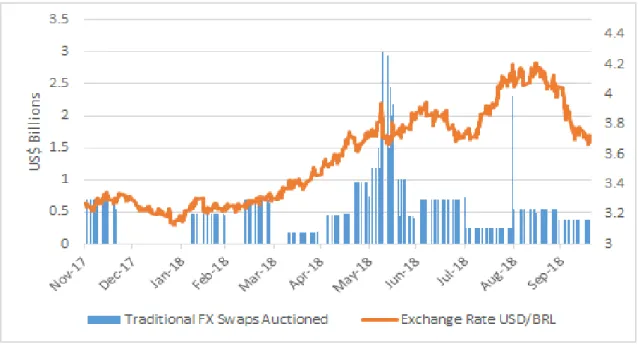
Figure 3 – Traditional Foreign Exchange Swap Interventions and USD/BRL Ex-change Rate. Source: BCB and Bloomberg. . . 32
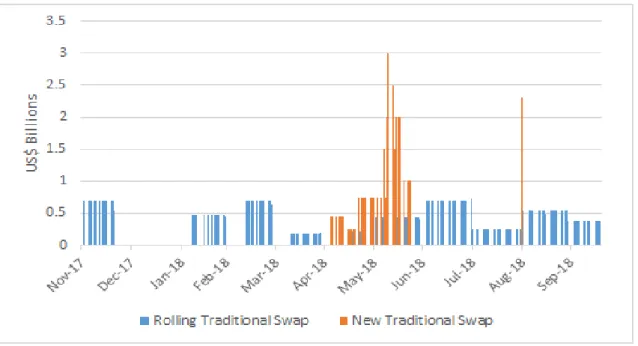
Figure 4 – New and Rolling Traditional FX Swap Contracts Auctioned. Source: BCB.. . . 33
Figure 5 – USD/BRL Exchange Rate Percentage Returns. Source: Bloomberg. . . 43
Figure 6 – Histogram of USD/BRL Exchange Rate Percentage Returns. Source: Bloomberg. . . 45
List of Tables
Table 1 – Exchange Rate Returns Descriptive Statistics . . . 44
Table 2 – Statistics for Benchmark GARCH(1,1) Model . . . 49
Table 3 – Parameter Estimates of the Benchmark GARCH(1,1) Mean Equation . 51
Table 4 – Parameter Estimates of GARCH(1,1) Conditional Variance Equation . . 55
Table 5 – Robustness Checks - Parameter Estimates for Model Variations . . . 57
Table 6 – Estimated Reaction Function of the Central Bank - New Traditional Swap Contracts Auctions . . . 59
Table 7 – Estimated Reaction Function of the Central Bank - Rolling Traditional Swap Contracts Auctions . . . 60
Table 8 – Parameter Estimates of the GARCH(1,1) Mean Equation (Accounting for a Reaction Function of the Central Bank) . . . 61
1 Introduction
Foreign exchange market interventions by central banks are commonly observed in emerging countries, and reasons for such operations include attempts to moderate exchange rate volatility, accumulate reserves, supply foreign exchange liquidity and con-tribute to the proper functioning of the market. Discussing the impacts these interven-tions may cause in economies, specially in exchange rates, is quite relevant, since countries that adopt independence of monetary policy and absence of capital controls cannot have also a determined exchange rate, in accordance to the impossible trinity in international economics. Indeed, considering the Brazilian case, there are no restrictions to capital mobility and the Central Bank of Brazil (BCB) determines the Selic interest rate with the main purpose of reaching the target inflation rate, therefore the exchange rate cannot be established. Meanwhile, it has been historically observed that the BCB intervenes in foreign exchange market; an essential point, though, is that these operations are sterilized, otherwise variations in monetary base would undermine the working of monetary policy. Not only in Brazil, central banks usually sterilize interventions in FX markets, preventing them from affecting the independence of monetary policy.
In this framework, therefore, impacts of sterilized foreign exchange interventions are not so evident: are they in fact capable of affecting exchange rate returns? If they are, the form how central banks intervene in FX markets, as well as the timing and size of the operations, configure important decisions to the monetary authority. After all, exchange rates play a key role in the performance of the economy, impacting, for example, inflation rates and balance of trade results.
The awareness of the potential effects that sterilized FX interventions can have in the path of exchange rates has made the empirical assessment of these episodes an impor-tant part of the literature on the area. In Brazil, several studies dedicated to addressing interventions made by the BCB during the last years have already been conducted. Even though they provide a great basis for understanding the Brazilian case, further analyses are still worth it and certainly will be as long as the BCB keeps on intervening on FX markets. Indeed, it is quite clear from a literature review on the interventions by the BCB that there is not a consensus regarding the existence of significant effects on the exchange rate and their magnitude. Results have differed according to interventions char-acteristics and types (e.g. spot or future markets, sales or purchases of USD) and to the periods considered in the analyses, in which motivations and purposes for interventions have varied significantly.
em-pirical assessments on the subject and no final conclusions have been reached on the existence and magnitude of impacts of sterilized FX interventions on exchange rate re-turns. Recognising this point, a new assessment that covers more recent episodes of FX interventions in Brazil is made in this dissertation. Traditional currency swaps were an important instrument used by the BCB with the purpose of providing liquidity and con-tributing to the proper functioning of FX markets during episodes of market instabilities in 2018. In the period, for instance, presidential elections expectations and uncertainties in Brazil and USA-China trade war episodes were very relevant issues at hand, besides the general macroeconomic scenario in Brazil which was also a point of attention, since the economy presented a weak growth, still in an attempt of recovery from the recession period of 2015-2016.
In order to test empirically the impacts of FX interventions through currency swaps by the BCB on the USD/BRL exchange rate returns, this dissertation proposes a GARCH(1,1) model as benchmark specification. The choice is based on previous works in literature which presented GARCH processes as an efficient methodology for time series event studies involving exchange rate data, since they account for heteroscedasticity issues often observed in financial series. Hourly-frequency data is used in this work for the USD/BRL exchange rate and for other variables included as regressors in the mean equation of the GARCH model, computing relevant intraday impacts.
This dissertation is organized as follows. Chapter 2 presents the most important theoretical issues that underlie sterilized foreign exchange interventions, giving emphasis on the channels of influence through which these operations may impact exchange rates. Chapter 3 provides a review of the literature dedicated to FX interventions empirical assessment, including cases of developed countries in the early literature on the field and cases of emerging markets more frequently assessed years later. An emphasis on the Brazilian case is given in section 3.1, where details of episodes of interventions in Brazil and specific features of the BCB’s methods for intervening are provided. In chapter 4, the process of data collection for the empirical assessment in this study is detailed. In chapter 5, the methodology of ARCH and GARCH models is presented, and the benchmark model with all variables considered for the estimation is described. Results are displayed in sequence, and robustness checks are made to validate them. Finally, a section is included in chapter 5 for the assessment of endogeneity issues that could possibly invalidate the results of the benchmark GARCH specification. This is made through the estimation of a reaction function for the Central Bank. Then, the GARCH model is re-estimated incorporating unexpected interventions, procedure that in turn validates results previously found with the benchmark GARCH specification.
2 Sterilized foreign exchange interventions:
theoretical issues
A vast knowledge about the manner and the extent to which a central bank in-tervenes in FX markets requires taking into account key factors that characterize such interventions and may vary according to different countries, periods and other circum-stances. Adler and Tovar (2011) list and explain briefly some of these points, as follows:
∙ Reasons: officially declared reasons for intervening in the FX market. Important motives include: (i) affecting the level of the exchange rate, (ii) affecting the speed of currency appreciation (or depreciation); (iii) containing the volatility of the ex-change rate; (iv) increasing reserve buffers for precautionary motives. Additionally to reasons pointed by Adler and Tovar, FX liquidity provision to domestic markets is an important reason to mention.
∙ Framework: refers to whether interventions made by central banks are predeter-mined by rules or conducted in a discretionary manner. When of the former type, a characterization of such rules is an important point to be considered, such as "ex-change rate-based" if the intervention is motivated by some ex"ex-change rate-related measure (e.g., change or volatility) or "quantity-based" if the rule does not specify any trigger for intervening, but an amount to be used in intervention operations during a period;
∙ Instruments: frequently observed mechanisms for interventions include FX pur-chases or sales in spot market and derivative financial instruments (forward, futures, options and swaps);
∙ Transparency: the timing of disclosure of information regarding FX operations, i.e., if intervention amounts are published before the operation takes place, within a week, at a later stage or never.
In addition to the points above, another characteristic regarding FX interventions refers to whether they are sterilized or non-sterilized operations, and this issue is particu-larly relevant for the purposes of the present work and of the majority of studies dedicated to evaluating the effectiveness of FX interventions. Indeed, it is noticeable that the core of analyses available in literature takes account of sterilized operations carried out by central banks, having non-sterilized interventions been rarely the focus of discussions and disagreements. Also, when considering the case of the BCB’s currency swaps offerings and estimating their impacts on the USD/BRL exchange rate, the goal of this work only
makes sense if it is well-known that operations with these derivatives are akin to sterilized forms of intervening in foreign exchange markets. Further considerations on singularities of FX swaps used by the BCB will be made in section 3.1.
When distinguishing sterilized from non-sterilized mechanisms for intervening,
Sarno and Taylor (2001) state that one intervention is defined sterilized when the au-thorities, simultaneously or in a short lag, act in order to offset the effects of a change in official foreign asset holdings on the domestic monetary base. Conversely, one interven-tion is said to be non-sterilized when there is not any offsetting procedure taken by the authorities after buying or selling foreign exchange against the local currency. In other words, Dominguez (2009) says that sterilization is the process by which monetary au-thorities ensure that foreign exchange interventions do not affect the domestic monetary base, which is one component of the overall money supply. Classical forms of sterilization widely used by central banks are open market operations in which the monetary authority buys (sells) financial assets, such as local currency denominated bonds, aiming to offset foreign exchange interventions that, in principle, would reduce (increase) the monetary base in the local economy.
The emphasis given by empirical studies on the sterilized methodology for inter-vening is understandable since there is not a consensus yet regarding its effectiveness, in contrast to the almost consensual effects of non-sterilized interventions. Indeed, the mech-anism for non-sterilization case is clearly explained by economic theory: the exchange rate is impacted in a quite comparable way to when monetary policy takes place, that is to say, rates alter in proportion to the variation in the relative supplies of domestic and foreign money. In the sterilization case, in turn, there is not a consensus about the ways through which interventions could impact exchange rates, but there already exists a standard tax-onomy commonly applied in the analysis. It defines channels of influence of sterilized operations: the portfolio balance and the expectations (signalling) channels. These were previously addressed by Mussa (1981) and, years later, formalized and discussed in more details by Sarno and Taylor (2001), who also suggested that a third channel of influence may operate as well: the coordination channel. In the next section, the main points that underlie the theory behind the functioning of these channels will be addressed, and a few works in the literature which tested their existence will be briefly presented.
2.1
The channels of influence: portfolio balance, signalling and
coordination effects
A comprehensive approach to the working of portfolio balance channel and how it provides conditions for interventions on FX markets to impact exchange rates requires the introduction of fundamental concepts of International Economics and Finance that
underlie the framework of the channel operation. As Sarno and Taylor (2001) state, the effects of official intervention through the portfolio balance channel are based on the as-sumptions that set a Portfolio Balance Model (PBM) of exchange rate determination. The PBM is characterized by a scenario where agents decide between investment alter-natives in an attempt to reach the utility-maximizing portfolio composition, considering assets of various countries on the basis of their relative expected risks and returns.
As a starting point to the analysis, following Diógenes (2007), it is convenient to introduce the concept of interest rate parity, since it plays an essential role in foreign exchange markets connecting interest rates, spot exchange rates and future exchange rates. Assuming high international capital mobility, the interest rate parity is a no-arbitrage condition in which the expected return on domestic assets equalizes the exchange rate-adjusted expected return on foreign currency assets. Under these circumstances, investors cannot profit by borrowing with a lower interest rate in a country, exchanging for foreign currency, and investing with a higher interest rate in another country, because the exchange rate is expected to adjust such that returns on domestic and foreign currency assets are exactly the same.
Interest rate parity takes on two distinctive forms in the literature: the uncovered interest rate parity and the covered interest rate parity.
The uncovered interest parity condition holds when the no-arbitrage condition is reached without forward contracts being used as a means of hedging against exchange rate risk. Risk-neutral investors are indifferent between the interest rates of assets in two different currencies because the exchange rate is expected to adjust in a way that returns on assets are equal, eliminating the potential for arbitrage profits. Then, when the uncovered interest rate parity holds, unless there is any shift on interest rates or on future exchange rate expectation, there is no possibility for a change in the spot exchange rate.
The mechanism described above is represented in the following equation, (𝑖𝑡+ 1) = (𝑖*𝑡 + 1)
𝐸𝑡(𝑆𝑡+𝑘)
𝑆𝑡
(2.1) where 𝑖𝑡 is the interest rate of domestic assets at time 𝑡, 𝑖*𝑡 is the interest rate of foreign
assets at time 𝑡, 𝐸𝑡(𝑆𝑡+𝑘) is the expected exchange rate for time 𝑡 + 𝑘 and 𝑆𝑡 is the spot
exchange rate. Importantly, the holding of the uncovered interest rate parity requires two assumptions, which make domestic and foreign assets perfect substitutes: perfect capital mobility and risk indifference by the investors.
Since the foreign exchange interventions in Brazil are sterilized, coherently with the fact that the BCB follows an inflation targeting regime in which the target inter-est rate is defined and pursued, the finding of any transmission channel through which FX interventions could impact the exchange rate under uncovered interest rate parity is
unlikely, as Diógenes (2007) shows. Supposing the Central Bank of Brazil intervened in FX market through sales of USD and the BRL appreciated; as a logical consequence, its expected appreciation (depreciation) would decrease (increase) and, assuming perfect capital mobility, capital outflows would cause the reversion of the appreciation trend so that the BRL would move back to the original level. Regardless, it is almost consensual among economists that the uncovered interest rate parity is rarely observed in practical applications.
The condition usually assumed in practice is the covered interest rate parity. This approach refers to a scenario in which a forward contract is used to hedge against exchange rate risk, allowing for the compliance of the no-arbitrage condition. Investors are indiffer-ent among assets denominated in two differindiffer-ent currencies because the forward exchange rate provides an equilibrium that equalizes returns on foreign currency assets and returns on domestic currency assets, not allowing covered interest arbitrage profits to exist. For instance, consider a domestic investor who takes a loan abroad paying foreign interest rate, 𝑖*, invests in domestic market earning 𝑖 and buys USD in future market in order to pay the foreign creditor. Even though he obtains hedging against risks of domestic currency depreciation, he pays the difference between the forward and the spot exchange rates, denominated forward premium. Therefore, costs and gains from the transaction are equalized and the no-arbitrage condition is satisfied.
In order to explain the mechanism above, the covered interest rate parity condition is represented as follows
(𝑖𝑡+ 1) = (𝑖*𝑡 + 1)
𝐹𝑡
𝑆𝑡
(2.2) where 𝐹𝑡 is the forward exchange rate at time 𝑡.
FollowingGarcia and Olivares(2001), the covered interest rate parity condition is rewritten as
𝑖𝑡 = 𝑖𝑡*+ 𝑓𝑡− 𝑠𝑡 (2.3)
where 𝑓𝑡= 𝑙𝑜𝑔(𝐹𝑡) and 𝑠𝑡= 𝑙𝑜𝑔(𝑆𝑡).
The forward exchange rate is determined by a parity relationship among the spot exchange rate and differences in interest rates between two countries, where the resultant equilibrium eliminates any arbitrage profits. In order for this equilibrium to hold under different interest rates, the forward exchange rate must generally differ from the spot exchange rate. Therefore, the forward rate is said to contain a forward premium or discount, adjusting for the interest rate differential.
The relation described above is expressed as
where 𝑝𝑡 is the forward premium or discount at time 𝑡, if positive or negative respectively.
It represents the difference, in percentage points, between the forward exchange rate and the spot exchange rate
Were agents assumed risk-neutral, the forward rate would be an unbiased predictor of the future spot exchange rate such that 𝑓𝑡= 𝐸𝑡(𝑠𝑡+𝑘). However, the framework
under-lying the portfolio balance channel assumes that agents consider risk differences between assets when making decisions regarding portfolio composition. Hence, there is a currency risk premium that creates a difference between the expected future spot exchange rate and the forward rate. The following equation represents it as
𝑓𝑡= 𝐸𝑡(𝑠𝑡+𝑘) + 𝑐𝑡 (2.5)
where 𝑐𝑡 is the currency risk premium at time 𝑡.
Combining (2.4) and (2.5), the resulting equation is
𝑠𝑡+ 𝑝𝑡 = 𝐸𝑡(𝑠𝑡+𝑘) + 𝑐𝑡 (2.6)
𝑝𝑡= 𝐸𝑡(𝑠𝑡+𝑘) − 𝑠𝑡+ 𝑐𝑡 (2.7)
where the forward premium, i.e., the difference between forward rate and spot rate, is split into two components: the expected exchange rate depreciation and the currency risk premium.
When covered interest rate parity condition holds, as exposed in the previous para-graphs, investors will be indifferent to assets denominated in the two different currencies, and arbitrage is not possible since one has to pay a price for getting protection against currency depreciation risks, namely the forward premium. Consequently, as Diógenes
(2007) shows, it follows that
𝑖𝑡= 𝑖𝑡*+ 𝑝𝑡 (2.8)
The introduction of the forward premium from (2.7) into (2.8) leads to
𝑖𝑡= 𝑖𝑡*+ 𝐸𝑡(𝑠𝑡+𝑘) − 𝑠𝑡+ 𝑐𝑡 (2.9)
Based on (2.9), it is now convenient to present the mechanism through which the portfolio balance channel allows a possible impact of sterilized foreign exchange interven-tions on exchange rates. The key idea includes the essential role played by the currency risk premium, as the next paragraphs will demonstrate.
According to the discussion proposed by Sarno and Taylor (2001) about the port-folio balance channel, the effectiveness of sterilized intervention operations depends on the relaxation of the assumption that domestic and foreign assets are perfect substitutes.
In case they were equivalent to investors, the currency denomination of the bonds would not matter and agents would be indifferent as to the relative amounts of domestic and foreign assets they hold, i.e., the importance would remain only on the total quantity of assets. Alternatively, the relaxation of the premise above leads to a scenario of asset differentiation, where bonds denominated in distinct currencies are not perfect substitutes and changes in their relative supply can influence the exchange rate through the portfolio balance channel, since risk averse agents will take account of both risk and return when diversifying their asset portfolio to obtain the best combination. Based on this, by chang-ing assets relative supply, sterilized intervention operations change risk characteristics of foreign and domestic bonds in the market portfolio, altering the equilibrium exchange rate, as Dominguez(2009) explains.
From the ideas above, it is clear that risk is an important factor usually considered by agents when choosing their portfolio composition. In a scenario of covered interest rate parity holding, the currency risk premium term, 𝑐𝑡, is associated to agents’ risk
aversion inherent to the fact that assets in different currencies present higher or lower risk characteristics. Accordingly, when buying future USD contracts, investors are willing to pay an extra cost for getting currency hedging, while agents who sell these contracts charge more than the expected exchange rate depreciation for having to entail higher risks. The equation (2.7) clarifies that the currency risk premium is what differentiates the forward premium from the expected variation in spot exchange rate from period 𝑡 to
𝑡 + 𝑘.
The ideas presented by Garcia and Olivares (2001) are helpful in summarizing fundamentals of the asset pricing theory and providing a better understanding of the key role played by currency risk premium in portfolio balance channel. The Capital Asset Pricing Model (CAPM) is used to determine a theoretically appropriate required rate of return of an asset in a framework of a well-diversified market portfolio, and an important result of the asset pricing theory is that systematic (non-diversifiable in market portfolio) risks indeed affect asset returns in the economy. As the authors show, this is represented by the coefficient 𝛽, which expresses the sensitivity of the expected excess asset returns to the expected excess market returns. On the other hand, when assets present risks that can be mitigated through diversification, their returns are prevented from being impacted. Reuniting concepts exposed above, an important point is that currency risk pre-mium exists when risks inherent to one currency can reflect systematically in the economy of a country. In contexts of greater systematic riskiness, currency risk premium becomes higher and prices of future USD contracts increase since they provide hedging against those risks, i.e., they work as an insurance against uncertainties, as Garcia and Olivares
(2001) point. Currency crises, as exemplified by the same authors and byDiógenes(2007), are examples of situations in which exchange rate depreciation events are followed by
col-lapses in financial markets and, usually, by economic recessions in a country. Under these circumstances, risk diversification among domestic assets would be unlikely, therefore the currency risk premium included in the forward exchange rate is high.
As Diógenes (2007) explains, while demand for currency insurance depends on how uncertain the scenario of a country is, the supply for that is associated to access domestic residents have to foreign assets. The availability of foreign currency insures do-mestic residents against risks and uncertainties in a country, therefore, sterilized foreign exchange interventions, when altering USD supply in domestic market, change the cur-rency risk premium and the forward exchange rate. Even though the sterilization process keeps monetary base unaltered, an increase in USD supply, for example, is not perfectly compensated by a decrease of domestic bonds in portfolios, since only assets denominated in USD insure agents against currency risks. Then, consequences in case of an operation of USD sale by a central bank would be a decrease in currency risk premium and in the expected return on domestic bonds, leading to an appreciation of domestic currency, as follows
𝑖𝑡= 𝑖𝑡*+ 𝐸𝑡(𝑠𝑡+𝑘)− ↓ 𝑠𝑡+ ↓ 𝑐𝑡 (2.10)
However,Diógenes(2007) raises an important issue: besides impacting USD avail-ability, sterilized FX interventions may also affect demand for foreign currency because while an intervention of USD sale reduces currency risk premium, the operation also leads to a decrease in the amount of international reserves held by monetary authority. This issue is assessed by García and Soto (2004), who point that international reserves often play an important role in preventing financial or currency crises. They find that the probability of a crisis is strongly related to the ratio of reserves to short-term debt. Therefore, an intervention based on USD sale would, somehow, increase the probability of a currency crisis, having the effects of rising uncertainty related to economic background, increasing demand for hedging against risks, and, consequently, leading to higher currency risk premium. In short, the effects of increasing foreign assets supply and increasing de-mand for currency insurance operate in opposite directions when affecting the price of currency risk premium. Diógenes concludes, then, that the effectiveness of sterilized FX interventions in impacting exchange rates through the portfolio balance channel is not completely established in theory, and empirical analyses may find different results under distinct circumstances.
A second channel through which sterilized interventions can affect exchange rates is the expectations, information or signalling channel. This approach, addressed bySarno and Taylor(2001), states that agents view an exchange rate intervention as a signal given by monetary authorities about their future decisions and actions concerning variables over which they have ultimate control. It is assumed that authorities have more precise infor-mation than private market participants, and current sterilized interventions on foreign
exchange markets are interpreted as a channel for implicitly revealing relevant information on future policy that the markets had not incorporated until then. As the exchange rate is a forward-looking variable, the impact of sterilized interventions on current exchange rate level, through the signalling channel, may be seen as a result of changes in market expectations regarding variables that may affect the exchange rate in the future, such as target interest rates and relative money supply.
Dominguez(2009) suggests that when it conveys future policy intentions from the central bank, sterilized intervention should not be considered an additional independent policy tool, even though it changes magnitude and timing impacts of monetary policy on exchange rates. Also, for the signalling channel to be an ongoing transmission mechanism, central banks should be seen to follow interventions with appropriate changes in monetary policy, so the efficacy of interventions is still strongly associated to the operation of traditional policy.
The discussion proposed by Vervloet (2010) details and exemplifies the working of signalling channel. Supposing a central bank is aware of possible future inflationary pressures in the economy, and plans to control it by means of monetary tightening some period ahead. In present time, one alternative the monetary authority has to avoid depreciation of exchange rate is to intervene in foreign exchange market through sterilized operations, increasing the amount of USD in domestic market without altering monetary base and interest rates. This foreign exchange policy procedure might be effective (through portfolio balance channel, for instance) and enhance inflation control, highly pursued by monetary authority. However, if the central bank systematically applies it as a manner of countering inflationary pressures, agents will begin to associate present USD sales to higher interest rates (lower money supply) some period ahead. It is known that when markets revise expectations on money supply, they also revise exchange rate forecasts. Therefore, agents anticipate an appreciation trend and demand more domestic currency in the present, resulting in an immediate appreciation of the exchange rate. The same mechanism works for the inverse situation, i.e., USD purchases by the central bank. As a result, an impact of sterilized FX interventions in exchange rates through the signalling channel can be observed.
As an additional contribution to the theory, Sarno and Taylor (2001) cite some limitations of the two traditional channels and claim that an analysis of a third possible channel, little explored by then, would be worthwhile: the coordination channel. Its working would be associated to remedying a coordination failure in foreign exchange market, subject to irrational speculative bubbles caused mostly by non-economic factors that make exchange rates move away from the level consistent with underlying economic fundamentals. When such a situation happens, individual market agents find it difficult to act effectively in altering the exchange rate because they failure to coordinate their
actions, even though they believe the rate is not in its fundamental equilibrium. Therefore, publicly announced intervention operations would act as a coordinating tool, organizing agents to enter in market at the same time and act simultaneously so as to sell (buy) the currency which is overvalued (undervalued) according to economic fundamentals.
An empirical analysis of FX interventions effects with a channel of influence dis-tinction will not be addressed in the present work, but previous studies have deeply covered this issue. Some focus on testing the significance of effects for these channels using econometric methodologies, and in some cases empirical evidence is found in favour of one or another channel. Alternatively, other studies argue in favour or against the validity of channels based on institutional characteristics of the monetary authority from the country where given interventions occur. Hereinafter, some contributions for the literature dedicated to testing channels validity and potential effects will be presented.
Dominguez and Frankel(1990) attempt to isolate portfolio and signalling channels effects for the USD/DM exchange rate estimating a system consisting of two equations, one describing investors’ portfolio behaviour and the other representing their formation of expectations, where the two endogenous variables are the current spot rate and investors’ expectation of the future spot rate. They find evidence of both portfolio and expectations effect. The latter is specially large when interventions are publicly known, what conforms to the working of signalling mechanism.
Dominguez (1990) tests the effects of signalling channel using data from United States, Germany and Japan in an attempt to evaluate impacts of coordinated interven-tions from G-3 central banks on USD/DM and USD/Yen exchange rates. The efficacy of sterilized interventions is tested with basis on the hypothesis that markets believe central banks have inside information about future monetary policy and have incentives to re-veal it truthfully through intervention signals, configuring the hypothesis of expectations channel. The empirical results found by Dominguez indicate that both unilateral and coordinated interventions by the G-3 central banks have influenced market expectations, revealing the existence of signalling channel effects.
Another empirical contribution regarding validity of expectation channel was pro-vided byKaminsky and Lewis(1996), who empirically examine the hypothesis using data of market observations on US interventions together with monetary policy variables and exchange rates during the late 1980s. They strongly reject the hypothesis that interven-tions convey no signal of future monetary policy. However, the results found show that, in some cases, interventions signalled changes in monetary policy in the opposite direction of the conventional signalling hypothesis, raising doubts on whether intervention policy was indeed effective.
In Brazilian background, the signalling effects do not seem to be a plausible channel for interventions to affect exchange rates, if considered fundamentals of inflation targeting
regime and principles that guide the BCB’s decisions, some of them already commented by Diógenes (2007) and Vervloet (2010). In fact, official releases by the BCB emphasize that, under inflation targeting regime, the monetary authority commits to ensure that the effective inflation is in line with a pre-established goal announced publicly, by means of controlling one instrument: the short-term interest rate. Therefore, additional targets, such as the foreign exchange rate or the economic growth, cannot be attributed to the monetary policy, even though these are considered when the prospective scenario for inflation is defined. Besides that, an element that essentially characterizes the inflation targeting regime in Brazil is the transparency in ways of communication used by the monetary authority to inform society about the conduction of targeting regime, plans, goals and reasons for decisions made. Since the use of foreign exchange interventions as a means of signalling future monetary policy intentions was never mentioned by the BCB, the existence of this mechanism would not be in line with commitments and transparency principles prized and enforced by monetary authority in Brazil.
In addition, Diógenes (2007) finds evidence of portfolio balance channel when estimating the impacts of spot market and future market interventions on the USD/BRL spot rate. He finds that both have depreciative effects on BRL, but, at the same time, the consequences of the same interventions are neutral when considering variations in the forward premium, included in forward exchange rate calculation. Therefore, assuming expected future exchange rate constant, the effects of both types of interventions indicate an increase in currency risk premium associated to the spot exchange rate depreciation, perfectly consistent with portfolio balance approach.
An interesting empirical study on coordination channel effectiveness is fromReitz and Taylor (2008), who estimate a micro-structural model of daily exchange rate be-haviour in order to evaluate Fed’s interventions in USD/DM foreign exchange market, and in particular to examine the relevance of the coordination channel on intervention effectiveness. Parameter estimates reveal that the further the exchange rate moved from its fundamental value, the weaker became trading activity, situation that provided basis for the coordinating role of the Fed. Results show that the intervention policy tended to reduce misalignments in USD/DM exchange rate in a manner consistent with the coordination channel.
In this chapter, the goal was to provide knowledge on the mechanisms often as-sumed in the literature to be reasonable explanations on how sterilized FX interventions might be effective in impacting exchange rates. Whether effectiveness is indeed empiri-cally observed or not is an issue which has been investigated in several studies, but remains a point of attention since the results found are diverse. Regarding this, the next chapter will address some relevant empirical analyses available in the related literature.
3 Sterilized foreign exchange interventions:
empirical evidence
The debate over sterilized foreign exchange interventions effectiveness would not make sense before the 1970s. Until then, the establishment of Bretton Woods agreement internationally made fixed currencies the norm. This is to say, gave to central banks of participating countries the task of maintaining fixed exchange rates between their currencies and the USD, the reserve currency through which interventions were carried out to adjust rates. With the collapse of Bretton Woods system, in the early 1970s, currencies were allowed to float freely and, gradually, floating exchange rate regimes spread out in the world. The flexible regime is split into two types: the free float, in which a currency fluctuates in response to market mechanisms and authorities do not intervene at all; and the managed float, also called dirty float, in which the rate is still determined by markets through supply and demand, but intervention by the authorities may be observed in different forms and degrees, in an attempt to make the exchange rate change in some direction especially during extreme appreciation or depreciation movements.
It was only in the beginning of the 1990s, however, that literature on foreign ex-change interventions was able to study the mechanism effectiveness with more robustness and consistency, as remarked by Sarno and Taylor (2001). By then, the lack of informa-tion due to non-disclosure of official interveninforma-tions reports by central banks was a strong limitation to any empirical analysis. As an attempt to deal with data restrictions, some works in the literature used quarterly data on movements of international reserves held by monetary authorities as a proxy for interventions, what clearly represented an inaccurate variable since other factors would also cause international reserves variations. Apart from this issue, quarterly and monthly data would not reveal crucial daily information.
To exemplify, when disentangling the influence of two potential channels (portfolio balance and expectation) in central bank intervention operations between 1982 and 1987 for USD/DM rate, the work by Dominguez and Frankel(1990) exposes procedures taken in order to deal with data limitation for the empirical assessment. For intervention data from German authorities, an exceptional agreement with the German Bundesbank allowed the authors to use confidential daily intervention data over the period of l982-l987, what provided data accuracy not commonly observed in studies till then. In the case of United States data, however, the Fed did not provide official access to daily intervention data over the period needed, what led the authors to construct a daily intervention series for the US from descriptions of foreign exchange desk operations published in the Federal Reserve Bank of New York Quarterly Review and other Federal Reserve publications.
An improvement in information availability, in the early 1990s, was quite related to the decision from United States authorities to start releasing official daily data for interventions, fact that enabled a broader assessment of interventions impacts by the subsequent literature. Dominguez and Frankel (1993a) mention how that change in US releasing policy allowed for a more accurate analysis and more reliable results in their work, together with the exceptional fact of having authorization for consulting German Bundesbank data. Dominguez and Frankel (1993b) find important results that would not have been possible without previously unavailable daily data for interventions by the US Federal Reserve and the German Bundesbank. All in all, after the United States, other countries followed similar procedures in the subsequent years and started releasing official FX interventions data. This new framework definitely consisted of a more enabling environment for the development of a wide literature dedicated to addressing the effects of official foreign exchange interventions. The seminal series of studies by Dominguez and Frankel in the early 1990s marked the beginning of a literature capable of producing more accurate studies based on released official daily data.
As the intervention literature expanded and a variety of data sources, methodolo-gies and results were observed, some authors engaged in developing surveys to compile them and compare important findings. One remarkable survey was provided by Neely
(2005), who mentions the use of at least three types of methodologies in the literature investigating impacts of interventions on returns and volatility of exchange rates: time series event studies, the most common approach that typically uses a single equation in which intervention and a limited set of regressors explain returns in the exchange rate; other event studies, defined as analyses that typically use data only from around periods of intervention, ignoring the behaviour of exchange rates when no interventions happen; and structural analyses, which explicitly model structural economic relations to identify the effect of intervention on exchange rate behaviour.
Dominguez and Frankel (1993b) produced one of the pioneer works to address interventions through a time series analysis, in which the estimation of a reduced form exchange rate equation using official daily data led the authors to find strong evidence that interventions implemented by the Fed, the German Bundesbank and the Bank of Japan in the 1980s indeed influenced the USD/DM and USD/Yen exchange rates.
Dominguez (1993) provides another remarkable work to FX intervention literature, in which a GARCH(1,1) model is used to assess the effects of interventions by the central banks on USD/DM and USD/Yen exchange rates level and volatility over the 1985-1991 period, on daily and weekly bases. Even though the analysis focuses on volatility issues, the coefficients on mean equation are estimated and reported. Results with daily data estimation show that effects from overall reported interventions from the three central banks on both currencies are positive signed and, in general, statistically significant when the entire sample is considered. In a weekly frequency data estimation, similar results
are found in terms of the signs of the coefficients, but for USD/Yen equations few of the parameter estimates were proved statistically significant.
Over the years, data availability also allowed the assessment of intraday impacts from interventions. Once again, Dominguez stands as an important reference in the liter-ature. Dominguez(2003a) checks if evidence found in favour of interventions effectiveness in previous works regarding 1980s episodes - from Dominguez and Frankel and other au-thors - were still valid in the 1990s, i.e. if intervention policy continued to work or had become less effective. She analyses short-term (four hours) effects of G-3 intervention op-erations on exchange rate returns, as well as longer-term correlations between episodes of intervention and subsequent currency movements, and concludes that intervention policy was still alive and successful by then. Dominguez(2003b) uses even higher frequency data (tick-by-tick indicative quotes) for USD/DM and USD/Yen obtained from Reuters to ex-amine the relationship between the efficacy of intervention operations made by the central banks and the "state of the market" at the moment when the operation is made public to traders. Results indicate that some traders know that a central bank is intervening at least one hour prior to the public release of the information. Also, the evidence suggests that the timing of intervention operations matters and that interventions coordinated with another central bank are more likely to be effective than the unilateral operations. In general, significant effects from the interventions by the three central banks are found in exchange rates returns.
Another notorious survey in FX intervention literature was published byMenkhoff
(2013). By that time, a vast majority of empirical studies on interventions refereed to advanced economies, but the author recognised that a deeper research on the issue for emerging countries was crucial. Firstly, because advanced economy countries were not the main owners of currency reserves any more; secondly, due to the fact that the major central banks, in the advanced economies, had reduced considerably their interventionist procedures, while monetary authorities in emerging markets had been increasing those measures. All in all, "emerging markets feel a need for exchange rate management, as they are heavily outwards oriented, are tentatively less diversified than more mature markets, have less developed financial institutions and are thus concerned about their exchange rate stability" (Menkhoff, 2013). Hence, the scenario in question was that empirical research was mostly covering institutional circumstances that no longer configured the most meaningful trends in the area; the goal of the survey, then, was to compile available knowledge and raise issues focusing on emerging economies.
Among a variety of studies presented in the Menkhoff’s survey for emerging economies, the choice here is to highlight works that applied the GARCH methodology for assessing FX interventions impacts. Therefore, more than introducing empirical analyses on the topic, a wider contextualization on the benchmark econometric methodology applied in
the present work will be provided. Moreover, as the main interest in the present study is to evaluate impacts of interventions on exchange rate returns (namely, on the mean equation), priority will be given to presenting findings on this point, even though some studies address the effects on volatility as well.
One of the pioneer works regarding emerging economies was published byGuimarães and Karacadag(2004). They examine the potential interventions have for impacting level and volatility of the exchange rates in Mexico and Turkey through a modified GARCH approach which includes one extra equation in the model for taking account of volatility at different time horizons. This specification allows for a time-varying long-term volatility, in contrast to the constant long-term volatility assumed in the standard GARCH models. Making use of daily data for the estimation, the study finds contrasting evidence on the effectiveness of the operations in both countries. In Mexico, foreign exchange sales have a non-negligible effect, with a US$100 mi sale of foreign exchange by the Central Bank estimated to appreciate the peso by 40 bps. However, foreign exchange purchases, which constituted the major part of interventions in the country during the period covered, do not appear to have had a statistically significant impact on the value of peso. When it comes to Turkey, neither sales nor purchases interventions seemed to affect exchange rate returns.
Another analysis on the cases of Mexico and Turkey is fromDomaç and Mendoza
(2004), who realise that central banks in emerging markets often make use of sterilized exchange rate interventions in response to large exchange rate shocks, trying to contain the impact of pass-through effects on inflation and to reduce excessive exchange rate volatility. The methodology applied is an Exponential GARCH using daily data, and the assessment made distinguishing sales and purchases presents results suggesting that a sale of US$ 100 mi appreciated the Mexican peso by 90 bps; meanwhile, in Turkey, an equivalent intervention appreciated the lira by 20 bps. On the other hand, purchases of USD revealed no statistical significance.
Kamil (2008) mentions the studies above, for Mexico and Turkey, as meaningful pioneer efforts for assessing the issue in emerging markets. Due to differences in mo-tivations for intervening and mechanisms to it, he claims that results found cannot be easily generalized to other emerging markets, suggesting that additional investigations for different countries can always enrich the literature. Therefore, Kamil revisits the theme through Colombia’s experience between 2004 and 2007, when the Colombian Central Bank engaged in large-scale discretionary purchases of foreign exchange to resist appreciation of the domestic currency. Colombia was seen as an interesting case because two sub-periods of discretionary intervention through FX purchases were observed in the covered sample, and these were associated with distinct stances of monetary policy: one with constant or falling interest rates and a loosening of monetary policy, and the other characterized by a
tightening of monetary policy to reduce inflationary pressures in an overheating economy. The methodology applied aimed to overcome two-way causality between exchange rates returns and interventions through a two-stage instrumental variable model based on esti-mates of the Central Bank’s reaction function. In the reduced-form equation of exchange rate returns, a GARCH methodology was applied in order to account for time-varying conditional variance. The estimation results based on daily data show that, during the first intervention period, there was a considerable impact on exchange rate, and in the direction intended by the authorities: each US$100 mi purchased depreciated domestic currency by 78 bps. Conversely, in the second period, no statistically significant effects were observed. Hence, the results support the premise that interventions cannot system-atically influence the level of the exchange rate when they oppose other goals of monetary policy somehow.
Regarding Colombian scenario as well, Rincón and Toro(2011) evaluate not only interventions, but also capital controls effectiveness in depreciating the exchange rate, reducing its volatility, and diminishing the exchange rate vulnerability to external shocks. For this purpose, the approach used high-frequency data for Colombia from 1993 to 2010 and an IGARCH(1,1) model for the exchange rate returns, incorporating statistical findings that volatility could become explosive and the standard GARCH model non-stationary, being inappropriate for analysing the data. The results suggest that FX interventions turned out to be non-significant in the mean return equation, not preventing the peso from appreciating. Also, capital controls, when used solely, did not succeed in depreciating the same currency. During the period 2008-2010, however, when both capital controls and FX interventions policies were used simultaneously, they were effective in producing a daily average depreciation of the peso.
Empirical evidence for Brazilian scenario will be addressed in the next section. Among a variety of methodologies, it will be demonstrated that GARCH models have been successfully used in important literature sources for evaluating impacts of interven-tions handled by the BCB in foreign exchange markets. Some remarkable features of the Brazilian case, including episodes, purposes, methods and results will be hereinafter discussed.
3.1
The case of Brazil
Important guidelines regarding the possibility of the BCB intervening in foreign exchange markets were given in 1999, when Brazil adopted a floating exchange rate regime. Besides reinforcing the priority commitment to fiscal consolidation and the important role of monetary and fiscal policies in assuring price stability achieved under the Real Plan, official releases affirmed that significant movements of the exchange rate could also
configure a short-term concern of monetary authority. In this framework, interventions by the BCB in FX market would be "occasional, limited, and designed to counter disorderly market conditions" (IMF Survey, 1999). Importantly, it should be mentioned that these key points officially raised in 1999 represent objectives and principles that, up to the present, guide somehow policy and intervention strategies by the BCB.
When intervening in foreign exchange market, the BCB usually informs its objec-tives through official releases. In fact, major intervention events in the period addressed in this work were accompanied by releases in the website of the BCB that reinforced im-portant issues. For instance, in 05/02/18, a press release stated that, with the objective of smoothing FX markets movements, the Central Bank would supply currency swaps contracts in an amount beyond the necessary to roll the contracts maturing. In 05/18/18, the BCB announced an increase in the number of currency swaps contracts auctioned and, in the same release, reinforced the autonomy of monetary policy and its separation from the interventions made by the Central Bank in FX markets. In 06/22/18, a new press release informed the maintenance of currency swaps auctions and announced also a repo USD sale operation, emphasizing that the measures taken aimed to provide liquidity and contribute to proper functioning of FX markets.
Still regarding motivations and purposes of the BCB when intervening, it is es-sential to point out that they were not always the same over the years and changed in accordance to macroeconomic framework. For instance, from 2004 to the mid-2008 most interventions were purchases of USD, and the BCB declared through official reports that its acting in FX markets was part of a program of official international reserves reconsti-tution. Importantly, the monetary authority emphasized that the operations were based on liquidity conditions for the moment, having absolute neutrality over any impacts on exchange rate returns and volatility. The motivation for interventions clearly changed in the second semester of 2008, within the scenario of global economic crisis. The BCB resumed USD sales on spot market and traditional swaps offerings, aiming to provide liquidity in a moment of instability when domestic markets faced USD shortage, scenario that lasted until the beginning of 20091.
In a different framework years later, after the Fed’s taper announcement in 2013, the BCB announced a major program of intervention2 through FX swaps, with the aim of
satisfying the excess demand for hedging and providing liquidity to the market. The pro-gram had some defined rules: daily offerings of US$ 500 mi in traditional currency swaps and the sale of US$1 bi on the spot market through repo USD lines (short term credit lines, with repurchase agreement) on Fridays. After some extensions were announced, the program lasted until March of 2015, and in general it differed from previous episodes
1 A full analysis over motivations and types of interventions during the period of 2004-2010 is found in
the work by Vervloet(2010).
of intervention by the BCB not only because of the rules-based characteristic the pro-gram assumed, but also because the instruments used were exclusively currency swap auctions and repo USD lines. Meanwhile, more traditional methods for intervening on spot markets, such as simple USD sales and purchases, were never observed during the period.
In an overview, the BCB has four types of instruments for carrying out foreign exchange markets interventions: USD transactions in spot market, USD transactions in future market, repo USD transactions (sales in spot market with future repurchase agreement) and traditional/reverse currency swaps offerings.
The analysis of interventions of the BCB, broken down by types, since 20093, is
possible with information summarized in figures 1 and 2. In Figure 1, it is displayed that, from May of 2009 until September of 2011, operations of USD purchases in spot market were quite important and the most frequently observed intervention modality, in accordance to measures taken for restoration of international reserves. Meanwhile, future market USD purchases were used in few episodes, of which the last and greatest one happened in March of 2012. In May of 2012, the last episodes of plain spot USD purchases operations were observed and, from this moment on, spot interventions in Brazil happened only through repo USD sales, as Figure1displays. In the chart, negative values for spot market repo USD transactions represent liquidity provision through USD sales, and positive values consist of the repurchase transactions some periods later.
Over the years, currency swaps became a crucial instrument for intervention oper-ations made by the BCB, with high amounts of contracts increasingly being offered. The confirmation of these derivatives as core instruments for intervening became unquestion-able when, in 2013, the BCB announced the program of intervention through currency swaps, which led to an important increase in the liability position of the BCB in foreign exchange regarding swap operations. The maximum value of US$115 bi was reached in March of 2015, as seen in Figure 2.
3 Time series data for USD transactions in spot and future markets, as well as for repo USD transactions,
is available in BCB’s website only as of May of 2009.
Figure 1 – Interventions of the Central Bank of Brazil through USD Transactions. Source: BCB.
Figure2 also illustrates that, with the end of the major program of intervention, in March of 2015, the liability position of the BCB in foreign exchange relative to swaps decreased in the subsequent months. It kept relatively stable during 2017, in a level between US$17 bi and US$28 bi, until April of 2018, when it presented a sharp rise again. This was the highest increase in the BCB’s liability position in foreign exchange for swap operations since the one observed during the program of intervention of 2013-2015. In 2018, the position reached the amount of US$ 68,9 bi as a result of new and rolling traditional currency swaps contracts auctioned, configuring them as the core mechanism for intervention again, even though repo USD sales were observed in occasional moments, specially in the end of the year 4 and when even more liquidity provision was necessary
beyond the amounts provided by swap operations. These eventual repo USD sales in 2018 can be noticed in Figure 1.
4 Significant spot USD sales with repurchase agreement operations were made in December of years
2012-2015 as well. According to Garcia and Volpon (2014), such transactions were frequently used to meet short-term, often seasonal, demand for USD. In year end period, many banking institutions would curtail international lending lines, causing temporarily illiquidity that could be partially solved with those operations
Figure 2 – Foreign Exchange Swap Contracts Balance of the Central Bank of Brazil. Source: BCB.
Since the goal of this dissertation is to find out impacts of currency swaps on the USD/BRL exchange rate returns, priority will be given to describing features of this modality of FX intervention specifically. Swaps are financial derivatives instruments that provide a simultaneous exchange of rates or returns of financial assets between economic agents. In Brazil, the currency swap operations exercised by the BCB consist of sales or purchases of derivative contracts negotiated in B3 S.A. – Brasil, Bolsa, Balcão. Accord-ing to official information obtained from the BCB’s website, by means of offerAccord-ing swap contracts to markets, the BCB attempts to avoid dysfunctional movements in foreign exchange markets, provide currency hedging against excessive changes in the USD/BRL exchange rate and, also, supply liquidity to domestic FX market.
Swap contracts offered by the BCB can be of two types: traditional or reverse. In the case of traditional swaps contracts, the BCB assumes the position of contract buyer and commits to pay, to the swap owner, the amount relative to USD/BRL variation added of a local onshore USD interest rate (the "cupom cambial"), and receives in exchange the amount given by cumulative variation of domestic interest rate (Selic) during the same period. In this situation, it is essential to highlight that the contract vendor gets protected in case of BRL depreciation against USD, and the contract offering operation works similarly to an USD injection in future market. When contracts are of reverse type, the positions taken by agents and the BCB invert.
Swap operations are registered in B3 S.A. according to the specifications of "Cur-rency vs. Interest Rate Swap Contract with Periodical Adjustment - SCS". When they consist of traditional swap contracts, they are named "SWAPC"; when they are
reverse swap contracts, they are registered "SWAPV". For informational purposes, until 05/31/2013, swap operations were registered in B3 S.A. as "Currency vs. Interest Rate Swap Contract with Periodical Adjustment - SCC" and the interest rate exposure assumed as a counterpart of foreign exchange rate exposure was the DI rate instead of Selic.
Still according to official information from the BCB, it does not exist any prede-fined calendar informing days and times of the BCB’s actuation in FX market. Swap contracts offerings are always preceded by announcements in "BC Correio", which are often released in the day before the event, at around 6:30 pm, although depending on market conditions auctions can be announced at any time of the day and shortly carried out. Results are released in the BCB’s website immediately after the conclusion of the auction.
A brief review of currency swaps use by monetary authority in Brazil must include the instrument (re)introduction in Brazilian scenario during the floating exchange rate period, explained by Bevilaqua and Azevedo (2005). When analysing Brazilian experi-ence with the use of foreign-exchange-linked debt instruments denominated in domestic currency, the authors state that the FX derivatives, which had not been used since the pre-floating period, were reintroduced by the Central Bank in 2002 and played an impor-tant role in replacing Treasury US$-linked notes (NTN-D). The new FX swap contracts presented lower credit risk than NTN-Ds because they were traded and settled at the BM&F and offered daily margin adjustments. As Garcia and Volpon (2014) notice, the development of a technology of offering USD substitutes as intervention instruments by the BCB was only possible because Brazil presented a highly developed financial structure characterized by an active FX derivative market.
Garcia and Volpon (2014) assert that the BCB’s strategy of intervening in FX markets through currency swaps has some singular features. Even though other countries have used derivative instruments that settle in their local currencies for other purposes, the BCB’s main objective of providing FX hedging is a quite unique strategy. The authors name the intervention instrument from the BCB as DNDFs (Domestic-Non-Deliverable Forwards), which are currency forwards that settle in domestic currency and differ from the NDFs (Non-Deliverable Forwards) in the sense that the Brazilian DNDFs are USD forwards that settle in local currency, while the NDFs of BRL settle in USD outside the Brazilian banking system.
According to the authors, the DNDFs are instruments that enable FX hedging in a different manner, providing investors a hedging similar to what they would obtain by buying spot USD and holding them until the maturity of the swap. By doing so, the BCB hopes to preserve foreign reserves despite high amounts of exchange rate interventions. However, even if one can mistakenly argue that, as long as those instruments are settled in domestic currency the BCB can offer an unlimited amount of DNDFs, a limit to the
strategy of using DNDFs indeed exists. They will only be marketable instruments if they are perceived to be effectively “collateralized” by reserves and if economic agents believe they can go easily from DNDFs to spot USD, i.e., if convertibility risk is negligible. The authors exemplify the existence of convertibility risk with the events of 1983 in Brazil, when facing a shortage of international reserves and a considerable depreciation of the BRL, the BCB intervened in FX market by fixing the exchange rate and imposing quota restrictions on foreign exchange transactions.
All in all, a crucial idea behind the BCB’s manner of intervening through DNDFs is to separate cases that need foreign currency instruments for hedging or speculative reasons - but do not actually need to settle transactions in foreign currency - from those that do need actual USD. If convertibility risk is negligible, meaning that DNDFs are a good substitute for USD, agents who look for hedging or speculation can benefit quite well from DNDFs.
For a comprehension on how interventions with DNDFs work, it is essential to point out how it changes the level of onshore USD rate, the "cupom cambial", and pro-vides incentives for investors and commercial banks to bring spot USD onshore. Garcia and Volpon (2014) describe this mechanism, noticing that onshore USD yields will vary negatively with the price of the forward exchange rate. According to covered interest parity:
(𝑟𝑡+ 1) = (𝑞𝑡+ 1)
𝐹𝑡
𝑆𝑡
(3.1) where 𝑆 is the spot rate, 𝐹 is the forward rate, 𝑟 is the local interest rate, and 𝑞 is the onshore USD rate.
By selling DNDFs, the BCB makes 𝐹 decrease, and even though some impact on
𝑆 is observed in the short run, 𝑞 increases in the process. Then, a sale of forward FX by
the BCB reduces forward against spot exchange rate, providing a lower cost for hedging a short USD spot position and having the effect of raising USD rates onshore. So, higher onshore USD rates encourage banks that have access to multiple markets to bring USD onshore, what is key for financing eventual current account deficits. In this scenario, the BCB is clearly willing to pay the banking system a premium to bring USD to Brazil in substitution to FX spot intervention, as shown by Garcia and Volpon (2014).
Besides the already mentioned limitation that convertibility risk must be negligible for the interventions through DNDFs to work, the authors also emphasize that even though the BCB’s instrument has the advantage of preserving foreign reserves, it is necessary to keep in mind that these instruments are BRL denominated/USD indexed liabilities of the BCB. Then, in the case of a sharp decrease of BRL, great losses would have to be financed by the government.
The Brazilian case of sterilized foreign exchange interventions, including impacts