EFFECT OF CANOPY MANAGEMENT PRACTICES -
HEDGING VS CURLING SHOOT TIPS - ON GROWTH, YIELD
AND FRUIT COMPOSITION OF MERLOT GRAPEVINES
Lucas Federico Pfister
Dissertação para obtenção do Grau de Mestre em
Vinifera EuroMaster – European Master of Sciences of Viticulture
and Oenology
Orientador: Doutor Carlos Manuel Antunes Lopes Co-orientador: Doutor Kees Cornelis van Leeuwen
Júri:
Presidente: Olga Maria Carrasqueira Laureano, Investigadora Coordenadora do Instituto Superior de Agronomia da Universidade Técnica de Lisboa.
Vogais: - Doutor Kees Cornelis van Leeuwen,Professor, ENITA, Bordeaux, França
- Doutor Carlos Manuel Antunes Lopes, Professor Associado do Instituto Superior de Agronomia da Universidade Técnica de Lisboa;
- Doutor Jorge Manuel Ricardo da Silva, Professor Associado do Instituto Superior de Agronomia da Universidade Técnica de Lisboa
3
Acknowledgments
I wish to express my sincere gratitude and appreciation to:
Professor Carlos Lopes of the Department of Sciences and Engineering of Biosystems (DCEB) of ISA, UTL., for his help and patience on the supervising of this thesis.
Professor Kees Van Leeuwen of the ENITA Bordeaux, for always finding some time to give advice.
Enrico Tuzzi for all the help and patience when doing the measurements.
Gaelle Barbaresco, Nicola Fagotto and Yannik Darouy for giving me a place in the enterprise and allow this project to exist
4
Abstract (English)
A study to compare the effects of hedging and curling the shoot tips (rolling) on the last wire of the trellising system was carried out in Saint Emilion (France) on Merlot grapevines in 2011. Vines were hedged or curled when shoots were 30 – 40 cm longer than the highest wire. The effects of the two canopy management strategies on vine performance, mainly vegetative growth, disease occurrence, phenology, water status, yield components and berry composition were compared.
Curled, not hedged vines presented longer main shoots, more lateral shoots and higher potassium values on the petioles. Hedged plants had a higher percentage of shaded clusters and a higher leaf layer number at the cluster zone and ¾ of the canopy.
Regarding leaf area, curled plants presented a bigger main leaf area but for lateral leaf area no differences were found. Although berries on hedged plants were prone to have a higher mass, no differences for berry composition were found.
Hedging seems to be an appropriated technique for the Sain Emilion region as it is less time consuming, less expensive, possible to be mechanized and it has no detriment regarding quality of berries.
5
Abstract (Portuguese)
Num ensaio instalado em Saint Emilion (França) numa parcela de vinha da casta Merlot foram comparados os seguintes tratamentos: H - desponta dos lançamentos cerca de 20 cm acima do último arame; C - enrola da extremidade dos lançamentos sobre o último arame). Comparou-se os efeitos das duas intervenções em verde ao nível da fenologia, crescimento vegetativo, densidade da sebe, ocorrência de doenças, estado hídrico, rendimento e composição da uva. Comparativamente à modalidade H, a modalidade C apresentou sarmentos mais longos, maior número de netas e valores mais elevados de potássio no pecíolo. As videiras despontadas apresentaram maior percentagem de cachos ensombrados e maior número de camadas de folhas quer na zona dos cachos quer na zona vegetativa. As videiras C apresentaram uma área foliar principal significativamente superior à das videiras H mas similar área foliar secundária. Apesar de se ter observado um peso do bago significativamente superior nas videiras despontadas não se registaram diferenças significativas quer no rendimento quer na composição da uva. Estes resultado indicam que a desponta deve ser preferida à enrola pois é mais barata e não provocou qualquer redução na produção e qualidade da uva.
6
Resumo alargado
Um estudo para comparar os efeitos da desponta comparativamente à enrola dos lançamentos sobre o último arame do sistema de armação, foi realizado em Saint Emilion (França) em videiras da casta Merlot, em 2011. A parcela foi dividida em três blocos casualizados, com dois tratamentos cada. Quando os lançamentos atingiram 30 - 40 cm acima do último arame procedeu-se à desponta e à enrola. Comparou-se os efeitos das duas intervenções em verde sobre as respostas da videira ao nível do crescimento vegetativo, ocorrência de doenças, fenologia, estado hídrico, componentes do rendimento e composição da uva.
Comparativamente às videiras despontadas, a modalidade enrola apresentou sarmentos mais longos, mais netas, valores mais elevados de potássio no pecíolo, um maior número de camada de folhas e mais folhas internas na zona superior do coberto junto ao último arame. As videiras submetidas à enrola não apresentaram qualquer buraco na zona superior do coberto junto ao último arame mas apresentaram maior percentagem de buracos na zona vegetativa abaixo daquele arame, correspondente a ¾ da sebe comparativamente às videiras despontadas. As videiras despontadas apresentaram maior percentagem de cachos ensombrados (antes da monda de cachos) e maior número de camadas de folhas quer na zona dos cachos quer na zona vegetativa correspondente a ¾ da sebe.
As plantas onde se efectou a enrola apresentaram uma área foliar principal significativamente superior à das plantas despontadas.Não foram encontradas diferenças significativas entre os dois tratamentos na área foliar secundária, no número de folhas principais e secundárias, no tamanho das folhas principais e secundárias, no peso e número de cachos, na compacidade do cacho, nos valores do potencial hídrico do ramo, nas datas e qualidade do pintor, no atempamento dos sarmentos, na taxa de crescimento da área foliar, no teor em azoto dos bagos e na razão entre a área foliar e a produção. Ao nível da composição da uva também não se observaram quaisquer diferenças significativas entre tratamentos quer no pH quer na acidez total, ácido málico, álcool provável, açúcares totais e polifenóis. As videiras despontadas apresentaram um peso do bago significativamente superior ao das não despontadas.
Relativamente à frequência e intensidade das doenças não se observaram diferenças significativas excepto relativamente ao míldio tardio que apresentou valores significativamente superiores nas plantas submetidas à enrola. No que se refere aos custos verificou-se que a enrola apresentou maiores exigências em mão-de-obra e, consequentemente, um custo superior à desponta.
7
A desponta parece ser uma técnica cultural mais adequada que a enrola para a região de Saint Emilion uma vez que é menos trabalhosa, mais barata, passível de ser mecanizada e não provocou qualquer redução na qualidade da uva.8
Contents
Acknowledgments ... 3 Abstract (English) ... 4 Abstract (Portuguese) ... 5 Resumo alargado ... 6 Contents ... 8 List of figures ... 10 List of tables ... 12 List of Equations ... 141 Aim of the Research project ... 15
2 Introduction ... 16
2.1 Looking for the control of the vine vigour and good quality grapes ... 16
2.2 Effects of hedging and shoot curling ... 19
2.3 Previous works comparing hedging versus curled vines ... 24
3 Material and Methods ... 26
3.1 Description of the Experiment ... 26
3.2 Cultural Practices carried out in the vineyard ... 26
3.3 Experimental design: ... 27 4 Results... 38 4.1 Phenology ... 38 4.1.1 Veraison date: ... 38 4.1.2 Veraison quality: ... 38 4.2 Water status ... 40 4.3 Vegetative growth ... 40 4.3.1 Shoot length: ... 40 4.3.2 Lateral shoots ... 41 4.3.3 Leaf area ... 42 4.3.4 Canopy density ... 46
4.3.5 Lignification of the shoots ... 52
4.4 Presence of diseases ... 53 4.5 Petiole analysis ... 55 4.6 Yield components ... 56 4.7 Cluster Compactness ... 57 4.8 Berry composition ... 57 4.9 Costs ... 58
9
5 Discussion and Conclusions ... 60
6 List of References ... 66
I. Annex: Stades Phenoloques de la Vigne dàpres Baggiolini ... 70
II. Annex: Treatments carried out during the growing season: ... 71
III. Annex: Tables ... 72
10
List of figures
Figure 1: Optimal period for the vegetative growth to stop in order to have balanced plants 17 Figure 2: Direction of the sap flow on the shoot depending on sink source relation ... 21 Figure 3: Optimal row spacing and height of the trellising system for maximal sun
interception ... 23 Figure 4: Photosynthetic response to different canopy dimensions ... 24 Figure 5: Distribution of selected Merlot plants in the experimental plot of Canon La
Gaffelliere in Saint Emilion ... 28 Figure 6: Point quadrat measurement on Merlot vines in Saint Emilion, France. ... 33 Figure 7: Effect of hedging on the percentage of veraison on Merlot grapevines in Saint
Emilion ... 38 Figure 8: Effect of hedging on shoot length of Merlot grapevines in Saint Emilion ... 41 Figure 9: Effect of hedging on the number of lateral shoots of Merlot plants in Saint
Emilion. ... 42 Figure 10: Effect of hedging on the length of lateral shoots of Merlot plants in Saint
Emilion ... 42 Figure 11: Effect of hedging on the length on the leaf area of Merlot plants in Saint Emilion 43 Figure 12: Effect of hedging on the percentage of lateral leaf area on Merlot grapevines in
Saint Emilion ... 44 Figure 13: Effect of hedging on Relative average Growth Rate of the leaf area in m2 per
day on Merlot grapevines in Saint Emilion.. ... 45 Figure 14: Effect of hedging on point quadrat measurements at cluster zone on Merlot
grapevines in Saint Emilion carried out the 16 of June. ... 47 Figure 15: Effect of hedging on point quadrat measurements at ¾ of the canopy height on
Merlot grapevines in Saint Emilion carried out the 16 of June. ... 48 Figure 16: Gaps in the canopy of curled Merlot grapevines in Saint Emilion ... 48 Figure 17: Effect of hedging on point quadrat measurements at the height of the last wire
of the trellising system on Merlot grapevines in Saint Emilion carried out the 16 of June. ... 49 Figure 18: Measurement of point quadrat at the height of the last wire of the trellising
system for curled Merlot grapevines in Saint Emilion ... 50 Figure 19: Measurement of point quadrat at the height of the last wire of the trellising
system for hedged Merlot grapevines in Saint Emilion ... 50 Figure 20: Effect of hedging on point quadrat measurements at ¾ of the canopy height on
11
Figure 21: Effect of hedging on point quadrat measurements at the height of the last wireof the trellising system on Merlot grapevines in Saint Emilion carried out the 19 of July. ... 52 Figure 22: Effect of hedging regarding Mildew intensity (MLI) and frequency (MLF) for the
25 of August on Merlot grapevines in Saint Emilion. ... 54 Figure 23: Effect of hedging regarding the attack of Mildew on Merlot grapevines in Saint
Emilion ... 54 Figure 24: Effect of hedging on the weight of 200 berries on Merlot grapevines in Saint
12
List of tables
Table 1: Effect of hedging on the date at which plants reached 50 % of veraison on Merlot grapevines in Saint Emilion. ... 38 Table 2: Effect of hedging on Veraison quality at 10 % of veraison on Merlot grapevines in
Saint Emilion ... 39 Table 3: Effect of hedging on Veraison quality at 50 % of veraison on Merlot grapevines in
Saint Emilion ... 39 Table 4: Effect of hedging on Veraison quality at 90 % of veraison on Merlot grapevines in
Saint Emilion ... 39 Table 5: Effect of hedging on stem water potential (MPa) on Merlot grapevines in Saint
Emilion ... 40 Table 6: Stem Water potential values ... 40 Table 7: Effect of hedging on leaf area parameters on Merlot grapevines in Saint Emilion ... 46 Table 8: Effect of hedging on the lignification of shoots on Merlot grapevines in Saint
Emilion on the 22 of June ... 52 Table 9: Interpretation of the lignification scale ... 52 Table 10: Effect of hedging regarding Diseases frequency (%) and intensity (%) on Merlot
grapevines in Saint Emilion on the 22 of June ... 55 Table 11: Normal average values for the different nutrients ... 55 Table 12: Effect of hedging on petiole analysis on Merlot grapevines in Saint Emilion ... 56 Table 13: Effects of hedging on cluster size and number on Merlot grapevines in Saint
Emilion before cluster thinning ... 56 Table 14: Effect of hedging on Yield, Cluster weight, number of clusters and leaf area to
yield ratio on Merlot grapevines in Saint Emilion ... 56 Table 15: Effect of hedging on cluster compactness on Merlot grapevines in Saint Emilion. 57 Table 16: Effect of hedging on maturity analysis on Merlot grapevines in Saint Emilion ... 58 Table 17: Effect of hedging on Glorie analysis on Merlot grapevines in Saint Emilion ... 58 Table 18: Effects of hedging on Shoot length (cm) on Merlot grapevines in Saint Emilion .... 72 Table 19: Effects of hedging on the number of lateral shoots on Merlot grapevines in
Saint Emilion ... 72 Table 20: Effects of hedging on the the length of lateral shoots on Merlot grapevines in
Saint Emilion ... 72 Table 21: Effects of hedging on the leaf area (m2) on Merlot grapevines in Saint Emilion .... 72 Table 22: Effects of hedging on the percentage of lateral leaf area on Merlot grapevines in
13
Table 23: Effects of hedging on the relative average growth rate per day of the leaf area(m2) on Merlot grapevines in Saint Emilion ... 73 Table 24: Effects of hedging on the Point quadrat measurements carried out the 16 of
June at cluster height on Merlot grapevines in Saint Emilion ... 73 Table 25: Effects of hedging on the Point quadrat measurements carried out the 16 of
June at ¾ of the canopy on Merlot grapevines in Saint Emilion ... 73 Table 26: Effects of hedging on the Point quadrat measurements carried out the 16 of
June at the height of the last wire of the trellising system on Merlot grapevines in Saint Emilion ... 74 Table 27: Effects of hedging on the Point quadrat measurements carried out the 19 of July
at ¾ of the canopy on Merlot grapevines in Saint Emilion. ... 74 Table 28: Effects of hedging on the Point quadrat measurements carried out the 19 of July
at the height of the last wire of the trellising system on Merlot grapevines in
Saint Emilion ... 74 Table 29: Effects of hedging on the percentage of veraison on Merlot grapevines in Saint
14
List of Equations
Equation 1 ... 29 Equation 2 ... 29 Equation 3 ... 30 Equation 4 ... 30 Equation 5 ... 30 Equation 6 ... 30 Equation 7 ... 30 Equation 8 ... 31 Equation 9 ... 31 Equation 10 ... 31 Equation 11 ... 31 Equation 12 ... 31 Equation 13 ... 32,
15
1 Aim of the Research project
The following thesis was carried out at the vineyards of Canon la Gaffeliere which belongs to the enterprise of the Neipperg family in Saint Emilion. As their vineyards have high vigour some years they need to do many hedges in order to control the vine vigour. At the moment they are doing about 5-7 hedges during the growing season (quantity depends on the climatic conditions of the year and vigour of the plot). In their opinion this is producing too many lateral shoots and the vines are not finding their own balance. What they are looking for is that the plants stop their growth earlier in the season (balanced plants) in order to avoid loosing to much potential (loss of carbohydrates in unnecessary growth) by trimming shoots and so enhancing lateral shoots. By avoiding unnecessary growth more nutrients are available for the grapes and their maturation.
The aim is to reduce or try to avoid hedging the vine. Their philosophy is to “touch” as less as possible the plant. They want to respect the vegetative cycle of plants and that they develop in the most natural way possible. By avoiding the hedging the plant is not receiving the sign to go on with the vegetative growth. This will reduce the accumulation of reserves and therefore reduce the vigour in following years.
As the problem they are confronting is a vigour issue they already tried to reduce the vigour by a high plant density, using vigour reducing rootstocks and cover crops that produce a competition for the nutrients and water. Of course they are looking for vineyards were it is easy to pass with the machinery and have a good canopy in order to do effective treatments. Another interesting point to investigate is to compare if with non hedged vines (curled vines) an earlier ripeness of the grapes is achieved. In this region they have some problems (depending on the year) to ripen Cabernet Franc.
As this is an enterprise which needs economic results the objective is to find a practical and feasible way to improve the wines.
16
2 Introduction
2.1 Looking for the control of the vine vigour and good quality grapes
The rich and deep soils of many vineyards stimulate vegetative growth of the vines which can cause a detriment of fruit ripening. This feature may be accented by the use of vigorous rootstocks, irrigation, fertilization, weed control, and the elimination of viral infections. One problem is that too much potential is gone in vegetative growth that is pruned away (lost). The aim of vigour control is to limit the vegetative growth and redirect the capacity to an increased yield and fruit ripening. There are several techniques which try to restrict vine vigour. An old technique used is hedging. However this technique might have uncertain results which result to be expressed slowly, and risks to induce an excessive loss in capacity of the vine (Ronald, 2008).Another procedure used is high density planting. They also tried to reduce vine vigour by restricting roots development influencing type and breadth of groundcover. Root pruning is another alternative (Reynier, 2003).
Permanent devigouration can be achieved by grafting the scion on devigorating rootstocks such as `3309 Couderc’, `420A’,`101-14Mgt’,and `Gloire de Montpellier’ ( Roby, 2010).
Restricting nitrogen fertilization and irrigation are additional ways to control vigour. Limiting fertilization, notably nitrogen, minimizes vegetative growth. Moderate water stress limits vegetative growth as well. For example, shoot growth terminates more than one month earlier if moderate water deficit occurs (Matthews et all., 1987).
As the soil type can indirectly affect the vine vigour, choosing the terroir is only an option when implanting a new vineyard. For example, stony to sandy soils restricts access to water and nutrients in a way that can reduce vines vigour (Lissarrague, 2010).
Another technique to reduce vigour consists in the application of growths regulators such as ethephon and paclobutrazol. Although they are effective they might have undesirable secondary effects (Stoll, 2010). Other growth retardant such as 2-chloroethyl trimethyl-ammonium chloride showed to improve fruit-set having a higher number of berries per bunch. But yield might not be affected and may even decrease (Coombe 1967, 1970; Brown et al. 1988
).
Ideally, reduction of vigour should be obtained by redirecting the potential for excessive vegetative growth into additional fruit growth and improved fruit quality. This is one of the reasons why hedging is a very used technique.
17
For the most part of the varieties (when not speaking about those that have problems of coulure) it is very important to try to delay the first hedging as late as possible and not do it before fruit set. Best case would be to hedge just before veraison (Fig. 1). Of course this depends on the vigour of the plants, for more vigorous plants hedging will be earlier and more often (Reynier, 2003). Coulure has been defined by May (2004) as `…the excessive shading of ovaries or very young berries`: the end result is a bunch with relatively few `true` berries (either seeded or seedless).Other authors such as Mario Fregoni (2005) recommend doing the hedging after fruit set in order to avoid a loss in sugar and berry mass.
Figure 1: Optimal period for the vegetative growth to stop in order to have balanced plants
Controlling vine vigour has an influence on canopy structure (Dokoozilan and Kliewer, 1995; Mabrouk and Sinoquet, 1998; Lebon et al., 2006). Different management practices carried out on the canopy of plants will have an effect on the structure of the plant changing its microclimate (Smart et al., 1990; Schultz, 1995; Gladstone and Dohoozilyn, 2003). As the vine is a creeper plant it can be guided with a trellis system. Vertical shoot positioning was designated to enhance light penetration in the fruiting zone (Jackson and Lombard, 1993; Heilman et al., 1996; Dry, 2000). This will directly affect the interception of the sun light which is known to affect productivity, yield (Smart et al., 1982; Dry, 2000; Poni et al., 2003), fruit composition (Kliewer and Lider, 1968; Haselgrove et al., 2002; Bergqvist et al., 2004). At the same time this will affect the temperature, relative humidity and wind velocity in the canopy. These changes will influence the biological behaviour of the plant regarding growth effects, vigour, cluster production and will also have an influence in the composition of the future wine (Lopes, 2005; Smart, 1985).
18
Leave microclimate influences the growth of the plant, photosynthesis rates, water status, temperature in the canopy and fertility of the buds. Photosynthesis is also influenced by the intercepted light. The photosynthetic capacity of leaves changes with the age of the leaves and with their exposition to sun light which certainly depends of the leaves growth. Light conditions the physiological response of leaves (Chaves, 1986).Plants with a high exposed leaf area can suffer water stress that can reduce the photosynthesis of the plants. This might happen due to high temperature that can not be diminished by transpiration. Photosynthesis will diminish when temperature exceeds optimal values (Lopes, 2005). In such cases major resistance to water stress could be achived by hedging (Fregoni, 2005).
A plant with a high number of internal leaves reduces its development of clusters, leaves and new shoots. Another consequence of low light levels is that internal leaves reduce photosynthesis and they have a shorter life span due to chlorosis problems and earlier abscission induced by the shadow. Shadow conditions in the interior of the canopy induces a lower development of primary and lateral shoots, a lower initiation of inflorescences and a lower production of clusters by basal shoots (Shaulis & Smart, 1974).
Several authors have confirmed that low light intensities during flowering and in earlier phases have a negative effect on the differentiation of inflorescences provoking a lower fertility in next season and diminishing berry set (Magalhaes, 1989; Pedroso, 1982).
In general effects of excessive shading are known to be detrimental for the quality of berries and for the wine. Shaded clusters have less sugar concentration, more total acidity and more malic acid. Regarding berry compounds a lower irradiation of clusters diminishes the total phenolic compounds, anthocyanins, the level of potassium and the colour intensity (Lopes, 2005). There are different theories trying to explain the difference in sugar concentration due to excessive shading but it is not completely clear. Some suggest that the lower sugar concentration is due to the fact of a later maturation rather than a reduction of its accumulation. Others sustain that the effect of shading is not the same if it is over leaves and clusters separately. They suggest that the composition of berries result from a combination of direct effects of a minor irradiation on the leaves that are next to the clusters with indirect effects of the temperature (Morrison & Noble, 1990).
On the other hand exposing clusters too much to the sun can be negative as well. It can cause stress due to dehydration as a direct consequence of high temperatures. An excessive increase of temperature of clusters can stop the accumulation of anthocyanins and other phenolic compounds (Kliewer, 1977; Bergqvist et al., 2001).
19
Carbonneau (1982) mentioned herbaceous aromas when clusters are in the shadow although leaves are well exposed to the sun. When leaves and clusters are well exposed to the sunlight the aromatic composition of berries is of mature fruit and it gives more complex wines.2.2 Effects of hedging and shoot curling
Trimming is the elimination of the apical part of the shoots when they overpass the height of the trellising system. It can vary widely in timing and intensity. Pinching refers to the removal of the uppermost few centimetres of shoot growth. More extensive trimming is called tipping, topping ore hedging, depending on the length of the cut shoot.
Pinching is usually conducted in early season. When conducted during flowering it may enhance fruit set (Coombe, 1959; Guerra, 2006). This might be used for varieties with poor fruit set (Collins and Dry, 2006). This process reduces inflorescence necrosis in varieties disposed to this disorder, presumably by reduction of competition for carbohydrates between developing leaves and embryonic fruit. Pinching can also be used in order to keep shoots in an upright position. The activation of lateral shoot growth (apical dominance is cut) may induce shading of fruit zone in hot and sunny climates.
Tipping (topping) is performed later than pinching and might be repeated several times during the growing season. It usually removes the shoot tips and associated young leaves, leaving at least 15 ore more mature leaves per shoot (depending on the height of the trellis system). Depending on timing it can decrease competition between developing leaves and developing flowers ore fruit regarding photosynthates. Tipping redirects carbohydrates from developing leaves to inflorescence and developing fruit (Quinlan and Weaver, 1970). Some authors found out that tipping during flowering increased berry number per bunch (10-30%) for a range of varieties (Coombe, 1959, 1962, 1970; Guerra, 2006
)
while other authors found that is has no effect (Brown et al., 1988). Shoot tipping may not be effective if shoot vigour is relatively low (Guerra, 2006) or if applied under conditions that are not limiting to fruit set (May, 2004).Tipping can also improve microclimate of the canopy by removing excessive leave cover. Tipping tends to reduce berry potassium and increase pH values. However, tipping can reduce cane and pruning weight and in the following season reduce shoots number and grape clusters (Vasconcelos and Castagnoli, 2000).
Hedging is used to remove vegetation in order to allow the machinery to pass through the rows. This is mainly used in dense plantations (rows of less than 2 meters distance).
20
Hedging increases the number of shoots but seems to reduce their relative length, increasing light and atmospheric exposure of the leaves and fruit (Ronald, 2008).Grapevine leaves are net importers of carbohydrates until they reach 50% to 80% of their final size (Yang and Hori, 1980; Koblet, 1969). Photosynthetic rate increases until leaves reach full size (approximately 40 days after unfolding) and decrease there efficiency after this point (Kriedemann et al., 1968; Kurooka et al., 1990). The most efficient leaves in the canopy are those that are recently expanded. The age of the vine canopy can be manipulated with shoot tipping (Vasconcelos and Castagnoli, 2000; Hunter, 2010).
Hedging enhances lateral shoot growth closer to the top of the shoot (Huglin, 1986; Wolf et al., 1986). Lateral shoots develop during the active shoot growth period and they will provide additional photo-assimilating surface during fruit ripening. Lateral shoots become net exporters of carbohydrates as soon as they have two fully expanded leaves (Hale and Weaver, 1962). They provide assimilates to support their own growth and export the surplus to the main shoot, contributing to fruit ripening (Koblet and Perret, 1971).
Lateral shoots are undesirable in vigorous vineyards because they produce dense canopies, with excessive shading and humidity reducing air circulation. Plants suffer a imbalance, enhancing vegetative growth in detriment of fruit production and therefore as a consequence the incidence of diseases is increased (English et al., 1989; Gubler et al., 1987; Smart, 1985, 1994).
In moderate vigour vineyards lateral leaves improve fruit quality and are the most important contributors to sugar accumulation in the fruit during ripening, and to starch accumulation in the parent vine (Candolfi-Vasconcelos and Koblet, 1994).
Leaving less than 15 leaves per shoot after trimming is usually undesirable. If this happens before or during fruit set undesirable lateral bud activation might occur. The extent to which this might happen is partially dependant on variety and training system employed. But late trimming (after veraison) seldom activates lateral growth. However a photosynthetic deficiency may happen causing a delay in fruit and cane maturation as well as a decrease in cold hardiness. Physiological compensation by remaining leaves, by delayed leaf senescence and higher photosynthetic rates, is usually inadequate. Depending on the severity of the trimming this problems might be more accentuated or not (Poni and Inrtieri, 1996).
Trimming can affect fruit composition in different ways depending on the severity, timing and vine vigour. The potassium content of the fruit increases more slowly and peaks at lower value. The rise in berry pH and decline in malic acid content associated with berry ripening
21
might be less marked. Total soluble solids may be little influenced or reduced in trimmed vines (Solari et al., 1988).Anthocyanins synthesis may be adversely affected in varieties such as `de Chaunac’ (Reynolds and Wardle, 1988).
Hedging reduces the leaf area of the vines (Vasconcelos and Castagnoli, 2000). It can have positive effects if it is not very intense and done in the proper timing. It can have negative effects if it removes a too big leaf area.
Hedging has the following effects (Reynier, 2003):
Physiological effects:
It stops for a moment the growth of the shoots and redirects the sap to the inflorescences, enhancing the fecundation of flowers or the growth of berries. This effect is particularly searched at the moment of flowering for varieties that are sensitive to coulure. Predominant sap flow directions in the shoot are shown in Fig. 2 at different periods of the growing season (Carbonneau, 2010).
Figure 2: Direction of the sap flow on the shoot depending on sink source relation
Activation of lateral shoots growth: When the apex is cut off the production of auxins is stopped. This hormone is produced in the apex and has a basipetally or polar transport. This means it will inhibit the growth of lateral buds below the apex. So by cutting off the apex, this signal is reduced and there is a start of growth of many lateral buds. (Stoll, 2010).
22
Reduction of water stress due to the suppression of young leafs where the transpiration is high. For example in a young vine where the canopy is over developed in comparison to the root system. In such cases evapotranspiration is higher than the water uptake capacity of the plant. In case of a spring frost where the buds left after pruning are destroyed and looking for lower buds to develop.
Cluster microclimatic:
Better sun radiation and aeration of the grapes. Reduction of theshadow produced by one row over the other.
Practical effects:
Easy passing of working equipment and better treatment possibility. Diminishing damages by the wind to the canopy
Keeps in an upright position the shoots and reduces their length.
Effects over the sanitary status of the vines:
Suppression of young organs which are more receptive to fungi (mildew).
Better pulverisation of products regarding penetration of the canopy and reaching clusters in a more effective way.
Effects on yield:
It can increase the yield if hedging is done before fruit set (enhances fruit set). It stops at that moment the growth of the apex redirecting nutrient to the flowers.
But it can have negative effects if too many leaves are removed. The ratio Fruit / Leaf area is reduced.
Effect on fruit composition
A too intense hedging reduces the leaf area and the ratio leaf area/yield is affected. This can delay maturation of berries and affect directly the quality of the grapes.
For sure the quantity of hedges depends on the vigour of the vines, the variety and the condition of the environment.
Hedging just before the application of a treatment increases the effectiveness because the parts to be treated are easier to reach. But in case of doing a hedging 5 to 10 days after a systemic treatment was carried out would reduce the efficiency of the treatment (Reynier, 2003).
23
In case of a late attack of mildew (after veraison) that affects the young leafs of the top, hedging would replace a treatment by cutting off the affected leafs.Where bacterial necrosis is present this late hedges should be omitted because they favour the dissemination of bacteria. It is advisable to clean the cutting elements after each intervention (Reynier, 2003).
In the vertical shoot positioning (VSP) trellising system the height of the hedging is dependant on the height of the trellising system (Fig. 3). Here we use a ratio known as H/E (H height of the canopy and E represents the spacing between rows). This ratio should be at least 0,6 being the optimal value 0,8. This ratio is used to know the efficiency of the light interception. If it is below 0,6 it means that there is a low sunlight interception efficiency. This means that there is a lot of sun that is not intercepted by the vines. If it is over 0,8 there is a risk of shading between rows (Carbonneau, 2010).
Figure 3: Optimal row spacing and height of the trellising system for maximal sun interception
For the width of the canopy the optimal would be between 30 and 40 cm in order to avoid leaves to remain in the middle of the canopy with no light reaching them (Fig. 4). Leaves that do not receive sunlight are only consuming carbohydrates and do not produce anything (negative balance due to low photosynthesis). Another thing to consider is that a too big exposed leaf area can lead to water stress. A too thick canopy could enhance diseases due to a more humid environment and difficulties to reach clusters with the spraying (Carbonneau, 2010).
24
Figure 4: Photosynthetic response to different canopy dimensions
The microclimate for the grapes is very important, (depending of course of the environment) extreme situations for them should be avoided. Berries have a low capacity to regulate temperature. They do not have stomata and can not transpire as leaves do. So maximal light exposure and only shading (in this case no anthocyanins would be produced) should be avoided. Balance should be the target.
2.3 Previous works comparing hedging versus curled vines
It is important to consider that the following trial was done in a hot-dry climate which does not correspond to the same conditions as existent in Saint Emilion.
Queioz et al. (1999) arrived to the following results in the Douro valley on Touriga Nacional grapevines. They compared three different canopy management practices. One was the rolling of the tips in the last wire (ancient practice of this region), intense hedging at flowering and hedging at the period where the grapes are closing. Their results showed that:
The 3 treatments had similar yields
Vigour: the first 3 years have not shown differences for exception of the year 1998. But the values of pruning weight showed to be always lower in the hedging at veraison values. The number of lateral shoots per plant has been lower for the curled vines. The weight of lateral shoots has only been significantly different in 1998 where the curled vines presented lower values.
Quality: Regarding probable alcohol there was a higher value for hedged vines. Regarding total acidity, anthocyanins and phenols no differences were found. But they show a tendency of higher pH values for hedging at flowering.
25
The objective of this paper was to change from the old system called enrola in Douro (rolling the plant tips on the last wire) to hedging the vines with machines. In this region this seems to be cheaper and quality is not affected and at the same time fruit set remains at good levels (fruit set is crucial for this variety).26
3 Material and Methods
3.1 Description of the Experiment
The trial was performed in 2011 on 25 years old Merlot (planted in 1986) vines grafted on the rootstock 3309 at the vineyards of the Chateau Canon-La-Gafféliere (Grand Cru Classé) in the appellation of Saint Emilion, Bordeaux, France.
This region has a climate that is very influenced by the Atlantic Ocean. The hot current of the Golf and the influence of the Gironde river act as temperature moderators. This region is characterised by soft winters, hot summers and very sunny autumns. It is defined as a continental clime due to the big variation between the night and day temperature. The average temperature is 12, 8 ° C. The historical rain average is 795 mm per year. Rain season is mainly during harvest time and there are fewer rains in summer and winter (France, 2002).
The chosen plot is located at latitude of 44°52´56´´N and longitude 0°9´41´´E and at an altitude of 32 m over see level. The plot is flat with no slope. It has a North-South orientation with a planting density of 6580 Vines per hectare (1,1m x 1,4m). The trellising system used is vertical shoot positioning with the last wire at the height of 1,30 m. Two pairs of movable wires are used to conduct the canopy. The pruning system is double Guyot with an average bud load of 10 buds per plant (65800 buds per hectare). The yield target yield is about 1 Kg per plant.
The first layers of the soil are composed by 4% of clay, 87% of sand and 9% of silk.
3.2 Cultural Practices carried out in the vineyard
All the cultural practices (for exception of hedging and curling) carried out in the vineyards were the same for all the blocks. The way they labour the soil is leaving one inter-row of resident vegetation and one with sawn cover crops. They use Vicia sativa L., Secale cereale L. (rye), Hordeum vulgare L. (barley) and Avena sativa L. (oats). They switch the rows every 5 years in average. The inter-row remains with resident vegetation and it is only mown when it gets too high. The cover crops are sawn in autumn and incorporated into the soil in spring. This year it was incorporated the 7 of June. Weeds are removed mechanically.
Secondary shoots and water shoots were removed manually the 2 of Mai in order to have only main shoots coming out of the guyot cane. Water shoots are only kept if they are in a good position to shorten the plant next season (in order to have the cane under the first wire). This is done to renew the plant.
27
Preventive treatments against Mildew (Soufreb 8 Kg/ha) and Oidium (Bouille bordelaise 1,5 Kg/ha ) were carried out each 7 to 10 days depending on the climatic conditions. In case of a rain over 20 mm treatments were done again.For treatment dates see annex II.As it was a very dry year (annex IV) they decided not to do an “intensive” leaf removal. Generally they do it in early growing stages. This will be interesting for the actual study. This year while they were doing the first cluster thinning around the 20 of June they removed just the leaves that are inside the canopy and in touch with the clusters. This is a very light defoliation which is not removing leaves that give shadow to the clusters. A second cluster thinning was carried out the 26 of July. Problem of this is that personal always removes some leaves.
Pinching was carried out the 31 of Mai (only apex was cut off).
At 20th June, by mistake, hedging was done again (cutting of the new tips and the canopy was also cut on the sides) and, consequently the measurements before hedging could not be done. Only an observation after hedging was carried out. The 20 of July hedging was carried out again and repeated at the 22th of August. In total 4 hedges were carried out.
At 14th June it was decided to remove the resident vegetation of every second inter-row due to the fact of competition for water. The idea is also to enhance mineralization in the soil in order to have more available nutrient for the vines. This decision was taken as the vines were looking a bit stressed. It means that they didn’t have the expression they usually have. Cutting of all the water shoots was done the 21 of June.
3.3 Experimental design:
The plot was divided in three blocks where each block had the following two treatments: - Curling (C): rolling the shoot tips on the last wire. This was the methodology used before, but in 2011 they wanted to bind with a pistol system the shoot tips to the wire. This was changed because it is a lot of work after pruning to remove the rolled shoots from the wire. It is very time consuming. But finally due to practical problems vines were also curled this year. - Hedging (H): trimming of all shoots 20 cm above the last wire (the last wire is located at 95 cm from the attached cane = this represents the height of the canopy till the wire). Hedging is carried out when shoots begin to fall (first hedging after movable wires were put up).
Each block had 10 selected plants for H treatment and 10 selected plants for the C plants (total plants selected: 60).
28
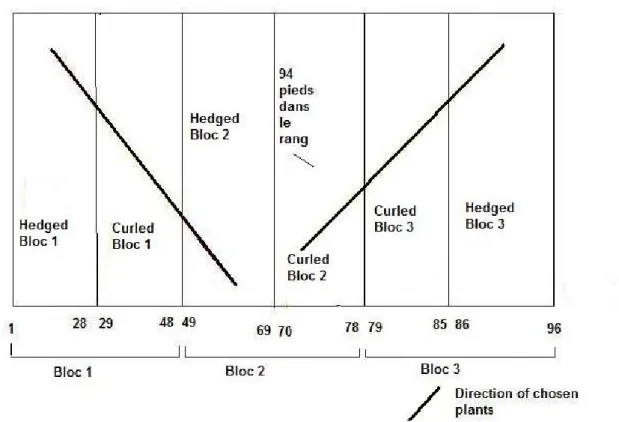
For each treatment 30 plants were labelled in order to follow their development during the season. The labelled plants represent a diagonal (crossing the entire plot and leaving some rows without selected plants at the end of the plot) in the plot in order to represent the whole parcel (Fig. 5). No plants from the sides, which could be not representative, were chosen. A representative shoot of the cane of each of the selected plants was labelled (with grafting tape in order to be flexible and do not disturb the sap flow) in order to do the measurements always on the same shoot and see its development and to compare it with all the other measurements done on the other plants.Figure 5: Distribution of selected Merlot plants in the experimental plot of Canon La Gaffelliere in Saint Emilion
Assessments:
The following observations have been carried out several times over the growing season. First measurement was done just one day before first pinching (30 of Mai).
Shoot length: Tagged shoot was measured in cm.
29
Lateral shoot growth:
the length of the third lateral bud was measured. One single lateralshoot was tagged per plant and observed over the whole growing season. It was always a lateral shoot coming out of the third nod. In order to have an idea of the average of the length of lateral shoots, the 5 of August the entire lateral shoots of the tagged shoots were measured.
Leaf area:
Leaf area was calculated using the methodology proposed by Lopes and Pinto(2005) in order to obtain leaf area in m2. Measurements were done just before hedging and after it. For exception of the 16 of June were vines were hedged before measurements could be done. So for this date only values after hedging were obtained.
24 Plants (12 for each treatment) of the 60 marked plants were chosen to do this measurement. Each shoot of the plant was measured in order to obtain leaf area per plant. Leaf area was established at the beginning only by measuring leaf area of the tagged shoot and then multiplying by number of shoots of the plant. As in some cases it gave an imprecise leaf area it was decided to measure all the shoots of the plant.
For the main shoot leaf area, length of the main vain of the biggest and smallest leaves was measured. The first leaf of the main shoot was not considered and leaves with a main vain smaller than 4 cm were not considered as well. Then using the formula established specially for Merlot leaf area calculation by Sanchez et al., (2011) was used in order to obtain individual leaf area for the smallest leaf (ILAs) and for the biggest leaf (ILAb).
Leaf area of the main shoot:
Equation 1: AFp_max (cm2) = 18,291 * L1p_max – 58,452
- AFp_max (cm2): Individual leaf area largest primary leaf - L1p_max: length main vein largest primary leaf
Equation 2: AFp_min (cm2) = 18,291 * L1p_min – 58,452 - AFp_min (cm2): individual leaf area smallest primary leaf - L1p_min: length main vein smallest secondary leaf
Once individual leaf area was established for the biggest and smallest leaf, mean leaf area was established.
30
Equation 3: AFp_med (cm2) = ( AFp_max + AFp_min ) / 2
- AFp_med (cm2): average individual primary leaf area
Number of leaves was counted (NFp) in order obtain the average individual primary leaf area (AFp_med NFp) of main shoot.
Equation 4: AFp_med NFp (cm2) = AFp_med (cm2) * NFp
AFp_med NFp (cm2): average individual primary leaf area x NFp: number of main leaves
Then the primary leaf area of the shoot was calculated using the model proposed by Lopes and Pinto (2005): .
Equation 5: AFp_shoot (cm2) = EXP (0,0835+0,992*LN (AFp_med NFp) ) - AFp_shoot (cm2): primary leaf area per shoot
Lateral shoot leaf area was estimated by counting all lateral leaves of all lateral shoots of one main shoot. Then the vein length of the smallest and of the biggest leaf was measured. Leaves with a main vein shorter than 4 cm were not considered. In order to obtain the lateral leaf area same procedure was used as for the leaf area calculation of the main shoot.
Lateral leaf area:
Equation 6: AFs_max (cm2) = 18,291 * L1s_max – 58,452
- AFs_max (cm2): individual leaf area of the largest secondary leaf - L1s_max: length main ve ofthe largest secondary leaf
Equation 7: AFs_min (cm2) = 18,291 * L1s_min – 58,452
- AFs_min (cm2): individual leaf area of the smallest secondary leaf - L1s_min: length main vein of the smallest secondary leaf
31
Once individual leaf area was established for the biggest and smallest leaf, mean leaf area was established;Equation 8: AFs_med (cm2) = ( AFs_max + AFs_min ) / 2 - AFs_med (cm2): average individual secondary leaf area
Number of secondary leaves was counted (NFs) in order obtain the average individual secondary leaf area (AFs_med Nfs) per main shoot.
Equation 9: AFs_med NFs (cm2) = AFs_med (cm2) * NFp
- NFs: number of secondary leaves
Than the secondary leaf area of the shoot was calculated.
Equation 10: AFs_shoot (cm2) = EXP (0,0835+0,992*LN (AFs_med NFs) ) - AFs_shoot (cm2): secondary leaf area per shoot
Leaf area of the shoot: (lateral leaf area + main leaf area)
Equation 11: AFt_shoot (cm2) = AFs_shoot (cm2) + AFp_shoot (cm2) - AFt_shoot (cm2): leaf area of total shoot
- AFs_shoot (cm2): secondary leaf area per shoot - AFp_shoot (cm2): primary leaf area per shoot
Leaf area of the vine:
Equation 12: AFtot_cep (m2) = addition of all the individual leaf area of the shoots
32
Relative average growth rate of the leaf area:
For the calculation of this parameter the formula developed by Teixeira and Ricardo (1983) was used:
Equation 13: RAG = (LN A2 – LN A1)/(t2 – t1)
- RAG: relative average growth of the leaf area - LN: napierian logarithm
- A2: leaf area at time 2 - A1: leaf area at time 1
- (t2 – t1): period of time between the two measurements
Canopy density measurements
For canopy density measurements it was used the point quadrat method (Smart and Robinson, 1991). This measurement was done just before the first cluster thinning where at the same time some leaves were removed. The measurement was carried out at cluster zone the 15 of June at the phenological stage of 50 % of berry closure.
A rod was inserted (horizontally to the VSP system) in the canopy at cluster zone and each time it touches a leaf (L) a cluster (C) or just passes through a gap (G) this is recorded (Fig. 6). The rod is inserted on one side of the canopy and it passes through the whole canopy. 50 measurements are done with a distance of 10 cm one from the other. This is repeated for each treatment in each block (6 times 50 measurements).
The following parameters were calculated with the obtained data:
Percent of Gaps: The total number of gaps (G) divided by number of insertions (50)
Leaf layer number (LLN): The total number of leaf contacts (L) divided by number of insertions (50)
Percent interior leaves: the number of interior leaves divided by the number of total leaves Percent interior clusters: the number of interior clusters divided by the number of total
33
Figure 6: Point quadrat measurement on Merlot vines in Saint Emilion, France.
The 19 of July it was carried out again but at 3/4 of the height of the canopy only for the leaves parameters. It was also carried out a measurement on the same date at the height of the last wire of the trellis system.
Cluster size and number:
Just before cluster thinning the clusters (23 of June at berry closure) on the same 24 plants used for establishing the leaf area were observed. Cluster per plant, number of third clusters and number of clusters per shoot were counted.
For the first, second and if it was present also for the third cluster width and length were measured. It was always measured the longest part of the cluster.
Cluster Compactness
The cluster compactness observations were done by two persons. The two persons passed two month together doing observations on all the plots of the enterprise. This gave them the same methodology and estimation method.
The observation was done with a value scale which helped to give a notation to each plant with 5 considered as the best, and 1 as the worst.
34
For cluster compactness the following notes were used (established at the company): Very compact (mark 1) Compact (mark 2) Very aerated (mark 3) Aerated (mark 4)
Medium compact (mark 5)
Presence of diseases:
To establish the % of diseases (Mildew, Oidium and Botrytis) 100 clusters and leaves were observed at different physiological stages for each treatment in every block. In the case of the leaves they were chosen at random and at all the canopy height. Observations were carried out at the two sides of the row in order to check both canopy sides.
Frequency was calculated as the ratio between the quantity of touched leaves and the number of observed leaves and intensity as the ratio between the surface of leaves touched by the disease and the number of observed leaves.
The same calculations were done for clusters.
Especially after a rain observations where done (6 to 10 days after a rain). But as it was a very dry year observations where not carried out so regularly.
So 10 days after the 7 of June (45 mm of rain) the first observation of mildew was carried out. Another observation was done the 5 of August after several rains and a last observation at the end of August.
Veraison date:
To determine the exact date of 50 % of veraison samples of 200 berries were taken for each treatment on four different dates. The 4 sample dates where: 11 of July, 18 of July, 21 of July and 24 of July. They were chosen in order to sample before 50% and after 50 % of veraison. Samples were taken on both canopy sides and from all type of cluster (shaded and exposed clusters). Berries were taken from different parts of the clusters (upper part, central part and lower part).Berries were observed and considered as already in veraison if they had any presence of red colour. Then percentage was established. To establish the 50 % of veraison, the collected data before and after 50 % of veraison were used. Calculating the percentage that veraison advanced by day, the exact date of 50 % of veraison was established.
35
Veraison quality:
In order to establish if there was a difference in the quality of veraison regarding homogeneity 3 observations were done. First observation was done at 10 % of veraison the 18 of July. Second observation was done the 25 of July at 50 % of veraison. Last observation was done the 1 of August at 90 to 100 % of veraison. For this observation the same 24 plants used for the leaf area calculation were observed. Every cluster was divided visually in 4 equal parts. In each of this part percentage of green, rose and red berries was established. All the clusters of all the shoots were observed. This method was proposed by the responsible of the vineyard.
Then general percentage of green, rose and red plants was established for each plant.
Lignification of the shoots:
Tagged shoots were observed in order to see if there was a difference in the lignification time of the shoots. The same 24 plants as for the leaf area were used. Each shoot was observed at the height of the second movable wire. A classification of 4 different colours was done (green: 1, yellow: 2, red-violet: 3, brown: 4) to establish lignifications. A number was assigned to each colour in order to obtain a comparable value and to establish an average of the bloc. This method was developed by the responsible of the vineyard and the author. This was carried out the 23 of June when the first lignifications were observed and repeated the 19 of July on the same plants.
Petiole analysis:
30 petioles were collected for each treatment at cluster height and sent to a laboratory (LCA Bordeaux) ([email protected]). This was done at mid veraison on the 25 of July. Leaves opposite to a cluster should be used. The petioles must be separated immediately from the leaf. In the laboratory they establish the nutrients quantity by ashes. Nitrogen, phosphor, Calcium, Potassium, Magnesium, Iron, Manganese, Zinc, Copper, Boron and Sodium were the measured nutrients.
Water status
In order to check if there is a difference in the behaviour of the two trials regarding water status, stem water potential was used to verify this. Stem water potential is an accurate tool for assessing vine water status at plot scale (Van Leeuwen et al., 2008).
Leaves at cluster zone were covered with a plastic and aluminium bag for at least one hour in order to avoid evapotranspiration and high temperatures. The measurement should take
36
place between 14:00 and 16:00 in order to have a stable water potential during the measurements. This is the moment where stem water potential values reach a minimum. This moment is generally chosen for comparing measurements among sites. By covering the leaf it reaches the same water potential than the stem. 10 leaves per each treatment were chosen (total of 60 leaves). Then with a pressure chamber we can establish the water potential. The petiole is cut and the leaf is putted into the pressure chamber (it should not take longer that 1 minute between cutting of the leaf and the measurement).With an auxiliary nitrogen bottle pressure is generated until a drop of sap flows out of the petiole (observed with a magnifying glass). When the petiole is cut the sap goes down due to the negative tension. In the pressure chamber we ad pressure till we equilibrate the old tension of the leaf. This way the measurement is obtained in bar (which later has to be transformed into mega Pascal). The more negative the water potential in the leaf, the greater the water deficit in the vine (Van Leeuwen, 2010).
Yield:
The harvest was on the 20 of September. Yield per individual vine was weighted. Average bunch weight was calculated. Just before harvesting Cluster numbers was counted and then all clusters were weighted on the same bin.
Together with the last measurement of leaf area it was calculated the ratio leaf area/ yield.
Berry composition
At harvest samples of berries of all the treatments were taken and sent to the laboratory. Glorie (polyphenol analysis) and maturity analysis were carried out at the laboratory Bordeaux Oenoconcept.
For the Glorie method the idea is to extract the anthocyanins from the skin with an acid at pH 1 (HCL N/10) and at pH 3,2 (solution at 5 g/L of tartaric acid, neutralised at 1/3). There is a correlation between the anthocyanins and tannins that allows through calculation establish the rest of the parameters.
Probable alcohol was done with the infrared method. Sugars in g/l and available nitrogen for mineralization (mg/l) were obtained with the enzymatic dosage method, Total acidity and pH was obtained with the ATP measurement with an electrode. Malic acid g/l was obtained by chromatography and enzymatic dosage.
Extractability of the anthocyanins (%), Tannins of the skin, Tannins of the seeds, Maturity of the tannins (%), Weight of 200 berries (g) and Anthocyanins at ph 1 (mg/l) were established with the Glorie method.
37
Costs:
In order to have an idea of the labour costs, workers had to fill out on a paper with the time it took them to finish a certain quantity of rows or a certain work. Knowing the cost by hour of a worker and the cost of different material used the cost by hectare was estimated.
Statistical analysis:
The data was analysed using MS Excel and the ANOVA was carried out in accordance with GLM procedures, from the SAS® program package (SAS Institute, Cary, NC, USA). Differences between means were assessed by LSD test (p < 0.05).
38
4 Results
4.1 Phenology
4.1.1 Veraison date:
If the statistical analysis of percentage of veraison is observed (annex: table 30), no significant difference for the treatments was found. Never the less, we can observe in Fig. 7 that there is a tendency to an earlier veraison in curled plants.
But when we observe in Table 1 the date at which the berries reached 50 % of veraison curled plants were two days in advance.
Table 1: Effect of hedging on the date at which plants reached 50 % of veraison on Merlot grapevines in Saint Emilion.
Hedged 24 of July Curled 22 of July 0 10 20 30 40 50 60 70 80 90
11 July 18 July 21 July 25 July
Ve ra is o n (% ) Hedged Curled
Figure 7: Effect of hedging on the percentage of veraison on Merlot grapevines in Saint Emilion
4.1.2 Veraison quality:
As shown in Table 2 for the veraison quality at 10 % of the veraison a significant difference was found for the violet zone 1, being higher for curled plants.
For the quality of veraison at 50 % no differences were found as observed in Table 3.
For the observation carried out at 90 % of veraison in the green zone 2 there were more green berries for the hedged plants (Table 4).
39
This results show no clear tendency ore difference regarding veraison quality between hedged and non hedged plants. Differences found might be by random.Table 2: Effect of hedging on Veraison quality at 10 % of veraison on Merlot grapevines in Saint Emilion 1 zone green 1 zone rose 1 zone violet 2 zone green 2 zone rose 2 zone violet Hedged 98,83 a 0,64 a 0,55 a 99,15 a 0,72 a 0,13 a Curled 98,95 a 0,72 a 0,32 b 99,28 a 0,42 a 0,32 a 3 zone green 3 zone rose 3 zone violet 4 zone green 4 zone rose 4 zone violet Hedged 99,51 a 0,22 a 0,27 a 99,64 a 0,16 a 0,21 a Curled 99,55 a 0,17 a 0,31 a 99,56 a 0,35 a 0,09 a
Means within columns designated by different superscript letters are significantly different by the F-test with P = 0,05.
Table 3: Effect of hedging on Veraison quality at 50 % of veraison on Merlot grapevines in Saint Emilion 1 zone green 1 zone rose 1 zone violet 2 zone green 2 zone rose 2 zone violet Hedged 42,33 a 34,14 a 23,55 a 41,78 a 33,23 a 24,62 a Curled 43,62 a 34,18 a 22,21 a 45,78 a 34,17 a 20,04 a 3 zone green 3 zone rose 3 zone violet 4 zone green 4 zone rose 4 zone violet Hedged 42,84 a 33,35 a 23,45 a 43,28 a 33,22 a 23,50 a Curled 46,36 a 34,57 a 19,08 a 47,48 a 33,99 a 18,53 a
Means within columns designated by different superscript letters are significantly different by the F-test with P = 0,05.
Table 4: Effect of hedging on Veraison quality at 90 % of veraison on Merlot grapevines in Saint Emilion 1 zone green 1 zone rose 1 zone violet 2 zone green 2 zone rose 2 zone violet Hedged 8,82 a 14,19 a 76,99 a 12,02 a 14,87 a 73,07 a Curled 6,05 a 12,42 a 81,50 a 8,69 b 11,80 a 79,51 a 3 zone green 3 zone rose 3 zone violet 4 zone green 4 zone rose 4 zone violet Hedged 10,34 a 15,41 a 74,26 a 12,31 a 15,22 a 72,45 a Curled 6,85 a 12,29 a 80,84 a 8,74 a 12,37 a 78,88 a
Means within columns designated by different superscript letters are significantly different by the F-test with P = 0,05.
40
4.2 Water status
As shown in Table 5 there are no significant differences between the treatments regarding water status measured by stem water potential.
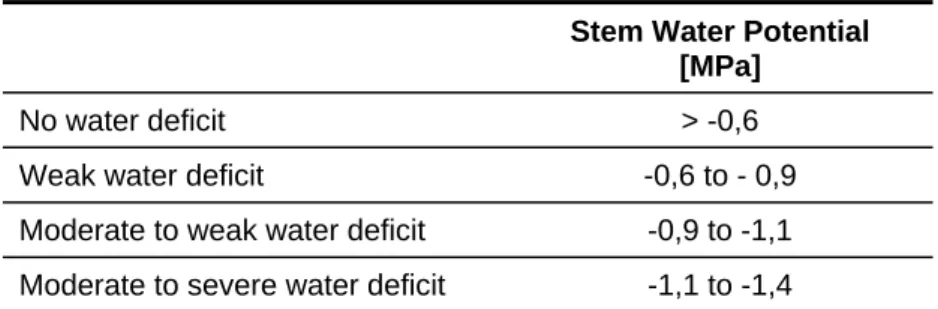
In Table 6 it is shown the interpretation scale for stem water potential values.
Table 5: Effect of hedging on stem water potential (MPa) on Merlot grapevines in Saint Emilion June 24th August 09th August 17th
Hedged -0,54 a -0,69 a -1,17 a
Curled -0,57 a -0,63 a -1,16 a
Means within columns designated by different superscript letters are significantly different by the F-test with P = 0,05.
Table 6: Stem Water potential values
Stem Water Potential [MPa]
No water deficit > -0,6
Weak water deficit -0,6 to - 0,9
Moderate to weak water deficit -0,9 to -1,1
Moderate to severe water deficit -1,1 to -1,4
4.3 Vegetative growth
4.3.1 Shoot length:
For the 30 of Mai there is no significant difference between treatments. This was before the first hedging was carried out. For all the following dates there is a significant difference between the hedged and curled plants (Fig. 8). It helped also to see before the first hedging if all the plants had more or less the same height. This is important because for the 30 of Mai the average of height is the same for the 3 blocs. This means that all plants that were hedged were more ore less in the same conditions.
As shown in Fig. 8 for the hedged plants the length of the main shoot remains the same once it was hedged. In the curled plants the main shoot continues its growth till the plants stops its vegetative growth indicating that lateral shoots and main shoot grow at the same time till the growth stops.
41
0 50 100 150 200 250 30.05 .2011 23.06 .2011 22.07 .2011 24.08 .2011 10.09 .2011 sh o o t le n gt h (c m ) Hedged CurledFigure 8: Effect of hedging on shoot length of Merlot grapevines in Saint Emilion
4.3.2 Lateral shoots
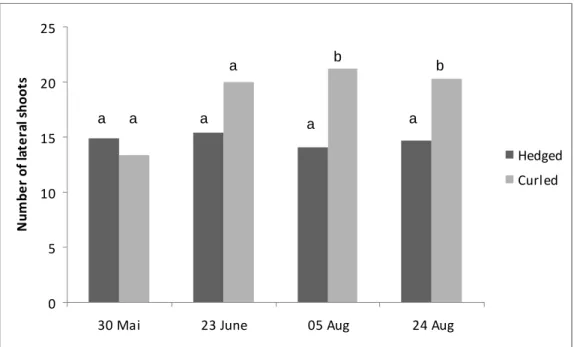
For the first measurement carried out the 30 of Mai there is no significant difference regarding the number of lateral shoots. In all the measurements done from the 23 of June till the end of the season all the blocs show that the curled plants have a higher number of lateral shoots (Fig. 9).
At least for the first measurements after hedging (22 of June) this is not the expected result. After cutting the apex and stopping the apical dominance a higher development of lateral shoots was expected in hedged plants. But curiously there is no significant difference between the two treatments at this date.
But only for the measurements of the 5 and 24 of August there is a significant difference. Curled vines have in average 21 lateral shoots while hedged vines have only 14. The higher number of lateral shoots is related to longer main shoots. As main shoots are much longer in curled plants the number of lateral shoots than can develop is much higher.
42
0 5 10 15 20 2530 Mai 23 June 05 Aug 24 Aug
Nu mb er of la tera l sh o o ts Hedged Curled a a a a a a b b
Figure 9: Effect of hedging on the number of lateral shoots of Merlot plants in Saint Emilion.
Columns designated by different letters are significantly different by the F-test with P = 0,05
The lateral shoots of the hedged plants were significantly longer compared to the ones of the curled Plants as shown in Fig. 10.
0 2 4 6 8 10 12 14 16 18 20 5 August La ter al sh o o t le n gh t (c m ) Hedged Curled a b
Figure 10: Effect of hedging on the length of lateral shoots of Merlot plants in Saint Emilion
Columns designated by different letters are significantly different by the F-test with P = 0,05
4.3.3 Leaf area
For all the measurements carried out no statistical difference was found regarding total leaf area (table 22 annex). But when regarding the data curled plants have always a higher leaf area value (Fig. 11). Loss of leaf area observed in the graph is the result of the hedging.
43
In hedged plants the main leaf area remains constant after the first hedging and it is the lateral leaf area that continues to grow.After the hedging carried out the 20 of July the curled plants have a bigger leaf area (0,71 m2 more than hedged plants). Just before the last hedging on the 22 of August the curled vines have an average of 0,91 m2 more of leaf surface than hedged vines.
But in any case this tendency of curled plants to have a higher leaf area is explained by the longer shoots and higher number of lateral shoots. As no leaf area is cut away and the plant has a constant and non interrupted growth it reaches a higher leaf area.
0 1 2 3 4 5 6
30 Mai 31 Mai 26 Jun 19 Jul 20 Jul 22 Aug 23 Aug 2 Sep
Le af a rea (m ²) Hedged Curled
Figure 11: Effect of hedging on the length on the leaf area of Merlot plants in Saint Emilion
For the first measurement carried out before the first hedging (30 of Mai) there is no significant difference on the fraction of lateral leaf area between treatments, but for the first measurement done after hedging (26 of June) the difference was significant with the hedged plants presenting a 11% more lateral leaf area (Fig.12).
For the measurements carried out the 19 of July the difference remains significant (before and after hedging). Hedged plants have a % of lateral leaf area that is 11 points higher. For the 22 of August and the last measurements the difference is not significant but the tendency remains the same. Hedged plants have 10 points more regarding % of lateral leaf area.
44
0 10 20 30 40 50 6030 Mai 31 Mai 26 Jun 19 Jul 20 Jul 22 Aug 23 Aug 2 Sep
La ter al le af ar e a (% ) Hedged curled a a a b a a b a b a a a a a a a
Figure 12: Effect of hedging on the percentage of lateral leaf area on Merlot grapevines in Saint Emilion. Columns designated by different letters are significantly different by the F-test with P = 0,05
Regarding the relative average of growth rate of the leaf area, the statistics show no significant difference for all the measurements carried out (Table 23 annex). But only after the first hedging during the period from the 30 of Mai to the 26 of June the hedged plants show a strong tendency to grow more than not hedged plants.
As observed in Fig. 13 hedged plants tend to have a more explosive growth in the beginning of the season and then they reduce their growth rate faster. Non hedged plants also grow more in early season but they reduce their growth less drastically compared with hedged plants. They reduce their growth gradually.
45
0,000 0,002 0,004 0,006 0,008 0,010 0,012 0,014 0,016 0,018 0,02030 Mai ‐ 26 June 26 June ‐ 19 july 19 july ‐ 22 August
Re la ti ve Gr o w th Ra te (m 2 / da y) Hedged Curled a a a a a a
Figure 13: Effect of hedging on Relative average Growth Rate of the leaf area in m2 per day on Merlot grapevines in Saint Emilion. Columns designated by different letters are significantly different
by the F-test with P = 0,05.
As shown in Table 7 no significant differences for lateral leaf area (m2), number of main leaves, number of lateral leaves, main leaf size (cm2) and lateral leaf size (cm2) were found. There was a significant difference for the main leaf area being higher for curled plants and remaining constant for hedged plants after first hedging was carried out. From the measurement of June onwards, the difference in main leaf area increased.
Although there is no significant difference regarding number of main leaves, by the end of the season curled plants have in average 91 more main leaves compared to hedged plants.