This technical note describes the implementation of the Levenberg-Marquardt algorithm for the inverse analysis of three-point bend tests on notched specimens of plain and fi ber reinforced concretes for determining softening parameters (σ-w curves). Tests indicated that the algorithm is suffi ciently effi cient and robust.
Keywords: inverse analysis, softening, concrete, Levenberg-Marquardt.
Esta nota técnica descreve a implementação de um algoritmo de Levenberg-Marquardt para a análise inversa de dados de ensaios de fl exão em três pontos em espécimes de concreto simples ou reforçado com fi bras para a determinação de parâmetros de amolecimento (curvas σ-w). Testes indicaram que o algoritmo é sufi cientemente efi ciente e robusto.
Palavras-chave: análise inversa, amolecimento, concreto, Levenberg-Marquardt.
A Levenberg-Marquardt algorithm for fi tting
σ
-w curves
from three-point bend tests for plain and fi ber reinforced
concretes
Um algoritmo de Levenberg-Marquardt para ajuste de
curvas
σ
-w a partir de ensaios de fl exão em três pontos
para concretos simples e reforçados com fi bras
J.L.A.O. SOUSA a
a Universidade Estadual de Campinas (UNICAMP), Faculdade de Engenharia Civil, Arquitetura e Urbanismo, [email protected],
Av. Albert Einstein, 951, Campinas, SP, Brasil 13083-852
Received: 13 Jul 2011 • Accepted: 30 Aug 2011 • Available Online: 07 Oct 2011
Abstract
Resumo
Volume 4, Number 4 (October, 2011) p. 691-694 • ISSN 1983-4195
© 2011 IBRACON
NOT
A
TÉCNICA
| TECHNICAL
692 IBRACON Structures and Materials Journal • 2011 • vol. 4 • nº 4
A Levenberg-Marquardt algorithm for fi tting
σ
-w curves from three-point bend tests for plain and fi ber
reinforced concretes
1. Introduction
A previous article (SOUSA & GETTU, 2006) describes an object oriented programming implementation of a system capable of fi t-ting different types of softening curves to data from three-point-bend tests performed on notched prismatic specimens of plain and fi ber reinforced concretes. The approach, implemented in a software named FIT3PB, is based on the minimization of the error function , where is the set of softening parameters. The function is described by the integral of the squared differ-ences along the fi tting interval, using a fi nite differdiffer-ences approach to compute gradient and Hessian of . This technical note describes the implementation an alternative based on Levenberg-Marquardt approach to minimize the error function without explicitly computing the Hessian and, thus, reducing the number of calls to the subroutine that evaluates , the main drawback of the original implementation.
2. Description of the Computational
Implementation
Let it be a load-versus-crack mouth opening displacement (P-CMOD) function
(1)
P
num=f (v, a)
where the scalar is the crack mouth opening displacement (CMOD), is the vector of softening parameters (e. g. ft and GF), and is the numerically computed load corresponding to and the trial softening parameters .
The squared error, in the east squares sense, is
(2)
where:
ν is the crack mouth opening displacement, usually referred as CMOD
P
expis the experimental value of the applied load corresponding to
a
is a set of softening parameters assumed at a step of the fi tting processf (v,a) is the value of the applied load, corresponding to a trial set
of parametersThe software FIT3PB was implemented according to the follow-ing steps:
1. The user introduces the experimental results as a list of P-CMOD pairs, selects a softening model to fi t and gives a trial set of softening parameters to start the iterative algorithm; 2. These data are preprocessed to eliminate noise usually
pres-ent in the beginning of the curve and the P-CMOD pairs are recomputed to create a list with equally spaced abscissas (the same spacing is used for the numerically obtained P-CMOD lists to help in the integration routines);
3. Given the softening model and the current set of parameters, the numerical P-CMOD values – – are computed; 4. These values are used to evaluate for the current set
of parameters;
5. An optimization routine fi nds the set of parameters corre-sponding to the minimum of , using gradient and Hes-sian of computed with a fi nite differences scheme; In this technical note the optimization routine referred in the step 5 is addressed, aiming at improving effi ciency and robustness.
2.1 Computation of Partial Derivatives
Considering n (n even) equally spaced segments along the fi tting
interval (spacing h), using the Simpson´s rule for numerical
inte-gration, Eqn. 2 can be rewritten as:
(3)
when
The gradient of is given by
(4)
The Hessian of is given by
(5)
693
IBRACON Structures and Materials Journal • 2011 • vol. 4 • nº 4
J.L.A.O. SOUSA
5. Compute the modifi ed Hessian ( ) matrix by multiplying the diagonal elements of the Hessian matrix ( ) by ;
6. Compute ( ), the vector with the increments by solving the
linear system ( );
7. If is small enough, break;
8. Evaluate at ;
9. If , multiply by 10 and return to
step 4 with ;
10. If , divide by 10, and return to step 5 with instead of .
The iterative process stops when the condition in step 7 is satisfi ed or a maximum number of iterations is reached.
3. Application tests
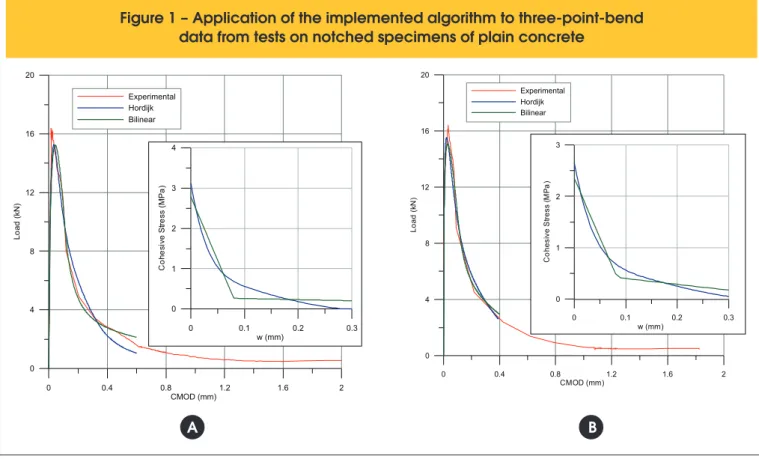
The described algorithm has been implemented in the system FIT3PB, and tested for plain and fi ber reinforced concretes. Running a series of test data from notched beam specimens tested in a three-point-bend setup by FERNANDES (2010) for plain concrete, and by BARRAGÁN (2002) for fi ber reinforced concrete, the obtained param-eters matched the previous ones computed with the former imple-mentation of FIT3PB. Figure 1 present the experimental load-CMOD curves, with the corresponding fi tted curves displayed in the details, resulting from the inverse analysis on data from two different plain concrete specimens. Two softening models were used: an exponen-tial model (HORDIJK, 1991) and a bilinear model. Similar results are presented in Figure 2 showing the inverse analysis results of a trilinear model fi tted to data from a fi ber reinforced concrete specimen.
4. Conclusions
The implementation of a Levenberg-Marquardt algorithm for the least square fi tting of a softening curve from three-point-bend specimens has been described. The intention is to improve effi -ciency and robustness of an inverse analysis system to deal with more complex problems related to fi tting of a time dependent mod-el to a group of specimens tested at different loading rates. The implemented algorithm uses a fi nite difference scheme only for de-termining the gradient of the error function , approximating the Hessian matrix through a dyadic product of such gradient by itself, as described in Eqn. 7.
Although exhaustive tests have not been developed, the imple-mented Levenberg-Marquardt algorithm has shown improved per-formance, both in terms of effi ciency and robustness.
5. Acknowledgements
The author would like to acknowledge the continuous support from FAPESP (Fundação de Amparo à Pesquisa do Estado de São Paulo, CAPES (Coordenação de Aperfeiçoamento de Pessoal de Nível Su-perior) and CNPq (Conselho Nacional de Desenvolvimento Científi co e Tecnológico) to the research projects related to this work. The test data used in the examples correspond to laboratory tests performed by Dr. Juliana F. Fernandes (Escola Politécnica, Universidade de São
(6)
This means that a fi nite differences scheme is no longer necessary to evaluate the Hessian matrix, which can be approximated by the positive defi nite matrix represented by Eqn.6. Thus, the gradient and the Hessian of the error function can be computed according to Eqn. 7.
(7)
The functions and are
de-scribed in terms of polygonal functions, using the same
abscissas. In order to compute the derivatives , the
fi nite differences scheme consists of giving increments to the parameter , maintaining the others, , approximating the par-tial derivative by
(8)
This generates the derivative of each ordinate of the P-CMOD curve with respect to the softening parameters. These values are used to perform the integrations using the Simpson´s rule in the same manner described in Eqn. 3.
2.2 Algorithm for Error Minimization
The Levenberg-Marquardt algorithm for minimization of the func-tion consists in disturbing the approximated Hessian ma-trix by multiplying the diagonal elements by a factor
where is modifi ed at each iteration step according to the follow-ing algorithm:
1. Start with a trial set of parameters ( ), where the superscript s refers to the current iteration
2. Compute ;
3. Pick a small value of , e.g. =0.001;
694 IBRACON Structures and Materials Journal • 2011 • vol. 4 • nº 4
A Levenberg-Marquardt algorithm for fi tting
σ
-w curves from three-point bend tests for plain and fi ber
reinforced concretes
Figure 1 – Application of the implemented algorithm to three-point-bend
data from tests on notched specimens of plain concrete
0 0.4 0.8 1.2 1.6 2
CMOD(mm) 0 4 8 12 16 20 Lo ad (kN) Experimental Hordijk Bilinear
0 0.1 0.2 0.3
w(mm) 0 1 2 3 4 C ohe si ve St re ss (MPa )
0 0.4 0.8 1.2 1.6 2 CMOD(mm) 0 4 8 12 16 20 Lo ad (k N ) Experimental Hordijk Bilinear
0 0.1 0.2 0.3 w(mm) 0 1 2 3 C oh es iv e S tre ss (M Pa )
A
B
Figure 2 – Application of the implemented
algorithm to three-point-bend
data from tests on notched specimens
of fiber-reinforced concrete
0 0.4 0.8 1.2 1.6 2
CMOD(mm) 0 10 20 30 Lo ad (kN )
E xperim ental T rilinear
0 0.1 0.2 0.3 0.4
w(mm) 0 1 2 3 4 C oh esi ve St re ss (MPa )
Paulo, Brazil), and Dr. Bryan E. Barragán (Universitat Politècnica de Catalunya, Spain).
6. References
[01] BARRAGÁN, B.E., Failure and Toughness of steel
fi ber reinforced concrete under tension and shear. Doctoral Thesis. Universitat Politècnica de Catalunya, Spain. 2002.
[02] FERNANDES, J.F., Relatório Interno, Laboratório de Estruturas e Materiais, Escola Politécnica,
Universidade de São Paulo, 2010.
[03] HORDIJK, D.A., Localapproach to fatigue of concrete. Doctoral thesis, Delft University of
Technology, The Netherlands. 1991.
[04] PRESS W.H., TEUKOLSKY, S.A. BETHE, H.A., VETTERLING, W.T., FLANNERY, B.P. NUMERICAL
RECIPES - The Art of Scientifi c Computing. Third Edition, Cambridge University Press. 2007.
ISBN-13 978-0-511-33555-6.
[05] SOUSA, J.L.A.O., GETTU, R. Determining the tensile stress-crack opening curve of concrete by
inverse analysis. Journal of Engineering Mechanics, v.132, p.141 - 148, 2006.