THE RELATIONSHIP BETWEEN OCCUPATIONAL STRESSORS AND
COPING STRATEGIES IN NURSING TECHNICIANS
Sandra de Souza Pereira1, Carla Araujo Bastos Teixeira2, Emilene Reisdorfer3, Mariana Verderoce Vieira4, Edilaine Cristina da Silva Gherardi-Donato5, Lucilene Cardoso6
1 Doctoral student of the Psychiatric Nursing Program, Escola de Enfermagem de Ribeirão Preto (EERP), Universidade de São Paulo (USP). Ribeirão Preto, São Paulo, Brazil. E-mail: [email protected]
2 Doctoral student of the Psychiatric Nursing Program, EERP/USP. Ribeirão Preto, São Paulo, Brazil. E-mail: carlinhateixeira@ hotmail.com
3 Ph.D. in Psychiatric Nursing. Faculty of Nursing, University of Alberta. Edmonton, Alberta, Canada. E-mail: [email protected] 4 Ph.D. in Psychiatric Nursing. EERP/USP. Ribeirão Preto, São Paulo, Brazil. E-mail: [email protected]
5 Ph.D. in Psychiatric Nursing. Professor, EERP/USP. Ribeirão Preto, São Paulo, Brazil. E-mail: [email protected] 6 Ph.D. in Psychiatric Nursing. Professor, EERP/USP. Ribeirão Preto, São Paulo, Brazil. E-mail: [email protected]
ABSTRACT: This is a quantitative, descriptive and exploratory research, with cross-sectional design that investigated the stressors experienced by nursing technicians working in general hospital and identiied the coping strategies most used by them. The sample contained 310 participants. A sociodemographic questionnaire and the Ways of Coping Scale were used. For the analysis we used descriptive statistics and calculated the Cronbach’s alpha. 60% of professionals used the strategies focused on the problem; 57.4% attributed their stress to working conditions, 26.8% to relationships in the workplace, 5.5% to the lack of reward at work and only 0.6% to problems personal. We conclude that strategies focused on the problems were the most used, indicating an approximation of the stressor in order to ix it. The identiied stressors indicate the need for planning, stimulating and recognizing nursing professionals.
DESCRITORES: Psychological adaptation. Nursing technicians. Coping strategies. Occupational stress. Occupational health.
A RELAÇÃO ENTRE ESTRESSORES OCUPACIONAIS E ESTRATÉGIAS
DE ENFRENTAMENTO EM PROFISSIONAIS DE NIVEL TÉCNICO DE
ENFERMAGEM
RESUMO: Pesquisa quantitativa, descritiva e exploratória, com desenho transversal, que investigou os estressores vivenciados por proissionais de enfermagem de nível técnico atuantes em hospital geral e identiicou as estratégias de enfrentamento mais utilizadas. Amostra composta por 310 participantes. Foram utilizados o questionário sociodemográico e a Escala de Modos de Enfrentamento dos Problemas. Para a análise utilizou-se a estatística descritiva e calculou-se o alfa de Cronbach. Observou-se que 60% dos proissionais utilizam de estratégias focalizadas no problema; 57,4% atribuíram seu estresse às condições de trabalho, 26,8% aos relacionamentos no ambiente laboral, 5,5% à falta de recompensa no trabalho e apenas 0,6% a problemas pessoais. Conclui-se que as estratégias focalizadas nos problemas foram as mais utilizadas indicando uma aproximação do estressor no intuito de solucioná-lo. Os estressores identiicados indicam a necessidade de um planejamento, estimulação e reconhecimento dos proissionais que atuam na enfermagem.
DESCRITORES: Adaptação psicológica. Técnicos de enfermagem. Estratégias de enfrentamento. Estresse ocupacional. Saúde do trabalhador.
LA RELACIÓN ENTRE LOS ESTRESORES OCUPACIONALES Y LAS
ESTRATEGIAS DE ENFRENTAMIENTO ENTRE PROFESIONALES DE
ENFERMERÍA DE NIVEL TÉCNICO
RESUMEN: Investigación cuantitativa, descriptiva y exploratoria, con diseño transversal, que investigó los factores de estrés que
experimentan los profesionales de enfermería de nivel técnico que trabajan en un hospital general e identiicar las estrategias de enfrentamiento más utilizadas por ellos. La muestra contó con 310 participantes. Se utilizaron cuestionario sociodemográico y la Escala de Modos de enfrentamiento a los Problemas. Para el análisis se utilizó estadística descriptiva y se calculó el alfa de Cronbach. 60% de los profesionales utilizan estrategias centradas en el problema; 57,4% atribuyen su estrés a condiciones laborales, el 26,8% a las relaciones laborales, el 5,5% a la falta de recompensa en el trabajo y sólo el 0,6% de los problemas personal. Se concluye que las estrategias centradas en los problemas eran las más utilizados, lo que indica una aproximación del estresor con el in de solucionarlo. Los factores de estrés identiicados indican la necesidad de una planiicación, estimulación y reconocimiento de los profesionales que actúan en enfermería.
DESCRIPTORES: Adaptación psicológica. Técnicos de enfermería. Estrategias de afrontamiento. Estrés laboral. Salud laboral.
INTRODUCTION
In health, the term stress was irst used in 1926
by Hans Selye, who at the end of several studies explained it as a general wear of the body, whose psychological reaction to emotional, physical, mental and chemical components to certain foreign stimuli cause irritability, frightening, excitement or confusion.1 Thus, stress was deined as a set of reac
-tions that occur in an organism when it is subjected to adaptation stress.2
The stimuli capable of causing the body’s ho-meostasis breaks are called stressor events, which
can be classiied as external (related to external
conditions that affect the individual) and internal (determined completely by the individual). The state of stress is related to an adaptive response and, thus,
is a normal, necessary and beneicial mechanism to
the body. Each individual has a different tolerance level to stressful situations and the individual’s sus-ceptibility to stress varies according to their ability to handle the problem.3
In 1956, Selye developed a designated a Gen-eral Adaptation Syndrome model, dividing the events and the changes produced by the biological system due to stress in three phases: the alarm or alert phase relates to the initial moment in which
the body identiies the stressor and mobilizes a
rapid organic response to face it; the resistance phase causes the body to resist independently of the permanence or not of the stressor, causing the organism to adapt, and in the exhaustion phase the stressor remains and the body starts to not be able to eliminate it or adapt again.2 A fourth phase
was identiied by Lipp between the resistance and exhaustion phase, identiied as near-exhaustion
phase, where there is weakening to resist or inabil-ity to adapt of the individual towards the stressor. At this stage light health problems may occur, but not incapacitantes.1
Sometimes the work causes negative feelings to the worker, and can take him/her to suffering and from that, developing resources to support and not get sick because of psychological pressures of the activity.4 Nursing is a stressful profession, which
generates harm to physical and mental health, which can converge to the professional illness, when it regularly faces: fragmentation of tasks and
relation-ships, little lexible hierarchical structure, monoto
-nous activities, insuficient sizing of personnel, high
absenteeism and sick leave, inadequate conditions
of work, overload of tasks and responsibilities, high standards, excessive continuous working hours, poor pay and job dissatisfaction, interpersonal relationship problems between individuals of the same class, exposure to loss, grief and death.5 Such
evidence conirms that 62.30% of the stress of nurs -ing staff comes from the work itself.6
And to deal with this situation the professional often needs to develop coping techniques, creating defense mechanisms and adaptation to stress, defen-sive emotions and feelings to promote a detachment from people and anxiogenic situations.5
The confrontation also called coping, corre-sponds to all the cognitive and behavioral efforts that are constantly changeable, for the control of internal and external demands, which exceed or exhaust the person’s resource. Thus, coping strate-gies may change over time, according to the stressor characteristics and context requirements.3
Coping strategies can be classiied by function and in two categories. The irst category refers to
strategies focused on the problem and the second focused on emotion.7 In the irst the individual seeks
to understand the stressor and tries to somehow modify it or avoid it in the future; in the second the subject seeks to reduce the distress the stimulus determines, even if the stressful situation cannot be changed.7
It is important to note that the types of cop-ing strategies used in a given situation will vary according to the personality or experiences of the individual, as well as the situation characteristics.8
Furthermore, the use of strategies protects the in-dividual from damage or strengthen their ability to address challenging situations.9
Thus, individuals develop different ways
of coping, even compared to the same conlicting
situation, which is due to several factors. It should be also noted that as the frequency and duration of stressful situations, resources tend to exhaustion. Therefore, different studies seek to understand the ways of coping used by professionals against the
conlicting factors so that they can understand the
work and relational dynamics and forms of expres-sion/positioning these individuals, favoring the improvement of professional quality of life.4,10
Given the above, developing a study to in-vestigate the stressors experienced by the techni-cians and nursing assistants* in a general hospital
* In Brazil, nursing is divided into three categories: nurse, nursing technicians and nursing auxiliaries, being the highest
is considered important, as well as identifying the coping strategies most used by these professionals.
METHOD
This is a quantitative, descriptive and explor-atory research, with cross-sectional design, held in a large hospital in the state of São Paulo.
The population of the study included all nursing technicians and assistants working in a general hospital. An increased demand associ-ated with less control of work corresponds to a greater wear level of the worker. Thus, the study was conducted in this population (technicians and nursing assistants) considering that these profes-sionals have an occupation that meets the above conditions, that is, they meet a high demand for labor and have little control of the work performed due to their level of training and also the constant supervision of the nurse.
In this study nursing technicians and assis-tants with service time equal or higher than a year of both sexes were included. The research excluded the professionals who were out of work.
To calculate the sample size was applied to N=Z2.p.q/E2 formula.11 Thus, the sample size was
calculated to detect an expected prevalence of 50%
with 95% conidence and a maximum error of 5%.
That is, the sample size should ensure such accuracy by detecting prevalence in the range of 45% to 55% with 95% probability. Prevalence values further than 50% will result in lower error or greater power estimation.
The correction for the finite population was performed by means of the expression: n=n(initial)/{1+n(initial)/population}, where n(initial)=384 and population=1,055 takes the value of n(intermediate)=282. Thus, assuming refusals and
partial responses in approximately 20%, the inal value was as follows: n(inal)=338, and randomiza -tion was done using the SPSS software.
Data collection took place between July and December 2012. A questionnaire was applied to sociodemographic, working conditions and health characterization and Scale of Ways of Coping with
Problems (EMEP, in Portuguese).
The questionnaire was developed by the researchers to record the sociodemographic and labor data, and thus characterize the study popu-lation. It consists of 27 questions that include the following variables: age, gender, education, civil status, religion, length of service in the CH sector,
length of service in the profession, the number of employment contracts, working time, with whom they live, number of persons residing in the house-hold, number of children, medical consultation in the last year, medical reason for consultation, type of health service, use of medicines; absence from work, self-reported diseases and use of alcohol and tobacco.
To measure the types of coping strategies
used by professionals the EMEP was used. This
scale was designed based on interactive model of
stress and conceptualizes coping as a set of speciic answers to speciic stressful situation. EMEP is
comprised of the 45 items divided into four factors: problem-focused coping on the (consisting of 18 questions), emotion-focused coping (consisting of 15 questions), search for religious practices (con-sisting of 7 questions) and search for social support (consisting of 5 questions).
The scale has a space for the participant to write down a stressful situation which he/she is experiencing in the workplace at the moment. After completing the stressful situation, the participant may continue answering the 45 statements of the
scale. The answers are given in Likert ive-point
scale (1=I never do that to 5=I always do that). The scores are obtained by the arithmetic mean and the higher the scores, the higher the frequency of use of the coping strategy. Only item four has negative factor analysis, so it is necessary to reverse the score before the calculation.
For the processing of the responses, the data
were coded and tabulated by the researcher in a Mi -crosoft Windows Excel spreadsheet, double-typing; the second typing was performed by a collaborator. Then, database validation was performed using the statistical software EpiData.
A descriptive analysis of population charac-teristics and variables studied through frequency distribution, absolute numbers and percentage, average, minimum and maximum was conducted. Content analysis was used for the open question
of EMEP,12 for processing the data, which, after
luctuating reading, proceeded to the categoriza -tion, considering the frequency of responses. The
Cronbach’s alpha (α) was calculated to check the internal consistency and reliability of EMEP, obtain -ing the follow-ing alphas: strategies focused on the
problem (α=0.84), strategies focused on emotion (α=0.78), search for religious practices (α=0.71) and search for social support (α=0.64). The overall alpha
Considering the ethical aspects of research involving human beings (Resolution 196/96), this study received authorization from the service; it was submitted to the Etichal Research Committee of the Escola de Enfermagem de Ribeirão Preto and was approved by the Opinion 23433, CAAE protocol n. 01658912.1.0000.5393.
RESULTS
We invited 338 nursing professionals to par-ticipate in the study, divided in assistants and
tech-nicians. There were 8.2% of refusals, and the inal
total of participants was 310. The sociodemographic and employment characteristics of the participants are presented in Table 1.
Table 1 - Sociodemographic and employment characteristics of study participants. Ribeirão Preto-SP, Brazil, 2012
Variables n(%) Average+ SD
Gender (female) 236 (76.1)
---Age (years) --- 47.19 + 10.94
Education (completed high school) 209 (67.4)
---Civil status (married or with a partner) 180 (58.1)
---Children (with children) 231 (74.5)
---Religion (catholic) 165 (53.2)
---Education (nursing assistant) 198 (63.9)
---Position (nursing assistant) 265 (85.5)
---Length of service --- 12.6 + 8.75
Time in the profession --- 15.9 + 8.83
Employment contracts (only) 246 (79.4)
---Working hours (up to 30h per week) 242 (78.0)
---When thinking of coping strategies, we note that each person seeks a way to deal with stressors, aimed at reducing them. It is noteworthy that, in
this study, the most prevalent strategies were those focused on the problem (Table 2).
Table 2 – Components of Scale of Ways of Coping with Problems of study participants. Ribeirão Preto-SP, Brazil, 2012
Strategies n(%) α Cronbach α Cronbach
Focused on the problem 181(58.4) 0.84
0.85
Focused on emotion 5(1.6) 0.78
Search for religious practices 65(21.0) 0.71
Search for social support 59(19.0) 0.64
Total 310(100.0)
The Cronbach’s alpha indicates the internal consistency of 0.85, which allows to infer that the responses obtained in the scale consists of reli-ability and that it is also very close to that found in the instrument factor analysis.7 Comparing the
values of Cronbach alpha of the scale with other studies using the same instrument, same behavior occurs, that is, problem-focused coping factors,
focused on emotion and search for social support were more reliable when compared to the social support search factor.
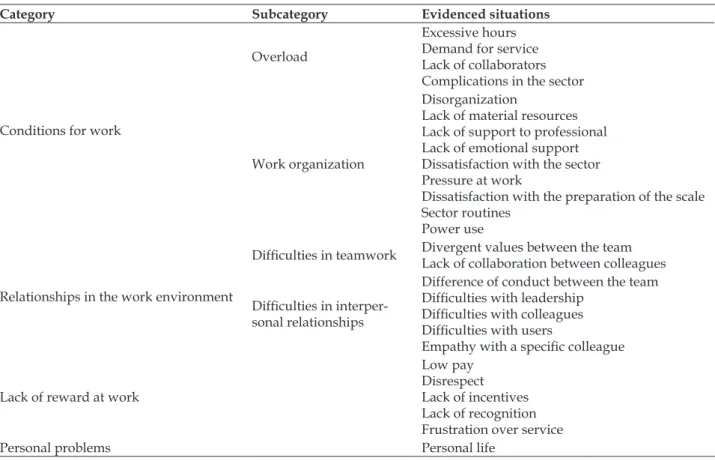
The data from the EMEP open question,
Table 3 - Stressful situations categorized from the responses of the participants. Ribeirão Preto-SP, Brazil, 2012
Category Subcategory Evidenced situations
Conditions for work
Overload
Excessive hours Demand for service Lack of collaborators Complications in the sector
Work organization
Disorganization
Lack of material resources Lack of support to professional Lack of emotional support Dissatisfaction with the sector Pressure at work
Dissatisfaction with the preparation of the scale Sector routines
Power use
Relationships in the work environment
Dificulties in teamwork Divergent values between the team
Lack of collaboration between colleagues
Dificulties in interper
-sonal relationships
Difference of conduct between the team
Dificulties with leadership Dificulties with colleagues Dificulties with users
Empathy with a speciic colleague
Lack of reward at work
Low pay Disrespect Lack of incentives Lack of recognition Frustration over service
Personal problems Personal life
The analysis of the answers allowed the for-mulation of categories that describe the stress situ-ations cited by participants, as Table 4.
Table 4 - Categorization of experienced stressors in the work environment. Ribeirão Preto-SP, Brazil, 2012
Category n(%)
Working conditions 178(57.4) Work environment 83(26.8) Lack of reward at work 17(5.5)
Personal problems 2(0.6)
Not informed 30(9.7)
Total 310(100.0)
According to the qualitative analysis of data obtained from the survey of stressful situations cited by participants as stressor produced in the work environment it could be observed that the vast majority (n=178) cited as stressful situations related to working conditions, either overload or the organization of the service. It is also noticed that few participants (n=2) cited personal factors as stressors, which highlights the centrality of work
in determining the stress direction in the work environment.
DISCUSSION
Regarding the sociodemographic and work characteristics of the study participants, similar results were found in other studies on the same population and location of study.13-18 These data
relect a population composed mostly of women,
which can be explained by the characteristics of the profession that was historically associated with the feminization of care. Another detail worth mentioning is that the minimum level of education
(completed high school) justiies the requirement
for the professionalization of the nursing technician and assistant.
Low remuneration is a highlighted factor in the literature as stressor, and having professionals working in positions different from their training and lower pay makes this situation important to be considered.
Nursing as a professional category has always been marked by professionals who reconciled more than one employment,20 as can be seen in a study21
performed with nurses in an oncology hospital, in which 70.8% of workers had double working hours with low wages and the need to improve the family
income as justiication. However, in this study most
of the nursing technicians and assistants had only one employment.
Similar data can be checked in other studies22-24
also conducted with these professionals. In this study, working in only one place may be related to the opportunity offered by the service itself so that the professional can increase their earnings through extra shifts at the unit.
It should be noted that even though the profes-sional does not need to go to another service, he/ she will have the working time increased, which could trigger professional wear. A large portion of nursing technicians and assistants in this study mentioned working up to 60 hours a week. Studies show that the overload of working hours may be related to illness.24
When thinking of coping strategies, we note that each person seeks a way to deal with stressors, aimed at reducing them. In this study, the strategy most commonly used by the sample was focused on the problem; this strategy represents an approach-ing condition that is performed by the individual in relation to the stressor towards solving the prob-lem or handle with the stressful situation. It also indicates that there are cognitive efforts aimed at re-evaluation of the problem, realizing it so as a positive manner.7
This result indicates that facing problems in order to solve them is the best way to deal with stressors that arise not only in the workplace but also in personal life. Studies in other populations, such as people with HIV, patients with ESRD, master’s students in health sciences and cancer patients cor-roborate such results.25-28
The Cronbach’s alpha indicates the internal consistency of 0.85, which allows to infer that the responses obtained in the scale consists of reliabil-ity and that it is also very close to that found in the instrument factor analysis.7 Comparing the values
of Cronbach α of the scale with other studies using
the same instrument, same behavior occurs, that is,
problem-focused coping factors, focused on emotion and search for social support were more reliable when compared to the social support search factor.
Occupational stressors reported by
par-ticipants were identiied and categorized for better
understanding.
According to the qualitative analysis of data obtained from the survey of stressful situations cited by participants as stressor factor produced in the work environment it could be observed that the vast majority (n=178) cited as stressful situations related to working conditions, either overload or the organization of the service. It is also noticed that few participants (n=2) cited personal factors as stressors, which highlights the centrality of work in determin-ing the stress direction in the work environment.
In terms of working conditions, work overload was mainly derived from the lack of collaborators, excessive working time, high demand for the ser-vice and the events that happen in the sector. Such situations are also evidenced by other studies.29-30
In relation to the service organization, it was evi-denced through the sector disorganization the lack of material resources, lack of professional support, lack of emotional support, dissatisfaction with the sector, pressure at work, dissatisfaction with the preparation of the scale, sector routines and use of power. It is noteworthy that the aspects related to the service organization has been associated with stress and lack of resources, whether personal, material or physical, is related to service conditions not always satisfactory, which leads to professional stress interfering with quality of service.30-32
It is noteworthy that among the experienced situations characterized as relationships in the work environment, this was divided into two
sub-categories: dificulties in teamwork, where it was
highlighted the divergent values between the team and the lack of cooperation from colleagues, and
the subcategory dificulties in interpersonal rela -tionships, which evidenced situations of different
practices among the team, dificulties with leader -ship, with colleagues and with users and empathy
with a speciic colleague. Such situations can directly
affect the functioning of the team, thus hindering the exchange of experiences and the opportunity to contribute with ideas designed to promote both the team as well as the assistance.30
low pay with stress at work, and also the relative lack of recognition is directly linked to motivation and accommodation by the professional to the tasks to be performed.30
Only two participants mentioned problems related to personal life as stressful situations that interfere with work.
FINAL REMARKS
Considering that the coping strategies become necessary to try to solve the stressful situations that permeate the work environment, the results of this research should be assessed carefully. Thus, the highlights were the coping strategies focused on the problem as a positive way to approach and resolve
the conlicting issue.
These results indicate three mainly organiza-tional components that affect the health of nursing workers in this study. Such components, by being di-rectly related to working conditions, can be reviewed
in order to develop modiications and interventions that minimize the situations identiied as stressful.
These results contributed to a more detailed view of reality perceived in practice. This research aims to contribute in some way, given the existing
lack of detailed studies speciically in the area of
nursing to address this issue as part of everyday life. The use of multifactorial instruments enables us to better clarity about the many subjective and objective factors surrounding the work environ-ment. However, as Brazil is a country rich in life contexts, further studies are suggested to be carried out in different departments and regions, so that
one can draw a broader and enhanced proile of
the profession.
It is expected that from this study it is possible to understand more concretely the occupational stress factors and their ways of coping, and then de-velop intervention methods to transform this reality, either through further studies, or with professional practice, directly.
REFERENCES
1. Barroso ML, Oliveira GF, Carvalho ACF, Batista HMT,
Silveira GBM. Estresse e uso de álcool em enfermeiros que trabalham em urgência e emergência. Cad Cultura Ciência. 2015; 13(1):60-75.
2. Selye H. Stress and the general adaptation syndrome. Br Med J. 1950; 1(1):1383-92.
3. Paiva KCM, Gomes MAN, Helal DH. Estresse
ocupacional e síndrome de Burnout: proposição de um
modelo integrativo e perspectivas de pesquisa junto a docentes do ensino superior. Gestão & Planejamento. 2015; 16(3):285-309.
4. Pereira SS, Teixeira CAB, Reisdorfer E, Gherardi-Donato ECS, Juruena MF, Cardoso L. Burnout in nursing professionals: associations with early stress. BJMHN. 2015; 4(6):267-75.
5. Ignatti C. Sofrimento psíquico de enfermeiros – um
olhar mitológico. Cientíica Integrada. 2012; 1(1):1-12. 6. Lautert L. O desgaste profissional do enfermeiro
[tese]. Salamanca (ES): Universidade Pontifícia de Salamanca, Faculdade de Psicologia; 1995.
7. Seidl EMF, Tróccoli BT, Zannon CMLC. Análise fatorial de uma medida de estratégias de enfrentamento. Psic.: Teor. e Pesq. 2001; 17(3):225-34.
8. Laal M, Aliramaie N. Nursing and coping with stress.
Int J Collab Res Intern Med Public Health. 2010; 2(5):168-81.
9. Townsend MC. Enfermagem psiquiátrica: conceitos
de cuidados. Rio de Janeiro (RJ): Guanabara; 2002.
10. Silveira KA, Enumo SR, Pereira de Paula KM, Batista
EP. Estresse e enfrentamento em professores: uma análise da literatura. Educ Rev. 2014; 30(4):15-36. 11. Silva NN. Amostragem probabilística. São Paulo (SP):
EDUSP; 2001.
12. Bardin L. Análise de conteúdo. Lisboa (PT): Edições
70; 2011.
13. Rosario CAR, Lopes AM, Pereira FFA, Costa FM. Avaliação do estresse entre enfermeiros que atuam na estratégia saúde da família de Montes Claros, MG. Rev Norte Min Enferm. 2015; 4(1):03-14.
14. Fuente GAC, Vargas C, Luis CS, García I, Cañadas
GR, Fuente EI. Risk factors and prevalence of burnout syndrome in the nursing profession. Int J Nurs Studies. 2015; 52(1):240-9.
15. Plieger T, Melchers M, Montag C, Meermann R, Reuter
M. Life stress as potencial risk factor for depression and burnout. Burnout Res. 2015: 2(1):19-24.
16. Schmidt DRC, Paladini M, Biato C, Pais JD, Oliveira
AR. Qualidade de vida no trabalho e burnout em trabalhadores de enfermagem de Unidade de Terapia Intensiva. Rev Bras Enferm. 2013; 66(1):13-7.
17. Silva JLL, Dias AC, Teixeira LR. Discussão sobre as causas da Síndrome de Burnout e suas implicações à saúde do proissional de enfermagem. Chía. 2012; 12(2):144-59.
18. França FM, Ferrari R. Síndrome de Burnout e os aspectos sócio-demográficos em profissionais de enfermagem. Acta Paul Enferm. 2012; 25(5):743-8.
19. Conselho Federal de Enfermagem (BR). Resolução
n. 276 de 16 de junho de 2003: Regula a concessão de inscrição provisória ao auxiliar de enfermagem. Rio de Janeiro: COFEN; 2003.
20. Felli VEA. Condições de trabalho de enfermagem e
trabalho para 30 horas. Enferm Foco. 2012; 3(4):178-81. 21. Pafaro RC, Martino MMF. Estudo do estresse do
enfermeiro com dupla jornada de trabalho em um hospital de oncologia pediátrica de Campinas. Rev Esc Enferm USP. 2004; 38(2):152-60.
22. Mello CV, Barros JFG, Souza NVDO, Fernandes MC,
Costa CCP. Violência no trabalho: as repercussões e enfrentamentos vivenciados pelos enfermeiros na prática assistencial em urgência e emergência. Rev Pesquisa Cuid Fund. 2012; 4(4):3069-79.
23. Meneghini F, Paz AA, Lautert L. Fatores ocupacionais associados aos componentes da síndrome de burnout em trabalhadores de enfermagem. Texto Contexto Enferm. 2011; 20(2):255-33.
24. Galindo RH, Feliciano KVO, Lima RAS, Souza AI. Síndrome de Burnout entre enfermeiros de um hospital geral da cidade de Recife. Rev Esc Enferm USP. 2012; 46(2):420-7.
25. Carreiro GSP, Ferreira Filha MO, Lazarte R, Silva AO, Dias MD. O processo de adoecimento mental do trabalhador da estratégia saúde da família. Rev Eletr Enf. 2013; 15(1):146-55.
26. Medeiros B, Saldanha AAW. Religiosidade e
qualidade de vida em pessoas com HIV. Estud Psicol.
2012; 29(1):53-61.
27. Valcanti CC, Chaves ECL, Mesquita AC, Nogueira
DA, Carvalho EC. Coping religioso/espiritual em pessoas com doença renal crônica em tratamento hemodialítico. Rev Esc Enferm USP. 2012; 46(4):838-45. 28. Faro A. Estresse e estressores na pós-graduação:
estudo com mestrandos e doutorandos no Brasil. Psic.: Teor. e Pesq. 2013; 29(1):51-60.
29. Leal RMAC, Bandeira MB, Azevedo K. Avaliação
da qualidade de um serviço de saúde mental na perspectiva do trabalhador: satisfação, sobrecarga e condições de trabalho dos proissionais. Psic.: Teor. e Pesq. 2012; 14(1):15-25.
30. Santos AFO, Cardoso CL. Profissionais de saúde mental: estresse e estressores ocupacionais em saúde mental. Psicol Estud. 2010; 15(2):245-53.
31. Galvin J, Smith AP. Stress in UK mental health training: a multi-dimensional comparison study. BJESBS. 2015; 9(3):161-75.
32. Goodman MJ, Schorling JB. A mindfulness course
decreases burnout and improves well-being among healthcare providers. Int J Psychiatry Med. 2012; 43(2):119-28.
Correspondence: Sandra de Souza Pereira Avenida Bandeirantes, 3900
14040-90 - Ribeirão Preto, SP, Brasil E-mail: [email protected]