Effectiveness of teaching strategies on the development of critical thinking in undergraduate nursing students: a meta-analysis
* Extracted from the dissertation, “Efetividade das estratégias de ensino para o desenvolvimento do pensamento crítico em estudantes de graduação em Enfermagem: revisão sistemática e metanálise”, Programa de Pós-graduação em Enfermagem na Saúde do Adulto, Escola de Enfermagem, Universidade de São Paulo, 2014. 1 Universidade de São Paulo, Escola de Enfermagem, Programa de Pós-graduação em Enfermagem na Saúde do Adulto, São Paulo, SP, Brazil.
2Red Iberoamericana de Investigación en Educación en Enfermería (RIIEE) – Region Brazil. 3 Centro Brasileiro para o Cuidado à Saúde Baseado em Evidências, Centro Colaborador do Instituto Joanna Briggs ( JBI - Brazil), Universidade de São Paulo, Escola de Enfermagem, Hospital Universitário, São Paulo, SP, Brazil.
4 Universidad Industrial de Santander, Bucaramanga, Colombia.
5 Universidade Federal de Juiz de Fora, Juiz de Fora, MG, Brazil.
Received: 09/23/2015 Approved: 12/28/2015
reVieW article DOI: http://dx.doi.org/10.1590/S0080-623420160000200023
Corresponding author: Larissa Bertacchini de Oliveira Av. Dr. Enéas de Carvalho Aguiar, 419 CEP 05403-000 – São Paulo, SP, Brazil [email protected]
abstract
Objective: To evaluate the efectiveness of teaching strategies used for development of critical thinking (CT) in undergraduate nursing students. Method: Systematic review with meta-analysis based on the recommendations of the Joanna Briggs Institute. Searches were conducted in the following databases: PubMed, CINAHL, EMBASE, Web of Science, SCOPUS, LILACS, Cochrane CENTRAL, PsycINFO, ERIC, and a database of theses from four continents. he initial selection and evaluation of studies and assessment of methodological quality was performed by two reviewers independently.
Results: Twelve randomized clinical trials were included in the study. In the meta-analysis of the four studies included that evaluated the strategy of problem-based learning (PBL), compared to lectures, the efectiveness of PBL was demonstrated with statistical signiicance (SMD = 0.21 and 95% CI = 0.01 to 0.42; p = 0.0434) for the development of CT in undergraduate nursing students, and the studies were homogeneous (chi-square = 6.10, p = 0.106). Conclusion: he efectiveness of PBL was demonstrated in the increase of overall CT scores. Further studies need to be conducted in order to develop, implement and evaluate teaching strategies that are guided in high methodological rigor, and supported in theoretical models of teaching and learning.
descriPtOrs
hinking; Students, Nursing; Education, Nursing; Randomized Controlled Trial; Review.
Effectiveness of teaching strategies on the development of critical
thinking in undergraduate nursing students: a meta-analysis*
Efetividade das estratégias de ensino no desenvolvimento do pensamento crítico de graduandos de enfermagem: uma metanálise
Efectividad de las estrategias de enseñanza en el desarrollo del pensamiento crítico de estudiantes de pregrado de enfermería: un metaanálisis
Larissa Bertacchini de Oliveira1,2,3, Leidy Johanna Rueda Díaz1,4, Fábio da Costa Carbogim1,2,5, Adriano Rogério Baldacin
Rodrigues3, Vilanice Alves de Araújo Püschel1,2,3
How to cite this article:
INTRODUCTION
It is increasingly important to train professionals that are critical, relective, and able to make complex decisions based on knowledge of scientiic evidence(1). In this context,
development of critical thinking (CT) skills has become a prerequisite for safe and efective clinical practice(2), given
the demonstrated positive and signiicant correlation be-tween CT and problem solving(3).
Critical thinking is an essential tool for nursing education, and its acquisition is one of the most desired results of higher education today(7). CT should not be confused with
intelli-gence; instead, it should be understood as a skill that can be taught(4) by developing logical and consistent thinking(5) that
involves both cognitive and behavioral components(6).
Critical thinking has been much discussed in nursing literature(8-9,4), and is considered one of the most important
concepts in education(10). Several studies(3,7,10-11) have
em-phasized the importance of preparing educators to teach CT skills through implementing active and innovative teaching strategies. Failure to teach CT at the university level can produce health care professionals devoid of this skill, which carries drastic consequences for the safety and proper treatment of patients in health care settings(11).
Experimental studies have shown favorable results from strategies for Problem-Based Learning(PBL)(12-14)
and the concept map(15-16) in developing CT in nursing
stu-dents. However, no systematic reviews (SR) of quantitative studies that sought to evaluate the efectiveness of these strategies were identiied in the literature; thus, the need was indicated for an SR on qualitative studies of CT(9). he
authors of the present study identiied SR on speciic teach-ing strategies such as PBL(17-18) and simulation(19), which
considered CT one of the outcomes assessed. In addition, only one SR(17) was identiied that assessed the efectiveness
of a teaching strategy for development of CT according to the variables and efect size in a meta-analysis.
herefore, given the importance of training nurses ca-pable of thinking critically, theLatin American Network for Research in Nursing Education (Red Iberoamericana de Investigación en Educación en Enfermería - RIIEE) has ad-dressed this issue in a multicenter research project carried out in 16 countries in Latin America, and the present study is part of this project. Investigation of CT in an interna-tional research network enabled the authors to identify the need to synthesize evidence available in the literature on ef-fective teaching strategies for development of CT. hus, this study aimed to evaluate the efectiveness of teaching strate-gies for the development of CT in undergraduate nursing students. he following research questions were considered:
What teaching strategies have been used and tested by random-ized clinical trials to promote CT in undergraduate nursing education? and What is the efectiveness of teaching strategies to develop CT in undergraduate nursing students?
METHOD
Systematic review and meta-analysis guided by rec-ommendations of the Joanna Briggs Institute(20) and the
Preferred Reporting Items for Systematic Reviews and Meta-Analyses (PRISMA)(21). he SR protocol was published in
the JBILibrary(22), and registered in the databaseInternational
Prospective Register of Systematic Reviews (PROSPERO)(23).
databaSeSearcheSandSelectionofStudieS
A preliminary search in the databases Cochrane Database of Systematic Reviews, Joanna Briggs Institute Library of Systematic Reviews, JBI COnNECT+, Database of Abstracts of Reviews of Efects (DARE), PubMed and PROSPERO yielded two SR(14,19) and one SR protocol(24)
on the efectiveness of teaching strategies for the develop-ment of CT in nursing students. However, none of these studies was designed based on the aims of the present study. Inclusion criteria for the present SR were: studies of randomized clinical trials (RCT); published in full in Portuguese, Spanish or English; and, having the aim of researching the efectiveness of teaching strategies on de-velopment of CT. Studies that did not show the abstract in full online in the databases searched, and those for which the full text was not obtained online or in the bibliographic archive, or after direct contact with the authors of the man-uscript were excluded. No time limit was set for the search. he PICOS strategy (P – population; I – intervention; C – comparison; O – outcomes and S – study) guided the development of the leading question of the SR, and was the basis for development of search strategies, so that the synonyms of each PICO component were combined using the Boolean operator “OR” and the components of the ac-ronym were combined with the Boolean operator “AND”. Undergraduate nursing students in any stage in the course were considered the study population. Teaching strategies used to develop CT were considered the study intervention. Studies that used a speciic teaching strategy or traditional teaching or no speciic intervention on the control group were considered the comparison. CT was considered the outcome, which was analyzed through skills and disposi-tions, and evaluated by means of CT measurement scales(25).
RCTs were considered for inclusion in thestudy.
Preliminary searches in the PubMed portal and CINAHL database were conducted to identify controlled and uncontrolled terms contained in the titles and abstracts of the studies. he searches were carried out by two review-ers independently, and the terms and search strategies de-veloped by the primary reviewer were validated by the sec-ondary reviewer and a librarian.
Effectiveness of teaching strategies on the development of critical thinking in undergraduate nursing students: a meta-analysis
Archive On-Line (DiVA), heses Canada, Electronic heses Online Service (EhOS), DART-Europe E-heses Portal and the National ETD Portal. he terms used for the search included: P - “nursing student”, “undergraduate”, “baccalaureate”; I and C - “teaching methods”, “learning, problem-based”, “simulation”, “case study”, “concept maps”, “lectures”; O - “thinking”, “critical thinking”; S - “random-ized controlled trial”, “experimental”, “evaluation study”.
Selection of studies by title, abstracts and full reading was performed by the primary and secondary reviewers in-dependently. he studies that generated some disagreement between the reviewers for inclusion were discussed with a third reviewer.
aSSeSSmentofmethodologicalQualityanddata extraction
CREMS version 5.02C and JBI-MAStARI were used to analyze the methodological rigor of the studies includ-ed, which was performed by two reviewers independently. he studies were evaluated using the Critical Appraisal Tools Randomized Control Trial/Pseudo-randomized Trial(MAStARI), the instrument for critical evaluation of randomized and controlled clinical trials. he instrument assessed whether the study participants were randomized; if the researcher who allocated the subjects and what was evaluated was blinded, as well as the study participants; analysis by intention to treat; if the subjects of the inter-vention and control groups at baseline were compared; if the groups were identically treated, except for the interven-tion group; if measurement of results in the control and intervention groups was identical and reliable; and inally, whether statistical analysis was appropriate. Studies that obtained a score of seven or higher of ten items evaluated were included, since the JBI leaves deinition of this cut-of point for inclusion of studies to the researcher’s criteria(20).
After assessment of methodological quality, data ex-traction of studies selected for the SR was performed by two reviewers using the MAStARI data extraction instrument, in order to ensure the accuracy of the indings. he extracted data included details of the study population, intervention, inclusion and exclusion criteria and study results. Data that were not identiied in the studies were obtained through contact with authors.
SummaryofdataandStatiSticalanalySiS
he results were presented descriptively, and studies evaluating the same teaching strategies and that presented homogeneity in their design were combined to carry out the statistical meta-analysis using the MIX 2.0 Pro software.
he standardized mean diference (SMD) is the dif-ference between two means, divided by an estimate of the standard deviation between the groups, and is used when the outcome is assessed by diferent scales(20,26). In the
analysis of continuous variables with outcomes considered desirable, an SMD>0 indicates that the intervention was favorable (statistically signiicant), and that the results ap-pear to the right of the forest plot(20,26).
he efect size (Overall Z) is a generic term for esti-mating the efect of a study, so that researchers can say that the efect of the intervention is signiicant when it has a value of p less than 0.05(20,26). In contrast, the heterogeneity
of the studies was assessed using the standard Chi-square, which is estimated by the method of inverse variance. hus, studies are considered homogeneous when the value of p is greater than 0.05(20).
Since the studies included evaluated CT through dif-ferent scales and were considered homogeneous, the efect size was assessed by the ixed efects model, standardized mean diference (SMD), and 95% conidence intervals were calculated for analysis.
RESULTS
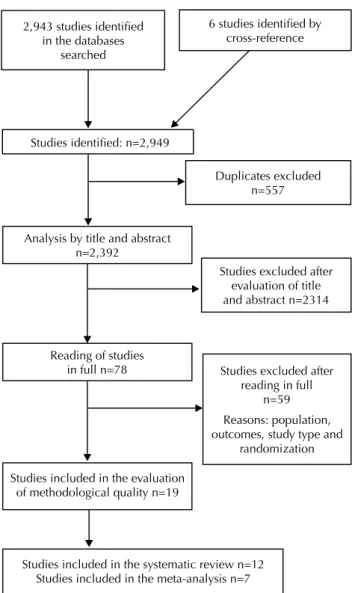
A total of 2,949 studies were found in the selected databases and by means of cross-reference strategy. 557 duplicates were excluded, and 78 studies were completely evaluated. After assessment of the methodological quality, 12 RCT were selected that comprised the inal sample of this SR, as noted in the lowchart in Figure 1.
Figure 1 – Flowchart of inclusion of studies – São Paulo, Brazil, 2015.
2,943 studies identified in the databases
searched
6 studies identified by cross-reference
Studies identified: n=2,949
Duplicates excluded n=557
Analysis by title and abstract n=2,392
Reading of studies in full n=78
Studies excluded after evaluation of title and abstract n=2314
Studies included in the evaluation of methodological quality n=19
Studies excluded after reading in full
n=59
Reasons: population, outcomes, study type and
randomization
characteriSticSofStudieS
All studies were published in English and had a level of evidence II, according to the JBI classiication of quantita-tive studies(20); 50% were carried out in the United States
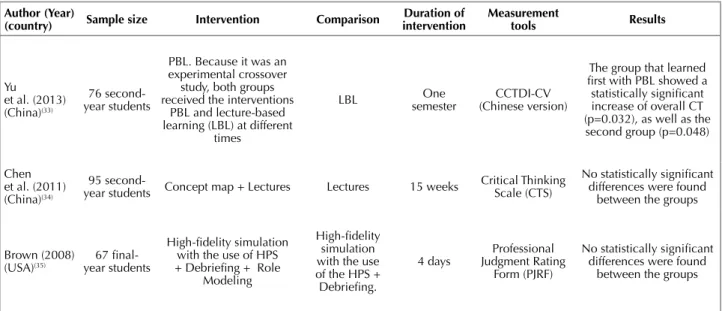
and 33% in China; 75% were published in article format; 83% had grade 7 according to the JBI-MAStARI instru-ment; and, 66% of the studies were developed in the last ive years. he complete characterization of the studies included is described in Chart 1.
Chart 1 – Characterization of the studies included – São Paulo, Brazil, 2015.
author (Year)
(country) sample size intervention comparison
duration of intervention
Measurement
tools results
Tiwari et al. (2006) (China)(27)
79 irst-year
students
Problem-based learning
(PBL) Lectures 2 semesters
California Critical Thinking
Disposition Inventory (CCTDI)
The PBL group had overall CT scores measured by
the CCTDI that were
signiicantly higher
than the lectures group (p=0.005) Ferguson (2012) (USA)(28) 57 irst-year students
Two groups were used:
1 – Traditional lectures + microsimulation + Human
Patient Simulation (HPS)
2 – Traditional lectures + Microsimulation + HPS,
and after one week a new HPS session without the
mentor was performed
Used lectures and
micro-simulation 2 weeks
Watson Glaser Critical Thinking
Appraisal (WGCTA)
There was no statistically
signiicant difference in
overall CT score on the pre-test and post-test examination for all groups
Atay & Karabacak (2011) (Turkey)(15) 80 irst-and second- year students
Concept map in the development of nursing
care plans
Traditional method using column format
1 semester CCTDI
There was no statistically
signiicant difference
between the groups. In the experimental group, the difference on the pre- and
post-test was statistically
signiicant (p=0.000)
Jun et al. (2013) (South Korea)(29)
161 second-year
students
5E learning model combined with PBL
Lectures and discussion groups 5 weeks Critical Thinking Disposition Scale for Nursing
Students
Signiicant increase in
capacity for CT (p=0.005) in the experimental group
Naber & Wyatt (2014) (USA)(30)
70 irst-year
students
Relective writing based
on Richard Paul’s CT Model
There was no intervention, the traditional method already
used in the discipline was
used
8 weeks
California Critical Thinking Skills Test (CCTST) and
CCTDI
No signiicant differences
were observed in CT scores measured by the
CCTDI (p=0.690) and CCTST (p=0.260) Ousley (2012) (USA)(31) 132 second-year students
Two groups were used:
1 – Lecture (4 hours) + Simulation (8 hours) + 32
hours of clinical practice 2 – Lecture (4 hours)
+ Online Case Studies (8 hours) + 32 hours of
clinical practice
Only lectures
(12 hours) +
32 hours of practice.
4 weeks CCTST
All groups showed
signiicant changes on
the pre- and post-test for overall CT (p<0.010)
Wheeler and Collins (2003) (USA)(16) 76 second-year
students Concept maps
Traditional
method 7.5 weeks CCTST
There was no signiicant
statistical difference. In the experimental group
signiicant difference of
overall CT was found between the pre- and post-test (p=0.020)
Yuan et al. (2008) (China)(14)
46 second-year
students PBL Lectures 18 weeks CCTST
There was a statistically
signiicant difference
between the PBL and lecture groups for overall
CT (p=0.040) after intervention
Morey (2012) (USA)(32)
50 students in their last semester
Animated Pedagogical Agents (APA). Using an online tool, students performed three case studies, which they received in writing and that were narrated by APA.
Online case studies
Critical Thinking Process Test
(CTPT)
There was no statistically
signiicant difference
between the overall CT scores in the groups after the intervention (p=0.561)
Effectiveness of teaching strategies on the development of critical thinking in undergraduate nursing students: a meta-analysis ...continuation
author (Year)
(country) sample size intervention comparison
duration of intervention
Measurement
tools results
Yu et al. (2013) (China)(33)
76 second-year students
PBL. Because it was an experimental crossover
study, both groups received the interventions
PBL and lecture-based learning (LBL) at different
times
LBL semesterOne (Chinese version)CCTDI-CV
The group that learned
irst with PBL showed a statistically signiicant
increase of overall CT (p=0.032), as well as the
second group (p=0.048)
Chen et al. (2011) (China)(34)
95
second-year students Concept map + Lectures Lectures 15 weeks
Critical Thinking Scale (CTS)
No statistically signiicant
differences were found between the groups
Brown (2008)
(USA)(35) year students67 inal-
High-idelity simulation
with the use of HPS
+ Debrieing + Role
Modeling
High-idelity
simulation with the use
of the HPS + Debrieing.
4 days
Professional Judgment Rating
Form (PJRF)
No statistically signiicant
differences were found between the groups
he teaching strategies used and tested in the RCTs included: PBL, concept map, simulation, relective writing, Role Modeling and Animated Pedagogical Agents. In the control group, lectures were used in 58.3% of the studies. he “traditional” strategy already used in the discipline ap-peared as a resource used in the control group in 25% of studies. In the remaining 16.7%, the control group’s strategy was the same as that used in the intervention group, except for the model that the researcher wanted to test, which were the APA(32) and Role Modeling(35).
It is notable that in only three studies was the interven-tion proposed based on a conceptual model, such as the 5E Learning Model(29), Richard Paul’s CT Instructional
Model(30) and the theoretical model of Role Modeling(35).
It is also notable that in only three studies(14,28,31) was it
men-tioned that the people who implemented the intervention were trained or had experience with the strategy applied.
biaSriSk
Bias risks were identiied in the studies based on JBI criteria(20) and the Cochrane Collaboration tool (Figure 2)
to assess bias risk in RCTs(36-37).
With regard to selection bias, this was uncertain in 50% of studies, due to the paucity of data regarding generation of the random sequence, and in only four studies did the authors explicitly state that they maintained the randomiza-tion sequence hidden throughout the study period(27-28,31,35).
In regard toperformancebias, in none of the studies was it possible to blind the participants, because educational interventions were being investigated. Regarding blinding of the professionals who applied the intervention, in only one study(29) was this described. Blinding of the researcher
who analyzed the data was reported in only two studies(31,35).
In regard to attrition bias, 33.4% of the studies did not perform analysis by intention to treat, and most had no losses in adherence. In reporting bias, most studies showed a low risk of bias.
Tiwari (2006)
Fergunson (2012)
Atay (2011)
Jun (2013)
Naber (2014)
Ousley (2012)
Wheeler (2003)
Yuan (2008)
Morey (2012)
Yu (2013)
Chen (2011)
Brown (2008) Adequate sequence gener
ation
Allocation concealment Blinding of participants Blinding of outcome assessment Incomplete outcome data addressed Selecti
ve reporting
Others bias
-Low risk High risk Unclear risk
meta-analySiS
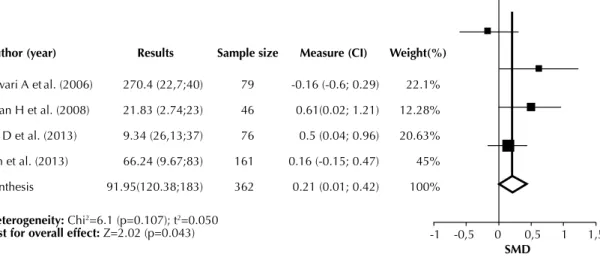
Four RCTs were included using PBL as the intervention and lectures on the control group(14,27,29,33). he combination
of these studies in a meta-analysis, including 362 partici-pants, demonstrated the efectiveness of PBL (SMD=0.32, 95% CI=0.08 to 0.56; Overall Z=2.67, p=0.0078) when compared to lectures for the development of overall CT in undergraduate nursing students (Figure 3), with homo-geneity being demonstrated (Chi-square=6.1, p=0.1068) between the studies.
author (year) results sample size Measure (ci) Weight(%)
Tiwari A etal. (2006) 270.4 (22,7;40) 79 -0.16 (-0.6; 0.29) 22.1%
Yuan H et al. (2008) 21.83 (2.74;23) 46 0.61(0.02; 1.21) 12.28%
Yu D et al. (2013) 9.34 (26,13;37) 76 0.5 (0.04; 0.96) 20.63%
Jun et al. (2013) 66.24 (9.67;83) 161 0.16 (-0.15; 0.47) 45%
Synthesis 91.95(120.38;183) 362 0.21 (0.01; 0.42) 100%
Heterogeneity: Chi2=6.1 (p=0.107); t2=0.050
test for overall effect: Z=2.02 (p=0.043)
sMd
-1 -0,5 0 0,5 1 1,5
hree RCTs were also included that used the concept map as intervention and traditional teaching on the control group(15-16,34). he combination of these studies in one
meta-analysis, including 251 participants, did not demonstrate efectiveness of the concept map (SMD=-0.53, CI 95%
Figure 3 – Meta-analysis of overall CT scores of studies that evaluated the strategy of PBL compared to lectures – São Paulo, SP, Brazil, 2015.
-0.79--0.28; Overall Z=4.07, p<0.0001) when compared to traditional education for development of overall CT in undergraduate nursing students (Figure 4). It is notewor-thy that statistical heterogeneity was identiied between the studies (Chi-square=10.82, p=0.0044).
sMd
-2 -1 0 1 2 author (year) results sample size Measure (ci) Weight (%)
Weeler (2003) 16.93 (4.37;44) 76 -0.14 (-0.6; 0.31) 31.50%
Chen et al. (2011) 41.04 (5.25;48) 95 -0.37 (-0.77; 0.04) 39.78%
Atay S (2011) 225.8 (19.2;40) 80 -1.19 (-1.67; 0.72) 28.72%
Synthesis 94.59 (7.23;132) 251 -0.53 (-0.79; -0.28) 100%
Heterogeneity: Chi2=10.82 (p=0.004); t2=23.243
test for overall effect: Z=4.07 (p<0.001)
DISCUSSION
To the best of the authors’ knowledge, this is the irst SR that sought to identify the most efective teaching strategies for development of CT in undergraduate nursing students. Other SR have been developed on this topic, however they sought to: evaluate one strategy in isolation, such as PBL (17-18) and simulation(19); to identify, in two recent SR, the
rela-tionship between learning styles and CT(38); and, one sought
to explore how CT is perceived by teachers and nursing students through a SR of qualitative studies(9).
From the results of studies that evaluated teaching of PBL and the meta-analysis performed of the RCT that used this teaching strategy, it can be said that PBL
Figure 4 – Meta-analysis of overall CT scores of studies that evaluated the strategy of the concept map compared to traditional teach-ing – São Paulo, SP, Brazil, 2015.
demonstrated efectiveness in increasing overall CT scores. his inding corroborates the results of the other two SR conducted that evaluated PBL(17-18). However, the SR for
the present study advances knowledge with respect to the previous ones, since it included only the RCT; identiied a statistically signiicant increase in CT skills using PBL, and not only abilities, as suggested in one SR that evaluated the efectiveness of PBL in development of CT(17). In
addi-tion, the meta-analysis for the present study demonstrated greater homogeneity between the studies included in rela-tion to this(17).
he concept map is a widely used teaching strategy and discussed in nursing education(39-40) as a promising
Effectiveness of teaching strategies on the development of critical thinking in undergraduate nursing students: a meta-analysis
experimental studies testing its efectiveness. Meta-analysis of the three studies included that used the strategy of concept map compared to the usual teaching method did not dem-onstrate its beneit, although the studies were identiied as heterogeneous, corroborating the indings of another study(41)
which performed an uncontrolled trial with the same goal. In addition to the PBL developed as an isolated teaching strategy, studies have been conducted evaluating the use of PBL associated with concept maps(42-43) and even in
web-based learning environments(44). Both demonstrate the
ben-eit of this association for the development of CT in students. herefore, further studies need to be developed with the combination of diferent teaching strategies, since, although in this SR the strategy of concept map did not demonstrate efectiveness in the development of CT, studies have shown promising results of its association with PBL(42-43).
As regards other teaching strategies used (simulation, Role Modeling, relective writing and APA), none of them proved to be efective to develop CT in undergraduate nurs-ing students. However, isolated studies have been conducted with small samples, and the authors of the present study en-courage future research on these strategies that is supported in theoretical models of teaching and learning.
It is no longer acceptable for a nursing instructor to tell their students to think critically, without irst providing a detailed explanation of the process and its assumptions(45),
since in order to improve CT skills among university stu-dents, CT should be taught in the classroom(46). Explicit
teaching of CT has been studied depth by means of in-structional models, in which the teacher teaches the theo-retical concepts related to the development of CT capacities and skills, in addition to stimulating the development of these skills. Although the only study included in this SR(30)
that used an instructional model for teaching CT did not show a signiicant increase in CT scores, studies have shown the efectiveness of this model in the development of CT abilities and skills in college students(46-47). hus, the authors
of the present study encourage research on the efectiveness of the instructional model combined with other teaching strategies, and highlight the need for a theoretical model of CT that better instructs teachers on instruction of CT for undergraduate nursing students.
Regarding instruments to evaluate CT, although all of those which were used in this SR have proven their validity and reliability according to statistical tests, only two studies used speciic instruments for nursing students(29,32), given
the shortage of scales available in the literature. herefore, there is a pressing need to develop tools to evaluate CT for undergraduate nursing students, and to consider the aspects inherent to the science and profession of nursing.
Another important issue discussed is the inluence of culture in the use of PBL to promote CT(48). In this SR,
of the four studies that tested the use of PBL for the de-velopment of CT, three were developed in China and one in South Korea. his seems to be an important aspect to consider with regard to the external validity of the studies included in this SR, which demonstrated the efectiveness of PBL, since the cultures of Asian countries greatly difer
from those in the West. hus, the authors of the present study encourage the development of further experimental studies in Western countries to assess the most efective strategies for teaching CT. In this sense, we believe that the next steps of the multicenter project of the RIIEE will contribute to these demands, especially in Latin America, because it will enable approximation of diferent cultures in the context of an international network.
For teaching in nursing, the authors believe that this SR enables relection on teaching practice in the training of nurs-es capable of thinking critically. hus, the authors encourage teachers to implement, develop and research new teaching strategies to promote CT in nursing students. he indings of the present study demonstrated the efectiveness of PBL when the JBI guidelines were used as a methodological ref-erence, because JBI is an organization internationally recog-nized for development of SR, since a comprehensive search of the published and unpublished literature was performed, and only studies with the highest level of evidence (RCT) were included, relecting the credibility of the indings.
As a secondary study, the SR is limited to the availability of data from the primary studies included. In this way, the following limitations of this SR were identiied: the diicul-ty in inding adequate information about the diicul-type of study design in the abstracts, as the authors put very diferent nomenclatures to designate experimental studies, particu-larly RCT, which may have produced a risk of search bias in this SR; there are several tools used to evaluate CT, few of which were speciic to nursing, so that the validity and reliability of diferent instruments may have inluenced the measurement of the outcome; inally, the diiculty of con-tacting authors to answer questions that would determine the inclusion of studies in the SR, which led to the exclu-sion of some studies due to lower methodological quality. It should be noted that for this SR, contact was attempted with six authors to obtain further information, though re-sponses were obtained from only two.
As implications for future research, the authors of the present study believe the following to be necessary: clarii-cation of the concept of CT in nursing literature; develop-ment and evaluation of teaching strategies that are based on instructional models of teaching CT; development of studies with larger, high-quality sample sizes, to withstand the efects it proposes to prove, using a pre- and post-test randomized format to control internal and external threats to the validity of the study; researchers who apply the in-tervention must be trained, and a standardized interven-tion needs to be applied, so that nurses need to develop the intervention method according to their actual educational context; and, it is urgent to develop an instrument capable of evaluating the development of CT, which considers the aspects inherent to the science and profession of nursing.
CONCLUSION
resUMO
Objetivo: Avaliar a efetividade das estratégias de ensino utilizadas para o desenvolvimento do pensamento crítico (PC) em estudantes de graduação em Enfermagem. Método: Revisão sistemática com metanálise baseada nas recomendações do Joanna Briggs Institute. A busca foi realizada nas bases de dados PubMed, CINAHL, EMBASE, Web of Science, SCOPUS, LILACS, Cochrane CENTRAL, PsycINFO e ERIC e de banco de teses dos quatro continentes. A seleção e avaliação inicial dos estudos e a avaliação da qualidade metodológica foi realizada por dois revisores de forma independente. Resultados: Incluídos 12 ensaios clínico randomizados. Na metanálise, dos quatro estudos incluídos que avaliaram a estratégia do Problem Based Learning (PBL), comparada a palestras, foi demonstrada a efetividade do PBL, estatisticamente signiicativa (SMD=0,21 e 95% IC=0,01-0,42; p=0,0434) para o desenvolvimento do PC em estudantes de graduação em Enfermagem e os estudos eram homogêneos (Qui-quadrado=6,10, p=0,106). Conclusão:
Foi demonstrada a efetividade do PBL no aumento dos escores de PC global. Novos estudos precisam ser feitos com o objetivo de desenvolver, implementar e avaliar estratégias de ensino, que sejam pautadas em alto rigor metodológico e amparadas em modelos teóricos de ensino-aprendizagem.
descritOres
Pensamento; Estudantes de Enfermagem; Educação em Enfermagem; Ensaio Clínico Controlado Aleatório; Revisão.
resUMen
Objetivo: Evaluar la efectividad de las estrategias de enseñanza utilizadas para el desarrollo del pensamiento crítico (PC) de estudiantes de pregrado de Enfermería. Método: Revisión sistemática con metaanálisis basado en las recomendaciones del Joanna Briggs Institute. La búsqueda fue realizada en las bases de datos PubMed, CINAHL, EMBASE, Web of Science, SCOPUS, LILACS, Cochrane CENTRAL, PsycINFO y ERIC, y de banco de tesis de los cuatro continentes. La selección y evaluación inicial de los estudios y la evaluación de la calidad metodológica las llevó a cabo dos revisores de modo independiente. Resultados: Incluidos 12 ensayos clínicos randomizados. En el metaanálisis, de los cuatro estudios incluidos que evaluaron la estrategia del Problem Based Learning (PBL), comparada con conferencias, fue demostrada la efectividad del PBL, estadísticamente signiicativa (SMD=0,21 y el 95% IC=0,01-0,42; p=0,0434) para el desarrollo del PC en estudiantes de pregrado en Enfermería, y los estudios eran homogéneos (Chi cuadrado=6,10, p=0,106). Conclusión: Fue demostrada la efectividad del PBL en el incremento de los puntajes de PC global. Se necesitan hacer nuevos estudios con el in de desarrollar, implantar y evaluar estrategias de enseñanza que se pauten en un alto rigor metodológico y se amparen en modelos teóricos de enseñanza-aprendizaje.
descriPtOres
Pensamiento; Estudiantes de Enfermería; Educación en Enfermería; Ensayo Clínico Controlado Aleatório; Revisión.
REFERENCES
1. Chang MJ, Chang YJ, Kuo SH, Yang YH, Chou FH. Relationships between critical thinking ability and nursing competence in clinical nurses. J Clin Nurs [Internet]. 2011 [cited 2015 Aug 10];20(21-22):3224-32. Available from: http://onlinelibrary.wiley.com/doi/10.1111/j.1365-2702.2010.03593.x/pdf
2. Pitt V, Powis D, Levett-Jones T, Hunter S. The inluence of critical thinking skills on performance and progression in a pre-registration
nursing program. Nurse Educ Today [Internet]. 2015 [cited 2015 Aug 16];35(1):125-31. Available from: http://dx.doi.org/10.1016/j. nedt.2014.08.006
3. Choi E, Lindquist R, Song Y. Effects of based learning vs. traditional lecture on Korean nursing students critical thinking, problem-solving, and self-directed learning. Nurse Educ Today [Internet]. 2014 [cited 2015 Sept 04];34(1):52-6. Available from: http://www. sciencedirect.com/science/article/pii/S0260691713000695
4. Ozkahraman S, Yildirim B. An overview of critical thinking in nursing and education. Am Int J Contemp Research [Internet]. 2011 [cited 2015 Sept 02];1(2):190-6. Available from: http://www.aijcrnet.com/journals/Vol_1_No_2_September_2011/25.pdf.
5. Borglin, G. Promoting critical thinking and academic writing skills in nurse education. Nurse Educ Today [Internet]. 2012 [cited 2015 Aug 10];32(5):611-13. Available from: http://www.sciencedirect.com/science/article/pii/S0260691711001675
6. Paul SA. Assessment of critical thinking: a Delphi study. Nurse Educ Today [Internet]. 2012 [cited 2015 Aug 09];34(11):1357-60. Available from: http://dx.doi.org/10.1016/j.nedt.2014.03.008 0260-6917
7. Bensley A, Spero RA. Improving critical thinking skills and metacognitive monitoring through direct infusion. Thinking Skills Creativity [Internet]. 2014 [cited 2015 Aug 10];12:55-68. Available from: http://www.sciencedirect.com/science/article/pii/S1871187114000066.
8. Papathanasiou IV, Kleisiaris CF, Fradelos EC, Kakou K, Kourkouta L. Critical thinking: the development of an essential skill for nursing students. Acta Inform Med [Internet]. 2014 [cited 2015 Aug 06];22(4):283-286. Available from: http://www.ncbi.nlm.nih.gov/pmc/articles/ PMC4216424/
9. Chan ZCY. A systematic review of critical thinking in nursing education. Nurse Educ Today [Internet]. 2013 [cited 2015 Aug 10];33(3):236-40. Available from: http://www.sciencedirect.com/science/article/pii/S0260691713000087
writing,Role Modeling and Animated Pedagogical Agents. Furthermore, based on the meta-analysis of the studies in-cluded, the efectiveness of PBL was demonstrated in the increased overall CT scores from homogeneous studies. his result conirmed our hypothesis that the teaching strategies that show better eicacy in RCT are those that involve the use of active methodologies.
Effectiveness of teaching strategies on the development of critical thinking in undergraduate nursing students: a meta-analysis
10. Azizi-Fini I, Hajibagheri A, Adib-Hajbaghery M. Critical thinking skills in nursing students: a comparison between freshmen and senior students. Nurs Midwifery Stud [Internet]. 2015 [cited 2015 Aug 10];4(1):e25721. Available from: http://www.ncbi.nlm.nih.gov/pmc/ articles/PMC4377532/.
11. Huang GC, Newman LR, Schwartzstein RM. Critical thinking in health professions education: summary and Consensus Statments of the Millennium Conference 2011. Teach Learn Med [Internet]. 2014 [cited 2015 Aug 08];26(1):95-102. Available from: http://www. tandfonline.com/doi/pdf/10.1080/10401334.2013.857335
12. Ozturk C, Muslu GK, Dicle A. A comparison of problem-based and traditional education on nursing students’ critical thinking dispositions. Nurse Educ Today [Internet]. 2008 [cited 2015 July 28];28(5):627-32. Available from: http://www.sciencedirect.com/science/article/pii/ S0260691707001529#
13. Lyons EM. Examining the effects of problem-based learning and NCLEX-RN scores on the critical thinking skills of associate degree nursing students in a Southeastern Community College. Int J Nurs Educ Scholarsh [Internet]. 2008 [cited 2015 Jun 24];5(1):1-17. Available from: http://www.degruyter.com/view/j/ijnes.2008.5.issue-1/ijnes.2008.5.1.1524/ijnes.2008.5.1.1524.xml
14. Yuan D, Kunaviktikul W, Klunklin A, Williams BA. Improvement of nursing students’ critical thinking skills through problem-based learning in the People’s Republic of China: a quasi-experimental study. Nurs Health Sci [Internet]. 2008 [cited 2015 Sept 01];10(1):70-6. Available from: http://onlinelibrary.wiley.com/doi/10.1111/j.1442-2018.2007.00373.x/epdf
15. Atay S, Karabacak U. Care plans using concept maps and their effects on the critical thinking dispositions of nursing students. Int J Nurs Pract [Internet]. 2012 [cited 2015 Aug 18];18(3):233-9. Available from: http://onlinelibrary.wiley.com/doi/10.1111/j.1440-172X.2012.02034.x/epdf.
16. Wheeler LA, Collins SKR. The inluence of concept mapping on critical thinking in baccalaureate nursing students. J Prof Nurs [Internet].
2003 [cited 2015 Aug 22];19(6), 339-46. Available from: http://www.sciencedirect.com/science/article/pii/S8755722303001340.
17. Kong LN, Qin B, Zhou YQ, Mou SY, Gao HM. The effectiveness of problem-based learning on development of nursing students’ critical thinking: a systematic review and meta-analysis. Int J Nurs Stud [Internet]. 2014 [cited 2015 Aug 08];51(3):458-69. Available from: http:// www.sciencedirect.com/science/article/pii/S0020748913001910
18. Yuan H, Willians BA, Fan L. A systematic review of selected evidence on developing nursing students critical thinking through problem-based learning. Nurse Educ Today [Internet]. 2008 [cited 2015 Aug 20];28(6):657-63. Available from: http://www.sciencedirect.com/ science/article/pii/S026069170700175X
19. Cant RP, Cooper SJ. Simulation-based learning in nurse education: systematic review. J Adv Nurs [Internet]. 2010 [cited 2015 Sept 02];66(1):3-15. Available from: http://onlinelibrary.wiley.com/doi/10.1111/j.1365-2648.2009.05240.x/epdf
20. Joanna Briggs Institute (JBI). Joanna Briggs Institute Reviewer’s Manual [internet]. Adelaide; 2014 [cited 2014 June 02]. Available from: http://joannabriggs.org/assets/docs/sumari/ReviewersManual-2014.pdf
21. Moher D, Liberati A, Tetzlaff J, Altman DG. Preferred reporting items for systematic reviews and meta-analyses: the PRISMA statment. Plos Med [Internet]. 2009 [cited 2015 Aug 04];6(7):1-6. Available from: http://www.plosmedicine.org/article/fetchObject. action?uri=info:doi/10.1371/journal.pmed.1000097&representation=PDF
22. Oliveira LB, Püschel VAA, Díaz LJR, Cruz DALM. The effectiveness of teaching strategies for the development of critical thinking in
nursing undergraduate students: a systematic review protocol. JBI Database System Rev Implement Rep [Internet]. 2015 [cited 2015 Aug 22];13(2):26-36. http://joannabriggslibrary.org/index.php/jbisrir/article/view/1073/2379
23. Oliveira LB, Püschel VAA, Díaz LJR, Cruz DALM. The effectiveness of teaching strategies for the development of critical thinking in nursing
undergraduate students: a systematic review protocol. PROSPERO 2015: CRD42015019034 Available from: http://www.crd.york.ac.uk/ PROSPERO/display_record.asp?ID=CRD42015019034.
24. Tang L, Sung H. The effectiveness of problem-based learning on nursing students’ critical thinking: a systematic review. JBI Database of System Rev Implement Rep [Internet]. 2012 [cited 2015 Aug 19];10(57):3907-16. Available from: http://www.joannabriggslibrary.org/ index.php/jbisrir/article/view/14/27
25. Carter AG, Creedy DK, Sidebothama M. Evaluation of tools used to measure critical thinking development in nursing and midwifery undergraduate students: a systematic review. Nurse Educ Today [Internet]. 2015 [cited 2015 Aug 26];35:864-74. Available from: http:// www.sciencedirect.com/science/article/pii/S0260691715000994
26. Ried K. Interpreting and understanding meta-analysis graphs: a practical guide. Aust Fam Physician [Internet]. 2006 [cited 2015 Aug 10];35(8):635-8. Available from: http://www.racgp.org.au/afpbackissues/2006/200608/20060805ried.pdf
27. Tiwari A, Lai P, So M, Yuen K. A comparison of the effects of problem-based learning and lecturing on the development of students’ critical thinking. Med Educ [Internet]. 2006 [cited 2015 Aug 26];40(6):547-54. Available from: http://onlinelibrary.wiley.com/doi/10.1111/j.1365-2929.2006.02481.x/epdf
28. Ferguson RA. Critical thinking skills in nursing students: using Human Patient Simulation [thesis]. California: Northern California University; 2012.
29. Jun WH, Lee EJ, Park HJ, Chang AK, Kim MJ. Use of the 5E learning cycle model combined with Problem-Based Learning for a fundamentals of nursing course. J Nurs Educ. 2013;52(12): 681-9.
30. Naber J, Wyatt TH. The effect of relective writing interventions on the critical thinking skills and dispositions of baccalaureate nursing
students. Nurse Educ Today [Internet]. 2014 [cited 2015 Aug 26];34(1),67-72. Available from: http://www.sciencedirect.com/science/ article/pii/S0260691713001251
31. Ousley TL. The Development of Critical Thinking with Technology in Nursing Education [thesis]. Chicago: Northcentral University; 2012.
32. Morey DJ. Development and evaluation of web-based animated pedagogical agents for facilitating critical thinking in nursing. Nurs Educ Perspect. 2012;33(2):116-20.
33. Yu D, Zhang Y, Xu Y, Wu J, Wang C. Improvement in critical thinking dispositions of undergraduate nursing students through problem-based learning: a crossover-experimental study. J Nurs Educ. 2013;52(10):574-81.
35. Brown SC. The impact of high idelity simulation and role modeling in the acquisition of critical thinking skills and self-eficacy: an
experimental study [thesis]. Colorado: University of Northern; School of Nursing, College of Natural and Health Sciences; 2008.
36. Carvalho APVC, Silva V, Grande A. Avaliação do risco de viés de ensaios clínicos randomizados pela ferramenta da colaboração Cochrane.
Rev Diagn Tratamento. 2013;18(1):38-44.
37. Higgins JPT, Green S, editors. Cochrane Handbook for Systematic reviews of interventions. Version 5.1.0, updated March 2011 [Internet]. Geneva: The Cochrane Collaboration; 2011 [cited 2015 Aug 26]. Available from: www.cochrane-handbook.org
38. Andreou C, Papastravou E, Merkouris A. Learning styles and critical thinking relationship in baccalaureate nursing education: a systematic review. Nurse Educ Today [Internet]. 2014 [cited 2015 Aug 16];34(3):362-71. Available from: http://www.sciencedirect.com/science/ article/pii/S0260691713002049
39. Senita J. The use of concept maps to evaluate critical thinking in the clinical setting. Teach Learn Nurs [Internet]. 2008 [cited 2015 Aug 08];3(1):6-10. Available from: http://www.sciencedirect.com/science/article/pii/S1557308707000844
40. Gerdeman JL, Lux K, Jacko J. Using concept mapping to build clinical judgment skills. Nurse Educ Pract [Internet]. 2013 [cited 2015 Aug 10]; 13(1):11-7. Available from: http://www.sciencedirect.com/science/article/pii/S1471595312001047
41. Lee W, Chiang CH, Liao IC, Lee ML, Chen SL, Liang T. The longitudinal effect of concept map teaching on critical thinking of nursing students. Nurse Educ Today [Internet]. 2013 [cited 2015 Aug 10];33(10):1219-23. Available from: http://www.sciencedirect.com/science/ article/pii/S0260691712001992
42. Tseng H, Chou F, Wang H, Ko H, Jian S, Weng W. The effetiveness of problem-based learning and concept mapping among Taiwanese registred nursing studets. Nurs Educ Today [Internet]. 2011 [cited 2015 Aug 22];31(8):41-6. Available from: http://www.sciencedirect.com/ science/article/pii/S0260691710002467
43. Orique SB, McCarthy MA. Critical thinking and the use of nontraditional instructional methodologies. J Nurs Educ .2015;54(8):455-9.
44. Crawford TR. Using problem-based learning in web-based components of nurse education. Nurse Educ Pract [Internet]. 2011 [cited 2015 Aug 22];11(2):124-30. Available from: http://www.sciencedirect.com/science/article/pii/S1471595310001368
45. Lovatt A. Deining critical thoughts. Nurse Educ Today [Internet]. 2014 [cited 2015 Sept 02];34(5):670-2. Available from: http://www.
sciencedirect.com/science/article/pii/S0260691713004255
46. Niu L, Behar-Horenstein LS, Garvan CW. Do instructional interventions inluence college students’ critical thinking skills? A
meta-analysis. Rev Educ Res [Internet]. 2013 [cited 2015 Aug 22];9:114–128. Available from: http://www.sciencedirect.com/science/article/ pii/S1747938X1300002X
47. Abrami PC, Bernard RM, Borokhovski E, Wade A, Surkes MA, Tamim R, et al. Instructional Interventions Affecting Critical Thinking Skills and Dispositions: A Stage 1 Meta-Analysis. Rev Educ Res [Internet]. 2008 [cited 2015 Aug 08];78(4):1102-34. Available from: http://www. physics.emory.edu/faculty/weeks//journal/abrami-rer08.pdf