Revista Brasileira de Geof´ısica (2007) 25(Supl. 2): 159-162 © 2007 Sociedade Brasileira de Geof´ısica
ISSN 0102-261X www.scielo.br/rbg
ANALYSIS OF GEOMAGNETIC STORM VARIATIONS AND COUNT-RATE OF COSMIC RAY
MUONS RECORDED AT THE BRAZILIAN SOUTHERN SPACE OBSERVATORY
Everton Frigo
1, Jairo Francisco Savian
2, Marlos Rockenbach da Silva
3, Alisson Dal Lago
4,
Nalin Babulal Trivedi
5and Nelson Jorge Schuch
6Recebido em 23 janeiro, 2006 / Aceito em 29 setembro, 2006 Received on January 23, 2006 / Accepted on September 29, 2006
ABSTRACT.
An analysis of geomagnetic storm variations and the count rate of cosmic ray muons recorded at the Brazilian Southern Space Observatory – OES/CRS/INPE-MCT, in S˜ao Martinho da Serra, RS during the month of November 2004, is presented in this paper. The geomagnetic measurements are done by a three component low noise fluxgate magnetometer and the count rates of cosmic ray muons are recorded by a Muon Scintilator Telescope – MST, both instruments installed at the Observatory. The fluxgate magnetometer measures variations in the three orthogonal components of Earth magnetic field, H (North-South), D (East-West) and Z (Vertical), with data sampling rate of 0.5 Hz. The Muon Scintilator Telescope records hourly count rates. The arrival of a solar disturbance can be identified by observing the decrease in the muon count rate. The goal of this work is to describe the physical morphology and phenomenology observed during the geomagnetic storm of November 2004, using the H component of the geomagnetic field and vertical channel V of the multi-directional muon detector in South of Brazil.Keywords: geomagnetic storms, geomagnetic variations, cosmic rays, interactions Earth-Sun, space weather.
RESUMO.
Neste trabalho apresentamos uma an´alise das variac¸˜oes geomagn´eticas e contagem de raios c´osmicos (muons) detectados no Observat´orio Espacial do Sul – OES/CRS/INPE – MCT (29.43◦S, 53.80◦W), em S˜ao Martinho da Serra, RS, durante o mˆes de Novembro de 2004. As medidas das variac¸˜oes geomagn´eticass˜ao realizadas atrav´es de um magnetˆometrofluxgatede trˆes componentes e baixo ru´ıdo, e as contagens de muons s˜ao obtidas atrav´es de um detector de muons multi-direcional, ambos instrumentos instalados no Observat´orio. O magnetˆometrofluxgatedetecta variac¸˜oes nas trˆes componentes ortogonais do campo magn´etico Terrestre, H (Norte-Sul), D (Leste-Oeste) e Z (Vertical), com uma taxa de aquisic¸˜ao de 0.5 Hz. O Telesc´opio Cintilador de Muons realiza contagens hor´arias. A chegada de um dist´urbio solar ´e identificada observando-se o decr´escimo na contagem de muons. O objetivo deste trabalho ´e fazer uma descric¸˜ao da morfologia e fenomenologia f´ısica observada durante a tempestade geomagn´etica de Novembro de 2004, usando a componente H do campo geomagn´etico e o canal vertical V do Telesc´opio Cintilador de Muons no Sul do Brasil.
Palavras-chave: tempestades, variac¸˜oes geomagn´eticas, raios c´osmicos, interac¸˜oes Terra-Sol, clima espacial.
1University of S˜ao Paulo, USP, Institute of Astronomy, Geophysics and Atmospheric Sciences, IAG/USP, Department of Geophysics, Rua do Mat˜ao, 1.226, Cidade Universit´aria – 05508-090 S˜ao Paulo, SP, Brazil. Phone: +55 (11) 3091-2789; Fax: +55 (11) 3091-5034 – E-mail: [email protected]
2Space Science Laboratory of Santa Maria, LACESM/CT, UFSM Southern Regional Space Research Center, CRS/INPE, MCT Campus of the Federal University of Santa Maria, UFSM, Center of Technology, LACESM, Cidade Universit´aria, P.O. Box 5021 – 97105-900 Santa Maria, RS, Brazil. Phone: +55 (55) 3220-8021; Fax: +55 (55) 3220-8007 – E-mail: [email protected]
3National Institute for Space Research, INPE/MCT, Division of Space Geophysics, DGE, Av. dos Astronautas, 1.758, P.O. Box 515 – 12245-970 S˜ao Jos´e dos Campos, SP, Brazil. Phone: +55 (12) 3945-6754; Fax: +55 (12) 3945-6810 – E-mail: [email protected]
4National Institute for Space Research, INPE/MCT, Division of Space Geophysics, DGE, Av. dos Astronautas, 1.758, P.O. Box 515 – 12245-970 S˜ao Jos´e dos Campos, SP, Brazil. Phone: +55 (12) 3945-6768; Fax: +55 (12) 3945-6979 – E-mail: [email protected]
5Partnership FATEC/UFSM, FURNAS, INPE, National Institute for Space Research, INPE/MCT, Division of Space Geophysics, DGE, Av. dos Astronautas, 1.758, P.O. Box 515 – 12245-970 S˜ao Jos´e dos Campos, SP, Brazil. Phone: +55 (12) 3945-6807; Fax: +55 (12) 3945-6810 – E-mail: [email protected]
160
ANALYSIS OF GEOMAGNETIC STORM VARIATIONS AND COUNT-RATE OF COSMIC RAY MUONSINTRODUCTION
Areas of instability in the Sun can release high-speed plasma
structures, with great amounts of matter and energy, the
so-called coronal mass ejections – CMEs (Hundhausen et al., 1984;
Hundhausen, 1997) throughout the whole 11-year solar cycle.
Although more frequent during maximum phase, these CMEs are
also present during low activity periods of the solar cycle.
Eventu-ally these solar CMEs reach the Earth (Schwenn et al., 2005),
inte-racting with the earth’ magnetosphere. A portion of the incoming
solar plasma may enter into the magnetosphere via a reconnection
process (Dungey, 1961), causing great disturbances in the Earth’s
magnetic field denominated geomagnetic storms (Gonzalez et al.,
1994), observed by ground magnetic observatories. These
geo-magnetic storms can be classified according to different Dst index
levels: weak: –50 nT
≤
Dst
≤
–30 nT; moderate 100 nT
≤
Dst
≤
–50 nT and intense Dst
<
–100 nT (Gonzalez et al., 1994).
This index is based on hourly measures of the H component of
the geomagnetic field at selected low latitude stations. The
prin-cipal characteristic of a geomagnetic storms is the decrease of the
H component of the geomagnetic field (Kamide et al., 1998). This
decrease is attributed to the increase of the population of particles
trapped in magnetosphere. The solar structures capable of
cau-sing geomagnetic storms move through the solar wind shielding
the passage of galactic cosmic rays, causing decreases in their
count rates on the ground, also known as “Forbush decreases”
(Cane, 1993; Cane et al., 1994, 1996). In this work we
analy-zed the variations observed in the H component of the
geomagne-tic field and the decrease in the high energy cosmic ray muon
count rates during the geomagnetic storm of November 2004,
both observed at the Southern Space Observatory, in S˜ao
Mar-tinho da Serra, RS.
DATA AND METHODOLOGY OF ANALYSIS
The Brazilian Southern Space Observatory is located in the
proxi-mities of the center of South Atlantic Magnetic Anomaly – SAMA,
that is, the area where the smallest intensity of the Earth’s magnetic
field is observed in the surface of the Earth (Trivedi et al., 2005).
A low noise fluxgate magnetometer was used to measure the
three orthogonal components of the geomagnetic field and the
data were recorded at a sampling rate of 2 seconds (0.5 Hz).
We used the data of the variations observed in the H component
during the period from 5 to 15 November, 2004, in order to
iden-tify the geomagnetic storm. The Muon Scintilator Telescope
loca-ted at the Observatory, in South of Brazil, is able to observe high
energy cosmic rays (muons) in several directions (Da Silva et al.,
2004), and it is part of the International Muon Detector Network,
with other ones at Nagoya (Japan) and Hobart (Australia). It
re-cords hourly count rates of the muon precipitation on the surface
of the Earth. As described previously, a relationship exists among
the solar disturbances, the variations in the geomagnetic field and
the decrease in the muons count rate.
RESULTS
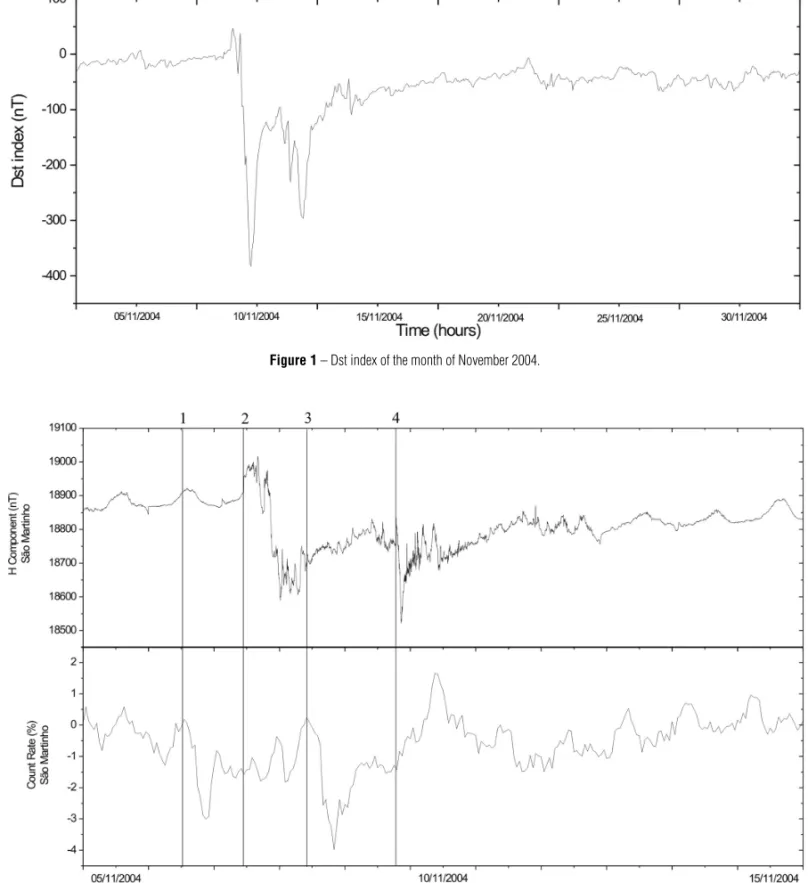
The Dst index is presented in Figure 1, obtained from Kyoto
Uni-versity (Japan), for November 2004. On November 8th, 2004, a
decrease is observed in the Dst index, reaching a negative peak
of –373 nT, indicating the occurrence of an intense
geomagne-tic storm. On November 10th, 2004 another decrease is
obser-ved, reaching –289 nT, indicating the occurrence of a second
ge-omagnetic storm. Figure 2, shows the variations observed in the
H component of the geomagnetic field for the period of 5-15
No-vember 2004, detected by the fluxgate magnetometer. Figure 2
also shows the counts for the same period, detected by the
mu-onscintilator telescope at the Southern Space Observatory. The
vertical line 1 of Figure 2 indicates an accentuated decrease of
approximately 3,5% in the muon count rate, indicating that a
Co-ronal Mass Ejection (CME) was driven towards the Earth, reaching
the earth’s magnetosphere. Line 2 display a sudden increase in the
intensity of the H component and a subsequent decrease,
indica-ting that a solar structure impact the Earth magnetosphere. Line 3
displays a second decrease in the muon count rate, of
approxima-tely 4%, indicating that another solar structure reached the Earth.
Line 4 shows a sudden increase in the intensity of the H
compo-nent, and subsequent decrease, indicating that the second solar
structure impact the Earth’s magnetosphere.
CONCLUSIONS
Based on these results, it is observed that the Muon
Scintila-tor Telescope Network may detect the passage of solar structures
(CMEs) by the Earth’s magnetosphere. It is of high importance for
Space Weather to detect the arrival of shocks and storms, from
detailed studies of these structures. In the near future, cosmic
ray data will be used to detect the arrival of CMEs before they
re-ach the earth, using data from the whole high energy cosmic ray
network. It is essential to detect them with a large antecedence,
in order to avoid eventual damages, such as: intensification of
electric currents in space and at the Earth surface, occurrence
of polar auroras, acceleration of charged particles, and several
damages in satellites, damages in the Global Positioning
Sys-tem (GPS), in telecommunications and even to the astronauts that
are in spaceships.
E. FRIGO, J.F. SAVIAN, M.R. DA SILVA, A. DAL LAGO, N.B. TRIVEDI and N.J. SCHUCH
161
Figure 1– Dst index of the month of November 2004.
Figure 2– Variations in H Component of Earth’s Magnetic Field and Count Rate of the Muon Scintilator Telescope for the period of 5-15 November 2004.
ACKNOWLEDGEMENTS
Thanks to World Data Center for Geomagnetism, Kyoto
Univer-sity, for the Dst index, and to the International Solar-Terrestrial
Physics Project. We thank the group of research workers at the
Space Weather Laboratory, to Shinshu University for technical
support and to the CNPq for the financial support: PIBIC/Process
104441/2004-6 and 107615/2003-7, and partial support from
162
ANALYSIS OF GEOMAGNETIC STORM VARIATIONS AND COUNT-RATE OF COSMIC RAY MUONSproject 472396/04-8 and also to Fundac¸˜ao de Amparo `a Pesquisa
do Estado de S˜ao Paulo – FAPESP for the financial support by
the project 05/54800-1.
REFERENCES
CANE HV. 1993. Cosmic ray decreases and magnetic clouds. J. Geophys.
Res., 98: 3509–3512.
CANE HV, RICHARDSON IG & von ROSENVINGE TT. 1996. Cosmic ray
decreases: 1964-1994. J. Geophys. Res., 101(A10): 21561-21572.
CANE HV, RICHARDSON IG, von ROSENVINGE TT & WIBBERENZ G.
1994. Cosmic Ray Decreases and Shock Structure: A Multispacecraft
Study. J. Geophys. Res., 99: 21429–21441.
DA SILVA MR, CONTREIRA DB, MONTEIRO S, TRIVEDI NB, MUNAKATA
K, KUWABARA T & SCHUCH NJ. 2004. Cosmic ray muon observation
at southern space observatory – SSO (29
◦S, 53
◦W). Astrophysics and
Space Science, 290: 389–397.
DUNGEY JW. 1961. Interplanetary magnetic field and the auroral zones.
Phys. Rev. Lett., 6(2): 47–48, January.
GONZALEZ WD, JOSELYN JA, KAMIDE Y, KROEHL HW, ROSTOKER G,
TSURUTANI BT & VASYLIUNAS VM. 1994. What is a magnetic storm?
J. Geophys. Res., 99(A4): 5771–5792, April.
HUNDUHAUSEN AJ. 1997. An Introduction. In: CROOKER N, JOSELYN
JA & FEYNMAN J. (Ed.). Coronal mass ejections, Washington, DC: AGU,
99: 1–7.
HUNDHAUSEN AJ, SAWYER CB, HOUSE LL, ILLING RME & WAGNER
WJ. 1984. Coronal mass ejections observed during the solar maximum
mission – latitude distribution and rate of occurrence. J. Geophys. Res.,
89(A5): 2639–2646.
KAMIDE Y, YOKOYAMA N, GONZALEZ WD, TSURUTANI BT, DAGLIS IA,
BREKKE A & MASUDA S. 1998. Two-Step development of geomagnetic
storms. J. Geophys. Res., 103(A4): 6917–6921, April.
SCHWENN R, DAL LAGO A, HUTTUNEN E, GONZALEZ WD. 2005. The
association of coronal mass ejection with their effects near the Earth. Ann.
Geophys., 23: 1033–1059.
TRIVEDI NB, PATHAN BM, SCHUCH NJ, BARRETO LM & DUTRA SLG.
2005. Geomagnetic Phenomena in the South Atlantic Anomaly Region in
Brazil. Advances in Space Research, England, 36: 2021–2024.
NOTES ABOUT THE AUTHORS
Everton Frigois Undergraduate in Physics (2005) at the Federal University of Santa Maria – UFSM, Santa Maria, Brazil. He developed during three years (2003-2005) activities of Undergraduate Research, studying the relationships between geomagnetic variations observed at the Earth’s surface and the Earth-Sun interaction, at the Laboratory of Solar Physics, Interplanetary Medium and Magnetospheres at the Southern Regional Space Research Center of the National Institute for Space Research – CRS/INPE – MCT, in Santa Maria. Currently, he is M.Sc. Student in Geophysics at the Institute of Astronomy, Geophysics and Atmospheric Sciences – IAG in the University of S˜ao Paulo – USP, S˜ao Paulo, Brazil.
Jairo Francisco Savianis a Physics Undergraduate student, attending the ninth semester, at the Federal University of Santa Maria – UFSM, trainee at the National Institute for Space Research – INPE. Currently he is developing his fourth year of science initiation research at the Southern Regional Space Research Center, Space Weather Laboratory – SWL/CRS/INPE – MCT, in Santa Maria. He is working with the data analysis of the Multidirectional Muon Detector Telescope on the Project “Analysis of the solar and interplanetary origins of intense geomagnetic storms”, in cooperation with the Space Science Laboratory of Santa Maria – LACESM/CT – UFSM.
Marlos Rockenbach da Silvais Undergraduate in Physics at the Federal University of Santa Maria – UFSM in 2003. He got his M.Sc. Degree on Space Geophysics in 2005 at the National Institute for Space Research, S˜ao Jos´e dos Campos, Brazil. Currently he is Ph.D. student at the National Institute for Space Research, in S˜ao Jos´e dos Campos.
Alisson Dal Lagois Undergraduate in Physics (1996) at the Federal University of Santa Maria – UFSM, Brazil, Master (1999) and Ph.D. (2003) in Space Geophysics at the National Institute for Space Research – INPE, Brazil, currently research scientist (since 09/2004) of the Space Geophysics Division – DGE, Atmospheric and Space Sciences – CEA of INPE, where he works with topics related to Space Weather, study and forecasting, using ground and space observations.
Nalin Babulal Trivediis Undergraduate in Physics (1960), M.Sc. (1962), and Ph.D. (1969), at the University of Gujarat in Ahmedabad, India. He is researcher (since 1970) in the area of geomagnetism at the Space Geophysics Division – DGE, Atmospheric and Space Sciences – CEA, in the National Institute for Space Research – INPE, Brazil.
Nelson Jorge Schuchis Undergraduate in Physics at the Federal University of Santa Maria – UFSM, in 1972. M.Sc. (Physics) – Extra Galactic Astrophysics, University of Mackenzie, Brazil, in 1975. Ph.D. (Astrophysics) – University of Cambridge, England, in 1979. Post Doctoral Experience at Cambridge University, in 1979/1980. From 1980 to 1995, he worked as Vice-Director of the National Observatory – ON/MCT, Brazil. He is the Head of the Southern Regional Space Research Center, CRS/INPE/MCT. His research fields are the Astrophysics, with emphasis in Radioastronomy/Observational Cosmology, and also the Space and Atmospheric Sciences, with emphasis in the Earth-Sun Interactions, Space Weather, Aeronomy, Space Geophysics.