ORIGINAL
RES
EAR
ABSTRACT | The purpose of this study was to verify the efect of nutritional status and physical activity on the posture of children and adolescents. Sixty individuals from both genders aged between 5 years and 14 years were evaluated. The posture was assessed by photogramme-try. The physical activity level was determined through the Physical Activity Questionnaire for Children (PAQ-C). The nutritional status classification was made using the body mass index for age and gender. The results showed that the physical activity variable had an efect on the shoulder and body asymmetry angles (p<0.05). The active group presented greater asymmetry in the shoulder and body asymmetry angles compared to the sedentary group (p<0.05). The nutritional status did not afect any postural angle (p>0.05). There was no interactive efect between the evaluated variables on the postural angles (p>0.05). The development of preventive and interventionist actions, such as controlled physical activity and nutritio-nal monitoring, is important for the postural alignment of school children and school adolescents.
Keywords | body mass index; motor activity; posture.
RESUMO | O objetivo do estudo foi verificar o efeito do per-fil nutricional e da atividade física na postura de crianças e adolescentes. Foram avaliados 60 indivíduos de ambos os sexos, com idade entre 5 e 14 anos. A postura foi
ava-on the posture of children and adolescents
Inluência do peril nutricional e da atividade física
na postura de crianças e adolescentes
Inluencia del peril nutricional y actividad física
en la postura de niños y adolescentes
Jerusa Jordão Coelho1, Maylli Daiani Graciosa1, Daiane Lazzeri De Medeiros2,
Letícia Miranda Resende Da Costa2, Micheli Martinello3, Lilian Gerdi Kittel Ries4
Study conducted at the Universidade do Estado de Santa Catarina (UDESC), Laboratory of Postural Development and Control (LADESCOP) – Florianópolis (SC), Brazil.
1Physical Therapy student at the UDESC – Florianópolis (SC), Brazil.
2Master’s degree student in the Physical Therapy Postgraduation Program at the UDESC – Florianópolis (SC), Brazil. 3Master’s degree in Human Movement Sciences at the UDESC – Florianópolis (SC), Brazil.
4Professor of the Physical Therapy Postgraduation Program at the UDESC – Florianópolis (SC), Brazil.
Correspondence to: Jerusa Jordão Coelho – CEFID – Rua Pascoal Simone, 358 – CEP: 88080-350 – Florianópolis (SC), Brazil – E-mail: [email protected] Presentation: Sep. 2012 – Accepted for publication: apr. 2013 – Financing source: none – Conflict of interest: nothing to declare – Approval at the Ethics Committee n. 165/2011.
liada por meio da fotogrametria. Para determinar o nível de atividade física foi utilizado o Questionário de Atividade Física para Crianças (PAQ-C). A classificação do perfil nutri-cional foi realizada por meio do Índice de Massa Corporal por idade e com relação ao sexo. Os resultados mostra-ram que a atividade física exerceu efeito sobre os ângul-os assimetria do ombro (AO) e assimetria corporal (ACO) (p<0,05). O grupo ativo apresentou maior assimetria nos ângulos de AO e ACO comparado ao grupo sedentário (p<0,05). O perfil nutricional não influenciou nenhum âng-ulo postural (p>0,05). Também não houve efeito interativo entre os parâmetros avaliados sobre os ângulos posturais (p>0,05). É importante o desenvolvimento de ações pre-ventivas e intervencionistas, como atividade física con-trolada e acompanhamento nutricional, no alinhamento postural de crianças e adolescentes em idade escolar.
Descritores | postura; atividade motora; índice de massa corporal.
INTRODUCTION
A good posture is a state of skeletal and muscular balance that is capable of protecting the body structures against injuries or deformities1,2. In childhood, the bal-ance between these structures is subject to modiications due to daily life habits3. he period of body growth and development that happen in childhood and adolescence are extremely important because many postural prob-lems originate in these stages of life4,5.
One of the possible factors associated with postural changes in children and adolescents is excess of body weight6. In the last few decades, indices of childhood overweight and obesity have grown rapidly and in a concerning manner7. he increase of these indices is associated with unhealthy eating habits and not a very active lifestyle8-10, in which activities like playing vid-eogames and watching television are predominant11,12. Incorrect habits in this period help acquire inappro-priate postures that may result in serious damage13 and may interfere in the recent and future health of these individuals14. hus, it is important to identify inappro-priate habits and postures adopted by these children and adolescents for prevention, pain decrease, and to provide an incentive to maintain a healthy posture2.
It is known that obesity overloads mechanical structures, especially the joints, due to the wearing sufered by the body for a long period6. Obesity predis-poses an individual to the alteration of the valgus knee for the realignment of the extremity due to fat accumu-lation in the medial region of the knees, which causes a knee hyperextension because of the internal rota-tion of the femur15. Furthermore, it is associated with head protraction1 and instabilities of feet joints16. hese changes can cause compensations in other areas of the body16 and result in pain, lack of mobility, and body biomechanical ineicacy15.
A good posture in childhood and adolescence has great importance, given that the incorrect alignment of the body segments is a risk factor for injuries in sports practice17. Some studies have reported the existence of an association of excess body weight with postural
del perfil nutricional fue realizada por medio del Índice de Masa Corporal por edad y con relación al sexo. Los resultados mostra-ron que la actividad física ejerce un efecto sobre los ángulos de asimetría del hombro (AH) y asimetría corporal (ACO) (p<0,05). El grupo activo presentó mayor asimetría en los ángulos AH y ACO comparado al grupo sedentario (p<0,05). El perfil nutricio-nal no influenció ningún ángulo postural (p<0,05). También no
hubo efecto interactivo entre los parámetros evaluados sobre los ángulos posturales (p<0,05). Es importante el desenvolvimiento de acciones preventivas e intervenciones, como la actividad físi-ca controlada y acompañamiento nutricional, en el alineamiento postural de niños y adolescentes en edad escolar.
Palabras clave | postura; actividad motora; índice de masa
corporal.
change. However, in the researched literature, there was no study verifying the association of nutritional status with physical activity and posture at the same time.
In addition, the majority of researches are limited to the evaluation of the lower limb alignment through angles that indicate rotations, valgus and varus deformi-ties, and pelvis positioning16,18,19. Body alignment anal-ysis may provide subside in order that postural changes will work globally in the clinical practice.
hus, it is relevant to understand the possible factors that may cause postural deviations in children and adolescents, in order that interventions directed towards their prevention and treatment may be prepared. It is believed that a sedentary lifestyle and obesity may inluence postural alignment. herefore, the objective of this study was to verify if nutritional status and physical activity have an efect on the posture of children and adolescents.
METHODOLOGY
A transversal study was intentionally carried out with 60 children and adolescents of both genders in the munic-ipality of Florianópolis, Santa Catarina, Brazil. Subjects presented a mean age of 10±2 years (44 children aged 5 to 11 years and 16 adolescents aged 12 to 14 years), mean height of 1.44±0.15 m, and a mean body mass index (BMI) of 40.20±13.44 kg. Twenty-ive (41.67%) subjects were male. he inclusion criteria included school children and adolescents aged 5 to 14 years, with diferent nutritional statuses. he exclusion criteria included systemic or neurological diseases, physi-cal therapy and/or orthopedic treatment, pathologies associated with posture, and injuries or musculoskeletal deformities that were evident in the inspection.
his study was approved by the Research and Eth-ics Committee of Universidade do Estado de Santa Catarina, under approval number 165/2011.
status in the anamnesis. From the BMI per age and gender, subjects were classiied into the following groups: low weight, eutrophic, overweight, and obese20. Additionally, the participants were divided into obese (obese and overweight), and non-obese (low weight and eutrophic) groups.
he Physical Activity Questionnaire for Children (PAQ-C)21 was used to investigate the level of phys-ical activity in children and adolescents and was per-formed in the seven days before the questionnaire had been answered. Each question was scored from one to ive, (1) meaning very sedentary and (5) meaning very active, and the inal score was achieved by calculating the mean of the questions22. From the classiication, subjects were divided into two groups: active (score higher than or equal to three) or sedentary (score lower than three)22.
A SANYO digital camera (model VPC-HD 2000) was used for the photogrammetry, positioned parallel to the loor, leveled at a 0.85 cm height and at a 3 m distance from the assessed participant. All recordings
were executed by the same photographer in the frontal and sagittal planes; they were analyzed by two trained evaluators for further reliability analysis.
Participants were wearing bathing clothes, and they remained in the orthostatic position with their arms comfortably positioned along the body and feet on a 30×40 cm sheet. Later, the outline of the feet was marked with a pen, which was used as a pattern for the next photos. he positioning place was marked with a masking tape at a standard distance of 3 m from the camera and the subject.
For the calibration, a vertically positioned plumb line was used as reference, in which there were two relexive markers with a 100 cm distance between both. he postural analysis was done by the Postural Analysis Software (SAPO)23,24.
In order to mark the anatomical points, spherical markers of 1 cm ixed bilaterally were used as a ref-erence for tracing the angles, positioned by only one investigator. he marked points were as follows: spinous process of the 7th cervical vertebrae (C7),
Figure 1. Analysis of the asymmetry of the anatomical marks in the fron tal plane
Body asymmetry Head asymmetry
Shoulder asymmetry
Pelvis asymmetry
Malleolus asymmetry Knee asymmetry
Figure 2. Analysis of the asymmetry of the anatomical marks in the sagittal plane
Forward shift of the head Protrusion of shoulders
glabella, tragus, acromion, iliac spine, anterosuperior, lateral epicondyle of the femur, and lateral mallelus.
he angles analyzed in the frontal plane were as follows: head, shoulder, pelvis, knee, and malleolus asymmetries. hey were determined by the intersec-tion of the straight traces joining the anatomical point marked in the right of its correspondent to the left and by the straight line traced in the horizontal position, parallel to the floor and perpendicular to the plumb line. Besides these two, body asymmetry (BA) was analyzed, which was measured through the free angle formed by the line that passes the glabella marker and mean point between the malleoli with a parallel trace to the plumb line that passes the mean point between the malleoli3. Figure 1 shows an analysis of the asymmetry of the anatomical marks in the frontal plane.
In the sagittal plane, the following aspects were an-alyzed: forward shift of the head (free angle formed by the trace through the tragus marker up to the C7 marker and by a perpendicular trace to the plumb line that passes in the C7 marker); shoulder protrusion (free angle formed by the line that passes the C7 marker up to the acromion marker and a perpendicular trace to the plumb line that passes the acromion marker); and anteroposterior position of the body (free angle formed by the line that passes the tragus markers up to the external malleolus and a parallel trace to the plumb line that passes the external malleolus)3. Figure 2 shows an analysis of the asymmetry of the anatomical marks in the sagittal plane.
STATISTICAL ANALYSIS
All measures were applied by two investigators and the mean of the measures obtained from both investigators were inally used in the analysis. he inter-evaluator reliability was assessed through the intraclass correlation coeicient (ICC – two-way random).
Descriptive data have been reported with 95% conidence intervals for the means (CIM 95%). he one-way analysis of variance (ANOVA) was used to ind the joined inluence of the nutritional s ta-tus ( non-obese/obese) and physical activity (active/ sedentary) variables in measures of every postural angle. Normality of the residues and homoscedastic-ity were veriied applying the Kolmogorov-Smirn-ov and Levene tests, respectively. Diferences in the mean postural angles between the groups with non-obese and non-obese nutritional statuses and between the sedentary and active groups were analyzed with the Student’s t-test for independent samples.
he program used was the Statistical Package for the Social Sciences (SPSS), version 17.0 for Windows, and all procedures adopted a 5% signiicance level (0.05), with a bicaudal distribution.
RESULTS
With regard to nutritional status, out of the 60 evaluated subjects, 41.67% (n=25) were obese. With regard to the level of physical activity, 50% (n=30) were sedentary.
he most practiced physical activities were volleyball and soccer, practiced at least twice a week.
High inter-evaluator reliability was obtained in all measures of the postural angles (all ICC>0.97; p<0.00), considering the arithmetic mean between them.
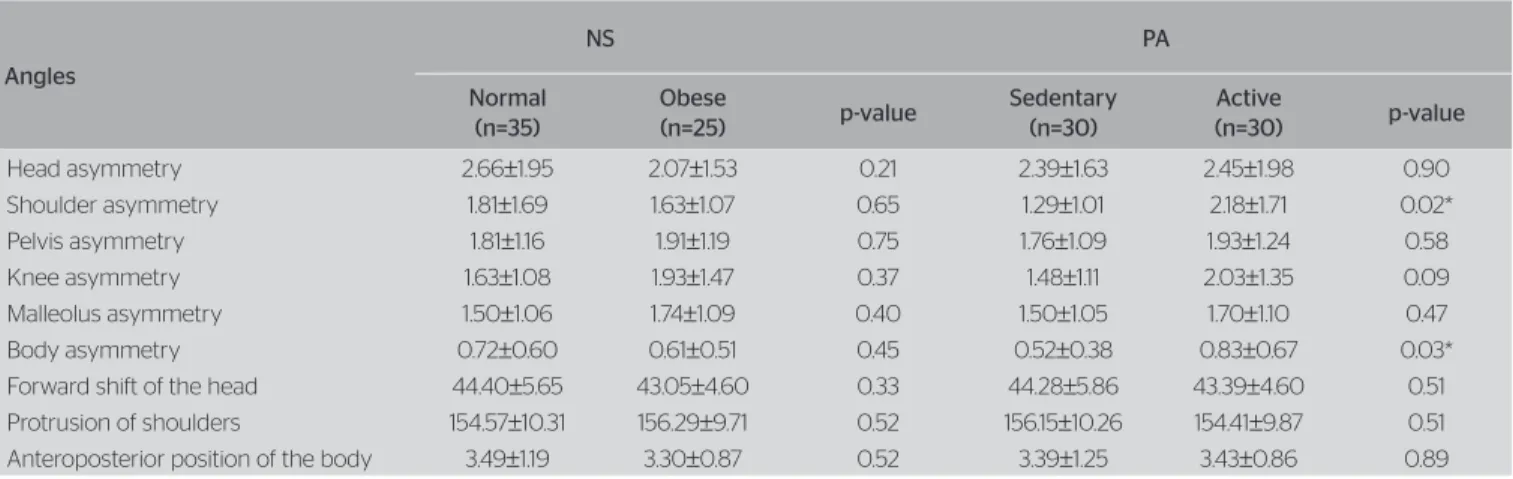
Table 1 shows the results of the ANOVA analyses. In the one-way analysis, the physical activity (PA) vari-able had an efect on the shoulder asymmetries (SA) and BA (p<0.05).
he active group presented higher asymmetry in the SA and BA angles compared to the sedentary group (p<0.05), as seen in Table 2. he nutritional status did not inluence any postural angle (p>0.05). here was also no interactive efect between the variables on pos-tural angles (p>0.05).
DISCUSSION
he evaluation of body segment alignment and posture alterations through photogrammetry has been a more reliable method to gather data when compared to visual observation, and it can quantify the morphological vari-ables associated with posture24,25.
Some authors report that obesity18,19 and sedentary lifestyle26 may have a negative inluence on posture. Results of the present study did not conirm the initial thesis. he existence of the nutritional status inluence on postural alignment was not seen in this study, and physical activity had an isolated efect on the increase of SA and BA.
right and left sides. Other investigations associated with posture and obesity in the upper limbs should be devel-oped in order to investigate possible alterations, given that the majority of studies found were focused on the lower limbs.
he postural alterations are not exclusive to obese subjects although they have been seen more frequently in these subjects because of increased mechanical needs and actions performed with excess of body mass27.
Although there are very few speciic studies with regard to obesity in the musculoskeletal system, a rea-son for the lack of inluence on the nutritional status may be the chronological age of the sample. Since the evaluations were performed during the growth period, it can be suspected that the excess of weight could not have resulted in biomechanical wearing or overloads that altered the assessed parameters. However, such variables were not evaluated herein, so this suspicion cannot be conirmed. Further researches should try to understand the formation process of this wearing, as well as the minimum period needed for their
appear-Table 1. Values of confidence intervals of means 95%CIM and one-way analysis of variance (ANOVA) for the postural angles
Angles 95%CIM
p-value
NS PA Interaction
(NS×PA)
Head asymmetry 1.951–2.881 0.208 0,711 0.23 Shoulder asymmetry 1.357–2.112 0.591 0.029* 0.29 Pelvis asymmetry 1.548–2.148 0.749 0.768 0.14 Knee asymmetry 1.433–2.081 0.397 0.081 0.51 Malleolus asymmetry 1.321–1.874 0.417 0.586 0.43 Body asymmetry 0.526–0.817 0.400 0.044* 0.48 Forward shift of the head 42.480–45.188 0.336 0.670 0.26 Protrusion of shoulders 152.695–57.870 0.508 0.511 0.95 Anteroposterior position of the body 3.135–3.685 0.526 0.928 0.67
NS: nutritional status; PA: physical activity; *Statistically significant
Table 2. Comparison between the means of scores obtained in the evaluation of postural angles according to the studied parameters
Angles
NS PA
Normal (n=35)
Obese
(n=25) p-value
Sedentary (n=30)
Active
(n=30) p-value
Head asymmetry 2.66±1.95 2.07±1.53 0.21 2.39±1.63 2.45±1.98 0.90 Shoulder asymmetry 1.81±1.69 1.63±1.07 0.65 1.29±1.01 2.18±1.71 0.02* Pelvis asymmetry 1.81±1.16 1.91±1.19 0.75 1.76±1.09 1.93±1.24 0.58 Knee asymmetry 1.63±1.08 1.93±1.47 0.37 1.48±1.11 2.03±1.35 0.09 Malleolus asymmetry 1.50±1.06 1.74±1.09 0.40 1.50±1.05 1.70±1.10 0.47 Body asymmetry 0.72±0.60 0.61±0.51 0.45 0.52±0.38 0.83±0.67 0.03* Forward shift of the head 44.40±5.65 43.05±4.60 0.33 44.28±5.86 43.39±4.60 0.51 Protrusion of shoulders 154.57±10.31 156.29±9.71 0.52 156.15±10.26 154.41±9.87 0.51 Anteroposterior position of the body 3.49±1.19 3.30±0.87 0.52 3.39±1.25 3.43±0.86 0.89
NS: nutritional status; PA: physical activity; *Statistically significant
ance due to excess of weight. he extended age range was presented as a limitation; therefore, investigations with a bigger sample and stratiication in subgroups are necessary.
With regard to the efect of physical activity on pos-tural alignment, active individuals were more asymmet-ric in all analyzed parameters, but with a statistic sig-niicance only on the level of the shoulders and on the general analysis of the body in the frontal plane. his result was not expected since the prediction of the study was that a sedentary lifestyle might have inluenced the acquisition of postural changes. However, it is possible that such a result was observed due to a practiced phys-ical activity, given that volleyball was the most frequent physical activity practiced by the subjects in this study.
con-5. Nissinen MJ, Heliövaara MM, Seitsamo JT, Könönen MH, Hurmerinta KA, Poussa MS. Development of trunk asymmetry in a cohort of chil-dren aged 11 to 22 years. Spine. 2000;25(5):570-4.
6. Lemos LFC, David AC, Teixeira CS, Mota CB. Obesidade infantil e suas relações com o equilíbrio corporal. Acta Fisiatr. 2009;16(3):138-41. 7. Pinto MCM, Oliveira AC. Occurrence of child obesity in preschool
chil-dren in a São Paulo day-care center. Einstein. 2009;7(2 Pt 1):170-5. 8. Silva LR, Rodacki ALF, Brandalize M, Lopes MFA, Bento PCB, Leite N.
Alterações posturais em crianças e adolescentes obesos e não-obes-os. Rev Bras Cineantropom Desemp Hum. 2011;13(6):448-54.
9. Nunes MMA, Figueiroa JN, Alves JGB. Excesso de peso, atividade física e hábitos alimentares entre adolescentes de diferentes clas-ses econômicas em Campina Grande (PB). Rev Assoc Med Bras. 2007;53(2):130-4.
10. Reilly JJ. Physical activity, sedentary behaviour and energy balance in the preschool child: opportunities for early obesity prevention. Proc Nutr Soc. 2008;67(3):317-25.
11. Cardon G, Van Cauwenberghe E, De Bourdeaudhuij I. What do we know about physical activity in infants and toddlers: A review of the literature and future research directions. Sci & Sports. 2011;26(3):127-30. 12. Lazzoli JK, Nóbrega ACL, Carvalho T, Oliveira MAB, Teixeira JAC, Lei-tão MB, et al. Atividade física e saúde na infância e adolescência. Rev Bras Med Esporte. 1998;4(4):107-9.
13. Zapater AR, Silveira DM, Vitta A, Padovani CR, Silva JCP. Postura senta-da: a eficácia de um programa de educação para escolares. Ciênc & Saúde Col. 2004;9(1):191-9.
14. Mello ED, Luft VC, Meyer F. Obesidade infantil: como podemos ser eficazes? J Pediatr. 2004;80(3):173-82.
15. Wearing SC, Hennig EM, Byrne NM, Steele JR, Hills AP. The impact of childhood obesity on musculoskeletal form. Obes Rev. 2006;7(2): 209-18.
16. Martinelli AR, Purga MO, Mantovani AM, Camargo MR, Rosell AA, Fregonesi CEPT, et al. Análise do alinhamento dos membros inferio-res em crianças com excesso de peso. Rev Bras Cineant Des Hum. 2011;13(2):124-30.
17. Calvete SA. A relação entre alteração postural e lesões esportivas em crianças e adolescentes obesos. Motriz. 2004;10(2):67-72.
18. Taylor ED, Theim KR, Mirch MC, Ghorbani S, Tanofsky-Kraf M, Ad-ler-Wailes DC, et al. Orthopedic complications of overweight in chil-dren and adolescents. Pediatrics. 2006;117(6):2167-74.
19. Pinto ALS, Holanda PMB, Radu AS, Villares SM, Lima FR. Mu-sculoskeletal findings in obese children. J Paediatr Child Health. 2006;42(6):341-4.
20. Center for Disease Control and Prevention – National Center for Chronic Disease Prevention and Health Promotion (EUA). Nutrition and Physical Activity. Body mass index-for-age (children). Atlanta: CDC. [cited on: 8 May 2012]. Available at: http://www.cdc.gov/healthyweight/ assessing/bmi/childrens_bmi/tool_for_schools.html
21. Kowalski KC, Crocker PRE, Faulkner RA. Validation of the Physi-cal Activity Questionnaire for older children. Pediatr Exerc Sci. 1997;9(2):174-86.
22. Silva RCR, Malina RM. Nível de atividade física em adolescentes do Município de Niterói, Rio de Janeiro, Brasil. Cad Saúde Pública. 2000;16(4):1091-7.
23. Ferreira EAG. Postura e controle postural: desenvolvimento e aplicação de método quantitativo de avaliação postural. [disser-tation] São Paulo: Faculdade de Medicina da Universidade de São Paulo; 2006.
24. Ferreira EAG, Duarte M, Maldonado EP, Burke TN, Marques AP. Postu-ral assessment software (PAS/SAPO): validation and reliability. Clinics. 2010;65(7):675-81.
irm this hypothesis since physical activity associated with posture has not been much investigated yet.
Olympic gymnastic athletes presented a tendency to decrease postural alterations, such as valgus knee, trunk rotation, and hip medial rotation when compared to a group of non-athletes29. However, an increase in the pelvic anteversion was noticed. Such results are contradictory and make it diicult to compre-hend the efects of sports practice on posture, there-fore, they do not show if this activity acts positively or negatively on posture.
Exercise practice is considered a category of planned and repetitive physical activity14, which can or cannot change the body symmetry. he practiced activity can sufer an inluence of some factors, such as time, kind and level of practice, besides the mus-culoskeletal balance. hus, it is important to carefully prepare the tasks during the physical activity, since posture alterations may be attributed to how the e x-ercises were performed.
herefore, it is very important to include exercises that improve physical itness since the lack of practice stimulation repels children and adolescents from sev-eral physical activities and games and conducts them to inactivity30.
CONCLUSION
he nutritional status did not inluence the evaluated postural parameters. he efect of physical activity on BA determines a careful planning in how to perform the exercises. he development of preventive and interven-tionist actions, such as controlled physical activity and nutritional monitoring, is important to prevent future complications and to ensure a good postural alignment in school children.
REFERENCES
1. Kussuki MOM, João SMA, Cunha ACP. Caracterização postural da coluna de crianças obesas de 7 a 10 anos. Fisiot Mov. 2007;20(1):77-84. 2. Penha PJ, João SM, Casarotto RA, Amino CJ, Penteado DC. Postural
asses-sment of girls between 7 and 10 years of age. Clinics. 2005;60(1):9-16. 3. Ries LGK, Martinello M, Medeiros M, Cardoso M. Peso da mochila
escolar, sintomas osteomusculares e alinhamento postural de escola-res do ensino fundamental. Ter Man. 2011;9(43):190-6.
25. Sacco ICN, Alibert S, Queiroz BWC, Pripas D, Kieling I, Kimura AA. Con-fiabilidade da fotogrametria em relação a goniometria para avaliação postural em membros inferiores. Rev Bras Fisioter. 2007;11(5):411-7. 26. Albuquerque PL, Quirino MAB, Santos HH, Alves SB. Interferência da
prática de atividade física habitual na postura de jovens. Ter Man. 2010;8(37):198-203.
27. Campos FS, Silva AS, Fisberg M. Descrição fisioterapêutica das alte-rações posturais de adolescentes obesos. Braz Pediatr News. 2002 [cited on: 15 April 2012]. Available at: http://www.portalsaudebrasil. com/artigospsb/obes167.pdf
28. Siqueira T, Costa LL, Fernandes WVB. Análise das alterações posturais em atletas de voleibol feminino nas categorias infantil e infanto-juve-nil. Ter Man. 2010;38(8):332-8.
29. Guimarães MMB, Sacco ICN, João SMA. Caracterização postu-ral da jovem praticante de ginástica olímpica. Rev Bras Fisioter. 2007;11(3):213-9.