Outcomes of Late Implantation in Usher
Syndrome Patients
Ana Cristina H. Hoshino
1Agustina Echegoyen
1Maria Valéria Schmidt Gof
fi
-Gomez
2Robinson Koji Tsuji
3Ricardo Ferreira Bento
31Department of Otolaryngology, Hospital das Clínicas, São Paulo, SP, Brazil
2Cochlear Implant Group, School of Medicine, Hospital das Clínicas, Universidade de São Paulo, São Paulo, SP, Brazil
3Department of Otolaryngology, Universidade de São Paulo, São Paulo, SP, Brazil
Int Arch Otorhinolaryngol 2017;21:140–143.
Address for correspondence Ana Cristina H. Hoshino, PhD, Department of Otorrinolaringologia, Hospital das Clínicas, R. Vigário Albernaz, 843/74 São Paulo 04134-021, Brazil
(e-mail: [email protected]).
Introduction
The Usher syndrome is an autosomal recessive disease characterized by varying degrees of sensorineural hearing loss and progressive visual impairment, caused by retinitis pigmentosa (RP).1
The syndrome’s incidence is estimated as 3–6/100.000 persons in the general population. Among the deaf
popu-lation, the prevalence of the syndrome is 3 to 6%. It is the most frequent cause of adult blindness and deafness. Stud-ies underestimate the true prevalence of the disease due to lack of early diagnosis or for being misdiagnosed. The average age at diagnosis is 10 years and some children are implanted before vision loss and even before the diagnosis of Usher’s disease.1
Keywords
►
usher syndromes
►
cochlear implant
►
delayed diagnosis
►
quality of life
Abstract
Introduction
Usher syndrome (US) is an autosomal recessive disorder characterized
by hearing loss and progressive visual impairment. Some deaf Usher syndrome patients
learn to communicate using sign language. During adolescence, as they start losing
vision, they are usually referred to cochlear implantation as a salvage for their new
condition. Is a late implantation bene
fi
cial to these children?
Objective
The objective of this study is to describe the outcomes of US patients who
received cochlear implants at a later age.
Methods
This is a retrospective study of ten patients diagnosed with US1. We
collected pure-tone thresholds and speech perception tests from pre and one-year
post implant.
Results
Average age at implantation was 18.9 years (5
–
49). Aided average thresholds
were 103 dB HL and 35 dB HL pre and one-year post implant, respectively. Speech
perception was only possible to be measured in four patients preoperatively, who scored
13.3; 26.67; 46% vowels and 56% 4-choice. All patients except one had some kind of
communication. Two were bilingual. After one year of using the device, seven patients
were able to perform the speech tests (from four-choice to close set sentences) and
three patients abandoned the use of the implant.
Conclusion
We observed that detection of sounds can be achieved with late
implan-tation, but speech recognition is only possible in patients with previous hearing
stimulation, since it depends on the development of hearing skills and the maturation
of the auditory pathways.
received
November 9, 2015
accepted
March 20, 2016
published online
May 4, 2016
DOI http://dx.doi.org/ 10.1055/s-0036-1583306.
ISSN 1809-9777.
Copyright © 2017 by Thieme-Revinter Publicações Ltda, Rio de Janeiro, Brazil
Original Research
THIEME
Three distinct subtypes of the syndrome have been de-scribed. Usher Type I (USHI) is characterized by profound sensorineural hearing loss at birth or during thefirst year of life, abnormal vestibular function, and delayed motor devel-opment. Children with Usher type II (USHII) have hearing loss from birth moderate to severe and normal vestibular func-tion. Affected children with Usher type III (USHIII) are usually born with normal hearing and undergo progressive hearing loss. Their vestibular function may be affected. The vision loss is gradual and usually begins in adolescence or adulthood.2 The severity of hearing loss and blindness is higher in Usher syndrome type I.
Several studies of patients with Usher syndrome concluded that cochlear implant (CI) is an effective treatment for such patients, since there is a deterioration of a duplicate sensory. Benefits vary from a better quality of life, observed in question-naires,3to superior performance in oral communication.2,4–6
This variability of the results is seen as being dependent on factors such as age of implantation, duration of deafness, and type communication prior to implantation.6,7
Families have sought the solution for children with Usher syndrome who did not have the opportunity to receive cochlear implants in early childhood, since the visual loss is progressive, starting in adolescence.
We seek to investigate whether late implant patients presenting Usher syndrome type I with pre-lingual hearing loss can benefit the cochlear implant.
Method
Among the 1.350 patients implanted in our service, 13 (0.9%) have Usher syndrome, 10 are USHI, and three are USHII. We conducted a retrospective study of data collection. We select-ed all patients with USHI and excludselect-ed patients with USHII plus those who had not been yet implanted. We collected patients’age at the time of surgery, type of communication before and after surgery, hearing thresholds (PTA) pre (with hearing aid) and post implant (1 year of CI use), and the
performance of speech perception pre and post implant. The protocol used to conduct the testing was according to Goffi
Gomez et al.8
The subjects were classified according to mode of commu-nication. In the case of bilinguals, we set up thefirst way of communication as the mother language or that of greater
fluency.
Results
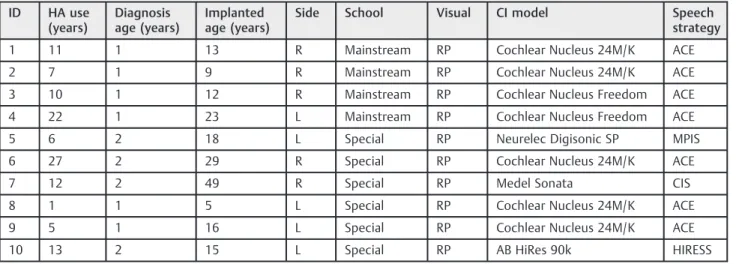
We selected 10 patients implanted (7 men, 3 women) diag-nosed with USHI. The average age for implantation was 18.9 years (5–49).►Table 1describes the summary of the
char-acteristics of each patient.
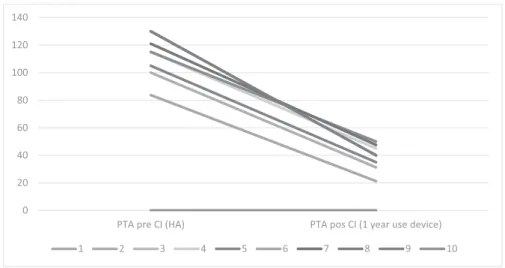
Average pre auditory threshold (PTA HA) was 103 dB HL (►Fig. 1). It was possible to measure speech perception in four
patients preoperatively (1, 2, 4, and 6), who could only detect speech. Other patients failed to perform the speech percep-tion tests. All patients except one had some kind of effective communication. Two were bilingual (►Table 2).
One year after the implantation, the average auditory thresh-old (PTA CI) was 35 dB (►Fig. 1). Only three patients improved
their performance in speech perception to 40%, 30%, and 10% for recognition of sentences in closed set, respectively (1, 2 and 3);
five patients had only speech detection, and two were not able to carry out tests (►Table 2). Three patients abandoned the use of
CI (8, 9, and 10).
Discussion
For proper indication and to establish a prognosis of the cochlear implantation beyond the knowledge of the etiology of deafness patients, it is important to survey the use of hearing aids and residual hearing that allows us to infer the development of the auditory pathway.9This will allow us to manage the expectations of the patient and family after cochlear implantation. Several factors can influence the outcome of cochlear implants as age of occurrence / diagnosis
Table 1 Summary of the characteristics of the 10 patients with implanted Usher syndrome
ID HA use
(years)
Diagnosis age (years)
Implanted age (years)
Side School Visual CI model Speech
strategy
1 11 1 13 R Mainstream RP Cochlear Nucleus 24M/K ACE
2 7 1 9 R Mainstream RP Cochlear Nucleus 24M/K ACE
3 10 1 12 R Mainstream RP Cochlear Nucleus Freedom ACE
4 22 1 23 L Mainstream RP Cochlear Nucleus Freedom ACE
5 6 2 18 L Special RP Neurelec Digisonic SP MPIS
6 27 2 29 R Special RP Cochlear Nucleus 24M/K ACE
7 12 2 49 R Special RP Medel Sonata CIS
8 1 1 5 L Special RP Cochlear Nucleus 24M/K ACE
9 5 1 16 L Special RP Cochlear Nucleus 24M/K ACE
10 13 2 15 L Special RP AB HiRes 90k HIRESS
Abbreviations: CI, cochlear implants; HA, individual sound amplification device; RP, retinitis pigmentosa.
of hearing loss (pre versus post-lingual) age at implant, residual hearing, systematic use of hearing aids, communica-tion mode, support from family, and educacommunica-tional environ-ment, as well as rehabilitation and personal motivation to join to the world of sound and learn to listen.
Indeed, studies on Usher syndrome reported outcomes of patients implanted with different ages and conclude that patients implanted late have good sound detection thresh-olds,2,4,6but the worst speech perception performance.
The fact that Usher syndrome patients are deprived of another sensory pathway does not necessarily mean that the patients will benefit from this type of rehabilitation. The clinical team should evaluate patients with Usher syndrome carefully and discuss the prognosis both in team and with the family.
The history of the systematic use of hearing aids, residual hearing, and the mode of communication allow us to infer the
value that the patient places on oral communication and listening in their life. They may not develop auditory cortical area and symbolic meaning of sounds. Patients who had no prior central auditory skills because they never had access to sounds when implanted can hardly adapt, leading to treat-ment failure.10The development of oral language skills from birth is essential to the patient subsequently acquire the new language sound of the cochlear implant. They need to use systematically bilateral hearing aids (even with little benefit) to keep the peripheral and central pathways as preserved as possible and learning one or more languages from birth.11,12 It is possible to the baby with congenital deafness to acquire the natural neurobiological development when the auditory stimulation is restored before 3.5 years of age (Sharma et al., 2009),13 on the other hand, patients implanted late show changes in the number of projections or synaptic density at various levels of the auditory pathway.10–14
0 20 40 60 80 100 120 140
PTA pos CI (1 year use device) PTA pre CI (HA)
1 2 3 4 5 6 7 8 9 10
Fig. 1 Results of average hearing thresholds pre and post one year of use device.
Table 2 Description of communication modes and results of speech perception of 10 patients with Usher syndrome type I
Pre CI Pos CI (1 year of use device)
Subjects Communication
mode
PTA HA Speech
perception
Age at CI
Communication mode
PTA CI Speech perception
1 Sign language/ Oral 83.75 13,3% vowels 13 Sign language/ Oral 21.25 40% closed set
2 Oral/ Sign language 100 26,67% vowels 9 Oral/ Sign language 31.25 30% closed set
3 Sign language 130 NT 12 Sign language 40 10% closed set
4 Oral 115 46% vowels 23 Oral/ Sign language 45 53% vowels
5 Sign language 115 NT 18 Sign language 50 20% vowels
6 Oral 130 56% 4 choice 29 Oral 40 15% vowels
7 Oral 121 NT 49 Oral 47.5 58% 4 choice
8 Sign language 130 NT 5 Sign language 40 NU
9 Sign language 105 NT 16 Sign language 35 NU
10 No language 123.75 NT 15 Sign language 31.25 60% vowels
Abbreviations: CI, cochlear implants; HA, individual sound amplification device; NT, not tested; NU, non user CI patient; PTA CI, pure tone threshold of cochlear implant; PTA HA, pure tone threshold of hearing aid. (no access to speech sounds even with the use of hearing aids).
International Archives of Otorhinolaryngology Vol. 21 No. 2/2017
Detecting the sounds achieved by the majority of our patients show that cochlear implants can provide access to sounds (peripheral input), however, when the implant is delayed, maybe, there are not enough central connections between the auditory area and the association areas. That means that detection is not enough for these people to give meaning to the sounds that they hear and may not be able to achieve the representation of the sounds. Another important factor is the inadequate expectations of the patient and families. Many teens already fluent in sign language also are disappointed with the CI because they might have expected something that had not happened, because the family might have imposed it or that his expectation was beyond that treatment could offer. The cochlear implant teams based on their own experience should judge each case individually to ensure realistic expectations of the outcome. This suggests that traditional measures of speech perception may not be sufficient to accurately reflect the real benefit of CI and alternative assessment tools, including educational, social and psychological areas are needed.15–19
Conclusion
Patients with Usher syndrome who were lately implanted have good hearing thresholds, but speech recognition and use of the device will depend mainly of previous stimulation, since they are directly related to the development of the auditory pathway and the central auditory skills.
References
1 Bronya JB. Keats, FACMG and Jennifer Lentz. Usher Syndrome Type
I. GeneReviews® [Internet]. Initial Posting: December 10, 1999; Last Update: June 20, 2013. http://www.ncbi.nlm.nih.gov/books/ NBK1265/ accessed in October,2015
2 Loundon N, Marlin S, Busquet D, et al. Usher syndrome and
cochlear implantation. Otol Neurotol 2003;24(2):216–221
3 Damen GW, Pennings RJ, Snik AF, Mylanus EA. Quality of life and
cochlear implantation in Usher syndrome type I. Laryngoscope
2006;116(5):723–728
4 Jatana KR, Thomas D, Weber L, Mets MB, Silverman JB, Young NM.
Usher syndrome: characteristics and outcomes of pediatric
cochlear implant recipients. Otol Neurotol 2013;34(3):484–489
5 Henricson C, Wass M, Lidestam B, Möller C, Lyxell B. Cognitive
skills in children with Usher syndrome type 1 and cochlear
implants. Int J Pediatr Otorhinolaryngol 2012;76(10):
1449–1457
6 Liu XZ, Angeli SI, Rajput K, et al. Cochlear implantation in
individ-uals with Usher type 1 syndrome. Int J Pediatr Otorhinolaryngol
2008;72(6):841–847
7 Pietola L, Aarnisalo AA, Abdel-Rahman A, et al. Speech recognition
and communication outcomes with cochlear implantation in
Usher syndrome type 3. Otol Neurotol 2011;33(1):38–41
8 Goffi-Gomez MVS, Guedes MC, Sant’anna SBG, et al. Critérios de
seleção e avaliação médica e audiológico dos candidatos ao implante coclear. Protocolo HCFMUSP. Arquivos Int
Otorrinolar-ingol. 2004;8(4):303–323
9 Lazard DS, Vincent C, Venail F, et al. Pre-, per- and postoperative
factors affecting performance of postlinguistically deaf adults using cochlear implants: a new conceptual model over time. PLoS ONE 2012b7(11):e48739
10 Lee HJ, Giraud AL, Kang E, et al. Cortical activity at rest predicts
cochlear implantation outcome. Cereb Cortex 2007;17(4):
909–917
11 Lazard DS, Giraud AL, Gnansia D, Meyer B, Sterkers O.
Understand-ing the deafened brain: implications for cochlear implant rehabil-itation. Eur Ann Otorhinolaryngol Head Neck Dis 2012a129(2): 98–103
12 Butler BE, Lomber SG. Functional and structural changes
through-out the auditory system following congenital and early-onset deafness: implications for hearing restoration. Front Syst Neurosci 2013;7:92
13 Sharma A, Nash AA, Dorman M. Cortical development, plasticity
and re-organization in children with cochlear implants. J Commun
Disord 2009;42(4):272–279
14 Campbell J, Sharma A. Cross-modal re-organization in adults with
early stage hearing loss. PLoS ONE 2014;9(2):e90594
15 Broomfield SJ, Bruce IA, Henderson L, Ramsden RT, Green KM.
Cochlear implantation in children with syndromic deafness. Int J
Pediatr Otorhinolaryngol 2013;77(8):1312–1316
16 Wiley S, Jahnke M, Meinzen-Derr J, Choo D. Perceived qualitative
benefits of cochlear implants in children with multi-handicaps. Int
J Pediatr Otorhinolaryngol 2005;69(6):791–798
17 Edwards LC. Children with cochlear implants and complex needs:
a review of outcome research and psychological practice. J Deaf
Stud Deaf Educ 2007;12(3):258–268
18 Daneshi A, Hassanzadeh S. Cochlear implantation in prelingually
deaf persons with additional disability. J Laryngol Otol 2007;
121(7):635–638
19 VlahovićS, Sindija B. The influence of potentially limiting factors
on paediatric outcomes following cochlear implantation. Int J
Pediatr Otorhinolaryngol 2004;68(9):1167–1174