ACPD
14, 8851–8914, 2014Cloud droplet activity changes of soot aerosol upon smog
chamber ageing
C. Wittbom et al.
Title Page
Abstract Introduction
Conclusions References
Tables Figures
◭ ◮
◭ ◮
Back Close
Full Screen / Esc
Printer-friendly Version
Interactive Discussion
Discussion
P
a
per
|
D
iscussion
P
a
per
|
Discussion
P
a
per
|
Discuss
ion
P
a
per
|
Atmos. Chem. Phys. Discuss., 14, 8851–8914, 2014 www.atmos-chem-phys-discuss.net/14/8851/2014/ doi:10.5194/acpd-14-8851-2014
© Author(s) 2014. CC Attribution 3.0 License.
Atmospheric Chemistry and Physics
Open Access
Discussions
This discussion paper is/has been under review for the journal Atmospheric Chemistry and Physics (ACP). Please refer to the corresponding final paper in ACP if available.
Cloud droplet activity changes of soot
aerosol upon smog chamber ageing
C. Wittbom1, J. H. Pagels2, J. Rissler2, A. C. Eriksson1, J. E. Carlsson2,
P. Roldin1,3, E. Z. Nordin2, P. T. Nilsson2, E. Swietlicki1, and B. Svenningsson1
1
Department of Physics, Lund University, P.O. Box 118 SE 221 00, Lund, Sweden
2
Ergonomics and Aerosol Technology, Lund University, P.O. Box 118 SE 221 00 Lund, Sweden
3
Department of Physics, P.O. Box 48, University of Helsinki, 00014, Finland
Received: 14 February 2014 – Accepted: 10 March 2014 – Published: 2 April 2014
Correspondence to: C. Wittbom ([email protected])
ACPD
14, 8851–8914, 2014Cloud droplet activity changes of soot aerosol upon smog
chamber ageing
C. Wittbom et al.
Title Page
Abstract Introduction
Conclusions References
Tables Figures
◭ ◮
◭ ◮
Back Close
Full Screen / Esc
Printer-friendly Version
Interactive Discussion
Discussion
P
a
per
|
D
iscussion
P
a
per
|
Discussion
P
a
per
|
Discuss
ion
P
a
per
Abstract
Particles containing soot, or black carbon, are generally considered to contribute to global warming. However, large uncertainties remain in the net climate forcing resulting from anthropogenic emissions of black carbon (BC), to a large extent due to the fact that BC is co-emitted with gases and primary particles, both organic and inorganic,
5
and subject to atmospheric ageing processes. In this study, diesel exhaust particles and particles from a flame soot generator spiked with light aromatic secondary organic
aerosol (SOA) precursors were processed by UV-radiation in a 6 m3Teflon chamber in
the presence of NOx. The time-dependent changes of the soot nanoparticle properties
were characterised using a Cloud Condensation Nuclei Counter, an Aerosol Particle
10
Mass Analyzer and a Soot Particle Aerosol Mass Spectrometer. The results show that
freshly emitted soot particles do not activate into cloud droplets at supersaturations≤
2 %, i.e. the black carbon core coated with primary organic aerosol (POA) from the exhaust is limited in hygroscopicity. Before the onset of UV radiation it is unlikely that any substantial SOA formation is taking place. An immediate change in cloud-activation
15
properties occurs at the onset of UV exposure. This change in hygroscopicity is likely attributed to SOA formed from intermediate volatile organic compounds (IVOC) in the diesel engine exhaust. The change of cloud condensation nuclei (CCN) properties at the onset of UV radiation implies that the lifetime of soot particles in the atmosphere
is affected by the access to sunlight, which differs between latitudes. The ageing of
20
soot particles progressively enhances their ability to act as cloud condensation nuclei, due to changes in: (I) organic fraction of the particle, (II) chemical properties of this
fraction (POA or SOA), (III) particle size, and (IV) particle morphology. Applying κ
-Köhler theory, using aκSOAvalue of 0.13 (derived from independent input parameters
describing the organic material), showed good agreement with cloud droplet activation
25
measurements for particles with a SOA mass fraction (mfSOA(APM)) ≥0.12 (slightly
aged particles). The activation properties are enhanced with only a slight increase in
ACPD
14, 8851–8914, 2014Cloud droplet activity changes of soot aerosol upon smog
chamber ageing
C. Wittbom et al.
Title Page
Abstract Introduction
Conclusions References
Tables Figures
◭ ◮
◭ ◮
Back Close
Full Screen / Esc
Printer-friendly Version
Interactive Discussion
Discussion
P
a
per
|
D
iscussion
P
a
per
|
Discussion
P
a
per
|
Discuss
ion
P
a
per
|
as predicted with Köhler theory. The discrepancy between theory and experiments might be due to solubility limitations, unevenly distributed organic material or hindering particle morphology.
The change in properties of soot nanoparticles upon photochemical processing
clearly increases their hygroscopicity, which affects their behaviour both in the
atmo-5
sphere and in the human respiratory system.
1 Introduction
Atmospheric aerosols are known to have a significant effect on visibility, climate and
human health. Aerosol particles influence the climate and hydrological cycle of Earth
by acting as cloud condensation nuclei (CCN), referred to as the indirect aerosol effect
10
(IPCC, 2007) or the effective radiative forcing from aerosol-cloud interactions (ERFaci,
IPCC, 2013). The ability of aerosol particles, to act as CCN, depends on the particle size and chemical composition as well as the ambient water vapour supersaturation.
The indirect aerosol effect includes reduction of drizzle and increased cloud lifetime
(Albrecht, 1989) increase in cloud albedo due to addition of cloud nuclei by pollution
15
(Twomey, 1974) as well as an increase in cloud thickness (Pincus and Baker, 1994). Also, soot aerosol can contribute to daytime clearing of clouds (Ackerman et al., 2000). Soot particles make up for a large fraction by number of the atmospheric aerosol,
es-pecially in urban locations in the size range<100 nm (Rose et al., 2006 and references
therein). Freshly emitted soot particles, or black carbon (BC), are known to have a
pre-20
dominantly warming effect on the climate due to their ability to absorb light, referred to
as a direct aerosol effect (IPCC, 2007) or the radiative forcing from aerosol-radiation
interactions (RFari, IPCC, 2013). Also, the absorption may increase with
photochemi-cal ageing and water uptake (Zhang et al., 2008; Cappa et al., 2012). After CO2, BC
is estimated as the strongest anthropogenic climate-forcing agent in the present-day
25
atmosphere (Bond et al., 2013). BC is estimated to have a total warming effect of about
ACPD
14, 8851–8914, 2014Cloud droplet activity changes of soot aerosol upon smog
chamber ageing
C. Wittbom et al.
Title Page
Abstract Introduction
Conclusions References
Tables Figures
◭ ◮
◭ ◮
Back Close
Full Screen / Esc
Printer-friendly Version
Interactive Discussion
Discussion
P
a
per
|
D
iscussion
P
a
per
|
Discussion
P
a
per
|
Discuss
ion
P
a
per
has an effect on Earth hydrological cycle. According to Bond et al. (2013) the largest
uncertainties in net climate forcing are addressed to the lack of knowledge about cloud interactions with BC when co-emitted with organic carbon (OC).
According to the World Health Organization (WHO, 2012), emissions of diesel en-gine exhaust are linked with climate change and classified as carcinogenic in humans.
5
Exposure to diesel exhaust is associated with unfavourable health effects (e.g. Sydbom
et al., 2001; Mills et al., 2007; Hart et al., 2009). The deposited fraction in the human
respiratory system is well described by the mobility diameter (for particles<400 nm),
whilst deposited dose by surface area and mass acquire knowledge of the character-istics of the particles due to their agglomerated structure (Rissler et al., 2012). The
10
particle lung deposition is substantially altered by hygroscopicity (Londahl et al., 2009). A change towards more hygroscopic properties will shift the deposited fraction in the respiratory-tract towards larger sizes. Photochemical processing of diesel exhaust par-ticles thereby alter the uptake in the human respiratory system due to enhanced hygro-scopicity.
15
Diesel exhaust aerosol is formed during combustion processes and consists mainly of refractory carbonaceous material (BC) that is highly agglomerated, primary organic compounds in the particle phase and volatile organic compounds (VOCs) in the gas phase. Typically, the particle size distribution of diesel exhaust is bimodal. Most of the particle mass is found in the in the size range 0.05–1.0 µm (volume mean diameter of
20
approximately 100 to 300 nm), composed of carbonaceous agglomerates and volatile matter absorbed onto their surface (Kittelson et al., 1998). Whilst most of the parti-cle number is typically found in the diameter range of 0.001 to 0.05 µm (depending on running conditions) and consists of organic and sulphur compounds, and may also contain metal compounds. Emissions from diesel engines vary significantly with the
25
ACPD
14, 8851–8914, 2014Cloud droplet activity changes of soot aerosol upon smog
chamber ageing
C. Wittbom et al.
Title Page
Abstract Introduction
Conclusions References
Tables Figures
◭ ◮
◭ ◮
Back Close
Full Screen / Esc
Printer-friendly Version
Interactive Discussion
Discussion
P
a
per
|
D
iscussion
P
a
per
|
Discussion
P
a
per
|
Discuss
ion
P
a
per
|
generator, including both black carbon and organic carbon (Petzold et al., 2013). Diesel exhaust particles (DEP) and soot generator particles (FSP) refers to particles from the diesel vehicle and the flame soot generator respectively.
Freshly emitted soot particles are hydrophobic or limited in hygroscopicity and un-likely to contribute to the CCN population in the atmosphere (Weingartner et al., 1997;
5
Meyer and Ristovski, 2007; Zhang et al., 2008; Tritscher et al., 2011). However, as the soot particles reside in the atmosphere, they undergo physical and chemical changes during UV exposure, they age. The agglomerated soot particles are exposed to chem-ical gas-to-particle processes in the atmosphere, resulting in condensation of organic and inorganic (Rose et al., 2006) vapours and coagulation of particles onto the
ag-10
glomerates. Due to this ageing process the soot particles collapse into a more com-pact structure (Weingartner et al., 1997; Pagels et al., 2009; Tritscher et al., 2011).
Hygroscopicity is enhanced with increasing ageing time, affected by high sulphur
con-tent in the fuel, high VOC levels in the emissions, pre-treatment of the exhaust gas with ozone, and UV radiation (e.g. Weingartner et al., 1997; Tritscher et al., 2011).
15
Weingartner et al. (1997) proposed that diesel exhaust aerosol, which was pre-treated
with O3and then subjected to UV radiation, would get an enhancement in
hygroscop-icity. However, the large scatter in data made it impossible to draw conclusions. Soot agglomerates become more hygroscopic when coated, partly or fully, by organic or in-organic material. The coating material transforms the agglomerates to enable them to
20
act as CCN.
In the atmosphere in general, aerosol particles are composed of both organic and inorganic compounds. Organic material makes up a significant fraction (20 to 90 %) of the submicrometer aerosol mass in many locations (Kanakidou et al., 2005; Jimenez et al., 2009). Organic aerosol is either introduced into the atmosphere from primary
25
ACPD
14, 8851–8914, 2014Cloud droplet activity changes of soot aerosol upon smog
chamber ageing
C. Wittbom et al.
Title Page
Abstract Introduction
Conclusions References
Tables Figures
◭ ◮
◭ ◮
Back Close
Full Screen / Esc
Printer-friendly Version
Interactive Discussion
Discussion
P
a
per
|
D
iscussion
P
a
per
|
Discussion
P
a
per
|
Discuss
ion
P
a
per
oxidised VOCs alters the particle properties, which may lead to an increased ability of the particle to act as CCN. Though, organic compounds will typically not improve the water activity as much as inorganic salts. Previous studies of biogenic SOA have shown that aerosol yield and hygroscopicity of SOA are dependent on experimental conditions (e.g. Asa-Awuku et al., 2009; Frosch et al., 2013). For example, hygroscopicity strongly
5
depended on exposure to OH, with less hygroscopic particles in the presence of an OH scavenger than in experiments with OH present.
It is believed that the radiative balance in the Arctic is influenced in numerous ways of aerosol particles. For example soot, when deposited on snow and ice, may enhance surface heating and ice melting by decreasing the surface albedo (e.g. Bond et al.,
10
2013; Tunved et al., 2013 and references therein). As mentioned previously, photo-chemical ageing of the soot particles may enhance the absorption of light, which in turn then may influence and boost the warming of the surroundings even further. The
par-ticle number concentration is in general low (about a couple of hundreds cm−3) in the
Arctic (Tunved et al., 2013). Wet removal and photochemical ageing play central roles
15
in controlling the aerosol size distribution properties during the Arctic summer time. If aged soot particles are transported to this remote site, an increase in hygroscopicity
of these particles could result in an increased number of cloud droplets i.e. affect the
cloud configuration of the Arctic. Changes in abundance and chemical properties of
aerosol particles will indirectly affect cloud microphysical properties and lifetime, as
20
mentioned above. As pointed out by Tunved et al. (2013), it is highly relevant to obtain
a better understanding of the microphysical properties of the different aerosol
popula-tions abundant in the Arctic environment, in order to improve the understanding of the direction and magnitude of a future climate change in the region.
Köhler theory (Köhler, 1936) is commonly used to predict and describe the ability of
25
ACPD
14, 8851–8914, 2014Cloud droplet activity changes of soot aerosol upon smog
chamber ageing
C. Wittbom et al.
Title Page
Abstract Introduction
Conclusions References
Tables Figures
◭ ◮
◭ ◮
Back Close
Full Screen / Esc
Printer-friendly Version
Interactive Discussion
Discussion
P
a
per
|
D
iscussion
P
a
per
|
Discussion
P
a
per
|
Discuss
ion
P
a
per
|
biogenic compounds such as limonene,α-pinene andβ-caryophyllene (Prenni et al.,
2007 (α-pinene,β-pinene,∆3-carene, and toluene); Duplissy et al., 2008 (α-pinene);
Kundu et al., 2012 (limonene); Frosch et al., 2013 (β-caryophyllene)).
Rissler et al. (2006) first introduced the hygroscopicity parameter κ
(H-TDMA-derived), describing the number of ions or non-dissociating molecules per unit volume
5
of the dry particle. A very similar parameter, also denotedκ, was later introduced by
Petters and Kreidenweis (2007b). Thisκ-parameter is in principle the same as theκ
introduced by Rissler et al. (2006), differing only due to different choice of units (Rissler
et al., 2010). Since the one introduced by Petters and Kreidenweis (2007b) is more broadly used and reported in literature this one will be reported here and is the one
10
referred to from now on. This hygroscopicity parameter ranges from 0.5 to 1.4 for salts such as NaCl that is highly-CCN-active. Slightly to very hygroscopic organic species
haveκ values between 0.01 and 0.5, and non-hygroscopic components have aκ=0.
κhas previously been reported to be in the range 0–0.13 (apparentκ) for
photochem-ically aged diesel soot, and for SOA from pure gas phase of the diesel vehicle in the
15
range 0.09–0.14 (Tritscher et al., 2011). These values could be compared to κ
val-ues for aged biogenic SOA; forβ-caryophyllene SOAκ is 0.002–0.16 (e.g. HuffHartz
et al., 2005; Asa-Awuku et al., 2009; Frosch et al., 2013), and foreα-pinene κ=0.1
(e.g. Prenni et al., 2007; Duplissy et al., 2008). Dusek et al. (2006) calculatedκvalues
for air masses in the range 0.15–0.30, originating from four different places but
arriv-20
ing at the same. Not many studies have been performed concerning how the ageing
process affects the activation properties of soot particles into cloud droplets and the
few previous studies performed have not been able to capture the rapid change of the particles properties and improved activation (e.g. Tritscher et al., 2011).
The aim of this study was to experimentally examine the change in cloud activation
25
properties of photochemically processed soot and evaluate the results usingκ-Köhler
ACPD
14, 8851–8914, 2014Cloud droplet activity changes of soot aerosol upon smog
chamber ageing
C. Wittbom et al.
Title Page
Abstract Introduction
Conclusions References
Tables Figures
◭ ◮
◭ ◮
Back Close
Full Screen / Esc
Printer-friendly Version
Interactive Discussion
Discussion
P
a
per
|
D
iscussion
P
a
per
|
Discussion
P
a
per
|
Discuss
ion
P
a
per
organic coating), evaluated through on-line mass spectrometry. Also used in the eval-uation is the knowledge about the change in shape and morphology of the particles, determined from the particle mass-mobility relationship. The change in particle prop-erties (chemical composition, shape and morphology) during ageing has also been
used for modelling the critical supersaturation (sc) of the coated soot particles.
Com-5
paring modelled (κ-Köhler) with empirical results show good agreement when taking
the change in particle properties into account.
2 Theory
Theoretical calculations of the critical supersaturations for the CCN activation of the
soot particles coated with different organics have been performed using Köhler and
10
κ-Köhler theory. The Köhler-theory describes the saturation ratio,s, over an aqueous
solution droplet as (Pruppacher and Klett, 1997; Seinfeld and Pandis, 2006):
s= p
p0 =aw×Ke (1)
The saturation ratio is defined as the ratio of the actual partial pressure of water (p) to
15
the equilibrium pressure over a flat surface of pure water (p0), at the same temperature.
The activity of water in solution is described by the termaw, and Ke (the so-called Kelvin
effect) determines the effect the surface curvature has on the equilibrium water vapour
pressure. The Kelvin term is given by:
Ke=exp
4σ
solMw
RT ρwDwet
(2)
20
whereσsolis the surface tension of the droplet solution,Mwandρwis the molar weight
and density of water,R is the universal gas constant, T is the absolute temperature,
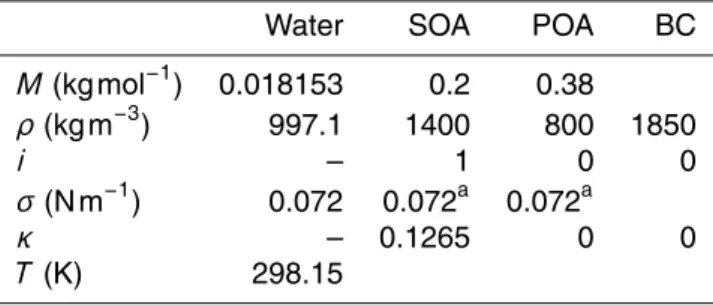
andDwet is the diameter of the spherical aqueous solution droplet (listed in Table 1). In
ACPD
14, 8851–8914, 2014Cloud droplet activity changes of soot aerosol upon smog
chamber ageing
C. Wittbom et al.
Title Page
Abstract Introduction
Conclusions References
Tables Figures
◭ ◮
◭ ◮
Back Close
Full Screen / Esc
Printer-friendly Version
Interactive Discussion
Discussion
P
a
per
|
D
iscussion
P
a
per
|
Discussion
P
a
per
|
Discuss
ion
P
a
per
|
the molar volume of pure water (Kreidenweis et al., 2005b). In this studyσsolis
param-eterised by the surface tension of water (σw), with a constant value of 0.072 N m−1. The
activity of water (aw), can be described by the following form of Raoult’s law, where the
van’t Hofffactor (is) represents the effects of ion interactions and dissociation
(Kreiden-weis et al., 2005a; Rose et al., 2008):
5
aw=
n
w
nw+isns
=
1+isns nw
−1
=
1+
nsumMw
ρwπ6Dwet3 −ds3
−1
(3)
in whichds is the diameter of the dry particle.ns andnw are the amount of substance
(number of moles) of solute and of water in the solution, respectively.nsum is the sum
of the different contributing components in the particles, calculated as:
10
nsum=Xi εiiiρid
3 s
Mi
π
6 (4)
in which εi is the volume fraction of a component i in the dry particle of diameter
ds, ii is the van’t Hoff factor and ρi is the density of the component, and Mi is the
corresponding molecular mass for that particular component. For hygroscopic salts
15
(strong electrolytes) such as ammonium sulphate and sodium chloride the van’t Hoff
factor is similar (but not identical) to the stoichiometric dissociation number (νs), i.e.
the number of ions per molecule or formula unit (ν(NH
4)2SO=3, νNaCl=2). Deviations
betweenis andνscan be attributed to solution non-idealities. The van’t Hofffactor can
be calculated using (see e.g. Kreidenweis et al., 2005b; Florence et al., 2011);
20
is=νsφs (5)
If the solution is non-ideal,φsdeviates from unity, i.e.φsrepresents the molal or
ACPD
14, 8851–8914, 2014Cloud droplet activity changes of soot aerosol upon smog
chamber ageing
C. Wittbom et al.
Title Page
Abstract Introduction
Conclusions References
Tables Figures
◭ ◮
◭ ◮
Back Close
Full Screen / Esc
Printer-friendly Version
Interactive Discussion
Discussion
P
a
per
|
D
iscussion
P
a
per
|
Discussion
P
a
per
|
Discuss
ion
P
a
per
The hygroscopicity parameterκis a broadly used parameter for direct comparison of
hygroscopicity between H-TDMA and CCNC measurements (Petters and Kreidenweis,
2007a), related toawas follows:
aw=
1+κVs Vw
−1
= D
3 wet−d
3 s
Dwet3 −ds3(1−κ) (6)
5
whereVs and Vw corresponds to the solute volume (assumed as the dry particle
vol-ume) and the water volume, respectively. In the same way asnsumabove,κis the total
contribution from all volume fractions of components in the particle and is given by a simple mixing rule:
κsum=
X
iεiκi (7)
10
κi =ii∗
ρ
iMw
ρwMi
(8)
κcan alternatively be calculated from pairedsc−dsvalues, derived from CCNC
mea-surements, with the following approximation (valid forκ >0.2):
κCCN=
4A3
27ds3ln2sc
!
(9)
15
A=
4σ
solMw
RT ρw
(10)
For 0< κ <0.2 the contribution of the initial dry aerosol particle volume to the total
volume of the droplet is non-negligible and the behaviour approaches that predicted by the Kelvin equation, i.e. expected for an insoluble but wettable particle.
ACPD
14, 8851–8914, 2014Cloud droplet activity changes of soot aerosol upon smog
chamber ageing
C. Wittbom et al.
Title Page
Abstract Introduction
Conclusions References
Tables Figures
◭ ◮
◭ ◮
Back Close
Full Screen / Esc
Printer-friendly Version
Interactive Discussion
Discussion
P
a
per
|
D
iscussion
P
a
per
|
Discussion
P
a
per
|
Discuss
ion
P
a
per
|
3 Modelling
3.1 CCN activation modelling
As discussed by others (e.g. Khalizov et al., 2009; Tritscher et al., 2011; Henning et al., 2012; Rissler et al., 2012) the non-sphericity and restructuring of the soot particles will introduce a systematic error assessing the volume from measurements of the mobility
5
diameter (dm). In the κ-model the particles are assumed to be spherical. Here, dm
is converted into volume equivalent diameter (dve), to account for the non-sphericity
of the dry particles when using κ-Köhler theory (dve is used in a similiar way as in
Tritscher et al., 2011). The sizes of the dry particles (dve) as well as the soot and
total organic mass fractions (mfBC(APM) and mforg(APM), respectively) in the particles
10
were derived from direct measurements of the relationship between particle mass and mobility diameter, using the DMA-APM set-up (see details in Sect 4.1). Calculations are performed according to (McMurry et al., 2002):
dve= 3
s
6 π
m ρcorr
(11)
15
wheremis the particle mass andρcorris the corrected material density of the particles,
assessed from:
1 ρcorr=
mfBC(APM)
ρBC +
mfSOA(APM)
ρSOA +
mfPOA(APM)
ρPOA (12)
mfBC(APM), mfSOA(APM), and mfPOA(APM) are the contributing mass fractions in the
20
particles of the different components, approximated as described below.
The initial mass fraction of POA (mfPOA(APM)) has been approximated with the
mea-sured values of mforg(APM), before the onset of UV. The mass ratio of soot to POA
is assumed to be constant for particles of a specific size throughout the experiment.
Therefore, after the onset of UV, mfPOA(APM) is assumed to decrease at the same
ACPD
14, 8851–8914, 2014Cloud droplet activity changes of soot aerosol upon smog
chamber ageing
C. Wittbom et al.
Title Page
Abstract Introduction
Conclusions References
Tables Figures
◭ ◮
◭ ◮
Back Close
Full Screen / Esc
Printer-friendly Version
Interactive Discussion
Discussion
P
a
per
|
D
iscussion
P
a
per
|
Discussion
P
a
per
|
Discuss
ion
P
a
per
rate as mfBC(APM). This assumption of constant proportions between soot and POA is
consistent with measurements by the AMS. Hence, after the onset of UV, mfPOA(APM)
is subtracted from mforg(APM) to calculate the mass fraction of SOA (mfSOA(APM)).
Volume fractions (εi) for the different components have been calculated from the mass
fractions and densities, to be used in theκ-Köhler modelling as well as in calculating
5
ρcorrabove.
In this study a high correlation is observed between the volume equivalent diameter
(dve), the mobility diameter (dm), and the SOA mass fraction (mfSOA(APM)) in the
par-ticle (Supplement, Fig. S1). Hence, by applying a fit to the empirical data, an estimated
volume equivalent diameter (dve, fit) has been derived fromdmand mfSOA(APM) to gain
10
a higher resolution in theκ-Köhler modelling (see equations in Sect 5.3).
The water activity is calculated from knowledge of the molar masses of the
compo-nents in the particle. The mean molar mass (M) is a difficult property to measure, as
pointed out by Hallquist et al. (2009). In literature a variety of average molar mass (M)
for both SOA (∼0.15–0.480 kg mol−1; Hallquist et al., 2009; Kuwata et al., 2013) and
15
POA (0.25–0.7 kg mol−1 for lubrication oil; e.g. Stubington et al., 1995) are reported.
The difference in molar mass among studies is probably due to different experimental
conditions (e.g. combustion conditions, NOxregime, aerosol loading, oxidants and
pre-cursors used). In this study the molar masses have been set to values of 0.2 kg mol−1
and 0.4 kg mol−1 for SOA and POA, respectively (Table 1). MSOA is a mean value
de-20
rived from model runs (see Sect. 3.2), whileMPOAis approximated with the molecular
weight of octacosane (C28−,M=0.395 kg mol
−1
; Lide, 2005) a representative compo-nent in the lubrication oil.
In the same way, the material densities for POA and SOA is set to constant values
of 800 and 1400 kg m−3, respectively. 800 kg m−3is typical for hydrocarbons (Ristimaki
25
et al., 2007). The density for SOA is derived from measurements of the aged particles in this study, in agreement with previously reported densities of anthropogenic SOA
formed from m-xylene and toluene (e.g. 1330–1480 and 1240–1450 kg m−3
ACPD
14, 8851–8914, 2014Cloud droplet activity changes of soot aerosol upon smog
chamber ageing
C. Wittbom et al.
Title Page
Abstract Introduction
Conclusions References
Tables Figures
◭ ◮
◭ ◮
Back Close
Full Screen / Esc
Printer-friendly Version
Interactive Discussion
Discussion
P
a
per
|
D
iscussion
P
a
per
|
Discussion
P
a
per
|
Discuss
ion
P
a
per
|
used in the model, in good agreement with previous studies. A density between 1800–
2000 kg m−3is often reported for the compacted soot core, e.g. 1840 kg m−3(Choi et al.,
1994), 1800 kg m−3 (Ristimaki et al., 2007), and 2000 kg m−3(Park et al., 2003; Cross
et al., 2007).
In this study SOA is treated as a water-soluble compound (iSOA=1; Svenningsson
5
et al., 2006) and POA as a water insoluble compound (iPOA=0, for example
octa-cosane is not water soluble, Lide, 2005;κ≈0–0.02 for SOA formed from lubrication oil,
Lambe et al., 2011). Using above values for molecular weight, density and van’t Hoff
factor as input the estimated values ofκi becomes: κSOA=0.1265 for SOA, κPOA=0
for POA andκBC=0 for the soot core, respectively. The calculatedκSOAvalue is similar
10
as reported in the literature for isoprene-derived secondary organic material particles
(κ=0.12±0.06; Kuwata et al., 2013, and references therein), laboratory smog
cham-ber SOA from trimethylbenzene (κ≈0.04–0.15; Jimenez et al., 2009),κvalues of SOA
formed fromm-xylene and toluene (κ≈0.1–0.27; Lambe et al., 2011) and
photochem-ically aged diesel soot particles (κ=0–0.13; Tritscher et al., 2011).
15
For fresh POA aκ value below 0.1 is expected, due to the low O : C ratio and high
MPOA (<0.2) of the material, as pointed out by others (Tritscher et al., 2011; Kuwata
et al., 2013). If impurities (such as sulphur) are present in the fuelκvalues greater than
0.1 may be found (Gysel et al., 2003). However, Tritscher et al. (2011) concluded that
theκ value for the fresh emissions (soot+POA) should be close to zero, due to low
20
sulphur content in the fuel used in the study. In this study low sulphur fuel was used
(<10 ppm) and the AMS detected no particulate sulphate (<4 ng m−3during 1 min of
detection). Therefore, POA is treated as a water insoluble compound. Due to the insol-ubility of black carbon, the soot particle as a whole is treated as a water insoluble. As
described previouslyκsumvaries with volume fractions of the organic coating material.
25
ACPD
14, 8851–8914, 2014Cloud droplet activity changes of soot aerosol upon smog
chamber ageing
C. Wittbom et al.
Title Page
Abstract Introduction
Conclusions References
Tables Figures
◭ ◮
◭ ◮
Back Close
Full Screen / Esc
Printer-friendly Version
Interactive Discussion
Discussion
P
a
per
|
D
iscussion
P
a
per
|
Discussion
P
a
per
|
Discuss
ion
P
a
per
3.2 Modelling of gas-phase chemistry, organic aerosol formation and composition: ADCHAM
In order to better understand the mechanisms responsible for the observed changes in SOA coating, chemical composition and hygroscopic properties we performed de-tailed modelling of the gas-phase chemistry, SOA formation and composition during
5
the DEP2 experiment. DEP2 was chosen due to the good cover in empirical results of cloud activation properties, mass-mobility relationship and particle chemical composi-tion. For this we used the ADCHAM model (Roldin et al., 2014). ADCHAM uses the detailed gas phase Master Chemical Mechanism version 3.2 (Jenkin et al., 2003), an aerosol dynamics and particle phase chemistry module and a kinetic multilayer module
10
for diffusion limited transport of compounds between the gas phase, particle surface
and particle bulk phase. In the online Supplement we describe in detail how the AD-CHAM model was setup.
4 Experimental
Ageing experiments of soot aerosols and precursors were carried out in the smog
15
chamber in the aerosol laboratory at Lund University (LU). In total 6 experiments were evaluated and presented in this study, chosen by coverage in data. The photochemical
ageing was induced using black lights (peak at 354 nm) in a 6 m3Teflon/FEP bag. The
experimental set-up is described elsewhere (Nordin et al., 2013). An overview of the experiments performed is given in Table 2.
20
Here we present the results from experiments where two sources of primary aerosol was used, soot agglomerates from (1) a Euro II Diesel Passenger Vehicle (VW
Pas-sat 1998) and (2) a diffusion flame soot generator described in detail elsewhere (Malik
et al., 2011). The soot nanoparticles and gases from the vehicle were transferred from the tailpipe via a heated inlet system using an ejector diluter (DI-1000, Dekati Ltd
Fin-25
ACPD
14, 8851–8914, 2014Cloud droplet activity changes of soot aerosol upon smog
chamber ageing
C. Wittbom et al.
Title Page
Abstract Introduction
Conclusions References
Tables Figures
◭ ◮
◭ ◮
Back Close
Full Screen / Esc
Printer-friendly Version
Interactive Discussion
Discussion
P
a
per
|
D
iscussion
P
a
per
|
Discussion
P
a
per
|
Discuss
ion
P
a
per
|
initially clean smog chamber (particle number and volume concentrations<100 cm−3
and<0.01 µg m−3, respectively). For the pressurized air, supplying the ejector and all
other pressurized air applications in the chamber, a special filter configuration was
used. In short, the pressurized air was preheated to 140◦
C and passed through
multi-ple filter sets to remove particles, organic acids, NOx, SOxand O3. Total dilution ratios
5
of ∼350 for the diesel vehicle and 50–100 for the flame soot generator were finally
achieved in the Teflon chamber, depending on the injection time of the exhausts. This
corresponds to number concentrations of 6000–12 000 cm−3and mass concentrations
of 3–14 µg m−3.
By changing the air to fuel ratio in the flame soot generator, particles with primary
10
particle sizes of ∼18 and ∼27 nm were generated (calculated according to Rissler
et al., 2013, see Sect. 5.1 for more details). In all experiments selected amounts of
toluene and m-xylene (at a ratio of 2 : 1) were added to allow investigations of the
early ageing as well as the full transformation of BC from agglomerates to spheres.
Toluene andm-xylene are anthropogenic SOA-precursors commonly found in diesel
15
and gasoline exhaust. The initial amount of VOCs was 300–900 ppb. The NO level
after exhaust injection was ∼500–600 ppb. Ozone was used to titrate NO down to
a concentration of about 50 ppb before the onset of UV radiation. This also allowed us
to investigate effects of addition of ozone on CCN properties of soot.
4.1 Instrumentation
20
For monitoring the soot transformation during ageing a comprehensive instrumental set-up was used, shown schematically in Fig. 1.
The cloud-activation properties were measured using continuous-flow streamwise thermal-gradient CCN counters (CFSTGC-CCNC from DMT, CCNC-100, DMT, de-scribed by Roberts and Nenes, 2005; and Lance et al., 2006). In the CCNC a single
25
ACPD
14, 8851–8914, 2014Cloud droplet activity changes of soot aerosol upon smog
chamber ageing
C. Wittbom et al.
Title Page
Abstract Introduction
Conclusions References
Tables Figures
◭ ◮
◭ ◮
Back Close
Full Screen / Esc
Printer-friendly Version
Interactive Discussion
Discussion
P
a
per
|
D
iscussion
P
a
per
|
Discussion
P
a
per
|
Discuss
ion
P
a
per
gradient through the column (change of temperature) and can be set to a range of 0.07–2 %, according to the manufacturer. The column is continually wetted and the
in-strument keeps a continuous flow. A Differential Mobility Analyser (DMA) was placed
prior to the CCNC, enabling a size selection of the dry, quasi-monodisperse aerosol
particles according to their mobility diameter (dm).
5
Shortly, the operation principle in the CCNC is that diffusion of water vapour is faster
than diffusion of heat in air. The temperature and water vapour concentration will travel
from different distances upwind from the walls to points along the symmetry axis in the
centre of the column. Water diffuses more quickly than heat. Hence, there is more water
vapour available than thermodynamically allowed at the points along the symmetry
10
axis.
Experiments were performed during two separate campaigns. During the first cam-paign (experiment DEP1), the supersaturation change was induced in a “conventional”
manner (forsc<1 %); the flow is kept constant, while the temperature gradient is varied
in a stepwise way (DEP1, Table 2). Due to the slow temperature stabilization,
measure-15
ment of whole supersaturation spectra is time consuming. To capture the sc>1 % in
the experiment DEP1, both the supersaturation (1.8 %) in the CCNC as well as dm
(150 nm) was kept constant, allowing the ageing of the aerosol scan past the super-saturation to capture the point of activation. The supersuper-saturation was changed in the
stepwise way while keeping the mobility diameter (dm) constant. The residence time in
20
the CCNC is∼6–12 s.
However, during the second campaign the Scanning Flow CCN Analysis (SFCA, in-troduced and described in detail by Moore and Nenes, 2009) was inin-troduced (DEP2-4 and FSP1-2, Table 2). This altered way of operation enables rapid and continuous mea-surements of the super saturation spectra. By adding a small software change to the
25
robust and well-established hardware of the CCNC, the flow is instead varied through
the column in a controlled manner, while the streamwise temperature gradient (∆T) and
pressure (P) is maintained constant. A higher flow increases the difference in travel
ACPD
14, 8851–8914, 2014Cloud droplet activity changes of soot aerosol upon smog
chamber ageing
C. Wittbom et al.
Title Page
Abstract Introduction
Conclusions References
Tables Figures
◭ ◮
◭ ◮
Back Close
Full Screen / Esc
Printer-friendly Version
Interactive Discussion
Discussion
P
a
per
|
D
iscussion
P
a
per
|
Discussion
P
a
per
|
Discuss
ion
P
a
per
|
rate in the chamber is varying in a scan cycle, where the flow increases/decreases linearly, as well as shortly kept constant at maximum/minimum flow rates.
When calibrating the instrument a size-selected aerosol of well-known chemistry is used, here ammonium sulphate and sucrose. The flow and the corresponding activated
fraction of the particles generate a supersaturation curve with a “critical flow rate”,Q50.
5
From knowledge of the particle dry diameter and chemical compositionQ50 is
trans-lated to a critical supersaturation (sc) using Köhler theory. Hence, every instantaneous
flow rate corresponds to a critical supersaturation (see calibration curves for one of the CCNCs, Supplement, Fig. S2). However, the calibration curves are specific for the
chosen∆T, scan time and pressure. The calibration curves are presented with error
10
bars representing 95 % confidence intervals. SFCA enables measurements of many supersaturation spectra during a short time period, allowing a better temporal reso-lution. The inlet temperature can be kept closer to ambient conditions and therefore minimizing biases from volatilization of semi-volatile compounds in the instrument.
To capture the whole supersaturation spectra of the ageing soot agglomerates, three
15
values of∆T were used (∆T =18, 10, and 4 K). Two CCNC instruments were running
in SFCA mode in parallel after a DMA. Hence, the two instruments were measuring the
samedm, but with overlapping∆T. The size-selection in the DMA is given in Table 2.
The rapid and continuous measurements of the supersaturation spectra made it possi-ble to capture the change in activation due to the fast ageing of the soot agglomerates.
20
By running the CCNC instruments in parallel with inverse scan cycles, i.e. with one instrument at maximum flow rate while the other at minimum, the aerosol flow was kept constant (1 L min−1).
The particle mass-mobility relationship of individual particles was measured using an
Aerosol Particle Mass Analyzer after size selection with a Differential Mobility Analyser
25
ACPD
14, 8851–8914, 2014Cloud droplet activity changes of soot aerosol upon smog
chamber ageing
C. Wittbom et al.
Title Page
Abstract Introduction
Conclusions References
Tables Figures
◭ ◮
◭ ◮
Back Close
Full Screen / Esc
Printer-friendly Version
Interactive Discussion
Discussion
P
a
per
|
D
iscussion
P
a
per
|
Discussion
P
a
per
|
Discuss
ion
P
a
per
and APM (Malik et al., 2011), operated at 300◦C. By comparing measurements with
and without thermodenuder it was possible to quantify the size dependent mass frac-tion condensed onto the non-volatile soot cores.
A custom built scanning mobility particle sizer (SMPS) system (Löndahl et al., 2008) was used for measuring the particle number size distribution from about 10 to
5
600 nm. The SMPS-system consists of a DMA (Vienna, 0.28 cm long), a63Ni bipolar
charger and a condensation particle counter (CPC, model 3010, TSI inc., USA) with
a sheath/aerosol flow relationship of 4.9/0.7 dm3min−1.
The chemical composition of the particles (soot core and organic coating) was de-termined using an online Aerodyne High-Resolution Time of Flight Mass Spectrometer
10
(HR-ToF-AMS, Aerodyne research). For detection of refractory black carbon (r-BC) the instrument was further equipped with a laser vaporizer, which is referred to as a Soot Particle Aerosol Mass Spectrometer (SP-AMS, Aerodyne research). The laser was operated in 5 min periods every hour. Both instrument configurations are described elsewhere (DeCarlo et al., 2006; Onasch et al., 2012).
15
High-resolution transmission electron microscopy (HR-TEM) image analysis of the soot agglomerates to determine primary particle size and soot microstructure has been performed and are described elsewhere (Rissler et al., 2013). In short, soot was de-posited onto lacey carbon coated copper TEM grids, using an electrostatic precipitator (NAS model 3089, TSI Inc., operated at 9.6 kV, 1 lpm), and then analysed using an
20
HR-TEM (JEOL 3000 F, 300 kV) equipped with a field emission gun.
For general monitoring as well as for detailed chemistry modelling (not included
in this study) NOx, O3, CO, RH, temperature, differential pressure, and UV-intensity
were continuously monitored throughout the experiment. Furthermore, in selected ex-periments a Proton Transfer Reaction Mass Spectrometer (PTR-MS, Ionicon Anlytik
25
ACPD
14, 8851–8914, 2014Cloud droplet activity changes of soot aerosol upon smog
chamber ageing
C. Wittbom et al.
Title Page
Abstract Introduction
Conclusions References
Tables Figures
◭ ◮
◭ ◮
Back Close
Full Screen / Esc
Printer-friendly Version
Interactive Discussion
Discussion
P
a
per
|
D
iscussion
P
a
per
|
Discussion
P
a
per
|
Discuss
ion
P
a
per
|
5 Results and discussion
5.1 The overall picture
No activation into cloud droplets was observed for the fresh soot particles at supersat-uration below 2 %, neither from the diesel exhaust (DEP) nor from the soot generator (FSP) experiments (Figs. 2, 4, 5 and 6). This is in agreement with previous
observa-5
tions, e.g. Tritscher et al. (2011) and Henning et al. (2012). The newly emitted diesel
exhaust aerosol show a carbon mean oxidation state in the range−1.9 to−1.6 (Fig. 7a)
similar with previous studies (carbon mean oxidation state ≈2O/C-H/C; Kroll et al.,
2011) and the mass spectrum show an organic (POA) content of mostly hydrocar-bon species (Fig. 7b), consistent with diesel exhaust measurements by Canagaratna
10
et al. (2007). An increase in carbon mean oxidation state is visible at the onset of UV exposure (Fig. 7a). At the same time measurements (AMS) as well as modelling (AD-CHAM) of the H : C ratio show a decrease (Fig. S4d). The mass spectra of the organic content (POA) of the aerosol emitted from the soot generator are very similar to the mass spectra of the POA from the diesel exhaust aerosol. According to measurements
15
of the chemical composition, inorganic salts do not form during the early stage of the experiments.
The morphology of the fresh emissions from both the diesel vehicle and the flame soot generator has been characterized in detail elsewhere (Rissler et al., 2013). The primary particle diameters are consistent between experiments for the DEP but
dif-20
fering for the FSP, depending on how the generator was operated. In summary, the
count median diameter of the primary particles diameter (dpp) in the agglomerates
from the diesel vehicle (experiment DEP1-4) was ∼28 nm by number, see Table 2.
From the flame soot generator agglomerates with two different dpp were generated,
agglomerates with a smallerdpp of about 18 nm by number (experiment FSP2) and
ag-25
glomerates with a largerdpp≈27 nm by number (FSP1). TEM samples for experiment
ACPD
14, 8851–8914, 2014Cloud droplet activity changes of soot aerosol upon smog
chamber ageing
C. Wittbom et al.
Title Page
Abstract Introduction
Conclusions References
Tables Figures
◭ ◮
◭ ◮
Back Close
Full Screen / Esc
Printer-friendly Version
Interactive Discussion
Discussion
P
a
per
|
D
iscussion
P
a
per
|
Discussion
P
a
per
|
Discuss
ion
P
a
per
Rissler et al. (2013). CCN measurements support that thedpp in experiment FSP1 is
close to thedpp of the diesel exhaust particles (Supplement, Fig. S1, FSP1 – circles
and DEP1-3 – triangles falls on the same line), while thedppin FSP2 are considerably
smaller. Thedppfrom calculations as well as TEM picture analysis are listed in Table 2.
The number size distribution showed a geometric mean diameter (GMD) average for
5
all DEP experiments of∼82 nm (with standard deviation, σg≈1.8) for the fresh soot
aerosols, ranging from 76 to 92 nm (1.78< σg<1.89) between experiments. The fresh
aerosols from experiment FSP1 and FSP2 showed a GMD of∼117 nm (σg≈1.63) and
∼79 nm (σg≈1.88), respectively. The parameters (GMD andσg) were determined from
the fitted lognormal number size distributions. Primary particle diameters and selected
10
sizes for the CCN measurements for the different experiments are listed in Table 2.
At the onset of UV exposure, an immediate (within 5 min) enhancement of the activa-tion properties of the coated soot cores is seen. Typically, the first full supersaturaactiva-tion spectra were measured within the first 10–15 min after onset of UV exposure, for the particle size-resolved aerosol (Fig. 4–6). In the early stage of the experiments, a
mobil-15
ity diameter (dm) of 150 nm was selected, in most experiments. The selected size was
based on that particles of a smallerdmwere not activated in the beginning of the
exper-iments and particles with largerdmwere too few in number. Furthermore, focusing on
one size improved the time-resolution of the measurements substantially. During one experiment (DEP3) the whole aerosol was measured continuously. In the beginning
20
of this experiment a small number fraction of particles of the whole aerosol (<1 %)
activates at high supersaturation (>2 %). This was the only experiment showing this
early activation, which could either be activation of exhaust aerosol or impurities. As the aerosol ages, the particles become better CCN and in the end of the experiment
almost the whole aerosol is activated at high supersaturations (>1.6 %) (Fig. 2).
25
The minimumdm that was able to activate at a certain supersaturation, at a certain
SOA mass fraction (mfSOA(AMS)), was retrieved by integrating number size
distribu-tions from larger to smaller sizes (Fig. 3). Here, the SOA mass fraction (mfSOA(AMS))
ACPD
14, 8851–8914, 2014Cloud droplet activity changes of soot aerosol upon smog
chamber ageing
C. Wittbom et al.
Title Page
Abstract Introduction
Conclusions References
Tables Figures
◭ ◮
◭ ◮
Back Close
Full Screen / Esc
Printer-friendly Version
Interactive Discussion
Discussion
P
a
per
|
D
iscussion
P
a
per
|
Discussion
P
a
per
|
Discuss
ion
P
a
per
|
fraction (mfSOA(APM)) is estimated from the APM measurements, but for the whole
size distribution, (information on the procedure how to derive the masses of BC and or-ganic material from SP-AMS data is found in the Supplement). Hence, size-distribution measurements, from the SMPS, along with the change in SOA mass fraction, derived from the SP-AMS, are linked to the activation properties measured by the CCNC. For
5
example, at the onset of UV exposure, if the particles are exposed to a supersaturation
of 1 % a minimumdm of 480 nm is required to activate 0.2 ‰ exhaust particles (Figs. 2
and 3). The mfSOA(AMS) has increased slightly from 0 to ∼0.01 at this point. As the
exhaust particles acquire more SOA they become better CCN. In the end of DEP3
the mfSOA(AMS) is about 0.4 and the minimumdm has decreased to about 60 nm for
10
a supersaturation of 1 %.
The observation of an immediate change in activation at the onset of UV exposure is consistent in all experiments, independent of amounts of added precursors, oxidants and soot particle source. Due to the new way of operating the CCNC, using scan-ning flow (SFCA) with a higher supersaturation and time resolution, it was possible
15
to cover the development of the activation properties more thoroughly than have ever
been done before (Figs. 4–6, “sc”). Hence, it was possible to capture both the onset of
activation, covering the very first changes of the particles becoming better CCN as well as following the evolution of the particles.
The evolution of a decreasing sc, along with an increasing SOA mass fraction
20
(mfSOA(APM)) coating the soot cores and a change in volume equivalent diameter is
illustrated in Fig. 5 (DEP2). The decline ofsccontinues throughout the ageing process,
although the effect is more prominent in the beginning of the ageing process. For the
mfSOA(APM) the trend is mirroring thesc, with a higher increase in mass fraction in the
beginning that levels out in the end. The rate of decreasingsc and increase of coating
25
mfSOA(APM) differ between experiments (compare Figs. 5 and 6), i.e. the rates are
de-pendent on amount of SOA precursors and ozone added, and NOxlevels. The time of
ACPD
14, 8851–8914, 2014Cloud droplet activity changes of soot aerosol upon smog
chamber ageing
C. Wittbom et al.
Title Page
Abstract Introduction
Conclusions References
Tables Figures
◭ ◮
◭ ◮
Back Close
Full Screen / Esc
Printer-friendly Version
Interactive Discussion
Discussion
P
a
per
|
D
iscussion
P
a
per
|
Discussion
P
a
per
|
Discuss
ion
P
a
per
cloud), range from 1.5 to>4.5 h. With respect to organic condensational growth this
corresponds to an atmospheric ageing time at the mid-latitudes of between 4 h to a few days (for details see Supplement). However, in the atmosphere other compounds, such
as biogenic organics and inorganics, are present which also will affect the
hygroscopic-ity and the life time of the soot particles, hence the calculated atmospheric ageing time
5
is an approximation.
5.2 Detailed picture
The time-dependent changes of activation properties of the coated soot cores can be attributed to four factors: (I) particle organic fraction; (II) type of organic coating (POA or SOA); (III) particle size; and (IV) morphology. Here, the results with respect to each
10
of these factors will be discussed.
(I) The ability of the soot cores to act as CCN increases with increasing amount of
organic coating material, i.e. increases in SOA mass fraction (mfSOA(APM)) (Figs. 5 and
6). At the end of the ageing process, when the SOA mass fraction makes up most of
the particles (mfSOA(APM)≥0.7, size dependent), thesclevels out. In all experiments,
15
all measured sizes show the same trend. The condensation rate of SOA was different
in different experiments. However, independent of the rate,scis more or less the same
for a chosen size with a certain mfSOA(APM) (Fig. 12).
(II) No activation was observed in the early stage of the ageing process, i.e. before UV exposure, although an increase is visible in carbon mean oxidation state (Fig. 7a).
20
At this stage the soot core makes up most of the particle mass (mfBC(APM) ∼0.9), and
the remaining fraction is dominated by POA. The mass spectral signature measured by the AMS corresponds well with hydrocarbon like OA (HOA) commonly found in ur-ban environments (Jimenez et al., 2009) and previous diesel exhaust emission (Cana-garatna et al., 2007) studies of POA (an example from DEP2 is shown in Fig. 7b). POA
25
originates from the combustion process (presumably from lubrication oil) and even as the POA reacts (change in carbon mean oxidation state, Fig. 7a) before the onset
supersatura-ACPD
14, 8851–8914, 2014Cloud droplet activity changes of soot aerosol upon smog
chamber ageing
C. Wittbom et al.
Title Page
Abstract Introduction
Conclusions References
Tables Figures
◭ ◮
◭ ◮
Back Close
Full Screen / Esc
Printer-friendly Version
Interactive Discussion
Discussion
P
a
per
|
D
iscussion
P
a
per
|
Discussion
P
a
per
|
Discuss
ion
P
a
per
|
tion. According to simulations with the ADCHAM model (Roldin et al., 2014, Sect. 3.2) no SOA is formed before the UV-light is turned on, and according to the simulations
the concentrations of ozone, hydroxyl radicals (OH) and nitrate radicals (NO3) at this
stage are insignificant (see Fig. S3 in the Supplement). Also, no detectable particle mass increase or fundamental changes in the mass spectra are observed before the
5
onset of UV radiation, other than a slight increase in m/z 44 due to CO+2. Hence, it
is unlikely that any substantial SOA formation is taking place during dark conditions, before the onset of UV exposure (DSOA in Fig. 8). Instead, the increase in carbon
mean oxidation state can be explained by heterogeneous oxidation of POA by NO2
at the surface of the soot core (illustrated in Fig. 8 as OPOA). Such reactions have
10
previously primarily been studied because of their potential importance for HONO for-mation in the atmosphere (e.g. Arens et al., 2001; and Han et al., 2013). Using ATR-IR spectra Han et al. (2013) observed a great increase in several absorbance bands
as-sociated with nitro (R-NO2) and nitrate (R-O-NO2) organic functional groups, after NO2
exposure. However, in our experiments the altered chemical composition of the
or-15
ganic coating material, i.e. a change in carbon mean oxidation state, does not affect
the activation properties of the particles at supersaturations ∼2 %. As concluded by
Tritscher et al. (2011) it cannot be ruled out that the hydrophobicity of the particles
surfaces could be a hindering effect of the particles to act as CCN. All experiments
show an O : C ratio<0.2, which according to Kuwata et al. (2013) classifies
non-CCN-20
active compounds. Also, lubrication oil (for example, octacosane or C28), which POA
originates from, is not water-soluble (Lide, 2005). In general it should be pointed out
that the organic mass fraction (mforg(APM)) is low throughout the period before UV
exposure. The initial OA fraction is 2–8 % and just after the onset of UV radiation (up
to 30 min in some experiments, see e.g. Fig. 2) it is still low (typically<9 %), i.e. the
25
amount of formed oxidized material in the early stage of experiments is very small compared to the SOA fraction of the aged soot in this study.
ACPD
14, 8851–8914, 2014Cloud droplet activity changes of soot aerosol upon smog
chamber ageing
C. Wittbom et al.
Title Page
Abstract Introduction
Conclusions References
Tables Figures
◭ ◮
◭ ◮
Back Close
Full Screen / Esc
Printer-friendly Version
Interactive Discussion
Discussion
P
a
per
|
D
iscussion
P
a
per
|
Discussion
P
a
per
|
Discuss
ion
P
a
per
are subjected to UV radiation, an enhancement in hygroscopicity occurs. Weingart-ner et al. (1997, and references therein) proposed that this change could be attributed to e.g. photolysis of PAH, or an oxidation of the particle surface from photochemi-cally produced hydroxyl radicals (OH), or condensation of photochemiphotochemi-cally produced compounds. At the onset of UV exposure there is often (but not always) a detectable
5
increase in the organonitrate (R-ONO2) level in the chamber. Also, more oxidized
or-ganic compounds are produced (increase in carbon mean oxidation state, illustrated in Fig. 7a). Condensation of organonitrates and other oxidized organic compounds, at the soot surface, would improve the hygroscopicity of the particle (illustrated in Fig. 8). Another possibility of the change in CCN properties at the onset of UV is oxidation
10
of POA by OH or ozone. Probably both mechanisms take place and contribute to im-proved CCN activity.
According to the ADCHAM model simulations of the DEP2 experiment, it takes ap-proximately one hour during this experiment before oxidation products of the added
precursors m-xylene or toluene start to contribute to the SOA formation. Instead the
15
initial SOA formation, after the onset of UV exposure, is likely condensation of low-volatile organic compounds formed when OH react with intermediate low-volatile organic compounds (IVOCs) present in the diesel exhausts. Naphthalene, alkylnaphthalenes and other PAHs are present in diesel exhausts (although at lower levels than light aromatic compounds and alkanes) (Schauer et al., 1999). Still, because of their high
20
reactivity towards OH and large fraction of low-volatile oxidation products (high SOA yields) they may dominate the initial SOA formation in fresh diesel exhausts (see e.g. Chan et al., 2009). However, with the best estimate of the PAH (naphthalene) concen-trations in the chamber, the ADCHAM model still substantially estimates the initial SOA formation (Supplement).
25
During the following hours of experimentscis declining, as the amount of condensed
organics increases. In the end of the ageing process, the organic coating consists
mostly of oxygenated compounds with an m/z signature similar to the semi-volatile
ACPD
14, 8851–8914, 2014Cloud droplet activity changes of soot aerosol upon smog
chamber ageing
C. Wittbom et al.
Title Page
Abstract Introduction
Conclusions References
Tables Figures
◭ ◮
◭ ◮
Back Close
Full Screen / Esc
Printer-friendly Version
Interactive Discussion
Discussion
P
a
per
|
D
iscussion
P
a
per
|
Discussion
P
a
per
|
Discuss
ion
P
a
per
|
atmosphere (Fig. 7c). Also, the carbon mean oxidation state is about−0.4 (illustrated
in Fig. 7a), in the range of what is reported for alkane/alkene photo-oxidized SOA (Kroll et al., 2011). According to our ADCHAM model simulations of the DEP2 experiment, in the end of the experiment more than 80 % of the SOA mass can be attributed to
the oxidation products from the added SOA precursorsm-xylene and toluene (Fig. S5
5
in the Supplement). The change in composition of the organic coating into more oxy-genated species is more pronounced in the beginning of the ageing process when the POA fraction of OA is still substantial. For example, the carbon mean oxidation state drastically increases in the beginning and then flattens out towards the end (illustrated in Fig. 7a).
10
(III) A size dependency is evident for both the activation properties as well as for the
condensation of organic material. For particles of a specific mfSOA(APM), the smaller
particles require a higher supersaturation for activation than the larger ones. This is
partly explained by the Kelvin effect, which is more pronounced for particles with higher
curvature and partly by the fewer amounts of water-soluble ions or molecules. However,
15
smaller particles are more efficient in relative mass acquisition by SOA condensation
(Fig. 6), as pointed out by Tritscher et al. (2011). They found that small particles show
the highest hygroscopic growth. Although, a more efficient acquisition of SOA does not
lower thescto a degree where it would compensate for a smaller particle size (Fig. 6).
It should be pointed out that the size dependence of mfSOA(APM) at a given time is
20
much smaller than that predicted for spherical particles according to transition regime mass transfer models. This is a direct consequence of the highly agglomerated particle morphology (Pagels et al., 2009).
(IV) A restructuring of the agglomerated soot particles is seen (Fig. 9a–c), in agree-ment with previous reported work (e.g. Weingartner et al., 1997; Tritscher et al., 2011).
25
Tritscher et al. (2011) argue that shape effects are the main reason for the absence