Brazilian Journal of Physics, vol. 37, no. 1, March, 2007 95
Hydrodynamic Evolution Near QCD Critical Point
C. E. Aguiar, T. Kodama, T. Koide
Instituto de F´ısica, Universidade Federal do Rio de Janeiro, C.P. 68528, 21945-970 Rio de Janeiro, RJ, Brazil
and Y. Hama
Instituto de F´ısica, Universidade de S˜ao Paulo, C.P. 66318, 05315-970 S˜ao Paulo-SP, Brazil
Received on 29 September, 2006
Some consequences of the presence of critical point in the equation of state on the hydrodynamical evolution of the strongly interacting matter are discussed. For this purpose, we apply the low energy effective theory of QCD, the Nambu-Jona-Lasinio model and show some examples.
Keywords: Piston effect; QCD critical point; Hydrodynamics; Spinodal decomposition
I. INTRODUCTION
Hydrodynamics is usually adequate to describe the collec-tive flow phenomena in macroscopic systems where thermo-dynamical relations are valid locally. Surprisingly enough, sometimes the hydrodynamical description is also useful as a model to describe the collective phenomena in microscopic and semi-microscopic systems. In fact, the collective flow be-havior of hot, dense matter produced in relativistic heavy-ion collisions are amazingly well described by the hydrodynami-cal models [1]. In the most of these models, the hot matter is approximated as an ideal fluid.
In spite of the success, there still remain several open ques-tions for hydrodynamical approach: the setup of the initial conditions, the finite volume effect, causality and dissipation, the freeze out mechanism, and so on [2]. In this work, we focus on one aspect of the equation of state (EOS) used in the hydrodynamical approach. In usual hydrodynamical mod-elings of relativistic heavy ion collision processes, the bag-model type of EOS’s are introduced. For these EOS’s, the phase transition between quark and hadronic phases is of the first order. However, it has been suggested that the QCD phase diagram has the critical point and the phase transition is crossover at the low chemical potential region[3].
As a matter of fact, the presence of a critical point gives rise to various interesting effects such as the focusing phenomena[4], the enhancement of susceptibility and critical slowing down[5], the critical opalescence, the piston effect[6] and so on. Accordingly, these effects should have influence on the hydrodynamical evolution of the system, too. In this work, we investigate how the hydrodynamical evolution is af-fected by the presence of a critical point in the EOS of the QCD matter.
II. CRITICAL POINT AND NJL MODEL
For a systematic study of the effect of critical point, we should construct an appropriate EOS with the critical point usable for the hydrodynamical applications. The most promis-ing way for realistic studies of the dynamics of the QCD mat-ter, will be the one obtained from the lattice QCD calculation, but this is still difficult to discuss the finite chemical potential
case. Thus, we have to look for other resources.
Some studies in this direction have already been done. For example, Nonaka and Asakawa discussed the hydrodynamics near the QCD critical point [4]. In this study, they used the so-called mapping relation to derive the EOS. The idea of map-ping relation is as follows. First consider the critical behavior of the liquid-gas transition. It is believed that the universality class of the liquid-gas transition belongs to the same as that of the 3D Ising model. If this is the case, then one may extract the critical behavior of the liquid-gas transition from that of the Ising model from the knowledge of the relation between the thermodynamic quantities of the liquid-gas transition and those of the Ising model. For example, the order parameterΨ
of the Ising model is the magnetization density, but that of the liquid-gas transition is defined by the volume. Then, we have the following mapping relation,
Ψ= 1
V
∑
i si→ V Vc−1,
wheresi is the spin at the lattice site i, andVc denotes the critical volume at the critical point of the liquid-gas transition. Substituting the expression to the van der Waals equation of state, we obtain the equation for the order parameter. To match the equation with the Landau free energy of the Ising model, one should choose the following mapping relation,
h=−p1
c
(p−pc) + 1
pc µ∂p
∂T 
cxs
(T−Tc),
wherehdenotes the external magnetic field,PcandTcmeans the pressure and the temperature at the critical point of the liquid-gas transition. The suffixcxs indicates the derivative along the coexisting line [6].
Nonaka and Asakawa applied the idea to obtain the QCD equation of state containing the critical point. They assume the universality class of QCD belongs to the same as that of the 3D Ising model, as is the case with the liquid-gas tran-sition. They further assumed the following simple mapping relations between QCD and the Ising maple,
(TQCD−Tc)/Tc = h, (1)
96 C. E. Aguiar et al.
By using the above mapping relations, one may construct the EOS corresponding to the QCD matter. However, the EOS obtained in this fashion can only describe the behavior of the matter near the critical point. Thus, they modified the derived EOS so as to reproduce the ideal gas QCD at high tempera-ture and the hadron resonance gas EOS at the low temperatempera-ture region, respectively.
The derived EOS seems to describe the anomalous behav-ior near the critical point and contains non-trivial fluctuations. However, they employed many assumptions whose validity is not well established. For instance, the universality class of the QCD phase transition is believed to be the same as that of the Heisenberg model, not the Ising model. In addition, we do not know how we can justify the mapping relation between QCD and the Ising model.
Hama et al. [7] introduced a QCD EOS with the critical point by modifying the usual bag model plus hadronic reso-nance gas method by a purely empirical interpolation of the two phases and applied to the hydrodynamical study of rela-tivistic heavy ion collisions. However, although the realistic behavior of the hadronic resonance gas and the high tempera-ture QGP state are incorporated correctly, this approach is too empirical to study the detailed behavior of the physical effect of the critical point.
The EOS can be estimated by using effective models of QCD, such as the Nambu-Jona-Lasinio (NJL) model, the sigma model, the QCD-like model, etc. The principal advan-tage of these models is that the critical point appears naturally even in the mean-field approximation in a simple fashion. Of course, the mean-field approximation cannot describe the ef-fects of fluctuations sufficiently. Furthermore, these the effec-tive models cannot describe the confinement-deconfinement phase transition.
In spite of the above shortcomings, we still expect that an effective theory is able to describe qualitatively the anomalous behaviors of thermodynamical quantities near the QCD criti-cal point to some extent. For example, we can estimate the temperature and chemical potential dependences of the spe-cific heat near the phase transition. At the phase transition, the specific heat shows discontinuity, and it becomes maxi-mum at the critical point[8]. The anomalous behavior of the specific heat affects the behavior of fluid. The Navier-Stokes equation of the non-relativistic fluid is given by
DT Dt −
µ 1−Cv
Cp ¶ µ∂T
∂P ¶ ρ DP Dt = 1
ρCpλ∇
2T,
where
D Dt =
∂
∂t+v·∇,
andCvandCpare the specific heat with constant volume and that with constant pressure, respectively. The r.h.s. of the equation is the thermal conduction term. Near the critical points, the specific heat with constant pressure often diverges. Thus, at first glance, the term seems to disappear near the criti-cal point. This represents the criticriti-cal slowing down of thermal conduction processes. On the other hand, the isobaric thermal
expansion diverges at the critical point. Thus, the competition between them should carefully be investigated.
These singularities can be described in the effective theo-ries. Thus, it is possible that the qualitative effect of the crit-ical point can be discussed by using the EOS of an effective model. In this work, we use the EOS calculated by using the NJL model.
The NJL Lagrangian density in the chiral limit is given by
L
(x) =q¯(x)[−i/∂]q(x)−G[(q¯(x)q(x))2+ (q¯(x)iγ5~τq(x))2],
where~τis the Pauli matrix. In the mean-field approximation, the thermodynamic potential per unit volumeωis
ω = m 2
4G−12
Z ΛUV 0
dk k
2
2π2
½ Ek+
1
βln
h
1+e−β(Ek+µ)i
+1
βln
h
1+e−β(Ek−µ)i
¾
, (3)
whereβ=1/T andEk=
√
k2+m2withm=−2Ghqq¯ ibeing the dynamically generated quark mass. The minimum ofω
with respect tomgives the equilibrium value of the thermo-dynamical potential. Thus, the quark massmis determined by the self-consistency condition,
∂ω(β,µ,m)
∂m =0.
Depending on the possible solutions of the above equation, the phase of chiral transition is determined. The thermodynamical quantities are then calculated from
∂ω ∂T =s,
∂ω ∂µ =n
and
ε=−p+T s+µn
wherep=−ω.
III. HYDRODYNAMIC EVOLUTION AND SPINODAL DECOMPOSITION
At the QCD critical point, it is considered that the transi-tion is changed from crossover to first order. Thus, for the larger values of the chemical potential, the effect of the first order transition in hydrodynamical evolution becomes impor-tant. In a usual hydrodynamical models, where the local ther-modynamical equilibrium is assumed, the EOS obtained from the Maxwell construction is applied. However, if the expan-sion rate of the QGP formed in relativistic heavy ion colliexpan-sions is very large, there is a possibility that the expanding matter can be supercooled and undergoes the so-called spinodal de-composition. An analogous process is believed to be the case in nuclear fragmentation phenomena [9].
Brazilian Journal of Physics, vol. 37, no. 1, March, 2007 97
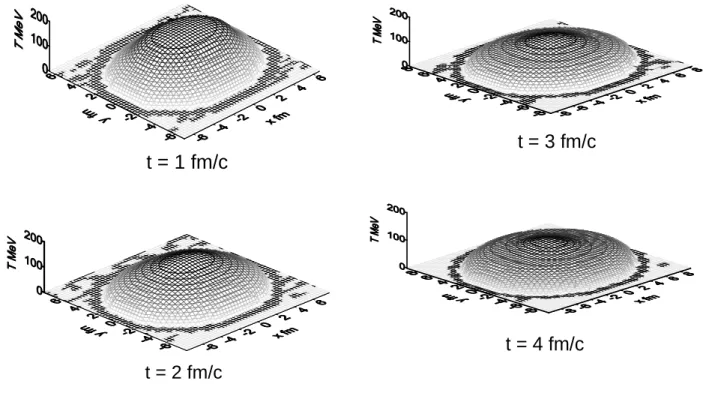
t = 1 fm/c
t = 2 fm/c
t = 3 fm/c
t = 4 fm/c
FIG. 1: The time evolution of temperature with the EOS calculated in the NJL model at vanishing chemical potential.
equilibrium. The EOS calculated by the effective field theo-retical models can be used to simulate such processes, when the dynamics of the order parameter is known as is the case of the linear sigma model. Aguiar et al. derived the coupled equations of motion between the relativistic hydrodynamical collective motion of the matter and the effective dynamics of the order parameter in terms of variational principle [?]. The NJL approach, the quark condensate is the order parameter, but we have to introduce the kinetic energy associated to this parameter.
As the first step of studying the effect of critical point on hydrodynamics, we performed the numerical study of the hy-drodynamical motion by using the EOS calculated in the NJL model. We adapted the smoothed particle hydrodynamics (SPH) to solve the hydrodynamic model [1] with our EOS. Here, for simplicity, we discuss the evolution for the trans-verse direction at vanishing chemical potential.
In Fig. 1, we show the numerical results. One can see that the temperature decreases as the system expands. Because of the second order phase transition at the vanishing chemi-cal potential, the evolution of the temperature shows simple monotonic decrease. This behavior is different from the result with the usual EOS of the first order phase transition, where the evolution of the temperature is decelerated during the
co-existing phase because of the disappearance of the gradient of pressure [1]. Thus, the order of the phase transition can affect the physical observables. For example, the elliptic flow with assuming the second order phase transition (or crossover) is expected to be smaller than that with assuming the first order phase transition [7].
IV. SUMMARY AND PERSPECTIVES
We used the NJL model to obtain the EOS with the critical point, and applied the EOS to discuss the hydrodynamic evo-lution at vanishing chemical potential. To discuss the effect of the critical point, we have to extend our calculation to finite chemical potential case.
Near the critical point, the competition between the sec-ond and first order phase transitions will give rise to nontrivial behavior. In particular, there is a possibility of the spinodal decomposition in the first order phase transition, although this has not yet discussed in the relativistic heavy-ion collisions.
To see the effect of the critical point, we have to generalize our numerical code to the finite chemical potential region.
98 C. E. Aguiar et al.
[1] See, for example, Y. Hama, T. Kodama, and O. Socolowski, Braz. J. Phys.35, 24 (2005).
[2] T. Kodama, T. Koide, G. S. Denicol, and Ph. Mota, hep-ph/0606161.
[3] O. Philipsen, PoS(LAT2005) 016, http://pos.sissa.it/.
[4] C. Nonaka and M. Asakawa, Phys. Rev. C71, 044904 (2005). [5] T. Koide and M. Maruyama, Nucl. Phys. A742, 95 (2004). [6] A. Onuki,Phase Transition Dynamics, Cambridge Univ. Press,
UK, 2002.
[7] Y. Hama, R. P. G. Andrade, F. Grassi, O. Socolowski Jr.,T. Ko-dama, B. Tavares, and S. S. Padula, Nucl. Phys. A 774, 169 (2006).
[8] M. Iwasaki, Phys. Rev. D70, 114031 (2004).