PSYCHO-PHYSIOLOGICAL CHARACTERISTICS OF STUDENTS-POWERLIFTERS OF DIFFERENT TRAINING EXPERIENCE, WHO HAVE AFFECTIONS OF MUSCULAR SKELETAL APPARATUS
Lobko V.S.
Luhansk Taras Shevchenko National University
Abstract. Purpose: study of many years’ power lifting trainings influence on psycho-physiological and other characteristics of students, who have affections of muscular skeletal apparatus. Material: the research covered 73 students of 18-22 yrs. Age, who have different training experience. To exclude influence of previous training on experiment’s results, researches were conducted after 2-3 days of rest. The author studied personality’s features (by T. Elers). Psychological diagnostic was conducted by methodic of M.V. Makarenko. Results: different psycho-physiological characteristics, indicators of psychological state and personality’s features were found in students, depending on their power lifting training experience. Improvement of functional and nervous power indicators under influence of systemic power lifting trainings was detected. Conclusions: it was determined that improvement of students’ sportsmanship is accompanied by noticeable improvement of practically all tested indicators.
Key words: health, personality, power-lifting, psycho-physiological, state, students.
Introduction1
As per data of specialists one of the most wide-spread diseases of students is connected with affections of muscular skeletal apparatus [1, 5, 8]. With it the highest threat of theses diseases is not so defects as certain psychological discomfort, which appears in process of person’s socialization in society [2, 4, 7, 10, 11, 14]. Analysis of recent researches points that one of promising solution of the mentioned problem is working out of appropriate methodic on the base of power lifting physical exercises in extra curriculum work with students [1, 12, 13, 15-19]. With it scientists note that up to the present time peculiarities of this kind of sports influence on psychological characteristics of students with affections of muscular skeletal apparatus has been being unsolved sufficiently [2, 7].
Purpose, tasks of the work, material and methods
The purpose of the work: to analyze dynamic of psycho-physiological characteristics, indicators of psychological state and personality’s features of students, who have affections of muscular skeletal apparatus under influence of many years’ power lifting training.
Material and methods of the research: 73 students of 18-22 yrs age with different experience of power lifting training, who have affections of muscular skeletal apparatus, participated in the research: 21 students trained power lifting for 1 year, 18- 2 years, 12 – 3 years, 11 – 4 years and 11 – 5 years of training. The methods of the research: theoretical analysis, synthesis and generalization of information, methods of psychological diagnostics and mathematical statistics.
As per the tasks of the research the author studied dynamic of psycho-physiological characteristics, indicators of psychological state and personality’s features of students with affections of muscular skeletal apparatus under influence of may years’ power lifting trainings.
For psychological diagnostics we used well known methodic by M.V. Makarenko, which permits to register latent period of simple visual-motor response (m.sec), latent period of response to choice of one or two irritators from three (m.sec), functional mobility of nervous processes (sec.) and power of nervous processes (quantity of symbols for 5 minutes). Besides, on the base of express-methodic “Prognoz” we assessed nervous-psychic stability of students and studied personality’s features (by T. Elers), their motivation for success and ability to avoid misfortune. In order to exclude influence of preceding trainings on results of experiment, we conducted tests after 2-3 days of rest. In tables 1 and 2 indicators of students’ psychological diagnostic are presented.
Results of the research
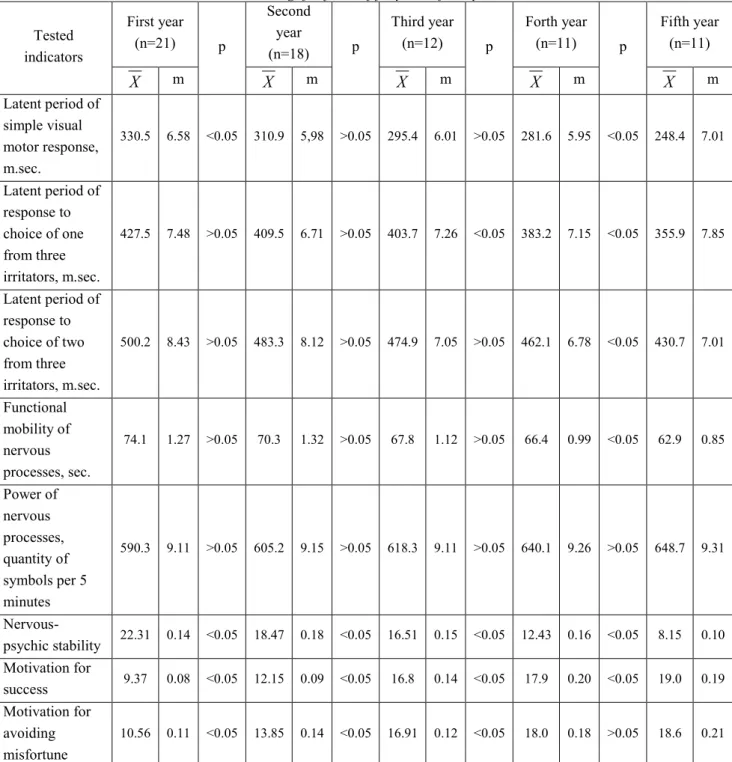
In table 1 one can see that many years’ power lifting trainings facilitate improvement of students’ (who have affections of muscular skeletal apparatus) psycho-physiological indicators. For example, in the course of the researches we registered steady increase of indicators of simple visual motor response latent period of students-power-lifters with different training experience: 1 year – 330.5 m.sec.; 2 years – 310.9 m.sec.; 3 years – 295.4 m.sec.; 4 years – 281.6 m.sec.; 5 years – 248.4 m.sec.
With it confident differences (p<0.05) were registered as follows: between data of 1st and 2nd year students; between indicators of 4th and 5th year students.
We also determined that parameters of latent period of simple visual motor response (by M.V. Makarenko’s scale) of 1st-3rd year students were assessed as “below middle” and 4th – 5th year students – as “middle”. Experiment permitted to detect that characteristics of latent period of visual motor response to choice of one or two from three irritators also increase with increasing of power lifting training experience – from 427.5 m.sec. of 1st year students to 355.9 m.sec. of 5th year students.
Such increase is characterized by confident (p<0.05) increase of indicators of students from 3rd to 5th year of studying. With it indicators of latent period of visual motor response to choice of one or two from three irritators of 1st –
© Lobko V.S., 2015
3rd year students were assessed as “below middle” and the same of 4th-5th year students – as “middle”. Analogous – positive dynamic of indicators- was registered in studying of influence of many years’ power lifting trainings on characteristics of latent period of visual motor response to choice of one from three irritators of students, who have affections of muscular skeletal apparatus: 1st year students– 500.2 m.sec.; 2nd year students– 483.3 m.sec.; 3rd year students – 474.9 m.sec.; 4th year students– 462.1 m.sec. and 5th year students– 430.7 m.sec.
Table 1 Psycho-physiological indicators of students with affections of muscular skeletal apparatus in process of power lifting
trainings fro first to fifth years of study
Tested indicators
First year (n=21) p
Second year
(n=18) p
Third year (n=12) p
Forth year (n=11) p
Fifth year (n=11)
X
mX
mX
mX
mX
mLatent period of simple visual motor response, m.sec.
330.5 6.58 <0.05 310.9 5,98 >0.05 295.4 6.01 >0.05 281.6 5.95 <0.05 248.4 7.01
Latent period of response to choice of one from three irritators, m.sec.
427.5 7.48 >0.05 409.5 6.71 >0.05 403.7 7.26 <0.05 383.2 7.15 <0.05 355.9 7.85
Latent period of response to choice of two from three irritators, m.sec.
500.2 8.43 >0.05 483.3 8.12 >0.05 474.9 7.05 >0.05 462.1 6.78 <0.05 430.7 7.01
Functional mobility of nervous processes, sec.
74.1 1.27 >0.05 70.3 1.32 >0.05 67.8 1.12 >0.05 66.4 0.99 <0.05 62.9 0.85
Power of nervous processes, quantity of symbols per 5 minutes
590.3 9.11 >0.05 605.2 9.15 >0.05 618.3 9.11 >0.05 640.1 9.26 >0.05 648.7 9.31
Nervous-psychic stability 22.31 0.14 <0.05 18.47 0.18 <0.05 16.51 0.15 <0.05 12.43 0.16 <0.05 8.15 0.10 Motivation for
success 9.37 0.08 <0.05 12.15 0.09 <0.05 16.8 0.14 <0.05 17.9 0.20 <0.05 19.0 0.19 Motivation for
avoiding misfortune
10.56 0.11 <0.05 13.85 0.14 <0.05 16.91 0.12 <0.05 18.0 0.18 >0.05 18.6 0.21
years. Quantitative characteristics of nervous system processes’ power improved in the following way: 1st year students – 590.3 symbols per 5 minutes; 2nd year students – 605.2 symbols per 5 minutes; 3rd year students – 618.3; 4th year students - 640.1 and 5th year students – 648.7 symbols per 5 minutes.
The data, received in the course of the researches, point at substantial improvement of psycho-physiological characteristics of students with affections of muscular skeletal apparatus under influence of many years’ trainings of power lifting. They also coincide with works of some scientists, devoted to influence of different kinds of sports on mental health of pupils and students, who have after effects of cerebral palsy. These authors proved that with specially worked out football and track and fields training methodic such students demonstrate improvements of psycho-physiological characteristics in parallel to improvement of sport results.
In the course of our experiments we determined that permanent power lifting trainings also positively influence on mental state and personality’s features of students with affections of muscular skeletal apparatus. As it is seen from table 2 indicators of nervous mental stability increase (p<0.05) with increasing of period of power lifting trainings in the following way: 1st year students-power lifters – 22.31 points; 2nd year students – 18.47 points; 3rd year students – 16.51 points; 4th year students – 12.43 points; 5th year students – 8.15 points. Analogous trend to increasing (p<0.05) of appropriate parameters we found during testing of students personality’s features. It is illustrated by materials of table 2. In particular 1st year students demonstrated low motivation for success (9.37 points), that confidently increase (p<0.05) in process of systemic power lifting trainings. 2nd and 3rd year students demonstrate middle level (12.15 and 16.8 points). 4th and 5th year students have moderately high level (17.9 and 19 points). In the same way students’ motivation for avoiding of misfortune is characterized (1st year students – 10.56 points) changes up to middle level (2nd and 3rd year students) and high level (4th and 5th year students) under influence of many years’ power lifting trainings.
Discussion
It should be noted that together with studying of psycho-physiological characteristics, indicators of psychic state and personality’s features we conducted pedagogic observations over students’ behavior and their progress in education. They resulted in the fact that 4th-5th year students are better in listed above psycho-physiological indicators. They also differ from 1st – 3rd year students-sportsmen by better average mark in educational process and are more assured in communication with their healthy peers. In our opinion it illustrates complex influence of many years’ power lifting trainings on different physiological systems of organism, mental potentials and psycho-emotional sphere of students with affections of muscular skeletal apparatus. It should be noted that obtained in experiments results point at improvement of mental state indicators and personality’s features of students with affections of muscular skeletal apparatus in the process of many years’ power lifting trainings. They also prove analogous data about positive influence of track and fields and football trainings on organisms of patients with cerebral palsy, substantially (p<0.05) improve characteristics of nervous-mental stability and features of personality.
Conclusions
1. Analysis of the received results of the conducted experimental research permitted to determine quantitative parameters of changes in psychological fitness’s characteristics of students with affections of muscular skeletal apparatus in the process of many years’ power lifting trainings. In particular, it was detected that increase of students-power lifters’ sportsmanship is accompanied by confident (p<0.05) improvement of the following characteristics:
- Parameters of latent period of simple visual-motor response, response to choice of one from three or two from three irritators;
- Quantitative indicators of functional mobility and nervous processes’ power, of nervous-mental stability; - Indicators, characterizing students’ motivation for success and avoiding of failures.
2.The characteristics, obtained in our research can be used for control over indicators of psychological fitness of students with different training experience in this kind of sports. The presented results correlate with data of some authors, prove and justify demand in working out and implementation of special extra curricular power lifting’s training methodic for students with affections of muscular skeletal apparatus, which would be based on theoretical-methodic approaches and practical experience of sportsmen-power lifters’ training.
The prospects of further researches in this direction can be connected with substantiation of appropriate health related power lifting training methodic for students with affections of muscular skeletal apparatus considering already received material.
Acknowledgement
The present work has been fulfilled as per complex program of scientific research of Olympic and professional sports department of Luhansk Taras Shevchenko National University by problem “Theoretical-methodic principles of physical culture training and pupils’/students’ health culture” (healthy and disabled subjects of education), state registration No. 0110U000394.
Conflict of interests
References:
1. Apanasenko G., Dovzhenko L. Riven' zdorov’ia i fiziologichni rezervi organizmu [The level of health and
physiological body reserves]. Teoriia i metodika fizichnogo vikhovannia i sportu, 2007, vol.1, pp. 17–21. (in Ukrainian)
2. Bened' V. P., Koval'chuk N. M., Zavac'kij V. I. Cilespriamovani dii fizichnikh vprav na rozumovu pracezdatnist'
liudini [Targeted action of exercise on mental performance rights], Luck, Nadstyr'ya, 1996, 104 p. (in Ukrainian)
3. Denisenko N. Osoblivosti rivnia zdorov’ia, fizichnoi pidgotovlenosti, samopochuttia ta vedennia zdorovogo
sposobu zhittia v uchniv zagal'noosvitnikh shkil i gimnazij [Features of health, physical fitness, health and healthy lifestyles in the students of secondary schools and high schools]. Slobozhans'kij naukovo-sportivnij visnik, 2007, vol.3, pp. 44–46. (in Ukrainian)
4. Korinchik L. Vpliv fizichnikh navantazhen' na rozumovu i sercevu diial'nist' molodi [Effect of physical activity
on mental and cardiac function of youth]. Sportivnij visnik Pridniprov’ia, 2004, vol.7, pp. 147–149. (in Ukrainian)
5. Kusel'man A. I., Solov'eva I. L., Cherdancev A. P. Sostoianie zdorov'ia detej, obuchaiushchikhsia po razlichnym
shkol'nym programmam [The health status of children enrolled in the various school programs]. Pediatriia, 2002, pp. 6, pp. 53–57. (in Russian)Platonov V.N. Obshchaia teoriia podgotovki sportsmenov v Olimpijskom sporte [A general theory of preparation of sportsmen in Olympic sport], Kiev, Olympic Literature, 1997, 584 p. (in Russian)
6. Prezliata G., Shpil'chak A. Zaniattia fizkul'turoiu ta zdorov’ia [Physical education and health], Kiev, World
School, Halichyna, 2006, 112 p. (in Ukrainian)
7. Sutula V. O., Kochuieva M. M., Bondar T. S. Zdorov’ia shkoliariv iak social'no-pedagogichna problema [Health
of pupils as socio-pedagogical problem]. Visnik Lugans'kogo nacional'nogo universitetu imeni Tarasa Shevchenka, 2010, vol.17(204), pp. 295–305. (in Ukrainian)
8. Chudnaia R. V. Adaptivnoe fizicheskoe vospitanie [Adaptive physical education]. Kiev, Scientific opinion, 2000,
360 p. (in Russian)
9. Astrand P., Rodahl K. Textbook of work physiology. New York, Mc Graw-Hill, 1986, pp. 523–576.
10. Keogh J.W.L, Hume P.A., Pearson S.N., Mellow P. To what extent does sexual dimorphism exist in competitive
powerlifters? Journal of Sports Sciences. 2008, vol.26(5), pp. 531-541. http://dx.doi.org/10.1080/02640410701644034
11. Keogh J.W.L., Hume P.A., Pearson S.N., Mellow P. Anthropometric dimensions of male powerlifters of varying body mass. Journal of Sports Sciences. 2007, vol.25(12), pp. 1365-1376. http://dx.doi.org/10.1080/02640410601059630
12. Korobeynikov Georgiy, Korobeinikova Lesia, Shatskih Vladimir. Psychophysiological Diagnostics of the
Functional States in Wrestlers. International Journal of Wrestling Science. 2013, vol.3(2), pp. 5-13. http://dx.doi.org/10.1080/21615667.2013.10878983
13. Kotendzhy L. V. Special equipment in competitive activities of powerlifters and dynamics of its manufacture.
Physical Education of Students. 2012, vol.2, pp. 46 - 49.
14. Nizhnichenko D.O. Intercommunication between the indexes of morphological, functional, speed-power and
special preparedness of powerlifters on the stage of previous base preparation. Pedagogics, psychology, medical-biological problems of physical training and sports. 2009, vol.7, pp. 128-134.
15. Pyšný L., Holá N. Chromosome investigations in weightlifters and powerlifters after intake of anabolic steroids.
Sports Medicine, Training and Rehabilitation. 1993, vol.4(1), pp. 15-19. http://dx.doi.org/10.1080/15438629309511961
16. Stetsenko A.I. The highest achievements of Ukrainian powerlifting at international events during its origin and
formation (1981-2012). Physical Education of Students, 2014, vol.1, pp. 44-49. http://dx.doi.org/10.6084/m9.figshare.903693
17. Stetsenko A.I. Theoretical and methodological support of educational process of students-powerlifters using
Internet resources. Pedagogics, psychology, medical-biological problems of physical training and sports. 2011, vol.11, pp. 118-124.