§Correspondent: Escola Superior de Biotecnologia, Rua Dr. António Bernadino de Almeida, 4200 Porto, Portugal. Fax: 351 2 590351.
*Part of the data presented in this paper was included in a poster entitled Studies on kefir grains: microbiological characterization, biomass increase rate, and rheology of the polysaccharide produced, which was presented at the Prof. Nicolau van Uden Portuguese Symposium of Applied Microbiology and Biotechnology – First Symposium on Yeasts, February 1993, Luso, Portugal.
Microbiological and rheological studies on Portuguese
kefir grains*
Manuela E. Pintado, J. A. Lopes Da Silva, Paulo B. Fernandes, F. Xavier Malcata§ &
Tim A. Hogg
Escola Superior de Biotecnologia, Universidade Católica Portuguesa, Porto, Portugal
Summary The native bacteria and yeasts present in Portuguese kefir grains stored under four
distinct sets of environmental conditions have been isolated and identified on the basis of morphology and biochemical tests. The microbial population of the kefir grains as a whole has been characterized in terms of rates of biomass production and formation of lactic acid and ethanol. The rheological properties of the purified polysaccharide (kefiran) produced by the microflora of the grains and accumulated therein were studied in a low water activity solvent and as a component of a binary gel containing either k-carrageenan or xanthan gum.
Keywords Biochemical parameter, dairy foods, gum blend behaviour, kefiran, mechanical spectra, storage and loss moduli.
Introduction
Kefir is a fermented beverage which has its ancient origins in the Caucasian mountains. This light alcoholic beverage is prepared by inocula-tion of raw milk with existing kefir grains (which can be stored in dried form). Kefir grains exhibit an irregular surface and they consist of a gel matrix in which yeasts and bacteria are imbedded and live symbiotically.
The microflora of kefir grains, which depends on their origin (Ottogalli et al., 1973), storage conditions and handling pattern (Zourari & Anifantakis, 1980), consists predominantly of Saccharomyces delbrueckii and Lactobacillus kefir
(previously included in L. brevis) (La Reviere et al., 1967; Kandler & Kunath, 1983), although several other varieties can be found, e.g. bacteri-al species of such genera as Streptococcus, Leuconostoc and Acinetobacter (Rosi, 1978b; Rosi & Rossi, 1978), and mould species such as Geotrichum candidum (Kosikowski, 1977). At least one quarter of the dry matter of the kefir grains consists of a capsular polysaccharide usually denominated kefiran (La Reviere et al., 1967). Kefiran is considered to be a result of the metabolism of such capsular bacteria as Lactobacillus kefis (La Reviere et al., 1967; Yokoi et al., 1990), a homofermentative, atypi-cal Streptobacterium (Rosi & Rossi, 1978), Lactobacillus kefiranofaciens (Toba et al., 1987; Fujisawa et al., 1988), and a new LAB strain ten-tatively named KPB-167B (Yokoi et al., 1991). Kefiran consists of approximately equal propor-tions of galactose and glucose residues (Kooiman, 1968). Rheological studies have shown that kefiran itself has a very low viscosity in solution and is unable to form rigid gels in the absence of ethanol (Mukai et al., 1990, 1991). Although the structural characteristics and hydrodynamic
prop-erties of kefiran raise some restrictions on its commercial use as a food thickening or gelling agent, some useful applications as a food additive might be devised. However, to date little work has been devoted to the rheological properties of this polysaccharide.
The purpose of the research reported in this communication was to gain insight into the microbiology of Portuguese kefir grains in terms of identification of their microflora and charac-terization of the biomass growth and product formation rates thereof, and to compare the results thus obtained with results available in the literature pertaining to kefir grains from other countries. Several rheological studies were also conducted on the polysaccharide extracted from the kefir grains in attempts to improve its potential applications as a gelling agent for foods.
Materials and methods Microbial strains
The kefir grains (0.7 to 1.4 g fresh, ,10% dry matter) were obtained from private sources in Portugal. Propagation and activation was per-formed by consecutive immersion (c. 10–12% w/v) in fresh batches of sterilized cow’s milk at room temperature three times a week.
The pure strains of Lactobacillus brevis NCFB 1749, Lactobacillus kefir NCFB 2753 and Lactococcus lactis subsp. lactis NCFB 604 were obtained from the National Collection of Food Bacteria (UK).
Microbiological analyses
Grains subject to four distinct environmental conditions were employed in these experiments, viz. (i) original grains, (ii) after propagation at home with daily change of milk, (iii) after storage for 3 months at room temperature (20–258C), and (iv) after refrigerated storage (48C) for 3 months.
For each experiment, 10 g of kefir grains (previously washed with sterile water) were homogenized with 90 g of Ringer solution in a Stomacher LAB-Blender 400™ (Seward Medical, UK) for 15 min. The homogenate, after appro-priate decimal dilution, was spread on different
media, and incubated under different conditions depending on the microorganism under study: (a) for Lactobacillus sp., the medium used was MRS (LabM, UK) supplemented with 3% (w/v) ethanol and 0.5% (w/v) cycloheximide (Sigma, USA) and incubation took place anaerobically (via Gas Pack BBL™ from Becton Dickinson, USA) at 308C for 5 days; (b) for Streptococci, the medium used was M17 Agar (Merck, Germany) with 0.5% (w/v) cycloheximide, with aerobic incu-bation at 308C for 2 days; (c) for yeasts, the medi-um used was MEA (Merck) incubated, aerobically, during 5 days at 258C; (d) for acetic acid bacteria, the medium used was WLNA (Oxoid, UK) with 0.5% (w/v) cycloheximide, with aerobic incubation at 258C for 21 days. Selected colonies were purified prior to identification. All isolated strains were stored in the presence of 30% glycerol at 2808C.
Identification of microoganisms
For biochemical profiles of lactic acid bacteria basal MRS media without meat extract and glu-cose were used according to Bergey (1986). The inoculated medium was added to the galleries of API 50™ (Bio Mérieux, France). The additional tests for streptococci and lactobacilli were exam-ined according to the schemes of Harrigan & McCance (1976). For lactobacilli the genus was further confirmed by SDS-PAGE of the disrupt-ed cells following preliminary growth under stan-dard conditions according to the method of Laemmli (1970) modified by Kiredjian et al. (1986) using chemicals from BioRad (USA); numerical analysis of the protein electrophore-gram was performed as described by Kersters & De Ley (1975).
In the case of yeasts, physiological and bio-chemical characteristics were tested according to Barnett et al. (1990) and identification was based on the Yeast Identification PC Program from the same authors.
Capsule production
For this purpose, two solid media were used, namely KPL, which was prepared as described by Toba et al. (1986) using lactic acid, glucose, galactose, and Tween 80™ (Merck) together with
milk whey and white table wine, and a new medi-um prepared with milk permeate (obtained by ultrafiltration), added with 10% (w/v) lactose and 3% (v/v) ethanol. Both solid media were supple-mented with 0.5% (w/v) cycloheximide, inoculat-ed with the homogeneous extracts of kefir grains, and incubated at 308C for 5 days under anaero-bic conditions.
Fresh permeate (without agar) was, after filter-sterilization (Nucleopore, USA), employed as the broth medium. After pouring 15 ml of broth into screw-capped tubes, each tube was inoculated with some of the lactobacilli isolated from the colonies in MRS added with 3% (v/v) ethanol and incubated at 308C with continuous shaking (100 r.p.m.) for 6 days.
Growth rate
Nine wet grains of activated kefir, with similar and representative appearance, were selected and washed with sterile, distilled water. They were dried to constant weight at 258C. Each grain was then submerged in 80 ml of sterile milk in a different beaker, and the beakers were incubated at 228C under gentle shaking conditions. For biomass assays the grains were removed, each one at a different time, and dried to constant weight at 258C. Assays for DL-lactic acid and ethanol by enzymic methods (Boehringer Manheim, Germany) of the supernatant milk of the corre-sponding beaker were performed at the six sampling times after the (previously determined) lag period of 3 days.
Extraction of polysaccharide from the kefir grains
For the extraction operation, 50 g of grains, previously washed with sterile water, were kept submerged in 100 ml water at 808C for 1 h with uniform stirring (100 r.p.m.). After this period, the mixture was cooled and centrifuged at 12 000 g for 20 min. The procedure was repeated once again with the remaining sediment. The polysaccharides dissolved in the supernatant were precipitated out by addition of an equal volume of cold ethanol. The precipitate was redissolved in 100 ml of water and a second purification step was performed using isopropanol in place of
ethanol following the procedure of Da Silva & Gonçalves (1990).
Determination of intrinsic viscosities
Several aqueous solutions of kefiran were prepared so as to give relative viscosities from about to 1.2 to 2.1. Viscosity was measured at 25.0 6 0.18C with a Cannon-Fenske capillary vis-cometer (Hipex, Portugal). The intrinsic viscosity, [h], was obtained by combined application of the Huggins and Kraemer extrapolations (Morris & Ross-Murphy, 1981).
Preparation of the sucrose/kefiran systems
The kefiran ([h] 5 0.29 m3 kg21) was previously dispersed in water at room temperature under moderate shaking for 1 h, heated at 908C for 30 min, and then centrifuged for 1 h at 28 000 g. The aqueous dispersion of kefiran was heated in a paraffin bath to 1058C for 3 min, and then sucrose (a water activity modifier) was added under continuous stirring. The heating was main-tained for another 7 min, water lost being replaced with fresh deionized water, and the sam-ple was transferred to the plate of the instrument at the desired temperature.
Preparation of the binary solutions of kefiran and k-carrageenan or xanthan
The kefiran and k-carrageenan samples were first dispersed in water under moderate agitation for 1 h, at room temperature, and then heated at 908C for 30 min with stirring. The binary systems were prepared by mixing, at 908C, the solutions of kefiran and k-carrageenan at the 1:4 (w/w) ratio for a final 1% (w/w) total concentration of poly-mer. The hot mixture was maintained at 908C for 15 min, and then cooled to 558C. In these experi-ments, the only potassium ions present were those accounted for by the salt form of the native k-car-rageenan.
In the case of the kefiran/xanthan mixture, both the kefiran and xanthan were first dispersed in a 0.1 Msolution of sodium chloride under moderate agitation for 60 min at room temperature, and then heated to 908C for 30 min with continuous stirring. The binary systems were prepared by
mixing, at 908C, the solutions of kefiran and xan-than at the 1:1 (w/w) ratio for a final 1% (w/w) total polymer concentration, and then maintained at 908C for 30 min under continuous stirring.
Rheological measurements
Dynamic rheological measurements were per-formed using a Carri-Med CS-50 (UK) con-trolled-stress rheometer with a cone-plate device (radius 25 mm, cone-plate angle 48) or a parallel plate geometry (radius 60 mm, gap 4 mm) with radial grooves in order to avoid gel slippage. The strain amplitude was fixed at 3%. After the hot sample was transferred to the rheometer plate, the exposed surface of the sample was covered with a thin layer of low viscosity paraffin oil to prevent evaporation of solvent.
Three types of experiments were then per-formed: cure experiments, mechanical spectra, and cooling/heating cycles. For the cure experiments, the kinetics of gel formation at different tempera-tures was monitored by measuring the storage (G9) and the loss (G0) moduli at a frequency of 6.3 rad s21. Mechanical spectra were recorded in a constant strain mode over the frequency range 0.063 to 63 rad s21. For the cooling/heating cycles, the storage modulus, G9, and the loss modulus, G0, were obtained from temperature sweep exper-iments at 6.3 rad s21, by cooling the systems from 55 to 58C and then reheating to 558C at the rate
of 188C h21 (kefiran/k-carrageenan); in the case of kefiran/xanthan, the mixture was cooled from 70 to 258C and then reheated to 708C at the rate of 608C h21.
Results and discussion
Microbiological characterization
The proportions of the different groups of microorganisms (bacteria such as lactobacilli and streptococci, and yeasts) found in the grains are depicted in Fig. 1. The grains did not reveal the presence of acetic acid bacteria as reported by Rosi (1978b). While lactobacilli dominate the microflora of the grain, yeasts were apparently the least affected by environmental conditions. It is interesting to note the similarities of the micro-bial counts of grains 1 and 4, confirming that storage of wet grains at 48C is a good method for the preservation of the grains as generally accept-ed (Kosikowski, 1977). This result is independent of the observed increase in weight of the refriger-ated grains, which is consistent with the results obtained by Toba et al. (1990).
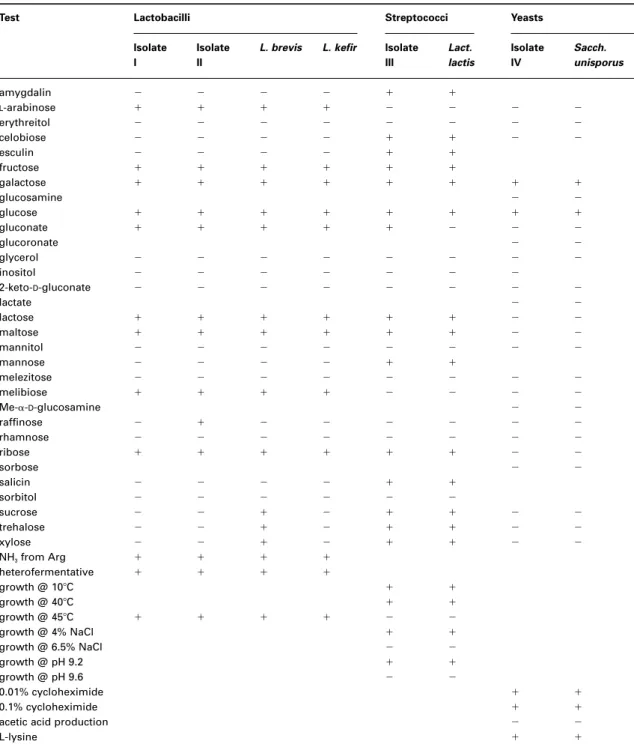
After screening bacteria showing different colony morphologies on MRS, two colonies (denoted hereafter as Isolate I and Isolate II) were further characterized. Table 1 shows sugar fer-mentation profiles of these two strains, and a comparison with those of reference strains. In a
Figure 1Number of Colony Forming Units (CFU) per unit mass of kefir grain for (1) original grains, (2) after propagation at home under typical conditions, (3) after storage for three months at room temperature, and (4) after refrigerated storage (48C) for three months.
similar fashion, one colony from M17 (denoted hereafter as Isolate III) and one colony from MEA (denoted hereafter as Isolate IV) were further characterized, and the results thereof are also included in Table 1. As shown in this table, all
strains of lactobacilli detected are heterofermenta-tive and produce ammonia from arginine. Inspection of Table 1 also indicates that the two strains of Lactobacillus tested differ in only one type of sugar fermented, raffinose (which has a
Test Lactobacilli Streptococci Yeasts
Isolate Isolate L. brevis L. kefir Isolate Lact. Isolate Sacch. I II III lactis IV unisporus
amygdalin 2 2 2 2 1 1 L-arabinose 1 1 1 1 2 2 2 2 erythreitol 2 2 2 2 2 2 2 2 celobiose 2 2 2 2 1 1 2 2 esculin 2 2 2 2 1 1 fructose 1 1 1 1 1 1 galactose 1 1 1 1 1 1 1 1 glucosamine 2 2 glucose 1 1 1 1 1 1 1 1 gluconate 1 1 1 1 1 2 2 2 glucoronate 2 2 glycerol 2 2 2 2 2 2 2 2 inositol 2 2 2 2 2 2 2 2-keto-D-gluconate 2 2 2 2 2 2 2 2 lactate 2 2 lactose 1 1 1 1 1 1 2 2 maltose 1 1 1 1 1 1 2 2 mannitol 2 2 2 2 2 2 2 2 mannose 2 2 2 2 1 1 melezitose 2 2 2 2 2 2 2 2 melibiose 1 1 1 1 2 2 2 2 Me-a-D-glucosamine 2 2 raffinose 2 1 2 2 2 2 2 2 rhamnose 2 2 2 2 2 2 2 2 ribose 1 1 1 1 1 1 2 2 sorbose 2 2 salicin 2 2 2 2 1 1 sorbitol 2 2 2 2 2 2 sucrose 2 2 1 2 1 1 2 2 trehalose 2 2 1 2 1 1 2 2 xylose 2 2 1 2 1 1 2 2 NH3from Arg 1 1 1 1 heterofermentative 1 1 1 1 growth @ 108C 1 1 growth @ 408C 1 1 growth @ 458C 1 1 1 1 2 2 growth @ 4% NaCl 1 1 growth @ 6.5% NaCl 2 2 growth @ pH 9.2 1 1 growth @ pH 9.6 2 2 0.01% cycloheximide 1 1 0.1% cycloheximide 1 1
acetic acid production 2 2
L-lysine 1 1
positive result for Isolate II). When compared with reference strains of lactobacilli commonly found in kefir grains, it can be observed that L. kefir is the most similar to the isolated strains. Confirmation of the above results was achieved via generation of electrophoretic patterns of the whole protein inventory of the two different isolates and refer-ence strains. The associated dendograms have shown 94.1% and 89.0% homology with L. kefir for Isolates I and II, respectively; these results are in agreement with the conclusions of Kandler & Kunath (1983). Different results were obtained by other authors, e.g. L. brevis (now included in L. kefir) was isolated by Rosi & Rossi (1978), where-as Ottogalli et al. (1973) described L. brevis and L. acidophilus for grains from Bulgaria, Yugoslavia and Russia, and Molska et al. (1983) isolated L. casei from Polish and Norwegian grains.
With respect to lactococci, Isolate III was identified as Lactococcus lactis on the basis of the sugar fermentation characteristics and other growth conditions (Bergey, 1986). From the great degree of homology with the corresponding refer-ence strain as apparent in Table 1, the isolated strains could be identified as Lactococcus lactis subsp. lactis. This result is similar to that obtained by Ottogalli et al. (1973) (i.e. Str. lactis subsp. lactis), but different from that by Rosi & Rossi (1978) who isolated Str. durans.
The isolated yeasts (Isolate IV) were identified as Saccharomyces unisporus or, synonymously, Saccharomyces delbrueckii, which is the yeast most frequently isolated from kefir grains (La Reviere et al., 1963). The identification was based on analysis of the results pertaining to the uti-lization of several sugars (see Table 1) as well as additional tests of growth in 0.1% (w/v) cyclo-heximide, growth on L-lysine, and acetic acid pro-duction, and employed the PC Program written by Barnett et al. (1990) as an identification aid.
Although the results obtained for Portuguese grains in terms of yeast content compare well with those by Rosi (1978a) and Ohara et al. (1977), they are quite different from the results available for Russian (i.e. Sacch. lactis), Yugoslavian (i.e. Candida tenuis, Saccharomyces lactis, and Sacch. carlbergensis) and Bulgarian grains (i.e. Cand. pseudotropicalis) by Ottogalli et al. (1973), and those reported by Kosikowski (1977) (i.e. Sacch. kefir and Torula kefir).
Capsule production
All lactobacilli isolated from kefir grains proved to be encapsulated. Although capsule production in solid media was not successful, the isolates identified as L. kefir incubated in milk permeate broth for 6 days produced capsules surrounding their rod-shaped body which could be easily visu-alized via Indian ink staining. Further character-ization of the capsular polysaccharide was not pursued (because it would have required sophisti-cated analytical techniques that were not avail-able at our premises at that time); however, our result is expected in view of the conclusions by La Reviere et al. (1967), viz. that L. kefir (formerly L. brevis) was most probably responsible for pro-ducing kefiran, the material of the capsules.
Growth rate
It took almost 3 days before the dry grains sub-merged in milk started their exponential growth (see Fig. 2). (This lag phase was expected in view of the commonly accepted idea that microorgan-isms in dried form take a considerable time to readapt their metabolic system to biomass pro-duction.) The exponential curve corresponded to a specific growth rate of m 5 0.002475 h21 (dou-bling time of 16.8 days). Although our result is not of the same order of magnitude of that of Rozhkova (1984), viz. doubling time of 24 h, it should be emphasized that the two sets of data are difficult to compare in view of the different experimental conditions employed.
The rates of production of lactic acid and ethanol were followed along with the biomass increase, and the results obtained suggest that both products are growth-associated (see Fig. 2); although it is apparent that the concentration of lactic acid and the biomass concentration reach maxima after the maximum concentration of ethanol is attained, the time delay in question cannot be considered to be significant given the intrinsic variability of the data presented.
Rheological characterization of the kefiran/sucrose systems
The results of the gel cure experiments performed on the kefiran/sucrose systems (1% kefiran, 60% sucrose) at some ageing temperatures are depicted
in Fig. 3. The general behaviour is typical of a biopolymer gel, with both moduli increasing as a result of the increasing junction zones density, and with the elastic component (storage modulus, G9) rising rapidly at first and then more slowly as the apparent plateau is approached. Note the small difference between the dynamic moduli, which is a characteristic of weak gels. The time elapsed from the moment when the sample reach-es the temperature under study until the cross-over of the storage (G9) and loss (G0) mod-uli can be considered as the gel time.
The viscoelastic behaviour of the kefiran/sucrose
gels changes with the ageing temperature to which the system has been exposed (Fig. 4). The behav-iour is characteristic of a weak biopolymer gel with low enough density of junction zones to allow some molecular rearrangements to take place within the network over the time scale under consideration.
Rheological characterization of the
kefiran/k-carrageenan binary systems
The effect of addition of kefiran on the thermal behaviour of k-carrageenan systems is shown in
Figure 2Growth data (s——s) for individual kefir grains each in 80 ml of milk at 228C under gentle shaking conditions superimposed on the curves of release of ethanol (h——h) and lactic acid (n——n).
Figure 3Storage modulus, G9 (open symbols), and loss modulus, G0 (filled symbols), as a function of time for a 1% kefiran sol/gel (60% (w/w) sucrose) at different ageing temperatures: 108C (e or r), 208C (h or j), and 308C (s or d). (For clarity, only some of the experimental points obtained are shown.)
Figure 4Mechanical spectra for a 1% kefiran gel (60% (w/w) sucrose) measured at 16 h ageing time, for different ageing temperatures: 108C (n or m), 208C (h or j), and 308C (s or d). Open symbols denote the storage modulus, G9, whereas filled symbols denote the loss modulus, G0. 140 130 120 110 100 90 80 70
Fig. 5 as the evolution of G9 and G0 versus tem-perature for the 1:4 kefiran/k-carrageenan blend at 1% final polymer concentration. The mixing ratio of 1:4 (kefiran/k-carrageenan) was used because it allows a direct comparison of the data found for the kefiran/k-carrageenan mixture with those of 1% 1:4 guar/k-carrageenan previously described by Fernandes et al. (1992). A hysteresis is clearly exhibited via the gelation temperature (Tg) of c. 138C and the melting temperature (Tm) of c. 218C, assuming that the sol–gel transition corresponds to the cross-over of G9 and G0 (Cuvelier et al., 1990; Lin et al., 1991). During maturation of the kefiran/k-carrageenan system at
158C, G9 increased rapidly at first and then more slowly approaching an apparent plateau. The cross-over of G9-G0 occurred after 20 min. The mechanical spectra exhibited by the 1:4 kefiran/k-carrageenan blend at 158C are displayed in Fig. 6. The fact that G9 . G0 throughout the frequency range coupled with the fact that both G9 and G0 are quite dependent upon frequency confirms that the system abides by the usual definition of a weak gel (Clark & Ross-Murphy, 1987).
The data obtained for 1:4 ke firan/k-car-rageenan blend can be discussed by reference to the values of Tg, Tmand G9 at 58C encompassing
Figure 5Evolution of G9 (s for cooling and d for heating) and G0 (for h cooling and j for heating) as functions of temperature for 1:4 kefiran/ k-carrageenan at 1% total polymer concentration for the frequency of 6.3 rad s21. Tg: gelation temperature; Tm: melting temperature.
Figure 6Frequency dependence of the viscoelastic moduli, G9 (s) and G0 (h), for 1:4 kefiran/ k-carrageenan at 1% total polymer concentration at the temperature of 158C.
k-carrageenan alone at the concentrations of 0.8% and 1% (Table 2). The first result expected from the addition of kefiran to k-carrageenan would be a dilution effect since there is a lower-ing of the k-carrageenan concentration down to 0.8% in the 1:4 mixed system at 1%. In fact, as apparent from inspection of Table 2, Tg, Tm and G9 for the mixture correspond to an intermediate behaviour between a k-carrageenan concentration of 0.8% and 1%. This means that kefiran does not exhibit synergistic effects when mixed with k-car-rageenan similar to those described for mixtures of locust bean gum/k-carrageenan (Fernandes et al., 1991); however, kefiran plays a role in the gelation of the system. This behaviour should be explained by a stabilizing effect of kefiran in the system which is originated by an increase in the actual concentration of k-carrageenan due to vol-ume exclusion, which results in a higher actual
concentration in the k-carrageenan-enriched phase. This interpretation is consistent with the results described for the 1:4 guar gum at 1% (see Table 2) (Fernandes et al., 1992, 1993). The difference between G9 values displayed by the two mixed systems (kefiran/k-carrageenan and guar gum/k-carrageenan) at 58C should be ascribed to the lower intrinsic viscosity of the kefiran sample ([h]water5 0.29 m3kg21) in contrast to that of guar gum (1.2 m3kg21).
Rheological characterization of the kefiran/xanthan binary systems
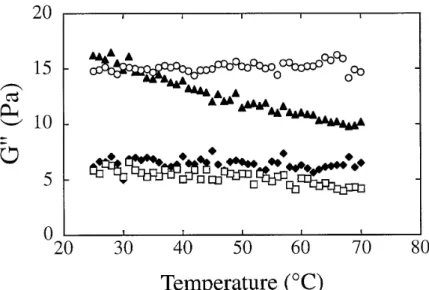
The evolution of G9 and G0 during the cooling and heating cycles of the 0.5% and 1% xanthan gum ([h]0.1 MNaCl5 3.3 m3kg21), 1% 1:1 ke firan/xan-than gum and 1% 1:1 guar gum/xanfiran/xan-than gum sys-tems are depicted in Figs. 7 and 8. The G9 modulus for 0.5% and 1% xanthan gum increases strongly as the temperature is decreased from 70 to 258C. The G9 vs. temperature profiles for cool-ing and heatcool-ing were virtually the same. The G0 vs. temperature profile was essentially flat in this temperature range, and again the heating and cooling cycles gave identical results. In the pres-ence of salt (0.1 M NaCl) the xanthan molecules should be present in the system in an ordered state (Milas & Rinaudo, 1986); hence, the G9 and G0 vs. temperature profiles of the ordered xan-than molecules can be associated with the degree of macromolecular association which increases
System Tg(8C) Tm(8C) G9 at 58C (Pa) 0.8% k-car 05 16 06 1% k-car 24 32 54 1% 1:4 kefiran/k-car 13 21 09 1% 1:4 guar/k-car 10 25 20 Tg: gelation temperature. Tm: melting temperature.
G9: storage modulus at the frequency of 6.3 rad n21.
Table 2Parameters related to the sol–gel transition of the binary system constituted by kefiran and k-carrageenan (k-car)
Figure 7Evolution of G9 as a function of temperature at the frequency of 6.3 rad s21for xanthan at the concentrations of 0.5% (h) and 1% (s), and binary mixtures of xanthan with guar (m) and with kefiran (r).
with decreasing temperature. As in the case of xanthan alone, both 1% 1:1 kefiran/xanthan or guar/xanthan mixtures displayed an increase of G9 as the temperature dropped from 70 to 258C. The G0 vs. temperature profile was flat for the 1% 1:1 kefiran/xanthan mixture, whereas in the case of 1% 1:1 guar/xanthan blend a slight increase of G0 was observed with the decrease of tempera-ture. (The G9 vs. temperature profiles of both blends for either cooling or heating were again essentially the same.) In general, the G9 and G0 vs. temperature profiles of both kefiran or guar/xanthan mixtures displayed a thermorheo-logical behaviour which is intermediate between those of 0.5% and 1% xanthan cooling-heating cycles. In the present experimental conditions (0.1 M NaCl), no significant interactions should take place between guar and xanthan (Lopes et al., 1992). Therefore, the difference between the G9 and G0 vs. temperature profiles observed for kefiran or guar/xanthan mixtures and those for 0.5% and 1% xanthan should be ascribed to a lack of interactions between kefiran (or guar) and xanthan. Consequently, the differences described between the G9 and G0 vs. temperature profiles of the two mixtures (kefiran or guar/xanthan) and those of xanthan alone should reflect the lower intrinsic viscosities of kefiran and guar when com-pared with that of the xanthan gum sample. This fact can also be explained by a dilution effect since there is a lowering of the xanthan concen-tration down to 0.5% in the 1:1 mixed systems at
1% total polymer concentration. Kefiran/xanthan mixtures displayed similar trends to those of the guar/xanthan blend; however, the G9 and G0 vs. temperature profiles are lower than in the case of the guar/xanthan blend. By the same token, the lower G9 and G0 values described for the kefiran/xanthan mixture when compared with that of guar/xanthan can also be explained by the lower hydrodynamic volume occupied by the kefiran molecules in solution compared with the guar molecules (a fact that can be accounted for by the different values of the intrinsic viscosity of guar and kefiran samples).
Conclusions
The results reported in this communication per-taining to Portuguese native kefir grains are in general agreement with those obtained for kefir grains from other countries in respect of the microbial flora, especially lactobacilli and lacto-cocci.
Kefiran can form weak gels in conditions of low water activity with potential practical appli-cations. The effect of kefiran on the thermal behaviour of k-carrageenan or xanthan systems shows no synergistic effects. The thermorheologi-cal profiles of kefiran/xanthan or k-carrageenan mixtures are comparable to those described for guar/xanthan or k-carrageenan mixed systems. The studies on the viscoelastic characteristics of biopolymers as a function of temperature allows
Figure 8Evolution of G0 as a function of temperature at the frequency of 6.3 rad s21for xanthan at the concentrations of 0.5% (h) and 1% (s), and binary mixtures of xanthan with guar (m) and with kefiran (r).
an assessment of their performances as ingredi-ents in food systems which undergo thermal treat-ment.
Acknowledgments
The experimental contribution of J. António Couto (c/o Escola Superior de Biotecnologia) to the performance of the electrophoresis experi-ments is gratefully acknowledged. The k-car-rageenan and the guar gum were gifts from SBI (France). The xanthan gum was kindly supplied by Jungbunzlauer Xanthan (Austria). White table wine was a gift by SOGRAPE (Portugal). Milk was a gift by AGROS (Portugal).
References
Bergey (1986). Manual of Determinative Bacteriology. Pp. 1043–1065; 1209–1234. Baltimore: Williams & Wilkins. Barnett, J.A., Payne, R.W. & Yarrow, D. (1990). Yeasts:
Characteristics and Identification. Pp. 27–31, 602. London: Cambridge University Press.
Clark, A.H. & Ross-Murphy, S.B. (1987). Structural and mechanical properties of biopolymer gels. Advances in Polymer Science, 83, 55–192.
Cuvelier, G., Peigny-Nourry, C. & Launay, B. (1990). Viscoelastic properties of physical gels: critical behaviour at the gel point. In: Gums and Stabilizers for the Food Industry – 5, (edited by G.O. Phillips, D.J. Wedlock, and P.A. Williams. Pp. 549–552. Oxford: IRL Press.
Da Silva, J.A.L. & Gonçalves, M.P. (1990). Studies on a purification method for locust bean gum by
precipitation with isopropanol. Food Hydrocolloids, 4, 277–287.
Fernandes, P.B., Gonçalves, M.P. & Doublier, J.L. (1991). A rheological characterization of kappa-carrageenan/galactomannan mixed gels: a comparison of locust bean gum samples. Carbohydrate Polymers, 16, 253–274.
Fernandes, P.B., Gonçalves, M.P. & Doublier, J.L. (1992). Effect of galactomannan addition on the thermal behaviour of kappa-carrageenan gels. Carbohydrate Polymers, 19, 261–269.
Fernandes, P.B., Gonçalves, M.P. & Doublier, J.L. (1996). Influence of locust bean gum on the rheological properties of kappa-carrageenan systems in the vicinity of the gel point. Carbohydrate Polymers (in press). Fujisawa, T., Adachi, S., Toba, T., Arihara, K. &
Mitsuoka, T. (1988). Lactobacillus kefiranofaciens sp. nov. isolated from kefir grains. International Journal of Systematic Bacteriology, 38, 12–14.
Harrigan, W.F. & McCance, W.F. (1976). Laboratory Methods in Food and Dairy Microbiology. Pp. 270–277. London: Academic Press.
Kandler, O. & Kunath, P. (1983). Lactobacillus kefir sp. nov., a component of the microflora of kefir. Systematic Applied Microbiology, 4, 286–294. Kersters, K. & De Ley, J. (1975). Identification and
grouping of bacteria by numerical analysis of their electrophoretic protein patterns. Journal of General Microbiology, 87, 333–342.
Kiredjian, M., Holmes B., Kersters K., Guilvout I. & De Ley J. (1986). Alcaligenes piechaudii, a new species of human clinical specimens and the environment. International Journal of Systematic Bacteriology, 36, 282–288.
Kooiman, P. (1968). The chemical structure of kefiran, the water-soluble polysaccharide of the kefir grain. Carbohydrate Research, 7, 200–211.
Kosikowski, F.V. (1977). Cheese and fermented milk foods. Pp. 40–42. Ann Arbor, Michigan: Edwards Brothers. Laemmli, U.K. (1970). Cleaving of the structural proteins
during the assembly of the head of bacteriophage T4 . Nature (London), 227, 680–685.
La Reviere, J.W.M. (1963). Studies on kefir grain. Journal of General Microbiology, 31, 5. (Proceedings of the Society for General Microbiology).
La Reviere, J.W.M, Kooiman, P. & Schmidt, K. (1967). Kefiran, a novel polysaccharide produced in the kefir grain by Lactobacillus brevis. Archives of Microbiology, 59, 269–278.
Lin, Y.G., Mallin, D.T., Chien, J.C.W. & Winter, H.H. (1991). Dynamic mechanical measurement of crystallization-induced gelation in thermoplastic elastomeric poly propylene. Macromolecules, 24, 850–854.
Lopes, L., Andrade, C.T., Milas, M. & Rinaudo, M. (1992). Role of conformation and acetylation of xanthan-guar interaction. Carbohydrate Polymers, 17, 121–126.
Milas, M. & Rinaudo, M. (1986). Properties of xanthan gum in aqueous solutions: role of the conformational transition. Carbohydrate Research, 158, 191–204. Molska, I., Moniuszko, I., Komorowska, M. &
Merilainen, V. (1983). Characteristics of bacilli of Lactobacillus casei species appearing in kefir grains. Acta Alimentaria Polonica, 9, 79–89.
Morris, E.R. & Ross-Murphy, S.B. (1981). Chain flexibility of polysaccharides and glycoproteins from viscosity measurements. In: Techniques in Carbohydrate Metabolism B310, (edited by D.H. Northcote). Pp. 1–46. Elsevier/North-Holland Scientific Publishers, Amsterdam.
Mukai, T., Watanabe, N., Toba, T., Itoh, T. & Adachi, S., (1991). Gel-forming characteristics and rheological properties of kefiran. Journal of Food Science, 56, 1017–1018, 1026.
Mukai, T., Toba, T., Itoh, T., Nimura, T. & Adachi, S. (1990). Carboxymethyl kefiran: preparation and viscometric properties. Journal of Food Science, 55, 1483–1484.
Ohara N., Kozaki, M. & Kitahara, K. (1977). Microbiological studies on kefir I. Isolation and
identification of yeasts from kefir. Journal of Agricultural Science, 21, 92–103.
Ottogalli, G., Galli, A., Resmini, P. & Volonterio, G. (1973). Composizione microbiologica, chimica ed ultrastruttura dei granuli di kefir. Annuario Microbiologia, 23, 109–121.
Rosi, J. (1978a). I microorganismi del kefir: Gli lieviti. Scienza Tecnica Lattiera-Casearia, 29, 59–67. Rosi, J. (1978b). I microorganismi del kefir: Gli
acetobatteri. Scienza Tecnica Lattiera-Casearia, 29, 221–227.
Rosi, J. & Rossi, J. (1978). I microorganismi del kefir: I fermenti lacticci. Scienza Tecnica Lattiera-Casearia, 29, 291–305.
Rozhkova, I.V. (1984). Biomass increase of kefir grains in whey. Molochnaya-Promyshlennost, 9, 14–16.
Toba, T., Abe, S., Arihara, K. & Adachi, S. (1986). A medium for the isolation of capsular bacteria from kefir grains. Agricultural and Biological Chemistry, 50, 2673–2674.
Toba, T., Abe, S. & Adachi, S. (1987). Modification of
KPL medium for polysaccharide prodution by lactobacillus sp. isolated from kefir grain. Japanese Journal of Zootechnical Science, 58, 987–990. Toba, T., Arihara, K. & Adachi, S. (1990). Distribution
of microorganisms with particular reference to encapsulated bacteria in kefir grains. International Journal of Food Microbiology, 10, 219–224. Yokoi, H., Watanabe, T., & Fujii, Y. (1990). Isolation
and characterization of polysaccharide-producing bacteria from kefir grains. Journal of Dairy Science, 73, 1684–1689.
Yokoi, H., Watanabe, T., Fujii, Y., Mukai, T., Toba, T. & Adachi, S. (1991). Some taxonomical characteristics of encapsulated Lactobacillus sp. KPB-167B isolated from kefir grains and characterization of its extracellular polysaccharide. International Journal of Food Microbiology, 13, 257–264.
Zourari, A. & Anifantakis, E.M. (1980). Le kefir: caractéres physico-chimiques, microbiologiques et nutritionels. Technologie de prodution. Une revue. Le Lait, 68, 373–392.