An dr é Raf ae l G . V ie ira UM in ho | 2 02 0 Par is Re vis ite d: Th e Ov er look ed Ae st he tic s of th e Ni ne te en T we nt ie s
André Rafael G. Vieira
Paris Revisited: The Overlooked
Aesthetics of the Nineteen Twenties
Universidade do Minho
Instituto de Letras e Ciências Humanas
André Rafael Guimarães Vieira
Paris Revisited:
The Overlooked Aesthetics
of the Nineteen Twenties
Master Thesis in English Language,
Literature and Culture
Supervised by
Professor Jaime Costa
iv
Direitos de Autor e Condições de Utilização do Trabalho por Terceiros
Este é um trabalho académico que pode ser utilizado por terceiros desde que respeitadas as regras e boas práticas internacionalmente aceites, no que concerne aos direitos de autor e direitos conexos. Assim, o presente trabalho pode ser utilizado nos termos previstos na licença abaixo indicada.
Caso o utilizador necessite de permissão para poder fazer um uso do trabalho em condições não previs-tas no licenciamento indicado, deverá contactar o autor, através do RepositóriUM da Universidade do Minho.
Atribuição-NãoComercial-CompartilhaIgual CC BY-NC-SA
v
Agradecimentos
Começo por agradecer a quem me deu começo, a minha mãe Sílvia, que tudo deu de si para eu poder estar aqui e que, ademais, me ensinou a ser firme de todo e qualquer valor que defenda ou venha a defender. És inabalável. Obrigado mãe por todo o amor e sacrifício.
Grande apreço à minha avó Sameiro, que sempre me alimentou de sorrisos fáceis e me muniu de todos os instrumentos para que chegasse intacto à vida estudantil e adulta. És o nosso pilar. Obrigada avó por todo o empenho e carinho.
Gratidão à minha tia Carina, por ter atuado tanto como minha terceira mãe como minha irmã mais velha, requerendo apenas a minha felicidade em troca. Foste quem me guiou adiante, quem me pavimentou o caminho. És insubstituível. Obrigado Ká por todo o afeto e paciência.
Um obrigado especial ao meu avô Mário por me mostrar que os pássaros não se medem só pelo canto.
Resta-me agradecer com apreço e amor a quem me mostrou que havia mais por aqui. Mais de tudo. Sem ti pensaria curto e abaixo. À minha Helena, um terno obrigado.
Finalmente, pelo suporte assíduo, os amigos.
Obrigado Henrique pelos dezasseis anos e por me mostrares que a bondade é praticável, até quando o chão treme debaixo dos nossos pés.
Obrigado Tiago por aquele café sem razão que aceitaste vir tomar. Já lá vão uns anos, mas a mesa prevalece e não a vejo a oscilar.
Obrigado Carolina, essencialmente, por existires e teres elevado os padrões da licenciatura ao seu nível espectável com extensas conversas conduzidas ao sabor do teu chá de ervas.
Para terminar, não podia deixar de agradecer ao meu orientador, Professor Jaime Costa, que desde cedo me marcou e que é, indubitavelmente, um sabedor. Foi consigo que mais aprendi. Um enorme obrigado pelo apoio, pelas conversas, e, acima de tudo, pela inspiração.
“These are the days that must happen to you” - Walt Whitman
vi
Statement of Integrity
I hereby declare having conducted this academic work with integrity. I confirm that I have not used plagiarism or any form of undue use of information or falsification of results along the process leading to its elaboration. I further declare that I have fully acknowledged the Code of Ethical Conduct of the University of Minho.
vii
Resumo
Esta dissertação tem como objectivo contextualizar a estéctica da década de 1920 relativamente à sua importância na arte e na sociedade. Propõe-se, também, a descrever o ambiente artístico conciso que nasceu em Paris durante o período, motivado por vários factores históricos.
As problemáticas abordadas referem-se às conexões entre diferentes artistas e movimentos, assim como, a possibilidade de a Geração Perdida de autores constituir um arquétipo em vez de ser apenas um subgrupo da literatura Americana. Com isto, levantaram-se matérias relacionadas com dois países intrinsecamente envolvidos: França e Estados Unidos da América. Ambos vivendo realidades
excecionalmente diferentes na primeira metade do século XX.
Como objetivo secundário, ainda que igualmente importante, este trabalho anseia elevar algumas linhas de comparação entre a era escolhida e o tempo presente, na esperança que um melhor entendimento desta época fértil e inexausta possa-se tornar, mais uma vez, enraizada no foro académico das instituições de educação superior e ser salva do aparente esquecimento.
Com o anterior em mente, a metodologia escolhida envolveu uma base suportada pela contextualização da época, seguida por um foco em três formas de arte distintas – pintura, poesia e prosa. Ao estruturar a dissertação desta forma foi possível realçar um número coeso e fechado de figuras e movimentos artísticos, facilitando assim a exemplificação das duradouras inovações que os mesmos trouxeram ao meio artístico visual ou literário.
Após o desenrolar deste estudo foi possível identificar várias razões pelas quais a geração dos retornados Americanos do pós-guerra, possam ser considerados um grupo paralelo ao modernismo Americano, embora sob a condição de terem abandonado o seu país de origem e tenham tido contacto subsequente com a vanguarda Europeia.
Finalmente, com o término deste estudo, é possível concluir que é imperativo que a comunidade académica olhe de forma actualizada para este período devido, distintamente, aos seus princípios inovativos, estéctica singular e o circundante ambiente político-social.
viii
Abstract
The aim of this dissertation is to conceptualize the aesthetics of the 1920’s in relation to their role amid the art and society of the time. It also strives to describe the concise artistic environment that was born in Paris during the period motivated by several historical factors.
The issues addressed refer to the interconnection between the different artists and movements and also to whether there is a reason to consider the writers of the Lost Generation as an archetype or a mere subgroup within modern American literature. This, thus, brought up matters related to the two majorly involved countries: France and the United States of America. Both of which living exceptionally different realities at the first half of the twentieth century.
As a secondary objective, this work wishes to draw a few lines of comparison between the chosen era and the present day, in hopes that a better understanding of this fertile and inexhaustible period can become, once again, rooted into academic focus in higher education institutions and be removed from apparent oblivion.
With the above in mind, the chosen methodology involved a baseline supported by the era’s contextualization, followed by a focus on three distinct art forms – painting, poetry and prose. By structuring the dissertation in this manner, it was possible to highlight a closed number of influential figures, as well as artistic movements, as to better exemplify the enduring innovations they brought to the visual or literary art medium.
Following the pull of this study, it was possible to identify several reasons why, parallel to modernism, the post-war generation of American expatriates could be considered as singular American literary subgroup of American Modernism albeit, admittedly, at the condition having departed from their homeland and consequently having contacted with the European avant-garde.
Finally, with the termination of this study, we can conclude that it is imperative for the academic community to take a renewed look at this era, particularly given its innovative principles, singular aesthetic and surrounding social and political climate.
ix
Table of Contents
Abstract ...vii Introduction ...1 I – Contextualization ...3 1. Aesthetics ...3 1.1. Origin ... 3 1.2. Approach ... 42. Shifting the Point of View ...4
2.1. Youth, the Casualty ... 5
2.2. Through Vibrant Lenses ... 7
2.3. The New Dawn ... 8
2.4. Dry Season ... 10
2.5. Altering of Spatial Perception ... 11
2.6. A Spotlight on Black Culture in the United States...12
2.7. A Spotlight on Black Culture in Europe ... 15
2.8. Economics ... 17
2.9. The Politics of Leaving the Land of the Free ... 17
2.10. Scene: Feminine ... 20
2.11. The Tune of the Decade ... 23
2.12. Religion and the Modernist’s Spiritual Descent ... 23
II – Modern Aesthetics ... 26
1. - The Coexisting of Subjectivity and Objectivity in Aesthetic Scrutiny ... 26
2 - Early Twentieth Century Visual Art ... 28
2.1. The American Artistic Standpoint ... 28
2.1.1. The Ashcan School... 29
2.1.2. Dove and O’Keeffe ... 33
2.1.3. The Armory Show ... 37
x
2.2.1. Enter the Age of Cubic Momentum... 38
2.2.2. Analytical Cubism ... 39
2.2.3. Synthetic Cubism ... 41
2.2.4. The Cube is Closed - Closing input ... 43
2.3. Dadaism ... 43
2.3.1. The Poetics of the Nonsensical ... 46
2.3.2. Dada’s Curtain Call - Closing input... 48
2.4. Surrealism ... 49
2.4.1. Methodological analysis ... 50
2.4.2. As the Clockwork Melted - Closing input ... 54
2.5. Final remarks ... 56
3 - Poetic Renewal - Early Twentieth Century Poetry ... 58
3.1. Cultivating the Image - Imagism ... 58
3.2. the unofficial imagist - e e cummings... 60
3.3. Lost Amid the Waste - T.S. Eliot ... 62
3.4. The Last Verse - Closing input ... 65
4. Fiction as fine art – Fiction and Prose ... 68
4.1. Hemingway, the Iceberg Theory and the “New Prose” ... 69
4.1.1. Hemingway’s Descriptive Technique ...71
4.2. Scott Fitzgerald ... 73
4.2.1. Style and technique ...75
4.2.2. Reality-fueled Fiction - Closing input ... 77
4.3. Gertrude Stein ...81
4.3.1. Stein’s Three Lives and other notable works ... 82
Conclusion ... 87
xi
List of Figures:
Figure 1 - Sanders, August. (1914). Young Farmers (Photograph). Retrieved from: https://www.tate.org.uk/art/artworks/sander-young-farmers-al00014
Figure 2 - Aronson, L., Tenenbaum, S., Roures, J. (Producers) Allen, Woody (Director). (2011). Midnight in Paris. (Film) United States and Spain: Mediapro.
Figure 3 - Nous Quatre à Paris (We Four in Paris). (Hayden, 1930). Retrieved from:
https://www.reproduction-gallery.com/oil-painting/1559213152/nous-quatre-a-paris-c1930-by-palmer-hayden/
Figure 4 - Charleston (Douglas, 1928). Retrieved from: https://ncartmuseum.org/art/detail/charleston Figure 5 -The Descent of the Modernists (Pace, 1924). Retrieved from:
https://blog.supplysideliberal.com/post/55396373003/the-descent-and-the-divine-calling-of-the Figure 6 - Stag at Sharkey’s (Bellows, 1909). Retrieved from:
https://www.clevelandart.org/art/1133.1922
Figure 7 - Six O’clock Winter (Sloan, 1912). Retrieved from:
https://www.wikiart.org/en/john-french-sloan/six-o-clock-winter-1912 Figure 8 - Sunset, West Twenty-Third Street (Sloan, 1906). Retrieved from:
https://www.wikiart.org/en/john-french-sloan/sunset-west-twenty-third-street-1906
Figure 9 - Automat (Hopper, 1927). Retrieved from: https://www.edwardhopper.net/automat.jsp Figure 10 - Nature Symbolized No.2 (Dove, 1911). Retrieved from:
https://www.artic.edu/artworks/90205/nature-symbolized-no-2
Figure 11 - Me and the Moon (Dove, 1937). Retrieved from: https://www.wikiart.org/en/arthur dove/me-and-the-moon-1937
Figure 12 - George Gershwin - "Rhapsody in Blue," Part I (Dove, 1927). Retrieved from: http://www.artnet.com/artists/arthur-dove/george-gershwin-rhapsody-in-blue-part-i-ritKOy0tq56R4PxNHUx41Q2
Figure 13 - Second, Out of My Head (O’Keeffe, 1915). Retrieved from: https://www.nga.gov/collection/art-object-page.75102.html
Figure 14 - Light of Iris (O’Keeffe, 1924). Retrieved from: https://www.georgiaokeeffe.net/light-iris.jsp Figure 15 - Blue and Green Music (O’Keeffe, 1921). Retrieved from:
https://www.artic.edu/artworks/24306/blue-and-green-music Figure 16 - New York, Night (O’Keeffe, 1928/9). Retrieved from:
http://xroads.virginia.edu/~MA02/freed/okeeffe/skyscrapers.html Figure 17 - Girl with a Cross (Georges Braque, 1911-12). Retrieved from:
xii
Figure 18 - Bowl of Fruit, Violin and Bottle (Picasso, 1914). Retrieved from:
https://www.tate.org.uk/art/artworks/picasso-bowl-of-fruit-violin-and-bottle-l01895
Figure 19 – Sunblind (Gris, 1914). Retrieved from: https://www.tate.org.uk/art/artworks/gris-the- sunblind-n05747
Figure 20 - Bicycle Wheel (Marcel Duchamp, 1951, Third Version). Retrieved from:
https://www.moma.org/learn/moma_learning/marcel-duchamp-bicycle-wheel-new-york-1951- thirdversion-after-lost-original-of-1913/
Figure 21 - Karawane (Ball, 1917). Retrieved from:
https://www.aklein.vsfd.hoodmuseum.dartmouth.edu/karawane
Figure 22 - Ball reading Karawane (1916). Retrieved from: https://www.thecollector.com/hugo-ball- founder-of-the-dada-movement/
Figure 23 - Landscape (collaboration work with Valentine Hugo, André Breton, Tristan Tzara, Greta Knutson, 1933). Retrieved from:
Figure 24 - La forêt (Max Ernst, 1927). Retrieved from: https://www.guggenheim.org/artwork/1133 Figure 25 - Untitled (Dali, 1934). Retrieved from: http://www.artnet.com/artists/salvador-
dal%C3%AD/les-chants-de-maldoror-sling-shot-from-les-chants-41fkwa-eLcElt8aNvktDnQ2 Figure 26 - Rayograph (Man Ray, 1925). Retrieved from: https://arthistoryproject.com/artists/man
ray/rayograph-1925/
Figure 27 - blac! (ee cummings, 1940). Retrieved from: https://www.pinterest.co.uk/pin/397653842091517000
Figure 28 - l(a (ee cummings, 1958). Retrieved from: https://owlcation.com/humanities/EE Cummings-The-Power-of-Structure-and-Form
Figure 29 - Robert P. Lamb (p.52). Retrieved from: Art Matters: Hemingway, Craft, and the Creation of the Modern short story. [PDF]
Figure 30 - Watch (Murphy, 1925). Retrieved from: https://collections.dma.org/artwork/5047701 Figure 31 - Cocktail (Murphy, 1927). Retrieved from: https://whitney.org/collection/works/10120
Introduction
In the first year of this master’s degree, we were directed towards the exploration of the intertextuality of works and the interconnectedness of different art forms – thus, making aesthetics the perfect meeting point for all the different artistic expression. This work emerges out of interest, as well as intrinsic will, of deconstructing an era (and generation) that was built upon foundations of joint learning and an immense drive to make a new imprint. The dichotomous nature of the era also strengthened its appeal. Since the typical modernist appears considerate of the inner workings of Man, one can be quick to judge these artistic movements as born out of pure individuality and self-reflection. Much of the challenge resides in turning these notions off and finding the link between overlooked contexts or philosophies and the raw factual data. Only then can the outcome help us portray the ethos of the era in question.
Our analysis should thus follow the chain of events of the turn of the century, all the while highlighting the most impactful happenings of the time such as World War I or the standardization of the use of electricity in the cityscape, for instance. By doing so, we can begin to ponder how could these circumstances, that vary in influence, alter the perception of the work of art.
Although not exclusively, the nature of this dissertation implies a large focus on American influence, be it social or literary. Because of this, it is expected of this work to shed light on the American viewpoint, using European notable figures and occurrences as a steppingstone. This is represented by the emphasis on the Lost Generation group of writers. Effectively, this is what allows this work to maintain a line of focus, so not to deviate from its global objective.
Admittedly, there is enough content within one artist, or even a single painting or poem, to develop an entire dissertation on. However, for the purposes of constructing a wholesome picture of a period, one feels very much enticed to enrich the work with as many contributors as possible. For that reason, the direction followed by this dissertation implies a reference to several painters, poets and writers along with their innovative techniques or movements. This proves crucial not only for the structure of the work itself, but also for the comprehension of the interactions between these figures – both in timeline and content. A good example of this situation is the impact of Cubism in other art forms, since its development paved the way, not solely in approach, but also in timing.
An important aspect that may help justify the making of this study revolves around its comparability with the present day. Or rather, its similarities and contrasts, which might be able to help us understand what can be expected of the art medium in the present-day version of the twenties – one hundred years after these subjects of study propelled modern art. It should serve, then, as a reflecting exercise to balance
2
how a generation acts, feels and expresses itself after a war, versus how one reacts to its absence clouded in imminence. This, along with some quite relevant social phenomena, like the Prohibition or the acknowledgement of women’s rights, can further reinforce the belief that the study of this epoch should be prioritized in the academic setting.
The chosen bibliography supports itself on the work developed in several academic writings – such as essays and dissertations – along with news articles, published works, paintings, photographs and other types of relevant content.
3
I – Contextualization
1. Aesthetics
1.1. OriginAesthetics, or the way we conceive and appreciate beauty, can be seen differently depending on which era one is focusing on. Indeed, the patterns by which we define what is pleasant to the eye differ geographically, temporally and even personally. To conceptualize, or even simply draw the outline, of something that is inherently made to satisfy a large group of people is no simple task. Most of the times, an artist will argue that that is not the point of their artwork and in fact it probably is not. What one can be sure of is that what is aesthetically well seen by a large group of people is rarely so by chance. Art, as we know, was initially seen as a means of deception, either by not representing the real accurately, or by doing it so well, and in such manner, that the observer would be fooled to mistake it with reality itself – which pointed out art’s dangerous nature. This is better described as Plato’s stance. It is also during his time that the English root word “art” came from to describe something apart from nature, made by Man (e.g. “artificial”). (Blocker & Jeffers, 1999: 2). On the other hand, we have Aristotle’s assessment, which seemed to tilt towards a more encompassing notion of art and, thus – abandoning the more precise demands of his teacher. For Aristotle, there needed to be at least some kind of separation between art and politics or philosophy – letting out a shout for autonomy. But in his merit, Plato seemed well intended.1 He fully recognized the power in art that his student later acknowledged, only the former chose to be cautious of it, since admittedly it had such a strong potential for social impact. What seemed crucial for Plato and indifferent for Aristotle were its boundaries. While the first insisted that art should follow clear ideals of morality – usually pressing on harmony, balance and proportion to ensure society would trail the same lines –, the latter found that art should live separate of pure rationality and science, elevated above those notions in a cloud of its own. More importantly, however, is how both stances can be said to have defined our own outlook on the notion of aesthetics, one that remains forever tied with the good, the beautiful and the cathartic. (Blocker & Jeffers, 1999: 3 and 4)
1“We all know that art is not truth. Art is a lie that makes us realize truth” (Picasso, 1923). This statement stands as proof of the timelessness of Plato’s
4 1.2. Approach
The aesthetic elements highlighted in a product of art, be it a poem or a painting for instance, can be identified through analysis of its blueprint, its structure, its color, shape or rhyme scheme. Being a mostly subjective notion, much of it is relative; however, here the main goal will be to take note of what the authors of said works included as a base of their art that might be suggestive of aesthetic elements and not what readers might consider pleasant or, by contrast, horrible.
Since aesthetic feedback depends so much on the audience’s personal experience, it is easy to tell why studying the 1920’s and the so-called Lost Generation2 might be a trail worth pursuing. Not only does this era entail a plethora of authors and movements whose primary objective was to break the mold, it also brings forth a sense of relatability associated with an indefinite future and continuous mutation of the American Dream when living as a young man or woman in the modern world.
“For a like reason, we are more pleased, in the course of our reading, with pictures and characters that resemble objects which are found in our own age or country, than with those which describe a different set of customs.” (Hume, 1757/1910, p.231)
2. Shifting the Point of View
“But though all the general rules of art are founded only on experience, and on the observation of the common sentiments of human nature, we must not imagine, that, on every occasion, the feelings of men will be conformable to these rules” (Hume, 1757, p.220)
One should first contemplate, from one’s privileged position, the historical and social status of the Western World in the nineteen twenties. What may have been a motivator to change the population in such a way that it thirsted for a change, a new way of grasping the reality surrounding them?
2The term refers to the generation of people who reached adulthood during or immediately following World War I. It is also specifically used for the
5 2.1. Youth, the Casualty - World War I
The war destroyed kings, Kaisers, czars and sultans; it demolished empires; it introduced chemical weapons, tanks and airborne bombing; it brought millions of women into the work force, hastening their legal right to vote. It gave independence to nations like Ukraine, Poland and the Baltic countries and created new nations in the Middle East with often arbitrary borders; it brought about major cultural changes, including a new understanding of the psychology of war, of “shell shock” and post-traumatic stress. (Erlanger 2014)
World War I appears as the obvious motivator, since it was the first conflict in such a global scale and one of the worst, most casualty-filled military movements in history. To have suffered the consequences, both by being in the trenches or witnessing the devastation as it occurred, must have been terrifying and life-changing in more ways than one. When death is nigh, human nature makes one backtrack and rethinks what was previously set in stone. Art and self-expression demand innovation to advance as much as a tank demands fuel to run and, therefore, it was unavoidable that surviving a war would result in fresh ideas and movements that defied the preconceived order of the world.
Visual arts, especially, although not exclusively, can be pointed out as having a deep and long-lasting connection with war, conflicts and battles – being that a clash of ideologies portrayed by the raw, animalesque and socially impactful actions of men offer several artistic premises that should not be ignored.
Perhaps the biggest outcome of the war, excluding political results, human casualties and overall destruction caused (and suffered) by its participants, was the change of mentality that turned the glory of war and the besting of the other nation into a desolating, pointless affair. Defending the interests of your country, at the beginning of World War I, represented the major goal of all young men who had volunteered. The nature of war had been distorted over time, bent in all directions by heroic tales of the past and wartime propaganda, creating a feeling of guilt in all those who did not offer to put their life at stake. In the aftermath, at the trenches, putrid and wet, nothing seemed to matter anymore.
At the turn of the century, modern ways came sweeping through the land. The outcome of the horrible battle brought along great findings and changes of mindset at the expense of human lives. Previously undiscussed consequences of sending troops to battle, such as individual traumatic repercussions, became a subject to be considered. It now demanded a question: Can a man truly come back unscathed from war? Or rather: Can these men be expected to come back from an outdoor slaughterhouse and
6
restart their lives as if they had not seen the horrible things they clearly had? This was a feeling perpetuated by T.S. Elliot’s The Waste Land: “And the dead tree gives no shelter / the cricket no relief, / And the dry stone no sound of water.” (1922) A generation lost in an arid land which offered no shelter and, above all, no relief.
To better analyze this matter, one may resort to photography given its objectivity in documenting history. August Sander was a renowned German portrait and documentary photographer known to depict the way of life of his home country, both in rural and urban settings. Appropriately, his subject theme was noteworthy for its ability to display the transition period between the countryside and the cityscape.
In Young Farmers, a photograph dating to 1914, Sander depicts three young men (who were in fact not farmers, but workers of an ore mine) in their twenties on their way to a dance. The clothes they wore are relevant since a few decades before, it would have been unthinkable for a farmer, or even a mine worker, to have access to such an attire – highlighting the beginning of a stir in the class system, manufacturing industry and consumerism. (Berger, John. 1980: 34) Yet, more prominently, this portrait’s execution allows it to be a kind of ode to the generation that would be struck by a world war shortly after the picture was taken. Their forward-facing position and the manner they look at the camera over the shoulder is reminiscent of youthful impatience. Moreover, their overall posture of vanity seems to indicate the feeling of pride of going towards a special event, well-dressed and accompanied by friends. But then, the picture also exerts some very clear pressure, perhaps because of elements such as the canes they carry or the cigarette one of them holds in his mouth – both reminiscent of higher class, or at least showing a urban lifestyle that does not harmonize with the countryside of the time. Or perhaps, it is rather in the way they are framed that we find this tension, this odd atmosphere. By focusing on their heads in the clouds and feet on the mud, as well as the line of the horizon stubbornly cutting through each one of their heads, one is left with a heavy image of young doubt. An image that would later prove to be an omen, since a few months afterwards, the three boys were drafted to the German Armed Forces to fight in the war, tragically resulting in the death of Auguste Klein, the young man in the middle, and the wounding of Otto Krieger and Ewald Klein. This portrait must be one of many representing the lives of a generation lost amid a conflict they did not chose to feed or much less begin. As John Green expertly put it: “(…) a picture is not a life. The young farmers photograph is about what those boys don’t know, but it is also about what we don’t know, and a reminder of what a picture cannot show us.” (Green, 2019)
7
Figure 1 - Young Farmers (Sander, 1914)
2.2. Through Vibrant Lenses - Photography
Technological breakthroughs also open creative doors. Though, before they are accepted by a given society, they go through an understandable phase of scrutiny. If something threatens one’s way of life, even slightly, the result is a questioning of its very purpose – not to simply put something down, but rather to prevent what negative outcome may arise from any such change. Perhaps, here it is relevant to mention the appearance of photography as a major motivator for traditional arts’ abandonment of the exact and the real, of depicting what is seen the way it is seen. If there was a simpler, more faithful way of producing a picture mimicking what we pick up with our eyesight, why should art bother to do the same? Why not depict what is felt or a personal, less thought of interpretation? These questions made it possible for another approach to arise, one that yearned for experimentation – motivating attempts to visit and represent previously uncharted places, such as the complete human psyche (mind, conscious and
8
subconscious). Moreover, with traditional art’s modern outlook, photography might have gained an advantage as well, allowing it to branch out and be accepted as its own artform, even after a prolonged skepticism of its use of “machinery” to express and convey elements of the human condition.
2.3. The New Dawn - Electricity
“Is it a fact — or have I dreamt it — that, by means of electricity, the world of matter has become a great nerve, vibrating thousands of miles in a breathless point of time?”
(Hawthorne, 1851/2008, p. 229)
Our time is engulfed in technology, which seems to limit the absorption of the imaginary and of artistic expression in general. In a different, but still revolutionary way, so were the people of early 20th century. They too had to deal with the extension of the day, for instance. The introduction of gas lighting to substitute oil lamps in late 19th century, as well as the arrival of electricity in the 20th century (as to replace gas lighting) swept away and left the population of the major western cities in awe (Hodara, 2016). This newly found brightness offered several possibilities as how to live one’s life or what business to invest in. This is one example of an aspect that is, presently, taken for granted but that was once revolutionary in ways which then seemed near impossible to fathom. From the moment the hours of the night became useful, the population began adapting to the shifting reality. This, along with social and political tranquility, ended up being one of the crucial reasons why the French Belle Époque (1871-1914), is remembered as beautiful.
But where does electricity stand out in comparison with Paris of prior years, under the gas lights? In a sense, we should have to consider a process of turning Paris into the city of lights, we have to concede, that it started around the eighteen seventies and culminated in the nineteen twenties. It inevitably led to a change bringing about a more vivid nightlife (in cafes, restaurants and bars alike). This welcomed the standardization of electricity allowed the decade to reach its full potential and coin terms such as “Années Folles”3. Indeed, this “investment” on the later part of the day– along with the recent end of a terrifying war – contributed heavily to the fame and wonder around these years, especially so in Paris.
9
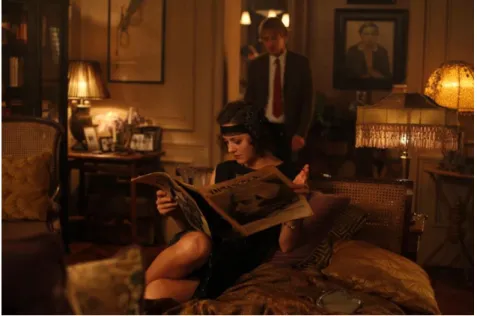
Because of the multiplicity of subjects in the theme of this dissertation, the use of different art mediums can be beneficial to better situate oneself. In a scene from Woody Allen’s Midnight in Paris, the main character Gil (portrayed by Owen Wilson), who travels back in time to Paris in the 1920’s states: “Because you look around and every street, every boulevard, is its own special art form and when you think that in the cold, violent, meaningless universe that Paris exists, these lights (…)” (Aronson & Allen, 2011)
In this film, which was served to viewers among a tray of romantic comedy mixed with magical realism, Woody Allen opted for a warm color palette for the night and indoor scenes to capture the nostalgic aesthetic created by the yellow lights that would have fed Paris. (Fig.2)
Figure 2 - Still from Midnight in Paris (37:51)
It appears obvious, then, that much of what one knows about the decade was promoted by the standardization of electricity and, consequently, the lights that lit up the cityscape and, more specifically, the households. Even Jazz music could be said to be electric at heart. The ambient mood captured in this, willingly highlighted by Woody Allen in his film, allows us to imagine how this revolutionary technological innovation might have been see by Parisians. It also delineates a very particular aesthetic associated with the time, be it in clothing, lighting or decoration.
10 2.4. Dry Season - Prohibition
“Understand now, I'm purely a fiction writer and do not profess to be an earnest student of political science, but I believe strongly that such a law as one prohibiting liquor is foolish, and all the writers, keenly interested in human welfare whom I know, laugh at the prohibition law.”
(Fitzgerald, 1928)
For quite some time in the United States, as well as in most of the world, alcohol played an important role in the everyday life of the population. This was not only the case for the working class – that took it as a stimulant in hopes of a supposed increase in productivity – but also in all the steps in the social ladder. Typical use was not only recreational, it was also seen as a means of fighting illnesses, something that doctors themselves would recommend. It is obvious that misinformation about alcohol and its side-effects and consequences was a great problem by itself, but it was not quite the reason why the 18th Amendment of 1917 (later ratified on 1919) was implemented in the first place. It was thought to make sense politically in the progressive era, easy to defend in the post-war, but proved highly complicated to implement since, not surprisingly, the population had grown accustomed to alcohol’s enticing spell. Furthermore, according to Peter Sasso: “It allowed reformers to assault big liquor while advocating for a moral cleansing that would strengthen the nation. Prohibition also encouraged early dry advocates to condemn urban decay and crime caused by drunken debauchery.” (2010, p. 5)
Indirectly, this contributed to two major social consequences: firstly and more evidently, the rise of organized crime, which now had the green light to sell a commodity everyone was already used to consuming and paying for, while being able to define where and at which flow it was sold, resulting in a monopoly on a substance that for many constituted part of the daily routine as much as food or water. Life in the major cities of the United States became increasingly unsafe with the rapid growth of these criminal organizations (e.g. the Italian American mafia). This motivated literary depictions, most famously, Hemingway’s short story The Killers which described how one’s fate was sealed if one would become a target for these new age criminals. (Hemingway, 1927)
What also ended up happening, after alcohol was made into the new forbidden fruit, was that a sudden migration of intellectuals, mostly, towards the European landscape which for a while, took the place of the United States as the land for freethinkers. Paris, specifically, brought to the table the feeling of an American speakeasy, without the dangers and illegality associated with it – and this was far from the only thing it imported, mimicked or made better and that consequently attracted young Americans.
11
For example, in the watercolor composition by Palmer Hayden shown below, the central characters belong to a social minority that found (hedonic) comfort in a French capital that chose not to prohibit the consumption of liquor while showing substantial glimpses of racial acceptance, both of which unthinkable America at the time. Interestingly, these characters also display a degree of worry, with all their heads looking over their shoulders. (Fig.3) This might have been an indication by the Hayden, referring to an underlying remnant of the uneasiness faced in American soil that was transposed to the Parisian setting. In other words, this sense of restlessness was carried over when they crossed the Atlantic.
Figure 3 - Nous Quatre à Paris (We Four in Paris). (Hayden, 1930)
2.5. Altering Spatial Perception
Distance had always been a limiting factor for people to move around or contact one another. This was facilitated with the invention and mass-production of the car. What this effectively meant was that there would be a move from animal powered vehicles, to actual petrol engines – from the simple and the natural to the intricate and mechanical in a sudden sweep. Taxis, especially for those taking advantage of the exchange rates, were cheap and bountiful allowing no one the excuse of missing a rendezvous. Noise pollution rose significantly helping to further implement the image of the modern cityscape, now more mechanical than ever, while at the same time getting rid of the waste left behind by the carriages and
12
their horses. Since the beginning, the car was a symbol of independence and escape and these two words are synonymous with the era. The line that separated the rural and the urban since the industrial revolution grew thinner and thinner and the suburbs arose as a decent possibility for the regular family to live in. In 1800, it is estimated that the world’s population reached its first billion. Agreeably, it took a long time to get to this point, however, by 1900 the population was already closer to the second billion. The world had almost the same amount of population growth in one century as it did in the thousands of years prior. Because of this, when bell of the turn of the century tolled, there was an interest of going farther than ever before. Not only figuratively but also literally (by traveling and/or mixing influences). Therefore, one can deduce that this change in how distance was perceived was important for the development of modern society and, further down the line, its relationship with art.
The normalization of the candlestick phone also allowed for more long-distance communication, which facilitated the spread of information. Not surprisingly, this affected the mentality of those who were born or lived around those years and, predictably, made it so people directed both their amazement and their skepticism to this new age of technology. Much of what needed to be said about the matter came in the form of modernist art. If not in its themes – such as speaking about the rumbling of machinery, oil or factories – art followed the idea of innovation and chose to abandon old ideals of truthful reenactment of the real and the palpable. Making it new, for all intents and purposes, and turning art into a murmur from within that made its way towards the outside rather than a depiction of the exterior the artist chose to transpose to a canvas. Even if, at times, the artist took inspiration from a peripheral object, it would never progress to the blank page before it was filtered through and shaped by his inner self.
2.6. A Spotlight on Black Culture in the United States: The Harlem Renaissance
The New York neighborhood of Harlem had been planned in the second half of the nineteenth century to become a kind of upper-class haven for wealthy white people. The sheer scale of residency turned out to be too extensive to fill in and soon black families from a nearby neighborhood moved there, upsetting the original residents and eventually resulting in most of them abandoning the area all together. This period coincided with the Great Migration (where millions of African Americans moved from the rural south to the cities of the north) and Harlem became one of the most densely populated neighborhoods for this reason. With such a great concentration of families of similar background it is no wonder that culture rose to the surface and flooded the premises with music, performative arts such as dance, poetry
13
and all manners of self-expression. The generally accepted date of the so-called Harlem Renaissance is between 1920 and mid 1930’s and it helped secure the beginning of the century as one of globalized taste, not limited to the culture of the old continent. Another characteristic that helped Harlem achieve a remarkable notoriety during this period were the speakeasies that found their way into the neighborhood and allowed Jazz, Blues and the Charleston to proliferate. Since these cultural phenomena attracted whites to the neighborhood, the bohemian ambience led to a clash between whites and blacks and as in many other cultural clashes, this ended up being less than positively interpreted. As described by Langston Hughes in The Big Sea:
“Nor did ordinary Negroes like the growing influx of whites toward Harlem after sundown, flooding the little cabarets and bars where formerly only colored people laughed and sang, and where now the strangers were given the best ringside tables to sit and stare at the Negro customers—like amusing animals in a zoo”. (Hughes, p. 176)
As we know, what goes up, usually ends up coming down. The swollen economic boom was no different. After the crash of the stock market (1929) and the end of the Prohibition (1933), many had to look elsewhere for income, resulting in a departure from Harlem and the north of the US – both in investment and in the number of people residing/maintaining businesses. The Renaissance was over but the voices of those that emerged from it would still echo for years to come.
But was it as magical, to the locals, as many seem to believe? According to yet another passage of Hughes biography, the “ordinary Negroes hadn’t heard of the Negro Renaissance. And if they had, it hadn’t raised their wages any.” Even then, the idea of a black Renaissance was likely to have been thought of by black intellectuals and/or upper-class whites, who chose to romanticize the epoch because they had been allowed to be part of it. But the general population of Harlem was not included in their own home’s entertainment – they had been turned into extras for this metaphorical play, allowed to be around the main actors, but never so close as to become one of them. Or as Hughes put it: “As for all those white folks in the speakeasies and night clubs of Harlem—well, maybe a colored man could find some place to have a drink that the tourists hadn’t yet discovered.” (Hughes, p.178)
Of the many notable figures, Langston Hughes stands out as one of the most influential. His style of poetry had never been seen before, it took advantage of the way black people spoke and the musicality of Jazz and Blues, while taking pride of all that their culture achieved, did or knew. Curiously, Hughes spent much of the period of activity of the Harlem Renaissance traveling – well aware of its ephemeral nature – and even remained in Paris halfway through the Jazz Age. It was there that he found another
14
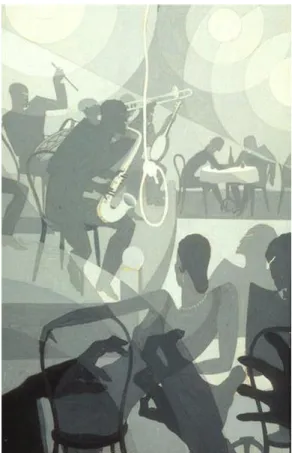
instance of racist inclinations when he was denied jobs, multiple times, losing them to his white counterparts. (Hughes, p. 130) This is one of the instances he took inspiration from to write I, too, a poem that starts with the verse: “I, too, sing America” (referring to the national anthem and the patriotic feeling of a black American) and that finishes with the equally self-explanatory verse: “I, too, am America.” (1926) Another well-known figure of the Harlem Renaissance was Aaron Douglas, a painter known for his modernist style that blended together African American and modernist art. His work was especially appreciated as an illustrator, even more so before the nineteen thirties (decade where he went on to produce his best works). The products of his imagination transcribed to the blank page resulted in compelling images composed by black shadows, often part of a type of performance. The use of Art Deco stylistics fueled Douglas’ intention of making his compositions act as a reminder of how blacks were seen in society, always as shadows that in one way or another had to hide but that struggled with many of the same issues – and more – than any white man or woman. Additionally, and perhaps more distinctive is “the rendering of an all-black world in which whiteness is not a point of reference.” (Thompson, 2000). The use of color in his works prior to 1930 seemed to be limited to a pale palette, darkening the tone of the illustration. The shapes are reminiscent of human figures but more geometrical rather than preoccupied with the faithfulness of the real. In Charleston, Douglas opted a satirical approach regarding the newly embraced interest in black culture. (Fig. 4) In it, the protagonist bathes in the limelight while a similar bright colored rope hangs from the ceiling. This rope seems to act as a reminder of gloomier intents behind the sudden change of perception towards black people. With this simplistic yet polished style, Aaron Douglas found a way to break the norm.
Finally, where Douglas also stood out was in his preferred means of exposition, choosing to publish his works in public media such as newspapers, magazines and books. Because of this, he would, more often than not, contribute to a collaboration between literature and painting, creating a rather complete composition of liberal intentions that could reach all walks of life, while describing the role of African Americans in the everyday life of the United States. (Earle, 2007, p.12)
15
Figure 4 - Charleston (Douglas, 1928)
2.7. A Spotlight on Black Culture in Europe: 1920’s Paris and the Concept of Negrophilia
At first glance, and to the untrained eye, the way black culture jumped to the spotlight in early 20th century Europe and, specifically, the nineteen twenties looks like a sign of progress, of overcoming and leaving behind old racial stereotypes that had long been tainting the western way of living. From the long, elongated African face masks serving as inspiration for various painters and sculptors to the musical phenomenon of Jazz and the seemingly offensive use of African American individuals in advertisements, the appropriation of black culture became an obsession to the point that one would be less in vogue, less fashionable if uneducated about the matter. Négrophilie (in French), or Negrophilia (i.e. love for black culture), became a kind of rebel status symbol in nineteen twenties Paris, where it had a fairly liberal connotation. (Archer-Straw, 2000)
Artistically, the importation of black culture into mainstream Parisian vanguard happened gradually over the years following the start of the twentieth century. Years prior to the events and the twists and turns that made young Americans become part of the Lost Generation in the first place, Paris was already thriving with artists. According to Fisun Güner, a small African figurine purchased by Henry Matisse in
16
1906 was shown to Picasso in Gertrude Stein’s home letting off a spark that would define modernist art forever – equally so overseas, with Max Weber. Güner further explains Picasso’s interest by stating that he “had already absorbed all that European art had to offer” and described him as being “hungry for something radically different” and “new to the Western gaze”. (Güner, 2017)
This seemed to represent a turning point in Paris, one that would come to resonate for years and that would then mark a definite departure from the old Western values and encourage creative endeavors that focused on being spontaneous and impulsive. Perhaps it is fair to say that this became the greatest contribution to all artists that came after, not only to focus on black art forms or other cultures’ art but to attempt what had yet to be attempted. This is the heritage that artists from the Lost Generation got and soon passed down once they stepped in Paris – a heritage that made them to look beyond Western Civilization.
It is also only when one steps away from the artistic standpoint of the era, the one that demanded innovation and an endless search for humanity’s identity and origin, that one starts questioning the true intention of the Parisian vanguard. The recurrent use of terms such as “primitive”, indicated that there was still underlying discriminatory behavior in the mouths of the avant-garde. As stated by Archer-Straw: “for members of the Parisian avant-garde the ‘primitive’ was an antidote to a stifling and civilizing bourgeois modernity; but their positive use of the word could not avoid the negative connotations that it had acquired. (2000, p. 2)
What this stance entailed was that the idea of a superior white race was still being enforced at this time and place, only it was being shadowed by the supposed amazement and interest in black culture. These ideals began flourishing between the 1900 and the years following 1920 – decade where they became even more central – during a time where standing out among the crowd and rebelling against the norm was the only way to live. For blacks, and according to Petrine Archer-Straw, the attraction for whites “was equally strong” since it “valued their sense of worth” and “gave them a sense of power”. In sum, there was indeed a bond created between whites and blacks, but it was one of highlighting differences and being fascinated by them, never quite attempting to find a common ground like in all other interpersonal relationships. In other words, a false start, but a start, nonetheless.
17 2.8. State of Affairs - Economics
“And the closer the impending catastrophe approached, the more a striking acceleration of luxury and high living could be observed.” (Chaney, 2011, p. 10)
In economic terms, France and America were far from being in the same situation – which helped the cause of migration. Paris, for instance, was a cheap destination and only became cheaper along the decade, with its national currency becoming increasingly low compared to the dollar – a war had just ravaged Europe, after all. America, on the other hand, was amid an economic boom that came about after the end of the war, moved by capitalist intentions that resulted in the creation of a consumerist United States. With the due advertisements and technological innovations, the bait was set for the population of a positive, post-war rejoicing country. Not only that, with new methods of production such as Henry Ford’s assembly line, the task of managing supply and demand became much easier to accomplish. Indeed, these were times of great wealth and even greater excess and everyone seemed to want to take part in it. So much so that in the United States, much of the rural population had already migrated to the cities around 1920, in search of better opportunities. The issue, one can easily deduce, was that everyone left the countryside to reach heights in terms of lifestyle and general income that would otherwise be impossible to achieve. This, of course, proved to be unsustainable and resulted in the fall of production, agricultural and otherwise, and a rise in unemployment. By the end of the decade, the scale had tipped, bringing down the stock market and all those involved in it – or just affected by it – back down to earth. In October 1929, the market crashed after years of reckless speculation and a weakened agricultural sector, among other miscalculated ordeals.
Until its inevitable end, however, life in the nineteen twenties (for those that could afford it) was not much more than a giant celebration of sorts, lasting for around 9 years, these were times where everyone seemed inclined to pursue a hedonist lifestyle, in one way or another. The booming economy was the cherry on top that allowed pleasurable excess to become an affordable commodity, especially so if you traveled and took advantage of the strength provided by the American dollar.
2.9. The Politics of Leaving the Land of the Free
First and foremost, why did so many young men and women decide to move out of the United States in the first place? Were there greater political reasons behind the choice of moving out?
18
To answer these questions, one needs to first shift the attention to Warren G. Harding, who before being elected in 1921, had given a speech on what his vision for post-war America would look like. In the speech, usually titled “Return to Normalcy”, the republican presidential candidate calls for the exact opposite of the philosophy of the Roaring Twenties – exalting the need to slow down and take a step back. He proceeds to use antagonistic terms to describe what the American people should look for now that the war was over and what they should leave behind. The terms he spoke positively about reflected his traditionalist ideology, referring to a need for “serenity”, “restoration” and “normalcy” and an obligation to leave behind “revolution”, “agitation” and “the dramatic” (Harding, 1920). Yet, this is where a problem emerged, right amid these highlighted words, and it happened simply because this was not what people had yearned for in a post-war scenario. Much less with the, then recent, implementation of the Prohibition and the rise of Puritanism. Agitation was what the new generation had hoped for (artistically and otherwise), moved by the end of a war and a new understanding of the concept of warfare, the population did not want to slow down, they wanted to live up to all that they almost did not have a chance to. And living up is what they did.
At the end of his speech, President Harding states: “Let us stop to consider that tranquility at home is more precious than peace abroad” in quite a nationalistic fashion, this seems to have had the opposite effect. Regrettably for Harding, tranquility was too tedious for the young, resulting in them leaving the country in search of all that had been denied to them – even if that something were the pleasures of life and the open-mindedness of Europe, this shows the nonconformity of a reasonable percentage of the population of the time. This somewhat conservative stance would continue even after the sudden death of president Harding (1923) with Calvin Coolidge taking his place from 1923 until 1929. As a sign of the times, we can also point out the resurgence of the KKK in 1925 (Ku Klux Klan) as an American attempt at Fascism, which entails an ever-deeper commitment to the right wing, albeit a radical one. At the very least, this certainly did not help the unstable political climate of the time and proved imperative in some minoritiy’s decision of leaving the United States.
In sum, the American post-war political stance became one of control and government-induced tranquility, which for many was just not an option – especially with a booming economy. The world was changing, and people wanted to change with it, to be at the forefront. The United States stopped to look to the past for answers and that ultimately sealed the deal for many who wanted to be intoxicated by the near future instead.
19
To further justify the outward inclination that took so many Americans overseas, one must consider the state of the arts and define whether or not certain political inclinations limited the aesthetics of artists and writers alike.
In the United States, more to the end of the 1920’s and the beginning of the following decade, there seems to have been an increase in realist depiction of rural America, with the movement of Regionalism4 that aimed to depict these areas in colorful yet lifelike fashion. Much of it served as an answer to the Great Depression, something that would please much of the population that, as mentioned above, had to return to the south and the Midwest and whose government promoted a doctrine of recycled social values. In these paintings of conservative nature, the authors seem to detail a similar image as that of the past and invoke traditional values of family, hard-work and escape from modern urban issues. The best instances of these ideas that gained life in a canvas are found in Grant Wood, Thomas Hart Benton, and John Stuart Curry, all of which studied in Paris but came back to the United States to distance themselves of the breakthroughs of modern art and focus on what they considered to be the true American identity. This explains why those with creative endeavors failed to accept the post-war artistic scenario found in America and attempted their luck elsewhere. After all, the difference between Regionalism and anything that emerged from Parisian art around the same time is already significant by itself, but it is further made worse when one considers that this type of American art only fell out of favor after the second World War had ended in 1945. The United States, if one excludes those that made their name in Europe, can be said to have fallen into an aesthetic standstill for at least 25 years.
Another relevant instance comes in the form of the first American to win the Nobel Prize in Literature, awarded in 1930 to Sinclair Lewis, a writer with an innate ability to create witty comedic yet socially relevant stories such as Babbit (1922) – a satirical novel that critiqued the hollowness of the middle-class way of life. In Lewis’ case, he was still following the rhythm of his country’s politics, although with the intent of picking it apart and attacking small-town America’s contradictions and hypocrisies. Where he fell short, however, was in his writing style that did not impose anything different, innovative or definitely characteristic – relegating Lewis to a position where he is still considered important, certainly; but only so for his socially relevant content, never for his aesthetics, which is where those who sought Paris excelled at. In a sense, indicating once more, that aesthetic progress was not to be found in America.
4American realist modern art movement that aimed to depict scenes of rural or small-town America in accordance to conservative ideals and a rejection of
20 2.10. Scene: Feminine
The existence of the concept of social minorities in the first place, is one of human society’s greatest shortfalls. From race and ethnicity to gender and sexuality, there was probably never a point where such small differences were reasoned as truly insignificant by humanity as a whole in an exercise of unanimous agreement. In the nineteen twenties, women caught one of the first glimpses of what that seemingly Utopian scenario could look like.
Right in the beginning of the decade, in August 18 of the year 1920, the 19th amendment was approved, giving men and women an equal right to vote. This unique landmark had taken a long time to come, after the rallying and campaigns for women had actually been going on since the second part of the 19th century. The service provided by women during World War I in the industrial sector, the so-called home front made more evident than ever the need to integrate women into mainstream American society. Indeed, the culmination of this movement and the application of the amendment could not have arrived in a better time, giving women a chance at deciding their own fate and role in this modern society, while gaining some leeway to explore and express themselves at a personal level.
Perhaps the answer lies in the idea that in appearing liberated through what one wore, it gradually became a genuine aspect of personal emancipation. Wearing short hair and short dresses, women were able to project a fantasy of their ideal, liberated selves moving freely in society. (Chaney, 2011, p. 30)
Starting with the obvious, the power finally entrusted to women meant more to them than just the right to vote in the next elections. It meant having a voice and opinion, it meant having a choice. And choices had not been abundant until then, a fact that explains why the first revolution started in the wardrobe. Flappers, as they were often called, were young women who proclaimed their newly-attained freedom by adopting a certain lifestyle, one that included a certain way to act and quite a few fashion accessories all of which culminated in the same old idea – freedom. Their dresses were usually not too long – nor was their hair – but wide and comfortable, combating the old insistence in a slim figure induced by corsets. Smoking became part of the image as well, especially so with the use of a cigarette holder, which prevented the scent of tobacco to stick to their hands, making the act seem more elegant by consequence. These women would, intentionally or not, define the aesthetic of the time by displaying a style that screamed freedom, sensuality and a certain elegance that defied reason – not so many years earlier, after all, “worthy” women would only be described as pure and innocent. The flapper represented herself in ways that would make that description more complex and at times unthinkable, thus, breaking
21
apart from the stereotypes. Paris, then, acted as an extension of this newly found freedom for “American women [who] enthusiastically adopted more public roles in the capital, foregoing the chaperones and rigid gender roles of old.” (Blower, 2011, p. 33).
Perhaps one of the most known examples of a woman that adopted the flapper lifestyle came in the form of Scott Fitzgerald’s wife, Zelda. Not only was she born in an arguably difficult place to be an emancipated woman – Montgomery, Alabama – she was also the daughter of a well-known judge. It is likely that what makes Zelda Fitzgerald such a good representative of the flapper was her life story, which could have ended up with her spending the rest of her life under her father’s wings, and doing men’s bidding, but that instead resulted in her adventurous lifestyle in both the United States and in Europe. Much of the contributions made at this time regarding the so-called “Jazz Age” came from Zelda’s husband, Scott, which in turn makes her as much of an aesthetic symbol as it makes him a “painter” of the era.
For Paris, the one woman who took the city by storm was Josephine Baker. Born in Missouri in 1906, the then soon-to-be icon was exposed to show-business all her life through her parents’ performative acts. Success was met quickly in her teenage years and so, aged nineteen, Josephine got her chance to travel to Paris and give the French crowd a show they would never forget. By using bold outfits and bringing to the stage a type of dance never before seen, which mixed scenes of eroticism and a seemingly infinite amount of vigor, Baker was an instant hit. Soon she would star in several films and shows all over France and Europe and become the most successful American entertainer in the old continent. With this level of fame, it is not surprising that she created fashion trends and had tremendous social influence – becoming a role model and a muse for writers and artists alike. However, her appeal was far from superficial. Eventually, Josephine resigned from being American altogether and became solely French. She then helped France in World War II and went on fighting, all her life, against racist principles as an activist. More than a symbol for the flapper, Baker – who devoted her life to the rights of women and African Americans – was, in all honesty, a symbol of freedom and individual courage. (Caravantes, 2015) To find the true epitome of the flapper through America’s eyes, however, one has to direct the attention to Lois Long, whose pseudonymous “Lipstick” served a column in The New Yorker for years, with telltales of going out to dance all night, mentions of speakeasies and alcohol consumption, and an enormous variety of subjects that would interest the “modern woman” and bother the more traditionalist individuals. With this public space to vent her opinions and thoughts, Lois was able to spread a clear message that showed women all over the United States that times were changing and that if it was a celebratory occasion for men, so it had to be for women as well.
22
It was a decade of fast living and not even the image of the flapper was left aside in advertisement. Indeed, it is easy to understand why publicity companies caught on the fashionable side of being an emancipated woman, especially so for the traditional housewife that now the chance to rethink what was previously set in stone. Anything from cosmetics to cigarette holders were publicized with the “new woman” as a target, and if one was not yet a part of the flapper “movement”, one would quickly start pondering or fantasizing ways to be closer to that idealized image, thus, resulting in successful sales of a said product. As immoral as it might be to play with people’s dreams for a profit, this was part of the consolidation of the flapper as a symbol of the twenties’ popular culture, along with certain novels and films.
Womanhood, as far as literature was concerned, took new turns that went beyond the image of the flapper. Many women characters in some of the most successful novels of the time, were strong-willed and complex without the expected flourishing. In Hemingway’s body of work, for instance, it is common to dismiss his female characters as two typed, dichotomous in the simplest of ways – either angelical or twisted – when in reality one can find many traits in each of these fictional women that would turn them into entities of a complex multi-dimensional nature, alike a real person. Many of which, were androgynous in looks, progressive in thought and emotionally complex. A good example is Brett, the character found in The Sun Also Rises (1926), who considered herself to be part of the men in celebratory occasions, had the habit of swearing and drinking in excess but maintained an emotional literary appeal due to her suffering in the hands of past lovers – that directed her to attempt to erase the pain with other men, albeit, unsuccessfully. Her actions regarding these masculine characters are arguably a secondary, consequent trait, and should result in dismissing her as a “twisted woman” that hurt others. In other words, Brett had her own justifications, her own reasoning to act and all things considered, this kind of modern, morally tangled woman would not have been written about years prior. (Brillhart, 1994, p.13)
It was then a defining era for women, both in common life and in fiction, showing that little to no effort had been applied in understanding the feminine struggles and longings beforehand. Alas, in a way, this seems to have been more like a momentary flash of light, much like the 1920’s themselves, than an actual light bulb that was turned on in people’s minds. What it did turn out to be, however, was a better development of women characters, along with a more accurate and precise defining role in the aesthetics of the time.
23 2.11. The Tune of the Decade - Jazz
If there is a product of culture that still manages to characterize Paris during this time, it was music – more specifically Jazz and Blues. The general embrace of this cultural phenomenon came originally as an importation from the black quarters of the United States. Helped by a rise in popularity of the capital of France in the eyes of outsiders, who saw it as a Mecca of all arts and a progressive place where black artists could thrive more easily than on American soil. According to Blower: “For [Aaron] Copland, jazz had seemed pedestrian back in his hometown of Brooklyn, but rediscovering it in Europe, haunting the Paris cafés where it played, was like hearing it for the first time” (Blower, 2011, p. 39). This seems to indicate that this transatlantic migration of music made Jazz grow stronger as a music genre, wider in range and of significantly more complete influences.
The upbeat tunes of Jazz, along with the mellow rhythm of Blues, designed the soundtrack of Paris in the twenties, coexisting in the same way dichotomous emotions did in people’s minds. Jazz was bohemian, joyful and celebratory. Blues represented the introspective modernity, slower and more focused on melody. Together they pointed firmly at a new age of experimentation and acceptance.
Scott Fitzgerald coined the term “Jazz Age” to characterize the times according its most defining characteristic. Jazz did not just sound like the twenties; the twenties were its very embodiment. No other type of music had ever incited so much contact and interaction with the public. Jazz was about electrifying people and paving the floor for the crowd to dance in stimulating fashion – and considering the big celebratory occasion that the twenties were, no other arrangement of notes and passion could have done it equal justice. This offered Jazz numerous honorable mentions in all sectors of art which resulted in its acquired recognition as an iconic music genre and the official tune of the nineteen twenties, both aesthetically and politically.
2.12. Religion and the Modernist’s Spiritual Descent
“Religion that has become established appears as law. A new religious vision is unlawful.”
(Townsend, 2001, p.174)
After the publication of what might have been one of the world’s most scientifically relevant books – Charles Darwin’s The Origin of Species (1859) –, Western Civilization faced changes that put in danger