www.scielo.br/aabc
Methylation-GC-MS analysis of arabinofuranose- and
galactofuranose-containing structures: rapid synthesis of partially
O
-methylated alditol acetate standards
GUILHERME L. SASSAKI, MARCELLO IACOMINI and PHILIP A.J. GORIN
Departamento de Bioquímica e Biologia Molecular, Universidade Federal do Paraná Cx. Postal 19046, 81531-990 Curitiba, PR, Brasil
Manuscript received on December 12, 2004; accepted for publication on February 24, 2005; contributed byPhilip A.J. Gorin*
ABSTRACT
Arabinose and galactose were treated with MeOH containing traces of H2SO4or HCl at 25◦C to give mixtures of their methyl alpha- and beta-furanosides, as shown by 1D and 2D nuclear magnetic resonance (NMR). Oxidation of the Me alpha,beta-Araf mixture with NaIO4 preferentially oxidised the beta-isomer, to give pure Me alpha-Araf. Each product was progressivelyO-methylated using the Purdie reagent (MeI/Ag2O) at 25◦C and resulting mixtures of partially methylated glycosides (PMGs) were rapidly assayed by thin layer
chromatography (TLC) first to favour higher yields of mono-O-methyl derivatives and later for products with higher degrees of methylation. The products were converted to complex mixtures of partiallyO-methylated alditol acetate derivatives (PMAAs) by successive hydrolysis, reduction with NaBD4, and acetylation. These can be used as gas chromatography-mass spectrometry (GC-MS) standards in methylation analysis of com-plex carbohydrates containing arabinofuranosyl and galactofuranosyl units. Of particular interest were the retention times and electron impact MS of the difficult to prepare alditol acetates of 5,6-Me2Gal, 2,5-Me2Gal, 2,5,6-Me3Gal, 3,5,6-Me3Gal, 5-MeAra, 2,5-Me2Ara, and 3,5-Me2Ara. The relative reactivities of hydroxyl groups for mixtures of Me alpha- and Me beta-Galf were HO-2 > HO-3 > HO-6 > HO-5, that of Me alpha-and Me beta-Araf HO-2 > HO-3 > HO-5, and that of Me alpha-Araf HO-2 > HO-3≥HO-5.
Key words: partiallyO-methylated alditol acetates, GC-MS standards, Purdie methylation, OH reactivity, NMR.
INTRODUCTION
Arabinose and galactose are widely found in complex carbohydrates and are present in pyranosyl and furanosyl rings in molecules encompassing a great variety of glycosidic linkages withα- andβ -anomeric configurations. Units of Araf are found in polysaccharides of plants, as in gums and free or protein-linked arabinogalactans: to the latter
*Member Academia Brasileira de Ciências Correspondence to: Philip A.J. Gorin E-mail: [email protected]
are highly immunogenic to them. The Galf -containing molecules of bacteria, protozoans, and fungi appear to play different roles, but their influ-ence in the recognition and/or invasion parasite-host have been observed (Suzuki et al. 1997, Levery et al. 1998), probably by theirβ-Galf-containing epitopes.
Methylation analysis of complex sugars pro-vides information on the substitution position of their glycosidic linkages. In this procedure the molecule can be first completely O-methylated by the methods of Haworth 1915, Kuhn et al. 1955, and Hakomori 1964, but nowadays the most used frequently in our hands is that of Ciucanu and Kerek 1984. The products can be converted by succes-sive hydrolysis to give partially O-methylated al-doses, which are reduced with NaBH4, followed by acetylation to provide partiallyO-methylated alditol acetates (PMAAs), which on GC-MS, have typical retention times (Rt) and electron impact (e.i.) spec-tra (Jansson et al. 1970). Sometimes, the product suffers from a symmetry problem, for example 2,3-di-O- = 3,4-di-O-methylxylitol acetate, but this can be overcome by reduction with NaBD4, which in-troduces deuterium at C-1 (Carpita and Shea 1989). For the preparation of PMAA standards, there is an option of preparing each one individually or all at once by partialO-methylation of methyl aldo-sides. For the latter experiment, Haworth (Me2SO4/ NaOH), Purdie (MeI/Ag2O), Kuhn (MeI/DMF/ Ag2O), and Hakomori (MeI/methylsulfinylmetha-nide/Me2SO) methylations have been carried out. The methylation of methylα-mannopyranoside was performed out by Handa and Montgomery (1969), using the Haworth, Kuhn, and Hakomori pro-cedures, and by Fournet and Montreuil (1973) with the Kuhn methylation, which formed all possible
O-methyl derivatives, except for the mono-O -methyl ones. This was rectified by Fournet et al. (1974) who prepared and converted them to their mono-O-methyl alditol acetates, which were exam-ined by GC-MS, sodium borodeuteride being used in the intermediate reduction step. A similar proce-dure was used for preparation of 15O-methyl alditol
acetates starting from methyl α-galactopyranoside (Fournet et al. 1978) and the MS data were presented in a tabular form.
Another of the early investigations directed to the preparation of methylation standards for carbo-hydrate analysis was by Elkin et al. (1975), who partially and fully O-methylated the methyl pyra-nosides of Rha, Fuc, Ara, Xyl, Man, Gal, and Glc, among others with the Purdie reagent (Purdie and Irvine 1903), but the resultingO-methyl derivatives were only poorly resolved by GLC and MS and not employed.
Although they did not contain the synthesis of PMAAs, the classic publications of Jansson et al. (1970) and Carpita and Shea (1989) contained the retention times (Rt’s) and e.i. profiles on GC-MS, with few exceptions, of those that can arise from pyranosyl and furanosyl structures.
Lomax and Conchie (1982) used the Purdie reagent to partially and fully methylate the same methyl pyranosides and converted them to PMAAs, which were subjected to GC and although MS was mentioned, no details were included. Methyl arabi-nofuranoside but not methyl galactofuranoside were investigated.
Doares et al. (1991) carried out partial to com-plete methylation of methyl pyranosides of Rha, Fuc, Ara, Xyl, Man, Gal, and Glc with potassium methylsulphinylmethanide in Me2SO/MeI to form PMGs. TheirRts of resulting PMAAs, formed us-ing an intermediate sodium borodeuteride reduc-tion, were recorded and identification was accom-plished by referring to the e.i. profiles of Carpita and Shea (1989). A study incorporating synthesis of partially to fullyO-methylated PMG derivatives from the same methyl pyranosides, followed by their conversion to all possible PMAAs, with the exception of the 6-O-methyl derivative, and deter-mination of their Rts and e.i. breakdown profiles, was carried out by Sassaki et al. (2005) using the relatively easy to handle Purdie reagent.
galactofura-nosides, to finally form all the PMAAs necessary for GC-MS analysis of arabinofuranose- and galacto-furanose-containing structures.
MATERIALS AND METHODS
Preparation of Methyl Glycofuranosides
Galactose and arabinose were obtained from Sigma-Aldrich, MO, U.S.A and each (500 mg) was stirred in 0.5% w/w MeOH-HCl (100 ml) or 0.5% w/w MeOH-H2SO4 (100 ml) at 25◦C until complete dissolution (for Ara: 6 h, for Gal: 16 h). The solution was neutralised with excess pyridine, evaporated to a small volume, and acetylated with Ac2O-pyridine (2 ml; 1:1, v/v) overnight at room temperature. The mixture was added to excess ice-water and after 1 h, it was extracted with CHCl3, which was evaporated to dryness. The residue was dissolved in MeOH containing NaOMe (5 ml, 200 mM) and after 2 h, the solution was evaporated to dryness, and then treated with an aq. suspension of Dowex 50W-X8 H+, providing after evaporation Meαβ-Araf or Meαβ-Galf.
Meαβ-Araf (113 mg) with treated with 2 mo-lar equivalents of NaIO4(295 mg) in H2O (10 ml) for 30 min at 25◦C. The solution was treated with a
mix-ture of Amberlite IR-120 (H+) and IR-400 (OH–), the latter to remove dialdehyde, the suspension fil-tered, and the filtrate freeze dried to give Meα-Araf
(19 mg).
NMR Analysis of Methyl Arabinoside and Methyl Galactofuranoside Preparations
Each methyl glycofuranoside preparation was deu-terium exchanged by repeated D2O dissolution, followed by evaporation. 1D and 2D1H and coupled and decoupled 13C NMR spectra were obtained using a Bruker Avance DRX-400 spectrometer with a 5 mm inverse probe. 13C-NMR acquisitions were performed using the following parameters: FIDRES- 0.8466 Hz, AQ- 0.5906 s, DW 15.75 s, DE- 5.5µs D1- 110 msec, D2- 3.4 msec, PL12-17dB (decoupler1H), waltz 16 pulse program. Coupled 13C NMR spectrum was obtained under similar
con-ditions using PL12 of 60db. The spectra were ob-tained in D2O either at 30◦C or 70◦C, and chemical shifts measured in relation to Me4Si (δ= 0).
Purdie Methylation of Methyl Glycofura-nosides
Each glycoside (10 mg) was submitted to vigorous stirring in MeI (1.5 ml), containing Ag2O (250 mg) at room temperature over a period of 2 h. Each one gradually dissolved in the suspension and the degree of methylation was monitored at 30 min intervals using aliquots, which were removed and spotted on to TLC plates (solvent: CHCl3-EtOH, 9:1 v/v), de-veloped with orcinol-H2SO4 spray – 100◦C for 5
min (Skipiski 1975), and the spot intensities mea-sured by Scion Imaging.
Preparation of PMAAs
PMG mixtures were evaporated to dryness and the residue was hydrolysed with M H2SO4 for 8 h at 100◦C. The solution was neutralised (BaCO
3), and the mixture containing partiallyO-methylated aldoses reduced with NaBD4 (5 mg) for 4 h at room temperature. The solution was neutralised with 50µl glacial HOAc, dried under reduced pres-sure, and co-distilled with 100µl of MeOH at 50◦C,
this step being repeated thrice. The product was acetylated with Ac2O-pyridine (500 µl; 1:1, v/v) overnight at room temperature. The PMAAs were extracted with CHCl3 and washed with 2% aq. CuSO4 and the organic layer containing PMAAs dried at room temperature, and the residue dissolved in acetone before GC-MS analysis.
GC-MS
1
08
.1
102.0
54.7
55.3
82.9
8
1.2
80.6
76.6
76.3
74.3 72.4
70.5
62.6
62.2
G108.1
G102.0 JC-1,H-1=172.4Hz
JC-1,H-1=176.8Hz
A
B
Fig. 1 –13C NMR spectrum of methylαβ-galactofuranoside product (A) and its 13C/1H-coupled anomeric region (B).
(1 min); temp. program: 40◦C min–1 to 220◦C,
maintained for 25 min.
RESULTS AND DISCUSSION
Arabinose and galactose were each converted to mixtures of methyl glycofuranosides using MeOH containing traces of H2SO425◦C. The acid was re-moved by neutralisation with pryridine, followed by acetylation and deacetylation, 13C-NMR exam-ination of the Me αβ-Gal product at 30◦C in D
2O
showed that they had furanosyl rings, as two typi-cal low field signals atδ108.1 and 102.0 (Fig. 1A) were present (Gorin and Mazurek 1975) in a ratio of
∼1.95:1. Its13C,1H-coupled spectrum contained
103.5
99.1
56.8
54.8
74.8
72.6
60.7
60.9
70.5
70.4
67.9
69.2
68.9
68.4
JC-1,H-1=162.1Hz
JC-1,H-1=170.2Hz
G 103.5
G99.1
A
B
Fig. 2 –13C NMR spectrum of mixed methylα- and methyl-β-galactopyranosides (A) and their13C/1H-coupled anomeric region (B).
β-Galp (Fig. 2A) andJ = 170.2 Hz (Fig. 2B) for Meα-Galp. TheJ values are consistent with those of Chambat et al. (1978), who found C-1 of Me
β-Galf to have 172.5 Hz and C-1 of Me α-Galf
to have∼175 Hz and Perlin and Casu (1969), who reported 169 Hz forα-Glcpand 160 Hz forβ-Glcp. Using a similar procedure, the decoupled and coupled13C-NMR spectra of the methyl glycosidic mixture formed from arabinose contained C-1 sig-nals for Meα-Araf and Meβ-Araf respectively at
δ 108.7 (Fig. 3A) andJ = 173.1 Hz (Fig. 3B) and 102.6 (Fig. 3A) andJ= 173.1 Hz (Fig. 3B) in a ratio
of∼1.5:1 (Fig. 3).
When the Me αβ-Araf mixture was treated with an excess of sodium periodate over a short pe-riod of time, the product after removal of dialdehyde with resin only gave the signals of Meα-Araf atδ
108.7 (C-1), 84.2 (C-4), 81.1 (C-2), 76.9 (C-3), 61.7 (C-5), and 55.6 OCH3, showing that the Meβ-Araf was preferentially oxidised.
G108.7
G 102.6 JC-1,H-1=173.1Hz
JC-1,H-1=173.1Hz
108.7
102.6
84.1
81.3
61.7
63.5
82.3
75.1 55.2
55.6
76.8
A
B
Fig. 3 –13C NMR spectrum of methylαβ-arabinofuranoside product (A) and its 13C/1H-coupled anomeric region (B).
was found using TLC that after 1 hour Me αβ -Araf gave rise mainly to mono-O- (Rf 0.31-0.50) and di-O-methyl derivatives (Rf 0.52-0.62) and af-ter two hours the tri-O-methyl derivative (Rf 0.75) was formed. The derivatives of Meαβ-Galf were mainly mono-O- (Rf 0.31-0.50) and di-O-methyl (Rf 0.52-0.62) after 1 hour and tri-O-methyl (Rf 0.64) and tetra-O-methyl (Rf 0.75) after two hours. The Purdie methylation has the advantage of being easier to handle than those of Kuhn et al. (1955) and
Doares et al. (1991), since TLC examination could be carried out by directly spotting the reaction mix-ture at intervals of 30 minutes on to TLC plates, without prior removal of non-volatile solvents.
galacto-TABLE I
PartiallyO-methylated alditol acetates obtained following Purdie methy-lation synthesis after 2 h reaction with methyl furanosides of Ara and Gal.
OMe alditol acetate Rt Fromαβ-derivativea Fromα-Araf
2,3,5-Me3Ara 7.3 1.0 1.7
3,5-Me2Ara 8.3 0.7 1.3
2,5-Me2Ara 8.5 11.1 18.0
2,3-Me2Ara 9.1 25.0 24.5
5-MeAra 9.5 3.4 7.3
2-MeAra 10.5 46.1 39.5
3-MeAra 11.1 12.0 7.7
2,3,5,6-Me4Gal 8.3 1.4 –
2,5,6-Me3Gal 10.5 5.6 –
2,3,5-Me3Gal 12.1 1.7 –
2,3,6-Me3Gal 11.1 5.9 –
3,5,6-Me3Gal 11.1 1.4 –
2,3-Me2Gal 15.2 10.2 –
2,5-Me2Gal 15.0 1.3 –
2,6-Me2Gal 12.6 32.0 –
3,5-Me2Gal 15.5 2.1 –
3,6-Me2Gal 13.5 6.0 –
b5,6-Me
2Gal 12.0 5.3 –
2-MeGal 17.4 17.8 –
3-MeGal 20.1 8.7 –
c5-MeGal 17.4 0 –
6-MeGal 16.5 0.4 –
aMixture ofαβ-anomers obtained on methyl glycosidation;b5,6-Me
2Gal eluted before
2,3,5-Me3Galf;cIndentifiable in methylation analysis mixtures with identicalRtas that of 2-MeGal,
but with a key ion atm/z117 instead of 118.
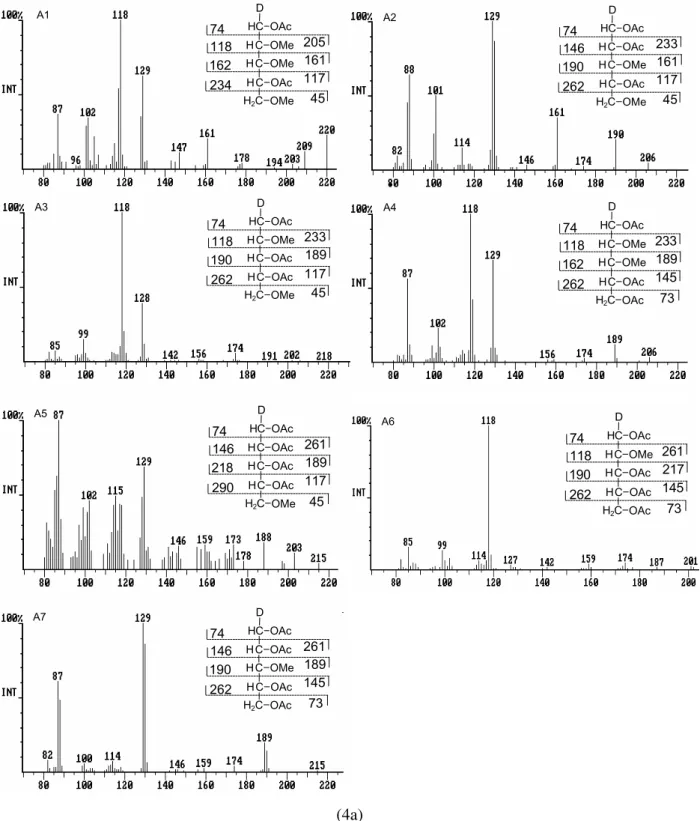
furanose-containing structures by GC-MS, by virtue of their typical Rts and e.i. breakdown patterns (Table I and Fig. 4). The e.i. profile of each PMAA was recorded over a range ofm/z80 to 220 and its key ions are represented in Figure 4. Although some of the yields were rather low, the required deriva-tives of 3,5,6-Me3Gal (1.4%), 2,5,6-Me3Gal (5.6%), 2,5-Me2Gal (1.3%), 3,5-Me2Gal (2.1%), and 5,6-Me2Gal (5.3%) were obtained, being were detec-table on GC-MS. One exception in the rapid
synthe-sis was the acetate of 5-O-methylgalactitol. How-ever, its presence in any methylation analysis mix-ture could be detected since it has anRtidentical to that of the 2-O-methyl derivative and would give a similar EI-MS, but with a key ion atm/z117 instead of 118 (Figure 4, B12).
-A1 A2 A3 A4 A5 A6 A7 C H D OAc C C C C H2 OMe
H OMe H OMe H OAc 74 118 162 234 45 205 161 117 C H D OAc C C C C H2 OMe
H OAc H OMe H OAc 74 146 190 262 45 233 161 117 C H D OAc C C C C H2 OMe
H OMe H OAc H OAc 74 118 190 262 45 233 189 117 C H D OAc C C C C H2 OAc
H OMe H OMe H OAc 74 118 162 262 233 189 145 73 C H D OAc C C C C H2 OMe H OAc H OAc H OAc 74 146 218 290 261 189 117 45 C H D OAc C C C C H2 OAc H OMe H OAc H OAc 74 118 190 262 261 217 145 73 C H D OAc C C C C H2 OAc H OAc H OMe H OAc 74 146 190 262 261 189 145 73 (4a)
B1 B2 B3 B4 B5 B6 B7 B8 C H C C C C C H2 OMe
D H OMe H OMe H OAc H OMe OAc 45 74 118 162 205 181 89 249 234 278 C H C C C C C H2 OMe
D H OMe H OAc H OAc H OMe OAc 181 89 45 233 277 74 118 190 262 306 C H C C C C C H2 OMe
D H OMe H OMe H OAc H OAc OAc 277 233 189 117 45 74 118 162 234 306 C H C C C C C H2 OAc
D H OMe H OMe H OAc H OMe OAc 74 118 162 234 278 277 233 189 117 73 C H C C C C C H2 OAc
D H OMe H OMe H OAc H OAc OAc 74 118 162 234 306 305 261 217 145 73 C H C C C C C H2 OAc
D H OMe H OAc H OAc H OMe OAc 74 118 117 73 190 189 306 305 262 261 C H C C C C C H2 OMe
D H OMe H OAc H OAc H OAc OAc 117 189 305 261 45 334 74 118 190 262 C H C C C C C H2 OMe
B9 B11 B10 B12 B13 B14 C H C C C C C H2 OAc
D H OAc H OMe H OAc H OMe OAc 233 189 117 305 73 74 190 306 262 146 C H C C C C C H2 OMe
D H OAc H OAc H OAc H OMe OAc 233 161 89 305 74 218 334 290 146 45 C H C C C C C H2 OAc
D H OMe H OAc H OAc H OAc OAc 289 217 145 333 190 334 262 118 73 74 C H C C C C C H2 OAc
D H OAc H OMe H OAc H OAc OAc 261 217 145 333 190 334 262 146 73 74 C H C C C C C H2 OMe
D H OAc H OAc H OAc H OAc OAc 261 189 117 333 218 362 290 146 45 74 C H C C C C C H2 OMe
D H OAc H OMe H OAc H OAc OAc 233 189 117 305 74 190 334 262 146 45 (4c)
CHOH groups vicinal to those of -CHOCH3would be more rapid. Consequently we can interpret (Table I) and that in the case of theαβ-mixture of Me-Galf
the order is HO-2 > HO-3 > HO-6 > HO-5, which differs from those of Me α- andβ-Galp, which is HO-3 > HO-2 > HO-4 > HO-6 (Sassaki et al. 2005). The relative reactivities for the Me αβ-Araf
mixture was HO-2 > HO-3 > HO-5, and for Meα -Araf, they were not markedly different, with HO-2 > HO-3≥HO-5 (Table I).
ACKNOWLEDGMENTS
The authors wish to thank the Brazilian agencies Financiadora de Estudos e Projetos (FINEP) and Conselho Nacional de Desenvolvimento Científico e
Tecnológico (CNPq), and FundaçãoAraucária, State of Paraná for financial support.
RESUMO
parcial-mente metilados (Me-GFP), os quais tiveram seus respec-tivos graus de metilação monitorados por cromatografia em camada delgada (CCD), que variaram inicialmente em altos rendimentos de derivados mono metilados de Me-GFP a derivados com alto grau de metilação. Os produtos da reação foram convertidos a derivados alditol acetato parcialmente metilados (AAPM), após hidrólise, seguida de redução com NaBD4e posterior acetilação. Os derivados obtidos podem ser utilizados como padrões de AAPM em CG-EM para auxiliar na análise de metilação de carboidratos complexos que possam conter unidades de arabinofuranose e galactofuranose. Os derivados AAPM de 6-MeGal, 5,6-Me2Gal, 2,5-Me2Gal, 2,5,6-Me3Gal, 3,5,6-Me3Gal, 5-Me2Ara, 2,5-Me2Ara e 3,5-Me2Ara mostraram espectros de eletroimpacto e tempos de re-tenção de maior interesse pois são de difícil síntese. A avaliação da reatividades dos grupos hidroxílicos nesta metilação mostrou que a mistura de alpha, beta-Me-Galf reage preferencialmente em 2 > 3 > 6 > HO-5, a mistura de alpha, beta-Me-Araf em HO-2 > HO-3 > HO-5, alpha-Me-Araf em HO-2 > HO-3≥HO-5. Palavras-chave:alditol acetatos parcialmente metilados, padrões p/ CG-EM, metilação de Purdie, reatividade gru-pos hidroxílicos, RMN.
REFERENCES
Barreto-Bergter E and Gorin PAJ.1983. Structural chemistry of polysaccharides from fungi and lichens. Adv Carbohydr Chem Biochem 41: 67–103.
Carpita NC and Shea EM. 1989. Linkage structure of carbohydrates by gas chromatography-mass spec-trometry (GC-MS) of partially methylated alditol ac-etates: analysis of carbohydrates by GLC and MS. InAnalysis of Carbohydrates by GLC and MS; Bier-mann CJ.; McGinnis GD., Eds., CRC Press, Inc., Boca Raton: 157–216.
Chambat G, Joseleau J-P, Lapeyre M and Lefebvre A.1978. Presence of galactofuranose in the capsular polysaccharide ofKlebsiellaserotype K-41: Synthe-sis of 5,6-di-O-methyl-D-galactofuranose. Carbo-hydr Res 63: 323–326.
Ciucanu I and Kerek F.1984. A simple and rapid method for the permethylation of carbohydrates. Carbohydr Res 131: 209–217.
Doares AS, Albersheim P and Darvill AG.1991. An improved method for the preparation of standards for glycosyl-linkage analysis of complex carbohydrates. Carbohydr Res 210: 1021–1037.
Elkin YN, Shulga NI, Vakorina TI and Dzizenko
AK.1975. Partial methylation of methyl glycoside: a source of samples for analysis of carbohydrate-containing compounds. Anal Biochem 68: 9–16.
Fournet B and Montreuil J.1973. Procédé d’ídentifi-cation et de prépration par chromatographie em phase gazeuse des éthers di-, tri-, et tetramethyliques de l’α -méthyl-D-mannoside. J Chromatogr 75: 29–37.
Fournet B, Leroy Y, Montreuil J and Mayer H.
1974. Analytical and preparative gas-liquid chro-matography of methyl α-mannoside monoethyl ethers. J Chromatogr 92: 185–190.
Fournet B, Dhalluin J-M, Leroy Y and Montreuil
J.1978. Analytical and preparative gas-liquid chro-matography of the fifteen methyl ethers of methyl α-D-galactopyranosides. J Chromatogr 158: 91–99.
Gorin PAJ and Mazurek M.1975. Further studies on the assignment of signals in13C magnetic reso-nance spectra of aldoses and derived methyl glyco-sides. Can J Chem 53: 1212–1223.
Hakomori S.1964. A rapid permethylation of glycol-ipid, and polysaccharide catalyzed by methylsulfinyl carbanion in dimethyl sulfoxide. J Biochem 55: 205–207.
Handa N and Montgomery R.1969. Partial methy-lation of methylα-D-mannopyranoside. Preparation and distribution of mono-, di-, and trimethyl ethers of D-mannose. Carbohydr Res 11: 467–484.
Haworth WN.1915. A new method of preparing alky-lated sugars. J Chem Soc 107: 8–16.
Jansson P-E, Kenne L, Liedgren H, Lindberg B and Lönngren J.1970. A practical guide to the methy-lation analysis of carbohydrates. J Chem Commun, Univ of Stockholm, 8: 1–76.
Jones C, Todeschini AR, Agrellos AO, Previato JO
and Mendonça-Previato L.2004. Heterogeneity in the biosynthesis of mucin O-glycans from Try-panosoma cruziTulahuen strain with the expression of novel galactofuranosyl-containing oligosaccha-rides. Biochemistry 43: 11889–11897.
Levery SB, Toledo MS, Straus AH and Takahashi
HK. 1998. Structure elucidation of sphingolipids from the mycopathogenParacoccidioides brasilien-sis: An immunodominantβ-galactofuranose residue is carried by a novel glycosylinositol phosphorylce-ramide antigen. Biochemistry 37: 8764–8775.
Lomax JA and Conchie J.1982. Separation of methy-lated alditol acetates by glass capillary gas chroma-tography and their identification by computer. J Chromatogr 236: 385–394.
Perlin AS and Casu B.1969. Carbon-13 and proton magnetic resonance spectra of D-glucose-13C. Tetra-hedron Letters: 2921–2924.
Purdie T and Irvine JC.1903. The alkylation of sugars. J Chem Soc 83: 1021–1037.
Sassaki GL, Ferreira JC, Glienke-Blanco C, Torri
G, de Toni F, Gorin PAJ and Iacomini M.2002. Pustulan and branched β-galactofuranan from the phytopathogenic fungusGuignardia citricarpa, ex-creted from media containing glucose and sucrose. Carbohydr Polym 48: 385–389.
Sassaki GL, Gorin PAJ, Souza LM, Czelusniak PA
and Iacomini M.2005. Rapid synthesis of partially O-methylated alditol acetate standards for GC-MS: Some relative activities of hydroxyl groups of methyl glycopyranosides on Purdie methylation. Carbohydr Res 340: 731–739.
Skipiski VP.1975. Thin layer chromatography of neutral glycolipids. Methods Enzymol 35: 396–425.
Suzuki E, Toledo MS, Takahashi HK and Straus AH.1997. A monoclonal antibody directed to termi-nal residue ofβ-galactofuranose of a glycolipid from
Paracoccidioides brasiliensis: cross-reactivity with
Leishmania majorandTrypanosoma cruzi. Glyco-biol 7: 463–468.