Hospital infection control programs: assessment
of process and structure indicators
Programas de Controle de Infecção Hospitalar: avaliação de indicadores de estrutura e processo Programas de Control de Infección Hospitalaria: evaluación de indicadores de estructura y proceso
Alessandra Lyrio Barbosa Giroti1, Adriano Menis Ferreira2, Marcelo Alessandro Rigotti2, Álvaro Francisco Lopes de Sousa3, Oleci Pereira Frota4, Denise de Andrade3
How to cite this article:
Giroti ALB, Ferreira AM, Rigotti MA, Sousa AFL, Frota OP, Andrade D. Hospital infection control programs: assessment of process and structure indicators. Rev Esc Enferm USP. 2018;52:e03364. DOI: http://dx.doi.org/10.1590/S1980-220X2017039903364
Received: 10/03/2017 Approved: 03/27/2018 Corresponding author:
Álvaro Francisco Lopes de Sousa Avenida dos Bandeirantes, 3900
Campus Universitário – Bairro Monte Alegre CEP 14040-902 – Ribeirão Preto, SP, Brazil [email protected]
ABSTRACT
Objective: To assess hospital infection control committees in relation to structure
and process indicators of hospital infection control programs. Method: Descriptive,
cross-sectional study conducted with hospital committees registered in the National Registry of Healthcare Facilities. Primary and secondary data collection was conducted through structured interview using validated instruments and verification of documents, respectively. Results: Fourteen committees participated in the research. Mean values of conformity of 80.58% were evidenced for the technical-operational structure assessment indicator, 60.77% for the infection control and prevention operational guidelines indicator, 81.59% for the epidemiological surveillance system assessment indicator, and 63.44% for hospital infection control and prevention activities assessment indicator.
Conclusion: Among the four instruments applied to assess hospital infection control programs, only two presented results with more than 80.0% of conformity: those related to the epidemiological surveillance and technical-operational structure assessments.
DESCRIPTORS
Cross Infection; Infection Control; Patient Safety; Quality of Health Care; Health Services Research.
1 Secretaria Municipal de Saúde Pública,
Campo Grande, MS, Brazil.
2 Universidade Federal de Mato Grosso
do Sul, Três Lagoas, MS, Brazil.
3 Universidade de São Paulo, Escola
de Enfermagem de Ribeirão Preto, Ribeirão Preto, SP, Brazil.
4 Universidade Federal de Mato Grosso
INTRODUCTION
Hospital infection (HI) is a major health problem that affects about 1.5 million people around the world every year. In terms of incidence, it is estimated that 10 out of 100 patients hospitalized in developing countries will be affected by HI, leading to ethical, legal, and social problems, as well as longer periods of hospitalization, increased costs related to hospitalization, and in more severe cases even to death(1-2).
Considering the impact of HI, it is imperative that hospi-tals form a Hospital Infection Control Committee (HICC), as instructed in the Brazilian law, based on ordinance 2.616/98 in relation to the implementation and execution of a Hospital Infection Control Program (HICP) to reduce infection rates to an acceptable level, becoming a foundation for a service of excellence committed to patient safety(3-4).
Despite the national legislation, the current assessment system does not favor the measurement, interpretation, and qualification of the assessment. The measurement of qual-ity of the care practices requires assessment indicators as a tool for the continuous advancement and development of improvements(5-6).
Thus, given the complexity and severity of HI, and based on the lack of knowledge on the structuring of health services of the studied municipality in relation to hospital infection control and prevention practices in accordance with the legal protection, the objective of this study was to assess Hospital Infection Control Committees in relation to the structure and process indicators of Hospital Infection Control Programs.
METHOD
A cross-sectional, descriptive study was conducted in the HICC of the health services of the city of Campo Grande, Mato Grosso do Sul, Brazil, which were recruited through the National Registry of Healthcare Facilities, and catego-rized into public, private, or philanthropic hospitals, gen-eral or specialized, with hospital beds. Sixteen HICC were identified, but the sample consisted of 14 services, as two institutions refused to participate.
Data were collected between December 2015 and January 2016 through a structured interview with the mem-bers of the HICC of each participating service, together with an analysis of the documents related to the HICP presented on the occasion of the visit to the institution, after contact and official authorization by the director.
Data collection instruments consisted of developed and validated indicators(7), approaching the HICP technical-op-erational structure assessment indicator (PCET), opera-tional guidelines for HI control and prevention (PCDO), HI epidemiological surveillance system (PCVE), and HI control and prevention activities (PCCP).
These instruments present a specific classification for the theoretical-scientific basis and a relevance scoring for each item of the assessment, obtained upon consensus by the experts during the validation for calculation of confor-mity. In addition to the calculation of total conformity and no conformity, partial conformity was considered when the health services submitted only part of the required
documents or out-of-date documents, as well as the crite-rion “does not apply” for the items that were not available in the assessed services(7-9).
Previously developed instruments(7-9) with questions organized to meet the objectives of this study were used to characterize the health services in relation to size, type of care, quality certification, legal nature, availability of inten-sive care units (ICUs), and HICC composition and structure.
The collected data were organized in spreadsheets using Microsoft Office Excel 2007 to calculate the mean and stan-dard deviation values, and the results were presented in the form of descriptive statistics or tables.
The study was approved by the Research Ethics Committee of the Universidade Federal de Mato Grosso do Sul under protocol number 1.327.464/2015 (CAAE − 49127215.0.0000.0021) in accordance with Resolution 466/12.
RESULTS
Among the 14 hospitals that participated in the study, 57.14% were general hospitals, 64.28% were small hospi-tals, and 50.00% consisted of private institutions. Only one institution (7.14%) presented quality certification in health granted by the National Accreditation Organization (ONA – Organização Nacional de Acreditação), level I. Regarding the availability of ICUs, a predominance of adult units (57.10%) and institutions with no ICU (35.70%) was observed.
All the hospitals had an operating HICC (100%); in 64.20% the HICC had been in place for over 9 years. These HICC were made up of hospital employees; outsourcers performed only some hospital infection control services supported by nursing trainees. On average, the physicians had been working in the HICC for 6 years, and nurses for 3 years.
The application of the instruments to assess the processes related to the HICP of the hospitals evidenced the best results in the indicators related to the technical-operational structure (PCET) and HI epidemiological surveillance sys-tem (PCVE), with mean conformity levels of 80.58% and 81.59%, respectively.
In general, the results for the indicators related to oper-ational guidelines (PCDO) and infection control and pre-vention actions (PCCP) were below the expectations, with respective mean conformity levels of 60.77% and 63.44%, far from the recommended mean value (100.0%).
There was also an absence of uniformity in the routines implemented in the hospitals, as there were significant vari-ations among the assessed items for each indicator; some presented excellent results, while others were far from ideal values.
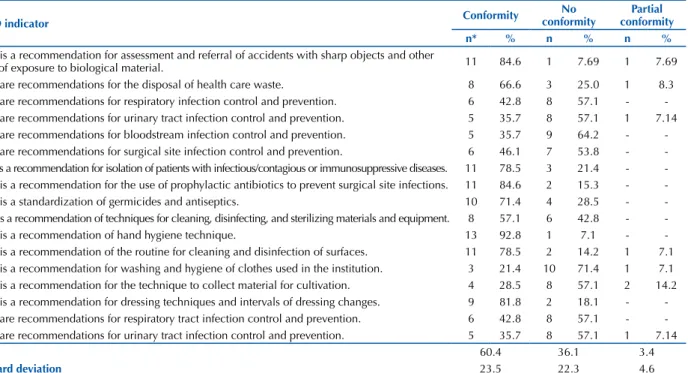
In the assessment of the operational guidelines for infec-tion control and preveninfec-tion, considering only the official recommendations (manuals, guidelines, standards, resolu-tions, and others), rather than the way the routines were
implemented, the applied instrument evidenced an unsat-isfactory level of conformity, as an average of 60.77% of the items assessed in this aspect were available in the committees (Table 2).
Table 1 – Number and percentage of conformity per item of the assessment indicator of the technical-operational structure of the hospital infection control program applied in hospitals − Campo Grande, MS, Brazil, 2016.
PCET* indicator Conformity
No conformity
Partial conformity n % n % n %
The HICC is represented by, at least, members of the administration, nursing, and medical services. 14 100.0 - - -
-There is a statute determining the operation of the HICC and/or hospital infection control services. 12 85.7 - - 2 14.2
There are two higher education health professionals performing exclusive actions for HI control
and prevention for every 200 beds; one of them is a nurse (associated or not). 8 57.1 6 42.8 -
-The nurse works exclusively dedicated to the service for at least 6 hours a day. 10 71.4 4 28.5 -
-There is another higher education professional working with exclusive dedication to the service for
at least 4 hours a day. 8 57.1 6 42.8 -
-The HICC conducts regular meetings with the participation of executive members and leaders. 12 85.7 2 14.2 -
-There is microbiology and pathology lab support, own or outsourced. 14 100.0 - - -
-There is a delimitated and exclusive physical space for the daily activities, files, etc. of the HICC or
hospital infection control services. 9 64.2 5 35.7 -
-There is availability of computerized resources for the activities developed by the HICC or hospital
infection control services. 14 100.0 - - -
-The administration provides statistical data (number of admissions, discharges, deaths, patients-day,
etc.) for the production of HICC or hospital infection control services reports 12 85.7 2 14.2 -
-Mean 80.7 17.8 1.4
Standard-deviation 17.1 18.2 4.5 *Source: Menegueti, Canini, Bellissimo-Rodrigues, Laus(9).
Table 2 – Number and percentage of conformity per item of the assessment indicator of the operational guidelines for prevention and control of hospital infections applied in hospitals − Campo Grande, MS, Brazil, 2016.
PCDO indicator Conformity
No conformity
Partial conformity n* % n % n %
There is a recommendation for assessment and referral of accidents with sharp objects and other
cases of exposure to biological material. 11 84.6 1 7.69 1 7.69
There are recommendations for the disposal of health care waste. 8 66.6 3 25.0 1 8.3
There are recommendations for respiratory infection control and prevention. 6 42.8 8 57.1 -
-There are recommendations for urinary tract infection control and prevention. 5 35.7 8 57.1 1 7.14
There are recommendations for bloodstream infection control and prevention. 5 35.7 9 64.2 -
-There are recommendations for surgical site infection control and prevention. 6 46.1 7 53.8 -
-There is a recommendation for isolation of patients with infectious/contagious or immunosuppressive diseases. 11 78.5 3 21.4 -
-There is a recommendation for the use of prophylactic antibiotics to prevent surgical site infections. 11 84.6 2 15.3 -
-There is a standardization of germicides and antiseptics. 10 71.4 4 28.5 -
-There is a recommendation of techniques for cleaning, disinfecting, and sterilizing materials and equipment. 8 57.1 6 42.8 -
-There is a recommendation of hand hygiene technique. 13 92.8 1 7.1 -
-There is a recommendation of the routine for cleaning and disinfection of surfaces. 11 78.5 2 14.2 1 7.1
There is a recommendation for washing and hygiene of clothes used in the institution. 3 21.4 10 71.4 1 7.1
There is a recommendation for the technique to collect material for cultivation. 4 28.5 8 57.1 2 14.2
There is a recommendation for dressing techniques and intervals of dressing changes. 9 81.8 2 18.1 -
-There are recommendations for respiratory tract infection control and prevention. 6 42.8 8 57.1 -
-There are recommendations for urinary tract infection control and prevention. 5 35.7 8 57.1 1 7.14
Mean 60.4 36.1 3.4
Standard deviation 23.5 22.3 4.6 *n presented variation among the items, as some of them were not applicable to all the hospitals participating in the study.
In relation to the epidemiological surveillance sys-tem adopted by the HICC, the result found was the best among all the applied instruments. This means that the programs are being implemented by means of
Among the activities performed by the HICC in the different sectors and areas of the hospitals it is possible to evidence the immediate need to strengthen these actions, since in certain locations, such as laboratories, nurseries, and
pharmacies, an unsatisfactory mean level of conformity was evidenced, requiring a more emphatic and continuous work by the infection controllers. The general mean level of conformity of the analyzed items was 63.27%, as shown in Table 4.
Table 3 – Number and percentage of conformity per item of the assessment indicator of the hospital infection epidemiological sur-veillance system applied in hospitals − Campo Grande, MS, Brazil, 2016.
PCVE indicator Conformity
No conformity
Partial conformity n* % n % n %
Epidemiological surveillance (global or per component) is conducted at determined intervals. 13 92.8 1 7.1 -
-HI epidemiological surveillance is conducted through active search of cases 13 92.8 1 7.1 -
-Active search of HI cases is conducted in higher risk units (ICU, nursery, burn units, etc.). 12 92.3 - - 1 7.6
Monitoring, at regular intervals and with regular records, the microbiological results of cultures
identifying strains or species of microorganisms, including resistant ones. 11 78.5 3 21.4 -
-There are predetermined criteria for HI diagnosis. 13 92.8 1 7.1 -
-Regular reports of the results of the epidemiological surveillance (endemic levels) are produced. 13 92.8 1 7.1 -
-The reports analyze and notify any changes in the epidemiological profile (descriptive and/or graphical). 11 78.5 3 21.4 -
-The reports correlate results with adopted control and prevention strategies (intervention). 5 35.7 9 64.2 -
-The reports are regularly made available to the several sectors and leaders of the institution. 11 78.5 3 21.4 -
-The reports are regularly made available to the concerning public bodies (managers). 12 85.7 2 14.2 -
-Mean 82.0 17.1 0.7
Standard deviation 17.5 18.1 2.4 *n presented variation among the items, as some of them were not applicable to all the hospitals participating in the study.
Table 4 – Number and percentage of conformity per item of the assessment indicator of the hospital infection control and prevention activities applied in hospitals − Campo Grande, MS, Brazil, 2016.
PCCP indicator Conformity
No conformity
Partial conformity n* % n % n %
Dialysis unit (I – D – R – C – O) 2 66.6 1 33.3 -
-Blood bank (I – D – R – C – O) 3 50.0 3 50.0 -
-Clinical analysis lab (I – D – R – C – O) 2 28.5 4 57.1 1 14.2
Pathological anatomy lab (I – D – R – C – O) 2 40.0 2 40.0 1 20.0
Hospitalization units (I – D – R – C – O) 13 92.8 1 7.1 -
-Intensive care units (I – D – R – C – O) 8 88.8 1 11.1 -
-Nursery (I – D – R – C – O) 2 40.0 3 60.0 -
-Material and sterilization center (I – D – R – C – O) 9 69.2 3 23.0 1 7.6
Surgical center (I – D – R – C – O) 11 84.6 2 15.3 -
-Emergency room (I – D – R – C – O) 7 77.7 2 22.2 -
-Outpatient facility (I – D – R – C – O) 8 61.5 5 38.4 -
-Pharmacy service (I – D – R – C – O) 8 57.1 6 42.8 -
-Nutrition and diet services (I – D – R – C – O) 10 71.4 4 28.5 -
-Participation in technical decisions for specification and acquisition of products and related products 8 57.1 4 28.5 2 14.2
Mean 63.2 32.7 4.0
Standard deviation 19.3 16.3 7.0 *n presented variation among the assessed items, as some of them were not applicable to all the hospitals participating in the study; Identification of the types of HI control and prevention activities: I: inspection, according to specific legislation in force or guidelines of the hospital; D: guidance/assessment to comply with specific legislation in force or guidelines of the hospital; R: participation in meetings; C: queries/guidance by spontaneous demand; O: other activity.
DISCUSSION
This study evidenced that the results of the HICP struc-ture and process indicators in the studied hospital institu-tions were, in general, below the expectainstitu-tions, corresponding to 100%. The best performance was obtained in the tech-nical-operational structure assessment indicators and the epidemiological surveillance system assessment indicator.
In addition, considering the high rate of adherence (87.5%) of the invited institutions, the results of this study reflect the diagnosis of the HICP in the city, and may be useful to establish an overview of the situation of these programs in the country, thus favoring the enforcement of public policies. A similar study conducted in the city of Ribeirão Preto, São Paulo, Brazil, obtained a similar rate of participation (81.2%)(9).
Other HICP diagnosis assessments in regions of Brazil found similar results to those found in this study, with higher levels of nonconformity in the same indicators(9-10). However, a study conducted in the city of São Paulo, São Paulo state, Brazil, obtained, in all the assessments, results above the findings found in the present investigation, and very close to the ideal value(5), despite the low rate of participation of the invited institutions (31%).
Regarding the assessment of the technical-operational structure, six hospitals met all the assessed items in relation to human and administrative resources and physical space, and one institution acted as an outlier by presenting only 30.76% of conformity to the detriment of a general average of 80.58%, resulting in a high level of standard deviation.
Still in relation to the assessment of the technical-opera-tional structure, a high percentage of hospitals (42.8%) reported the unavailability of exclusive professionals or an appropriate number of professionals to perform the activities; also, the phys-ical space intended for the HICC was reported to be a shared space with other administrative sectors (35.7%). This scenario contrasts with the guidelines of the national legislation, and is also evidenced in other studies conducted in Brazil(9-10). A study developed in Catalonia, Spain, also pointed out a deficit of hours/professionals for the activities focused on HI control, mentioning that human resources were minimal(11).
According to the Brazilian law, there must be at least two higher education health professionals for every 200 beds work-ing as executwork-ing members of the HICC, that is, performwork-ing the actions specified in the HICP. The legislation also instructs that one of them must be preferably a nurse working 6 hours per day(3). A study conducted in Vancouver, Canada, pointed out that personnel and financial support are imperative for an effec-tive infection control program, together with the engagement of individuals involved in the process(12). In this sense, a multicenter study conducted in India also reinforced that institutional sup-port is essential for the effective implementation of infection control programs as it guarantees appropriate resources in terms of personnel, tasks, and organization(13).
The assessment of the operational guidelines for pre-vention and control of hospital infections, in the form of manuals, statutes, resolutions, and others, revealed through the PCDO instrument the lowest results of conformity in all the instruments of this study. Conflicting results were observed among some institutions; only one was successful in all the items of the assessment, while another reached only 20.0%. Among the 17 items of this instrument, eight presented a conformity rate below 50%; the lowest mean values were related to the recommendations for cleaning and hygiene of clothes (21.4%) and the technique to collect material for cultures (28.5%).
This is an alarming finding, as clothes and several items (pens, thermometer, stethoscope, and others) used in health care are contaminated. Despite the fragility of studies in the area, the contamination of aprons, uniforms, and white coats with resistant isolated bacteria from patients hospitalized has been already proven. This reinforces the need for recommen-dations and actions by the HICC to cease and minimize the pathogenic potential posed by such clothing(14-17).
The highest level of conformity was related to the rec-ommendation for hand hygiene (92.80%), which, although present in most participating hospitals, should continue to be emphasized as an essential action in patient and professional safety strategies(18-19).
In relation to the recommendations for prevention of infections related to the respiratory and urinary tracts, bloodstream, and surgical site, a prevalence of hospitals with inadequacies or that have not presented them (60%) was observed, a result that corroborates the findings of another study conducted in Brazil(9).
Inadequacies in diagnostic criteria may lead to higher or underestimated infection incidence rates, masking the surveillance of these aggravations and impairing the imple-mentation of HI control measures. Health institutions are encouraged to adhere to consensus recommendations, offer appropriate education and training, and supervise teams as strategies to improve the risk reduction process(20).
Also in relation to the assessment of operational guide-lines, a limited number of institutions(8) presented written routines to guide the practices of cleaning, disinfection, and sterilization of materials and items, an alarming fact considering that since March 2012 there are official guide-lines for the adequacy of this area in Brazilian health-care services(21). It is reinforced that the supervision and follow-up of such theoretical frameworks of institutions represent an attribution of the HICC, directing efforts to their proper fulfillment(3,21).
The assessment conducted with the use of the PCVE instrument – pertinent to the epidemiological surveillance system addressed in the HICP – presented a more favor-able result in this study, with a general mean conformity of 81.59%. This result is above the result found in a study conducted in the state of Paraná, Brazil, (76.00%)(10) and below other two studies, one conducted in Ribeirão Preto, São Paulo, Brazil, (83.72%)(22) and the other in São Paulo, São Paulo state, Brazil (99.40%)(5).
The assessment of the HI control and prevention activ-ities performed in the HICP of the hospitals by means of the PCCP instrument evidenced an unsatisfactory scenario in the studied city, as the mean rate of conformity was low (63.4%). Only one hospital presented actions in all the sec-tors enquired and applicable to the institution (100%), and other six registered a mean value above 80%. The study also points out that three hospitals presented performance below 30%, limiting their activities to the Hospitalization Units, Surgical Center, and the Pharmacy. It is extremely important that the activities of the HICC include all the sectors in order to favor the appropriate application of standards and routines aimed at the prevention of HI(3).
Another item assessed in the hospitals was the participation of the HICC in the technical decisions for specification and purchase of products and correlated products, evidencing that only 57.10% of the sample presents this routine officially imple-mented. Two hospitals (14.20%) reported the participation of the committee, however they presented no evidence with meeting minutes, reports, and others. It is part of a good HICP that the HICC defines, together with the pharmacy service, protocols pertinent to the use of antimicrobials, germicides, medical-hospital materials, and others for the health service(3).
In this scenario, it is important that HI control is not an isolated program; it should be an integral part of quality care and patient safety, as there is a number of challenges to make care safer, requiring an association of the practices to education and research(1,6).
The development of further studies aimed at mapping the reality of the city in order to subsidize public policies to improve HI control practices is important and necessary. This study suggests that the application of HICP assess-ment indicators should incorporate the assessassess-ment rou-tine in the health services, including internal audits and health inspections(17).
This study presents limitations inherent to its method-ological design (descriptive), preventing the assessment of cause and effect relationships. In addition, it was conducted in only one city, a fact that may hinder generalization of its findings, and the documentary stage was based on secondary data research and may be subject to information inaccuracies.
CONCLUSION
Among the four instruments applied to assess Hospital Infection Control Programs, only two presented results above 80.0% of conformity in relation to the epidemiological surveillance and technical-operational structure assessments. The operational recommendations and guidelines and the activities performed to prevent and control HI presented conformity close to 60.0%.
Therefore this study emphasizes the fact that hospitals need to adopt strategies for the continuous assessment of the effectiveness of hospital infection control programs and their impact on the quality of health care, as these programs are essential for patient safety and require improvements to care practice.
REFERENCES
1. Oliveira AC, Paula AO. Infecções relacionadas ao cuidar em saúde no contexto da segurança do paciente: passado, presente e futuro. REME Rev Min Enferm [Internet]. 2013 [citado 2017 set. 17];17(1):221-4. Disponível em: http://www.reme.org.br/artigo/detalhes/592
RESUMO
Objetivo: Avaliar Comissões de Controle de Infecção Hospitalar quanto aos indicadores de estrutura e processo dos Programas de Controle de Infecção Hospitalar. Método: Estudo transversal e descritivo, realizado com Comissões de hospitais registrados no Cadastro Nacional de Estabelecimentos de Saúde. A coleta de dados primários e secundários foi realizada por meio de entrevista estruturada, utilizando-se de instrumentos validados e verificação de documentos, respectivamente. Resultados: Participaram da pesquisa 14 Comissões. Evidenciaram-se médias de conformidade de 80,58% para o indicador de avaliação da estrutura técnico-operacional, 60,77% para o indicador das diretrizes operacionais de prevenção e controle de infecção, 81,59% para o indicador de avaliação do sistema de vigilância epidemiológica e 63,44% para o indicador de avaliação das atividades de controle e prevenção de infecção hospitalar. Conclusão: Entre os quatro instrumentos aplicados para a avaliação dos Programas de Controle de Infecção Hospitalar, apenas dois deles apresentaram resultado superior a 80,0% de conformidade, os relativos às avaliações da estrutura técnico-operacional e à vigilância epidemiológica.
DESCRITORES
Infecção Hospitalar; Controle de Infecções; Segurança do Paciente; Qualidade da Assistência à Saúde; Avaliação de Serviços de Saúde.
RESUMEN
Objetivo: Evaluar comisiones de Control de Infección Hospitalaria en cuanto a los indicadores de estructura y proceso de los Programas
de Control de Infección Hospitalaria. Método: Estudio transversal y descriptivo, realizado con Comisiones de hospitales inscritos
en el Registro Nacional de Establecimientos Sanitarios. La recolección de datos primarios y secundarios se llevó a cabo mediante entrevista estructura utilizándose instrumentos validados y verificación de documentos, respectivamente. Resultados: Participaron en la investigación 14 Comisiones. Se evidenciaron promedios de conformidad del 80,58% para el indicador de evaluación de la estructura técnica y operativa, el 60,77% para el indicador de las directrices operativas de prevención y control de infección, el 81,59% para el indicador de evaluación del sistema de vigilancia epidemiológica y el 63,44% para el indicador de evaluación de las actividades de control y prevención de infección hospitalaria. Conclusión: Entre los cuatro instrumentos aplicados para la evaluación de los Programas de Control de Infección Hospitalaria, solo dos de ellos presentaron resultado superior al 80,0% de conformidad, los relativos a las evaluaciones de la estructura técnica y operativa y a la vigilancia epidemiológica.
DESCRIPTORES
This is an open-access article distributed under the terms of the Creative Commons Attribution License.
2. Souza ES, Belei RA, Carrilho CMDM, MatsuoT, Yamada-Ogatta SF, Andrade G, et al. Mortality and risks related to healthcare-associated infection. Texto Contexto Enferm. [Internet]. 2015 [cited 2017 Sep 17];24(1):220-8. Available from: http://www.scielo.br/scielo. php?script=sci_arttext&pid=S0104-07072015000100220&lng=en
3. Brasil. Ministério da Saúde. Portaria GM/MS n. 2.616, de 12 de maio de 1998. Dispõe sobre diretrizes e normas para a prevenção e o controle das infecções hospitalares [Internet]. Brasília; 1998 [citado 2017 set. 17]. Disponível em: http://bvsms.saude.gov.br/bvs/saudelegis/ gm/1998/prt2616_12_05_1998.html
4. Brasil. Agência Nacional de Vigilância Sanitária. Medidas de prevenção de infecção relacionada à assistência à saúde [Internet]. Brasília: ANVISA; 2013 [citado 2017 set. 17]. Disponível em: https://www20.anvisa.gov.br/segurancadopaciente/images/documentos/livros/Livro4-MedidasPrevencaoIRASaude.pdf
5. Silva CPR, Lacerda RA. Validation of a proposal for evaluating hospital infection control programs. Rev Saúde Pública [Internet]. 2011 [cited 2017 Sep 17];45(1):121-8. Available from: http://www.scielo.br/pdf/rsp/v45n1/en_1955.pdf
6. Reis AT, Martins M, Laguardia J. A segurança do paciente como dimensão da qualidade do cuidado de saúde: um olhar sobre a literatura. Ciênc Saúde Coletiva [Internet]. 2013 [citado 2017 set. 17];18(7):2029-36. Disponível em: http://www.scielo.br/pdf/csc/v18n7/18.pdf
7. Silva CPR, Lacerda RA. Indicadores para avaliação de programas de controle de infecção hospitalar: construção e validação. Epidemiol Serv Saúde [Internet]. 2007 [citado 2017 set. 17];16(2):128-31. Disponível em: http://scielo.iec.pa.gov.br/pdf/ess/v16n2/v16n2a11.pdf
8. São Paulo. Secretaria de Estado de Saúde, Divisão de Infecção Hospitalar, Centro de Vigilância Epidemiológica. Manual de avaliação da qualidade de práticas de controle de infecção hospitalar: Projeto de parceria multi-profissional e multi-institucional de política pública de saúde na área de controle de infecção hospitala [Internet]. São Paulo; 2006 [citado 2017 set. 17]. Disponível em: http://www.osteos. com.br/arquivos/manuais/avalicao-qualidade-praticas-controle-infeccao-hospitar.pdf
9. Menegueti MG, Canini SRMS, Bellissimo-Rodrigues F, Laus AM. Evaluation of Nosocomial Infection Control Programs in health services. Rev Latino Am Enfermagem [Internet]. 2015 [cited 2017 Sep 17];23(1):98-105. Available from: http://www.scielo.br/scielo.php?script=sci_ arttext&pid=S0104-11692015000100098
10. Alves DCI, Lacerda RA. Evaluation of Programs of Infection Control related to Healthcare Assistance in Hospitals. Rev Esc Enferm USP [Internet]. 2015 [cited 2017 Sep 17];49(n.spe):65-73. Available from: http://www.scielo.br/scielo.php?pid=S0080-62342015000700065&script=sci_arttext&tlng=en
11. Limón E, Pujol M, Gudiol F. Validation of the structure and resources of nosocomial infection control team in hospitals ascribed to VINCat program in Catalonia, Spain. Med Clin (Barc). 2014;143 Suppl 1:43-7. DOI: http://dx.doi.org/10.1016/j.medcli.2014.07.010
12. Lloyd-Smith E, Curtin J, Gilbart W, Romney MG. Qualitative evaluation and economic estimates of an infection control champions program. Am J Infect Control. 2014;42(12):1303-7. DOI: http://dx.doi.org/10.1016/j.ajic.2014.08.017
13. Barker AK, Brown K, Siraj D, Ahsan M, Sengupta S, Safdar N. Barriers and facilitators to infection control at a hospital in northern India: a qualitative study. Antimicrob Resist Infect Control [Internet]. 2017 [cited 2017 Sep 17];6:35. Available from: https://www.ncbi.nlm.nih. gov/pmc/articles/PMC5385016/
14. Margarido CA, Villas-Boas TM, Mota VS, Silva CKM, Poveda VB. Contaminação microbiana de punhos de jalecos durante a assistência à saúde. Rev Bras Enferm [Internet]. 2014 [citado 2017 set. 17];67(1):127-32. Disponível em: http://www.scielo.br/scielo.php?script=sci_ar ttext&pid=S0034-71672014000100127
15. Oliveira AC, Silva MDM, Garbaccio JL. Clothing of health care professional as potential reservoirs of micro-organisms: an integrative review. Texto Contexto Enferm [Internet]. 2012 [cited 2017 Sep 17];21(3):684-91. Available from: http://www.scielo.br/pdf/tce/v21n3/ en_v21n3a25.pdf
16. Sehulster LM. Healthcare laundry and textiles in the united states: review and commentary on contemporary infection prevention issues. Infect Control Hosp Epidemiol. 2015;36(9):1073-88. DOI: http://dx.doi.org/10.1017/ice.2015.135
17. Mitchell A, Spencer M, Edmiston CJ. Role of healthcare apparel and other healthcare textiles in the transmission of pathogens: a review of the literature. J Hosp Infect. 2015;90(4):285-92. Available from: DOI: http://dx.doi.org/10.1016/j.jhin.2015.02.017
18. Freitas TSC, Ferreira SCM. Higienização das mãos em unidades de terapia intensiva: monitoramento do consumo de álcool em gel. Nursing (São Paulo). 2016;14(220):1196-200.
19. Santos TCR, Roseira CE, Piai-morais TH, Figueiredo RM. Hand hygiene in hospital environments: use of conformity indicators. Rev Gaúcha Enferm [Internet]. 2014 [cited 2017 Sep 17];35(1):70-7. Available from: http://www.scielo.br/scielo.php?pid=S1983-14472014000100070&script=sci_arttext&tlng=en
20. Vandijck D, Cleemput I, Hellings J, Vogelaers D. Infection prevention and control strategies in the era of limited resources and quality improvement: a perspective paper. Aust Crit Care. 2013;26(4):154-7. DOI: https://doi.org/10.1016/j.aucc.2013.07.005
21. Brasil. Ministério da Saúde; Agência Nacional de Vigilância Sanitária. Resolução n. 15, de 15 de março de 2012. Dispõe sobre requisitos de boas práticas para o processamento de produtos para saúde [Internet], Brasília: ANVISA; 2012 [citado 2017 set.17]. Disponível em: http://bvsms.saude.gov.br/bvs/saudelegis/anvisa/2012/rdc0015_15_03_2012.html