1. Ankara Numune Education and Research Hospital Department of Physical Medicine and Rehabilitation
INtrODUctION
Ankylosing spondylitis (AS) is a chronic inflammatory rheumatic disease that mainly affects the sacroiliac joints and the spine. Neurologic and cardiac involve-ments are among the extraarticular manifestations of the disease. Neurologic complications of ankylosing spondylitis can be caused by fracture, instability, compression or inflammation. Fractures of the spine, atlan -toaxial/atlantooccipital subluxations can occur and can lead to spinal cord injury. Ossification of the posterior longitudinal ligament, destructive intervertebral disc lesions and spinal stenosis may cause compressive neu-rologic complications. Cauda equina syndrome is an-other neurologic complication of the disease. The cause of this syndrome may be due to arachnoiditis and arachnoid adhesions.
Manifestations of cardiac involvement include ascen ding aortitis, aortic valve incompetence, con-duction abnormalities, cardiomegaly and pericarditis1. Cardiac functions of human body are under the control of autonomic nervous system (ANS). The functions of ANS can be evaluated clinically with some non-in-vasive, simple tests based on cardiovascular reflexes. The heart rate variation during deep, slow breathing – for the evalua tion of parasympathetic system – and the diastolic blood pressure response to sustained handgrip – for the evaluation of sympathetic system – are among them. Sympathetic skin response (SSR) and R-R interval varia tion (RRIV) are noninvasive electro-physiological tests used in the assessment of sympa-thetic and parasympasympa-thetic nervous system function, respectively.
There is no classical information regarding the au-tonomic nervous system involvement in patients with AS, and only a few studies have been performed on this issue up to date. Besides the studies showing distur-bance of particularly the parasympathetic autonomic nervous system in AS, there is a study with contrary re-sults2-4.
Autonomic functions and their relations with
disease activity in ankylosing spondylitis
ACTA REUMATOL PORT. 2012;37:234-239
Tuba Gunay1, Ozlem Yilmaz1, Hatice Bodur1
AbstrAct
Objectives: To evaluate the autonomic functions in pa-tients with ankylosing spondylitis (AS) by means of clinical and electrophysiological tests, to compare the data with those of healthy individuals and to investigate the relationship with the disease activity.
Patients and methods: 32 asymptomatic AS patients and 30 healthy controls were included in the study. Parasympathetic functions were evaluated clinically with heart rate variability (HRV) and electrophysiologi cally with R-R interval variation (RRIV). Sympathetic functions were evaluated clinically with diastolic blood pressure response to isometric exercise (DBP) and elec-trophysiologically with sympathetic skin response (SSR). Bath Ankylosing Spondylitis Disease Activity Index (BASDAI) and Ankylosing Spondylitis Disease Acti vity Score –C (ASDASC) were used to estimate the di -sease activity.
Results: HRV and RRIV was significantly lower in tients with AS when compared to controls, and in pa-tients with BASDAI≥4 when compared to the papa-tients with BASDAI<4. There was no difference between the AS and the control groups and between the groups with BASDAI≥4 and BASDAI<4 for DBP. Although there was no difference for SSR between AS and the control groups, SSR latency was significantly longer and SSR amplitude was significantly smaller in the group with BASDAI≥4 when compared to the group with BASDAI<4.
Conclusions: Our results indicate a parasympathetic dysfunction in AS patients, however the sympathetic system seems to be affected when the disease activity is increased. Patients with AS even they are asymptoma -tic must be investigated for autonomic dysfunction. Keywords: Ankylosing spondylitis; Sympathetic; Para -sym pathetic; electrophysiology
ObJectIVes
The aim of this study is to evaluate autonomic func-tions in patients with AS by means of clinical and elec-trophysiological tests, to compare the data with those of healthy individuals and to investigate the relation-ship with the disease activity.
pAtIeNts AND MethODs
Thirty-two patients who were diagnosed as AS ac-cording to modified New York Criteria, and 30 age and sex-matched healthy controls were included in the study. Ethical approval for the study was obtained from the Committee of Scientific Investigations, Ankara Nu-mune Education and Research Hospital. Informed consents were obtained from all of the participants. They were questioned for their age, gender, disease du-ration and medication use.
Exclusion criteria were as follows: Patients younger than 18 or older than 65 years of age, patients with dia betes mellitus, hypo / hyperthyroidism, uremia, heart failure, cardiac arrhythmia or other systemic disea ses that could affect nervous system or cardio-vascular system functions, diseases that could affect electrophysiological tests such as polyneuropathy, pe-ripheral nerve disease, reflex sympathetic dystrophy or entrapment neuropathy, and the patients who use medications that could affect ANS or cardiovascular function.
All subjects were asked to stop caffeine, tea and al-cohol intake one day before, and to stop smoking at least 3 hours prior to the study. They were told to avoid activities such as running and jumping that could in-crease the blood pressure at least two hours before the study. Subjects rested in a quiet room for 30 minutes before the study. All tests were performed in late mor -ning, after a light breakfast.
Symptoms that might be related to ANS dysfunction such as vertigo, vertigo that appeared after standing up suddenly, and vertigo that appeared while standing still were questioned, and a detailed neurological exa -mination was performed. None of the subjects had aforementioned symptoms and their neurological exa -minations were normal. Laboratory analysis included hemoglobin, C-reactive protein (CRP) levels and ery-throcyte sedimentation rate (ESR). Bath Ankylosing Spondylitis Disease Activity Index (BASDAI) and Ankylosing Spondylitis Disease Activity Score –C
(ASDASC) were used to determine the disease activi -ty5-7. The patients were divided into two groups ac-cording to their BASDAI scores, as patients with BAS-DAI<4 and patients with BASDAI ≥4.
clINIcAl tests
Heart rate variability (HRV) was calculated in order to evaluate parasympathetic nervous system function clinically. The patients were asked to breathe 6 times per minute, each breathing cycle lasting 10 seconds and their electrocardiographies (ECG) were obtained simultaneously for one minute using Nihon Kohden Cardiofax ECG equipment. An ECG ruler was used to calculate the heart rate according to the longest (R-R max) and the shortest (R-R min) R-R intervals during 6 breathing cycles, and the difference between them was determined.
The function of the sympathetic system was evalua -ted with diastolic blood pressure response to isome tric exercise (DBP). For this, the patient’s arterial blood pres-sure (ABP) was meapres-sured three times, with one-minute intervals. Then, the patient was asked to grasp the Ja-mar dynamometer as strong as possible while she/he was sitting up straight, and this value was recorded in kilograms. Later, the patient was asked to grasp the dy-namometer with a one-third force of her/his maximal grasp for five minutes, and her/his ABP was measured with oneminute intervals during this time. The diffe -rence between the mean of the measurements obtained at rest and the maximum measurement obtained du ring contraction was calculated8. Omron M6 digital sphygmomanometer was used to measure ABP.
electrOphysIOlOgIcAl tests
Sympathetic skin response (SSR) and RR interval va ria tion (RRIV) were performed according to the me -thods described by Shahani in order to evaluate ANS function electrophysiologically9. All measurements were performed by the same physician who was una -ware of the identity and clinical information of the pa-tients. The tests were performed at least 2 hours after a light breakfast in a quiet, semi-darkened room in which the temperature was maintained between 23–26°C, and the skin temperature of the patient was at least 31°C. Clinical and electrophysiological tests were performed on the same day.
Parasympathetic functions were evaluated with RRIV. A disk-shaped ground electrode was placed on the right axillary line, over the last rib and disk elec-trodes were placed over the chest wall, along the
car-diac position. Bandpass filter was set at 20- 1000 Hz with a sensitivity of 0.5 mV and with a screening time of 0.2-1 seconds. Using the triggering mode and ad-justing the screening time, two QRS complexes (espe-cially R waves) were displayed on the monitor at the same time. The first QRS complex presented the trig-gering potential whereas the time-related alterations of the second QRS complex reflected the alterations in R-R interval. Twenty waves were recorded, put to-gether, and a printout was obtained for later measure-ments. One scanning was performed when the patient was at rest, and the second one was recorded during the forced ventilation, when the patient breathed 6 times per minute. The formula described by Shahani (a/b x 100) was used to calculate RRIV. The R-R inter-val variation was expressed as percent. In the formu-la, “a” represented the difference between the earliest and latest R waves and “b” represented the mean of RR intervals. The difference of RRIV% recorded during deep breathing (%RRIV-D) and RRIV% recorded at rest (%RRIV-R) was obtained. Recordings and calculations were performed by the software.
SSR recordings were performed with the disk electro des attached to the palm and dorsal side of the right hand. For electrical stimulation, single square pulses of 0.1 second duration and 10-20 mA intensi-ty were applied to the volar wrist; dominant median nerve was stimulated first, then nondominant median nerve and dominant tibial nerve were stimulated. When there was no response to 10 consecutive stimu -li, it was regarded that there was no response to the stimulus. The latency and the amplitude of the res -ponse were analyzed. Peak-to-peak amplitude was measured, and the latency was measured from the on-set of the stimulus artifact until the first negative de-flection of the signal base.
stAtIstIcAl ANAlysIs
Statistical analysis of the data was performed using SPSS for Windows 15.0 package program. Shapiro--Wilk test was used to analyze the normal distribution of the continuous variables. Descriptive statistics were presented as mean ± and standard deviation or me dian (minimum – maximum) whereas categorical variables were presented as number of the patients and (%). The difference of the means between the groups was ana-lyzed with Student’s t test while the analysis of the me-dians of the groups was performed with Mann Whit-ney U test. The significance of an intergroup difference of one variable was investigated using Kruskal Wallis test. Categorical variables were analyzed with Pearson’s Chi square test and Fisher’s exact Chi square test. Any significant correlation among the continuous variables was analyzed by using Spearman’s correlation test.
resUlts
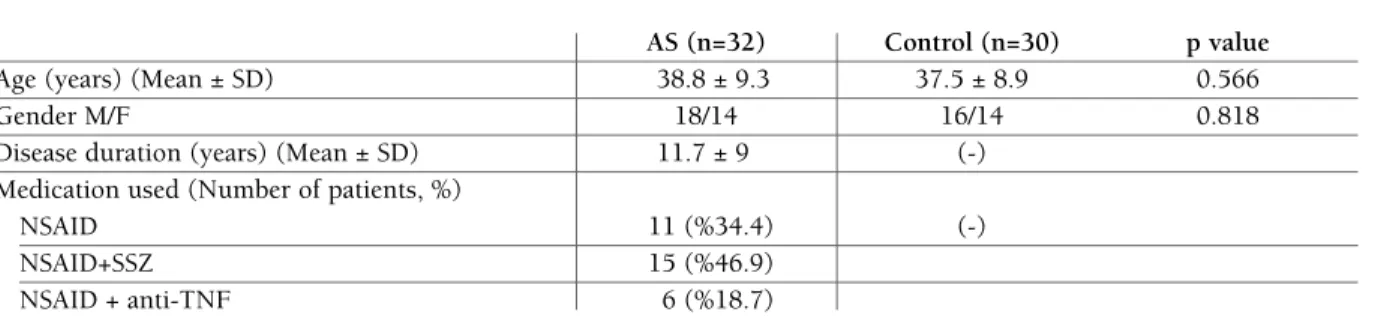
The demographic characteristics of the subjects are presented in Table I.
heArt rAte VArIAbIlIty AND r-r INterVAl VArIAbIlIty
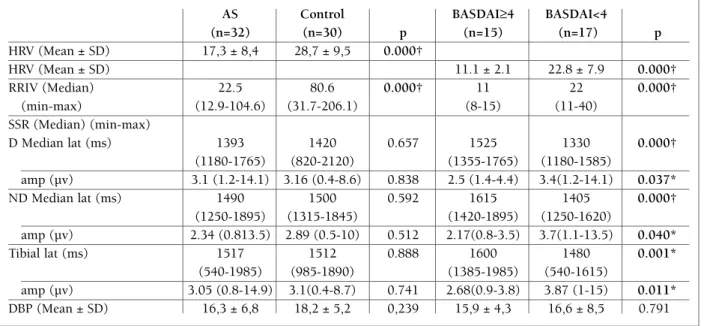
HRV was significantly lower in the AS group than con-trols and was significantly lower in the group with BASDAI≥4 when compared to the group with BAS-DAI<4. There was less RRIV in AS group when com-pared to the control group (Table II). This result indi-cates a parasympathetic dysautonomia in AS group.
DIAstOlIc blOOD pressUre (Dbp) AND syMpAthetIc skIN respONse
There was no statistically significant difference
be-tAble I. DeMOgrAphIc chArActerIstIcs Of the pAtIeNts
AS (n=32) Control (n=30) p value
Age (years) (Mean ± SD) 38.8 ± 9.3 37.5 ± 8.9 0.566
Gender M/F 18/14 16/14 0.818
Disease duration (years) (Mean ± SD) 11.7 ± 9 (-) Medication used (Number of patients, %)
NSAID 11 (%34.4) (-)
NSAID+SSZ 15 (%46.9)
NSAID + anti-TNF 6 (%18.7)
tAble III. cOrrelAtIONs Of ssr wIth bAsDAI AND AsDAs-c
ASDAS-C BASDAI
Dom. median latency r = 0,664 r=0.75 p= 0.000† p= 0.000†
Dom. median amplitude r=-0.384 r = -0.392 p= 0.030* p= 0.026* ND median latency r=0.611 r=0.697 p= 0.000† p= 0.000† ND median amplitude r= -0.470 r= -0.434 p= 0.007* p= 0.013* Tibial latency r= 0.712 r= 0.691 p= 0.000† p= 0.000† Tibial amplitude r= -0.521 r= -0.426 p= 0.002* p= 0.015* SSR: Sympathetic skin response, BASDAI: Bath Ankylosing Spondylitis Disease Activity Index, ASDAS-C: Ankylosing Spondylitis Disease Activity Score–C. Dom: Dominant, ND: Non-dominant
*: p<0,05, †: p<0,001
tAble II. clINIcAl AND electrOphysIOlOgIcAl test resUlts AccOrDINg tO grOUps
AS Control BASDAI≥4 BASDAI<4
(n=32) (n=30) p (n=15) (n=17) p HRV (Mean ± SD) 17,3 ± 8,4 28,7 ± 9,5 0.000† HRV (Mean ± SD) 11.1 ± 2.1 22.8 ± 7.9 0.000† RRIV (Median) 22.5 80.6 0.000† 11 22 0.000† (min-max) (12.9-104.6) (31.7-206.1) (8-15) (11-40) SSR (Median) (min-max) D Median lat (ms) 1393 1420 0.657 1525 1330 0.000† (1180-1765) (820-2120) (1355-1765) (1180-1585) amp (µv) 3.1 (1.2-14.1) 3.16 (0.4-8.6) 0.838 2.5 (1.4-4.4) 3.4(1.2-14.1) 0.037* ND Median lat (ms) 1490 1500 0.592 1615 1405 0.000† (1250-1895) (1315-1845) (1420-1895) (1250-1620) amp (µv) 2.34 (0.813.5) 2.89 (0.5-10) 0.512 2.17(0.8-3.5) 3.7(1.1-13.5) 0.040* Tibial lat (ms) 1517 1512 0.888 1600 1480 0.001* (540-1985) (985-1890) (1385-1985) (540-1615) amp (µv) 3.05 (0.8-14.9) 3.1(0.4-8.7) 0.741 2.68(0.9-3.8) 3.87 (1-15) 0.011* DBP (Mean ± SD) 16,3 ± 6,8 18,2 ± 5,2 0,239 15,9 ± 4,3 16,6 ± 8,5 0.791
tween AS and the control groups as well as the group with BASDAI ≥4 and the group with BASDAI <4 for sympathetic nervous system functions evaluated clini cally with DBP response to isometric exercise. In addi -tion, there was no statistically significant difference between AS group and the control group for sympathe -tic skin response (SSR) tested electrophysiologically. On the other hand, SSR amplitudes were significantly smaller and the latencies were significantly longer in the group with BASDAI≥4 when compared to the group with BASDAI<4 (Table II). In addition to these, there was a significant positive correlation between BASDAI and ASDAS-C scores and SSR latencies, and there was a significant negative correlation between BASDAI and ASDAS-C scores and SSR amplitudes (Table III).
DIscUssION
In our study, we found abnormalities in clinical and electrophysiological autonomic tests that evaluates parasympathetic system in patients with AS. These ab-normalities were also related with the disease activity. The results of the tests that analyzed the sympathetic
system were not different in the AS and the control groups. However, the results of the electrophysiologi-cal tests showed a statistielectrophysiologi-cally significant difference
be-AS: Ankylosing spondylitis, BASDAI: Bath Ankylosing Spondylitis Disease Activity Index
HRV: Heart rate variability, SD: standard deviation RRIV: R-R interval variation, min: minimum, max: maximum, SSR: Sympathetic skin response D: Dominant, ND: Non-dominant, lat : latency, amp : amplitude, DBP: Diastolic blood pressure to isometric exercise, *: p<0,05 †: p<0,001
tween the patients with active and inactive disease. Our results suggest that parasympathetic system is af-fected in AS whereas sympathetic system is afaf-fected when the disease activity increases.
In a review about the autonomic control of immu-nity, Czura et al. mentioned the effects of the parasym-pathetic function on the organization of inflammato-ry response10. Cholinergic neurons control TNF syn-thesis by means of acetylcholine (ACH)11,12. ACH is the main neurotransmitter of the parasympathetic system, and it has a property to decrease the activity of the macrophages. This relation between the autonomic nervous system and immune system has been called as “cholinergic anti-inflammatory pathway”. Inflamma-tory stimuli stimulate vagal afferents and then the hy-pothalamus. Experimental stimulation of the vagus caused decreased TNF synthesis in liver, spleen and heart, and serum TNF levels decreased in endoto -xemia, ischemia / reperfusion injury and hemorrha gic shock. After vagotomy, animals showed an exaggera -ted TNF response to an inflammatory stimulus11-16. These results suggest that individuals may develop exaggerated immune response due to dysfunction of cholinergic anti-inflammatory pathway. This concept has been supported in the literature by demonstrating autonomic dysfunction in inflammatory diseases such as diabetes mellitus, rheumatoid arthritis, systemic lu-pus erythematosus and Crohn’s disease17-22. Other in-flammatory conditions such as sepsis have been demonstrated to be related to autonomic dysfunc-tion23,24.
Initially, this dysfunction was thought to be secon dary to inflammation. Recently, as an alternative expla -na tion it has been suggested that excessive cytokine production develops as a result of dysfunction in the cholinergic anti-inflammatory pathway after a harm-less stimulus, in other words, inflammation develops as a result of the dysfunction of the parasympathetic system. Treatment of the inflammatory diseases by en-dogenous neural mechanisms has become a current issue after identification of cholinergic anti-inflamma-tory pathway. Animal studies previously showed that electrical stimulation of vagus had an anti-inflamma-tory effect25. This method and other similar methods may be treatment options in inflammatory diseases such as rheumatoid arthritis and AS, in the future.
There are a few studies about autonomic nervous system activity in AS patients The first study was per-formed by Toussirot et al. in 1999. They reported that the blood pressure dropped more and there was less
spontaneous baroreflex activity in AS patients when they were upright. In addition, when they stood up af-ter a supine position, the heart rate was shown to be higher in the patients with BASDAI score ≥5 when compared to the control group and the ones with BAS-DAI score <52. Similar to Toussirot et al., our study showed that these results indicating parasympathetic autonomic nervous system dysfunction were more pronounced in the patients with active disease.
Similar to our study Borman et al. reported that HRV, RRIV and hearth rate response to standing (HRS, a clinical test that evaluates parasympathetic system functions) were statistically significantly lower in the patient group with AS than the control group. In ad-dition, they reported a significant negative correlation between HRV and BASDAI scores. Although there was no statistically significant difference between the pa-tients and the control groups for SSR, latencies were longer and amplitudes were smaller in patients with active disease3. These results indicate that sympathe -tic dysfunction is only apparent when the disease is active. The disease activity was evaluated with BAS-DAI in the studies of Toussirot and Borman. Diffe rently, we used ASDAS in addition to BASDAI to investigate disease activity, and found a linear correlation between ASDAS and electrophysiological tests. Another study that investigated this subject was performed by Yildirir et al. They investigated heart rate variability in AS pa-tients using power spectral analysis. There was no dif-ference in AS and the control groups for HRV4. Mean disease duration was approximately 5 years in the study of Yildirir et al. while this duration was 11.7 years in our study, and this difference may be respon-sible for the dissimilarity of the results of two studies.
It is known that there is increased mortality in pa-tients with AS and cardiovascular diseases are among the causes of death26. Parasympathetic nervous system dysfunction may cause mortality in these patients by impairing baroreflex function and causing conduction defects.
cONclUsIONs
In conclusion, clinicians must be bewared for auto-nomic dysfunction in patients with AS. Future studies may help us to appreciate its clinical importance and effect on immunity and may aid for the development of new alternative treatment methods for AS and other inflammatory diseases.
AckNOwleDgeMeNts
We would like to express our gratitude to all patients who have participated in our study.
cOrrespONDeNce tO
Camlica M PTT Loj. A Blok No: 23 Yenimahalle, Ankara, Turkey
Telephone number: +90 05056460390 Fax number: +90 312 3095308 E-mail: [email protected]
refereNces
1. van der Linden S, van der Heijde D, Braun J. Ankylosing spondylitis. In: Harris ED, Budd RC, Firestein GS, Genovese MC, Sergent JS, Ruddy S, Sledge CB, eds. Kelley’s Textbook of Rheumatology. Philadelphia: Elsevier, 2005: 1125-1141. 2. Toussirot E, Bouhaddi MB, Poncet JC, et al. Abnormal
auto-nomic cardiovascular control in ankylosing spondylitis. Ann Rheum Dis 1999;58: 481–487
3. Borman P, Gokoglu F, Kocaoglu S, Yorgancioglu ZR. The auto-nomic dysfunction in patients with ankylosing spondylitis: a clinical and electrophysiological study. Clin Rheumatol 2008; 27: 1267-1273. Epub 2008 May
4. A Yildirir, S Aksoyek, M Calguneri, et al. No evidence of car-diac autonomic involvement in ankylosing spondylitis, as assessed by heart rate variability. Clin Rheumatol 2001; 20:185-188.
5. Garret S, Jenkinson T, Kennedy LG, et al. A new approach to defining disease status in ankylosing spondylitis; the bath ankylosing spondylitis disease activity index. J Rheumatol 1994; 21:2286–2291.
6. Akkoc Y, Karatepe AG, Akar S, Kirazli Y, Akkoc N. A Turkish version of the Bath Anklylosing Spondylitis Disease Activity Index: reliability and validity. Rheumatol Int 2005; 25: 280--284.
7. C Lucas, R Landewe, J Sieper, et al. Development of an ASAS-endorsed disease activity score (ASDAS) in patients with ankylosing spondylitis. Ann Rheum Dis 2009; 68: 18-24. 8. Ewing DJ, Clarke BF. Diagnosis and management of diabetic
autonomic neuropathy. Br Med J 1982; 285: 916-918. 9. Shahani BT, Day TJ, Cros D, Khalil N, Kneebone CS. R–R
interval variation and the sympathetic skin response in the assessment of autonomic function in peripheral neuropathy. Arch Neurol 1990; 47: 659–664.
10. Czura CJ, Friedman SG, Tracey KJ. Neural inhibition of inflammation: the cholinergic anti-inflammatory pathway. J Endotoxin Res 2003; 9: 409-413.
11. Borovikova LV, Ivanova S, Zhang M, et al. Vagus nerve stimu-lation attenuates the systemic inflammatory response to endotoxin. Nature 2000; 405: 458–462.
12. Wang H, Yu M, Ochani M, et al. Nicotinic acetylcholine receptor alpha7 subunit is an essential regulator of inflamma-tion. Nature 2003; 421: 384–388.
13. Bernik TR, Friedman SG, Ochani M, et al. Pharmacological stimulation of the cholinergic antiinflammatory pathway. J Exp Med 2002; 195: 781–788.
14. Bernik TR, Friedman SG, Ochani M, et al. Cholinergic anti-inflammatory pathway inhibition of tumor necrosis factor during ischemia reperfusion. J Vasc Surg 2002; 36: 1231– –1236.
15. Guarini S, Altavilla D, Cainazzo MM, et al. Efferent vagal fibre stimulation blunts nuclear factor-kappaB activation and pro-tects against hypovolemic hemorrhagic shock. Circulation 2003; 107: 1189–1194.
16. Guarini S, Cainazzo MM, Giuliani D, et al. Adrenocorticotro-pin reverses hemorrhagic shock in anesthetized rats through the rapid activation of a vagal anti-inflammatory pathway. Cardiovasc Res 2004; 63: 357–365.
17. Toussirot E, Serratrice G, Valentin P. Autonomic nervous sys-tem involvement in rheumatoid arthritis. 50 cases. J Rheu-matol 1993; 20: 1508–1514.
18. Edmonds ME, Jones TC, Saunders WA, Sturrock RD. Auto-nomic neuropathy in rheumatoid arthritis. Br Med J 1979; 2: 173–175.
19. Gamez-Nava JI, Gonzalez-Lopez L, Ramos-Remus C, et al. Autonomic dysfunction in patients with systemic lupus eryt-hematosus. J Rheumatol 1998; 25: 1092–1096.
20. Huynh C, Ho SL, Fong KY, Cheung RT, Mok CC, Lau CS. Peripheral neuropathy in systemic lupus erythematosus. J Clin Neurophysiol 1999; 16: 164–168.
21. Meyer C, Milat F, McGrath BP, Cameron J, Kotsopoulos D, Teede HJ. Vascular dysfunction and autonomic neuropathy in type 2 diabetes. Diabet Med 2004; 21: 746–751.
22. Straub RH, Antoniou E, Zeuner M, Gross V, Scholmerich J, Andus T. Association of autonomic nervous hyperreflexia and systemic inflammation in patients with Crohn’s disease and ulcerative colitis. J Neuroimmunol 1997; 80: 149–157. 23. Ellenby MS, McNames J, Lai S, et al. Uncoupling and
recou-pling of autonomic regulation of the heart beat in pediatric septic shock. Shock 2001; 16: 274–277.
24. Munford RS, Tracey KJ. Is severe sepsis a neuroendocrine disease? Mol Med 2002; 8: 437–442.
25. Borovikova LV, Ivanova S, Nardi D, et al. Role of vagus nerve signaling in CNI-1493-mediated suppression of acute inflam-mation. Auton Neurosci 2000; 85: 141–147.
26. John Reveille. Clinical features of ankylosing spondylitis. In: M. C. Hochberg, A. J. Silman, J. S. Smolen, M. E. Weinblatt, M. H. Weisman, eds. Rheumatology 4th edn. Edinburgh: Mosby-Elsevier, 2008: 1113.