Brazilian Journal of Physics, vol. 36, no. 3A, September, 2006 645
Monte Carlo Study of the Metamagnet Ising model in a Random and Uniform Field
A. Weizenmann, M. Godoy, and A. S. de Arruda
Departamento de F´ısica, Universidade Federal de Mato Grosso, 78060-900, Cuiab ´a, Mato Grosso, Brazil
Received on 30 September, 2005
Monte Carlo simulation has been used to determine the phase diagram of a metamagnet Ising model in the presence of a random and uniform magnetic field. The model consists of a spin-1/2 metamagnet in which the nearest neighbor and next nearest neighbor spin interactions are antiferromagnetic (J1<0) and ferromagnetic (J2>0), respectively. We used a bimodal probability distribution for the random magnetic field. We have calculated the staggered magnetization and the fourth-order Binder cumulants in order to obtain the critical points. The phase diagram in the uniform field versus temperature plane presents continuous and first-order transition lines. The phase transition lines, together with the critical and tricritical points, have been obtained for several random field values.
Keywords: Random field; Monte Carlo simulation; Tricritical point
I. INTRODUCTION
Random field and disordered magnetic systems have been a considerable source of research in the last years [1]. The random field Ising model (RFIM) has been one of the most interesting research topics in theoretical physics (Condensed Matter) in the last fifteen years and it occupies an important position within the physics of disordered systems [2, 3]. Ba-sically, there are two types of disorder in the spin models: disorder bonds (type I) and randomness in the strength of the applied magnetic field (type II). The Spin Glass models, which result from the type I disorder, have been very sucess-full [4]. RFIM, in which the disorder is coupled directly to the external applied magnetic field (type II), has been shown very hard to handle. Although RFIM has deserved many in-vestigations from both experimental and theoretical points of view [3], no significant progress has been achieved to fully understand the nature of the phase transitions and critical be-havior. On the other hand, questions such as the lower critical dimension [5, 6] and the existence of a static phase transi-tion have already been solved from the theoretical point of view. However, questions such as the existence of the tricrit-ical point [7–11] are still open. The relevance of RFIM is due to the fact that it is the simplest model used to describe the essential physics of a rich class of experimentally acces-sible disordered systems, which includes: i) structural phase transitions in random alloys [12], ii) commensurate charge-density-wave systems with impurity pinning [13, 14], iii) bi-nary fluid mixtures in random porous media [15], iv) melt-ing of intercalates in layered compounds such as TiS2 [16],
v) frustration introduced by the disorder in interacting many body systems, besides explaining several aspects of electronic transport in disordered insulators [17] and vi) systems near the metal-insulator transition [18, 19]. In the last ten years, the physics of the hysteresis, of the avalanche behavior and of the origin of self-organized criticality [20] have been mod-elled employing the non-equilibrium behavior of the RFIM. In particular, a new class of problems, such as self-generated glassy behavior, has been studied through the non-disordered model with infinitesimal random field [21]. Recently, random magnetic fields have been considered in metamagnet systems
of Ising type. In these systems, only the competition between the ferromagnetic and antiferromagnetic ordering are interest-ing. However, the application of a random and uniform mag-netic field can yield the appearance of new phenomena and a richer critical behavior becomes possible. This is in fact the subject of the present work.
The plan of the paper is as follows. The model and the simulation background are given in section II while the results are discussed in section III.
II. MODEL AND SIMULATION
The Hamiltonian model for the spin-1/2 Ising metamagnet can be written as
H = −
∑
hi ji
J1σiσj−
∑
hiki
J2σiσk− N
∑
i=1
(h−hi)σi,
where the first and second sum run over all pairs of spin near-est neighbors (hi ji) and next nearest neighbors (hiki), respec-tively, on a simple square lattice withN spins andσi=±1.
J1<0 (antiferromagnetic) represents the nearest neighbor
spin interactions and J2>0 (ferromagnetic) represents the
next nearest neighbor spin interactions. his the strength of the external uniform magnetic field and the random magnetic fieldshiin the last sum are governed by the bimodal distribu-tion
P(hi) = 1
2[δ(hi−hr) +δ(hi+hr)], wherehris the strength of the random field.
646 A. Weizenmann et al.
equilibrium state we take, for guarantee, at least 2×10⁵MCs (Monte Carlo steps) for all the lattice sites we studied. Then, we take more 3×10⁵MCs to estimate the average values of
the quantities of interest. Here, 1 MCs means L2 trials for change the state of a spin of the lattice.
We calculated the sublattice magnetizations per spin
m1=
" 1 N1
*
∑
i∈1
σi +#
hr
,
and
m2=
" 1 N2
*
∑
i∈2
σi +#
hr
.
The transition lines of the phase diagram were obtained from the staggered magnetization, defined as mS= (m1−m2)/2.
We also calculated the reduced fourth-order Binder cumulants [23]
UL=1− £
m4s®¤h
r
3hhm2
si
2i hr
,
associated with the staggered magnetization. From the cross-ing point of the cumulants for different lattice sizes we de-termined the critical points of the model [23]. In the above expressions[· · ·]hr denotes the average over the disorder and
h· · · idenotes the thermal average. The average over the
dis-order was done usingNsamp=100 independent samples for lattices in the range 16≤L≤128.
III. RESULTS
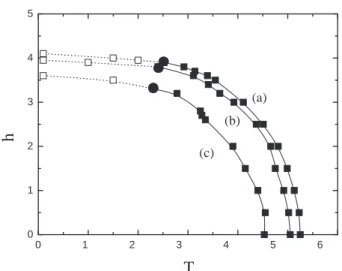
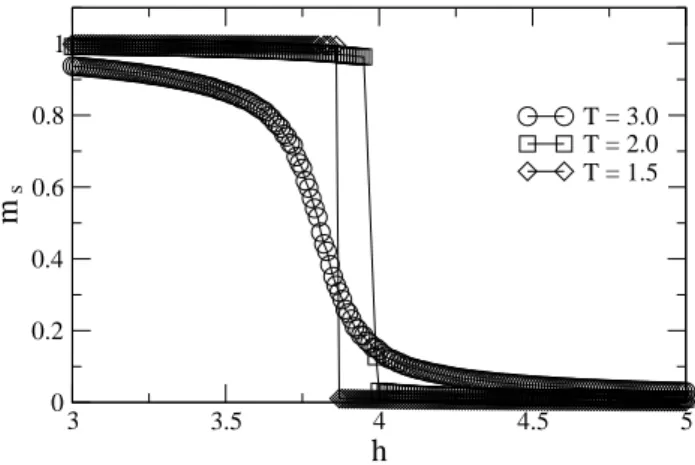
We present in Fig. 1 the phase diagram of the model in the plane external uniform fieldhversus temperature T, for three selected values of the random fieldhr. The phase dia-gram displays continuous phase transition lines which end at a tricritical point at low temperatures. The solid curves join-ing the square are continuous phase transition lines while the dashed lines represent first-order transitions. Circles repre-sent the positions of the tricritical points. The points in the continuous transition lines were obtined by considering the common point where the cumulants for different lattice sizes cross. As an example, we show in Fig. 2 a typical case for hr=0 andh=1.0. On the other hand, the first-order tran-sition lines were estimated by observing the discontinuity in the staggered magnetization at the transition point. An exam-ple of this is given in Fig. 3. We found the tricritical points for the following random fields (see Fig. 1): (a) hr=0.0
(Tt=2.52,ht=3.90), (b)hr=0.5(Tt=2.40,ht=3.80)and (c)hr=1.0(Tt=2.30,ht =3.30). Forh=0 and different values ofhr the phase diagram presents different values for the critical temperature. The result shown in (Fig. 1) is qual-itatively similar to that obtained by the use of a mean-field calculation [24].
In Fig. 3 we show the behavior of the staggered magneti-zationms as a function of the external uniform fieldh. For
0 1 2 3 4 5 6
0 1 2 3 4 5
(c) (b)
(a)
h
T
FIG. 1: Phase diagram in the plane uniform fieldhversus tempera-tureTfor three different values of the random fieldhr. The solid lines joining the full squares represent continuous transitions while dashed lines joining the open squares represent first-order transitions. Full circles represent the positions of the tricritical points. (a)hr=0.0 (Tt=2.52,ht=3.90), (b)hr=0.5(Tt=2.40,ht=3.80)and (c) hr=1.0(Tt=2.30,ht=3.30). The erros bars are less than the size of the data points.
4 4.5 5 5.5 6
T
0 0.2 0.4 0.6
U L L = 16
L = 32 L = 48 L = 64 L = 96 L = 128
FIG. 2: Fourth-order Binder cumulantsULversus temperatureT, for various lattice sizes as indicated in the figure and for the pointhr=0, h=1.0. The erros bars are less than the size of the data points.
Brazilian Journal of Physics, vol. 36, no. 3A, September, 2006 647
0 0.2 0.4 0.6 0.8 1
m
s3 3.5 4 4.5 5
h
T = 3.0 T = 2.0 T = 1.5
FIG. 3: Staggered magnetization as a function of the external uni-form fieldh, for several values of the temperatureT as indicated in the figure forhr=0.0.
h, indicating the existence of a continuous phase transition. From the crossing of the analytical continuation of the first-and second-order lines we estimate the location of the tricriti-cal points shown in Fig. 1.
In summary, the present Monte Carlo simulations for a metamagnet Ising model in a random and uniform field show that the phase diagram in the plane uniform field h versus temperature present continuous and first-order transition lines separated by tricritical points.
Acknowledgments
The authors acknowledge the financial support given by the Brazilian agencies CAPES, CNPq and FAPEMAT.
[1] D. P. Belanger, Braz. J. Phys.30682 (2000).
[2] D. P. Belanger,in Spin Glasses and Random Fields, edited by A. P. Young (World Scientific, Singapore, 1998); R. J. Birgeneau, J. Magn. Magn. Mater. 177, 1 (1998).
[3] Y. Shapir,in Recent Progress in Random Magnets, edited by D. H. Ryan (World Scientific, Singapore, 1992), pp. 309-334. [4] J. R. L. de Almeida and D. J. Thouless, J. Phys. A11, 983
(1978).
[5] J. Z. Imbrie, Phys. Rev. Lett.531747 (1984).
[6] Y. Imry and S. K. Ma, Phys. Rev. Lett.351399 (1975). [7] A. S. de Arruda, W. Figueiredo, R. M. Sebastianes, and V. K.
Saxena, Phys. Rev. B394409 (1989).
[8] A. S. de Arruda and W. Figueiredo, Mod. Lett. B11 (21,22) 973 (1997).
[9] D. F. de Albuquerque and A. S. de Arruda, Physica A31613 (2002).
[10] D. C. Mattis, Phys. Rev. Lett.553009 (1985). [11] A. Aharohy, Phys. Rev. B183318 (1978).
[12] J. R. Childress and C. L. Chien, Phys. Rev. B43, 8089 (1991). [13] D. S. Fisher, Phys. Rev. Lett.50, 1486 (1983).
[14] D. S. Fisher, Phys. Rev. B31, 1396 (1985).
[15] J. V. Maher, W. I. Goldburg, D. W. Pohlm and M. Lanz, Phys. Rev. Lett.53, 60 (1984).
[16] R. M. Suter, M. W. Shafer, P. M. Hornm and P. Dimon, Phys. Rev. B26, 1495 (1982).
[17] A. L. Efros and B. L. Shklovskii, J. Phys. C8, L49 (1975). [18] T. R. Kirkpatrick and D. Belitz, Phys. Rev. Lett.73, 862 (1994). [19] A. A. Pastor and V. Dobrosavljevi´c, Phys. Rev. Lett.83, 4642
(1999).
[20] A. A. Pastor, V. Dobrosavljevi´c, and M. L. Horbach, Phys. Rev. B66014413 (2002).
[21] M. Mezard, Physica A265, 352 (1999).
[22] D. P. Landau and K. Binder,A Guide to Monte Carlo Simula-tions in Statistical Physics(Cambridge University Press, United Kingdom, 2000).
[23] K. Binder and D. W. Heermann, Monte Carlo Simulation in Statistical Physics. An Introduction, 3rd ed. (Springer, Berlin, 1997).