A Harris-Todaro Agent-Based Model to Rural-Urban Migration
Aquino L. Esp´ındola,
Instituto de F´ısica, Universidade Federal Fluminense 24.210-340, Niter ´oi, RJ, Brazil
Jaylson J. Silveira,
Depto de Economia, Universidade Estadual Paulista - UNESP 14.800-901, Araraquara, SP, Brazil
and T. J. P. Penna
Instituto de F´ısica, Universidade Federal Fluminense 24.210-340, Niter ´oi, RJ, Brazil
Received on 6 September, 2005
The Harris-Todaro model of the rural-urban migration process is revisited under an agent-based approach. The migration of the workers is interpreted as a process of social learning by imitation, formalized by a com-putational model. By simulating this model, we observe a transitional dynamics with continuous growth of the urban fraction of overall population toward an equilibrium. Such an equilibrium is characterized by stabilization of rural-urban expected wages differential (generalized Harris-Todaro equilibrium condition), urban concentra-tion and urban unemployment. These classic results obtained originally by Harris and Todaro are emergent properties of our model.
Keywords: Agent-based model; Harris-Todaro model; Econophysics; Complex system
I. INTRODUCTION
In this paper we turn upon the seminal Harris and Todaro [1] work, which together with Todaro [2] is considered one of the starting points of the classic rural-urban migration theory [3]. The hypothesis and predictions of Harris-Todaro model have been subjected to econometric evaluation and have been corroborated by several studies [4–7]. The key hypothesis of Harris and Todaro are that migrants react mainly to economic incentives, earnings differentials, and the probability of get-ting a job at the destination have influence on the migraton decision. In other words, these authors posit that rural-urban migration will occur while the urban expected wage [12] ex-ceed the rural wage. From thiscrucial assumption, as denom-inated by Harris-Todaro [1], is deduced that the migratory dy-namics leads the economic system toward an equilibrium with urban concentration and high urban unemployment.
In our previous works [8, 9] we analyzed the rural-urban migration by means of an agent-based computational model taking into account the influence of the neighborhood in the migration decision. The inclusion of the influence of neigh-bors was done via an Ising like model. The economic anal-ogous to the external field in the Ising hamiltonian was the differential of expected wages between urban and rural sec-tors. Therefore, in theses works [8, 9] the crucial assumption of Harris and Todaro were taken for granted.
Now, we are motivated by the following question: can the crucial assumption and equilibrium with urban concentration and urban unemployment obtained from the original Harris-Todaro model be generated as emergent properties from the interaction among adaptative agents? In order to answer this question we implemented an agent-based computational model in which workers grope for best sectorial location over time in terms of earnings. The economic system simulated is characterized by the assumption originally made by Harris and Todaro.
The paper is arranged as follows. Section II describes the analytical Harris-Todaro model showing its basic equilibrium properties. In Section III we present the implementation of the computational model via an agent-based simulation and com-pare its aggregate regularities with the analytical equilibrium properties. Section IV shows concluding remarks.
II. THE HARRIS-TODARO MODEL
A. Assumptions
Harris and Todaro [1] studied the migration of workers in a two-sector economic system, namely, rural sector and urban sector. The difference between these sectors are the type of goods produced, the technology of production and the process of wage determination. The rural sector is specialized in the production of agricultural goods. The productive process of this sector can be described by a Cobb-Douglas production function:
Ya=AaNaφ, (1)
whereYais the production level of the agricultural good,Na is the amount of workers used in the agricultural production, Aa>0 and 0<φ<1 are parametric constants.
Similarly, the urban sector also has its productive process described as Cobb-Douglas production function:[13]
Ym=AmNmα, (2)
Both goods and labor markets are perfectly competitive. Nevertheless, there is segmentation in the labor market due to a high minimum urban wage politically determined.
In the rural sector, the real wage, perfectly flexible, is equal to the marginal productivity of labor in this sector:[15]
wa=φAaNaφ−1p, (3) wherewais the real wage andpis the price of the agricultural good, both expressed in units of manufactured good.
In the urban sector, a minimum wage,wm, is assumed fixed institutionally at a level above equilibrium in this labor mar-ket. It can be formalized as [16]
wm=αAmNmα−1, such that Nm≤Nu, (4) whereNuis the amount of workers in the urban sector.
The relative price of the agricultural good in terms of the manufactured good,p, varies according to the relative scarcity between agricultural and manufacturated goods. Then,[17]
p=ρ
µY
m Ya
¶γ
, (5)
whereρ>0 and γ>0 are a parametric constants. γis the elasticity ofpwith respect to the ratioYm/Ya.
The overall population of workers in the economy is N, which is kept constant during the whole period of analysis. By assumption there are only two sectors and rural prices are wholly flexible, which implies that there is full employment in the rural area, i.e., all workers living at the rural sector are employed at any period. Then at any period the following equality is verified:
Na+Nu=N. (6)
B. Temporary Equilibrium
Given a parametric constant vector (Aa,Am,φ,α,ρ,γ), an initial urban populationNu, and a minimum wagewmone can calculate the temporary equilibrium of the economic system by using eqs. (1-6).
From eq. (4) one can find the employment level at the man-ufacturing sector
Nm=
µαA
m wm
¶1−1α
. (7)
Replacing eq. (7) in eq. (2) we get the production level of the manufacturing sector
Ym=A 1 1−α
m
µ α
wm
¶1−αα
. (8)
From eq. (6) one can obtain the relation
Na=N−Nu, (9)
which is used with eq. (1) to obtain the agricultural production
Ya=Aa(N−Nu)φ. (10) By using eqs. (5), (8) and (10) the terms of trade are deter-mined
p=ρ
A 1 1−α m ³ α wm
´1−αα
Aa(N−Nu)φ
γ
. (11)
Finally, by using eqs. (3), (9) and (11), the rural wage in units of manufacturated good is obtained
wa=φρA1a−γA
γ 1−α
m
µ α
wm
¶1−αγα
1 (N−Nu)1−φ+φγ
. (12)
In sum, the vector(Nm,Ym,Na,Ya,p,wa)configures a tem-porary equilibrium that might be altered whether occurs a migration of workers, induced by the differential of sector-ial wages, which changes the sectorsector-ial distribution of overall population.
C. The Long Run Equilibrium
Harris and Todaro, in determining the long run equilibrium, i.e., the absence of a net rural-urban migratory flow, argue that the rural workers, in their decision on migrating to the urban area, estimate the expected urban wage,we
u, defined as:
weu=Nm
Nuwm. (13)
The ratioNm/Nu, which is the employment rate, is an estima-tive of the probability that a worker living at urban sector gets a job in this sector.
As mentioned before, the key assumption of the model of Harris and Todaro is that there will be a migratory flow from the rural to the urban sector while the expected urban wage is higher than the rural wage. Thus, the long run equilibrium is attained when the urban worker population reaches a level such that the expected urban wage equates the rural wage:
weu−wa=0. (14)
valueδ6=0. When this differential reachesδ, the net migra-tion ceases. Thisgeneralized Harris-Todaro conditioncan be expressed as follows:
weu−wa=δ. (15)
The level of the urban population that satisfies the eq. (15), i.e., the equilibrium urban share n∗u=Nu∗/N, is determined from the solution of the equation resulting from substitution of equations (12), (13) in eq. (15):
Nm Nu
wm−φρA1a−γA
γ 1−α
m
µ
α wm
¶1−αγα
×
1 (N−Nu)1−φ+φγ
=δ. (16)
The solution of eq. (16) is parametrized by the vector (Aa,Am,ρ,γ,α,φ,wm).
Harris and Todaro [1], in order to evaluate the stability of the long run equilibrium, postulate a mechanism of adjust-ment that is based on the following function of sign preserva-tion:
˙
Nu=ψ(weu−wa), with ψ′(¦)>0 and ψ(0) =0. (17) The differential equation that governs the state transition in the model of Harris and Todaro is obtained by replacing equations (12), (13) in eq. (17). Based on this postulated ad-justment process, Harris and Todaro [1] show that the long run equilibrium is globally asymptotically stable. This means that the economy would tend to long run equilibrium with unem-ployment in the urban sector generated by the presence of a relatively high minimum wage for all possible initial condi-tions. From now on we will refer to the long run equilibrium simply as equilibrium.
0 0.1 0.2 0.3 0.4 0.5 0.6 0.7 0.8 0.9
0.8 0.9 1 1.1 1.2 1.3
wm
FIG. 1: Numerical solution of eq. (16) for different values ofwm.
Squares: urban share n∗u; Circles: urban unemployment rate (1−
Nm/N). Fixed parameters used areAa=1.0, Am=1.0, φ=0.3,
α=0.7,ρ=1.0 andγ=1.0.
0 0.1 0.2 0.3 0.4 0.5 0.6 0.7 0.8
0 1 2 3 4 5 6 7 8
gamma
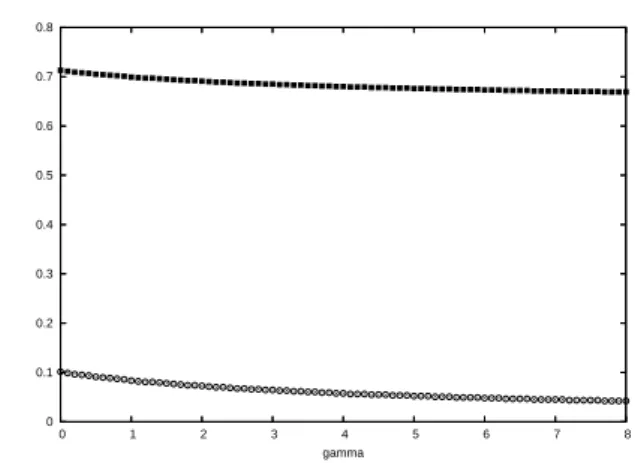
FIG. 2: Numerical solution of eq. (16) for different values ofγ.
Squares: urban sharen∗u; Circles: urban unemployment rate,(1−
Nu∗/N). Fixed parameters used areAa=1.0, Am=1.0,φ=0.3,
α=0.7,ρ=1.0 andwm=0.8
Based on the numerical solutions of eq. (16) one can eval-uate the impact that the variation of the minimum wage and the elasticity of the terms of trade on the equilibrium. In Fig. 1 we see that under the hypothesis of a Cobb-Douglas tech-nology, the equilibrium urban share,n∗u, does not depend on the minimum wagewm. However, changes in the value ofwm reduces the labor demand on the manufacturing sector what results in higher unemployment rates in the equilibrium.
In turn, as seen in Fig. 2, changes in the elasticity of the terms of trade alter slightly the equilibrium urban share and unemployment rate. A net migration toward urban sector shift the terms of trade to higher values. The greaterγthe greater this shift, what cause an increase in the rural wage in units of manufacturing good, becoming the urban sector less attrac-tive.
III. HARRIS-TODARO AGENT-BASED MODEL
In this section we describe the implementation of the com-putational model we proposed, as well as the aggregate pat-terns obtained numerically and the comparison with the re-spective analytical results.
A. Computational Implementation
tempo-rary equilibrium of the system by using eqs. (7-12).
By using eq. (7), the employment level of the urban sector, Nm, is obtained. Ifnu≤Nm/N all workers in the urban sec-tor are employed and each individualiearns the wage given by the manufacturing marginal productivity,wi=αAmNuα−1. Otherwise, nu >Nm/N there will be a fraction of Nm/Nu workers employed, which earn the minimum wage,wi=wm, and (1−Nm/Nu) workers unemployed, which earn a wage wi=0.
Each worker can be selected to review his sectorial location with probability a, called activity [11]. Therefore, in each time step only a fraction of workers becomes potential mi-grants, going through the sectorial location reviewing process. Potential migrants will determine their satisfaction level of being in the current sector by comparing their earnings, wi, among nearest neighbors.
The potential migrant starts the comparison process with a initial satisfaction levelsi=0. Whenwi>wneighbor the sat-isfaction levelsiis added in one unit; ifwi<wneighbor,si is diminished in one unit; ifwi=wneighbor,sidoes not change. After the worker has passed through the reviewing process his/her satisfaction level is checked. The migration will occur only ifsi<0, what means that the worker’siearnings is less than the most of his/her nearest neighbors.
After all the potential migrants complete the reviewing process and have decided migrate or not, a new configura-tion of the system is set. Therefore, once again a new tem-porary equilibrium of the system is calculated by using eqs. (8-12). The whole procedure is repeated until a pre-set num-ber of steps is reached. It is important to emphasize thatNmis kept constant throughout the simulation. Its given by eq. (7) which depends on the technological parameters,α,Am, and the minimum wage,wm, which are constants too.
B. Analysis of the Emergent Properties
In this section we develop the analysis of the long run ag-gregate regularities of Harris-Todaro agent-based computa-tional model. These long run properties will be compared be-tween the solution of the analytical model and simulations we ran.
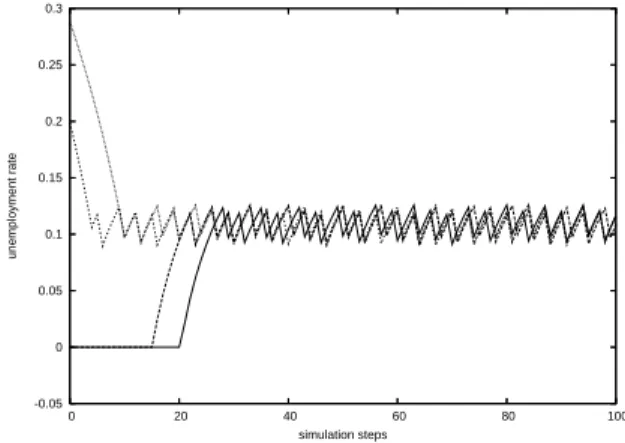
Figures 3, 4 and 5 show the basic characteristics of the tran-sitional dynamics and long run equilibrium generated by sim-ulations. When the economic system has a low initial urban share, nu=0.2 ornu=0.3, there is a net migration toward urban sector. This migration takes the urban sector from a full employment situation to an unemployment one. The positive differential of expected wages that pulls workers to the urban sector diminishes. However, if the economic system initiates with a high urban share,nu=0.8, ornu=0.9 there is net flow of migration toward rural sector in such a way that the unem-ployment rate of the urban sector decreases. In this case, the differential of expected wages is negative.
In an economy mainly rural (nu<0.5), the transitional dy-namics characterized by a continuous growth of population of the urban sector with a differential of expected wages rela-tively high is followed by the stabilization of rural-urban
0.2 0.3 0.4 0.5 0.6 0.7 0.8 0.9
0 20 40 60 80 100
urban share
simulation steps
FIG. 3: Urban sharenuas function of simulation steps. From top to
bottom the initial urban shares are 0.9,0.8,0.3,0.2.
-0.05 0 0.05 0.1 0.15 0.2 0.25 0.3
0 20 40 60 80 100
unemployment rate
simulation steps
FIG. 4: Unemployment rate (1−Nm/Nu) as function of
simu-lation steps. From top to bottom the initial urban shares are
0.9,0.8,0.3,0.2.
ferential of expected wages. In other words, the generalized Harris-Todaro condition, eq. (15), arises as a long run equi-librium result of the agent-based migratory dynamics.
Figure 3 also shows that even after the urban share has reached an stable average value, there are small fluctuations around this average. Therefore, differently from the original Harris-Todaro model, our computational model shows in the long run equilibrium the reverse migration. This phenomenon has been observed in several developing countries as remarked in Ref. [10].
In Figures 6, 7 and 8 one can see that for a given value of α, the variation ofwm practically does not change the equi-librium values of the urban share, the differential of expected wages and the unemployment rate. However, for a givenwm, higher values ofα make the urban sector less attractive due the reduction of the employment level. This causes a lower equilibrium urban share, a higher unemployment rate and a gap in the convergence of the expected wages.
-2 -1.5 -1 -0.5 0 0.5 1 1.5
0 20 40 60 80 100
wu_expect-wa
simulation steps
FIG. 5: Rural-urban expected wage differential(we
u−wa)as function
of simulation steps. From top to bottom the initial urban shares are 0.9,0.8,0.3,0.2.
FIG. 6: Equilibrium urban sharenuas function of the technological
parameterαand the minimum wagewm. White area is not a valid
combination of parameters.
wm, dramatically change the equilibrium values of the vari-able mentioned before. Higher values of γgenerate a lower urban concentration, a higher gap in the expected wages and a higher unemployment rate in the equilibrium.
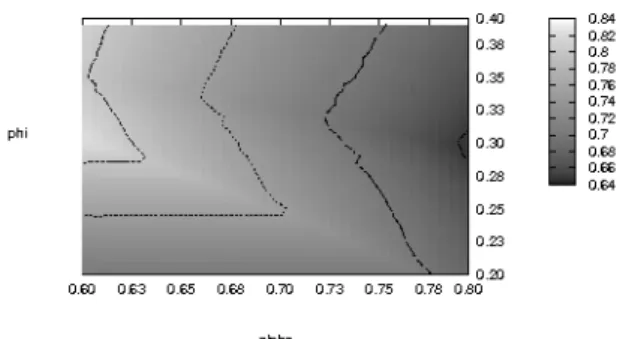
Finally, in Fig. 12 is shown that the convergence of migra-tory dynamics for a urban share, compatible with historical data, is robust in relation to the variation of the key techno-logical parameters, αandφ. The impact of the variation of these parameters in the values of the equilibrium differential of expected wages,(weu−wa), and the equilibrium urban un-employment rate,(1−Nm/Nu)can be seen in Fig. 13 and 14, respectively.
IV. CONCLUSION
In this paper we developed and agent-based computational model which formalizes the rural-urban allocation of workers as a process of social learning by imitation. We analyze a two-sectorial economy composed by adaptative agents, i.e.,
FIG. 7: Equilibrium differential of expected wages as function of the
technological parameterαand the minimum wagewm. White area is
not a valid combination of parameters.
FIG. 8: Equilibrium urban unemployment rate(1−Nm/Nu)as
func-tion of the technological parameterαand the minimum wagewm.
White area is not a valid combination of parameters.
FIG. 9: Equilibrium urban sharenuas function of the parameterγ
and the minimum wagewm. White area is not a valid combination of
FIG. 10: Equilibrium differential of expected wages(we
u−wa) as
function of the parameterγand the minimum wagewm. White area
is not a valid combination of parameters.
FIG. 11: Equilibrium urban unemployment rate (1−Nm/Nu) as
function of the parameterγand the minimum wagewm. White area
is not a valid combination of parameters.
FIG. 12: Equilibrium urban sharenuas function of the
technolog-ical parametersαandφ. White area is not a valid combination of
parameters.
FIG. 13: Equilibrium differential of expected wages(we
u−wa)as
function as function of the technological parametersαandφ. White
area is not a valid combination of parameters.
FIG. 14: Equilibrium urban unemployment rate (1−Nm/Nu) as
function of the technological parametersαandφ. White area is not
a valid combination of parameters.
individuals that grope over time for best sectorial location in terms of earnings. This search is a process of imitation of successful neighbor agents.
The dispersed and non-coordinated individual migration decisions, made based on local information, generate aggre-gate regularities. Firstly, the crucial assumption of Harris and Todaro, the principle that rural-urban migration will occur while the urban expected wage exceed the rural wage, comes out as spontaneous upshot of interaction among adaptative agents.
Secondly, the migratory dynamics generated by agents that seek to adaptate to the economic environment that they co-create leads the economy toward a long run equilibrium char-acterized by urban concentration with urban unemployment. When this long run equilibrium is reached, the generalized Harris-Todaro condition is satisfied, i.e., there is a stabiliza-tion of the rural-urban expected wage differential.
terms of trade in a long run equilibrium obtained by simu-lations are in agreement with the predictions of the original Harris-Todaro model with Cobb-Douglas technology.
Finally, the simulations showed an aggregated pattern not found in the original Harris-Todaro model. There is the possi-bility of small fluctuations of the urban share around an aver-age value. This phenomenon is known as reverse migration.
Acknowledgments
Aquino L. Esp´ındola thanks CAPES for the financial sup-port. Jaylson J. Silveira acknowledges research grants from CNPq. T. J. P. Penna thanks CNPq for the fellowship.
[1] J. R. Harris and M. P. Todaro, American Economic Review60,
126 (1970).
[2] M. P. Todaro, American Economic Review59, 138 (1969).
[3] D. Ray,Development Economics(Princeton: Princeton
Univer-sity Press, 1998).
[4] L. Y. L. Yap, Journal of Development Economics 4, 239
(1977).
[5] D. Mazumdar, Rural-urban Migration in Developing countries. In: Handbook of Regional and Urban Economics, Elsevier, Amsterdam, 1987.
[6] L. Ghatak, P. Levine, and S. Price, Journal of Economics
Sur-veys10, 159 (1996).
[7] J. G. Willianson, Migration and Urbanization. In: Chenery, H.
and Srinivasan, T.N., Handbook of developments economics,
Elsevier, Amsterdam, 1988.
[8] J. J. Silveira, A. L. Esp´ındola, and T. J. P. Penna,
physics/0506021, Physica A, to appear.
[9] A. L. Esp´ındola, T. J. P. Penna, J. J. Silveira, forthcoming
Inter-national Journal of Modern Physics C16, issue 12 (2005).
[10] R. H. Day et al, The Economic Journal97, 940 (1987).
[11] D. Stauffer and T. J. P. Penna, Physica A256, 284 (1998).
[12] The urban sector wage times the probability of getting a job in this sector.
[13] Harris and Todaro set their model using sectorial production
function with general functional form, i.e., in each sector i,
Yi= fi(Ni)withfi′(Ni)>0 andfi′′(Ni)<0. Except where it is
indicated, the results presented in this section are valid for this general case. The Cobb-Douglas form is a standard assumption about technology.
[14] The endowment of land of the rural sector and the stocks of capital of both sectors are given for the period of analysis. [15] This marginal product is the derivative of the agricultural
pro-duction function, eq. (1), with respect toNamultiplied byp.
[16] The right-hand side of this equation is the marginal productivity of the manufacturing labor, i.e., the derivative of manufacturing
production function, eq. (2), with respect toNm.
[17] Actually, Harris and Todaro worked with a general form,ρ