From the Faculty of Medicine of Marília, Marília - São Paulo, Brazil.
Received for publication on August 21, 2002.
HISTOPATHOLOGIC AND BIOCHEMICAL LIVER TEST
ABNORMALITIES IN CHRONIC ASYMPTOMATIC OR
OLIGOSYMPTOMATIC ALCOHOLICS: A REVIEW
Paulo Borini, Romeu Cardoso Guimarães and Sabrina Bicalho Borini
BORINI P et al. - Histopathologic and biochemical liver test abnormalities in chronic asymptomatic or oligosymptomatic alcoholics: a review. Rev. Hosp. Clín. Fac. Med. S. Paulo 58(3):147-156, 2003.
PURPOSE: To review the medical literature regarding the histopathologic and biochemical liver test abnormalities in
chronic asymptomatic or oligosymptomatic alcoholics.
METHODS: Review of articles in the MEDLINE and LILACS databases regarding serum levels and prevalence of
alterations in aspartate-aminotransferase, alanine-aminotransferase, alkaline phosphatase, and total bilirubin, in relation to liver histopathology, with or without discrimination of types of histopathologic alteration.
RESULTS: Global mean prevalence rates of aspartate-aminotransferase and alanine-aminotransferase alterations were
86.3% and 51.1%; in cases with steatosis they were 79.1% and 38.5%; and in cases of hepatitis, 90.1% and 58%. In all studies, prevalence rates of aspartate-aminotransferase alterations were significantly higher with lower variability than those of alanine-aminotransferase. Mean aspartate-aminotransferase levels were higher than 2N (N is the upper normal limit of the method employed) in all cases with hepatitis histopathology, while those of alanine-aminotransferase were 1.48N, in the same cases.
Prevalence of alkaline phosphatase and total bilirubin abnormalities were 74.5% and 74.9% globally; in cases of steatosis, they were 70.9% and 67.9%; and in cases of hepatitis, 75.9% and 77.7%. Mean alkaline phosphatase levels were above the upper normal limit in all cases, but those of total bilirubin were above normal in 4 of 7 hepatitis studies.
CONCLUSIONS: Prevalence of aspartate-aminotransferase alteration was consistently related to presence of
histopathologic abnormalities; an enzyme level higher than 2N suggests the diagnosis of alcoholic hepatitis.
DESCRIPTORS: Chronic alcoholism. Asymptomatic or oligosymptomatic alcoholics. Liver tests. Liver enzymes and
bilirubin. Histopathology.
Various drugs, including alcohol, produce metabolic alterations and may lead to hepatocellular damage through complex interactive mechanisms. Hepatocytes submitted to noxious stimuli may be functionally or struc-turally damaged, transitorily or perma-nently, depending on the strength and duration of the stimuli. Nonetheless, even structurally damaged liver cells may be at least partially functional. Because of this ambiguity, possible confusion arises regarding structural damage with functional alteration, es-pecially when functional tests are al-tered, which are taken to indicate
structural damage. Non-invasive pre-sumptive diagnosis of structural dam-age usually becomes dependent on quantitative and associated functional evaluations. In almost all stages, the various drug-induced alterations of hepatocytic membranes and organelles can be accompanied by enzyme altera-tions and can be observed histologically1. The liver being the
main organ responsible for drug
bi-otransformation2 may be or not
func-tionally3,4,5 or structurally6,7,8 altered in
chronic alcoholics, and such altera-tions may be or not followed by clini-cal manifestations or laboratory abnor-malities7.
produce an average of 24% false nega-tives9; no evidence of necrosis or
fibro-sis was obtained in 40% to 50% of chronic alcoholics10; biopsies are
asso-ciated with significant morbidity and with 0.015% to 0.03% mortality rates11; and other negative factors
in-clude the unnecessary upsetting of pa-tients and the hospitalization costs. Consequently, it is difficult to accept and follow the norm established by the International Consensus12 of
classify-ing the liver lesions that may occur in these patients according to the histo-logic findings.
Liver histologic abnormalities in-cluding steatosis, hepatitis, and cirrho-sis that are caused by alcohol are not mutually exclusive. On the contrary, each one may be present in the same case with variable intensity13,
repre-senting a disease continuum14;
clini-cal15,16 and biochemical8,15 alterations
may overlap in the 3 types of his-topathologic lesions.
Studies of chronic asymptomatic or oligosymptomatic alcoholics7,17,18 have
revealed enzyme and bilirubin altera-tions that are sometimes so minor that it is difficult to interpret their real mean-ing with regard to whether they indi-cate the presence of liver damage, whether they indicate an abnormal liver test, or whether they indicate a mere biochemical alteration that is not abnor-mal. Such ambiguity has led to argu-ments and even divergent positions among researchers and specialists19.
A review of the bibliography was conducted, selecting reports on chronic oligosymptomatic or asymptomatic al-coholics containing liver biochemical and histopathologic evaluations, with the purpose of exploring conceptual as-pects and the criteria for interpretation of biochemical tests. On these bases, we intended to establish criteria for such interpretations of enzymes and bilirubin abnormalities for patients with mild or sub-clinical symptoms.
MATERIALS AND METHODS
A systematic search in the MEDLINE and LILACS databases was conducted from 1982 to 2000, in Eng-lish and neo-Latin languages, employ-ing the followemploy-ing terms semploy-ingly or as-sociated: alcoholism or alcoholic, oligosymptomatic or asymptomatic or subclinical, liver disease.
Publications included in this study referred to asymptomatic patients and those presenting mild and non-specific clinical manifestations or sub-clinical liver disease (oligosymptomatic), and contained data on prevalence and types of histopathologic liver altera-tions and prevalence and levels of liver enzymes and bilirubin. Excluded were publications not containing data on liver histopathology and/or liver enzymes and bilirubin as well as those not relating the 2 types of abnormali-ties. Other comments on such criteria are indicated in specific cases below.
A total of 14 studies were selected comprising 1540 patients (1412 males, 128 females) presenting, singly or as-sociated, data on prevalence of liver tests alterations, average plasma levels of liver enzymes and bilirubin, and cor-relation between prevalence and de-grees of liver test alterations with liver histopathology, with or without dis-crimination of the type of histopatho-logic alteration. Four of these did not include data on histopathology4,17,18,20,
5 related the prevalence of liver test ab-normalities to histopathologic altera-tions but did not specify the types of the latter6,7, 21-23; and 5 related the
aver-age serum levels of liver enzymes and bilirubin to the specific types of his-topathologic alterations3,24-27. One of the
studies with liver histopathology21 was
excluded because the biochemical al-terations were not correlated with the histopathology classes.
Seven studies3,6,22-26 of a total of
847 patients (796 males, 51 females)
were analyzed for evaluation of preva-lence of liver test alterations accord-ing to anatomopathologic lesions. Five studies3,24-27 of a total of 277
pa-tients (267 males, 10 females) were re-viewed for correlated elevated serum levels of biochemical tests and types, specific or not, with anatomopatho-logic lesions. Three reports6,22,23 did not
detail the serum levels of liver en-zymes. From 2 articles24,26, data
ex-pressed as the average and its stand-ard error were transformed into the av-erage and the standard deviation.
Statistical comparisons were con-ducted on qualitative variables, through the chi-square test, or where indicated, two-tailed Fisher’s exact tests. Correlation between variables was established with Pearson’s coeffi-cient and significance test. From some studies, data were displayed as 2 x 2 matrixes and coded, relating the bio-chemical tests and histopathologic al-terations as true positive (a), false posi-tive (b), false negaposi-tive (c) or true nega-tive (d). Sensitivity [(a/a+c)100], specificity [(d/b+d)100], positive [(a/ a+b)100] and negative [(d/c+d)100] predictive values, all expressed as %, plus prevalence and proportion of probabilities (odds; posPP/negPP) were calculated. The probability of finding individuals with enzymes and bilirubin higher than twice the upper limit of normality was calculated based on the normal probability curve [(z~N (0;1)], with the purpose of com-parison with the Consensus criteria. The 5% significance level was adopted.
RESULTS
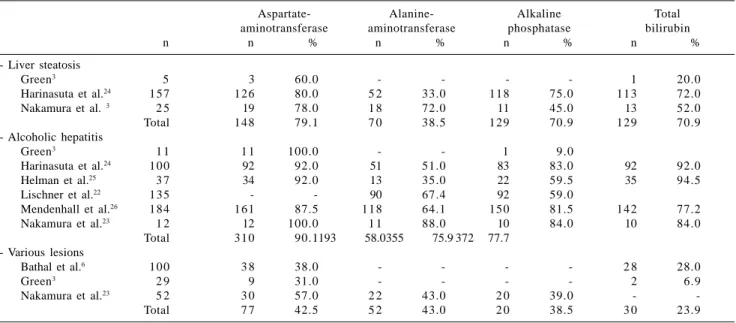
Table 1 - Prevalence of alterations in liver enzymes in chronic asymptomatic or oligosymptomatic alcoholics
according to the types of histopathologic lesions.
Aspartate- Alanine- Alkaline Total
aminotransferase aminotransferase phosphatase bilirubin
n n % n % n % n %
- Liver steatosis
Green3 5 3 60.0 - - - - 1 20.0
Harinasuta et al.24 157 126 80.0 5 2 33.0 118 75.0 113 72.0
Nakamura et al. 3 2 5 19 78.0 1 8 72.0 11 45.0 13 52.0
Total 148 79.1 7 0 38.5 129 70.9 129 70.9
- Alcoholic hepatitis
Green3 1 1 1 1 100.0 - - 1 9.0
Harinasuta et al.24 100 92 92.0 51 51.0 83 83.0 92 92.0
Helman et al.25 3 7 34 92.0 13 35.0 22 59.5 35 94.5
Lischner et al.22 135 - - 90 67.4 92 59.0
Mendenhall et al.26 184 161 87.5 118 64.1 150 81.5 142 77.2
Nakamura et al.23 1 2 12 100.0 1 1 88.0 10 84.0 10 84.0
Total 310 90.1193 58.0355 75.9 372 77.7 - Various lesions
Bathal et al.6 100 3 8 38.0 - - - - 2 8 28.0
Green3 2 9 9 31.0 - - - - 2 6.9
Nakamura et al.23 5 2 3 0 57.0 2 2 43.0 2 0 39.0 -
-Total 7 7 42.5 5 2 43.0 2 0 38.5 3 0 23.9
Table 2 - Values of liver enzymes and total bilirubin in chronic asymptomatic or oligosymptomatic alcoholics according to
the types of histopathologic lesions.
Aspartate- Alanine- Alkaline Total
aminotransferase aminotransferase phosphatase bilirubin 1 - Liver steatosis
- Green3 (n=5) 56.8 ± 37.0 - - 0.62 ± 0.61
RV ≤ 40 U/dL - - ≤ 1 mg/dL
2 - Alcoholic hepatitis
- Green3 (n=11) 92.4 ± 30.2 - - 0.61 ± 0.43
RV ≤ 40 U/dL - - ≤ 1mg/dL
- Harinasuta et al.24 (n = 100) 144 ± 150 56 ± 80 8.6 ± 5 5.7 ± 6
RV ≤ 40 U ≤ 38 U ≤ 4 B U ≤ 1.0 mg/dL
- Helman et al.25 (n = 12) 9 8 3 8 21.4 5.7
RV 40 U/mL 35 U/mL 14 KA U ≤ 1.2 mg/dL
- Mendenhall et al.26 (n = 89) 84 ± 56.6 56 ± 56 165 ± 80.2 1.6 ± 0.94
RV 10-40 mU/mL 10-30 mU/mL 40-120 U/mL 0.1-1 mg/dL
3 - Various lesions
- Ryback et al.27 (n = 60) 64.0 ± 71.9 47.2 ± 48.7 84.1 ± 27.8 0.84 ± 0.41
References values 10-40 mU/mL 10-30 mU/mL 40-120 IU/mL 0.1-1 mg/dL
RV = references values; B U = Bodansky units; KA U = King Armstrong units.
I. Aminotransferases
Mean prevalence rates of increases of aspartate-aminotransferase (AST) were 458/531 (86.3%) globally, with 148/187 (79.1%, range 60%-80%) in the steatosis cases and 310/344 (90.1%, range 87%-100%) in alco-holic hepatitis cases; the difference between these was not statistically
sig-nificant. For alanine-aminotransferase (ALT), the prevalence rates of increases were 263/515 (51.1%) globally, 70/182 (38.5%, range 33%-72%) in the stea-tosis cases and 193/333 (58%, range 35%-88%) in alcoholic hepatitis cases. The prevalence rates of AST altera-tions were always significantly higher and showed lower variation among the various studies than those of ALT
(Ta-ble 1). In the study where the types of histopathologic alterations were not differentiated, the prevalence rates were 77/181 (42.5%) for AST and 22/ 52 (42.3%) for ALT.
Table 3 - Distribution of prevalence of histopathologic lesions and of
aspartate-aminotransferase alterations in chronic symptomatic or oligosymptomatic alcoholics.
Aspartate-aminotransferase Histopathology
Altered Normal Total
n % n % n %
Above the upper reference limit 1 4 48.8 4 13.8 1 8 62.6 Inside the normal reference limit 2 6.9 9 31.0 1 1 37.9 Total 1 6 55.7 1 3 44.8 2 9 100.0 Adapted from Green3. P = 0.002, 95% CI 1.88 to 184.58, odds ratio = 4.28; sensitivity 87.5%;
specificity 69.2%; predictive values: positive 77.8%, negative 81.8%
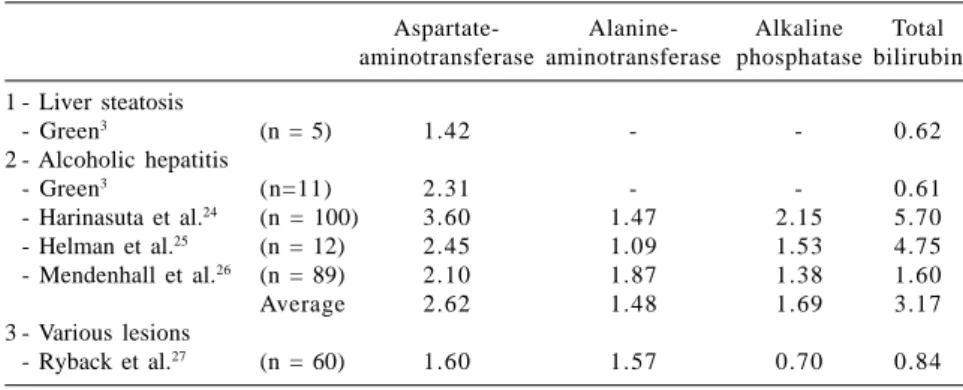
Table 4 - Ratios between the average liver enzyme and total bilirubin values, and
the upper limit of normality for the respective test.
Aspartate- Alanine- Alkaline Total aminotransferase aminotransferase phosphatase bilirubin 1 - Liver steatosis
- Green3 (n = 5) 1.42 - - 0.62
2 - Alcoholic hepatitis
- Green3 (n=11) 2.31 - - 0.61
- Harinasuta et al.24 (n = 100) 3.60 1.47 2.15 5.70
- Helman et al.25 (n = 12) 2.45 1.09 1.53 4.75
- Mendenhall et al.26 (n = 89) 2.10 1.87 1.38 1.60
Average 2.62 1.48 1.69 3.17
3 - Various lesions
- Ryback et al.27 (n = 60) 1.60 1.57 0.70 0.84
prevalence of AST alteration and his-topathologic damage indicate an 87.5% sensitivity, 77.8% positive dictive value, and 81.8% negative pre-dictive value (Table 3).
Mean levels of AST were greater than 2N (twice the upper limit of nor-mality) in all cases with histopathol-ogy of hepatitis, averaging 2.6N (range 2.1N-3.6N), while those of ALT, in the same cases, were 1.48N (range 1.09N-1.87N) (Table 4).
II. Alkaline phosphatase
In studies with defined histopatho-logic examinations, prevalence of al-kaline phosphatase (AP) increases were 484/650 (74.5%) globally, 129/ 182 (70.9%, range 45%-75%) in cases of steatosis, and 355/468 (75.9%, range 59.5%-84%) in cases of hepati-tis. Where histopathologic abnormali-ties were not differentiated, altered AP prevalence was 20/52 (39%).
In all cases of hepatitis, average AP levels were above the upper normal level, which was not observed where patients had the histopathologic types of lesions not differentiated. An aver-age above 2N was reported in only 1 of the studies of alcoholic hepatitis patients (Table 4).
III. Total bilirubin
Prevalence of bilirubin alterations in studies with defined histopatho-logic data were 499/666 (74.9%) glo-bally, with 127/187 (67.9%, range 20%-72%) in steatosis cases and 372/ 479 (77.7%, range 9%-94.5%) in cases of alcoholic hepatitis. Where the type of histopathologic alteration was not defined, prevalence was 30/139 (23.3%, range 6.9%-28%).
In 4 studies on patients with alco-holic hepatitis, the average of total bi-lirubin (TB) was above normal, but was above 2N only in 3 of them. In
one study of patients with steatosis and hepatitis, and in another where the types of lesions was not differentiated, the average value was below the up-per limit of normality (Table 4).
IV. Association of enzymes and bilirubin alterations
Patients presenting 1 or more bio-chemical abnormality in liver tests (AST, ALT, AP, TB) showed a signifi-cantly higher prevalence of histopatho-logic alteration than those with normal tests (P = 0.001; 95% CI range 1.99-20.31; odds ratio 5.78). Under these criteria, sensitivity was low (49.1%), but the positive predictive value was high (91.4%) (Table 5).
Comparing results from tables 3 and 5, it can be concluded that con-sidering only the aminotransferases in-creases related to presence of his-topathologic alteration, irrespective of type, there is a gain in sensitivity and negative predictive value but a loss in specificity. The probability of diag-nosing liver damage is increased when other alterations are considered, in-cluding any of the aminotransferases plus AP and TB (Tables 3 and 5).
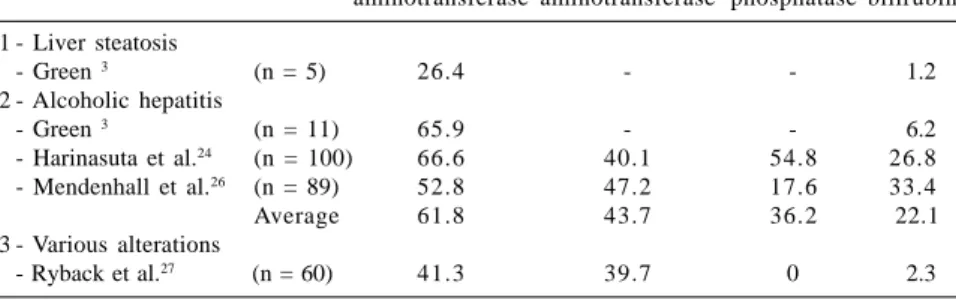
The low probability of occurrence of liver enzymes and bilirubin values above 2N (Table 6) was noticeable.
COMMENTS
A biochemical survey of asympto-matic residents of the USA detected about 6% with abnormal levels of liver enzymes, while the prevalence of liver disease in the general population was significantly lower (about 1%)28. In
routine examinations of Canadians, about 10% showed at least 1 abnormal liver biochemical test29.
Table 5 - Distribution of prevalence of histopathologic lesions and biochemical
alterations in chronic oligosymptomatic and asymptomatic alcoholics.
Biochemical data Histopathology
Altered Normal Total
n % n % n %
One or more abnormalities 53 37.1 5 3.5 5 8 40.5
No abnormality 55 38.5 3 0 20.9 8 5 59.5
Total 108 75.6 3 5 24.4 143 100.0 Data from Bruguera et al.7, on Aspartate-aminotransferase, Alanine-aminotransferase, Alkaline
phosphatase, and Total bilirubin, in HBsAg negative and without history of viral hepatitis patients. P = 0.001, 95% CI 1.99 to 20.31, odds ratio = 5.78; sensitivity 49.1%; specificity 85.7%; predictive values: positive 91.4%, negative 35.3%
Table 6 - Frequency of occurrence of liver enzymes and total bilirubin values
higher than the upper limit of normality in chronic asymptomatic or oligosymptomatic alcoholics.
Aspartate- Alanine- Alkaline Total aminotransferase aminotransferase phosphatase bilirubin 1 - Liver steatosis
- Green 3 (n = 5) 26.4 - - 1.2
2 - Alcoholic hepatitis
- Green 3 (n = 11) 65.9 - - 6.2
- Harinasuta et al.24 (n = 100) 66.6 40.1 54.8 26.8
- Mendenhall et al.26 (n = 89) 52.8 47.2 17.6 33.4
Average 61.8 43.7 36.2 22.1
3 - Various alterations
- Ryback et al.27 (n = 60) 41.3 39.7 0 2.3
All values in %.
hydes39,40, some of these in amounts
higher than the allowed limits, which could act synergistically with alcohol in producing liver disease. Excessive and prolonged ingestion of beverages containing high iron contents could lead to elevations in blood iron con-centrations which is associated with significantly elevated average plasma levels of AST, ALT, and AP18; the high
(close to 100%33) prevalence of
under-nutrition in alcoholics with alcoholic hepatitis due to both proteic and ca-loric deficiency resulting from low in-gestion and inadequate utilization of nutrients absorbed41; and biochemical
and histologic abnormalities resulting from variations in abstinence periods before blood sampling or obtaining biopsies6, as well as in different
alco-holism regimes, with respect to time and amount of the habit. When pa-tients look for assistance due to com-plications resulting from the alcoholic state or just for treatment of the alco-holism, they might comprise selected samples that would create at least par-tial differences in the incidence of types and severity of structural liver lesions6 as well as in the prevalence of
alterations of some types of liver en-zyme activity3,26 (for example, a
pro-portion of alcoholics showed slight spontaneous elevation of the activity of aminotransferases soon after alcohol withdrawal42). In addition to these
fac-tors, genetic conditions and individual susceptibility may affect the develop-ment of alcoholic liver disease15,43.
Among the various series studied, independently of whether patients were symptomatic or not, the prevalence rates of steatosis varied from 50% to 55% and that of alcoholic hepatitis from 8% to 63%32. In a Brazilian study,
histopathologic alterations were de-tected in 67.9%, being milder (sis, reactional or grades I and II steato-hepatitis) in 26.8% and more severe (steato-hepatitis grades III and IV) in 41.1%30.
liver disease7,30,31. In the present study, in
the same category of patients, biochemi-cal liver tests indicated 31% (range 21%-40%) free from liver disease.
The variations observed in oligosymptomatic or asymptomatic al-coholics among studies of prevalence rates of enzyme increases, which were relatively modest with respect to AST, as well as of histologic abnormalities, could be due to various conditions and peculiarities. These include the different sex ratios in the samples, women being more susceptible to al-coholic liver damage32; morphologic
identification of classic alcoholic hepatitis being difficult in cases with massive adipose deposition, as well as the distribution of adipose tissue not being uniformly distributed in the liver33; the 3 types of liver
morpho-logic alterations-steatosis, hepatitis,
and cirrhosis-possibly being present or distributed with different intensities in the same case13; infection by C- type
virus that may act synergistically in liver damage, provoking a more ag-gressive course of the alcoholic hepa-titis34,35 with elevation of serum levels
of both aminotransferases36, especially
ALT37; tobacco-smoking alcoholics
showing higher AST levels (with higher AST/ALT ratios) and also of AP levels, relative to non-smokers, sug-gesting synergism between alcohol and tobacco in liver damage38; the
alde-The behavior of each of the en-zymes and bilirubin, as well as the correlation between biochemical ab-normalities and liver histopathology is detailed below.
1. Aminotransferases
In this review, among all enzymes, the prevalence of alteration in AST, es-pecially in patients with alcoholic hepatitis, was the highest and most uniform across all series. AST abnor-mality was directly correlated with the presence of histopathologic liver al-terations. The fact that the test for AST had high sensitivity demonstrates its capability for indicating liver damage in alcoholics; additionally, its high positive and negative predictive val-ues allow the differentiation with high probability of individuals with and without liver disease.
Our conclusions regarding the behavior of AST do not agree with those of Rosman and Lieber44 when
they state that activities of liver en-zymes, including AST, have limited di-agnostic usefulness in predicting the histologic staging. These authors have generalized the results of Li et al.45 to
all types of histologic lesions; these re-sults indicate the limitations of the en-zyme values only for identification of liver fibrosis (perivenular fibrosis, sep-tal fibrosis, and incipient cirrhosis) and for accurately discriminating liver fi-brosis from non-complicated steatosis.
We found that detection of serum AST levels higher than twice the up-per normal limits, irrespective of the reference values in each procedure, was correlated with high probability of alcoholic hepatitis. In another study13,
it was observed that the AST levels were correlated among alcoholics di-rectly and exclusively with the pres-ence and extent of hepatocellular necrosis.
Prevalence of altered levels and average values of ALT varied widely
in both categories of steatosis and al-coholic hepatitis, confirming that this enzyme was not an adequate test for liver alterations in alcoholics.
The generally low values of aminotransferases in alcoholic hepati-tis, relative to viral hepatitis and le-sions caused by other types of drugs, could be consequent to pyridoxine de-ficiency, which occurs in chronic alco-holics at high frequency43, as well as
to the slow course of hepatocellular necrosis resulting from alcohol con-sumption and undernutrition. This contrasts with the acute cell lesions following viral infections or toxin in-gestion, where there is quick release of great amounts of enzymes into the cir-culation 13.
2. Alkaline phosphatase
In chronic alcoholics, AP altera-tions are related more closely to dis-turbances in the free flow in biliary routes, while those of gamma-glutamyltransferase (GGT) would indi-cate liver enzymatic induction and hepatocellular damage46 or difficulties
in biliary excretion47. Therefore in
al-coholics, AP alterations are more sig-nificant than those of GGT. AP activ-ity is elevated when cholestatic proc-esses are present48. Elevation in AP is
detected in liver steatosis and in alco-holic hepatitis in a frequency of about 2/3 of the cases.
Elevation in AP, especially in the absence of cholestasis signs, is sugges-tive of alcoholic hepatitis15. In this
sur-vey, we observed that in studies where alcoholic hepatitis was the fundamen-tal lesion, AP was always elevated.
3. Bilirubin
Total bilirubin abnormalities in chronic alcoholics may result from isolated or combined increases of the non-conjugated and conjugated frac-tions. An increase in the conjugated
fraction always denotes hepatocyte damage15. Elevation of the
non-conju-gated fraction may result from various causes, including increased absorption from enterohepatic pools for reasons that are not entirely clear49,50; deficient
uptake and conjugation by the liver, similar to Gilbert’s syndrome51;
in-creased back flow of unaltered non-conjugated bilirubin to the plasma af-ter having been taken up by the liver in a first passing due to reduced intra-cellular glutathione52; functional and
structural alterations in hepatocyte organelles and plasmatic membranes due to lipid peroxidation32; hemolysis
due to hypersplenism secondary to liver disease; and hyperlipidemia re-sulting from low activity of serum li-poprotein lipase in patients with alco-holic hepatitis15,48.
Hypertriglyceri-demia was observed in 56% of oligo-symptomatic or aoligo-symptomatic chronic alcoholics53.
Serum bilirubin levels were best correlated with the severity of alco-holic hepatitis54.
4. Associated abnormalities
A recent publication analyzing re-sults of liver laboratory tests con-cluded that such exams are of limited usefulness due to insufficient sensitiv-ity or specificsensitiv-ity55. Nevertheless,
care-ful reading of the article leads to the conclusion that the authors were gen-eralizing from observations on viral hepatopathies.
In alcoholism, the probability of diagnosing liver damage was in-creased when abnormalities of ALT, AP, and TB were considered in asso-ciation with those of AST7. This
in-creased probability was significantly reduced when the criteria for altered tests adopted the 2N cut-off limit of values.
Results in this review confirm the previous conclusion29 that in cases of
there are high frequencies of abnor-malities in AST, AP, and TB. A conjunc-tion of elevated bilirubin serum level, increased AP activity, leucocytosis, and increased erythrocyte sedimentation rate is suggestive of alcoholic hepati-tis15. Association of enzyme
abnormali-ties with other biochemical evidence of liver dysfunction (bilirubin, albumin, or prothrombin activity) indicates ad-vanced liver disease and functional im-pairment of the organ29.
Associated concerted elevations of one of the aminotransferases and of AP would favor diagnosis of cholestatic more than the hepatocellular types of liver disease. The latter type would be considered singly only when elevation of the aminotransferases was twice or more than that of AP29.
Probabilities of occurrence of 2N enzyme values in the presence of his-topathologic alterations were very low, and adoption of such criteria for con-sidering the results abnormal could have caused biases in studies56
at-tempting to investigate the occurrence of abnormal tests in specific groups or in the general population, neglecting alcoholic conditions.
CONCLUSIONS
Prevalence of increases in AST3 was
consistently related to the presence of histopathologic abnormalities and el-evated levels of the enzyme; higher than twice the upper limit of normal-ity of the determination method indi-cating the diagnosis of alcoholic hepa-titis. The possibility of recognizing al-coholic hepatitis through laboratory tests in patients with mild or no symp-toms should be an important goal that
would be useful for at least 2 reasons: it would allow therapeutic interven-tion32,57 and it would make preventive
measures possible58,59, with the purpose
of avoiding evolution to more severe forms of liver disease48.
The probability of diagnosing liver disease in alcoholics increased when associated abnormalities of aminotransferases, alkaline phos-phatase, and bilirubin were considered. While there is no uniformity in definitions, it can be concluded for practical purposes that values equal to, or below 2N or 3N, between 3N and 20N, or higher than 20N, for aminotransferases, and equal to, or be-low 1.5N or 2N, between 2N and 5N, and higher than 5N, for alkaline phos-phatase, would be considered, respec-tively mild, moderate, and strong el-evations60. Adoption of such criteria in
analysis of results in this review indi-cated that in alcoholics, irrespective of the type of liver lesion, enzyme in-creases should be considered mild. Nevertheless, the probability of diag-nosing liver disease in alcoholics was increased when associated increases of aminotransferases, alkaline phos-phatase, and bilirubin were considered, irrespective of their levels.
Therefore, the generalization of cri-teria and terminology established by the International Consensus12 (that is,
defining the label of liver damage as when increases of ALT and TB are higher than 2N; biochemical
abnor-malities as when isolated increases of
AST, AP, or TB are higher than 2N; and
liver test abnormality as when increases
in ALT, AST, AP, and TB are between N and 2N) have not been backed by data in this review on alcoholics with mild or no clinical manifestation or with
his-topathologic lesions considered mild. Were such strict criteria applied to al-coholics, one would be misled and risk not being able to identify occurrences of liver damage. Missed diagnoses could be construed as negligent behavior towards the therapeutic and preventive missions.
In the majority of studies attempt-ing to evaluate the occurrence of liver disease in the general population, one of the parameters considered to be of value is the alteration of ALT, the en-zyme thought to be the most sensitive and specific indicator for detecting hepatocellular damage. Considering that an average of about 10% of populations are alcoholics61 (between
3% and 20% in Latin America62), and
that in alcoholism the most frequently altered enzyme is AST, it can be said that the choice between the two aminotransferases may constitute an important factor of statistical bias.
More than a proposition for spe-cific terminological attribution to al-terations in complementary clinical exams, this study points to the need for revision of generalizations and estab-lished concepts regarding liver en-zyme tests in chronic alcoholics with mild or no clinical manifestation.
A more detailed study of other methodologic aspects and a qualitative evaluation of the heterogeneity in the samples reported in the reviewed bib-liography, as well as a possible expan-sion of the searches, should improve the present state of knowledge.
ACKNOWLEDGMENTS
RESUMO
70,9% e 67,9% nos casos de esteatose e 75,9% e 77,7% nos casos de hepati-te, respectivamente. Em todos os casos de hepatite, os níveis médios da fosfatase alcalina estavam acima do li-mite superior da normalidade. Em 4 de 7 estudos sobre pacientes com hepati-te a média da bilirrubina total estava acima do normal.
CONCLUSÕES: As prevalências
de alterações da aspartato-aminotrans-ferase foram consistentemente relacio-nadas a presença de alterações histopa-tológicas e o nível elevado da enzima, maior que 2N do método de determi-nação, sugere o diagnóstico de hepa-tite alcoólica.
DESCRITORES: Alcoolismo
crô-nico. Alcoolistas assintomáticos ou oligossintomáticos. Testes hepáticos. Enzimas hepáticas e bilirrubina. Histopatologia.
BORINI P e col. - Alterações histopato-lógicas e testes bioquímicos hepá-ticos em alcoolistas crônicos assintomáticos ou oligossinto-máticos: uma revisão. Rev. Hosp.
Clín. Fac. Med. S. Paulo 58(3):
147-156, 2003.
OBJETIVO: Revisar a literatura
médica referente às relações entre al-terações histopatológicas e testes bioquímicos hepáticos em alcoolistas crônicos assintomáticos ou oligossin-tomáticos.
MÉTODOS: Levantamento, a
par-tir das bases de dados MEDLINE e LILACS e referências em publicações, das prevalências de alterações e níveis séricos da aspartato-aminotransferase, alanino-aminotransferase, fosfatase al-calina e bilirrubina total relacionados com a histopatologia hepática, com e sem discriminação do tipo de alteração
histopatológica.
RESULTADOS: As taxas médias das
prevalências da aspartato-aminotrans-ferase e alanino-aminotransaspartato-aminotrans-ferase foram 86,3% e 51,1% globalmente, sendo 79,1% e 38,5% nos casos de esteatose e 90,1% e 58% nos casos de hepatite, respectivamente. As taxas das preva-lências das alterações da aspartato-aminotransferase foram, em todos os es-tudos, significativamente mais altas e mostraram menores variações que aque-las da alanino-aminotransferase. Os ní-veis médios da aspartato-aminotrans-ferase foram maiores que 2N (duas ve-zes superior o limite superior da norma-lidade) em todos os casos com histo-patologia de hepatite, enquanto que os da alanino-aminotransferase, nos mes-mos casos, foram 1,48N.
As prevalências de alterações da fosfatase alcalina e bilirrubina total fo-ram 74,5% e 74,9% globalmente,
REFERENCES
1. MARZELLA L, TRUMP BF - Pathology of the liver: functional and structural alterations of hepatocyte organelles induced by cell injury. In: MEEKS RG, HARRISON SD, BULL RJ -Hepatotoxicology. Boca Raton, CRC Press, 1991. p. 93-138.
2. THURMAN RG, KAUFFMAN FC, BARON J - Biotransformation and zonal toxicity. In: THURMAN RG, KAUFFMAN FC, JUNGERMANN K - Regulation of Hepatic Metabolism. New York, Plenum Press, 1986. p. 321-381.
3. GREEN JR - Subclinical acute liver disease of the alcoholic. Aust Ann Med 1965; 14: 111-124.
4. KNOTT DH, BEARD JD - Liver function in apparently healthy chronic alcoholic patients. Am J Med Sci 1966; 252: 260-264.
5. MENDENHALL CL and THE VA COOPERATIVE STUDY GROUP ON ALCOHOLIC HEPATITIS - Alcoholic hepatitis. Clin Gastroenterol 1981; 10: 417-441.
6. BATHAL PS, WILKINSON P, CLIFTON S et al. - The spectrum of liver disease in alcoholism. Aust N Z J Med 1975; 5: 49-57.
7. BRUGUERA M, BORDAS JM, RODES J - Asymptomatic liver disease in alcoholics. Arch Pathol Lab Med 1977; 101: 644-647.
8. INSUNZA I, ITURRIAGA H, UGARTE G et al. - Clinical and histological liver abnormalities in alcoholics. Acta HepatoSplenol 1971; 18: 460-470.
9 . NORD JH - Biopsy diagnosis of cirrhosis: blind percutaneous versus guided direct vision techniques. A review. Gastrointest Endosc 1982; 28: 102-104
10. DIEL AM - Alcoholic liver disease. Med Clin North Am 1989; 73: 815-830.
11. PICCININO F, SAGNELLI E, PASQUALE G et al. - Complications following percutaneous liver biopsy: a multicentre retrospective study on 68,276 biopsies. J Hepatol 1986; 2: 165-173.
13. GREGORY DH, LEVI DF - The clinical and pathologic spectrum of alcoholic hepatitis. Am J Dig Dis 1972; 17: 479-488. 14. FLEMING KA, McGEE JO’D - Alcohol-induced liver disease. J
Clin Pathol 1984; 37: 721-733.
15. BRUNT PW, KEW MC, SCHEUER PT et al. - Studies in alcoholic liver disease in Britain. 1. Clinical and pathological patterns. Gut 1974; 15: 52-58.
16. FREDERIKS WM, MYAGKAYA GL, BOSCH KS et al. - The value of enzyme leakage in the prediction on necrosis in liver ischemia. Histochemistry 1983; 78: 459-472.
17. BORINI P - Avaliação do envolvimento hepático em alcoolistas crônicos assintomáticos ou oligossintomáticos. 2-Aspectos laboratoriais. GED 1991; 10: 137-144
18. BORINI P, GUIMARÃES RC - Indicators of inflammation and cellular lesion in chronic alcoholists. Correlation with alterations of bilirubin and hepatic and pancreatic enzymes. Rev Hosp Clín Fac Med S Paulo 1999; 54: 53-60.
19. BORGES DR - Testes hepáticos. In: CINTRA DO PRADO F, RAMOS J, RIBEIRO DO VALE J - Avaliação terapêutica: manual prático de diagnóstico e tratamento, 19ª ed. São Paulo, Artes Médicas, 1999. p. 321-325.
20. SKINNER HA, HOLT S, SHEU WJ et al. - Clinical versus laboratory detection of alcohol abuse: the alcohol clinical index. Br Med J 1986; 292: 1703-1708.
21. GONÇALVES CS, PEREIRA FEL, BUAIZ V et al. - Biópsia hepática percutânea em alcoólatras crônicos internados em hospital psiquiátrico. Arq Gastroenterol 1972; 9: 5-10. 22. LISCHNER MW, ALEXANDER JF, GALAMBOS JT - Natural
history of alcoholic hepatitis. I. The acute disease. Dig Dis 1971; 16: 481-494.
23. NAKAMURA T, NAKAMURA S, AIKAWA T et al. - Clinical studies of alcoholic hepatic diseases. Tohoku J Exp Med 1967; 93: 179-189.
24. HARINASUTA U, ZIMMERMAN HJ - Alcoholic steatonecrosis. 1. Relationship between severity of hepatic disease and presence of Mallory bodies in the liver. Gastroenterology 1971; 60: 1036-1046.
25. HELMAN RA, TEMKO MH, NYE SW at al. - Alcoholic hepatitis. Natural history and evaluation of prednisolone therapy. Ann Inter Med 1971; 74: 311-321.
26. MENDENHALL CL, SEEFF L, DIEHL AM et al. - Antibodies to hepatitis B virus and hepatitis C virus in alcoholic hepatitis and cirrhosis: their prevalence and clinical relevance. The VA Cooperative Study Group (no. 119). Hepatology 1991; 14: 581-589.
27. RYBACK RS, ECKARDT MJ, FELSHER B et al. - Biochemical and hematologic correlates of alcoholism and liver disease. JAMA 1982; 248: 2261-2265.
28. ROSEN HR, KEEFFE EB - Laboratory evaluation of the patient with signs and symptoms of liver disease. In: BRANDT LJ -Clinical Practice of Gastroenterology. Philadelphia, Livingstone, 1998. p. 812-820, v. 2.
29. MINUK GY - Canadian Association of Gastroenterology practice guidelines: Evaluation of abnormal liver enzyme tests. Can J Gastroenterol 1998; 12: 417-421.
30. ALMEIDA JR, ANDRADE NMP, FERREIRA APS et al. - Perfil histopatológico da hepatopatia alcoólica. HU Revista 1998; 24: 79.
31. PIMISTONE NR, FRENCH SW - Hepatopatia alcoólica. In: GEOKAS MC - Álcool etílico e enfermidades associadas. Clín Méd Am Norte 1984; 1: 43-61.
32. MINCIS M Doença hepática alcoólica. In: MINCIS M -Gastroenterologia & Hepatologia: diagnóstico e tratamento. São Paulo, Lemos Editorial, 1997. p. 669-690.
33. CRABB DW, LUMENG L - Alcoholic liver disease. In: HAUBRICH W, SCHAFFNER F, BERCK JE - Bockus-Gastroenterology. Philadelphia, Saunders, 1995. p. 2215-2245, v. 3.
34. AYUB K, ANDERSON S, ANAND BS - Response of chronic alcoholics with hepatitis C virus infection to interferon therapy: preliminary results. Gastroenterology 1998; 114(4 Part 2): A1293. [Abstract L0032].
35. ROSMAN AS, PARONETTO F, GALVIN K et al. - Hepatitis C virus antibody in alcoholic patients: association with the presence of portal and/or lobular hepatitis. Arch Intern Med 1993; 153: 965-969.
36. SHEN CY, LEE HS, HUANG LC et al. - Alcoholism, hepatitis B and C viral infections, and impaired liver function among Taiwanese aboriginal groups. Am J Epidemiol 1996; 143: 936-942.
37. HERBELE MF, HOLTZMULLER KC, BEDNAREK JM et al. -Prevalence of hepatitis C and hepatitis G in alcoholics at an inpatient alcoholism recovery facility. Gastroenterology 1998; 114(4 Part 2): A1253. [Abstract L0227].
38. BORINI P - Interação álcool-fumo na agressão hepática. Rev Hosp Clín Fac Med S Paulo 1995; 50: 259-263.
39. BORINI P - Pseudoicterícia e alcoolismo? Disparidade paradoxal entre a intensidade da icterícia e níveis de bilirrubina sérica. F med (BR) 1997; 114: 103-108.
40. MINCIS M, MIZUTA K, BULHÕES E et al. - Substâncias hepatotóxias em pingas nacionais. Rev Ass Med Brasil 1993; 39: 234-236.
41. LIEBER CS - Alcohol-Nutrition interaction. Bol Asoc Med P Rico 1984; 76: 445-447.
42. CAMPBELL S, TIMMS PM, MAXWELL PR et al. - The effect of alcohol withdrawal on liver transaminases and tissue inhibitor of metalloproteinase1 (Timp1). Gastroenterology 1998; 114(4,Parte 2): A1218. [Abstract L0082].
43. LEEVY CM, BAKER H, TENHOVE W et al. - B complex vitamins in liver disease of the alcoholic. Am J Clin Nutr 1965; 16: 339.
45. LI JJ, ROSMAN AS, LEO MA et al. - Tissue inhibitor of metalloproteinase (TIMP) is increased in the serum of precirrhotic and cirrhotic alcoholics, and can serve as a marker of fibrosis. Hepatology 1994; 19: 1418-1423.
46. POYNARD T, AUBERT A, BEDOSSA P et al. - A simple biological index for detection of alcoholic liver disease in drinkers. Gastroenterology 1991; 100: 1397-1402.
47. TESCHKE R, NEUEFEIND M, STROHMEYER G - Hepatic gamma-glutamyltransferase activity in alcoholic fatty liver. Gut 1983; 24: 625-630.
48. SCHAFFNER F, POPPER H - Alcoholic hepatitis in the spectrum of ethanol-induced liver injury. Scand J Gastroent 1970; Suppl. 7: 69-78.
49. GARTNER U, GOESER T, WOLKOFF AW - Effect of fasting on the uptake of bilirubin and sulfobromophthalein by isolated perfused rat liver. Gastroenterology 1997; 113: 1701-1713. 50. PALMER RH - Fasting hyperbilirubinemia (Letter).
Gastroenterology 1998; 115: 799.
51. FELSHER BF, RICKARD D, REDEKER AG - The reciprocal relation between caloric intake and the degree of hyperbilirubinemia in Gilbert’s syndrome. N Engl J Med 1970; 283: 170-172.
52. BOYER TD - The glutathione S-transferase: an update. Hepatology 1989; 9: 486-496.
53. BORINI P - Metabolismo de carboidratos, lipídios e purina em alcoolistas crônicos assintomáticos ou oligossintomáticos. Correlações entre as alterações metabólicas e os testes avaliadores de agressão e disfunção hepática. R Metab Nutr 1996; 3: 152-159.
54. SHERLOCK S, DOOLEY J - Alcohol and the liver. In: SHERLOCK S, DOOLEY J - Diseases of the Liver and Biliary System. Oxford-England, Blackwell Scient Pub, 1993. p. 370-389. 55. GOPAL DV, ROSEN HR - Abnormal findings on liver function
tests: interpreting results to narrow the diagnosis and establish a prognosis. Postgradmed 2000; 107: 100-114.
56. SHERWOOD P, LYBURN I, BROWN S et al. - How are abnormal results for liver function tests dealt with in primary care? Audit of yield and impact. BMJ 2001; 322: 276-278.
57. SHERLOCK S, DOOLEY J - Alcohol and the liver. In: SHERLOCK S, DOOLEY J - Diseases of the Liver and Biliary System. Oxford-England, Blackwell Scient Pub, 1993. p. 385-403. 58. KERSHENOBICH D, VARGAS F, GARCIATSAO G et al.
-Colchicine in the treatment of cirrhosis of the liver. N Engl J Med 1988; 318:1709-1713.
59. PARISE ER, CHEHTER L, NOGUEIRA MD et al. - Colchicina na doença hepática crônica de etiologia alcoólica. Rev Ass Med Brasil 1995; 41: 207-212.
60. KEEFFE EB - Diagnostic approach to mild elevation of liver enzyme levels. Gastrointest Dis Today 1994; 3: 1-9. 61. SWIFT RM - Drug therapy for alcohol dependence. N Engl J
Med 1999; 19: 1482-1490.