
ACPD
13, 9953–10007, 2013Chemical characterization and
source apportionment
R. Zhang et al.
Title Page
Abstract Introduction
Conclusions References
Tables Figures
◭ ◮
◭ ◮
Back Close
Full Screen / Esc
Printer-friendly Version Interactive Discussion
Discussion
P
a
per
|
Dis
cussion
P
a
per
|
Discussion
P
a
per
|
Discussio
n
P
a
per
|
Atmos. Chem. Phys. Discuss., 13, 9953–10007, 2013 www.atmos-chem-phys-discuss.net/13/9953/2013/ doi:10.5194/acpd-13-9953-2013
© Author(s) 2013. CC Attribution 3.0 License.
Atmospheric Chemistry and Physics
Open Access
Discussions
Geoscientiic Geoscientiic
Geoscientiic Geoscientiic
This discussion paper is/has been under review for the journal Atmospheric Chemistry and Physics (ACP). Please refer to the corresponding final paper in ACP if available.
Chemical characterization and source
apportionment of PM
2.5
in Beijing:
seasonal perspective
R. Zhang1,*, J. Jing1,2, J. Tao3, S.-C. Hsu4, G. Wang5, J. Cao5, C. S. L. Lee6, L. Zhu3, Z. Chen7, and Y. Zhao7
1
Key Laboratory of Regional Climate-Environment Research for Temperate East Asia, Institute of Atmospheric Physics, Chinese Academy of Sciences, Beijing
2
University of Chinese Academy of Sciences, Beijing
3
South China Institute of Environmental Sciences, Ministry of Environmental Protection, Guangzhou
4
Research Center for Environmental Changes, Academia Sinica, Taipei
5
K LAST, SKLLQG, Institute of Earth Environment, Chinese Academy of Sciences, Xi’an
6
Institute of Earth Sciences, Academia Sinica, Taipei
7
ESPC, College of Environmental Sciences and Engineering, Peking University, Beijing
*
ACPD
13, 9953–10007, 2013Chemical characterization and
source apportionment
R. Zhang et al.
Title Page
Abstract Introduction
Conclusions References
Tables Figures
◭ ◮
◭ ◮
Back Close
Full Screen / Esc
Printer-friendly Version Interactive Discussion
Discussion
P
a
per
|
Dis
cussion
P
a
per
|
Discussion
P
a
per
|
Discussio
n
P
a
per
|
Received: 9 March 2013 – Accepted: 28 March 2013 – Published: 16 April 2013 Correspondence to: S.-C. Hsu ([email protected])
ACPD
13, 9953–10007, 2013Chemical characterization and
source apportionment
R. Zhang et al.
Title Page
Abstract Introduction
Conclusions References
Tables Figures
◭ ◮
◭ ◮
Back Close
Full Screen / Esc
Printer-friendly Version Interactive Discussion
Discussion
P
a
per
|
Dis
cussion
P
a
per
|
Discussion
P
a
per
|
Discussio
n
P
a
per
|
Abstract
In this study, 121 daily PM2.5 (aerosol particle with aerodynamic diameter less than 2.5 µm) samples were collected from an urban site in Beijing in four months between April 2009 and January 2010 representing the four seasons. The samples were de-termined for various compositions, including elements, ions, and organic/elemental
5
carbon. Various approaches, such as chemical mass balance, positive matrix factor-ization (PMF), trajectory clustering, and potential source contribution function (PSCF), were employed for characterizing aerosol speciation, identifying likely sources, and apportioning contributions from each likely source. Our results have shown distinc-tive seasonalities for various aerosol speciations associated with PM2.5in Beijing. Soil
10
dust waxes in the spring and wanes in the summer. Regarding the secondary aerosol components, inorganic and organic species may behave in different manners. The for-mer preferentially forms in the hot and humid sumfor-mer via photochemical reactions, al-though their precursor gases, such as SO2and NOx, are emitted much more in winter. The latter seems to favorably form in the cold and dry winter. Synoptic meteorological
15
and climate conditions can overwhelm the emission pattern in the formation of sec-ondary aerosols. The PMF model identified six main sources: soil dust, coal combus-tion, biomass burning, traffic and waste incineration emission, industrial pollution, and secondary inorganic aerosol. Each of these sources has an annual mean contribution of 16, 14, 13, 3, 28, and 26 %, respectively, to PM2.5. However, the relative contributions
20
of these identified sources significantly vary with changing seasons. The results of tra-jectory clustering and the PSCF method demonstrated that regional sources could be crucial contributors to PM pollution in Beijing. In conclusion, we have unraveled some complex aspects of the pollution sources and formation processes of PM2.5 in Bei-jing. To our knowledge, this study is the first systematical study that comprehensively
25
ACPD
13, 9953–10007, 2013Chemical characterization and
source apportionment
R. Zhang et al.
Title Page
Abstract Introduction
Conclusions References
Tables Figures
◭ ◮
◭ ◮
Back Close
Full Screen / Esc
Printer-friendly Version Interactive Discussion
Discussion
P
a
per
|
Dis
cussion
P
a
per
|
Discussion
P
a
per
|
Discussio
n
P
a
per
|
1 Introduction
Particulate matter (PM) is composed of various chemical components (Seinfeld, 1989). PM profoundly affects our living environments in terms of air quality (in close relation to public health), visibility, direct and indirect radiative forcing, climate effects and ecosys-tems (Watson, 2003; Streets et al., 2006; Andreae and Rosenfeld, 2008; Mahowald,
5
2011). Numerous epidemiological studies have demonstrated that longterm exposure to pronounced PM2.5increases morbidity and mortality (Dockery and Pope, 1995; Pope et al., 1995; Schwartz et al., 1996). Given its tiny size, fine mode PM (i.e. PM2.5, PM with aerodynamic diameter less than 2.5 µm) can readily penetrate the human bronchus and lung (Pope et al., 1995; Oberdorster, 2001). Through absorption and scattering of
10
solar radiation and serving as cloud condensation nuclei, PM2.5extensively affects the global climate (Bardouki et al., 2003), and thus, the hydrological cycle (Ramanathan and Feng, 2009). The diverse effects of PM2.5could be a function of its complex chem-ical components and composition (He et al., 2009; Niwa et al., 2007; Malm et al., 2005; Eatough et al., 2006).
15
Due to the rapid economic and industrial developments and urbanization in the past few decades, there is an escalating increase in energy consumption and the number of motor vehicles in China, where air pollution has become ubiquitous (Chan and Yao, 2008). According to Shao et al. (2006), nearly 70 % of urban areas in China do not meet China’s national ambient air quality standards, which are even much laxer than the air
20
quality exposure standards/guidelines of the World Health Organization (WHO, 2005). The Beijing–Tianjin–Hebei region, the Yangtze River Delta, and the Pearl River Delta are of special concern because of their severe PM pollution, which can be explicitly shown by the spatial distribution of aerosol optical depth (AOD) retrieved by satellites (He et al., 2009; Lee et al., 2010). Three megacities that are representatives of each
re-25
ACPD
13, 9953–10007, 2013Chemical characterization and
source apportionment
R. Zhang et al.
Title Page
Abstract Introduction
Conclusions References
Tables Figures
◭ ◮
◭ ◮
Back Close
Full Screen / Esc
Printer-friendly Version Interactive Discussion
Discussion
P
a
per
|
Dis
cussion
P
a
per
|
Discussion
P
a
per
|
Discussio
n
P
a
per
|
(followed by petroleum at over 20 %). Such quantity ranks number one in the world, representing∼37 % of global consumption (Fang et al., 2009; Chen et al., 2010). The
use of coal in China encompass from large power plants, industries to individual do-mestic households where coal combustion is the largest contributor of air pollution (Liu and Diamond, 2005; Chan and Yao, 2008). Given the rapid growth in vehicle numbers
5
at a rising rate of∼20 %, traffic has become a major urban pollutant emitter (He et al., 2002; Fan et al., 2009). Other than anthropogenic pollutants, desert and loess dust of natural origins with annual emissions of over 100 million tons also serves as important PM source in China, particularly in late winter and spring (Zhang et al., 1997; Sun et al., 2001).
10
Atmospheric pollutants in China are a complex mixtures of various sources, from gases to particulates, from natural to anthropogenic, from primary to secondary, and from local to regional and the term “Air Pollution Complex” or “Complex Atmospheric Pollution” has been emerged in the last decade (He et al., 2002; Shao et al., 2006; Chan and Yao, 2008; Fan et al., 2009). One of the major air pollutants is PM,
par-15
ticularly PM2.5, which remains a nationwide problem despite considerable efforts for its removal (Fan et al., 2009). As the capital of China and a rapidly industrialized and typical urbanized city, Beijing has elicited much more attention domestically and in-ternationally (Zhang et al., 2003a, 2007; Zhou et al., 2012). PM2.5 in Beijing is ab-normally elevated, often rising to more than 100 µg m−3, and characterized by
mul-20
tiple components and sources, ranging from inorganic to organic constituents, from anthropogenic to natural origins, from primary to secondary components, and from local to long-range transported sources, and in dynamic variability with time and/or meteorological conditions and climate regimes (He et al., 2001; Wang et al., 2005; Duan et al., 2006; Okuda et al., 2011; Song et al., 2012). In spite of many
scien-25
ACPD
13, 9953–10007, 2013Chemical characterization and
source apportionment
R. Zhang et al.
Title Page
Abstract Introduction
Conclusions References
Tables Figures
◭ ◮
◭ ◮
Back Close
Full Screen / Esc
Printer-friendly Version Interactive Discussion
Discussion
P
a
per
|
Dis
cussion
P
a
per
|
Discussion
P
a
per
|
Discussio
n
P
a
per
|
the highest PM2.5hourly concentration of 886 µg m−3(http://www.nasa.gov/multimedia/
imagegallery/image feature 2425.html). Some essential questions remain unknown, although the government has devoted itself to improving air quality and numerous stud-ies have been conducted. Therefore, a systematically comprehensive investigation of employing multiple techniques in conjunction with chemical measurements is inevitably
5
needed, particularly to unravel the likely contributors of PM2.5.
Receptor models are used to quantitatively estimate the pollutant levels contributed by different sources through statistical interpretation of ambient measurement. The positive matrix factorization (PMF) developed by the Environmental Protection Agency of USA is a well adopted receptor model for source apportionment analysis. A few
10
studies have applied PMF to identify the likely dominant sources and apportion their respective contributions. For example, Wang et al. (2008) analyzed certain elements, ions, and black carbon in PM2.5and PM10 samples collected in Beijing in summer and winter (one month representative for each season) between 2001 and 2006. Based on the obtained data set, they performed PMF analyses and identified six main sources:
15
soil dust, vehicular emission, coal combustion, secondary aerosol, industrial emission, and biomass burning. By applying the PMF model with only elemental data as input data, Yu et al. (2013) identified seven likely sources of PM2.5 in Beijing, with relative contributions following the order secondary sulfur (26.5 %), vehicle exhaust (17.1 %), fossil fuel combustion (16. %), road dust (12.7 %), biomass burning (11.2 %), soil dust
20
(10.4 %), and metal processing (6.0 %). Song et al. (2007) analyzed a few elements, ions, and organic/elemental carbon (OC/EC) in PM2.5collected from multiple stations in Beijing during a short period in January and August 2004, and subjected them to PMF analyses. Six potential sources were registered: coal combustion, biomass burning, secondary sulfate, motor vehicles, secondary nitrate, and road dust, with emphases on
25
ACPD
13, 9953–10007, 2013Chemical characterization and
source apportionment
R. Zhang et al.
Title Page
Abstract Introduction
Conclusions References
Tables Figures
◭ ◮
◭ ◮
Back Close
Full Screen / Esc
Printer-friendly Version Interactive Discussion
Discussion
P
a
per
|
Dis
cussion
P
a
per
|
Discussion
P
a
per
|
Discussio
n
P
a
per
|
dust, crustal soil, coal combustion, secondary sulfate, secondary nitrate, biomass burn-ing with municipal incineration, and vehicle emissions. All these studies were limited to a particular season and based on selected PM species.
To attain a better understanding of the chemical characteristics and sources of fine aerosols on a seasonal basis, we conducted a delicate investigation in Beijing. We
5
continuously collected daily PM2.5 samples at an urban site for four months, each of which in the respective seasons (i.e. spring, summer, autumn and winter). The samples were subjected to chemical measurements of various aerosol compositions as a whole, such as a suite of crustal and anthropogenic elements, major water-soluble ions, and OC/EC. Furthermore, we identified and apportioned the main sources to PM2.5by
em-10
ploying chemical mass closure construction and the PMF model in conjunction with trajectory cluster and potential source contribution function analyses according to the hybrid singleparticle Lagrangian integrated trajectory (HYSPLIT) model. This study will elucidate the source profile of PM2.5in different seasons and the relative contribution from each source in the complex urban airshed in Beijing and provide vital information
15
in formulating the future air management framework to address the current alarming level of PM pollution in China which has been affecting the air quality on a vast regional scale.
2 Methodology
2.1 Sample and chemical analysis
20
2.1.1 Sampling site
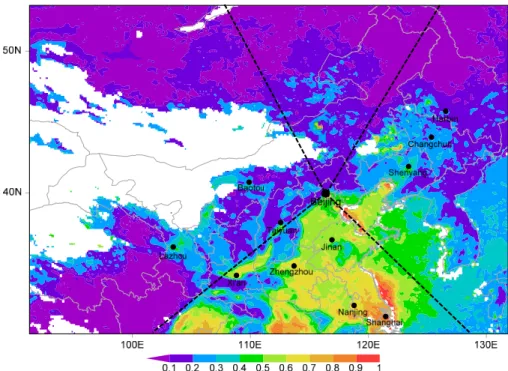
Beijing is located on the northern edge of the North China Plain, surrounded by the Yanshan Mountains in the west, north, and northeast (Fig. 1). According to the spatial distribution of fine AOD ranging from 0.0 to 1.0 that has been retrieved from Moderate-resolution Imaging Spectrometer (MODIS) sensors on board Terra and Aqua satellites
ACPD
13, 9953–10007, 2013Chemical characterization and
source apportionment
R. Zhang et al.
Title Page
Abstract Introduction
Conclusions References
Tables Figures
◭ ◮
◭ ◮
Back Close
Full Screen / Esc
Printer-friendly Version Interactive Discussion
Discussion
P
a
per
|
Dis
cussion
P
a
per
|
Discussion
P
a
per
|
Discussio
n
P
a
per
|
(Fig. 1), Beijing is one of the PM2.5 hot spots in China. The four seasons are char-acterized by variable meteorological conditions: spring by highspeed winds and low rainfall, summer by high temperature and frequent rain usually accounting for 75 % of annual rainfall, autumn by sunny days and northwest winds, and winter by cold and dry air. The population is 17.55 million. In 2009, the number of motor vehicles increased to
5
4.019 million, and energy consumption was equivalent to 65.73 million tons of standard coal (Beijing Statistics Yearbook, 2010). The sampling station was set up at the roof of the Science Building in Peking University (116.30◦E, 39.99◦N) 26 m a.g.l. A few field experimental campaigns have been conducted at this urban site (He et al., 2010; Guo et al., 2012). This site is located within the educational, commercial, and residential
10
districts, and no main pollution sources exist nearby. Thus, the observations could be typical of the general urban pollution in Beijing.
2.1.2 Sample collection
Daily PM2.5samples were collected in April, July, and October 2009 and January 2010, representing spring, summer, autumn, and winter, respectively. Two collocated aerosol
15
samplers (frmOMNITM, BGI, USA) were used to collect PM2.5 samples from 10 a.m. to 10 a.m. the next day simultaneously. The two substrates used in each sampler were 47 mm quartz filter (Whatman QM/A, England) and Teflon filter (pore size=2 µm; What-man PTFE, England). The flow rate was set at 5 L min−1. The quartz filters were baked at 800◦
C for 3 h before use. The filter samples were stored at−18◦C until pretreatment.
20
2.1.3 Gravimetric weighing
Before and after each sampling, the PTFE filters were conditioned at 22±1◦C in
rel-ative humidity of 35±2 % for 24 h and then weighed in a weighing room by using an
electronic balance with a detection limit of 1 µg (Sartorius, Gottingen, Germany). The corresponding PM2.5 mass concentration of each filter was equal to the weight diff
er-25
ACPD
13, 9953–10007, 2013Chemical characterization and
source apportionment
R. Zhang et al.
Title Page
Abstract Introduction
Conclusions References
Tables Figures
◭ ◮
◭ ◮
Back Close
Full Screen / Esc
Printer-friendly Version Interactive Discussion
Discussion
P
a
per
|
Dis
cussion
P
a
per
|
Discussion
P
a
per
|
Discussio
n
P
a
per
|
2.1.4 Chemical analysis of trace elements and water-soluble ions
Prior to extraction and digestion, each aerosol-laden PTFE membrane filter was cut into two equal halves with ceramic scissors. One half was subjected to Milli-Q water extraction for ionic measurement and the other half to acid digestion for elemental measurement. For the acid digestion, the polypropylene support O-ring on half of each
5
PTFE filter sample was carefully removed with a ceramic knife from contamination. The filter samples were digested with an acid mixture (5 mL HNO3+2 mL HF) by using an ultra-high throughout microwave digestion system (MARSXpress, CEM, Matthews, NC). A blank reagent and two filter blanks were prepared in each run following the same procedure used for the samples. All the acids used in this study were of ultra-pure grade
10
(Merck, Germany). The detailed digestion method has been published elsewhere (Hsu et al., 2008). Another half of all filter samples were used for extraction with 20 mL Milli-Q purified water (specific resistivity=18.2 MΩcm; Millipore, Massachusetts, USA) for 1 h. The detailed extraction procedures have been described in Hsu et al. (2007, 2010a).
Ionic species (Na+, NH+4, K+, Mg2+, Ca2+, F−, Cl−, SO24− and NO−3) in the leachate
15
were analyzed through a Dionex model ICS-1100 (for anions) and ICS-900 (for cations) ion chromatograph equipped with a conductivity detector (ASRS-ULTRA). Trace ele-ments in the digestion solutions, including Al, Fe, Na, Mg, K, Ca, Ba, Ti, Mn, Co, Ni, Cu, Zn, Mo, Cd, Sn, Sr, Sb, Pb, Tl, Se, Ge, Cs, Ga, V, Cr, As, Se, and Rb, were analyzed by inductively coupled plasma–mass spectrometry (ICP–MS). Quality assurance and
20
control of the ICP–MS was guaranteed by the analysis of a certified reference stan-dard, NIST SRM-1648 (urban particulates). The resulting recoveries fell within±10 %
of the certified values for most elements, except for Se, As, Cs, Sb, and Rb (±15 %)
(Hsu et al., 2009, 2010a).
2.1.5 OC and EC measurements
25
ACPD
13, 9953–10007, 2013Chemical characterization and
source apportionment
R. Zhang et al.
Title Page
Abstract Introduction
Conclusions References
Tables Figures
◭ ◮
◭ ◮
Back Close
Full Screen / Esc
Printer-friendly Version Interactive Discussion
Discussion
P
a
per
|
Dis
cussion
P
a
per
|
Discussion
P
a
per
|
Discussio
n
P
a
per
|
at 140◦C (OC1), 280◦C (OC2), 480◦C (OC3), and 580◦C (OC4), and then in 2 % O2/98 % He atmosphere at 580◦
C (EC1), 740◦
C (EC2), and 840◦
C (EC3) to con-vert any particulate carbon on the filter to CO2. After catalyzed by MnO2, CO2 was reduced to CH4, which was then directly measured. Mass concentrations of OC and EC were obtained according to the IMPROVE protocol (Chow et al., 2007),
5
OC=OC1+OC2+OC3+OC4+OP; EC=EC1+EC2+EC3-OP, where OP is the op-tical pyrolyzed OC. Detailed descriptions can be found in Zhang et al. (2012a).
2.2 Data analysis methods
2.2.1 Chemical mass closure
In this study, we constructed chemical mass closure (CMC) on a seasonal basis by
10
considering mineral dust, SO2− 4 , NO
− 3, NH
+
4, EC, particulate organic matter (POM),
chloride salt (instead of sea salt; reason given below), trace element oxide (TEO), and biomass burning-derived K+. SO24−, NO−3, and NH+4 can be regarded as the secondary inorganic aerosols.
The aluminosilicate (i.e. soil, dust, or mineral) component is often estimated through
15
the following formula (Malm et al., 1994; Chow et al., 1994), which includes Si.
[Mineral]=2.20 Al+2.49 Si+1.63 Ca+2.42 Fe+1.94 Ti [Mineral]=1.89 Al+2.14 Si+1.40 Ca+1.43 Fe
However, Si is volatilized as SiF4 in the acid digestion of aerosol samples when
us-20
ing HF. Therefore, a few studies estimated Si from Al in the calculation of the mineral component (Hueglin et al., 2005). However, once Al is used in estimating Si concen-trations, it generates relatively large uncertainty in the mineral component proportion as Si/Al mass ratios could largely vary in China’s dust (Yan et al., 2012, and refer-ences therein). Accordingly, we adopted a straightforward method conventionally used
ACPD
13, 9953–10007, 2013Chemical characterization and
source apportionment
R. Zhang et al.
Title Page
Abstract Introduction
Conclusions References
Tables Figures
◭ ◮
◭ ◮
Back Close
Full Screen / Esc
Printer-friendly Version Interactive Discussion
Discussion
P
a
per
|
Dis
cussion
P
a
per
|
Discussion
P
a
per
|
Discussio
n
P
a
per
|
in estimating dust aerosols from Al:
[Mineral]=Al/0.07
where 0.07 is the average Al content (7 %) reported by Zhang et al. (2003b). A similar estimation has been applied previously (Ho et al., 2006; Hsu et al., 2010b).
5
In estimating POM, we adopted a factor of 1.6 in converting OC to POM (Viidanoja et al., 2002), whereas a wide range of 1.4–2.2 has been utilized in previous investiga-tions (Turpin and Lim, 2001; Andreae et al., 2008). The main determinants in selecting a conversion factor are the origin and age of the organic aerosols. The factor of 1.6 was employed in this study because the latest result shows a OM/OC ratio averaged at
10
1.59±0.18 in PM2.5over China (Xing et al., 2013). This factor was used for the PM2.5
of Beijing by Dan et al. (2004), who also observed a similar seasonality for EC and OC and a OC/EC ratio (2–3) close to our results.
Sea salt is usually calculated as [Sea salt]=1.82×Cl−or=2.54 Na+. Given that
Bei-jing is about 150 km away from East China’s coastal oceans (i.e. Bohai Sea), sea
spray-15
generated sea salt particles are not readily transported and are therefore insignificant to fine aerosols in Beijing. Nevertheless, dust blowing from Northern and Northwestern China is often associated with NaCl and Na2SO4 from salt lake sediments and saline soils (Zhang et al., 2009). On the other hand, Cl may be essentially contributed by coal combustion in Beijing, particularly in winter (Yao et al., 2002). Thus, we
consid-20
ered chloride salt, instead of sea salt, as an individual component of PM2.5 aerosols in Beijing: [Cl salt]=[Cl−]+[Na+]+[ss-Mg2+]. By considering chloride depletion in sea salt particles within the marine boundary layer because of the heterogeneous reaction, Hsu et al. (2010a) successfully evaluated such formula.
Following Landis et al. (2001), we estimated the contribution of heavy metals as
25
metal oxides by employing the following equation:
TEO=1.3·[0.5·(Sr+Ba+Mn+Co+Rb+Ni+V)+1.0
ACPD
13, 9953–10007, 2013Chemical characterization and
source apportionment
R. Zhang et al.
Title Page
Abstract Introduction
Conclusions References
Tables Figures
◭ ◮
◭ ◮
Back Close
Full Screen / Esc
Printer-friendly Version Interactive Discussion
Discussion
P
a
per
|
Dis
cussion
P
a
per
|
Discussion
P
a
per
|
Discussio
n
P
a
per
|
The enrichment factor (EF) of a given element (E) was calculated by using the for-mula EF=(E/Al)Aerosol/(E/Al)Crust(Hsu et al., 2010a), where (E/Al)Aerosol is the ratio of the element to the Al mass in aerosols and (E/Al)Crust is the ratio in the average crust (Taylor, 1964). The result of the EF is shown in Fig. S1. Elements with EFs of≤1.0,
such as Cr and Y, were not considered, as they are of exclusive crustal origin.
Ele-5
ments with EFs between 1 and 5 were multiplied by a factor of 0.5, as they are possibly originated from two sources (i.e. anthropogenic and crustal sources). Elements with EFs ≥5.0 were multiplied by unity, as they are dominated by anthropogenic origins.
Furthermore, the multiplicative factor was set at 1.3 so that metal abundance could be converted to oxide abundance, similar to those used by Landis et al. (2001). We also
10
considered biomass burning-derived K+ (KBB) as an individual component, although KBBsalt may exist in the chemical forms of KCl and K2SO4(P ´osfai et al., 2004), where both Cl− and SO24− have already been considered in other components.
2.2.2 PMF model
PMF is an effective source apportionment receptor model that does not require the
15
source profiles prior to analysis and has no limitation on source numbers (Hopke, 2003; Shen et al., 2010). The principles of PMF can be found elsewhere in detail (Han et al., 2006; Song et al., 2006, Yu et al., 2013). In the present study, PMF 3.0 was employed with the inclusion of 34 chemical species in the model computation: PM2.5, Al, Fe, Na, Mg, K, Ca, Ba, Ti, Mn, Co, Ni, Cu, Zn, Mo, Cd, Sn, Sb, Pb, V, Cr, As, Se, Rb, Na+, NH+4,
20
K+, Mg2+, Ca2+, Cl−, SO24−, NO−3, OC, and EC. Six physically realistic sources were identified.
2.2.3 Air mass back trajectory cluster
We calculated 48 h air mass back trajectories arriving at the sampling site (116.30◦E, 39.99◦N) during our sampling period by using the National Oceanic and Atmospheric
25
ACPD
13, 9953–10007, 2013Chemical characterization and
source apportionment
R. Zhang et al.
Title Page
Abstract Introduction
Conclusions References
Tables Figures
◭ ◮
◭ ◮
Back Close
Full Screen / Esc
Printer-friendly Version Interactive Discussion
Discussion
P
a
per
|
Dis
cussion
P
a
per
|
Discussion
P
a
per
|
Discussio
n
P
a
per
|
final meteorological database. The six hourly final archive data were generated from the National Center for Environmental Prediction’s Global Data Assimilation System (GDAS) wind field reanalysis. GDAS uses a spectral medium range forecast model. More details about the HYSPLIT model can be found at http://www.arl.noaa.gov/ready/ open/hysplit4.html (NOAA Air Resources Laboratory). The model was run four times
5
per day at starting times of 04:00, 10:00, 16:00, and 22:00 UTC (12:00, 18:00, 00:00, and 06:00 LT, respectively). The arrival level was set at 100 m above ground level. The method used in trajectory clustering was based on the GIS-based software TrajStat (http://www.meteothinker.com/TrajStatProduct.aspx).
2.2.4 Potential source contribution function
10
The potential source contribution function (PSCF) is a method for identifying regional sources based on the HYSPLIT model. The zone of concern is divided intoi×j small
equal grid cells. The PSCF value in the i jth cell is defined as mi j/ni j, where ni j is designated as the numbers of endpoints that fall in thei jth cell andmi j denotes the numbers of “polluted” trajectory endpoints in the i jth cell. In this analysis, average
15
concentrations were treated as the “polluted” standard (Hsu et al., 2003). To better reflect the uncertainty in cells with smallni j values (Polissar et al., 1999), the weighting functionwi j was adopted:
wi j =
1.00 80< ni j
0.70 20< ni j≤80
0.42 10< ni j≤20 0.05 ni j≤10
20
ACPD
13, 9953–10007, 2013Chemical characterization and
source apportionment
R. Zhang et al.
Title Page
Abstract Introduction
Conclusions References
Tables Figures
◭ ◮
◭ ◮
Back Close
Full Screen / Esc
Printer-friendly Version Interactive Discussion
Discussion
P
a
per
|
Dis
cussion
P
a
per
|
Discussion
P
a
per
|
Discussio
n
P
a
per
|
3 Results
3.1 Annual average
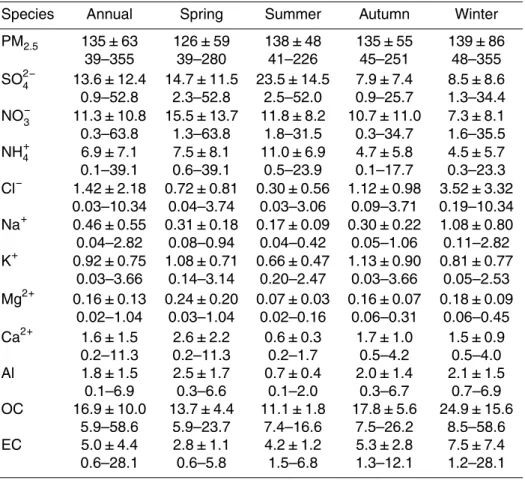
Table 1 provides a statistical summary of the obtained data on atmospheric con-centrations for PM2.5, Al (a tracer of aluminosilicate dust), water-soluble ions, OC, and EC during the sampling period. The annual mean PM2.5 concentration reached
5
135±63 µg m−3. This mean value is nearly three times higher than that (35 µg m−3)
of the interim target-1 standard for annual mean PM2.5 recommended by the WHO. The level of PM2.5 in Beijing is much higher than other megacities around the world. In comparison with that of domestic cities, PM2.5seems to display a spatial tendency, increasing northward and decreasing southward (Zhang et al., 2012b). Such a spatial
10
pattern may be related to the low rainfall and high dust in northern China (Qian et al., 2002, 2005). According to Wang et al. (2008), PM2.5 concentrations in winter were much higher than in summer in 2001 to 2002. However, such a trend seemed to be reversed in 2005 to 2006, with rather higher concentrations in summer.
For the ionic concentrations, SO24− ranked the highest among the water-soluble ions
15
analyzed, with an annual mean of 13.6±12.4 µg m−3, followed by NO−3 (11.3±10.8
µg m−3), NH+4 (6.9±7.1 µg m−3), Ca2+ (1.6±1.4 µg m−3), Cl− (1.4±2.2 µg m−3), K+
(0.92±0.75 µg m−3), Na+ (0.46±0.55 µg m−3), and Mg2+ (0.16±0.13 µg m−3). Such
levels of mean concentrations are rather comparable with those measured in many Chinese cities such as Shanghai, Tianjin, Jinan, and Guangzhou (Yao et al., 2002;
20
Tao et al., 2009; Gao et al., 2011; Gu et al., 2011). On average, the combination of SO24−, NO−3, and NH+4, which could be regarded as secondary inorganic aerosols, constituted the majority (88 %) of the total ionic concentrations, consistent with ear-lier studies (Yao et al., 2002; Duan et al., 2003). The annual mean concentrations of OC and EC reached up to 17.0±10.0 and 5.0±4.4 µg m−3, respectively. Such
lev-25
els are close to those observed for regional sites across China (16.1±5.2 µg m−3 for
ACPD
13, 9953–10007, 2013Chemical characterization and
source apportionment
R. Zhang et al.
Title Page
Abstract Introduction
Conclusions References
Tables Figures
◭ ◮
◭ ◮
Back Close
Full Screen / Esc
Printer-friendly Version Interactive Discussion
Discussion
P
a
per
|
Dis
cussion
P
a
per
|
Discussion
P
a
per
|
Discussio
n
P
a
per
|
carbonaceous aerosols around China; however, such concentrations are approximately half of those observed at urban sites (33.1±9.6 µg m−3 for OC and 11.2±2.0 µg m−3
for EC) by Zhang et al. (2008).
3.2 Seasonality
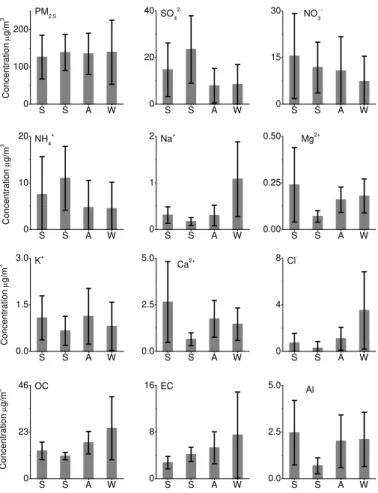
As illustrated in Fig. 2, the seasonalities of PM2.5and these primary species were
char-5
acterized by distinctive features. The seasonality of PM2.5concentration was not very evident and typical, with nearly equal concentrations of around 140 µg m−3in summer,
autumn, and winter and a relative minimum (∼125 µg m−3) in spring. The minimum concentration typically occurs in summer because precipitation in Beijing is usually concentrated at that period. However, this is not the case, because the maximum
con-10
centrations of secondary sulfate and ammonium were observed in summer, arising from strong photochemistry and accounting for a large proportion (∼25 %) of PM2.5 in
Beijing (Yao et al., 2003).
In contrast to PM2.5, sulfate and ammonium revealed a typical seasonality with higher concentrations in spring and summer and lower concentrations in autumn and winter,
15
consistent with the seasonal variability of AOT (Xia et al., 2006). The summertime max-imum concentrations of sulfate and ammonium were 24 and 12 µg m−3, respectively, which were higher than those in Beijing before 2003 (∼15 and ≤10 µg m−3,
respec-tively) (He et al., 2001; Duan et al., 2006; Wang et al., 2005) but rather comparable to those observed in the last few years (Okuda et al., 2011; Song et al., 2012). By
20
contrast, the wintertime concentration of sulfate (8.5 µg m−3) was significantly reduced compared with earlier literature data (He et al., 2001; Hu et al., 2002; Wang et al., 2005). The decrease in wintertime sulfate concentration seemed to result from the effective control of SO2emissions from coal combustion (Hao et al., 2005). High sum-mertime sulfate concentration is ascribed to enhanced photochemistry during summer,
25
ACPD
13, 9953–10007, 2013Chemical characterization and
source apportionment
R. Zhang et al.
Title Page
Abstract Introduction
Conclusions References
Tables Figures
◭ ◮
◭ ◮
Back Close
Full Screen / Esc
Printer-friendly Version Interactive Discussion
Discussion
P
a
per
|
Dis
cussion
P
a
per
|
Discussion
P
a
per
|
Discussio
n
P
a
per
|
artificial biases, particularly of nitrate and ammonium, possibly occurred during sam-pling because no denuder and/or back-up filter was used to trap ammonia and nitric acid (Pathak et al., 2004). The maximum concentration (15.5 µg m−3) of nitrate was
observed in spring rather than summer, which was different from that of sulfate (Wang et al., 2008). This observation may be ascribed to the volatility of ammonium nitrate,
5
which is one of the main chemical forms of nitrate associations revealed by the ionic relationships. Thus, ammonium nitrate could evaporate at relatively high temperature. Besides, there are distinct emission sources for their respective precursor gases, SO2 and NOx. The minimum concentration of nitrate was observed in winter. Nitrate levels could be a function of various factors in terms of emissions, such as exhaust, coal
10
combustion, and biomass burning, and complex chemical processes with respect to photochemistry, heterogeneous reaction, renoxification, and gas–aerosol equilibrium. Rapid increases in on-road vehicular numbers in Beijing may offset any control mea-sures for NOxemissions, especially from coal combustion.
Crustally derived ions and elements, such as Mg2+, Ca2+, and Al, waxed in the
15
spring and waned in the summer, followed by significant increases toward autumn and winter. Such levels of seasonal mean concentrations and seasonalities are consistent with those observed in previous studies (Duan et al., 2006; Wang et al., 2005), which are related to dust storms and anthropogenic and fugitive dust. The seasonal concen-trations of Na+ and Cl− peaked in winter, consistent with Hu et al. (2002) and Wang
20
et al. (2005). The seasonality of Mg2+ was distinguishable from that of Na+, demon-strating the difference in their dominant sources. K+ had relatively higher concentra-tions in both spring and autumn than in summer and winter, which was closely associ-ated with the agricultural burning around Beijing (Zheng et al., 2005). Such seasonality was distinct from those of previous studies, in which winter often had the highest
con-25
centration (He et al., 2001; Duan et al., 2006; Wang et al., 2005).
ACPD
13, 9953–10007, 2013Chemical characterization and
source apportionment
R. Zhang et al.
Title Page
Abstract Introduction
Conclusions References
Tables Figures
◭ ◮
◭ ◮
Back Close
Full Screen / Esc
Printer-friendly Version Interactive Discussion
Discussion
P
a
per
|
Dis
cussion
P
a
per
|
Discussion
P
a
per
|
Discussio
n
P
a
per
|
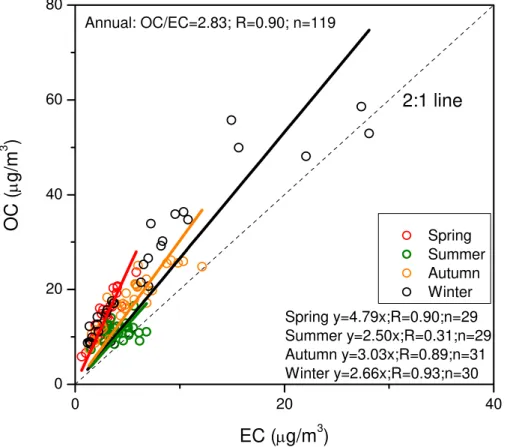
in China, namely, a maximum in winter and a minimum in summer. The seasonalities may be governed by the variability in emission strengths and meteorology. For instance, lower-molecular weight semi-volatile organic compounds are mostly in gaseous phase at high temperature in summer (Yassaa et al., 2001). The OC/EC mass ratio 2.0 indi-cates the presence of secondary organic matter (Chow et al., 1996). In this work, the
5
OC/EC ratios mostly fell within the range of 2–5, with mean ratios of 4.8, 2.5, 3.0, and 2.7 in spring, summer, autumn, and winter, respectively (Fig. 3). These figures are very similar to those observed in previous studies (Duan et al., 2006; Zhang et al., 2008), which suggests the relative domination of secondary organic aerosols in spring but of primary sources in other seasons (Zhang et al., 2008). Another reason for the relatively
10
higher springtime OC/EC mass ratio may be the open biomass burning source, consis-tent with higher K+ in the spring (Fig. 2), as the aerosols from open biomass burning are generally characterized by elevated OC/EC ratios (Cao et al., 2007).
3.3 Stoichiometric analyses of cations and anions
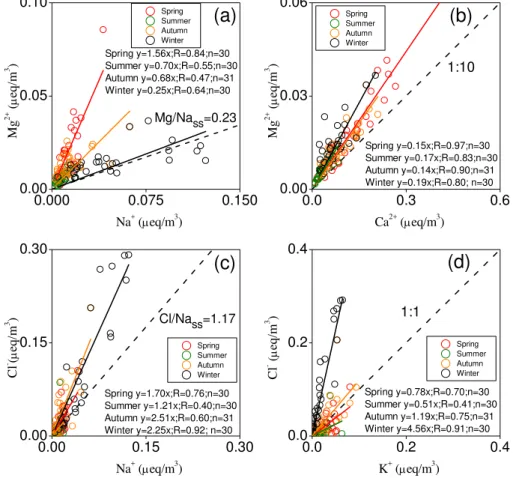
Note that equivalent concentrations (µeq m−3) are used throughout this section.
Fig-15
ure 4 shows the scatter plots of (a) Mg2+ vs. Na+, (b) Mg2+ vs. Ca2+, (c) Cl− vs. Na+, and (d) Cl− vs. K+. Figure 5 shows the scatter plots of (a) total cations vs. total anions, (b) NH+4 vs. SO24−, (c) NH+4 vs. [SO42−+NO−3], (d) [NH+4+Ca2+] vs. [SO2−
4 +NO
−
3], (e) [NH
+
4+Ca 2+
+Mg2+] vs. [SO2−
4 +NO
−
3], and (f) [NH
+
4+Ca 2+
+Mg2+] vs. [SO24−+NO−3+Ex-Cl−]. Ex-Cl− is the excessive Cl−, defined as the excessive
20
amount of Cl− relative to the amount sea salt can sustain with Na+ as the tracer of sea salt: Ex-Cl−=Cl−−[Na+]·1.17, where 1.17 is the typical Cl/Na+ equivalent ratio
of average seawater (Chester, 1990). If the resulting Ex-Cl− is negative, then no Cl− excess exists. In other words, Cl−is totally contributed by sea salt and is even depleted by heterogeneous reactions. Nevertheless, total Na+ does not necessarily originate
25
ACPD
13, 9953–10007, 2013Chemical characterization and
source apportionment
R. Zhang et al.
Title Page
Abstract Introduction
Conclusions References
Tables Figures
◭ ◮
◭ ◮
Back Close
Full Screen / Esc
Printer-friendly Version Interactive Discussion
Discussion
P
a
per
|
Dis
cussion
P
a
per
|
Discussion
P
a
per
|
Discussio
n
P
a
per
|
Figure 4a illustrates that Mg2+ mostly comes from non-sea salt sources, except in wintertime, because the regression slopes that represent the Mg2+/Na+ ratios (1.56, 0.70, 0.68, and 0.25 for spring, summer, autumn, and winter, respectively) are clearly deviated from the ratio (0.23) of average seawater (Chester, 1990). Instead, the domi-nant source of Mg2+ is mineral dust, mainly carbonate minerals (Li et al., 2007), as
re-5
flected by the good correlations (0.97, 0.83, 0.90, and 0.80 for spring, summer, autumn, and winter, respectively) between Mg2+ and Ca2+(Fig. 4b). Similarly, most Cl−
/Na+ ra-tios (1.70, 1.21, 2.51, and 2.25 for spring, summer, autumn, and winter, respectively) in PM2.5are larger than the mean ratio (1.17) of seawater, except the summertime sam-ples (Fig. 4c). This difference indicates the dominance of the non-sea salt sources, of
10
which the most likely contributor of Cl− is coal combustion (Yao et al., 2002), particu-larly in winter when Cl− and SO2are maximal (Figs. 2 and S2). In summer, air masses are dominated by the southerly monsoon from Bohai (as supported by the trajectories below), leading to a mean Cl−/Na+ ratio close to that of average seawater. Moreover, the correlations between K+ and Cl− largely varied with the seasons, with better
cor-15
relation and higher ratios in autumn and winter and moderate correlations and lower ratios (less than unity) in summer and spring (Fig. 4d). Thus, the results suggested that K+ was not present in chemical form KCl at high temperature, but as K2SO4 (P ´osfai et al., 2004). By contrast, low temperature in winter may favor the presence of KCl.
Furthermore, the ratio of total cation concentration to total anion concentration is
av-20
eraged at near unity throughout the year (Fig. 5a), which indicates excellent charge bal-ance in PM2.5and high data quality. Figure 5b shows good correlations between NH+4 and SO24− for the annual data set, with ratios (represented by the slope of the linear regression line) between 1.25 and 1.77 (all higher than unity). These good correlations reveal the dominance of (NH4)2SO4 (Ianniello et al., 2011), rather than NH4HSO4and
25
ACPD
13, 9953–10007, 2013Chemical characterization and
source apportionment
R. Zhang et al.
Title Page
Abstract Introduction
Conclusions References
Tables Figures
◭ ◮
◭ ◮
Back Close
Full Screen / Esc
Printer-friendly Version Interactive Discussion
Discussion
P
a
per
|
Dis
cussion
P
a
per
|
Discussion
P
a
per
|
Discussio
n
P
a
per
|
which demonstrates the presence of NH4NO3in the fine mode aerosols. Moreover, ra-tios lower than unity suggest that nitrate may be present in other chemical forms than NH4NO3. Heterogeneous reactions between NOx(and its products, such as HNO3and N2O5) and dust carbonate are often observed in northern China (Li and Shao, 2009). Accordingly, we examined the correlations of [NH+4+Ca2+] vs. [SO24−+NO−3] (Fig. 5d)
5
and of [NH+4+Ca2++Mg2+] vs. [SO24−+NO−3] (Fig. 5e), given that the good correla-tions between Mg2+ and Ca2+ suggest the possible existence of water-soluble Mg in reacted carbonate dust. These ions are strongly correlated throughout the year, with high coefficients (all 0.99 or higher) and slopes of regression lines around unity. These correlations indicate that nitrate is partly present in Ca(NO3)2and Mg(NO3)2, not just
10
in NH4NO3. We assumed that fine sized sulfate is exclusively associated with ammo-nium and that Na+is present only in the associated NaCl. However, these assumptions may not always be true because Na2SO4is observed in dust particles from dried lakes in northern China (Zhang et al., 2009a) and NaCl could react with nitric acid to form NaNO3via heterogeneous reaction (Hsu et al., 2007). Therefore, based on the
afore-15
mentioned equivalent interrelationships and assumptions, we quantitatively estimated that the former two chemical forms (Ca(NO3)2and Mg(NO3)2) represent∼20 % of the
total nitrate and that NH4NO3is the dominant association accounting for the remaining
∼80 %. The elevated Cl−/Na+ ratio (>1.17) shows that excessive Cl− seemed to be attributed to coal combustion rather than sea salt particles from dried salt lake
sedi-20
ment. The addition of excessive Cl− (Fig. 5f) insignificantly changed the correlations of positive and negative charges. Nevertheless, we noted that in wintertime, the equiv-alent ratio improved from 1.10 to 1.00, which indicates the presence of chloride salts such as KCl, CaCl2, and MgCl2other than NaCl at low ambient temperature (Ianniello et al., 2011). KCl may have originated from biomass burning, and CaCl2 and MgCl2
25
ACPD
13, 9953–10007, 2013Chemical characterization and
source apportionment
R. Zhang et al.
Title Page
Abstract Introduction
Conclusions References
Tables Figures
◭ ◮
◭ ◮
Back Close
Full Screen / Esc
Printer-friendly Version Interactive Discussion
Discussion
P
a
per
|
Dis
cussion
P
a
per
|
Discussion
P
a
per
|
Discussio
n
P
a
per
|
3.4 Chemical mass closure
By employing the methods in Sect. 2.2.1, we constructed the CMC of PM2.5 in Beijing on a seasonal and annual basis. The reconstructed PM2.5 mass concentrations were compared with the gravimetric PM2.5 mass concentrations, as shown in Fig. 6, which shows a good correlation with one another in each season and throughout the year.
5
However, the ratios seasonally changed, with higher ratios of 0.82 in spring and 0.75 in winter and lower ratios of 0.59 in summer and 0.68 in autumn. The proportions of all specific components in PM2.5together with the unidentified constituents as a whole are schematically illustrated by five pie charts for the four seasonal and annual cases (Fig. 7). Overall, the major components are secondary inorganic aerosols (combination
10
of sulfate, nitrate, and ammonium), mineral dust, and POM, which account for each
∼20 %, albeit with seasonal variations. The minor components include EC, chloride
salt, potassium salt, and TEO, each of which represents less than 5 %. Specifically, the proportions of mineral dust are maximal (33.4 %) in spring, minimal (only 8.2 %) in summer, and intermediate (23.6 and 28.9 %) in the other two seasons, consistent
15
with the tendency of seasonal Al concentrations. The totals of secondary inorganic species (SO2−
4 , NO −
3, and NH
+
4) have the largest proportion (27 % to 30 %) in spring
and summer and a minimal percentage (<15 %) in autumn and winter. However, sulfate peaks were noted in summer (15.4 %), whereas nitrate peaks were observed in spring (11.1 %). Ammonium decreased from around 5 to 7 % in spring and summer to half
20
(2 to 3 %) in autumn and winter. The POM fractions largely varied as follows: summer (14.7 %)<spring (18.9 %)<autumn (22.1 %)<winter (28.6 %). EC and chloride salt exhibited the largest proportions (5.2 and 3.3 %, respectively) in winter. Potassium salt and TEO had slightly higher proportions in spring and autumn than in summer and winter.
25
ACPD
13, 9953–10007, 2013Chemical characterization and
source apportionment
R. Zhang et al.
Title Page
Abstract Introduction
Conclusions References
Tables Figures
◭ ◮
◭ ◮
Back Close
Full Screen / Esc
Printer-friendly Version Interactive Discussion
Discussion
P
a
per
|
Dis
cussion
P
a
per
|
Discussion
P
a
per
|
Discussio
n
P
a
per
|
concentrations is relatively small, temporal trends in the proportions of each compo-nent of PM2.5resemble the atmospheric concentrations of their corresponding chemi-cal species. The likely factors for such seasonalities are partially addressed in Sect. 3.2 and discussed in detail in the following two sections.
On average, the unidentified components reached 28.6 % of the total PM2.5. They
5
also showed seasonal variability, with the smallest (15.9 %) in spring when dust was prevalent, and the largest (42.5 %) in summer when secondary inorganic aerosol for-mation was favorable. Such high uncertainties in the CMCs were caused by the water absorption of water-soluble components in the weighing environment, though relative humidity was controlled (Speer et al., 1997; Tsai and Kuo, 2005). The absorption likely
10
led to positive biases in PM2.5concentrations. Alternatively, such uncertainties may be partly due to the volatilization of NH4NO3 and organic matter, particularly in summer and autumn during the storage of the weighted samples prior to extraction, which may have resulted in negative biases in the specific components. Another likely reason for the non-match of the reconstructed and gravimetric mass concentrations is the
vary-15
ing factors used in transferring a given analyzed species (e.g. OC and Al) to a certain component (e.g. POM and mineral soils) (Rees et al., 2004; Hsu et al., 2010a; Yan et al., 2012). For example, a few studies adopted a factor of only 1.4 for converting OC content to organic matter (Duan et al., 2006; Song et al., 2007; Guinot et al., 2007). An-other study obtained a much higher POM/OC mean ratio over China (Xing et al., 2013)
20
of up to 1.92±0.39 based on a mass balance method. If we adopt this higher ratio,
the unidentified percentage would be reduced by 3 %. In the present study, the EFcrust of Ca averages at 2.6, which shows its enrichment relative to average crust compo-sition. In Beijing, fine sized Ca-rich dust is partly attributed to construction activities. Therefore, we may underestimate carbonate abundance in the mineral component
es-25
ACPD
13, 9953–10007, 2013Chemical characterization and
source apportionment
R. Zhang et al.
Title Page
Abstract Introduction
Conclusions References
Tables Figures
◭ ◮
◭ ◮
Back Close
Full Screen / Esc
Printer-friendly Version Interactive Discussion
Discussion
P
a
per
|
Dis
cussion
P
a
per
|
Discussion
P
a
per
|
Discussio
n
P
a
per
|
4 Discussion
4.1 Source identification and apportionment
By utilizing the PMF model with the obtained full data set as input data, we identi-fied six main sources: mineral dust, biomass burning, coal combustion, traffic emis-sions plus waste incineration, industrial pollution, and secondary inorganic aerosol.
5
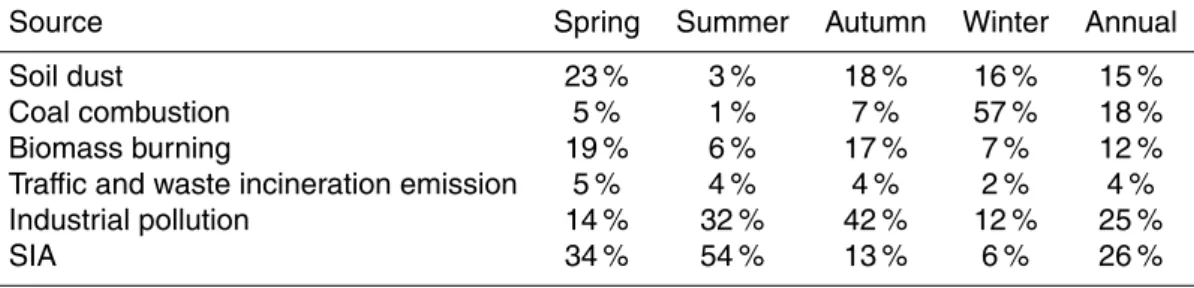
These sources have average contributions of 15, 18, 12, 4, 25, and 26 %, respectively (Table 2). Figures 8 and 9 show the modeled source profiles and the time series of modeled concentrations for each identified main source, respectively. Table 2 summa-rizes the source apportionment results of the relative contributions from each identified source to the PM2.5on both seasonal and annual bases in Beijing. Again, the relative
10
dominance of each identified source largely varies with changing seasons, which is roughly consistent with the CMC results. For mineral dust, only one of the six sources mostly dominated by nonvolatile substance, its proportions (e.g. annual mean∼20 %)
and relative order in the four seasons are consistent with the CMC results, with higher contribution in spring, lower contribution in summer, and intermediate contribution in
15
autumn and winter. This consistency indirectly verifies the reliability of the PMF results. The other five sources all appear to be related to high-temperature activities and/or photochemical processes and involved with volatile species. We then compared the contribution percentages of the secondary inorganic aerosol (SIA) with the CMC re-sults as this source is also identified in the CMC analyses. Apparently, the percentages
20
of SIA in the four seasons differ from those obtained by CMC in terms of the values (e.g. 6 to 54 % versus 14 to 33 % for SIA), although the seasonal trends are quite similar. Thus, CMC method only offers chemical characterization instead of source apportion-ment. The PMF model provides real information on sources of aerosol speciation.
Moreover, we evaluated the distinctive characteristics of each modeled source
pro-25
ACPD
13, 9953–10007, 2013Chemical characterization and
source apportionment
R. Zhang et al.
Title Page
Abstract Introduction
Conclusions References
Tables Figures
◭ ◮
◭ ◮
Back Close
Full Screen / Esc
Printer-friendly Version Interactive Discussion
Discussion
P
a
per
|
Dis
cussion
P
a
per
|
Discussion
P
a
per
|
Discussio
n
P
a
per
|
to∼12 %, which suggests resuspended dust because of the presence of high levels
of OC (Watson and Chow, 2001). Thus, this source possibly mixes desert/loess dust, anthropogenic construction dust, fugitive dust, and resuspended road dust. Construc-tion activities are prevalent in the urban cities of China, and no effective measures for dust control are implemented. Therefore, calcium is used as an indicator element
5
for construction dust in Beijing (Zhang and Iwasaka, 1999). The second source, coal combustion, is characterized by elevated Cl− associated with high Na+, OC, and EC. Extraordinarily high Cl−associated with fine aerosols in winter is a distinctive feature in Beijing and even around inland China, which is ascribed to coal combustion (Yao et al., 2002; Wang et al., 2008). Coal combustion in China is the predominant source of fine
10
aerosols over China (Yao et al., 2009), especially of mercury in the atmosphere, not only in the Northern Hemisphere but also around the globe (Pirrone et al., 2010). Coal fly ash contains abundant Pb because of ineffective dust removal in power plants and residential boilers (Zhang et al., 2009b). Sodium is enriched in fine particulates from coal combustion (Takuwa et al., 2006). Wang et al. (2008) and Zhang et al. (2009a)
15
attributed such high Na and Cl to the presence of Na2SO4 and NaCl that may have originated from dried lake salt sediment in Inner Mongolia, a non-local dust source. However, as discussed, salt lake aerosols alone cannot account for such strikingly high Cl− in winter, which suggests that coal combustion is the most likely dominant source. Different investigations have obtained significantly different contributions of coal
com-20
bustion to PM2.5 in Beijing, which range from 7 to 19 %. Yao et al. (2009) concluded that the likely fraction ranges between 15 and 20 %. Nevertheless, previous studies have not considered that other main identified sources, such as secondary inorganic and organic aerosols, have contributions from coal combustion.
The third source, biomass burning, is characterized by high K (K+), which is an
ex-25
ACPD
13, 9953–10007, 2013Chemical characterization and
source apportionment
R. Zhang et al.
Title Page
Abstract Introduction
Conclusions References
Tables Figures
◭ ◮
◭ ◮
Back Close
Full Screen / Esc
Printer-friendly Version Interactive Discussion
Discussion
P
a
per
|
Dis
cussion
P
a
per
|
Discussion
P
a
per
|
Discussio
n
P
a
per
|
incineration emissions, which is characterized by high NO−3, EC, Cu, Zn, Cd, Pb, Mo, Sb, and Sn. These aerosol species are all enriched in vehicular and/or waste incinera-tion emissions (Lee et al., 1999; Alastuey et al., 2006; Birmili et al., 2006; Marani et al., 2003; Dall’Osto et al., 2012; Tian et al., 2012). For instance, W ˚ahlin et al. (2006) ob-served that traffic-generated aerosol particles are rich in Cu, Zn, Mo, and Sb. Christian
5
et al. (2010) analyzed the aerosol particles emitted from garbage burning, which are rich in Zn, Cd, Sb, and Sn. Leaded gasoline was phased out in 1997 in Beijing and in 2000 in the rest of China. Coal burning was then suggested as the most important source of Pb aerosols in China (Mukai et al., 2001). However, Widory et al. (2010) argued that in Beijing, metal refining plants are the dominant sources of aerosol Pb,
10
followed by thermal power stations and other coal combustion sources.
The fifth source is industrial pollution, which is characterized by high contents of OC, EC, Zn, Mn, and Cr. This source may also be involved with secondary organic aerosols. Coal is the primary energy source commonly used in industries in China. Both coal combustion and vehicle emissions are the main sources of primary OC (Zhang et al.,
15
2007; Cao et al., 2011). However, Zhang et al. (2008) estimated that secondary OC represents more than half of the measured OC at regional sites (∼67 %) and urban
sites (∼57 %), which is higher than those reported by Cao et al. (2007) (i.e. 30 to 53 %).
Therefore, industrial pollution could act as a vital source of carbonaceous aerosols, which seems to be widely ignored. Furthermore, given that Zn and Cr contents are
20
high, this source may be relevant to smelters and metallurgical industries (Dall’Osto et al., 2012). The sixth source is relevant to secondary inorganic aerosols, which are typically characterized by remarkable SO24−, NO−3, and NH+4. Certain identified sources, such as biomass burning, coal combustion, vehicle exhausts, and waste incineration, can also contribute to secondary inorganic and organic aerosols through the emission
25
of their precursor gases.
ACPD
13, 9953–10007, 2013Chemical characterization and
source apportionment
R. Zhang et al.
Title Page
Abstract Introduction
Conclusions References
Tables Figures
◭ ◮
◭ ◮
Back Close
Full Screen / Esc
Printer-friendly Version Interactive Discussion
Discussion
P
a
per
|
Dis
cussion
P
a
per
|
Discussion
P
a
per
|
Discussio
n
P
a
per
|
species that could represent respective contribution sources (Fig. 2). For instance, we compared the maximal and minimal contributions of mineral dust in spring and sum-mer, respectively, which are consistent with the seasonality of aerosol Al. Dust storms are essentially responsible for springtime dust aerosols, whereas in autumn and winter, fugitive dust from construction and the resuspension of street dust are the main
contrib-5
utors. Obviously, the reconstructed time series of daily concentrations from coal com-bustion reveals a pronounced wintertime maximum, consistent with those of aerosol Cl− (Fig. 2) and even gaseous SO2 (Fig. S2). Moreover, the time series of biomass burning contributions show relatively higher concentrations in spring and autumn and lower concentrations in summer and winter, consistent with the seasonality of K+. For
10
traffic and waste burning emissions, the resulting time series do not reveal evident sea-sonality, corresponding with the seasonalities of nitrate and some trace metals, such as Pb, Cu, Sb, and Cd (Fig. S3). Industrial pollution has higher contributions in summer and autumn, possibly corresponding with the seasonalities of Zn and Cr. However, such seasonality is inconsistent with that of OC, with a wintertime maximum, because OC
15
may be from various sources, including the former five sources identified. Coal com-bustion has the largest contribution in winter, and low temperature in winter facilitates the formation of secondary organic aerosols. SIA has higher contributions in summer and spring, mirroring the seasonalities of sulfate, nitrate, and ammonium. This result is definitely related to the photochemistry that accounts for SIA formation. The formed
20
SIA species may not appear in their original emission sources (i.e. coal combustion, biomass burning, traffic exhausts, waste incineration, and industrial pollution), but in the SIA component. Based on the PMF results based and chemical data in January and August 2004, Song et al. (2007) found that the most predominant sources of PM2.5are coal combustion in winter and secondary aerosols in summer, along with other
signif-25
ACPD
13, 9953–10007, 2013Chemical characterization and
source apportionment
R. Zhang et al.
Title Page
Abstract Introduction
Conclusions References
Tables Figures
◭ ◮
◭ ◮
Back Close
Full Screen / Esc
Printer-friendly Version Interactive Discussion
Discussion
P
a
per
|
Dis
cussion
P
a
per
|
Discussion
P
a
per
|
Discussio
n
P
a
per
|
4.2 Regional sources deduced from trajectory and PSCF analyses
The regional sources and transport of air pollutants exert a profound impact on lo-cal air quality in Beijing (e.g. Wang et al., 2004). To address this issue, both trajec-tory clustering and PSCF methods were employed. The 48 h back trajectories start-ing at 100 m from Beijstart-ing were computed by usstart-ing the HYSPLIT model of NOAA
5
(http://www.arl.noaa.gov/ready.html). Four clusters were made (Fig. 10): northwestern (including western, NW), northern (N), eastern (from northeastern to southeastern, E), and southern (S) directions. The NW cluster was further differentiated into two types, namely, fast (NWf) and slow (NWs), according to the motion speed (≤7 m sec−1 for
NWsand>7 m sec−1for NWf,) and distance of air parcels. The classification is
consis-10
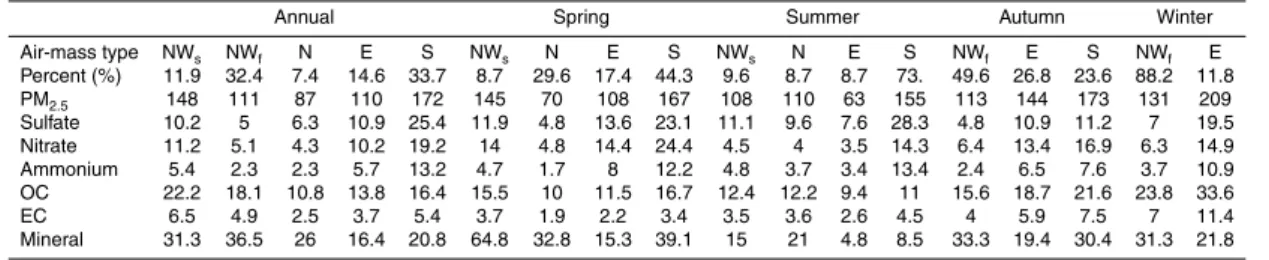
tent with the spatial distribution of fine AOD retrieved by remote sensing (Fig. 1). Table 3 summarizes the percentages of each trajectory cluster in the total on annual and seasonal bases and the corresponding mean concentrations of PM2.5and various aerosol species associated within each trajectory cluster. Annually, the trajectory clus-ters are dominated by both NW and S, accounting for 44 % and 34 %, respectively. The
15
E and N clusters represent the rest (15 % and 7 %, respectively). However, the variabil-ity is large and season-dependent. For instance, the predominant clusters are N (30 %) and S (44 %) in spring, S (73 %) in summer, NWf (50 %) in autumn, and NWf (88 %) in winter. The resulting mean concentrations of main aerosol species seasonally vary with certain types of air masses. In winter, a few PM2.5pollution cases (only 12 % of the
20
wintertime trajectories) with mean concentration as high as 209 µg m−3are associated within the E trajectories that passed over Hebei and Liaoning Provinces, where heavy industries are concentrated in certain cities (e.g. Tianjin, Tangshan, Dalian, Shenyang). However, in spring, summer, and autumn, high PM2.5 (>150 µg m−3) is preferentially associated with the S trajectory cluster. Overall, the general patterns agree with the
25
spatial distribution of the MODIS retrieved fine AOD around Beijing (Fig. 1).
ACPD
13, 9953–10007, 2013Chemical characterization and
source apportionment
R. Zhang et al.
Title Page
Abstract Introduction
Conclusions References
Tables Figures
◭ ◮
◭ ◮
Back Close
Full Screen / Esc
Printer-friendly Version Interactive Discussion
Discussion
P
a
per
|
Dis
cussion
P
a
per
|
Discussion
P
a
per
|
Discussio
n
P
a
per
|
as sulfate, nitrate, ammonium, OC, EC, and mineral dust in Beijing, as illustrated in Fig. 11. A few main features were found: (a) sulfate, nitrate, and ammonium have similar spatial patterns, with higher values in the east to the south, covering Tianjing, Shijiazhuang, and Zhengzhou; (b) both OC and EC show similar spatial distribution, with higher values in the northwest, the south, and the northeast, covering the
bor-5
der of Hebei and Shanxi Provinces, Inner Mongolia, the border of the Hebei, Shanxi, and Henan Provinces, and the area from Tianjing to Shenyang; (c) the higher value for mineral aerosols is localized in the northwest and the south; and (d) for these six aerosol speciations, the southern area appears to be a common hot spot. The overall PSCF results are rather consistent with the spatial distribution of fine AOD (Fig. 1).
10
The statistics obtained from the trajectory clustering (Table 3) shows that the southern air masses bring high levels of secondary inorganic and carbonaceous aerosols and the northwestern air masses are enriched in mineral dust and carbonaceous aerosols. Sun et al. (2006) and Street et al. (2007) found that the S sector has much higher sec-ondary species, such as sulfate, nitrate, and ammonium. During haze-fog events in
Bei-15
jing, chemical constituents of secondary inorganic aerosols are also much higher when the winds blow from the south. Such high amounts of secondary fine-sized aerosols in southern air parcels may be related to high humidity (water vapor) and enhanced heterogeneous reaction in clouds/fog, aside from strong photochemistry. The associa-tion of high dust with the NW trajectories is consistent with Wang et al. (2004) and Yu
20
et al. (2011).
4.3 Implications for atmospheric chemistry, PM control measures, and climate
Rigorous efforts exerted for air pollutant governance prior to the 2008 Beijing Summer Olympics, such as changing the energy source structure, reducing local dust emis-sions, controlling vehicle exhaust emisemis-sions, and relocating major industrial emitters,
25
![Fig. 5. Same as Fig. 4, but for (a) total cations versus total anions, (b) NH + 4 versus SO 2 4 − , (c) NH + 4 versus [SO 2−4 + NO −3 ], (d) [NH +4 + Ca 2+ ] versus [SO 2−4 + NO −3 ], (e) [NH +4 + Ca 2+ + Mg 2+ ] versus [SO 2 4 − + NO −3 ], and (f) [NH +](https://thumb-eu.123doks.com/thumbv2/123dok_br/18411718.359851/49.918.204.504.54.485/total-cations-versus-anions-versus-versus-versus-versus.webp)


