Importance of human values of personnel in the contemporary
organization
Şerb Diana1*, Cicioc Nicoleta2 1
University Valahia Târgovişte, Nr. 190, Gheboieni, Dambovita, Romania
2
University Valahia Târgovişte, Nr 23, Valulul lui Traian Baia Mare, Maramures, Romania
Abstract
With the theme of importance of human values in contemporary organizations staff this article has two parts: the theoretical and practical part. The first part presented the concept of human values knowledge. In part two of the article we made of an office research based on the analysis of secondary sources. An analysis approached from two perspectives: at the European level and at national level. The assumption behind this article is that human values are essential in the workplace.. Data was retrieved and processed in Excel, and SPSS. In order to test research hypotheses correlation was used. To support the argument we used a series of tables and representative images. The conclusions of this analysis show that the Romanian and European respondents consider important the following human values: creativity and freedom of decision.
Keywords:human values, personnel, organization
Jel:A13
1. Theoretical Approach
Personal values have an impact on knowledge sharing in the workplace and personal values, they play a role in the formation of attitudes toward organizational change (N Koivula, 2008). At the managerial level we should propose modifying the employee’s values to support the organization's objectives.
Value according to another definition is an important component of one’s self and personality, distinct attitudes, beliefs, norms and traits. Values are motivator critics of behavior and attitudes (S Schwartz, 2012).Human values were important factors for scientists in their empirical studies of social, psychological, economic and political nature. There is a diversity of views on the classification of human values. According to many specialists in human values (Cheng et all, 2010):
1. competence (creativity, independence, physical ability, logic, imagination) Vs. security (family security, peace)
2. morality (forgiveness, honesty, courage) Vs. success (social recognition, power, comfortable life)
3. social reliability (responsibility, courtesy, self-control, obedience) to beauty (beauty world)
4. political harmony (equality, world peace, social justice) vs sociability (being cheerful, cleaning, being loving).
There are twelve items of value in PVS ( personal values scale) (Shou A, 2010): (1) intellectualism, (2) kindness, (3) social skills (4) loyalty (5) academic (6) the physical growth (7) state, (8) honesty (9) religion, (10), self-control, (11) creativity, and (12) independence.
The structure of these values is considering relationships of conflict and congruence between values. Values are structured in similar ways. This suggests that there is a universal organization of human motivations. Although the nature of values and their structure may be universal, individuals and groups are different.
2. Human Values of Contemporary organization’s staff
Research methodology
Objectives:
- Knowledge of any differences of perception between Europeans and Romanians about human values,
- Observing what percentage of research participants were happy.
Hypotheses:
1. Europeans and Romanians mostly declare themselves happy,
2. Equality is perceived as important,
3. European respondents gender influences the perception of the importance of creativity,
4. The ability of Europeans to make their own decision affects their level of happiness. Research organization
The method of gathering the information for the present research was the analysis of secondary sources. The data was taken from two websites specializing in analysis of conditions of life and work of individuals (European Social Survey, analyzing human values of Europeans and World Values Survey-analyzing the human values of Romanians). The sample for the study that was conducted at the European level consists of 28 221 people.
The sample size for this research in our country consists of 1500 people.
Duration of the survey - 2012 (for the World Values Survey) and 2014 (European Social Survey).
The results obtained
Analysis takes place on two levels:
1. At the European level,
2. National level
1. Analysis at European level
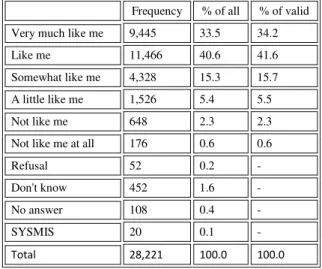
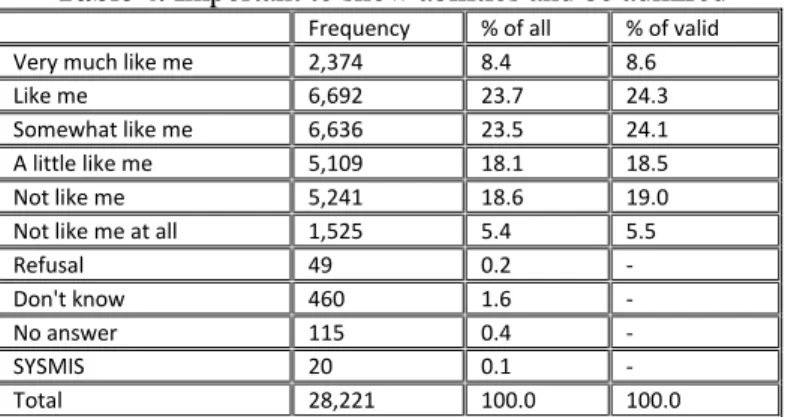
European Social Survey (ESS) is a multi-country academic – led study, which was administered in more than 30 countries so far. Romania is not among the states that participated in the research, instead there are: Austria, Belgium, Switzerland, Czech Republic, Germany, Denmark, Estonia, Finland, France, Ireland, Netherlands, Norway, Poland, Sweden and Slovenia. Respondents were presented a few cases, and they had to compare their situation to that shown according to the importance of creativity, decision, admiration and equality in the workplace (see Table 1, Table 2, Table 3 and Table 4).
Table 1. Important to think new ideas and being creative
Frequency % of all % of valid
Very much like me 9,445 33.5 34.2
Like me 11,466 40.6 41.6
Somewhat like me 4,328 15.3 15.7
A little like me 1,526 5.4 5.5
Not like me 648 2.3 2.3
Not like me at all 176 0.6 0.6
Refusal 52 0.2 -
Don't know 452 1.6 -
No answer 108 0.4 -
SYSMIS 20 0.1 -
Total 28,221 100.0 100.0
Source:http://nesstar.ess.nsd.uib.no/webview/
Table 2. Important to make own decisions and be free
Frequency % of all % of valid
Very much like me 6,099 21.6 22.1
Like me 9,141 32.4 33.2
Somewhat like me 6,960 24.7 25.2
A little like me 3,042 10.8 11.0
Not like me 1,862 6.6 6.8
Not like me at all 469 1.7 1.7
Refusal 47 0.2 -
Don't know 467 1.7 -
No answer 114 0.4 -
SYSMIS 20 0.1 -
Source: http://nesstar.ess.nsd.uib.no/webview/
The answers to this question are as follows: 24.7% of the research participants think ,, somewhat like me ", 21% of respondents think,, very much like me", 32.4% of respondents think ,, like me ' 10.8% of respondents consider,, a little like me. "
Table 3. The importance of equality of chances
Frequency % of all % of valid
Very much like me 8,611 30.5 31.2
Like me 10,898 38.6 39.5
Somewhat like me 5,071 18.0 18.4
A little like me 1,974 7.0 7.1
Not like me 892 3.2 3.2
Not like me at all 170 0.6 0.6
Refusal 50 0.2 -
Don't know 418 1.5 -
No answer 117 0.4 -
SYSMIS 20 0.1 -
Total 28,221 100.0 100.0
Source: http://nesstar.ess.nsd.uib.no/webview/
On the importance of equal opportunities from the perspective of comparison it is found that respondents considered important the equal opportunities and situations presented.
Table 4. Important to show abilities and be admired
Frequency % of all % of valid
Very much like me 2,374 8.4 8.6
Like me 6,692 23.7 24.3
Somewhat like me 6,636 23.5 24.1
A little like me 5,109 18.1 18.5
Not like me 5,241 18.6 19.0
Not like me at all 1,525 5.4 5.5
Refusal 49 0.2 -
Don't know 460 1.6 -
No answer 115 0.4 -
SYSMIS 20 0.1 -
Total 28,221 100.0 100.0
Source: http://nesstar.ess.nsd.uib.no/webview/
For 62% of respondents the desire to be admired is similar with the case presented. Tables 5 and 6 last are correlation tested through the last two assumptions.
Table 5. The correlation between sex and the importance of creativity
Gender
Important to think new ideas and being creative
Correlation 0.052 ** Significance 0.0000
Table 6. The relationship between happiness and own decision
How happy are you
Important to make own decisions and be free Correlation 0.052 ** Significance 0.0000
Count 27573
In both cases the tests are statistically significant, between sex and the importance of creativity there is a direct link and between the level of happiness and the power to make their own decisions is a reverse link.
Table 7. Enjoyed life, how often past week
Code Frequency % of all % of valid
None or almost none of the time
1 1,288 4.6 4.6
Some of the time 2 5,590 19.8 19.9
Most of the time 3 12,634 44.8 45.1
All or almost all of the time 4 8,531 30.2 30.4
Refusal 7 17 0.1 -
Don't know 8 150 0.5 -
No answer 9 11 0.0 -
Total 28,221 100.0 100.0
Source: http://nesstar.ess.nsd.uib.no/webview/
Most Europeans said that they enjoyed life several times during the last weekend.
2. Nationwide analysis
For this analysis the data was obtained as a result of the survey results published by the World Values Survey in 2012. We took the information and processed it in Excel.. The sample consists of 1500 people, of Romanian origin. The questionnaire was applied on the phone, and the data obtained was taken and processed.
Table 8. Feeling of happiness
Number of cases %/Total
Very happy 205 13.6%
Rather happy 833 55.4%
Not very happy 397 26.4%
Not at all happy 60 4.0%
No answer 4 0.3%
Do ´t k ow 4 0.3%
(N) (1,503) 100%
Source: http://www.worldvaluessurvey.org/WVSOnline.jsp
70% of Romanian respondents declare themselves happy, and the remaining percentages declared themselves as being unhappy
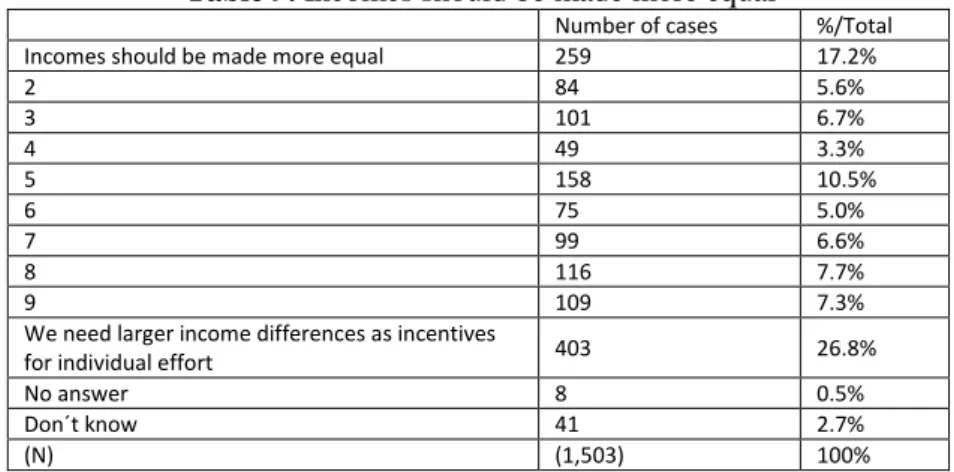
Table 9. Incomes should be made more equal
Number of cases %/Total
Incomes should be made more equal 259 17.2%
2 84 5.6%
3 101 6.7%
4 49 3.3%
5 158 10.5%
6 75 5.0%
7 99 6.6%
8 116 7.7%
9 109 7.3%
We need larger income differences as incentives
for individual effort 403 26.8%
No answer 8 0.5%
Do ´t k ow 41 2.7%
(N) (1,503) 100%
Regarding equality of chances the majority of respondents said that there should be more equality in their lives.
Table 10. Happiness as seen by Romanians
Romania Years
1989-1993 Years 1994-1998
Years 1999-2004
Years 2005-2009
Years 2010-2014
Very happy 6% 5% 4% 10% 14%
Quite happy 55% 51% 43% 53% 55%
Not very happy 33% 35% 40% 30% 26%
Not at all happy 5% 7% 12% 6% 4%
No answer - - 1% 0% 0%
Don´t know 0% 2% 1% 1% 0%
(N) 1,103 1,239 1,146 3,265 1,50
Source: http://www.worldvaluessurvey.org/WVSOnline.jsp
Analysis of the degree of happiness of Romanians from 1989 until 2014 show that for the entire period analyzed Romanians declare themselves happy.
3. Conclusions
Through this article we achieved two objectives formulated under the methodology part of the research. Frequencies and linkage have demonstrated that none of the assumptions verify. Most Romanians and Europeans declare themselves happy, first hypothesis is verified using frequencies. Equality is seen as important, and so the hypothesis number two is checked. European respondents' gender influences the perception of the importance of creativity and Pearson's test verifies this hypothesis. Europeans' ability to make their own decision affects their level of happiness - the last hypothesis is verified through correlation. In conclusion, Europeans and Romanians focus on human values and overall they are happy with the life they lead.
Bibliography
[1] Cheng A., FleischmannK , Wang, P, Ishita, E, Oard, D, ,, Values of stakeholders in the Net neutrality debate: Applying content analysis to
telecommunications policy". Proceedings of the 43rd Hawai’i International Conference on System Sciences (HICSS), 2010.
[2] Koivula N, ,,Basic Human Values in the Workplace", Ed. P.O. Box 4 , Helsinki, 2008.
[3] Schwartz S, ..An Overview of the Schwartz Theory of Basic Value", The psychology of values: The Ontario Symposium (Vol. 8, pp. 1-24). Hillsdale, NJ: Erlbaum , 2012.
[4] Shou A, Kenneth R, ,,Developing a Meta-Inventory of Human Values" ,, October 22–27, 2010, Pittsburgh, PA, USA, 2012.
[5] http://www.worldvaluessurvey.org/WVSOnline.jsp