CT ASSESSMENT OF BRAIN VENTRICULAR SIZE BASED ON AGE AND SEX: A
STUDY OF 112 CASES
Vinoo Jacob1, A.S. Krishna Kumar2
HOW TO CITE THIS ARTICLE:
Vinoo Jacob, A.S. Krishna Kumar. CT Assessment of Brain Ventricular Size Based On Age And Sex: A Study of 112 Cases . Journal of Evolution of Medical And Dental Sciences 2013; Vol2, Issue 50, December 16; Page: 9842-9855.
ABSTRACT: CT being the primary modality of choice in many centers for the diagnosis of brain pathology, normal brain ventricular size measurements is an important parameter for the diagnosis of conditions like hydrocephalus, age related atrophic changes and also other brain pathologies producing ventriculomegaly. It is also important for knowing the normal upper and lower limits of the brain ventricular system in the different age groups, and in both sexes so as to diagnose brain pathology.The ventricular system of the brain undergoes changes with aging and varies with gender.Our study consists of 48 female, and 64 male patients. Apart from the ventricular measurements, two ratios and two indices were also calculated – which included the right and left Evan’s ratio, CM index, and ventricular size index.
KEYWORDS: Ventriculomegaly, Ventricular Size )ndex, atrophy, Evan’s ratio.
METHODS: Retrospective analysis of 112 patients referred to our department for various clinical complaints like headache, dizziness, vertigo, trauma and seizures and whose scans were normal were randomly selected. All the patients were divided into sub groups based on age and sex. The study was carried out from January 2013 to October 2013. The equipment used was a GE dual slice CT scanner.
RESULTS: VSI is calculated as the ratio of the frontal horns diameter to the bi-frontal diameter x . Left Evan’s Ratio is x left anterior by (IS) maximum internal wide of skull, similarly Right Evan’s ratio can also be calculated. CM index is OS maximum external width of skull / middle portion of lateral ventricle. The ratios have been attained from the Atlas of Roentgenographic measurements by Theodrore E. Keats, Lee B. Lusted1.
MEASUREMENT MEAN (%) STD DEVIATION (%) MIN (%) MAX (%)
VSI 32.4 4.1 18 40
Table-1: The results of our study on the VSI measurement.
There was 1% increase in the normal range and this could be attributed to measurement error caused due to measuring the inner diameter of the skull, at a higher level than the ventricular level.
All the parameters measured showed increase in values with increasing age, although there was considerable overlap in the different age groups. This corroborated with the findings of the study conducted by Hang G2, on age and sex dependence of the size of normal ventricles, and Charles
Gradually progressive increase in ventricular size was noted from first to fifth decades which were followed by the dramatic increase in the sixth and seventh decades. The range of VSI was relatively wider in the sixth and seventh decades, than in the first five. Thus abnormalities in the ventricular size may be more easily identified in younger than older patients. Significant increases were shown with increase in age on all measurements. The right and left Evan’s ratio also increased and the CM index decreased with increase in age.
CONCLUSION: In our study of 112 patients, we concluded the following:
1. With increasing age, there is increase in all ventricular parameters, which is most profound in the sixth and seventh decades. This proves that ventriculomegaly is age dependent. Diagnosis of ventriculomegaly in the later decades should be made with caution.
2. Male patients had minimal increase in ventricular parameters as compared to females, although there was considerable overlap in the values in both sexes.
3. In our study the range of ventricular size index was between 18% and 39% with a mean of 32.4% and Standard deviation of 4.1%. Age and sex of the patients had little or no effect on the ventricular size index.
4. CT is a valuable tool with a high degree of diagnostic sensitivity for detecting conditions producing ventriculomegaly, and can be easily performed in all age groups.
INTRODUCTION: The advent of CT and MRI has produced the capability image the human central nervous system non-evasively. This in turn has changed the diagnostic approach to the pathology to the brain. The last few decades showed significant technical advancements in imaging modalities that produced detailed anatomic and physiological information without subjecting the patient to highly invasive or painful procedures.
CT being the primary modality of choice in many centers in India, for the diagnosis of brain pathology, normal brain ventricular size measurements is an important parameter for the diagnosis of conditions like hydrocephalus, age related atrophic changes, and also the brain pathologies producing ventriculomegaly. It is also important for knowing the normal upper and lower limits of the brain ventricular size in different age groups and in both sexes so as to diagnose various brain pathologies.
The accuracy of CT in assessing ventricular size, and therefore abnormalities is almost equal to that of MRI, besides being more cost effective when compared to that of MRI.The study by Errest J.W, FloroMiraldi in: Imaging principles in computer tomography4, and Hagga J.R. Lanzaicri F.C,
Sartoris D. J, Zarhouni E.A (Edr)in: Computer tomography and magnetic resonance imaging of the whole body5 also supported this assessment.
MATERIALS AND METHODS: This study was done in 112 cases. The patients were referred to our department from various departments, mainly from the departments of Neurology, Neurosurgery, Casualty, and Pediatrics for various neurological complaints.
history if any was recorded. This study was conducted in the Department of Radio-Diagnosis in SreeGokulam Medical College, between January 2013 and November 2013.
The equipment used for the study was a GE High Speed, Dual Slice CT Scanner.
Factors 130 KV and 70 MA were a constant for all cases and factors of 110 KV and 50 MA were used for pediatric patients.
Technique: Routine axial scans were performed in all cases taking infra orbito-meatal line as the base line. 5mm slices were performed for the infra tentorium, and 7mm for the supra tentorium. Thin sections were done where ever necessary. Six cuts were taken for each patient, whose CT scan examination proved to be normal. The third, fourth ventricle, and the temporal, frontal and occipital horns of the lateral ventricle were included in these sections.
Two ratios were calculated from these measurements. The right and left Evan’s Ratio, and also calculated were the CM index, and the Ventricular Size index.
Apart from Radiological data, patient data such as age, sex, presenting complaints, past history, family history and relevant clinical data were also recorded.
DISCUSSION: The two most important conditions that produce ventricular enlargement are hydrocephalus and atrophy. Atrophy can either be due to aging, or due to neuro-degenerative brain disease. Hydrocephalus on the other hand results from impaired circulation of CSF or in certain rare circumstances, due to the increased production of CSF, such as what occurs in choroidplexus tumors. The other features which suggest a ventricular enlargement due to increased CSF pressure include effacement of the cortical sulci, elevation and thinning of the corpus callosum, dilatation of the optic and infundibular recess of the third ventricle and penal recess posteriorly.
When apparent increase in CSF space results from volume loss of brain parenchyma, caused by normal aging or neurodegenerative process, it is defined as atrophy.
Several measurements have been used to grade ventricular enlargement, such as Ventricular Size Index (VSI). The normal range is 18 to 31 ± 8%with a mean value of 32.4% and a Standard Deviation of 4.1%, with minimum value of 18%, and maximum value of 40%.
In a study conducted on 200 normal patients, by CT, by Francis J Y Hahn and Kwan Tim6, in
March 1997, the VSI ranged between 18 to 31% ±8%, with a minimum value of 18.5%, and a maximum value of 39.3%, the mean being 31.1% and a Standard Deviation of 3.7%
Age Groups No of Cases Percentage (%)
0 – 10 15 13.4
11 – 20 15 13.4
21 – 30 28 25.0
31 – 40 22 19.6
41 – 50 15 13.4
51 – 60 13 11.6
>60 4 3.6
Table - 2
All ventricular parameters such as the right and left Evan’s Ratio, increased with age, while the CM Index showed decrease in value with increase in age from first to seventh decades. In a study done by Stephan A Barron, and Lawrence Jacobs et al9, on the changes in the size of normal
ventricles determined by CT, they reported a gradually progressive increase in ventricular size from first through sixth decades was followed by a dramatic increase in the eighth and ninth decades. In another study by Gyldensted10, in the measurements of the normal ventricular system and
hemispheric sulci on 100 patients by CT, he reported that significant increases were shown with increasing age, on all measurements with the exception of the skull size. In another study by Kaye JE, et al11– their results corroborated our findings on age related enlargement of the cerebral ventricles
by CT.
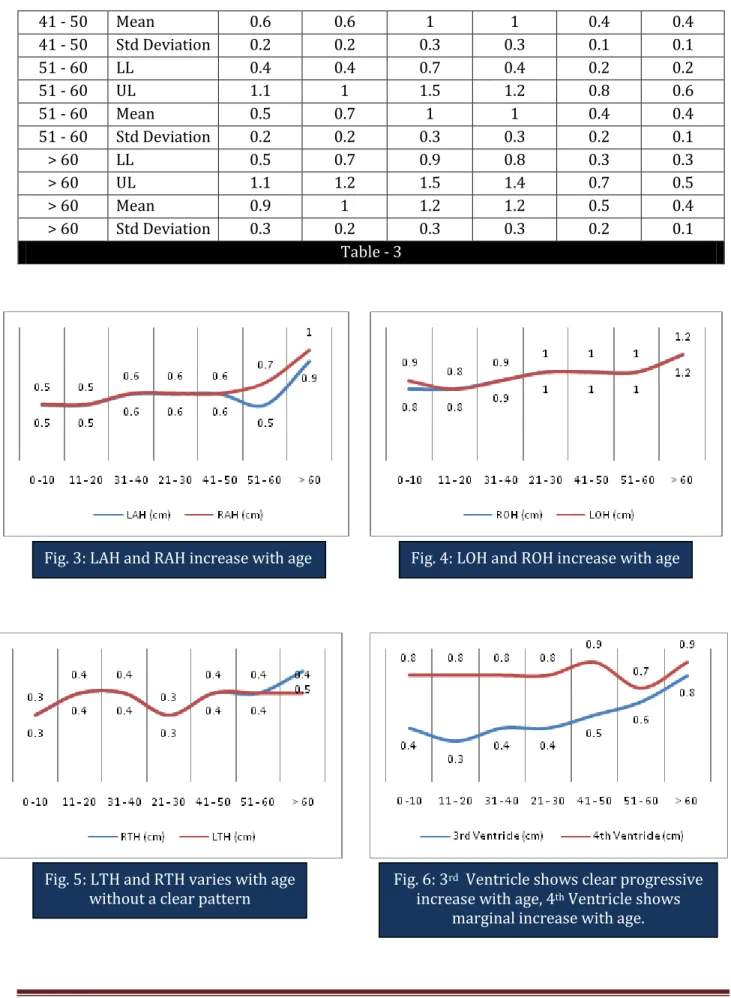
Age Group Range Limit LAH (cm) RAH (cm) ROH (cm) LOH (cm) RTH (cm) LTH (cm)
0 -10 LL 0.2 0.3 0.4 0.7 0.2 0.2
0 -10 UL 1.2 1 1.5 2 0.4 0.4
0 -10 Mean 0.5 0.5 0.8 0.9 0.3 0.3
0 -10 Std Deviation 0.1 0.2 0.3 0.3 0.1 0.1
11 - 20 LL 0.3 0.2 0.5 0.5 0.2 0.2
11 - 20 UL 0.8 0.9 1.2 1.2 0.5 0.6
11 - 20 Mean 0.5 0.5 0.8 0.8 0.4 0.4
11 - 20 Std Deviation 0.2 0.2 0.2 0.2 0.1 0.1
21 - 30 LL 0.3 0.3 1.7 0.7 0.2 0.2
21 - 30 UL 1 1.1 2.9 1.4 0.5 0.6
31 - 40 Mean 0.6 0.6 0.9 0.9 0.4 0.4
21 - 30 Std Deviation 0.2 0.2 0.2 0.2 0.1 0.1
31 - 40 LL 0.3 0.3 0.5 0.5 0.2 0.2
31 - 40 UL 0.9 1 1.2 1.2 0.5 0.5
21 - 30 Mean 0.6 0.6 1 1 0.3 0.3
31 - 40 Std Deviation 0.2 0.2 0.2 0.2 0.9 0.1
41 - 50 LL 0.4 0.4 0.3 0.3 0.2 0.2
41 - 50 Mean 0.6 0.6 1 1 0.4 0.4
41 - 50 Std Deviation 0.2 0.2 0.3 0.3 0.1 0.1
51 - 60 LL 0.4 0.4 0.7 0.4 0.2 0.2
51 - 60 UL 1.1 1 1.5 1.2 0.8 0.6
51 - 60 Mean 0.5 0.7 1 1 0.4 0.4
51 - 60 Std Deviation 0.2 0.2 0.3 0.3 0.2 0.1
> 60 LL 0.5 0.7 0.9 0.8 0.3 0.3
> 60 UL 1.1 1.2 1.5 1.4 0.7 0.5
> 60 Mean 0.9 1 1.2 1.2 0.5 0.4
> 60 Std Deviation 0.3 0.2 0.3 0.3 0.2 0.1
Table - 3
Fig. 3: LAH and RAH increase with age Fig. 4: LOH and ROH increase with age
Fig. 5: LTH and RTH varies with age without a clear pattern
Fig. 6: 3rd Ventricle shows clear progressive increase with age, 4th Ventricle shows
Age Group
3rd Ventricle (cm)
4th Ventricle (cm)
LER (cm)
RER
(cm) CMI
VSI (%)
0 -10 0.2 0.6 0.2 0.2 5.5 27.9
0 -10 0.7 1 0.04 0.06 1.1 38
0 -10 0.4 0.8 0.1 0.1 4.1 31.4
0 -10 0.1 0.1 0.04 0.04 1.1 4.1
11 - 20 0.2 0.4 0.2 0.2 6.7 24.7
11 - 20 0.4 1.1 0.1 0.04 3.7 34
11 - 20 0.3 0.8 0.1 0.1 4.8 32
11 - 20 0.1 0.2 0.03 0.04 0.8 3.2
21 - 30 0.2 0.4 0.2 0.2 6.3 18
21 - 30 1 1.1 0.05 0.1 4 40
31 - 40 0.4 0.8 0.1 0.1 5.1 32.5
21 - 30 0.2 0.2 0.04 0.04 0.6 4.9
31 - 40 0.2 0.4 0.3 0.1 5.4 21
31 - 40 0.6 1.1 0.07 0.08 4 38
21 - 30 0.4 0.8 0.1 0.1 4.7 31.7
31 - 40 0.1 0.2 0.04 0.04 0.5 4.5
41 - 50 0.2 0.6 0.2 0.2 6.8 26
41 - 50 1 1.3 0.1 0.08 1.1 37
41 - 50 0.5 0.9 0.1 0.1 4.6 33
41 - 50 0.8 0.2 0.04 0.05 1.3 3.2
51 - 60 0.3 0.5 0.2 0.2 5.6 30
51 - 60 1 0.8 0.08 0.08 3.1 38
51 - 60 0.6 0.7 0.1 0.1 4.3 33.2
51 - 60 0.2 0.8 0.03 0.04 0.6 2.6
> 60 0.6 0.6 0.2 0.2 5.4 32.3
> 60 1.1 1.1 0.1 0.1 3.9 38
> 60 0.8 0.9 0.2 0.2 4.4 36
> 60 0.2 0.2 0.04 0.04 0.7 2.6
Fig. 7: Left and Right Evan’s ratio
show increase with age
Fig. 8: VSI shows marginal increase with age CMI remains constant with age
As per the study by Celik H. H. et al12, the size of the cerebral ventricles increases with age in
both sexes. He also revealed that as compared to women, the size of the third ventricle was larger in men.
In our study of 112 cases of normal cases, we had a ventricular size index ranging from 18 to 40%, with a mean value of 32.4%, and a standard deviation of 4.1%.
The right and left Evan’s ratio also increased with age, while the CM )ndex, decreased with increase in age. From the first to fifth decades, there was considerable overlap in the ventricular parameters in both sexes.
Scans: Shown above shows the axial CT sections of a 16 year old male patient, showing measurements of the example of VSI, CM, 3rd and 4th Ventricles, IS,
Effect of sex on the Size of Ventricles: In our study consisting of 112 normal, the cases were divided into two groups based on their sex – consisting of 48 females, and 64 males.
On the ventricular parameters, male, female and total patients the mean, standard deviation, 5th, 50th (Median) and 95th percentile values were calculated. All ventricular parameters including
right and left Evan’s ratio and CM )ndex were found to be on the higher size for male patients as compared to the female patients, although there was considerable overlap in both sexes.
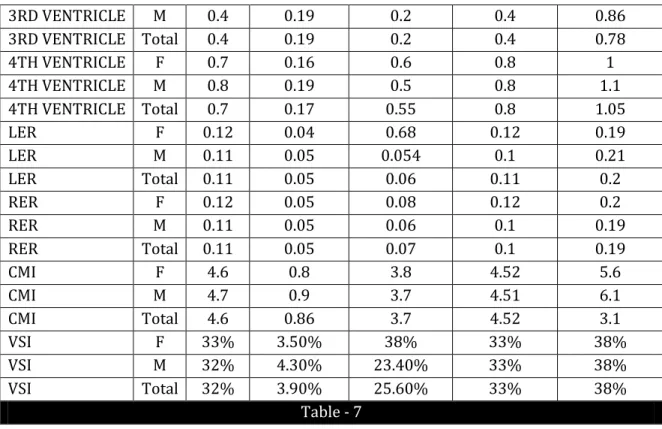
Parameter Sex Mean in Cm
Std Deviation in cm
5th Percentile in cm
50th Percentile in
cm
95th Percentile in
cm
LAH F 0.6 0.2 0.3 0.6 0.97
LAH M 0.6 0.2 0.3 0.5 0.99
LAH Total 0.6 0.2 0.3 0.55 0.98
RAH F 0.6 0.2 0.4 0.6 1
RAH M 0.6 0.2 0.3 0.5 0.9
RAH Total 0.6 0.2 0.35 0.55 0.9
CM F 0.5 0.35 2 2.5 3.06
CM M 0.6 0.4 2 2.6 3.08
CM Total 0.5 0.35 2 2.55 3.07
IS F 9.9 0.38 9.3 9.8 10.6
IS M 10.3 0.4 9.7 10.3 10.9
IS Total 10.1 0.4 9.5 10 10.7
OS F 11.5 0.6 10.7 11.5 12.6
OS M 11.8 0.6 10.7 11.9 12.6
OS Total 11.7 0.6 10.7 11.7 12.6
WROH F 0.8 0.3 0.5 0.9 1.3
WROH M 0.9 0.2 0.6 0.9 1.2
WROH Total 0.9 0.2 0.5 0.9 1.2
WLOH F 0.9 0.3 0.5 0.9 1.4
WLOH M 1 0.2 0.7 0.9 1.4
WLOH Total 0.9 0.3 0.6 0.9 1.4
WRTH F 0.3 0.12 0.2 0.3 0.5
WRTH M 0.4 0.13 0.2 0.4 0.6
WRTH Total 0.36 0.12 0.2 0.35 0.55
Mean values:All Brain Ventricular measurements show marginally less values for female patients (4th Ventricle, WROH, WLOH,
WRTH, WLTH)
5th percentile:4th Ventricle, WROH, WLOH –
show good variance, especially for WLOH, however most values show parity
50th percentile –Parity in all measurements
noted except for LAH, and RAH where female measurements seem marginally more
95thpercentile:Parity in all measurements noted
except for 3rd Ventricle where female
measurements seem marginally less
Parameter Sex Mean in Cm
Std Deviation
in cm
5th Percentile
in cm
50th Percentile
in cm
95th Percentile
in cm
WLTH F 0.3 0.12 0.2 0.4 0.5
WLTH M 0.4 0.18 0.2 0.4 0.6
WLTH Total 0.36 0.14 0.2 0.4 0.55
3RD VENTRICLE F 0.4 0.19 0.2 0.4 0.7
Fig. 9 Fig. 10
3RD VENTRICLE M 0.4 0.19 0.2 0.4 0.86
3RD VENTRICLE Total 0.4 0.19 0.2 0.4 0.78
4TH VENTRICLE F 0.7 0.16 0.6 0.8 1
4TH VENTRICLE M 0.8 0.19 0.5 0.8 1.1
4TH VENTRICLE Total 0.7 0.17 0.55 0.8 1.05
LER F 0.12 0.04 0.68 0.12 0.19
LER M 0.11 0.05 0.054 0.1 0.21
LER Total 0.11 0.05 0.06 0.11 0.2
RER F 0.12 0.05 0.08 0.12 0.2
RER M 0.11 0.05 0.06 0.1 0.19
RER Total 0.11 0.05 0.07 0.1 0.19
CMI F 4.6 0.8 3.8 4.52 5.6
CMI M 4.7 0.9 3.7 4.51 6.1
CMI Total 4.6 0.86 3.7 4.52 3.1
VSI F 33% 3.50% 38% 33% 38%
VSI M 32% 4.30% 23.40% 33% 38%
VSI Total 32% 3.90% 25.60% 33% 38%
Table - 7
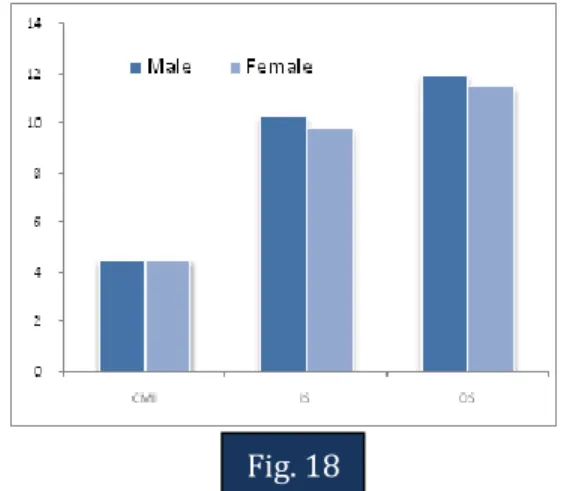
The below figures show the comparison between the measurements between Male and Females for – CM, LER, RER, VSI, CMI, IS, OS:
CM, LER, RER, VSI Mean values: All parameters seem comparable for male and female patients
CMI, IS, OS, Mean values: All parameters seem comparable for male and female patients
CM, LER, RER, VSI,5th percentile –LER seems
higher for Female patients
CMI, IS, OS, 5thpercentile:All parameters
seem comparable for male and female patients
CM, LER, RER, VSI,50thPercentile:All parameters
seem comparable for male and female patients
CMI, IS, OS, 50thpercentile:All parameters
seem comparable for male and female patients
CM, LER, RER, VSI,95th percentile: All
parameters seem comparable for male and female patients.
CMI, IS, OS, 95thpercentile:All parameters
seem comparable for male and female patients.
Fig. 15 Fig. 16
Fig. 17 Fig. 18
The Ventricular Size Index remained constant in both sexes, revealing that sex does not affect VSI.
In a study conducted by Gyldensted9 the measurement of normal ventricular system on 100
adults by CT, revealed that six parameters were larger in men than women. These parameters were LA(, RA(, Right Evan’s ratio, CM, OS and IS.
As compared to our study the ventricular parameter readings by Gyldensted10were on the
higher side. However a study by Celik HH et al12on the measurements of normal ventricular size on
100 adults showed no significant difference in the measurements between the two sexes.
Abbreviations:
LAH: Maximum width of left anterior horn RAH: Maximum width of right anterior horn
CM: Minimum width of middle portion of lateral ventricle IS: Maximum Internal width of skull
OS: Maximum External width of skull LER: Left Evan’s Ratio
RER: Right Evan’s Ratio VSI: Ventricular Size Index
WLTH: Width of Left Temporal Horn WRTH: Width of Right Temporal Horn
Formulae
LER = (2 x LAH) / IS RER= (2 x RAH) / IS CMI= OS/CM
VSI= (Frontal Horn Diameter/ Bi-Frontal Diameter) x 100 LER = (2 x LAH) / IS
RER= (2 x RAH) / IS
REFERENCES:
1. Theodrore E. Keats, Lee B. Lusted: Atlas of Roentgenographic measurements, 5thedn. , 1985;
Year book Medical publishers (INC) 1985; pp 6 – 12.
2. Hang G. Age and sex dependence of the size of normal ventricles on computed tomography. Neuroradiology 1977;14:201-204.
3. Charles P. Hughes, MohktarGado, Computed tomography and aging of the brain. Radiology 1981;131:391– 396.
4. Errest J.W, FloroMiraldi in: Imaging principles in computer tomography.
5. Hagga J.R. Lanzaicri F.C, Sartoris D. J, Zarhouni E.A (Edr) in: Computer tomography and magnetic resonance imaging of the whole body. 3rdedn. Mosby year book INC Missouri 3rdedn.
1994; pp. 3-24.
7. Michael P. Earnest: Robert K. Heaten et al: Cortical atrophy, Ventricular enlargement and Intellectual impairment in the aged. Neurology 1979;29:1138– 1143.
8. M. Leon Skolnick, Arthur E. Rosenbaum et al, Detection of Dilated cerebral ventricles in infants: A correlative study between Ultrasound and Computed tomography. Radiology1979;131:447 – 451.
9. Stephan A Barron, and Lawrence Jacobs et al: Changes in the size of normal lateral ventricles during aging determined by CT. Neurology 1976, November, Vol 26, pp 1011-1013.
10.Gyldensted C. Measurements of the normal ventricular system and hemispheric sulci of 100 adults with computed tomography. Neuroradiology 1977; 14: 183 – 192.
11.Kaye J.E, De Carli C et al The significance of age related enlargement of the cerebral ventricles in healthy men and women by quantitative computed X-Ray tomography.
12.Celik H.H: Gurbuz F. et al: CT Measurements of the normal brain ventricular system in 100 adults, Kiabogaku – Zashi, 1995 April; 70 (2); pp 107-115.
AUTHORS:
1. Vinoo Jacob 2. A.S. Krishna Kumar
PARTICULARS OF CONTRIBUTORS:
1. Associate Professor, Department of Radiodiagnosis, Sree Gokulam Medical College and Research Foundation.
2. Associate Professor, Department of Radiodiagnosis, Sree Gokulam Medical College and Research Foundation.
NAME ADRRESS EMAIL ID OF THE CORRESPONDING AUTHOR:
Dr. Dr. Vinoo Jacob, Associate Professor,
SreeGokulam Medical College and Research Foundation, Venjaromoodu P.O.,
Thiruvananthapuram – 695 607. Email – [email protected]