What do Cochrane systematic reviews say about
interventions for autism spectrum disorders?
O que as revisões sistemáticas Cochrane falam sobre intervenções para os
transtornos do espectro autista?
Larissa Lyra
I, Luiz Eduardo Rizzo
I, Camila Sá Sunahara
I, Daniela Vianna Pachito
II, Carolina de Oliveira Cruz Latorraca
III,
Ana Luiza Cabrera Martimbianco
IV, Rachel Riera
VDiscipline of Evidence-Based Medicine, Escola Paulista de Medicina (EPM), Universidade Federal de São Paulo (Unifesp), São Paulo (SP), Brazil
ABSTRACT
CONTEXT AND OBJECTIVE: Autism spectrum disorders (ASDs) include autistic disorder, Asperger’s disor-der and pervasive developmental disordisor-der. The manifestations of ASDs can have an important impact on learning and social functioning that may persist during adulthood. The aim here was to summarize the evidence from Cochrane systematic reviews on interventions for ASDs.
DESIGN AND SETTING: Review of systematic reviews, conducted within the Discipline of Evidence-Based Medicine, Escola Paulista de Medicina, Universidade Federal de São Paulo.
METHODS: We included and summarized the results from Cochrane systematic reviews on interventions for ASDs.
RESULTS: Seventeen reviews were included. These found weak evidence of beneits from acupuncture, glu-ten and casein-free diets, early inglu-tensive behavioral interventions, music therapy, parent-mediated early interventions, social skill groups, Theory of Mind cognitive model, aripiprazole, risperidone, tricyclic anti-depressants and selective serotonin reuptake inhibitors (SSRI); this last only for adults. No beneits were found for sound therapies, chelating agents, hyperbaric oxygen therapy, omega-3, secretin, vitamin B6/ magnesium and SSRI for children.
CONCLUSION: Acupuncture, gluten and casein-free diets, early intensive behavioral interventions, music therapy, parent-mediated early interventions, social skill groups and the Theory of Mind cognitive model seem to have beneits for patients with autism spectrum disorders (very low to low-quality evidence). Aripiprazole, risperidone, tricyclic antidepressants and SSRI (this last only for adults) also showed some beneits, although associated with higher risk of adverse events. Experimental studies to conirm a link between probable therapies and the disease, and then high-quality long-term clinical trials, are needed.
RESUMO
CONTEXTO E OBJETIVO: Os transtornos do espectro autista (TEA) incluem autismo, doença de Asperger e transtorno global do desenvolvimento. As manifestações dos TEA podem ter importante impacto na aprendizagem e funcionamento social, que pode persistir durante a fase adulta. O objetivo foi resumir as evidências de revisões sistemáticas Cochrane sobre intervenções para TEA.
TIPO DE ESTUDO E LOCAL: Revisão de revisões sistemáticas conduzida na Disciplina de Medicina Basea-da em Evidências Basea-da Escola Paulista de Medicina, UniversiBasea-dade Federal de São Paulo.
MÉTODOS: Nós incluímos e resumimos os resultados de revisões sistemáticas Cochrane sobre interven-ções para TEA.
RESULTADOS: Foram incluídas 17 revisões que encontraram evidências fracas de benefícios da acupun-tura, dietas isentas de glúten e caseína, intervenção comportamental intensiva precoce, musicoterapia, intervenção precoce mediada pelos pais, grupos de habilidades sociais, modelo cognitivo de Teoria da Mente, aripiprazol, risperidona, antidepressivos tricíclicos, inibidores seletivos da recaptação da serotonina (ISRS); o último apenas para adultos. Nenhum benefício foi encontrado com terapias sonoras, agentes quelantes, oxigenoterapia hiperbárica, ômega-3, secretina, vitamina B6/magnésio e ISRS para crianças.
CONCLUSÃO: Acupuntura, dietas sem glúten e caseína, intervenção comportamental intensiva precoce, musicoterapia, intervenção precoce mediada pelos pais, grupos de habilidades sociais e modelo cognitivo de Teoria da Mente parecem ter benefícios para pacientes com TEA (evidência de qualidade muito baixa a baixa). Aripiprazol, risperidona, antidepressivos tricíclicos e ISRS (o último apenas para adultos) também apresentam algum benefício, embora estejam associados a maior risco de eventos adversos. Estudos ex-perimentais conirmando a relação entre prováveis terapias e a doença, e então ensaios clínicos de alta qualidade e de longo seguimento, são necessários.
IUndergraduate Medical Student, Escola Paulista
de Medicina (EPM), Universidade Federal de São Paulo (Unifesp), São Paulo (SP), Brazil.
IIMD, MSc. Neurologist; Postgraduate Student,
Evidence-Based Health Program, Universidade Federal de São Paulo (Unifesp), São Paulo (SP), Brazil; and Assistant Researcher at Cochrane Brazil, São Paulo (SP), Brazil.
IIIPsychologist. Postgraduate Student,
Evidence-Based Health Program, Universidade Federal de São Paulo (Unifesp), São Paulo (SP), Brazil; and Assistant Researcher, Cochrane Brazil, São Paulo (SP), Brazil.
IVMSc, PhD. Physiotherapist and Assistant
Researcher, Cochrane Brazil, São Paulo (SP), Brazil.
VMD, MSc, PhD. Rheumatologist and Adjunct
Professor, Discipline of Evidence-Based Medicine, Escola Paulista de Medicina (EPM), Universidade Federal de São Paulo (Unifesp); and Assistant Coordinator, Cochrane Brazil, São Paulo (SP), Brazil.
KEY WORDS:
Autism spectrum disorder. Therapeutics.
Review [Publication type]. Evidence-based practice. Evidence-based medicine.
PALAVRAS-CHAVE: Transtorno do espectro autista. Terapêutica.
Revisão.
INTRODUCTION
Autism spectrum disorders (ASDs) have an estimated preva-lence ranging from 3.3 to 116 children per 10,000 and it is widely accepted that autism afects approximately 1% of children world-wide.1 his may relect increased access to diagnosis, concern
among healthcare professionals and parents, more sensitive diag-nostic criteria and/or a true increase in prevalence.2
ASDs include autistic disorder, Asperger’s disorder and perva-sive developmental disorder. Patients with these conditions present deicits in communication, social interaction and cognitive function; problems with feeding; hypo or hypersensitivity; and, sometimes, self-harmful behavior.3 With greater severity of ASDs, activities
of daily living are limited and the impairments of ASDs can have an important impact on learning and social functioning that may persist during adulthood.4
Healthcare and social care for people with ASDs is frequently complex, since they are more likely to have mental health comor-bidities and suicidal ideation.5 Assessments need to be
multidis-ciplinary and developmental, and early detection is determinant. herapeutic interventions need to be personalized, focusing on the speciic clinical features presented by each patient.6
Individual or parent-based psychosocial interventions are fre-quently used in clinical practice, with the aim of improving clinical features relating to communication, cognition, behavior and rela-tionships, for instance. Pharmacological therapy is an option for mental health comorbidities. New therapeutic approaches include genetic and pharmacological strategies for reducing synthesis of spe-ciic proteins and inhibiting pleiotropic growth factors.7 Concerning
the time for starting the treatment, randomized controlled trials have added new evidence that, for many children aged up to three years, early intervention can improve outcomes, thus increasing the potential beneits of early diagnosis facilitated by early screening.8,9
Despite recent advances in this area, the evidence regarding autism remains limited and this condition continues to be a challenge for researchers, healthcare professionals, patients, parents and caregivers.
OBJECTIVES
To map out and summarize all Cochrane systematic reviews on interventions for autism spectrum disorders, and present the results on the basis of the quality of the evidence.
METHODS
Design
Review of Cochrane systematic reviews on interventions for ASD.
Setting
Discipline of Evidence-Based Medicine, Escola Paulista de Medicina, Universidade Federal de São Paulo (UNIFESP), Brazil.
Criteria for including reviews
Types of study
We included completed Cochrane systematic reviews, with no restriction regarding date of publication. Protocols for systematic reviews and reviews signaled as “withdrawn” in the Cochrane Database of Systematic Reviews (CDSR) were not considered. We included only the latest version of each review.
Types of participants Individuals with ASD.
Types of interventions
All types of interventions (pharmacological and non-pharmaco-logical) aiming to treat ASD.
Type of outcomes
Clinical and laboratory outcomes were considered, as presented by the systematic reviews.
Searching for reviews
We conducted systematic searches in the Cochrane Database of Systematic Reviews (CDSR) (via Wiley) using a sensitive search strategy (Table 1).
Selecting reviews
hree reviewers evaluated the titles and abstracts of records that had initially been retrieved on the basis of the inclusion crite-ria. he full texts of records with the potential for inclusion were read to conirm whether they should be included (reasons for exclusions were recorded and presented). Divergences between reviewers were resolved through reaching a consensus.
Presenting the results
We used a narrative structure (qualitative synthesis) to present the results from the systematic reviews included.
RESULTS
Search results
he initial search retrieved 24 reviews. From these, we excluded six reviews addressing other clinical situations (X fragile syndrome,
Table 1. Search strategy and results from Cochrane Database of Systematic Reviews (conducted on November 22, 2016)
#1 “autism spectrum disorder” in Title, Abstract, Keywords
prematurity and attention deicit hyperactivity disorder) and one that was a previous version of a review that we included. hus, we included 17 systematic reviews.4,10-25
Results from systematic reviews
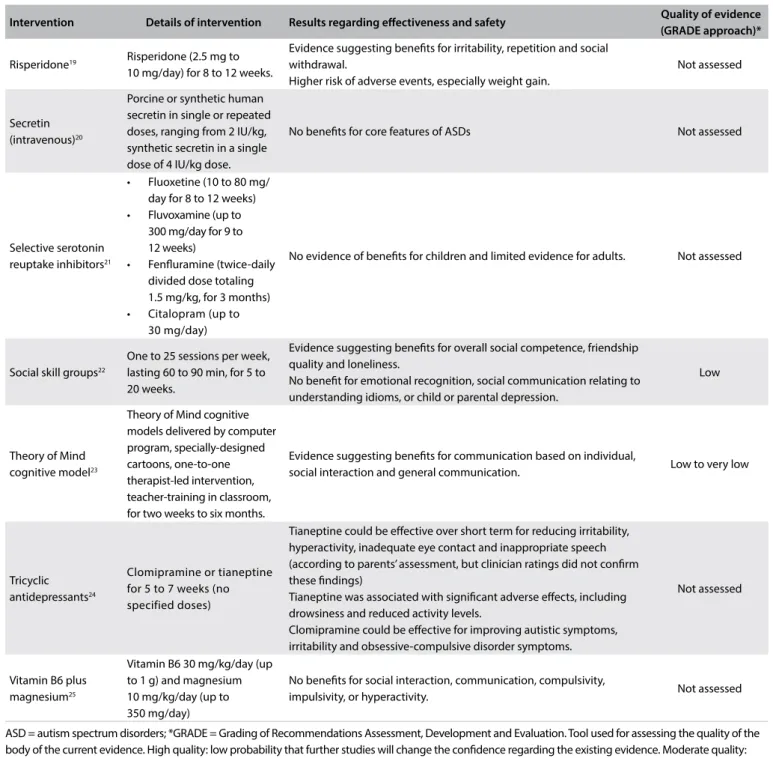
A summary of each systematic review is presented narratively below. In addition, Table 24,10-25 presents the issues addressed,
the main indings from each systematic review and the quality of the evidence (based on the GRADE approach).26
1. Acupuncture
he review4 considered randomized controlled trials (RCTs)
and quasi-randomized controlled trials and included 10 studies (from low to high methodological quality) on 390 children aged from 3 to 18 years who presented ASDs and received acupunc-ture for periods ranging from four weeks to nine months. he fol-lowing results were found:
• Needle acupuncture (by means of manual or electrical stim-ulation) versus sham: no diference in core autistic features. On the Ritvo-Freeman Real Life Rating Scale (RFRLRS): mean diference (MD) = 0.09; 95% conidence interval (CI) = -0.03 to 0.21; P = 0.16. Acupuncture seemed to result in better lan-guage comprehension, cognition, selfcare and social function-ing, and a higher probability of improvement in overall func-tioning greater than or equal to 25%.
• Needle acupuncture (by means of manual or electrical stimu-lation) versus no treatment: acupuncture seemed to improve autistic features, speech, cognition, overall functioning, self-care, sensory functioning, imitation, repetitive behavior and physical health.
• Acupressure versus no treatment: acupressure might result in improvement in overall functioning, communication attitude, non-verbal communication and matching, and in language and social interaction.
Most of the favorable outcomes were observed only in a single study and few outcomes were supported by pooled results from more than one study. he majority of the efect size estimates for the signiicant outcomes had imprecisions with a wide conidence interval. hese limitations mean that the signiicant result was not suiciently robust to enable a reliable conclusion.
herefore, the authors concluded that the current evidence did not support use of acupuncture for treating ASDs. For further details, the original abstract can be consulted, available from: http://onlineli-brary.wiley.com/doi/10.1002/14651858.CD007849.pub2/abstract.
2. Aripiprazole
Antipsychotics have been used as medications for ASD-related irritability. he review10 included three RCTs on children and
adolescents (aged from 9 to 17 years): two were short-term stud-ies (eight weeks) on the efects of aripiprazole on behavioral problems among 316 children/adolescents; one was a longer-term study (up to 16 weeks) in which 85 children/adolescents whose symptoms initially improved through aripiprazole were withdrawn from the medication to assess whether their behav-ioral problems would recur. All three RCTs were supported by Bristol-Myers Squibb (Princeton, NJ, United States) and Otsuka Pharmaceutical Company, Ltd. (Tokyo, Japan), and had edito-rial support from Ogilvy Healthworld Medical Education and Bristol-Myers Squibb. he results from a meta-analysis showed that there was an improvement favoring aripiprazole, in compar-ison with placebo, for the following outcomes:
• Aberrant Behavior Checklist (ABC) - irritability subscale (MD = -6.17 points; 95% CI = -9.07 to -3.26; two RCTs; 308 partici-pants; moderate-quality evidence);
• ABC hyperactivity subscale (MD = -7.93 points; 95% CI = -10.98 to -4.88; two RCTs; 308 participants, moderate-quality evidence);
• ABC stereotypy subscale (MD = -2.66 points; 95% CI = -3.55 to -1.77; two RCTs; 308 participants, moderate-quality evidence).
In terms of side efects, aripiprazole was associated with greater increase in weight (MD = 1.13 kg; 95% CI = 0.71 to 1.54; two RCTs; 308 participants; moderate-quality evidence), higher risk of seda-tion (risk ratio [RR] = 4.28; 95% CI = 1.58 to 11.60; two RCTs; 313 participants; moderate-quality evidence) and tremor (RR = 10.26; 95% CI = 1.37 to 76.63; two RCTs; 313 participants; moder-ate-quality evidence). he discontinuation RCT study showed no diference in relapse rate, with regard to symptoms of irritability (hazard ratio [HR] = 0.57; 95% CI = 0.28 to 1.12; 85 participants; low-quality evidence).
he authors concluded that aripiprazole might be efective as a short-term intervention for some behavioral aspects of ASDs among children/adolescents. However, they stated that notable side efects, including weight gain, sedation, drooling and tremor, needed to be considered. For further details, the original abstract can be consulted, available from: http://onlinelibrary.wiley.com/ doi/10.1002/14651858.CD009043.pub3/abstract.
3. Auditory integration training and other sound therapies Auditory integration therapies (including Tomatis therapy and Samonas sound therapy) are techniques for improving abnormal sound sensitivity in individuals with behavioral disorders including ASDs. he review11 identiied six RCTs that used auditory
Intervention Details of intervention Results regarding efectiveness and safety Quality of evidence (GRADE approach)*
Acupuncture4
Manual or electrical acupuncture (four weeks to nine months) versus sham or no intervention
Acupuncture seemed to result in better language comprehension, cognition, selfcare, social functioning and overall functioning. Acupressure seemed to improve some autistic features, speech, cognition, overall functioning, self-care, sensory functioning, imitation, repetitive behavior, physical health, communication attitude, nonverbal communication and matching, and language and social interaction.
Very low
Aripiprazole10 Aripiprazole 5, 10 or 15 mg/ day for eight weeks
Aripiprazole can be efective over short term for some behavioral aspects of ASDs in children/adolescents.
Weight gain, sedation, drooling and tremor were more frequent with aripiprazole.
Aripiprazole discontinuation was not associated with lower relapse rates (irritability symptoms)
Moderate to low
Auditory integration training and other sound therapies11
Auditory integration training
or Tomatis No evidence suggesting beneits Very low
Chelating agents12
Multiple doses of oral dimercaptosuccinic acid for up to six months for children with ASDs who excrete high levels of heavy metals
No evidence suggesting beneits Very low
Early intensive behavioral intervention13
Early intensive behavioral intervention over a period of 14 months to 36 months
Evidence from non-randomized trials suggesting beneits for adaptive behavior, intelligence quotient, expressive language, receptive language, daily communication skills, socialization and daily living skills
Low
Gluten and casein-free diets14
Diet for 12 weeks or 12 months
Evidence suggesting beneits for overall autistic traits and overall ability
to communicate and interact Very low
Hyperbaric oxygen therapy15
Hyperbaric oxygen therapy (pressure of 1.5 ATA with 100% oxygen), 20 one-hour sessions held on weekdays over 10 weeks
Evidence suggesting no improvement in social interaction and communication, behavioral problems, communication and linguistic abilities, or cognitive function.
More adverse events in hyperbaric oxygen group.
Low
Music therapy16 Music therapy for one week to seven months
Evidence suggesting beneits for: social interaction within the therapy context, general social interaction outside therapy context, nonverbal communicative skills within the therapy context, verbal communicative skills, initiating behavior, social-emotional reciprocity, social adaptation, joy and quality of parent-child relationships
No beneits regarding nonverbal communicative skills outside of the therapy context
None of the studies reported adverse events.
Low to moderate
Omega-3 fatty acids17
Capsule or paste, at doses ranging from 1.3 g/day (0.7 g of eicosapentaenoic acid and 0.46 g of docosahexaenoic acid) to 1.5 g/day (0.84 g of eicosapentaenoic acid and 0.7 g of docosahexaenoic acid), for six to 12 weeks.
No beneits for social interaction, communication, stereotypy or
hyperactivity Low
Parent-mediated early intervention18
Home-based and/or center or clinic-based interventions, delivered on a one-to-one basis or to groups of parents or self-training from a manual and videotapes.
No beneit for most of the primary outcomes (language and communication, child initiations in observed parent-child interaction, child’s adaptive behavior and parents’ stress).
Strong and statistically signiicant beneits for shared attention and parent synchrony.
Evidence suggestive of improvement in child vocabulary
comprehension, and reduction in the severity of autism characteristics.
Low
Table 2. Characteristics and main results from systematic reviews included
Intervention Details of intervention Results regarding efectiveness and safety Quality of evidence (GRADE approach)*
Risperidone19 Risperidone (2.5 mg to 10 mg/day) for 8 to 12 weeks.
Evidence suggesting beneits for irritability, repetition and social withdrawal.
Higher risk of adverse events, especially weight gain.
Not assessed
Secretin (intravenous)20
Porcine or synthetic human secretin in single or repeated doses, ranging from 2 IU/kg, synthetic secretin in a single dose of 4 IU/kg dose.
No beneits for core features of ASDs Not assessed
Selective serotonin reuptake inhibitors21
• Fluoxetine (10 to 80 mg/ day for 8 to 12 weeks) • Fluvoxamine (up to
300 mg/day for 9 to 12 weeks)
• Fenluramine (twice-daily divided dose totaling 1.5 mg/kg, for 3 months) • Citalopram (up to
30 mg/day)
No evidence of beneits for children and limited evidence for adults. Not assessed
Social skill groups22
One to 25 sessions per week, lasting 60 to 90 min, for 5 to 20 weeks.
Evidence suggesting beneits for overall social competence, friendship quality and loneliness.
No beneit for emotional recognition, social communication relating to understanding idioms, or child or parental depression.
Low
Theory of Mind cognitive model23
Theory of Mind cognitive models delivered by computer program, specially-designed cartoons, one-to-one therapist-led intervention, teacher-training in classroom, for two weeks to six months.
Evidence suggesting beneits for communication based on individual,
social interaction and general communication. Low to very low
Tricyclic antidepressants24
Clomipramine or tianeptine for 5 to 7 weeks (no specified doses)
Tianeptine could be efective over short term for reducing irritability, hyperactivity, inadequate eye contact and inappropriate speech (according to parents’ assessment, but clinician ratings did not conirm these indings)
Tianeptine was associated with signiicant adverse efects, including drowsiness and reduced activity levels.
Clomipramine could be efective for improving autistic symptoms, irritability and obsessive-compulsive disorder symptoms.
Not assessed
Vitamin B6 plus magnesium25
Vitamin B6 30 mg/kg/day (up to 1 g) and magnesium 10 mg/kg/day (up to 350 mg/day)
No beneits for social interaction, communication, compulsivity,
impulsivity, or hyperactivity. Not assessed
Table 2. Continuation
integration therapy over control interventions. hree RCTs reported improvements from auditory integration therapy on the Aberrant Behavior Checklist, ater three months, but they used a total score rather than subgroup scores, which is questionable. he study addressing Tomatis therapy did not ind any diference between the treatment and control conditions regarding language.
he authors concluded that, considering the methodologi-cal limitations of the existing RCTs, no evidence supporting the
use of auditory integration therapy or other sound therapies was available up to that time. For further details, the original abstract can be consulted, available from: http://onlinelibrary.wiley.com/ doi/10.1002/14651858.CD003681.pub3/abstract.
4. Chelating agents for autism spectrum disorders (ASDs) It has been suggested that the severity of autism spectrum dis-order (ASD) symptoms is associated with the levels of serum or
stored toxic metals, and that chelating agents improve symptoms. he review12 aimed to assess the efects of these agents on ASDs
and included one randomized clinical trial (RCT) with 49 chil-dren. his RCT compared multiple doses of oral dimercaptosuc-cinic acid (DMSA), for up to six months versus placebo among children who excreted high levels of heavy metals.
he authors concluded that there was no evidence to suggest that multiple rounds of oral DMSA had any efect on ASD symp-toms. Considering previous reports of serious adverse events, including hypocalcemia, renal impairment and reported death, they stated that the risks involved in chelation to treat ASDs cur-rently outweighed the beneits. Evidence supporting a causal rela-tion between heavy metals and autism would be needed before fur-ther trials were conducted. For furfur-ther details, the original abstract can be consulted, available from: http://onlinelibrary.wiley.com/ doi/10.1002/14651858.CD010766.pub2/abstract.
5. Early intensive behavioral intervention
Early intensive behavioral intervention (EIBI) is based on the principles of applied behavioral analysis on interventions deliv-ered over many years for 20 to 40 hours per week. For the review,13 the participants needed to have been less than six years
of age at treatment onset and to have been assigned to their study condition prior to starting treatment. his review included one RCT and four non-randomized trials (203 participants) that used a treatment-as-usual comparison group. Positive efects favoring EIBI were found for all the following outcomes:
• Adaptive behavior (standardized mean diference using Hedges g = 0.69; 95% CI = 0.38 to 1.01; P < 0.0001);
• Intelligence quotient, IQ (g = 0.76; 95% CI = 0.40 to 1.11; P < 0.0001);
• Expressive language (g = 0.50; 95% CI = 0.05 to 0.95; P = 0.03); • Receptive language (g = 0.57; 95% CI = 0.20 to 0.94; P = 0.03); • Daily communication skills (g = 0.74; 95% CI = 0.30 to 1.18;
P = 0.0009);
• Socialization (g = 0.42; 95% CI = 0.11 to 0.73; P = 0.0008); • Daily living skills (g = 0.55; 95% CI = 0.24 to 0.87; P = 0.0005).
he authors concluded that there was some evidence that EIBI was efective for children with ASDs. However, they consid-ered that the current state of the evidence was limited because the data came from non-randomized studies. For further details, the original abstract can be consulted, available from: http://onlineli-brary.wiley.com/doi/10.1002/14651858.CD009260.pub2/abstract.
6. Gluten and casein-free diets
It has been hypothesized that peptides from gluten and casein may participate in the origins of autism and that that physiol-ogy and psycholphysiol-ogy of autism might be explained in terms of
excessive opioid activity linked to these peptides. he review14
included two small RCTs (35 participants) assessing the efects of gluten and casein-free diets for ASDs. No meta-analysis was pos-sible, due to diferent outcome measurements. here were signii-cant treatment efects favoring the dietary intervention for over-all autistic traits (MD = -5.60; 95% CI = -9.02 to -2.18; P = 0.001) and the overall ability to communicate and interact (MD = 1.70; 95% CI = 0.50 to 2.90). No adverse events were reported.
he authors concluded that, despite the high rates of use of gluten and/or casein-free diets for children with ASDs, the current evidence was not robust enough to support these practices. For further details, the original abstract can be consulted, available from: http://onlineli-brary.wiley.com/doi/10.1002/14651858.CD003498.pub3/abstract.
7. Hyperbaric oxygen therapy
It has been hypothesized that hyperbaric oxygen therapy might reduce the biochemical dysfunction and clinical symptoms of ASDs. he review15 included one RCT (60 children) comparing
hyperbaric oxygen therapy and sham treatment, and the results showed that there were no improvements in social interaction and communication, behavioral problems, communication and linguistic abilities, or cognitive function. here were more adverse events (odds ratio [OR)] = 3.87; 95% CI = 1.53 to 9.82) and more children who experienced adverse events (OR = 4.40; 95% CI = 1.33 to 14.48) in the hyperbaric oxygen group.
he authors concluded that up to that time, there was no evi-dence that hyperbaric oxygen therapy improved the core symptoms and associated symptoms of ASDs. hey stated that it was important to consider that adverse events could occur. For further details, the original abstract can be consulted, available from: http://onlineli-brary.wiley.com/doi/10.1002/14651858.CD010922.pub2/abstract.
8. Music therapy
he review16 is an updated version of a review published in
2006 that aimed to assess the efects of music therapy for ASD. Ten RCTs (165 participants) examined the short and medium-term efects of music therapy over periods of one week to seven months for children with ASDs. Music therapy was better than “placebo” therapy or the usual care for the following outcomes: • Social interaction within the therapy context (standard mean
diference [SMD] = 1.06; 95% CI = 0.02 to 2.10; one RCT; 10 participants);
• General social interaction outside of therapy context (SMD = 0.71; 95% CI = 0.18 to 1.25; three RCTs; 57 participants; mod-erate-quality evidence);
• Nonverbal communicative skills within the therapy context (SMD = 0.57; 95% CI = 0.29 to 0.85; three RCTs; 30 participants); • Verbal communicative skills (SMD = 0.33; 95% CI = 0.16 to
• Initiating behavior (SMD = 0.73; 95% CI = 0.36 to 1.11; three RCTs; 22 participants; moderate-quality evidence);
• Social-emotional reciprocity (SMD = 2.28; 95% CI = 0.73 to 3.83; one RCT; 10 participants; low-quality evidence); • Social adaptation (SMD = 0.41; 95% CI = 0.21 to 0.60; four
RCTs; 26 participants);
• Joy (SMD = 0.96; 95% CI = 0.04 to 1.88; one RCT; 10 partici-pants); and
• Quality of parent-child relationships (SMD = 0.82; 95% CI = 0.13 to 1.52; two RCTs; 33 participants; moderate-quality evidence).
here was no diference in nonverbal communicative skills out-side of the therapy context (SMD = 0.48; 95% CI = -0.02 to 0.98; three RCTs; 57 participants; low-quality evidence). None of the studies reported any adverse events. For further details, the original abstract can be consulted, available from: http:// onlinelibrary.wiley.com/doi/10.1002/14651858.CD004381. pub3/abstract.
9. Omega-3 fatty acid supplementation
he review17 included two RCTs (37 children) comparing
omega-3 fatty acid supplementation versus placebo. No evi-dence was found that omega-3 supplements had any efect on social interaction (MD = 0.82; 95% CI = -2.84 to 4.48), commu-nication (MD = 0.62; 95% CI = -0.89 to 2.14), stereotypy (MD = 0.77; 95% CI = -0.69 to 2.22) or hyperactivity (MD = 3.46, 95% CI = -0.79 to 7.70).
he authors concluded that, up to that time, there was no high-quality evidence that omega-3 fatty acid supplementation was efective for children with ASDs. For further details, the original abstract can be consulted, available from: http://onlinelibrary.wiley. com/doi/10.1002/14651858.CD007992.pub2/abstract.
10. Parent-mediated early intervention
Approaches that help parents develop strategies for interactions and management of behavior can be useful in cases of ASDs. he review18 included 17 RCTs on 919 children with ASDs. he
following results were found:
• No beneit for most of the primary outcomes (language and communication, child initiations in observed parent-child interaction, child’s adaptive behavior and parents’ stress); • Strong and statistically signiicant beneits for patterns of
parent-child interaction: shared attention (SMD = 0.41; 95% CI = 0.14 to 0.68) and parent synchrony (SMD = 0.90; 95% CI = 0.56 to 1.23);
• Evidence suggestive of improvement of child vocabulary com-prehension reported by parents (MD = 36.26; 95% CI = 1.31 to 71.20) and reduction in the severity of children’s autism characteristics (SMD = -0.30; 95% CI = -0.52 to -0.08).
For further details, the original abstract can be consulted, avail-able from: http://onlinelibrary.wiley.com/doi/10.1002/14651858. CD009774.pub2/abstract.
11. Risperidone
he review19 included three RCTs (211 adults or children)
com-paring risperidone (2.5 mg to 10 mg/day) with placebo over periods of eight to 12 weeks. Some beneits were found regard-ing irritability, repetition and social withdrawal. However, these needed to be considered in relation to the adverse events, espe-cially weight gain.
he authors concluded that risperidone might be beneicial in relation to some features of autism, but that the evidence was limited because the existing studies had small sample sizes with short follow-ups, and because of the lack of a single standardized outcome measurement. For further details, the original abstract can be consulted, available from: http://onlinelibrary.wiley.com/ doi/10.1002/14651858.CD005040.pub2/abstract.
12. Secretin
Secretin, a gastrointestinal hormone, has been suggested as an efective treatment for ASDs based on anecdotal evidence. he review20 included 16 heterogeneous RCTs (two of these were
conducted by Repligen, a pharmaceutical company) in which over 900 children were recruited to receive intravenous secre-tin (porcine or synthetic, in single or multiple doses) or placebo. Twenty-ive established standardized outcome measurements assessing communication, behavior, visuospatial skills, efects and adverse events were reported.
he authors concluded that there was no evidence that secretin was efective and that therefore currently it could not be recom-mended and should not be administered as a treatment for ASDs. hey stated that further RCTs would only be justiiable if there was any new high-quality replicable scientiic evidence proving a link between secretin and ASDs. For further details, the original abstract can be consulted, available from: http://onlinelibrary.wiley.com/ doi/10.1002/14651858.CD003495.pub3/abstract.
13. Selective serotonin reuptake inhibitors (SSRIs)
he review21 included nine heterogeneous RCTs (320 adults or
and obsessive-compulsive behavior (OCB); one RCT showed improvements in aggression; and another in relation to anxiety.
he authors concluded that there was no evidence of efects from SSRIs on children and that the evidence relating to adults was limited due to the small size of the studies, with unclear risk of bias. For further details, the original abstract can be consulted, avail-able from: http://onlinelibrary.wiley.com/doi/10.1002/14651858. CD004677.pub3/abstract.
14. Social skill groups
Major diiculties in social interactions have been found to be a deining feature of individuals with ASDs. he review22 included
ive RCTs (196 participants aged 6 to 21 years). he results showed that social skill groups improved overall social compe-tence (SMD = 0.47; 95% CI = 0.16 to 0.78; P = 0.003), friendship quality (SMD = 0.41; 95% CI = 0.02 to 0.81; P = 0.04) and loneli-ness (SMD = -0.66; 95% CI -1.15 to -0.17; one RCT). No difer-ences were found regarding emotional recognition (SMD = 0.34; 95% CI = -0.20 to 0.88; two RCTs), social communication in rela-tion to understanding idioms (SMD = 0.05; 95% CI = -0.63 to 0.72; one RCT) or child or parental depression. No adverse events were reported. Given the nature of the intervention and the out-come measurements selected, the risks of performance and detection bias were high. here was only limited external validity for these results, since all the RCTs were conducted in the United States, focusing mainly on children aged 7 to 12, and the partici-pants were all of average or above average intelligence.
he authors concluded that there was some evidence that social skill groups might improve social competence for some children and adolescents with ASDs. hey stated that further research was needed in order to reach conclusions that would be more robust, especially with regard to improvements in quality of life. For fur-ther details, the original abstract can be consulted, available from: http://onlinelibrary.wiley.com/doi/10.1002/14651858.CD008511. pub2/abstract.
15. Theory of Mind cognitive model
he heory of Mind (ToM) model suggests that people with ASDs have diiculty in understanding the minds (emotions, feelings, beliefs and thoughts) of other people. Interventions to teach ToM for patients could provide some beneits for ASDs. he review23 included 22 heterogeneous RCTs (695
partici-pants). Evidence of some beneit was found for communication based on individual results (three RCTs; very low-quality evi-dence), social interaction (11 RCTs; low-quality evievi-dence), gen-eral communication (4 RCTs; very low-quality evidence) and ToM ability (4 RCTs; very low-quality evidence). he meta-anal-ysis showed that interventions targeting recognition of emotions across age groups and working with people within the average
range of intellectual ability had a positive efect on the target skill (through a test using photographs of faces; mean increase = 0.75 points; 95% CI = 0.22 to 1.29 points; four RCTs; 105 participants). It was found that therapist-led joint-attention approaches could improve joint attention behavior within adult-child interactions (mean increase = 0.55 points; 95% CI = 0.11 to 0.99 points; two RCTs; 88 participants). However, further analysis undermined this conclusion by demonstrating that there was no clear evi-dence that intervention could improve joint-attention initiations as measured using a standardized assessment tool (mean increase = 0.23 points, 95% CI = -0.48 to 0.94 points; three RCTs; 92 par-ticipants). No adverse efects were observed.
he authors concluded that there was some evidence that teach-ing ToM to people with ASD seemed to present beneits. However, inconsistencies in the indings and measurements meant that that the evidence was of very low or low quality, which reduced the con-idence in these indings. For further details, the original abstract can be consulted, available from: http://onlinelibrary.wiley.com/ doi/10.1002/14651858.CD008785.pub2/abstract.
16. Tricyclic antidepressants
Because of the impact of tricyclic antidepressants (TCAs) on sero-tonins, they have been used to treat ASDs. he review24 included
three RCTs assessing clomipramine (two RCTs) or tianeptine (one RCT), for children and young adults with ASDs. Due to het-erogeneity among the study participants, types of TCAs and out-comes measured, no meta-analysis was performed. One study showed that tianeptine could be efective over the short term for reducing irritability, hyperactivity, inadequate eye contact and inappropriate speech, but clinician ratings found that it did not have any signiicant impact on these symptoms. here were also signiicant adverse efects, including increased drowsiness and reduced activity levels. For clomipramine, there was evidence of improvement in autistic symptoms, irritability and obsessive-compulsive disorder symptoms. However, there was conlicting evidence in relation to hyperactivity across the two studies on clomipramine, and no signiicant changes were found regarding inappropriate speech. here were signiicant dropout rates in the clomipramine arm of one study.
he authors concluded that since there was limited and conlict-ing evidence regardconlict-ing the efects and side efects of TCAs for this purpose, further research would be required before TCAs could be recommended for ASDs. For further details, the original abstract can be consulted, available from: http://onlinelibrary.wiley.com/ doi/10.1002/14651858.CD008372.pub2/abstract.
17. Vitamin B6 plus magnesium
he review25 included three small heterogeneous RCTs (33
not report suicient data to be analyzed. he second RCT did not ind any signiicant diferences between the treatment and pla-cebo groups regarding social interactions, communication, com-pulsivity, impulsivity or hyperactivity. he last RCT focused on a subgroup of children with pervasive developmental disorders (PDDs) who exhibited clinical features similar to those with pyr-idoxine-dependent epilepsy. his small study (n = 8) only mea-sured IQ and social quotient and found that there was a statisti-cally signiicant beneit from vitamin B6 plus magnesium for IQ (MD = 5.2; 95% CI = 0.2 to 10.3).
he authors concluded that due to the small number of studies, the methodological quality of studies and the small sample sizes, no recommendations could be made regarding use of vitamin B6 plus magnesium for ASDs. For further details, the original abstract can be consulted, available from: http://onlinelibrary.wiley.com/ doi/10.1002/14651858.CD003497.pub2/abstract.
DISCUSSION
his review found that despite increasing prevalence of ASDs, there are still few systematic reviews and there is a scarcity of high-qual-ity randomized trials addressing interventions for improving the main clinical features of ASDs. None of the reviews included here provided high-quality evidence for any outcome. Even more sur-prisingly, some of the interventions studied do not have any proven pathophysiological link with the disease or any well-known poten-tial therapeutic mechanism (such as gluten and casein-free diets, omega-3 fatty acids and chelating agents). Furthermore, many of the of-label interventions used present no beneit for patients and could also increase the risk of adverse events.
Overall, the primary studies from each of the systematic reviews included had limited methodological quality, small sample sizes, short-term measurements of outcomes and poor reporting of adverse events. All of these facts increase the uncertainty surrounding the efects of the pharmacological and non-pharmacological interventions that are frequently used in clinical practice as options for patients with ASDs. Regarding the implications for practice, some non-pharma-cological interventions seem to be useful, given that they pres-ent some beneicial efects with few adverse evpres-ents (albeit based on very low to low-quality evidence). hese include gluten and casein-free diets, acupuncture, early intensive behavioral inter-vention, music therapy, parent-mediated early interinter-vention, social skill groups and the heory of Mind cognitive model. heir use needs to be discussed with patients, parents and care-givers in order to clarify the uncertainties regarding the results, time taken and costs.
Among the pharmacological options, aripiprazole, risperi-done tricyclic antidepressants (clomipramine and tianeptine) and selective serotonin reuptake inhibitors (this last category only for adults) seem to have some beneits for speciic symptoms, but the
adverse events that have been reported need to be carefully con-sidered before making decisions.
Regarding the implications for further research, this review of reviews makes it clear that much needs to be done on the thera-peutics of ASDs. Firstly, experimental research exploring physio-pathological mechanisms needs to be conducted in order to sup-port further clinical studies. Subsequently, good-quality long-term clinical trials are required.
CONCLUSION
his review included 17 Cochrane systematic reviews. None of them provided high-quality evidence for any autism-related out-come. Acupuncture, early intensive behavioral intervention, glu-ten and casein-free diets, music therapy, parent-mediated early intervention, social skill groups and the heory of Mind cogni-tive model seem to have beneits for patients with autism spectrum disorders (very low to low-quality evidence). Aripiprazole, risperi-done, clomipramine, tianeptine and selective serotonin reuptake inhibitors are pharmacological options that seem to have some beneits (this last one only for adults), but all of them are associated with high risks of important adverse events. Experimental research to conirm the links between therapeutic options and the disease is needed, followed by high-quality long-term clinical trials.
REFERENCES
1. Baird G, Simonof E, Pickles A, et al. Prevalence of disorders of the autism spectrum in a population cohort of children in South Thames: the Special Needs and Autism Project (SNAP). Lancet. 2006;368(9531):210-5. 2. Foley KR, Trollor J. Management of mental ill health in people with
autism spectrum disorder. Aust Fam Physician. 2015;44(11):784-90. 3. Bhandari P, Khanal P. Pride in autistic diversity: against treatment or for
inclusion? Lancet. 2016;388(10059):2477.
4. Cheuk DK, Wong V, Chen WX. Acupuncture for autism spectrum disorders (ASD). Cochrane Database Syst Rev. 2011;(9): CD007849. 5. Simonof E, Pickles A, Charman T, et al. Psychiatric disorders in children
with autism spectrum disorders: prevalence, comorbidity, and associated factors in a population-derived sample. J Am Acad Child Adolesc Psychiatry. 2008;47(8):921-9.
6. Lai MC, Lombardo MV, Baron-Cohen S. Autism. Lancet. 2014; 383(9920):896-910.
7. Gogliotti RG, Conn PJ. Pharmacological Treatments for Autism Spectrum Disorder: Will Emerging Approaches Yield New Treatments? Neuropsychopharmacology. 2016;41(1):376-7.
8. Dawson G, Rogers S, Munson J, et al. Randomized, controlled trial of an intervention for toddlers with autism: the Early Start Denver Model. Pediatrics. 2010;125(1):e17-e23.
10. Hirsch LE, Pringsheim T. Aripiprazole for autism spectrum disorders (ASD). Cochrane Database Syst Rev. 2016;(6): CD009043.
11. Sinha Y, Silove N, Hayen A, Williams K. Auditory integration training and other sound therapies for autism spectrum disorders (ASD). Cochrane Database Syst Rev. 2011;(12):CD003681.
12. James S, Stevenson SW, Silove N, Williams K. Chelation for autism spectrum disorder (ASD). Cochrane Database Syst Rev. 2015;(5): CD010766.
13. Reichow B, Barton EE, Boyd BA, Hume K. Early intensive behavioral intervention (EIBI) for young children with autism spectrum disorders (ASD). Cochrane Database Syst Rev. 2012;10:CD009260.
14. Millward C, Ferriter M, Calver S, Connell-Jones GG. Gluten- and casein-free diets for autistic spectrum disorder. Cochrane Database Syst Rev. 2008;(2):CD003498.
15. Xiong T, Chen H, Luo R, Mu D. Hyperbaric oxygen therapy for people with autism spectrum disorder (ASD). Cochrane Database Syst Rev. 2016;10:CD010922.
16. Geretsegger M, Elefant C, Mössler KA, Gold C. Music therapy for people with autism spectrum disorder. Cochrane Database Syst Rev. 2014;(6):CD004381.
17. James S, Montgomery P, Williams K. Omega-3 fatty acids supplementation for autism spectrum disorders (ASD). Cochrane Database Syst Rev. 2011;(11):CD007992.
18. Oono IP, Honey EJ, McConachie H. Parent-mediated early intervention for young children with autism spectrum disorders (ASD). Cochrane Database Syst Rev. 2013;(4):CD009774.
19. Jesner OS, Aref-Adib M, Coren E. Risperidone for autism spectrum disorder. Cochrane Database Syst Rev. 2007;(1):CD005040.
20. Williams K, Wray JA, Wheeler DM. Intravenous secretin for autism spectrum disorders (ASD). Cochrane Database Syst Rev. 2012;(4):CD003495. 21. Williams K, Brignell A, Randall M, Silove N, Hazell P. Selective serotonin
reuptake inhibitors (SSRIs) for autism spectrum disorders (ASD). Cochrane Database Syst Rev. 2013;(8):CD004677.
22. Reichow B, Steiner AM, Volkmar F. Social skills groups for people aged 6 to 21 with autism spectrum disorders (ASD). Cochrane Database Syst Rev. 2012;(7):CD008511.
23. Fletcher-Watson S, McConnell F, Manola E, McConachie H. Interventions based on the Theory of Mind cognitive model for autism spectrum disorder (ASD). Cochrane Database Syst Rev. 2014;(3):CD008785. 24. Hurwitz R, Blackmore R, Hazell P, Williams K, Woolfenden S. Tricyclic
antidepressants for autism spectrum disorders (ASD) in children and adolescents. Cochrane Database Syst Rev. 2012;(3):CD008372. 25. Nye C, Brice A. Combined vitamin B6-magnesium treatment in autism
spectrum disorder. Cochrane Database Syst Rev. 2005;(4):CD003497. 26. GRADE Working Group. Grading quality of evidence and strength of
recommendations. BMJ. 2004;328:1490-4.
Sources of funding: None
Conlict of interest: None
Date of irst submission: February 24, 2017
Last received: March 15, 2017
Accepted: March 20, 2017
Address for correspondence: Ana Luiza Cabrera Martimbianco
Programa de Pós-graduação em Saúde Baseada em Evidências da Universidade Federal de São Paulo (Unifesp)
Rua Botucatu, 740 — 3o andar
Vila Clementino — São Paulo (SP) — Brasil CEP 04023-900
Tel. (+55 11) 5576-4203