ISSN 0104-6632 Printed in Brazil
www.abeq.org.br/bjche
Vol. 29, No. 04, pp. 763 - 773, October - December, 2012
Brazilian Journal
of Chemical
Engineering
PHENOL REMOVAL FROM WASTEWATERS BY
ELECTROCHEMICAL OXIDATION USING BORON
DOPED DIAMOND (BDD) AND Ti/Ti
0.7
Ru
0.3
O
2
DSA
®
ELECTRODES
P. H. Britto-Costa and L. A. M. Ruotolo
*Department of Chemical Engineering, Federal University of São Carlos, Phone: + (55) (16) 3351-8706, Fax: + (55) (16) 3351-8266, P.O. Box 676, 13565-905, São Carlos - SP, Brazil.
E-mail: [email protected]
(Submitted: November 10, 2011 ; Revised: January 5, 2012 ; Accepted: February 22, 2012)
Abstract - Industrial wastewater containing non-biodegradable organic pollutants consists of highly toxic effluents whose treatment is necessary due to environmental and economical restrictions. In order to treat
these effluents, an electrochemical process using a dimensionally stable anode (DSA®) and boron-doped
diamond (BDD) electrode was studied. The performance of these electrodes for COD removal from aqueous phenol solution was evaluated in the absence and presence of different chloride concentrations. The results
showed that DSA® could be successfully used to remove COD when high chloride concentration (3035 mg L-1
Cl-) and mild current density are employed (50 mA cm-2). On the other hand, the presence of chloride did not
have the same significant effect on the COD depletion rate using BDD; however, under mild conditions
(50 mA cm-2, 0.190 m s-1), the addition of 607 mg L-1 Cl- improved the COD removal by approximately 52%
after 8 hours of electrolysis. The effect of current density (i) and flow velocity (v) were also studied, and it
was verified that they have an important role on the process performance, especially when DSA® is used.
Keywords: Active chlorine; Anodes; Electrochemical oxidation; Wastewater treatment.
INTRODUCTION
The increase in the waste produced through industrial and domestic activities makes the investigation of alternative routes for the degradation and treatment of hazardous materials imperative. Biological treatment of polluted water is the most economical process and it is used for the elimination of biodegradable organic pollutants present in waste-water; however, when the wastewater contains toxic and refractory organic pollutants, other processes must be employed ( Bevilaqua et al., 2002; Azevedo
et al., 2009). One interesting possibility is to couple
partial oxidation and biological treatment in order to decrease the toxicity and to increase the biode-gradability of the wastewater before biological treatment (Palmas et al., 2007; Anglada et al., 2009).
Recent research has demonstrated that anodic oxidation, often indicated as electrochemical inci-neration, offers an attractive alternative to traditional routes for treating wastewaters containing toxic and refractory organic pollutants, mainly because of the ease of control and the increase of efficiency provided by the use of electrochemical reactors (Comninellis and Pulgarin, 1993; Comninellis and Nerine, 1995; Comninellis et al., 2008; Scialdone et al., 2008). The best results obtained in this area were achieved using inert electrodes such as SnO2-Sb, PbO2, and boron
doped diamond (BDD). These electrodes are able to generate weakly adsorbed hydroxyl radicals (Simond
et al., 1997) that guarantee good oxidation rates (Bock
and MacDougall, 2000). Despite the good results, SnO2-Sb has problems with deactivation and short
764 P. H. Britto-Costa and L. A. M. Ruotolo
contaminate the wastewater with lead. BDD has high anodic stability and a wide potential window for water discharge; however, its effective use for wastewater treatment is still limited by its high cost (Panizza et al., 2008).
During the electrochemical process, the pollutants could be destroyed by either direct or indirect oxidation processes. In the direct anodic oxidation process, the compounds are first adsorbed on the anode surface and then destroyed by the anodic electron transfer reaction. In the indirect oxidation process, strong oxidants such as hypochlorite/ chlorine, ozone, and hydrogen peroxide are electrochemically generated and react with the organic molecules in the bulk (Rajkumar and Kim, 2006; Rajkumar et al., 2007). Particularly, chloride has been considered for indirect oxidation since chloride salts are usually found in wastewaters (Oliveira et al., 2001, Palmas et al., 2007). Moreover, the role of active chlorine has been intensively investigated for dye degradation (Ruotolo
et al., 2007; Panizza et al., 2007; Montanaro and
Petrucci, 2009). However, an important drawback of electrolysis in chloride media may be the formation of chloroderivatives of the organic compound (Polcaro et al., 1999). In such cases, an electro-chemical treatment would result in an increase in toxicity of the wastewater and would difficult a further biological treatment (Bonfatti et al., 2000, Alves et al., 2001; Rajkumar and Palanivelu, 2004).
Despite the good results obtained using electrochemical techniques for organic degradation, mineralization of organics can be a very expensive process. The electrochemical treatment of wastewaters can be an interesting alternative to the chemical treatment for water containing toxic and non-biodegradable compounds; however, the future development of electrochemical technology requires reducing considerably the energy consumption in order to lower the operating cost far beyond the cost of a chemical treatment. The poor current efficiency usually found with common electrode materials such as graphite or DSA® has been the major drawback of the process, which otherwise would be convincingly simple and environmentally favorable (Pelegrino
et al., 2001, Costeiro and De Andrade, 2001).
Considering all aspects aforementioned, this study concerns the use of indirect oxidation, employing electrogenerated active chlorine to oxidize phenol. Phenol has been used as a model compound to evaluate the anode performance towards electrochemical oxidation using different electrocatalytic materials, operational conditions, and indirect methods (Iniesta et al., 2002). Furthermore, the use of BDD and DSA for organic degradation has been
reviewed by several authors (Martínez-Huitle and Ferro, 2006; Martínez-Huitle and Andrade, 2011). Although much research on phenol electroxidation using BDD and DSA® can be found in literature, the comparison between electrodes is very difficult due to very different hydraulic conditions used, current densities, flow velocities, etc. In this work we performed a systematic study of the main variables affecting the electrochemical oxidation in order to compare the performance of these two important commonly employed electrodes. Phenol oxidation rate was investigated and expressed in terms of COD depletion, using two different electrodes: DSA® (Ti/Ti0.7Ru0.3O2) and BDD. The purpose of adding
chloride for the indirect oxidation at DSA® was to investigate if there is any improvement in the reaction rate in order to make the electrochemical oxidation of organic compounds using this type of electrode a feasible process in terms of energy consumption and operational time. This is of great interest because Ti/Ti0.7Ru0.3O2 is a less expensive
and commercially available electrode; hence, even if a large electrode area is necessary, the electrode cost for this type of DSA® would be low compared to the BDD electrode. On the other hand, since the major challenge of applying BDD is its high cost, the purpose of adding chloride in this case is to improve the reaction rate in order to decrease the electrode area necessary to accomplish the treatment considering the same operational time.
EXPERIMENTAL
Phenol (Aldrich) and 0.1 mol L-1 H2SO4
(Mallinckrodt), used as supporting electrolyte, were employed to prepare all solutions. The phenol concentration in all experiments was 210 mg L-1. NaCl (Synth) was used as a source of chloride ions to prepare solutions with 607 and 3035 mg L-1 Cl-. These phenol and chloride concentrations were chosen since they are typically of those found in desalting streams in oil refineries. All solutions were prepared using deionized water. A volume of 2.5 L was used in all experiments. The pH of all solutions was in the range of 0.76 – 0.87 and remained within this range throughout all the experiments.
Phenol Removal from Wastewaters by Electrochemical Oxidation Using Boron Doped Diamond (BDD) and Ti/Ti0.7Ru0.3O2 DSA Electrodes 765
(a) (b)
Figure 1: (a) Experimental system: 1) electrolyte reservoir; 2) magnetic centrifugal pump; 3) flow meter (rotameter); 4) diaphragm valve to control flow rate; 5) voltmeter; 6) electrochemical reactor; 7) current source (Minipa, model 3003D); 8) thermostatic bath; 8) ball valve for by-pass and 9) ball valve for electrolyte removal. (b) Reactor: 1) counter-electrode (stainless steel 316); 2) electrolyte path; 3) working electrode (DSA® or BDD) and 4) electrolyte in and out.
The one compartment reactor was chosen after preliminary experiments (not shown) using a
two-compartment reactor separated by a Nafion®
membrane. The comparison of phenol oxidation using one or two compartments revealed that there was no difference between the kinetics obtained in the two cases, indicating that the cathodic reaction does not interfere in the oxidation process when one compartment is used.
The procedure consisted of making the electrolyte flow through the reactor at a selected flow-rate and current density. Samples were collected during electrolysis for COD analysis using the standardized colorimetric technique (Hach, Germany). Cell voltage was also measured in order to calculate the energy consumption. The temperature was maintained around the range of 26-28 °C. All electrolyses were performed for 8 hours.
Experiments of active chlorine generation were also performed in the system and reactor shown in Figure 1. The concentration of active chlorine was measured using the DPD (N-N-diethyl-p-phenylenodiamine) method (APHA, 1998), and its concentration was expressed in terms of Cl2.
The Ti/Ti0.7Ru0.3O2 DSA® (DeNora Brazil) was
chosen due to its low overpotential for the chloride evolution reaction, which is the reason of its use in the chlor-alkali industry. The BDD was purchased from Umex (Eilenburger, Germany) and consisted of a 2.0 mm niobium substrate covered by a 5 µm diamond thickness (homogeneity of +/- 10%). The doping level was 4500 ppm, which gives a 20 mΩ cm ohmic resistance. Both electrodes have an active area of 28 cm2 (4.0 cm x 7.0 cm).
The energy consumption was calculated for different applied currents (I) using equation (1) and considering the decrease in COD (ΔCOD) after the
electrolysis time (t) of 8 hours and the average cell voltage (ΔU).
(
)
I U t
EC
COD
⋅Δ ⋅ =
Δ (1)
RESULTS AND DISCUSSION Cyclic Voltammetry
766 P. H. Britto-Costa and L. A. M. Ruotolo
0.4 0.6 0.8 1.0 1.2 1.4 1.6
0 4 8 12 16
20 0.1 M H2SO4
0.1 M H2SO4 + 607 mg L-1 Cl 0.1 M H2SO4 + 3035 mg L-1 Cl 0.1 M H
2SO4 + 607 mg L -1
Cl + 200 mg L-1 phenol
0.1 M H2SO4 + 3035 mg L-1 NaCl + 200 mg L-1 phenol
i /
m
A
c
m
-2
E / V vs. Ag/AgCl
0.9 1.2 1.5 1.8 2.1 2.4 2.7
0 4 8 12 16
20 0.1 M H
2SO4 0.1 M H
2SO4 + 607 mg L -1 Cl
0.1 M H2SO4 + 3035 mg L-1 Cl 0.1 M H
2SO4 + 607 mg L -1
Cl + 200 mg L-1 phenol
0.1 M H
2SO4 + 3035 mg L -1
NaCl + 200 mg L-1 phenol
i /
m
A
c
m
-2
E / V vs. Ag/AgCl
(a) (b)
Figure 2: Cyclic voltammograms. (a) DSA®; (b) BDD. 50 mV s-1.
Oxidation Using DSA®
Initially some electrolyses were carried out using
DSA® in the absence of chloride; however, as
expected, after 8 hours of electrolysis no appreciable COD decrease was observed, confirming that this electrode is not suitable to be used for this application since its overpotential for OER is very low. On the other hand, according to Fig. 3, when chloride is added, there is a decrease in COD which is strongly dependent on the chloride concentration and operational variables (i and v), confirming the indirect oxidation of phenol. In all experiments using DSA®,
COD depletion was linear and the reaction rate was constant, indicating that the reaction was occurring in the bulk. Considering a zero order reaction, the kinetic constants could be estimated by applying linear regression to the data points (Fig. 3). In all cases, the correlation coefficient (R) was greater than 0.99. The energy consumption was also calculated using Equation (1). These results are summarized in Table 1, where it can be seen that the main variable affecting the reaction rate is the chloride ion concentration; however, the operational variables also play an important role and they should be optimized in order to achieve the best reaction rate and energy consumption.
0 2 4 6 8 10
0.5 0.6 0.7 0.8 0.9 1.0
50 mA cm-2, 0.049 m s-1 50 mA cm-2
, 0.268 m s-1 150 mA cm-2, 0.049 m s-1 150 mA cm-2, 0.268 m s-1
CO
D
/CO
D 0
time / h
0 2 4 6 8
0.2 0.4 0.6 0.8 1.0
50 mA cm-2, 0.049 m s-1 50 mA cm-2, 0.268 m s-1 150 mA cm-2, 0.049 m s-1 150 mA cm-2, 0.268 m s-1
CO
D
/CO
D 0
time / h
(a) (b)
Phenol Removal from Wastewaters by Electrochemical Oxidation Using Boron Doped Diamond (BDD) and Ti/Ti0.7Ru0.3O2 DSA Electrodes 767
Table 1: Zero order rate constants and energy consumption for phenol oxidation at DSA® using different chloride concentrations, current densities and flow velocities.
607 mg L-1 Cl- 3035 mg L-1 Cl -i
(mA cm-2)
u (m s-1)
kCOD (mg L-1 h-1)
EC (kWh kg-1)
kCOD (mg L-1 h-1)
EC (kWh kg-1)
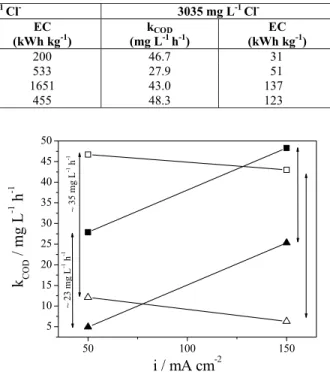
50 0.049 12.1 200 46.7 31 50 0.268 4.91 533 27.9 51 150 0.049 6.30 1651 43.0 137 150 0.268 25.3 455 48.3 123
The values of the zero order rate constants were plotted in Fig. 4 in order to enable a better visualization of the effect of current density and flow velocity. As it can be verified, despite the values of flow velocity and current density, the presence of a high concentration of chloride increases the reaction rate. It is interesting to observe that, for the lower value of flow velocity, there is a kCOD increase of
~ 23 mg L-1 h-1 units when the Cl- concentration changes from 607 mg L-1 to 3,035 mg L-1, while for the high flow velocity this value was ~ 35 mg L-1 h-1, disregarding the current density applied. This behavior suggests that there is no change in the reaction mechanisms associated with current density and flow velocity when the chloride concentration is increased. At low current density and the same Cl -concentration, an increase in the flow velocity makes the reaction rate slower, despite the improvement of mass transfer (Comninellis et al., 2008). This behavior suggests that, although the mass flux of the species to be oxidized from bulk to the surface increases, there is also an improvement of the mass flux of the partially oxidized species from the surface to the bulk. Consequently, the molecules on the surface do not have enough time to be converted to more oxidized species and the overall oxidation rate expressed in terms of COD is low. However, when a high current density is applied, this behavior changes and the increase of flow velocity makes the oxidation process faster, suggesting that there is an improvement of mass transfer of Cl- to the surface. Thus, the quantity of active chlorine increases and the reaction becomes faster (Anglada et al., 2009). Since there is a high concentration of active chlorine being generated, the effect of mass flux discussed before becomes less important. Additionally, energy consumption is also improved when the chloride ion concentration is high. Considering the best operational conditions, i.e., 50 mA cm-2 and 0.049 m s-1, the energy consumption decreased from 200 to 31 kWh kg-1 due to the improvement of the reaction rate and the low cell voltage resulting from the high conductivity provided by the concentrated chloride medium.
50 100 150
5 10 15 20 25 30 35 40 45 50
~
35 m
g
L
-1 h
-1
~
23 m
g
L
-1 h
-1
k CO
D
/
m
g
L
-1 h
-1
i / mA cm-2
Figure 4: (a) Zero order rate constant against current density. (■) 0.268 m s-1 / 3035 mg L-1 Cl-; (□) 0.049 m s-1 / 3035 mg L-1 Cl-; (▲) 0.268 m s-1 / 607 mg L-1 Cl-; (Δ) 0.049 m s-1 / 607 mg L-1 Cl-.
Regarding the effect of current density at low flow velocity, upon increasing the current density from 50 mA cm-2 to 150 mA cm-2 there is a decrease in kCOD, especially at low chloride concentration.
Supposing that the process is mass controlled at low flow rates, an increase of applied current will not improve the reaction rate and the additional charge would deviate to OER, mainly at low Cl- concentra-tion. This fact would have an impact on the current efficiency and, consequently, on the energy consumption shown in Table 1. We believe that the kCOD drop could be associated with the resistive
characteristic of oxygen bubbles formed at high rate at 150 mA cm-2, which block the electrode surface.
768 P. H. Britto-Costa and L. A. M. Ruotolo
active chlorine was also measured during phenol electrolysis; however, practically no active chlorine was detected until the organic concentration becomes very low (for COD/COD0 < 0.2). This result suggests
that the active chlorine is immediately consumed or that it is being further oxidized to chlorate or perchlorate (Bergmann et al., 2009).
The chloride electrolyses were carried out for eight hours and a linear relationship was observed between the active chlorine concentration and time; hence a zero order rate constant,
2
Cl
k , was
deter-mined using linear regression. In all cases, the correlation coefficient was greater than 0.99. Observing the values of
2
Cl
k from the ordinate of
Figure 5, it is possible to conclude, as expected, that when high concentrations of Cl- are present in the solution the active chlorine production is greatly improved and is highly dependent on flow rate and current density. In all cases,
2
Cl
k is improved when
the current density is increased. On the other hand, the effect of flow velocity is much more complex since, at low values of current density,
2
Cl
k is improved when high flow velocities are used, which can be explained by the enhancement of mass transfer (Comninellis et al., 2008); however, when 150 mA cm-2 is applied, the opposite effect of flow velocity on the reaction rate for active chlorine generation is observed.
0 4 8 12 100 200 300 400 500
50 mA cm-2 0.268 m s-1 k Cl 2 / m g L -1 Operational conditions 607 mg L-1 Cl
3035 mg L-1 Cl
-50 mA cm-2 0.049 m s-1
150 mA cm-2 0.268 m s-1 150 mA cm-2
0.049 m s-1
Figure 5:
2
Cl
k for DSA® as a function of operational conditions using different chloride concentrations.
Although
2
Cl
k was obtained in the absence of
phenol, the best values of kCOD were obtained in
conditions were active chlorine formation is favored,
i.e., in conditions of high chloride concentration. For example, when the chloride concentration is changed
from 607 to 3035 mg L-1,
2
Cl
k is greatly improved
and the rate of COD removal increases more than six-fold in some cases. On the other hand, it can also be observed from Figures 4 and 5 that operational conditions have an influence on
2
Cl
k and kCOD, but
the exact role of these variables on
2
Cl
k and kCOD
cannot be correlated since
2
Cl
k was obtained in the
absence of phenol.
Oxidation Using BDD
Despite the best results obtained using the high concentration of chloride, there are some drawbacks associated with this issue. The use of high concentrations of chloride can favor the formation of toxic organo-chlorinated compounds and, secondarily, if a biological post-treatment is planned, high Cl -concentration can interfere in the osmotic equi-librium of the microorganism cells that compose the activated sludge. Thus, low concentrations of chloride would be desirable and, in the experiments using BDD, only the 607 mg L-1 concentration was considered.
Figures 6 (a) and (b) show the results obtained for phenol oxidation using BDD in the absence and presence of chloride, respectively. It can be observed that phenol oxidation at the BDD electrode presents a clearly different mechanism when compared with DSA®, since the COD reduction rates using BDD are much greater than those obtained using DSA®. When BDD is used, the ●OH reacts directly with phenol
molecules. The addition of Cl- when the BDD
electrode is used leads to an increase of the COD depletion which can be attributed to the indirect oxidation mainly, due to chlorine formation in the very acid pH of the experiment (Cheng and Kelsall, 2007). It can also be seen that the operational variables flow velocity and current density have an influence on the velocity of COD depletion, especially when chloride is present in the medium. The curve shape also changed. While for the DSA® the COD depletion was linear, it showed an exponential shape using the BDD electrode, indicating first-order kinetics and mass transfer control. In order to facilitate the parameter analyses on the reaction rate, the experimental curves were adjusted to an exponential model using the least square method to determine the first-order rate constant, kCOD. In most cases, the correlation
coefficient was greater than 0.99. These results are shown in Fig. 7.
Phenol Removal from Wastewaters by Electrochemical Oxidation Using Boron Doped Diamond (BDD) and Ti/Ti0.7Ru0.3O2 DSA Electrodes 769
chloride is not present in the medium, except when high current density and high flow rate are used. When chloride is added, Fig. 7 (b), the reaction rate is improved compared to the DSA® results. Flow velocity and current efficiency have an influence on kCOD only for flow velocities lower than 0.350 m s-1.
Under these conditions, a minimum kCOD can be
observed and the same discussion in terms of mass
transfer and kinetics aforementioned for DSA® can be considered.
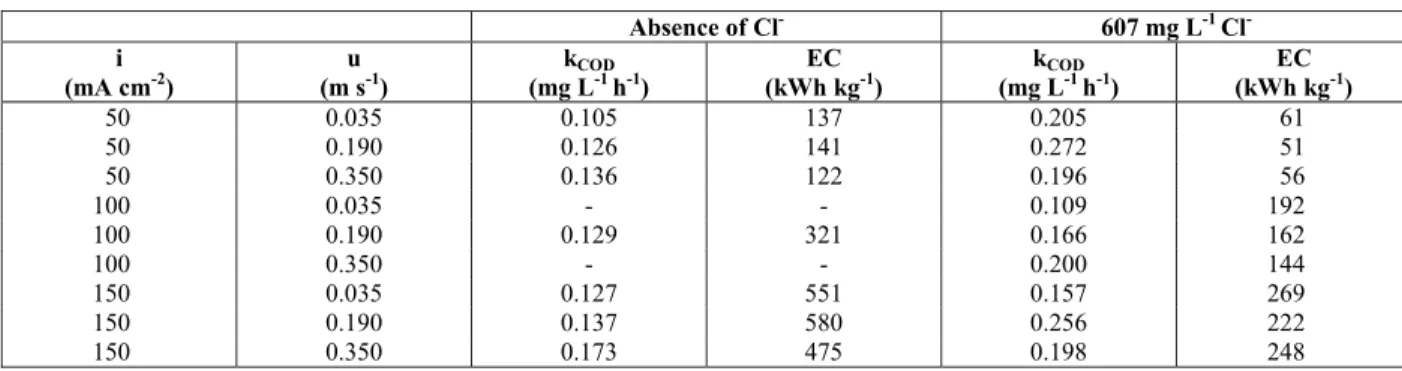
Considering the values of energy consumption shown in Table 2, it can be verified that the addition of Cl- significantly improves the energy consumption, decreasing it by almost half in most conditions. This can be attributed to the lower cell voltage resulting for this more conductive electrolyte.
0 2 4 6 8
0.2 0.4 0.6 0.8 1.0
CO
D
/CO
D 0
time / h
0 2 4 6 8
0.0 0.2 0.4 0.6 0.8 1.0
CO
D
/CO
D 0
time / h
(a) (b)
Figure 6: Normalized COD against electrolysis time using BDD for different current densities and flow velocities. (a) absence of Cl-; (b) 607 mg L-1 Cl-. Experimental conditions: ■ 50mA cm-2, 0.035 m s-1; 50 mA cm-2, 0.190 m s-1; 50 mA cm-2, 0.350 m s-1; 100 mA cm-2, 0.035 m s-1; 100 mA cm-2, 0.190 m s-1; 100 mA cm-2, 0.350 m s-1; 150 mA cm-2, 0.190 m s-1; 150 mA cm-2, 0.190 m s-1; 150 mA cm-2, 0.350 m s-1. COD0 = 500 mg L-1. Lines represent the fitted exponential model.
0.00 0.05 0.10 0.15 0.20 0.25 0.30
0.350 0.190
0.035
50 mA cm-2 100 mA cm-2 150 mA cm-2
k CO
D
/
h
-1
flow velocity / m s-1
0.00 0.05 0.10 0.15 0.20 0.25 0.30
0.350 0.190
0.035
50 mA cm-2 100 mA cm-2 150 mA cm-2
k CO
D
/
h
-1
flow velocity / m s-1
(a) (b)
Figure 7: kCOD against flow velocity for BDD electrode in the absence of chloride (a) and in the presence
770 P. H. Britto-Costa and L. A. M. Ruotolo
Table 2: First order rate constants and energy consumption for phenol oxidation on BDD for different current densities and flow velocities in absence and presence of chloride.
Absence of Cl- 607 mg L-1 Cl
-i (mA cm-2)
u (m s-1)
kCOD (mg L-1 h-1)
EC (kWh kg-1)
kCOD (mg L-1 h-1)
EC (kWh kg-1)
50 0.035 0.105 137 0.205 61 50 0.190 0.126 141 0.272 51 50 0.350 0.136 122 0.196 56 100 0.035 - - 0.109 192 100 0.190 0.129 321 0.166 162 100 0.350 - - 0.200 144 150 0.035 0.127 551 0.157 269 150 0.190 0.137 580 0.256 222 150 0.350 0.173 475 0.198 248
The values of
2
Cl
k for oxidation using BDD are
shown in Fig. 8. Comparing these values with those shown in Fig. 5 for DSA®, it can be verified that the reaction rate for active chlorine generation at BDD is lower than that observed for the DSA® electrode. This pattern can be explained considering the results obtained by Cañizares et al. (2009) in which it was observed that active chlorine can be further oxidized to chlorate and perchlorate by the ●OH generated at the BDD surface.
Comparison Between DSA® and BDD Electrodes
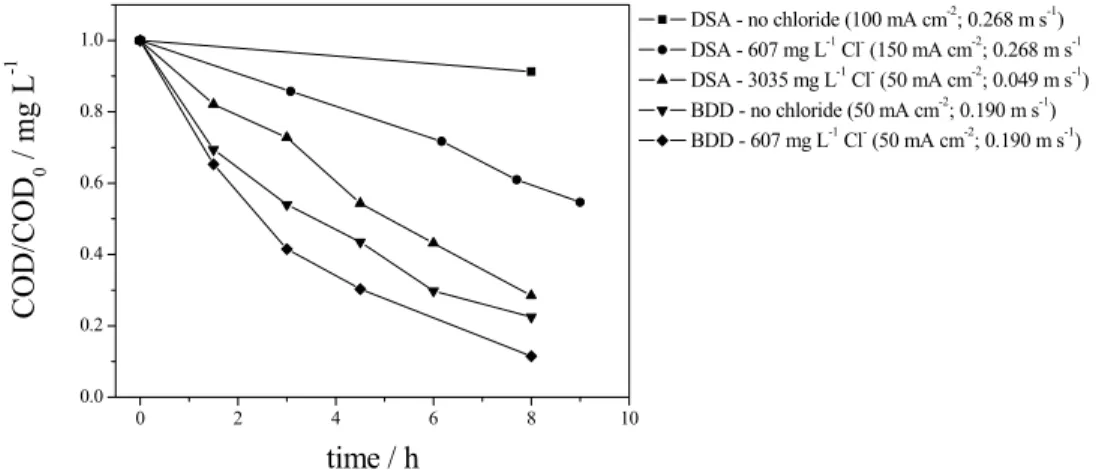
Figure 9 shows the kinetics of COD depletion considering the best results obtained using DSA® and BDD in the absence and presence of chloride. As it can be seen, DSA® is suitable to be used only when chloride is added and the process is highly dependent on the chloride concentration since the
organic oxidation is being carried out by the active chlorine generated during the electrolysis. When low concentrations of Cl- are used, it is necessary to apply a high current density and high flow velocity in order to obtain faster kinetics; however, the use of high current densities leads to high values of energy consumption (Table 1). Furthermore, the use of high flow rates also increases the energy consumption with the pumping operation. Therefore, the process under these conditions is not suitable to be used. On the other hand, when a high concentration of chloride is used, high current density and flow velocity are necessary in order to obtain the best COD depletion rates. Thus, the energy consumption is low and the cost of pumping will not be significant. Additionally, under these conditions, the COD depletion rates for DSA® are very close to those observed using BDD in the absence of chloride.
0 1 2 3 4 5 6
k Cl
2
/
m
g
L
-1
50 mA cm-2 0.350 m s-1
Operational conditions
50 mA cm-2 0.035 m s-1
150 mA cm-2 0.350 m s-1 150 mA cm-2
0.035 m s-1
Figure 8:
2
Cl
k for BDD electrodeas a function of
Phenol Removal from Wastewaters by Electrochemical Oxidation Using Boron Doped Diamond (BDD) and Ti/Ti0.7Ru0.3O2 DSA Electrodes 771
0 2 4 6 8 10
0.0 0.2 0.4 0.6 0.8
1.0 DSA - no chloride (100 mA cm
-2
; 0.268 m s-1) DSA - 607 mg L-1 Cl- (150 mA cm-2; 0.268 m s-1 DSA - 3035 mg L-1 Cl- (50 mA cm-2; 0.049 m s-1) BDD - no chloride (50 mA cm-2; 0.190 m s-1) BDD - 607 mg L-1 Cl- (50 mA cm-2; 0.190 m s-1)
CO
D
/C
O
D 0
/
m
g L
-1
time / h
Figure 9: Comparison between normalized COD depletion against time for DSA® and BDD. COD0 = 500 mg L-1.
CONCLUSIONS
In this work, we attempted to show that the COD depletion rate at DSA® and BDD electrodes can be increased by adding chloride ions. Our goals were, on the one hand, to investigate if DSA®, a less expensive commercial stable anode, could work at low energy consumption by improving the degradation kinetics and make it feasible for effective application for wastewater treatment. On the other hand, BDD was considered in the literature to deliver the best performance for this purpose, but it is very expensive. However, upon increasing the reaction rate by the addition of chloride, the electrode area necessary for a given treatment process should decrease and the investment cost of the electrode would be acceptable. The results showed that this approach can be used successfully for DSA® electrodes since the reaction rates were greatly improved at high chloride concentrations. On the other hand, for BDD electrodes, the increase of the reaction rate due to addition of Cl- to the
electrolyte was not as strong as for DSA®.
Consequently, the reduction in the required BDD electrode area obtained by adding chloride to improve the kinetics will not have an important impact on the capital investment cost. Although the results showed that the COD depletion rate using DSA® can be comparable to those obtained using BDD when high concentrations of Cl- are added, there are some drawbacks that should be overcome
before using this electrode, e.g., whether
organochlorinated compounds and chlorate and perchlorate are being produced. However, the major
drawback concerning applying DSA® or even BDD
electrodes for wastewater treatment is still the high energy consumption associated with these processes. Even considering the best operational conditions at which the lowest energy consumptions were obtained, these values are still very high and need to be reduced in order to make the electrochemical technology suitable to be used in a large-scale wastewater treatment plant. In one approach to reduce the energy consumption, electrochemical technology could be used only to oxidize the non-biodegradable aromatics, so that the resulting compounds could be sent to biological treatment.
ACKNOWLEDGMENTS
The authors acknowledge FAPESP (Fundação de Amparo à Pesquisa do Estado de São Paulo) for financial support (project number 2006/56011-7).
REFERENCES
Alves, P. D. P., Spagnol, M., Tremiliosi-Filho, G. and Andrade A. R., Investigation of the influence of the anode composition of DAS-type electrodes on the electrocatalytic oxidation of phenol in neutral medium. J. Braz. Chem. Soc., 15, 62 (2004).
772 P. H. Britto-Costa and L. A. M. Ruotolo
Andrade, L. S., Ruotolo, L. A. M., Rocha-Filho, R. C., Bocchi, N., Biaggio, S. R., Iniesta, J., García-Garcia, V. and Montiel, V., On the performance of Fe and Fe,F doped Ti-Pt/PbO2 electrodes in the
electrooxidation of the blue reactive 19 dye in simulated textile wastewater. Chemosphere, 66, 2035 (2007).
Anglada, A., Urtiaga, A. and Ortiz, I., Contributions of electrochemical oxidation to waste-water treatment: Fundamentals and review of applications. J. Chem. Technol. Biotechnol., 84, 1747 (2009). Azevedo, E. B., Torres, A. R., Aquino Neto, F. R.
and Dezotti, M., TiO2 photocatalyzed degradation
of phenol in saline media in an annular reactor: Hydrodynamics, lumped kinetics, intermediates, and acute toxicity. Braz. J. Chem. Eng., 26, 75 (2009).
Bergmann, M. H. E, Rollin, J. and Iourtchouk, T., The occurrence of perchlorate during drinking water electrolysis using BDD anodes. Electrochim. Acta, 54, 2102 (2009).
Bevilaqua, J. V., Cammarota, M. C., Freire, D. M. G. and Sant’Anna Jr. G. L., Phenol removal through combined biological and enzymatic treatments. Braz. J. Chem. Eng., 19, 151 (2002).
Bock, C. and MacDougall, B., The influence of metal oxide properties on the oxidation of organics. J. Electroanal. Chem., 491, 48 (2000). Bonfatti, F., Ferro, S., Lavezzo, F., Malacarne, M.,
Lodi, G. and De Battisti, A., Electrochemical incineration of glucose as a model organic substrate. II. Role of active chlorine mediation. J. Electrochem. Soc., 147, 592 (2000).
Cañizares, P., Sáez, C., Sánchez-Carretero, A. and Rodrigo, M. A., Synthesis of novel oxidants by electrochemical technology. J. Appl. Electrochem., 39, 2143 (2009).
Cheng, C. Y. and Kelsall, G. H., Models of hypochlorite production in electrochemical reactors with plate and porous anodes. J. Appl. Electrochem., 37, 1203 (2007).
Comninellis, C., Kapalka, A., Malato, S., Parsons, S. A., Poulios, I. and Mantzavinos, D., Advanced oxidation processes for water treatment: Advances and trends for R&D. J. Chem. Technol. Biotechnol., 83, 769 (2008).
Comninellis, C. and Nerini, A., Anodic oxidation of phenol in the presence of NaCl for wastewater treatment. J. Appl. Electrochem., 25, 23 (1995). Comninellis, C. and Pulgarin, C., Electrochemical
oxidation of phenol for wastewater treatment using SnO2 anodes. J. Appl. Electrochem., 23,
108 (1993).
Costeiro, R. D. and De Andrade, A. R., Electrochemical oxidation of 4-chlorophenol and its by-products using Ti/Ru0.3M0.7O2 (M = Ti or Sn) anodes:
preparation route versus degradation efficiency. J. Appl. Electrochem., 37, 691 (2007).
Iniesta, J., Expósito, E., González-García, J., Montiel, V. and Aldaz, A., Electrochemical treatment of industrial wastewater containing phenols. J. Electrochem. Soc., 149, D57 (2002).
Matínez-Huitle, C. A. and Ferro, S., Electrochemical oxidation of organic pollutants for the wastewater treatment: direct and indirect processes. Chem. Soc. Rev., 35, 1324 (2006).
Matínez-Huitle, C. A. and Andrade, L. S., Electro-catalysis in wastewater treatment: Recent mechanism advances. Quím. Nova, 34, 850 (2011). Montanaro, D. and Petrucci, E., Electrochemical
treatment of remazol brilliant blue on a boron-doped diamond electrodes. Chem. Eng. J., 153, 138 (2009).
Montilla, F., Morallón, E., De Battisti, A. and Vázquez, J. L., Preparation and characterization of antimony-doped tin dioxide electrodes. Part 1. Electrochemial characterization. J. Phys. Chem., B 108, 5036 (2004).
Oliveira, F. H., Osugi, M. E., Paschoal, F. M. M., Profeti, D., Olivi, P. and Zanoni, M. V. B., Electrochemical oxidation of an acid dye by active chlorine generated using Ti/Sn(1-x)IrxO2
electrodes. J. Appl. Electrochem., 37, 583 (2007). Palmas, S., Polcaro, A. M., Vacca, A., Mascia, M.
and Ferrara, F., Influence of the operating conditions on the electrochemical disinfection process of natural waters at BDD electrodes. J. Appl. Electrochem., 37, 1357 (2007).
Panizza, M., Kapalka, A. and Comninellis, C., Oxidation of organic pollutants on BDD anodes using modulated current electrolysis. Electrochim. Acta, 53, 2289 (2008).
Panizza, M., Barbucci, A., Ricotti, R., and Cerisola, G., Electrochemical degradation of methylene blue. Sep. Sci. Technol., 54, 382 (2007).
Pelegrino, R. L., Di Iglia, R. A., Sanches, C. G., Avaca, L. A. and Bertazzoli, R., Comparative study of commercial oxide electrodes performance in electrochemical degradation of organics in aqueous solutions. J. Braz. Chem. Soc., 13, 60 (2002).
Polcaro, A. M., Palmas, S., Renoldi, F. and Mascia, M., On the performance of Ti/SnO2 and Ti/PbO2
Phenol Removal from Wastewaters by Electrochemical Oxidation Using Boron Doped Diamond (BDD) and Ti/Ti0.7Ru0.3O2 DSA Electrodes 773
Rajkumar, D. and Palanivelu, K., Electrochemical treatment of industrial wastewater. J. Hazard. Mater., 113, 123 (2004).
Rajkumar, D. and Kim, J. G., Oxidation of various reactive dyes with in situ electro-generated active chlorine for textile dyeing wastewater treatment. J. Hazard. Mat., B136, 203 (2006).
Rajkumar, D., Song, B. J. and Kim, J. G., Electrochemical degradation of reactive blue 19 in chloride medium for the treatment of textile dyeing wastewater with identification of intermediate compounds. Dyes & Pigments, 72, 1 (2007).
Scialdone, O., Galia, A., Guarisco, C., Randazzo, S. and Filardo, G., Electrochemical incineration of oxalic acid at boron doped diamond anodes: role of operative parameters. Electrochim. Acta, 53, 2095 (2008).
Simond, O., Schaller, V. and Comninellis, C., Theoretical model for the anodic oxidation of organics on metal oxide electrodes. Electrochim. Acta, 42, 2009 (1997).