*e-mail: [email protected]
Trabalho apresentado no XV CBECIMAT, Natal - RN, Novembro de 2002.
Study of Pyroelectric Activity of PZT/PVDF-HFP Composite
Luiz Francisco Malmonge, José Antonio Malmonge, Walter Katsumi Sakamoto*
Grupo de Polímeros, Depto de Física e Química, UNESP, Ilha Solteira Av. Brasil 56, Centro, 15385-000 Ilha Solteira - SP, Brazil
Received: January 31, 2003; Revised: September 1, 2003
Flexible, free-standing piezo and pyroelectric composite with 0 to 3 connectivity was made up from Lead Zirconate Titanate (PZT) powder and poly(vinylidene fluoride-hexafluoropropylene) (PVDF-HFP) copolymer. The pyroelectric and the piezoelectric longitudinal (d33) coefficients were measured. A 50/50 vol.% PZT/PVDF-HFP composite resulted in piezo and pyroelectric coeffi-cients of d33= 25.0 pC/N and p = 4.5 × 10⁻⁴ C/m2K at 70 °C, respectively. Analysis of the complex
permittivity in a wide range of frequency was carried out indicating lower permittivity of the composite in comparison with a permittivity of the PZT ceramic. The low value of the permittivity gives a high pyroelectric figure of merit indicating that this material can be used to build a tem-perature sensor in spite of the lower pyroelectric coefficient compared with PZT.
Keywords: composite piezoelectric, permittivity, thermally stimulated current, thermal sensors
1. Introduction
The discovery of ferroelectric effect and its application brings progress in materials science with a growth in search of new materials, which have best properties for specific application. PZT has been the best transducer material for a long time period, however, for some applications, PZT of-fers some limitations. That is the reason why researchers are still searching for a new single-phase material, or het-erogeneous systems satisfying the required conditions. In opposition to heavy and rigid ceramics they found ferroelectric polymers, specially the poly(vinylidene fluo-ride) (PVDF)1. Light and flexible, ferroelectric polymers
show many advantages over ceramics for several applica-tions. A great impact in the electronic industry was observed with the progress on ferroelectric polymer research.
The continuous progress and ceaseless search for new materials lead to the study of heterogeneous materials. Copolymers of PVDF2,3 and composites4,5 became the
tar-get. The present paper reports some results obtained in elec-tromechanical characterization of a ceramic/copolymer com-posite prepared mixing lead zirconate titanate and poly(vinylidene fluoridehexafluoropropylene) -PZT/PVDF-HFP.
2. Experimental
2.1. Sample Preparation
PZT/PVDF-HFP composite was prepared with 50/50 vol.% by mixing ceramic powder and copolymer in powder form. The copolymer PVDF-HFP (90/10 composi-tion) Kynar 2821 in powder form was obtained from Atofina do Brazil. The mixture was pressed (15 MPa) at 180 °C and the composite films were obtained in the range of 100 µm thickness. Aluminum electrodes (1 cm of diameter) were deposited on both sides of the samples for electrical meas-urements. Samples were poled applying the electric field of 20 MV/m for 1 h at 90°C.
2.2. Measurements
The longitudinal piezoelectric coefficient d33of the com-posite film poled as early describedwas measured using the d33 piezo tester model 8000 from American Piezo Ce-ramics (APC). The measurement is based in the compari-son of the piezo activity of a standard piezo-ceramic. The dielectric data was taken in a frequency range from 10-5 Hz
to 106 Hz. In the 100 to 106 Hz range an impedance analyzer
amplifier (PAR model 5210) was used in the medium fre-quency range (10-1 to 100 Hz) and for low-frequencies
(10-5 to 10-2 Hz) the time domain technique was used6.
The ε” values in the (10-5 to 10-2 Hz) frequency range
were obtained from the discharge current measured during 3.0 h after charging the sample with an electric field of 105 V/m for 27 h. As showed by Hamon ε” can be written
as a function of the discharge current, I(t), as:
(1)
where Co is the geometric capacitance of the sample, V the applied voltage and f = 0.1/t is the Hamon frequency6.
In the 10-1 to 100 Hz frequency range values of the
com-plex permittivity, i. e., real (ε’) and imaginary (ε”) parts, were obtained using the following equations7:
(2)
(3)
where d is the sample thickness, A is the electrode area,
εo = 8.85 × 10⁻¹² F/m is the vacuum permittivity, f(= ω/2π)
the frequency, V is the applied voltage and Iy, Ix are the in phase and quadrature current, respectively.
The pyroelectric current was measured using the direct method8. In this method a pre-polarized sample is heated
with its electrodes shorted and the short-circuit current is monitored with an electrometer. The sample was poled at 90 °C and was heated till 70 °C in all TSDC runs were to avoid its depolarization. Three runs were carried out to ob-tain the pyroelectric current (reversible) because some charge were released during the first and second runs. The presence of space charges in the first run gives an unreal pyroelectric current.
Scanning electron microscopy (SEM) was performed in a ZEISS DSM 960 computerized microscope operated between 10 to 20 kV on a PVDF-HFP copolymer film and PVDF-HFP/PZT composite. A thin layer of gold was sput-tered on the sample surface. Phase transitions were studied using a differential scanning calorimetry (DSC) (TA Instru-ments model MDSC 2920) at a scan rate of 10 °C/min in nitrogen atmosphere.
3. Results and Discussion
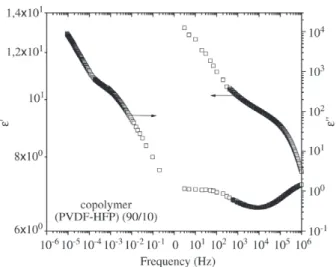
Figures 1 and 2 show the behavior of real (ε’) and imaginary (ε”) parts of permittivity for copolymer PVDF-HFP (90/10 composition) and for the 50/50 vol.%
PZT/PVDF-HFP composite. ε” was experimentally ob-tained in the frequency range of 10-5 to 106 Hz while ε’ was
experimentally obtained in the range of 0.5 to 106 Hz. The
ε’ value in low-frequency range (10-5 to 10-2 Hz) can be
calculated using the Kramers-Kronig9 relationship
(4)
where P is the Cauchy principal value of the integral and ε∞
is the permittivity in the highest frequency value.
It can be seen from Figs. 1 and 2 that the imaginary part of permittivity of the composite is dominated by that of the Figure 1. Real and imaginary parts of the complex permittivity for the copolymer PVDF-HFP (90/10).
polymer phase. In the low-frequency range both the ionic conduction contribution and low-frequency dispersion (LFD) were observed. According to Jonscher10 several
poly-mers show similar behavior. For the PZT/PVDF-HFP com-posite there is an evidence of a peak around 3 × 10⁻⁴ Hz,
masked by the ionic contribution. That peak is more visible in the copolymer alone. Using the co-relation frequency-temperature due to van Turnhout11 the peak can be observed
in TSDC spectra and related with the observed peak in the imaginary part of the permittivity measurements by
(5)
where Ea is the activation energy, b is the inverse of heating rate, k = 1.38 × 10⁻²³ J/K is Boltzmann constant and T is the
absolute temperature (50 °C) of the maximum in the TSDC curve.
Using 1.0 eV for the activation energy resulted in the corresponding frequency of 3 × 10⁻⁴ Hz. The activation
en-ergy (Ea = 1.0 eV) was calculated by initial rise method12.
The peak observed around 50 °C in the TSDC is related with a phase transition in copolymer according to Jayasuriya13.
Figure 3 and 4 show, respectively, the thermally stimu-lated discharge current and the pyroelectric current in PVDF-HFP copolymer and in PZT/PVDF-HFP composite 50/50 vol.%, respectively. The first run provides irreversible current, which is subsequently reduced in the following runs.
The second TSDC run shows reduction of current as some charges have been released during the first heating. The third subsequent heating shows no appreciable reduction in the current, thus establishing a reversible pyroelectric current in the sample.
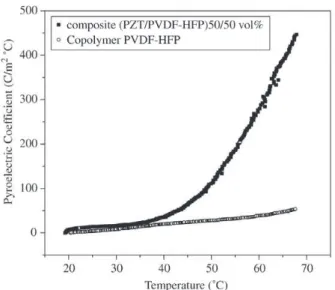
The pyroelectric coefficient p(T) is calculated using the well-known relationship14:
(6)
where I is the pyroelectric current, A is the electroded sam-ple area and dT/dt is the heating rate (1 °C/min).
It can be seen from Fig. 4 that the pyroelectric current, consequently the pyroelectric coefficient (Fig. 5), of the PZT/PVDF-HFP 50/50 vol.% is much higher than that of the copolymer. Furthermore, the composite is very sensi-tive in the temperature range of 40 to 70 °C, where the pyroelectric coefficient changed from 0.4 to 4.5 × 10⁻⁴ C/m2K, i.e., for small temperature variations there
is a large change in the pyroelectric current.
The permittivity, pyroelectric coefficient and longitudi-nal piezoelectric coefficient for some materials are showed in Table 1. It can be seen that although the poling of ce-ramic is difficult, due to the decrease of the electric field across the polymer phase, very good piezo and pyroelectric activities were obtained in PVDF-HFP/PZT composite, in comparison with the copolymer itself and other composites
Figure 3. Typical thermally stimulated discharge current and pyroelectric current for the 90/10 PVDF-HFP copolymer: a) first run; b) second run; c) third run.
described in literature13,15. The values of p(T) were taken at
70 °C for comparison. The high pyroelectric activity and also the high figure of merit (FOM = p/ε = 5.3 × 10⁻⁶ C/m2K)
of PZT/PVDF-HFP 50/50 vol.% give a real possible appli-cation as temperature sensor, mainly in the temperature range 40 to 70 °C. The longitudinal piezoelectric coefficient d33 were found to be 3.0 and 25.0 pC/N for PVDF-HFP and PZT/PVDF-HFP, respectively, which also gives to the com-posite the possibility of being applied as an actuator since those values of d33 are comparable with these of PVDF and PZT/VDF-TrFE 50/50 vol.% composite.
Figure 6 shows the PVDF-HFP micrograph. The ob-served morphology for the copolymer used as matrix for Table 1. Values of the permittivity and of the pyroelectric coeffi-cient of some materials.
MATERIAL ε’(1 kHz) p (C/m2K) d
33(pC/N)
PZT(13,15) 1200 5.0 × 10⁻⁴ 110
PVDF(13,15) 12 9.0 × 10⁻⁶ 20
PZT/PVDF
95 1.4 × 10⁻⁴ 36
50/50 vol.%(13,15)
PZT/VDF-TrFE
85 1.4 × 10⁻⁴ 20
50/50 vol.%(13,15)
PVDF-HFP 90:10 12 0.5 × 10⁻⁴ 3
PZT/PVDF-HFP
85 4.5 × 10⁻⁴ 25
50/50 vol.%
Figure 7. SEM photomicrograph of the (PZT/PVDF-HFP) 50/50 vol.% composite film (magnification 5000×).
Figure 6. SEM photomicrograph of the PVDF-HFP copolymer film (magnification 5000×).
Figure 5. Pyroelectric coefficient as a function of temperature. Sample poled with E = 20 MV/m at 90 °C for 1.0 h.
the composite being so closed and compacted means an undefined morphology, unlike observed in the PVDF film16.
The PVDF-HFP/PZT micrograph showed in Fig. 7 reveals the homogeneity of the PZT grain distribution and also that a 0 to 3 connectivity is predominant in that composite. Be-sides, the Furukawa’s model17 or Yamada’s model18 for two
Figure 8. DSC thermogram of the PVDF-HFP copolymer film.
Figure 8 shows the DSC thermograms of the copoly-mer. The sample was scanned at a heating rate of 10 °C/min within an appropriated temperature range. It can be seen from Fig. 8 that the glass transition temperature (Tg) of the PVDF-HFP copolymer is around -35 °C and the melting point (Tm) is 143 °C. It is shown in the thermogram an evi-dence of a phase transition around 50 °C, which was also observed in the dielectric and TSDC measurements. For the PVDF-HFP/PZT composite that TSDC peak is less evident due to the ceramic contribution to the intensity of the elec-tric current. Ongoing studies are being taken for a compre-hensive characterization of the composite such as the piezo and pyroelectric behavior as a function of the ceramic con-tent and poling field.
4. Conclusions
Composite films of PZT/PVDF-HFP were obtained heat-ing the mixture at 180 °C and with at 15 MPa pressure. A relaxation peak was observed in the imaginary part of the complex permittivity around 3 × 10⁻⁴ Hz. This peak is
re-lated with that observed at 50 °C using TSDC and DSC, and might be due to a phase transition in the copolymer. The piezo and pyroelectric activities of the composite were considerably enhanced in comparison with the copolymer. Also in relation with other single phase or composite mate-rials the PZT/PVDF-HFP composite shows higher
pyroelectric coefficient and pyroelectric figure of merit. Those results indicate that the new composite might be a good alternative for technological applications.
Acknowledgements
The financial support given by FAPESP is gratefully acknowledged. The authors are also grateful to Atofina do Brasil for supplying the copolymer PVDF-HFP.
References
1. Kawai, H. Jpn. J. Appl. Phys., v. 8, p. 975, 1969. 2. Oka, Y.; Murata, Y.; Koizumi, N. Polym. J., v. 18, p. 417,
1986.
3. Furukawa, T.; Lovinger, A.J.; Davis, G.T.; Broadhurst, M.G. Macromolecules, v. 16, p. 1885, 1983.
4. Dias, C.J.; Das-Gupta, D.K. IEEE Trans. Diel. Elect. Ins., v. 3, n. 5, p. 706, 1996.
5. Clegg, W.W.; Jenkins, D.F.L.; Cunningham, M.J. Sen-sors and Actuators A, v. 58, p. 173, 1997.
6. Hamon, B.V. Proc. IEE Part IV Monograph, v. 99, p. 151, 1952.
7. Sakamoto, W.K.;. Kanda, D.H.F.; Das-Gupta, D.K. Mater. Res. Innovat., v. 5, n. 6, p. 257, 2002.
8. Byer, R.L.; Roundy, C.B. Ferroelectrics, v. 3, p. 333, 1972.
9. Jonscher, A.K. Dielectric Relaxation in Solids, Chelsea Dielectric Press, London, 1996.
10. Jonscher, A.K. J. Phys. D.: Appl. Phys., v. 32, R57, 1999. 11. Van Turnhout, J., In: International Symposium on Electrets and Dielectrics, ed. Academia Brasileira de Ciências, Rio de Janeiro - RJ, p. 97, 1997.
12. Van Turnhout, J. In: Sessler, G.M., ed. Electrets Topics in Applied Physics, v. 33, Berlin, Springer-Verlag, p. 81, 1980.
13. Jayasuriya, A.C.; Scheinbeim, J.I. Appl. Surface Sci., v. 175-176, p. 386, 2001.
14. Das-Gupta, D.K., Ferroelectrics, v. 181, p. 165, 1991. 15. Sakamoto, W.K. et al., Phys. Stat. Sol. (a), v. 172, p.
265, 1999.
16. Mattoso, L.H.C.; Malmonge, L.F.; Mantovani, G.L.; MacDiarmid, A.G., Current Trends in Polymer Science, v. 3, p. 99, 1998.
17. Furukawa, T. IEEE Trans. Electr. Insul., v. 24, p. 375, 1989.