the Structural and Electrical Properties of PZT Thin Films
*e-mail: [email protected]
Articles presented at the XV CBECIMAT, Natal - RN, November de 2002.
Influence of the Crystallization Thermal Treatment on the Structural and
Electrical Properties of PZT Thin Films
Antonio Leondino Bacichetti Juniora*, Manuel Henrique Lentea, Ricardo Gonçalves Mendesb, Pedro Iris Paulin Filhob, José Antonio Eirasa
aUniversidade Federal de São Carlos, Departamento de Física Grupo de Cerâmicas
Ferroelétricas, 13565-670 São Carlos - SP, Brazil
bUniversidade Federal de São Carlos, Departamento de Engenharia de
Materiais, PGCEM, 13565-670 São Carlos - SP, Brazil
Received: March 25, 2003; Revised: December 12, 2003
Different methods have been proposed in the literature to deposit PZT thin films. Among these, chemical based processes have been revealed as a promising preparation route due to their low cost processing and the facility for controlling the stoichiometry of complex systems. The objective of this work was to investigate the influence of the time and temperature of crystallization on the physical properties of the Pb(Zr0.53Ti0.47)O3 thin films prepared by a hybrid method. The structural and microstructural dependence on the crystallization conditions of the PZT films were investigated by X-ray diffraction and atomic force microscopy. Dielectric and ferroelectric properties were also characterized and their behaviors were related to the structural evolution of films.
Keywords:Thin films, PZT, ferroelectrics, crystallization
1. Introduction
Over the last 50 years several efforts have been made in order to make digital memories from ferroelectric
materi-als, particularly in thin film form 1,2. The advantages of such
devices lie in non-volatility memory, low power consump-tion and high speed. In the past, some disadvantages were encountered such high voltage operation. These films re-quired more than 5 V to operate, which are higher than the standard voltage of “TTL” or “CMOS”. Nevertheless, in recent years, many new preparation methods and techniques of deposition have been developed allowing the produc-tion of films with a wide range of thickness and grain size. However, the production of ferroelectric thin films with nanograins has revealed remarkable new features in their physical properties in relation to their bulk ceramic
coun-terparts3,4. For instance, smaller polarization and electrical
permittivity values than those observed for ceramics are very often noticed.
Undoubtedly, ferroelectric thin films based on lead
zirconate titanate, Pb(Zr,Ti)O3, have a strong impact for a
large number of technological applications, including
ob-viously ferroelectric memory devices1,5. Other methods to
deposit Pb(Zr,Ti)O3 thin films such as RF sputtering6 and
sol gel7 have been reported. However, chemical based
proc-esses have been revealed as a promising preparation route due to their low cost processing and the facility for control-ling the stoichiometry of complex systems (e.g. binary or ternary systems). Recently, it was proposed a hybrid
chemi-cal method for the preparation of Pb(Zr,Ti)O3 (PZT)
ferroelectric thin films based on oxide precursors8. This
ox-ide precursor method is an alternative chemical method for the preparation of PZT thin films starting from the pre-calcinated precursor oxides. Nevertheless, even it is being a promising method, it is imperative to determine the best preparation conditions in order to produce films with good quality, thus optimizing their physical properties.
The aim of this work is to investigate the influence of time and temperature of crystallization on the physical
prop-erties of the Pb(Zr0.53Ti0.47)O3 thin films prepared by the
diffraction and atomic force microscopy, respectively. Di-electric and ferroDi-electric properties were also characterized and their behaviors were related to structural evolution of the films. The influences of the grain size and mechanical stresses on the ferroelectric and dielectric properties were also pointed out.
2. Experimental
Pb(Zr0.53Ti0.47)O3 (PZT) thin films were prepared through
a chemical method developed for Menegazzo and
collabo-rators9,10. It is a hybrid method based on the precalcination
of oxides or carbonates followed by dissolution in acid and
subsequent preparation of polymeric resin8.In order to
pre-pare the films, precursor powder Pb(Zr0.53Ti0.47)O3 was
pre-pared by conventional mixed oxide method11,12 using
com-mercial powders reagents PbO (99.9% - Aldrich), ZrO2
(99.6% - Tam) and TiO2 (99.8% - Vetec). Then the calcined
powder was dissolved in an aqueous solution of nitric acid
(10% of HNO3 and 90% of distillate water) under agitation
and heating. After that, citric acid and ethylene glycol were added into the solution at 90 °C under continuous agita-tion. A transparent resin, with homogeneously distributed ions with the same composition of the precursor powder, was obtained. The experimental procedure is detailed
de-scribed in a previous work8.
Films of the polymeric resin were deposited by spin coated at 4500 rpm for 40 s on Pt/Si substrates. Each depos-ited layer was followed by a thermal treatment to remove the organic compounds. The crystallization was performed in air atmosphere through a Rapid Thermal Annealing (RTA) at different temperatures (500, 600 and 700 °C) and differ-ent times (1, 5 and 10 min). The thickness and the surface roughess of thin films were around 500 nm and 30 nm, re-spectively, which were determined using a Perfilometer Mytutoyo 178-896D. The formation and evolution of the crystallized phases were investigated by X-ray diffraction (XRD) analysis using a Rigaku Rotaflex RU200B
diffractometer with CuKαradiation, at room temperature.
The microstructure was characterized employing an atomic force microscope NanoScope III from Digital.
Dielectric and ferroelectric measurements were con-ducted in metal-ferroelectric-metal (MFM) configurations. Platinum electrodes (0.5 mm in diameter) were sputtered deposited on the thin film surface forming the MFM con-figuration. The frequency dependence of the electrical
per-mittivity (ε’) and the losses (ε’’) were measured using an
impedance analyzer HP 4194A in a frequency range from
1 kHz to 1 MHz. The electrical permittivity (ε’)
depend-ence on the electric bias field was measures at 10 kHz in the same apparatus. A modified Sawyer-Tower bridge was used for ferroelectric hysteresis loops characterization at 100 Hz. All measurements were performed at room temperature.
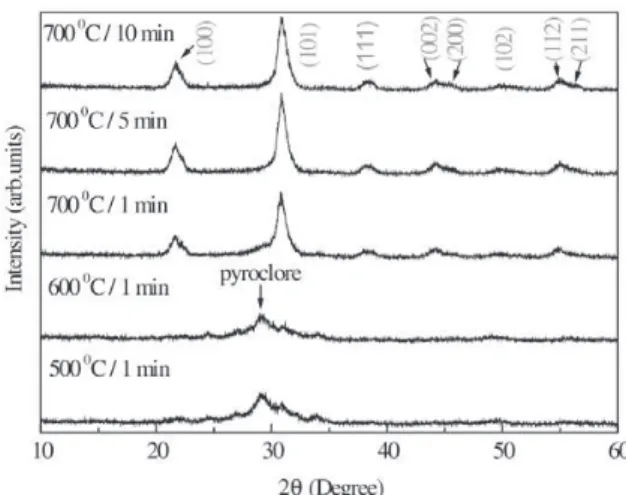
Figure 1. XRD pattern of the PZT films crystallized at different
temperatures and times.
3. Results and Discussions
Figure 1 shows the XRD pattern of the PZT films crys-tallized at different temperatures and times. A remarkable crystalline structure dependence on the temperature can be viewed. The presence of pyroclore phase is remarkably noticed at lower crystallization temperatures. For the sake of simplicity, for these films only the annealing for 1 min is shown in Fig. 1. Nevertheless, it is verified that the perovskite phase is completely formed at 700 °C independently of the time. Moreover, it is observed that when the perovskite phase is present the crystallization time does not have strong influ-ence on the XRD pattern. The films crystallized at 700 °C for 1, 5 and 10 min presented basically the same diffraction patterns. Thus, it is concluded that temperature has much more influence on the crystallization process than time. In addition, Figure 1 shows that at temperatures higher than 700 °C and times longer than 5 min pyroclore free films are
obtained. The lattice constants a and c, calculated for the
tetragonal PZT phase crystallized at 700 °C for 10 min, were
3.99 and 4.11 Å (c/a = 1.03 ± 0.06), respectively.
Figure 2 a) and (b) show the surface morphology of PZT films obtained at 700 °C for 5 and 10 min, respectively. It is noticed that both films exhibit a homogeneous microstruc-ture and grains are rounded-shape, which are characteristics
typical of films obtained through chemical methods14. In
the Structural and Electrical Properties of PZT Thin Films
Figure 2. Surface morphology of PZT films obtained at 700 °C for:
a) 5 min; b) 10 min.
Figure 3. Ferroelectric hysteresis loops dependence on the
anneal-ing condition.
have the same roughess (30 nm) independently of the tem-perature and time of sintering.
Figure 3 shows the ferroelectric hysteresis loops depend-ence on the crystallization condition. Although the XRD pattern for the films obtained at 700 °C practically did not show remarkable differences between them, the ferroelectric characterizations revealed clearly that the highest polari-zation values was obtained for the film crystallized for
10 min. The remanent polarization (PR) and coercive field
(EC) found for this films were PR = 2.3 µC/cm2 and
EC = 141,0 kV/cm, respectively. The results obtained for
5 min (not shown here) was intermediate between 10 and 1 min. These results are consistent with those observed from PZT thin films produced by other chemical methods, as for
example sol-gel14, 15
. In accordance with the XRD
charac-terization, Fig. 3 shows that the film obtained at 600 °C/10 min does not show a ferroelectric hysteresis loop, which is clearly related to the absence of a ferroelectric crystalline phase. Identical results were obtained for the other films
Figure 4. a) Frequency dependency of the real (ε’) and imaginary (ε’’) part of the electrical permittivity for the films annealed at differ-ent conditions; b) dielectric constant dependence on the electric bias field.
(a)
crystallized at 600 and 500 °C regardless of crystallization time.
Figure 4 a) shows the frequency dependence of the real
(ε’) and imaginary (ε’’) part of the electrical permittivity for
the films annealed at different conditions. Similarly as ob-served in the ferroelectric behavior (Fig. 3), is also verified a remarkable influence of the crystallization conditions on the dielectric properties. The results show that higher tem-peratures and longer crystallization times furnish better
values for ε’, although an increase in ε’’ is also noticed.
Nevertheless, the increase in ε’’, which is related to the
losses, is negligible in comparison with the enhancement
reached for ε’. All films obtained at 600 °C showed similar
results (as shown in Fig. 3 for the 600 °C/1 min) regardless of the crystallization time. Films crystallized at 700 °C for 5 min showed an intermediate value related to those showed in Fig. 4. Therefore, according to the dielectric and ferroelectric results it is possible to conclude that the best condition to obtain the crystallization of films is 700 °C/10 min. Figure 4 b) shows the electrical permittiv-ity dependence on the electric bias field crystallized at 700 °C/10 min. The bias field was switched from negative to positive polarity and to the negative polarity again and its intensity was similar to that used in the ferroelectric measurements. It is observed one peak for each field polar-ity. The field where each peak appears has almost the same
value that EC, obtained from the hysteresis loops curves
(Fig. 3). The nonlinear behavior of ε’ vs. E curve has been
attributed to the domain reorientation process16.
The values obtained in this work for PR and ε’ are
con-sistent with those found for nonoriented thin films depos-ited on random Si substrates, as will be discussed below. However, they are lower than those found for epitaxial films
deposited on oriented Si substrates17, 18 and bulk
ceram-ics19-20. This behavior can be justified based on the
produc-tion of thin films in the nanometer scale. Indeed, in the
nanometer scale several factors such as grain boundary21,22
and the existence of high internal stresses present in the
film23 due to thermal expansion and misfit between the
lat-tice parameter of the film and substrate became remarkable. These constraints lead to a considerable increase of inter-nal stress in the domain structure that makes the domain motion more difficult, thus affecting the electrical
proper-ties 21, 23. Consequently, the values of polarization23 and
electrical permittivity24 are smaller than those observed for
oriented films and bulk ceramics. Although it is theoreti-cally expected some contribution of 90 ° domains to the electrical properties in non oriented thin films, recent works employing piezoresponse force microscopy have evi-denced the possibility that only 180 ° domain contributes to the polarization switching process, thus leading to
rela-tive low polarization values25.
4. Conclusion
In this work, the influence of both temperature and time of crystallization on the structural, microstructural and elec-trical properties was investigated. It was verified by XRD measurements that the perovskite phase is completely formed at 700 °C regardless of crystallization time. Never-theless, based on dielectric and ferroelectric results it was concluded that the best crystallization occurs at 700 °C for 10 min. Pyroclore phase was always predominant at crys-tallization temperatures lower than 700 °C. The results re-ported in this work show the viability of the proposed chemi-cal route, to produce PZT thin films.
Acknowledgments
The authors thank FAPESP and CNPq for the financial support.
References
1. Scott, J. F., Ferroelectrics Review, V. 1, Gordon and Breach Science Publishers, 1998.
2. Scott, J. F., McMillian, B. M., Araujo, C. A. P., Ferroelectrics, V. 93, n. 1, p. 1, 1989.
3. Randall, C. A., Kim, N., Kucera, J. P., Cao, W. W., Shrout, T. R., J. Am. Ceram. Soc., V. 81, p. 677, 1998.
4. Yan, F., Bao, P., Chan, H. L. W., Choy, C. L., Wang, Y., Thin Solid Films, V. 406, p.282, 2002.
5. Uchino, K., Ferroelectric Devices - Marcel Dekker, Inc., 2000.
6. Sreenivas, K., Sayer, M., Garret, P., Thin Solid Films, V. 172, p.251, 1989.
7. Yi, G. H., Wu, Z., Sayer, M., J. Appl. Phys., V. 64, p.2717, 1988.
8. Araújo, E. B., Eiras, J. A., J. Mat. Sci. Letters, V. 17, p.833, 1998.
9. Menegazzo, B. A., Garcia, D., Eiras, J. A., Solid State Ionics, V. 63, p. 692, 1993.
10. Menegazzo, B. A. and Eiras, J. A., J. Am. Ceram. Soc., V. 76, p.2734, 1993.
11. B. Jaffe, W.R. Cook and H. Jaffe, Piezoelectric Ceramic Academic, New ork, 1970.
12. Lente, M. H., Póvoa, J. M., Eiras, J. A., Revista Cerâmica, V. 46 n° 298, p. 61, 2000.
13. Shao, Q., Li, A., Ling, Huiqin, Wu, D., Wang, Y., Ming, N., Materials Letters, V. 50, p.32, 2001.
14. Sedlar, M., Sayer, M., J. Appl. Phys., V. 80, p.372, 1996. 15. Yi, G., Wu, Z., Sayer, M., J. Appl. Phys., V. 64, p.2717,
1988.
16. Bar-Chaim, N., Brunstein, M., Grünberg, J., Seidman, A., J. Appl. Phys., V. 45, p.2398, 1974.
the Structural and Electrical Properties of PZT Thin Films
18. Xu, F., Trolier-McKinstry, S., Ren, W., Xu, B., Xie, Z.-L., Hemker, K. J., J. Appl. Phys., V. 89, p. 1336, 2001. 19. Lente, M. H., Eiras, J. A., J. Appl. Phys., V. 89, p.5093,
2001.
20. Wu, L., Wei, C., Wu, T., Teng, C., J. Phys. C: Solid State Phys., V. 16, p.2803, 1983.
21. Randall, C. A., Kim, N., Kucera, J., Cao, W.W., Shrout, T. R., J. Am. Ceram. Soc., V. 81, p.677, 1998.
22. Uchino, K., Sadanaga, E., Hirose, T., J. Am. Ceram. Soc., V. 72, p.1555, 1989.
23. Schäfer, J. D., Näfe, H., Aldinger, F., J. Appl. Phys., V. 85, p.8023, 1999.
24. Arlt, G., Pertsev, N. A., J. Appl. Phys., V. 70, p.2283, 1991.