ABSTRACT: The application of luoropolymers in high-energy-release pyrotechnic compositions is common in the space and defense areas. Pyrotechnic compositions of magnesium/Telon/Viton are widely used in military lares and pyrogen igniters for igniting the solid propellant of a rocket motor. Pyrotechnic components are considered high-risk products as they may cause catastrophic accidents if initiated or ignited inadvertently. To reduce the hazards involved in the handling, storage and transportation of these devices, the magnesium/Telon/Viton composition was subjected to various sensitivity tests, DSC and had its stability and compatibility tested with other materials. This composition obtained satisfactory results in all the tests, which qualiies it as safe for production, handling, use, storage and transportation.
KEYWORDS: MTV, Pyrotechnic, Rocket motor, Safety.
Qualiication of Magnesium/Telon/Viton
Pyrotechnic Composition Used in Rocket
Motors Ignition System
Luciana de Barros1,2, Afonso Paulo Monteiro Pinheiro1, Josemar da Encarnação Câmara1, Koshun Iha2
INTRODUCTION
Pyrotechnic compositions are mechanical mixtures of diferent components that combust to produce special efects such as heat, light, smoke or sound (Agrawal 2010). The compositions including magnesium are widely known by the pyrotechnics community for their eiciency and performance. Telon (Fig. 1) is a polymer with highly-polarized lourine atoms (luoropolymer) and, when mixed with magnesium, a highly energetic material is formed with application in lares and propulsion systems of rocket motors (Göçmez et al. 1999).
he application of the magnesium and Telon compositions in propulsive systems is due to the quantity of heat produced by the oxidation of the magnesium by the gaseous luorine released by the Telon (Yong and Smit 1991). he combustion reaction for this composition can be simpliied by the equation (Peretz 1982):
a
Mg + [- C
2F
4-] → 2MgF
2+ (
a
– 2)Mg + 2C
(1) To facilitate the processing, the magnesium and Telon mixture is coated with another luoropolymer, Viton (Fig. 2), which acts as a binder increasing the homogeneity of the mixture, the conception of the inal product (pellets or granules), and protects the magnesium against oxidation from humidity during the storage period.he magnesium/Telon/Viton pyrotechnic composition (MTV) has good technical features for application in ignition systems because during combustion hot solid and liquid particles and condensable gaseous products are released, enhancing the energy transfer to the solid propellant surface (Göçmez et al. 1999).
1.Departamento de Ciência e Tecnologia Aeroespacial – Instituto de Aeronáutica e Espaço – Divisão de Propulsão Espacial – São José dos Campos/SP – Brazil.
2.Departamento de Ciência e Tecnologia Aeroespacial – Instituto Tecnológico de Aeronáutica – Departamento de Química – São José dos Campos/SP – Brazil.
Author for correspondence: Luciana de Barros | Departamento de Ciência e Tecnologia Aeroespacial – Instituto de Aeronáutica e Espaço – Divisão de Propulsão Espacial | Praça Marechal Eduardo Gomes, 50 – Vila das Acácias | CEP: 12.228-904 | São José dos Campos/SP – Brazil | Email: [email protected]
However, pyrotechnic devices and rocket propellants have a potential for catastrophic accidents in case of an inadvertent initiation or ignition. In 1985, the US Army experienced an accident with the Pershing II missile, when a rocket motor made of Kevlar auto-ignited, killing three people. he auto-ignition of the motor was attributed to electrostatic discharge throughout the motor in cold and dry weather (Mellor and Boggs 1987).
Events like this made the global aerospace industry to evolve with respect to safety. In 2007, the Agência Espacial Brasileira (AEB) prepared the General Regulation of Space Safety, containing requirements to be applied in space activities that characterize Brazil as a launcher state to protect people, propriety and environment against potentially dangerous systems. he Regulation states that, to prevent potentially dangerous systems from activating unexpectedly by hardware failure or human error, barriers should be introduced. hese barriers are referred as interception devices (AEB 2007).
he US military standard MIL-STD-1901A of 1992 states that only pyrotechnic compositions qualified by another standard, MIL-STD-1751A, now replaced by the North Atlantic Treaty Organization (NATO) standard AOP-7 (Edition 2) — Manual of Data Requirements and Tests for the Qualiication of Explosive Materials for Military Use, may be used in a rocket motor ignition system without interruption (MIL-STD-1901A), that is, these compositions can be used ater the interception device.
he AOP-7 standard provides mandatory tests that provide data to evaluate the performance and the safety of energetic materials, including pyrotechnic compositions. he mandatory tests to qualify these compositions are sensitivity to impact, to friction and to electrostatic discharge, stability, thermal analysis
and compatibility. he explosive hexogene (RDX) is used as a comparative for the sensitivity tests.
The MTV composition produced by the Instituto de Aeronáutica e Espaço (IAE) is used on the space vehicles developed by the Brazilian Space Program. he qualiication of this pyrotechnic composition will increase personnel and patrimonial safety and reduce the costs of launch operations by providing physical-chemical data of this speciic formulation. herefore, this study has the objective of certifying that the MTV pyrotechnic composition is safe for fabrication, handling, use, storage, and transportation, thereby meeting the safety requirements for launching space vehicles.
MATERIALS AND METHODS
MATERIALSFor the MTV pyrotechnic composition, Merch KGaA magnesium powder was used with purity higher than 97% and grain size less than 0.21 mm; Teflon 850A® (PTFE) of DuPont
™
with grain size less than 0.42 mm; Viton B® (68% luorine) of DuPont™
in pellets; and Acetone P.A. of Synth with minimum purity of 99.5%.he RDX used was produced by SNPE Poudres et Explosifs, Groupe SNPE, France, class 5, with 97% of grain size less than 0.044 mm.
MTV COMPOSITION MANUFACTURE
he preparation of the MTV composition (58% magnesium and 38% Telon) started with the complete dissolution of 4% Viton in acetone inside a proper recipient. A low-molecular-weight ketone swelled and vulcanized the Viton, creating a lacquer. he magnesium powder and the Telon were added to the Viton lacquer and manually homogenized until the acetone completely evaporated. he mixture was passed through a sieve to classify the grain size less than 0.71 mm and was kiln-dried to remove traces of acetone.
IMPACT SENSITIVITY
he German Bundesanstalt fur Materialprufung (BAM) fall hammer is used to submit solid and liquid substances to an impact force that may cause detonation of the energetic material. he test set consists of two steel cylinders, one over another, and both cylinders are held together by a steel ring, as shown in Fig. 3 (AOP-7). A 20-mm3 sample is placed between the two steel cylinders, and the test set is positioned at the base Figure 2. Viton (vinilydene luoride/hexaluoropropylene
copolymer).
Figure 1. Telon (polytetraluoroethylene or PTFE).
CF
2 C F2
n
C H2 C F2
n
C F2 C F
C F 3
of the fall hammer. he weight is ixed at a chosen height and, guided by guide rails, the weight is released. he aim of the test is to estimate the energy that corresponds to a 50% probability of reaction. The reaction can be defined as flash, sparks, noise or explosion. he Bruceton analysis is used to evaluate the results in accordance with the French standard NF T70-500.
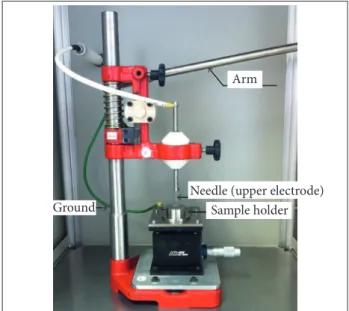
circuit charged with 5 kV. he gap between the upper electrode (needle) and the metal sample holder is ixed at 0.018 mm. A sample of 30 mg is put inside a Telon washer placed on the top of the grounded sample holder, and a mylar sheet (insulating material) is placed on the top of the washer to conine the powder. he needle is charged and manually moved down to the adjusted gap, piercing the mylar sheet and discharging into the material. A positive reaction is deined as a lash, spark, burn or noise. No reaction in 20 out of 20 trials is a pass (AOP-7).
FRICTION SENSITIVITY
he BAM friction tester is used to measure the response of energetic materials to a friction stimulus generated by two porous porcelain surfaces. A 10-mm3 sample is placed in a porcelain plate attached to the sample table. he porcelain pin placed on the lever arm descends to come in contact with the sample, as shown in Fig. 4. Weights are set at diferent distances on the lever arm to adjust the force applied on the sample. An electric motor moves the table back and forth causing friction of the sample with the porcelain pin. he aim of the test is to estimate the energy in Newtons that corresponds to a 50% probability of reaction. A positive result is evidenced by gas liberation, sparks or noise. he Bruceton analysis is used to evaluate the results in accordance with the French standard NF T70-503.
Figure 3. BAM impact test set.
Figure 4. BAM friction test set.
St e e l p in
Steel ring
Sample
Arm
Needle (upper electrode) Sample holder Ground
Po r celain plate
Porcelain pin
Sample
Initial movement
direction
ELECTROSTATIC DISCHARGE SENSITIVITY
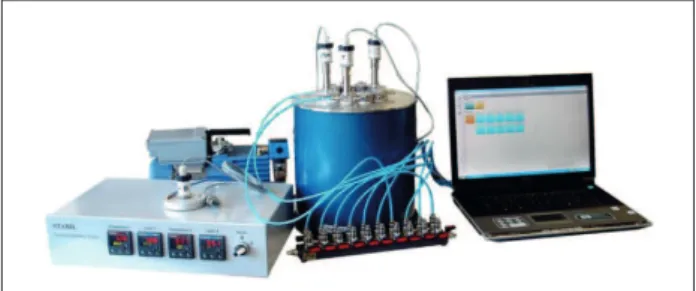
his test determines the energy limit needed to ignite an explosive by electrostatic stimulus of various intensities. he test is run in an Energetic Materials Test Unit (Fig. 5), integrated to a Test Unit of 5 kV (Fig. 6) of the Electrostatic Discharge Sensitivity (ESD) Tester ESD-100 (Equatorial Sistemas). he initial energy is 0.25 J, charged by a capacitor of 0.02 µF connected to a discharge
Figure 6. Test unit of 5 kV.
Figure 5. Energetic material test unit.
THERMAL ANALYSIS
VACUUM STABILITY (CONSTANT TEMPERATURE)
he stability test was performed using STABIL Vacuum Stability Tester of OZM Research (Fig. 7), which consists in a heating block and glass tubes with temperature and pressure sensors. A 5-g mass was placed inside the glass tube and closed with a head that contains pressure and temperature transducers. A vacuum was created in the tube until the internal pressure reached values lower than 1 atm. he head is rotated to maintain the internal vacuum, and the tube is placed inside the heating block. he samples were heated at 100 °C for 40 h (AOP-7).
MTV sensitivity levels should not be more sensitive than RDX, which is a military explosive with high stability and low levels of sensitivity.
IMPACT SENSITIVITY
he results are presented in Table 1. Using the “up and down” Bruceton method with a minimum of 30 tests, we can analyze the data statistically and ind, with a 95% conidence level, the energy that causes a 50% probability of a positive result, that is, initiation or detonation, as well as the lower and upper limits. he RDX resulted in a range of initiation energy from 2.5 to 6.3 J with average of 5.0 J. Meyer et al. (2007) reported in their book “Explosives”an energy of 7.5 J for RDX, but they did not specify the grain size of the explosive, which has an inluence on the sensitivity of the material. he results show that the MTV composition is less sensitive to impact than RDX, since the energy required to initiate the sample is 50 J. Koch (2012) states that large spherical grains, with 2 or 3 mm diameter, may not have a positive reaction at a 50-J energy. he grain size of the sample was less than 0.71 mm, which resulted in nine positive results in 30 trials, conirming the inluence of the grain size on the sensitivity of the material.
In this test, the energetic material is subjected to a plastic work, which causes heating and initiation. he strain rate of the material in the edges is greater than in the center, causing an initiation reaction at the edges irst (Mellor and Boggs 1987). his was seen when the MTV composition was tested. Positive reactions vary from small black dots at the edges to expulsion of the steel pin from the ring along with noise and sparks.
Product Impact sensitivity results (J)
RDX 5.0 (2.5 to 6.3)
MTV 50
Figure 7. STABIL Vacuum Stability Tester.
COMPATIBILITY
he compatibility of the MTV composition was tested with the alkyl lacquer DOPE LP 453, a resin composed of nitrocellulose, aromatic solvents, alcohols, acetates and additives. his lacquer is used in the assembly of pyrotechnic devices that use the MTV composition as active material. During the assembly and sealing of the pyrotechnic device, the contact between the lacquer and the MTV composition could occur, so it was important to assess the compatibility between the two materials.
The test was conducted with a differential scanning calorimeter DSC-7 made by PerkinElmer, at a heating rate of 2 °C/min. Nitrogen gas was purged into the furnace at a rate of 50 mL/min (STANAG 4147). he temperature range was from 30 °C up to 500 °C, the maximum temperature allowed by this equipment. he samples were analyzed individually and in a mixture with a proportion of 1:1. About 2 mg was placed in a platinum crucible with a perforated lid.
RESULTS AND DISCUSSION
For the MTV pyrotechnic composition to be qualiied and considered safe, all the tests must have satisfactory results. For sensitivity tests, the AOP-7 standard requires that RDX be tested contemporaneously with the composition, and the
Table 1. Impact sensitivity results.
FRICTION SENSITIVITY
Table 2. Friction sensitivity results.
Product Friction sensitivity results
(N)
RDX 159 (105 to 183)
MTV > 353
Table 3. ESD sensitivity results.
Product ESD threshold energy (mJ)
RDX 22
MTV 250
Temperature [oC]
H
ea
t fl
o
w e
nd
o u
p [mW
]
30 50 55 60 65 70
180 330 480
Figure 8. DSC curve of MTV composition — heating rate of 2 °C/min under nitrogen atmosphere from 30 to 500 °C. to ignition by friction due to the low friction coeicient of the
PTFE (m = 0.04). here is no reaction up to 360-N friction forces with the BAM apparatus (Koch 2012).
Friction is the hardest stimulus to eliminate, because it is present at handling, at manufacture and at the storage of the energetic material. Friction is found in sliding, rotation and scrape movements (Mellor and Boggs 1987), which oten happens during the preparation of the composition and the assembly of pyrotechnic devices.
characterization will be used afterwards to analyze the compatibility of the composition with other materials that it might come in contact with.
Figure 8 presents the DSC curve for the MTV composition. A small endothermic peak is identiied at 340 °C and indicates the fusion point of the polymeric material in the mixture, because the Telon fusion point is about 335 °C. he complete decomposition of the MTV composition at this heating rate occurs at temperatures above 500 °C, since there is no register of any exothermic event in the present curve.
ESD SENSITIVITY
he results are presented in Table 3. As we can see in the tests results, the MTV composition is about ten times less sensitive to ESD than RDX. Low ESD sensitivity materials are in a range from 12.5 mJ to 12.5 J (TM 9-1300-214), therefore, both samples can be considered low ESD sensitive. he threshold energy is found with no positive results at 20 consecutive trials.
he Telon on the composition justiies the low ESD sensitivity of the MTV composition. he Telon has high dielectric strength, in other words, it is considered an insulating material. he hazard of initiation by ESD arises when the energetic material becomes charged to a potential where the breakdown of the material occurs, or when changes at the grounding allow the discharge of the existing charge. he discharge process reduces the material resistance, which increases the electric current passing through. his process can create an arc and can also establish discharge paths followed by the catastrophic initiation of the material (Mellor and Boggs 1987). herefore, the use of insulating material in pyrotechnic compositions decreases the hazard of initiation due to ESD.
THERMAL ANALYSIS
This analysis is conducted to characterize the thermal decomposition behavior of the MTV composition. This
VACUUM STABILITY (CONSTANT TEMPERATURE) he gas volume released by the MTV composition ater 40 h at 100 °C was of 0.61 mL/g. he AOP-7 standard requires a maximum gas release volume of 2 mL/g. he gas volume released in this test is a valid measure of the material stability (MIL-STD-1751A).
Usually, energetic materials remain in warehouses for a long period of time, and the environment conditions, such as temperature and humidity, depend exclusively on the storage location. he energetic material should maintain its performance, physical-chemical properties and safety during the entire storage time (Agrawal 2010).
he exposure of the MTV composition to the humidity transforms the magnesium in the composition into Mg(OH)2 and MgO, as shown in Eqs. 2 and 3. hese two products reduce the composition performance and increase the risk of accident due to the formation of gaseous hydrogen (Koc et al. 2009).
Mg(s) + 2H
2O → Mg(OH)
2(s) + H
2(g)
(2)Product Peak temperature (ºC)
Peak temperature (ºC)
MTV - 340.6 ± 0.3
DOPE 187.6 ± 0.7
-MTV/DOPE 184.5 ± 0.4 340.0 ± 1.0
Temperature [oC]
H
ea
t fl
o
w e
nd
o u
p [mW
]
30 130 230 330 430
50 55 60 65 70
Figure 9. DSC curve of MTV, DOPE and MTV/DOPE 1:1 – heating rate of 2 °C/min at nitrogen atmosphere from 30 to 500 °C.
Table 4. Peak temperature of MTV, DOPE and MTV/DOPE. Besides helping in the conception of the inal product, the
Viton has the function of coating the magnesium grains, which protects the magnesium from oxidation by the humidity (Yong and Smit 1991).
COMPATIBILITY
When an energetic material has direct contact with a polymer or other type of material, the following conditions can occur: (a) one or more properties of the energetic material can be afected; (b) one or more properties of the contact material can be afected; and (c) none of the properties of the energetic material or the contact material can be afected.
his test provides evidence that certain materials can be used in a pyrotechnic device without any loss in safety or reliability (STANAG 4147). he alkyl lacquer DOPE was tested in a mixture with the MTV composition to verify if these two products are compatible, since they are used in the assembly of pyrotechnic devices.
Figure 9 presents the DSC curve for the MTV composition for the alkyl lacquer DOPE and a mixture of 1:1 proportion of the two materials. Table 4 presents the temperature peaks of the samples.
An exothermic peak with temperature of approximately 188 °C is identiied in the DOPE curve, correspondent to the exothermic decomposition of the nitrocellulose contained in the lacquer (Andrade et al. 2007). It was veriied before that the MTV composition has a small endothermic peak at 340 °C, relative to Telon fusion point. Table 4 shows a small advance of 3 °C in the decomposition temperature of DOPE and the mixture MTV/DOPE. To evaluate the mixture behavior ater
this exothermic peak, a run was performed until 240 °C, and the mixture was analyzed visually, which resulted in a small alteration of the polymeric material in the composition. It is assumed that the energy released by the nitrocellulose decomposition caused a thermal degradation of the polymeric material at the contact area, but it was not suicient to initiate or ignite the MTV composition, because there are no exothermic reactions depicted in the curve before 500 °C. herefore, at the analyzed temperature range by diferential scanning calorimetry, we can say that the MTV composition and the DOPE alkyl lacquer are compatible (Pinheiro 2010).
CONCLUSION
The MTV pyrotechnic composition was subjected to a series of tests such as sensitivity to impact, friction and ESD, contemporaneously with RDX, and the results were compared. Stability, thermal analysis and compatibility were also performed, and the MTV composition obtained satisfactory results in all of them. he composition is less sensitive than RDX in sensitivity tests, it has good stability proprieties and is compatible with the DOPE lacquer used to assemble and seal pyrotechnic devices used in the ignition system of rocket motors.
Therefore, it is concluded that the MTV pyrotechnic composition developed by IAE is now qualiied, being safe for fabrication, handling and application in the ignition systems of solid propellant rocket motors as well as storage and transportation.
ACKNOWLEDGMENT
REFERENCES
Agência Espacial Brasileira (2007) Parte 1 – Regulamento técnico geral da segurança espacial. Brasília: Agência Espacial Brasileira.
Agrawal JP (2010) High energy materials: propellants, explosives and pyrotechnics. Weinheim: Wiley-VCH.
Andrade J, Iha K, Rocco JAFF, Suzuki N, Suárez-Iha MEV (2007) Determinação dos parâmetros cinéticos de decomposição térmica para propelentes BS e BD. Eclética Química 32(3):45-50. doi: 10.1590/S0100-46702007000300007
Göçmez A, Gürkan YA, Pekel F, Özkar S (1999) Development of MTV compositions as igniter for htpb/ap based composite propellants. Propellants Explos Pyrotech 24(2):65-69. doi: 10.1002/(SICI)1521-4087(199904)24:2<65::AID-PREP65>3.0.CO;2-8
Koc S, Erogul F, Tinaztepe HT (2009) Accelerated aging study for MTV ignition charges. AIAA-2009-5276. Proceedings of the 45th AIAA/ ASME/SAE/ASEE Joint Propulsion Conference & Exhibit; Denver, USA.
Koch EC (2012) Metal-luorocarbon based energetic materials. Weinheim: Wiley-VCH.
Mellor AM, Boggs TL (1987) Energetic materials hazard initiation: DoD assessment team inal report. USA: U.S. Army Research Ofice.
Meyer R, Köhler J, Homburg A (2007) Explosives. 6th ed. Berlin: Wiley-VCH.
Peretz A (1982) Investigation of pyrotechnic MTV compositions for rocket motor igniters. Reston: American Institute of Aeronautics and Astronautics.
Pinheiro GFM (2010) Relatório interno de ensaio de compatibilidade de MTV com AERODOPE, SNOOP e LOCTITE 242. São José dos Campos: Instituto de Aeronáutica e Espaço.