Disponible en castellano/Disponível em língua portuguesa SciELO Brasil www.scielo.br/rlae 1 Paper extracted from Doctoral Dissertation; 2 RN, Doctoral student, Faculty, Federal University of Vales do Jequitinhonha e Mucuri, Brasil, e-mail: [email protected]; 3 Advisor, Full Professor, e-mail: [email protected]. University of São Paulo at Ribeirão Preto College of Nursing, WHO Collaborating Centre for Nursing Research Development, Brazil.
CREATION AND EVALUATION CYCLE OF A DISTANCE MODULE FOR NURSING
UNDERGRADUATES, NAMED “MEDICATION ADMNISTRATION”
1Paulo Celso Prado Telles Filho2 Silvia Helena De Bortoli Cassiani3
Telles Filho PCP, Cassiani SHB. Creation and evaluation cycle of a distance module for nursing undergraduates, named “medication admnistration”. Rev Latino-am Enfermagem 2008 janeiro-fevereiro; 16(1):78-85.
The objective of this study was to describe the creation cycle of the module “medication administration” and to evaluate it. It is an evaluation research, using the Engagement Theory as a methodological/theoretical approach carried out in two phases: the first related to the creation of the module and the second to its evaluation by specialists using the instrument based on the Model of Analytical Appreciation of Hypermedia Systems. The creation cycle of the module followed the following steps: gathering the objectives of the module, organization of the content, selection of the media, creation of the classes and activation of the learning process. It was evaluated by contents specialists, informatics specialists and nursing students. The evaluation of the distribution and the accessibility of the contents, the utilization of images, the clarity and ease of execution of the program were positive. The module was considered appropriate to be used with nursing students.
DESCRIPTORS: education, distance; nursing; pharmaceutical preparations
CICLO DE CREACIÓN Y EVALUACIÓN DE UN MÓDULO A DISTANCIA, PARA ESTUDIANTES
DE ENFERMERÍA, TITULADO “ADMINISTRACIÓN DE MEDICAMENTOS”
Este estudio tuvo como objetivo describir el ciclo de creación de la disciplina “Administración de Medicamentos” y realizar su evaluación. Fue una investigación de evaluación, que utilizó la Teoría del Comprometimiento como referencia teórica metodológica, la que fue realizada en dos fases: la primera está relacionada a la creación del módulo y la segunda, a la evaluación por especialistas a través del instrumento basado en el Modelo de Apreciación Analítica de Sistemas Hipermedia. La descripción del ciclo de creación del módulo siguió las siguientes etapas: levantamiento de los objetivos del módulo, organización del contenido, selección de los medios de comunicación, creación de las clases y organización y ejecución del aprendizaje. El ciclo de creación analizado por especialistas en contenido en informática y por estudiantes de enfermería, evaluaron positivamente la distribución y accesibilidad del contenido, a la utilización de imágenes, a la claridad y a la facilidad de ejecución del programa. El módulo fue considerado apropiado para ser utilizado por los alumnos del curso de enfermería.
DESCRIPTORES: educación a distancia; enfermería; preparaciones farmacéuticas
CICLO DE CRIAÇÃO E AVALIAÇÃO DO MÓDULO ADMINISTRAÇÃO DE MEDICAMENTOS
PARA ENSINO À DISTÂNCIA
Este estudo teve por objetivos descrever o ciclo de criação do módulo Administração de Medicamentos, bem como proceder à sua avaliação. Trata-se de pesquisa de avaliação, que utilizou a Teoria do Engajamento como referencial teórico-metodológico, realizada em duas fases: a primeira, relacionada à criação do módulo e a segunda, à avaliação por especialistas, através do instrumento baseado no Modelo de Apreciação Analítica de Sistemas Hipermídia. A descrição do ciclo de criação do módulo seguiu os seguintes passos: levantamento dos objetivos do módulo, organização do conteúdo, seleção da mídia, criação das aulas e operacionalização da aprendizagem. Foi avaliado por especialistas em conteúdo, em informática e por graduandos de enfermagem, os quais o avaliaram positivamente em relação à distribuição e acessibilidade de conteúdo, à utilização de imagens, à clareza e à facilidade de execução do programa. O módulo foi, pois, considerado apropriado para utilização com alunos do curso de enfermagem.
INTRODUCTION
T
he contemporary society demandsindividuals to develop their abilities of raising theories,
reflecting, analyzing and organizing, which validate
conscious decision making. It is necessary to develop
talents that allow for autonomous ways of creation,
communication and expression, generating attitudes
of cooperation and reciprocity.
In this perspective, distance education stands
out as an educative process in which learning occurs
through a physical separation between the students
and the teachers. Communication and learning take
place through technological resources that go beyond
oral exposition.
In this kind of process, both the student who
will use it, and the teacher who develops the material
need to be capable. Both these parties’ motivation
for learning is the accelerated scientific and
technological development of the current world, which
brings about constant changes in work places,
demanding professionals able to adapt themselves
to the changes and who are equipped and motivated
for continuous learning.
A study cited in this research focused on the
learning environment, with the use of the Internet,
addressing intravenous therapy teaching. It aimed at
developing educational material on this therapy, using
the Internet and evaluating its use by the students.
The latter positively evaluated the learning opportunity
through the Internet, mentioning the interaction with
the instructor, space-time flexibility, access to technical
resources and aspects related to course content
organization(2).
Therefore, based on the idea that distance
education resources are very useful, efforts were
made to conduct and use it in the nursing area.
A study that revealed the educational needs
of hospital nurses in terms of medication
administration exposed the need for knowledge on
contents like: action mechanisms, medication
preparation and administration, medication
interactions, stability, adverse effects of the medication
and other aspects(3).
This data indicated the existence of knowledge
deficits on essential questions for safe and correct
medication administration.
In view of these considerations and aware of
the challenge of extending knowledge on medication
administration, the researcher aimed to carry out a
study that would present the contribution related to
the subject: teaching medication administration, using
distance education as a possibility of development in
professional education of nursing undergraduates.
Therefore, the development of this study was
proposed, which intended to describe the creation
cycle of a distance module called “Medication
Administration”, as well as to evaluate it for its later
implementation in undergraduate Nursing courses.
OBJECTIVES
This article aimed at:
- Describing the creation cycle of a distance module
in the Teleduc environment, called “Medication
Administration”.
- Proceeding to the evaluation of the module
mentioned by specialists in content, informatics and
undergraduates in nursing, through an instrument
based on the Analytical Appreciation Model of
Hypermedia Systems.
METHODOLOGY
First Phase
The first phase of the work is an evaluation
research, aimed at discovering how well a practice or
program is working out when used to search for
answers to practical questions(4).
In nursing education, there is usually a need
to evaluate the range of goals and the efficiency of the
means used to achieve a goal(4). This study aimed at
describing the development and evaluation of a module
in a virtual learning environment, through information
and communication technologies available on the web.
The engagement theory developed by Greg
Kearsley, a consultant specialized in on-line and
distance education, Assistant Professor of the Distance
Education Program at the University of Maryland
-USA, was used as a theoretical/methodological
reference framework.
The option to use the latter is justified because
the intention was to develop a distance module for
medication administration teaching which would reflect
the current and innovative learning focus that unites
individuals with common interests and seeks
The main characteristics of this theory are
related to collaboration (students working together);
connectivity (all students connected to each other
all of the time); community (groups are defined
according to common interests) and
multi-sensoriality (the information can involve sound,
graphs and figures)(5).
Therefore, its fundamental idea is the
interaction among students engaged in learning
activities. Such theory differs from others because it
promotes human interaction in the context of group
activities and not in the individual’s interaction with
the instructional program only(6).
Important determinants that stand out in the
quality of the instructional material are: little quantity
of information on each screen and the use of different
styles, font sizes and colors to highlight ideas, using
figures to transmit them(7).
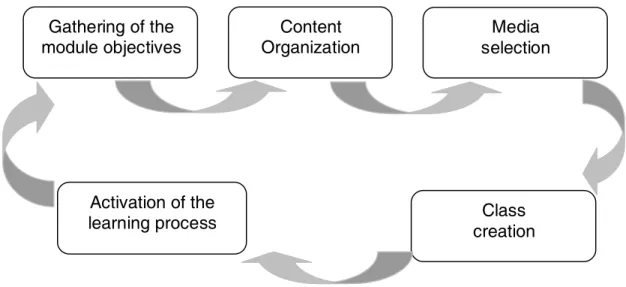
The below figure presents the module
development cycle.
Figure 1 - Development cycle of the module: “Medication Administration”
)CVJGTKPIQHVJG
OQFWNGQDLGEVKXGU
%QPVGPV
1TICPK\CVKQP
/GFKC
UGNGEVKQP
#EVKXCVKQPQHVJG
NGCTPKPIRTQEGUU
ETGCVKQP
%NCUU
Second Phase
Study and Population Location - Target
The module evaluation was developed at a
university in the interior of São Paulo, Brazil.
It was carried out by ten specialists: five
specialists in content were nurses, post-graduates and
university professors. It is worth stressing that all of
them attended the criteria of having a Master’s Degree
and being professors in Nursing Fundamentals. There
were five specialists in informatics: a system analyst,
an electronic engineer, an undergraduate in Systems
Analysis and two informatics technicians. All of them
attended the criteria of being involved with informatics
and teaching technology, as well as with educational
computer programs.
Posters were hung up in the research
institution, describing the study goals and asking
interested people to contact the researcher. Five
students from the eighth term showed up and were
interested in participating.
Evaluation Instrument
The evaluation was performed through an
instrument based on the Analytical Appreciation Model
of Hypermedia Systems(8), which was adapted and
validated(9) to evaluate educational software.
Ethical Aspects
The study was authorized by the General
Board of the research institution. It started after the
approval by the Research Ethics Committee at the
University of São Paulo College of Nursing, registered
under number 0304/2002. Each participant was aware
of the Free and Informed Consent Term for
Participation in Research and issued a written record
RESULTS AND DISCUSSION
First Phase
The steps of the development cycle of the
“Medication Administration” module are described below.
Gathering the objectives of the module
The objectives were raised based on the
program content of the subject “Fundamentals for the
Care Process II”, taught at the institution where the
researcher was a professor; on his experience in courses
about the theme, taught to undergraduates and
post-graduates in the health area in general and in nursing in
particular; on his participation in scientific events where
the theme has been discussed with specialists in the area.
The objectives of the module are presented
as follows.
- General Objective
Develop competences related to several
contents about medication administration and to the
execution of its techniques, to motivate students for
the development.
- Specific Objective
Class 1: develop competences related to
pharmacological aspects, nursing orientations and
information sources for safe medication administration.
Class 2: develop competences related to the
preparation of the material for medication
administration.
Class 3: develop competences related to intradermal
medication administration.
Class 4: develop competences related to subcutaneous
medication administration.
Class 5: develop competences related to
intramuscular medication administration.
Class 6: develop competences related to endovenous
medications administration.
Content organization
After the module objectives were determined,
the content was organized. Therefore, all material was
joined to be organized in a logical sequence for its
broad and clear presentation.
Scientific articles, several materials prepared
as content for the classes, materials presented in
scientific events and books were part of this material.
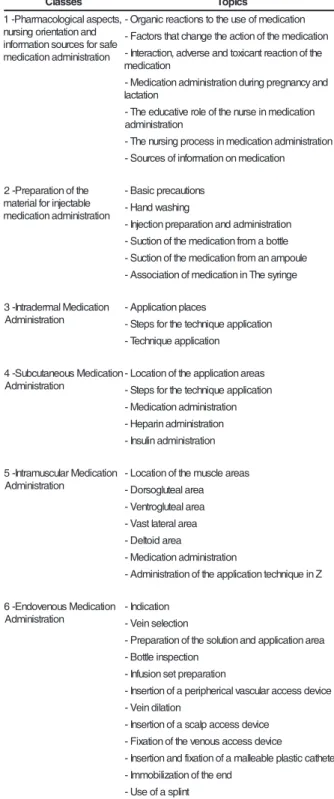
The content was organized as presented in Table 1.
Table 1 - Content distribution of the “Medication
Administration” module according to classes and
topics. Descalvado, 2005
A fact that stands out is that each class
mentioned above has specific exercises and that the s e s s a l
C Topics
-entire content in this table was compiled into a text,
presented in 102 pages, typed and reviewed using
the text editor Word.
It also stands out that this content went
through a language adaptation process, in order to
become appropriate for the interactive
communication means of the Internet. For this
purpose, some points were observed, such as the
recommendation that the style should be simple and
used in the habitual sense, that the images should
be subtitled, the paragraphs should be short and that
competent sources of quotation and reference should
be used, as well as the fact that hyperlinks at the
end of each screen should be stimulated and the
quantity of text should be reduced, but not of
information(10).
Media selection
After determining the objectives and
organizing the content, the media selection proceeded,
which is a crucial moment for the professor, because
it is the time to decide on the best way to present the
content to the students(11).
A f t e r t h e l o n g b i b l i o g r a p h i c m a t e r i a l
reading, the discussion with postgraduate colleagues,
p e d a g o g u e s a n d s y s t e m s a n a l y s t s , t h e w h o l e
c o n t e n t wa s m a d e a va i l a b l e i n t h e Te l e d u c
environment.
Teleduc was considered a support
environment for the distance education on the web
that has been developed since 1997 by the Center of
Informatics Applied to Education - NIED, in partnership
with the Institute for Computer Sciences Institute
-IC, both from the State University of Campinas
(UNICAMP). This environment was developed in a
continuous and participative way, having all of its tools
idealized and projected according to the needs related
by its users(12).
The architecture of this platform was
developed based on the activities. Several tools were
arranged for the student, such as support and reading
material and frequent questions. These tools promote
both teacher-student and student-student interaction
and, consequently, collective work.
Creation of classes
The creation of classes followed the
determination of the module objectives, as well as
the content organization and media selection, which
were already presented.
A fact that stands out is that 120 photographs
were taken, especially produced for the module.
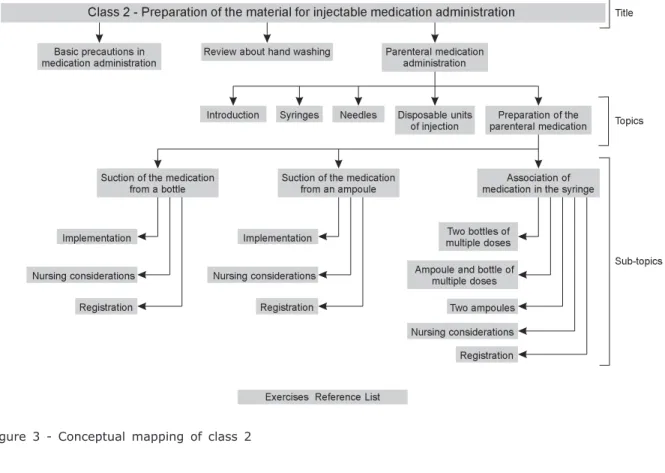
After the association of the objectives, contents and
possibilities established for the media, the classes
were creation as shown in the following conceptual
maps.
Figure 2 - Conceptual mapping of class 1
Class 1 - Pharmacological aspects, nursing orientation and information sources for the security of medication administration
Organic reactions to
the use of medication
Factors that change the action of the
medication in the body
Nursing considerations for the factors that change the action of the medication
Interaction of the medication
Adverse
reaction Toxicantreaction administrationMedication during pregnancy and lactation
The educative role of the nurse in the
medication administration
Nursing orientation
for the patient
The nursing process in the
medication administration
Sources of information on
medication
Patient records
Nursing diagnosis
Care plan Nursing evolution
Through the systematic reviews
Through the pharmaceutical industry
Through the Internet
Exercises Reference List
Title
Topics
Figure 3 - Conceptual mapping of class 2
Class 2 - Preparation of the material for injectable medication administration
Basic precautions in
medication administration Review about hand washing Parenteral medicationadministration
Title
Topics
Sub-topics Needles
Introduction Syringes Preparation of the parenteral medication Disposable units
of injection
Association of medication in the syringe Suction of the medication
from an ampoule Preparation of the
parenteral medication Suction of the medication
from a bottle
Two bottles of multiple doses
Ampoule and bottle of multiple doses
Two ampoules
Nursing considerations
Registration Nursing considerations
Implementation
Registration Nursing considerations
Implementation
Registration
Exercises Reference List
Class 3 - Intradermal medication administration
Introduction Application Places Steps for the technique application
Title
Topics
Exercises Reference List
Figure 4 - Conceptual mapping of class 3
It is important to stress that the classes
related to subcutaneous, intramuscular and
endovenous medication administration followed
conceptual mappings similar to the class on
intradermal administration.
Activation of the learning process
The module has a total schedule of 50 hours,
considering the hours of meetings at school (13 hours
and 20 minutes), classes in the Teleduc environment
(20 hours), as well as classes in the laboratory (16
hours and 40 minutes).
The four meetings aim to provide information
on specific needs during the module implementation.
This way, in the first meeting, students are offered
general orientations about the module development,
explaining and demonstrating its use, which
approximates the students, the instructor and the
on-line Teleduc environment. The second and third meetings
are held after the conclusion of classes 3 and 6, because
it is believed that, in this period, content revisions are
necessary, in which possible questions related to the
corresponding contents are answered. In the fourth
meeting, the theoretical evaluation is made.
What the distance content is concerned, there
is the screen “Welcome”, presenting the necessary
information to learn how to use the Teleduc platform,
essential for the process. In order to continue the
user experience, it is necessary that the participant
uses the tool “course dynamic”, through which the
students get information on class dates and schedules,
contents, exercises, chats, forums, laboratory classes
It is important to highlight that the dynamic
of the module comprises the following sequence of
activities: classes, exercises, chats and forum
discussions. On these screens, the dates scheduled
for this sequence are specified; it is important to stress
that the classes are available during the entire period
of the module development and that the exercises,
chats and forums discussions are available for a week
from the publication of the content of the classes it
refers to.
In order to access the content of the class
itself, the tool “readings” should be used.
The opening screen of the classes of the
module allows the students to surf in a non linear
way, in other words, according to their study needs.
The student can access the content from classes one
to six, the support material, the image links and list
of references.
After studying the content regarding the class,
the exercises are done and the program provides the
student a grade immediately after its conclusion.
The next steps are the use of the chat session
and the discussion forum, which the students use to
exchange information on the content studied, as well
as to clarify questions; the professor can then visualize
the students’ access and register them for later
analysis.
The laboratories, from one to five, refer to
practical classes, in other words, to technique training
and practical evaluation. Laboratory 1 deals with the
preparation of the material for injectable intradermal
medication; laboratory 2, subcutaneous; laboratory
3, intramuscular; laboratory 4, endovenous and
laboratory 5, practical evaluation.
In order to follow-up the students’
development, formative evaluation is used, verifying
and quantifying, in short periods of time and with tools
from Teleduc, the accesses to the following items:
content of each class, exercise access and resolution,
access to the chat and discussion forum.
The additive evaluation takes place at the end
of the module, through two classroom evaluations: a
theoretical and a practical one, both using printed
material, according to the guidelines of the educational
institution where the module is implemented.
Second Phase
The results of evaluations by specialists in
content refer to the content distribution and
accessibility, the explicitness of its presentation, the
structure and accuracy of the information presented,
the utilization of images and its relation to the text
information, the presentation of diverse texts that
correspond to the objectives of the module and the
relevance of the exercises to reinforce the content.
The unanimous agreement of the specialists
in content regarding all items above cited and
evaluated was observed, as all of the five participants
checked the item “In Conformity” of the instrument
used.
Positive aspects emerged from these
observations, mostly in what concerns the photographs
in a process of detriment of images; the placement
of tests at the end of each class; the existence of
personal meetings during the module, as a way to
clarify possible questions; the information quality and
its contribution to daily nursing practice; content
explicitness and quantity, the tests put at the end of
each class as a possibility of revision and fixation of
the knowledge acquired and the instructional sequence
of the classes as learning motivators.
Continuing with the evaluation by specialists,
there is the evaluation by the specialists in informatics.
The items evaluated by these specialists were
reported regarding their explicitness and the
visualization of the main menu presentation, logical
and pleasant sequence of the classes, suitability of
the visual presentation for the study objective, easy
execution of the program, speed of access,
accessibility of the contents, efficient use of platform
resources and easy interaction and communication
provided by the environment. Regarding the items
mentioned, 100% of conformity was registered.
As to the observations, information regarding
the quality of the education system and easy
accessibility were described. However, an item was
pointed out as requiring modification regarding the
item readings, as the quantity of bibliographical
references should be increased.
After the modification was carried out, there
was the evaluation by undergraduates from a nursing
course, described next.
The same items evaluated by the specialists
in informatics and content were evaluated by five
undergraduates and, according to the records, 12
items received the classification “In Conformity”. Three
participants disagreed with the items “The main menu
presentation is clear and of easy visualization” and
Some positive aspects emerged in the
observations, such as the relation of the module to
the digital evolution and professional development,
the placement of the content in a clear way and the
use of the module for students and people outside
the health area.
Regarding aspects requiring modification, the
delay in access time stood out. It should be explained
that this depends on the net the student is accessing
the program from, as each network has a different
configuration that interferes with the speed.
After all modifications were completed, it is
believed that the module is appropriate to be
implemented in undergraduate nursing courses.
FINAL CONSIDERATIONS
This study described the creation cycle of the
“Medication Administration” module, developed in the
educational environment Teleduc, based on up-to-date
bibliography. For this purpose, Engagement Theory
was used, which seeks the union of individuals with
common interests, collaboration and connectivity.
The following sequence was adopted for the
description: determining the objectives of the module,
content organization, media selection, creation of
classes and activation of the learning process.
The “Medication Administration” module was
created in the Teleduc environment, based on up-to-date
bibliography and with practical examples. It is a resource
integrated to the pedagogical process as one of its
mediators, providing the participants with knowledge
construction on medication administration, to be built in
constant interaction between students and teacher.
It was positively evaluated by specialists in
content, informatics and undergraduates in nursing in
terms of content distribution and accessibility, explicitness
of its presentation, information structure and accuracy,
image utilization and its relation to the text information,
presentation of diverse texts, relevance of the exercises
for content reinforcement, explicitness and visualization
of main menu presentation, logical and pleasant
sequence of the classes, suitability of visual presentation,
easy execution of the program and interaction and
communication provided by the environment. The
module was then considered appropriate for use with
nursing undergraduates.
REFERENCES
1. Magdalena BC, Costa IT. Internet na sala de aula: com a palavra os professores. Porto Alegre: Artmed; 2003. 2. Dias D.C, Cassiani SHB. Educação sem distâncias: utilização do Web CT como ferramenta de apoio para o ensino de terapia intravenosa na graduação de enfermagem. Rev Brasileira de Enfermagem 2003; 56(4):443-6.
3. Telles PCP Filho, Cassiani SHB . Administração de medicamentos: aquisição de conhecimentos e habilidades requeridas por um grupo de enfermeiros. Rev Latino-Americana de Enfermagem 2004; 12(3):533-40.
4. Polit D, Hungler BP. Nursing research - principles and methods. 6ª ed. Philadelphia: Lippicontt; 1999.
5. Kearsley G. New Developments in Learning. [citado em 2004 jul 7]. Disponível em: http://home.sprynet.com/ ~gkearsley/.htm.
6. Kearsley G. O profesor virtual: um estudo de caso pessoal. [citado em 2003 dez 23] Disponível em: http:// home.sprynet.com/~gkearsley/.htm.
7. Kearsley G. Training for tomorrow. Distributed learning through computer and communications technology. New York: Addison-Wesley Publishing; 1985.
8. Struchiner M. Introdução a informática na área da saúde. Rio de Janeiro: NUTES/UFRJ; 1997
9. Lopes MVO, Araújo TL, Silva RM. Software para o auxílio a prática docente no ensino de necessidades humanas básicas. Texto & Contexto - Enfermagem. 2000; 9(1):79-92. 10. Kearsley G, Moore M. Distance education: a system view. Belmont (USA): Wasdsworth Publishing; 1996.
11. Zaína LAM. Acompanhamento do aprendizado do aluno em curso a distância através da Web: metodologias e ferramentas [dissertação]. São Paulo (SP): Escola Politécnica/USP; 2002.
12. Rocha HV. O ambiente Teleduc para educação a distância baseada na Web: princípios, funcionalidades e perspectivas de desenvolvimento. Campinas (SP): Unicamp; 2000.