ww w . r e u m a t o l o g i a . c o m . b r
REVISTA
BRASILEIRA
DE
REUMATOLOGIA
Original
article
Chronic
low
back
pain
in
patients
with
systemic
lupus
erythematosus:
prevalence
and
predictors
of
back
muscle
strength
and
its
correlation
with
disability
Raíssa
Sudré
Cezarino
a,
Jefferson
Rosa
Cardoso
b,
Kedma
Neves
Rodrigues
a,
Yasmin
Santana
Magalhães
a,
Talita
Yokoy
de
Souza
c,
Lícia
Maria
Henrique
da
Mota
c,
Ana
Clara
Bonini-Rocha
a,
Joseph
McVeigh
d,
Wagner
Rodrigues
Martins
a,e,∗ aUniversidadedeBrasília(UnB),CursodeFisioterapia,Brasília,DF,BrazilbUniversidadeEstadualdeLondrina(UEL),LaboratóriodeBiomecânicaeEpidemiologiaClínica,Londrina,PR,Brazil
cHospitalUniversitáriodeBrasília,ClínicadeReumatologia,Brasília,DF,Brazil
dUlsterUniversity,SchoolofHealthSciences,CentreforHealthandRehabilitationTechnologies(CHaRT),Coleraine,NorthernIreland
eUniversidadedeBrasília(UnB),ProgramadePós-Graduac¸ãoemCiênciasdaReabilitac¸ão,Brasília,DF,Brazil
a
r
t
i
c
l
e
i
n
f
o
Articlehistory:
Received13February2017 Accepted6March2017 Availableonline29April2017
Keywords:
Systemicerythematosuslupus Chroniclowbackpain Musclestrength Prevalence Prediction
a
b
s
t
r
a
c
t
Objective:TodeterminetheprevalenceofChronicLowBackPainandpredictorsofBack MuscleStrengthinpatientswithSystemicLupusErythematosus.
Methods:Cross-sectionalstudy.Ninety-sixambulatorypatientswithlupuswereselectedby non-probabilitysamplingandinterviewedandtestedduringmedicalconsultation.The out-comesmeasurementswere:Pointprevalenceofchroniclowbackpain,OswestryDisability Index,TampaScaleofKinesiophobia,FatigueSeverityScaleandmaximalvoluntary isomet-riccontractionsofhandgripandofthebackmuscles.Correlationcoefficientandmultiple linearregressionwereusedinstatisticalanalysis.
Results:Ofthe96individualsinterviewed,25hadchroniclowbackpain,indicatingapoint prevalenceof26%(92%women).ThecorrelationbetweentheOswestryIndexandmaximal voluntaryisometriccontractionofthebackmuscleswasr=−0.4,95%CI[−0.68;−0.01]and betweenthemaximalvoluntaryisometriccontractionofhandgripandofthebackmuscles wasr=0.72,95%CI[0.51; 0.88].TheregressionmodelpresentedthehighestvalueofR2 beingobservedwhenmaximalvoluntaryisometriccontractionofthebackmuscleswas testedwithfiveindependentvariables(63%).Inthismodelhandgripstrengthwastheonly predictivevariable(ˇ=0.61,p=0.001).
∗ Correspondingauthor.
E-mail:[email protected](W.R.Martins).
http://dx.doi.org/10.1016/j.rbre.2017.03.003
Conclusions: Theprevalenceofchroniclowbackpaininindividualswithsystemiclupus erythematosuswas26%.Themaximalvoluntaryisometriccontractionoftheback mus-cleswas63%predictedbyfivevariablesofinterest,however,onlythehandgripstrength wasastatisticallysignificantpredictivevariable.Themaximalvoluntaryisometric con-tractionofthebackmusclespresentedalinearrelationdirectlyproportionaltohandgrip andinverselyproportionaltoOswestryIndexi.e.strongerbackmusclesareassociatedwith lowerdisabilityscores.
©2017PublishedbyElsevierEditoraLtda.ThisisanopenaccessarticleundertheCC BY-NC-NDlicense(http://creativecommons.org/licenses/by-nc-nd/4.0/).
Lombalgia
crônica
em
pacientes
com
lúpus
eritematoso
sistêmico:
prevalência
e
preditores
da
forc¸a
muscular
de
extensão
de
tronco
e
sua
correlac¸ão
com
a
incapacidade
Palavras-chave:
Lúpuseritematososistêmico Lombalgiacrônica
Forc¸amuscular Prevalência Predic¸ão
r
e
s
u
m
o
Objetivo: Determinara prevalênciadelombalgia crônica (LBC)eospreditores deforc¸a muscularnascostas(FMC)empacientescomlúpuseritematososistêmico(LES).
Métodos: Estudo transversal. Selecionaram-se 96 pacientesambulatoriais com LESpor amostragemnãoprobabilística, entrevistadosetestadosdurante consultasmédicas.As medidas de desfecho foram: prevalência ocasional de LBC, Índicede Incapacidade de Oswestry,Escala TampaparaCinesiofobia,Escala deGravidadeda Fadiga econtrac¸ões isométricasvoluntáriasmáximas(CIVM)depreensãomanualedosmúsculosdascostas. Usaram-seocoeficientedecorrelac¸ãoearegressãolinearmúltiplanaanáliseestatística. Resultados: Dos96 indivíduosentrevistados,25 apresentavamLBC, oqueindicou uma prevalênciacircunstancialde26%(92%mulheres).Acorrelac¸ãoentreoÍndicede Incapaci-dadedeOswestryeacontrac¸ãoisométricavoluntáriamáximadosmúsculosdascostasfoi der=−0,4,IC95%[−0,68;−0,01]eentreaCIVMdepreensãomanualedosmúsculosdas costasfoider=0,72,IC95%[0,51;0,88].Omodeloderegressãoapresentouomaiorvalorde R2observadoquandoaCIVMdosmúsculosdascostasfoitestadacomcincovariáveis inde-pendentes(63%).Nessemodelo,aforc¸adepreensãomanualfoiaúnicavariávelpreditiva (ß=0,61,p=0,001).
Conclusões:AprevalênciadeLBCemindivíduoscomLESfoide26%.ACIVMdosmúsculosdas costasfoi63%previstaporcincovariáveisdeinteresse.Noentanto,apenasaforc¸ade preen-sãomanualfoiumavariávelpreditivaestatisticamentesignificativa.ACIVMdosmúsculos dascostasapresentouumarelac¸ãolineardiretamenteproporcionalàforc¸adepreensão manualeinversamenteproporcionalaoÍndicedeIncapacidadedeOswestry(ouseja, mús-culosdascostasmaisfortesestãoassociadosamenorespontuac¸õesdeincapacidade).
©2017PublicadoporElsevierEditoraLtda.Este ´eumartigoOpenAccesssobuma licenc¸aCCBY-NC-ND(http://creativecommons.org/licenses/by-nc-nd/4.0/).
Introduction
Lowbackpainisdefinedbythepresenceofpainbetweenthe costalmarginandtheglutealfolds,ithasavariableclinical presentationand issaid to bechronicwhen persisting for morethanthreemonths.1,2 Chroniclowbackpain(CLBP)is consideredapublichealthproblemassociatedwithhigh eco-nomiccostsinindustrializednations.3,4Thedirectcostsoflow backpainintheUnitedStatesofAmerica(USA),forexample, areapproximately$100billionperyear.5InEurope,thecosts aretwotofourbillioneurosperyear,however,therehasbeen noevaluationofthesocietalcostsofbackpaininBrazil.6,7
Systemiclupuserythematosus(SLE)isachronic inflamma-tory,autoimmunedisease,whichnegativelyaffectsmultiple organsandsystemsandpresentswithperiodsofremission andexacerbation.8SLEmorecommonlyaffectsyoungwomen ofreproductiveage,inaratioofninetotenwomentoone
man.9 TheincidenceofSLEinBrazilisestimatedtobe8.7 cases per 100.000people per year.10 The etiology ofSLEis unclear, however, diagnostic and management criteria are available.11–13
SLE is a complex disease with a variable clinical pre-sentationinflammatoryarthritis,mainlyaffectingthesmall joints ofthe hands and knees,isthe mostfrequentcause of musculoskeletal pain, often preceding other manifesta-tionsofthedisease.14CLBPiscommoninsomeinflammatory arthropathies,forexamplearecentstudyreporteda preva-lence of65%ofCLBP inpatientswithrheumatoid arthritis (RA).15 However, there is currently no information on the prevalenceofCLBPinSLE.
corticosteroids, which cancause muscle fiber hypertrophy, leadingtodecreasedstrengthandexacerbationoffatigue.17 About80%ofthosewithSLEidentifyfatigueasthesymptom thatmostimpactsonqualityoflifeand physicalactivity,18 and thereisgrowing consensusthatback exercisesare an importantinterventioninpreventingandmanagingCLBP.19 However,therehasbeennoresearchthathasexploredhow the characteristics of SLE are related to the back muscle strengthinpatientswithSLE,whoarealsoaffectedbyCLBP. Therefore,thisstudyaimed:(I)todeterminetheprevalence ofCLBPinpatientswithSLEand(II)toevaluatethe relation-shipbetween clinical,physical,and functional variables as predictorsofthebackmusclestrengthinpatientswithSLE andCLBP.
Material
and
methods
Subjects
This study was approved in 2014 by the Research Ethics Committeeofthe University who judged the study (CAAE: 27527214.7.0000.0030). Participants were recruited from the University Hospital (Rheumatology Clinic) under non-probabilisticsamplingmethod.Duringconsultations par-ticipantswererecruited byrheumatologists,who explained the study and gained written informed consent. Accord-ing to information from the Statistics Department of the Hospital, the Rheumatology Clinic has about 200 patients regularlyattended bythe team ofcliniciansand residents. Basedon thesefigures, the followingformulawas used to calculatethe required number ofinterviews for the study: n=N*n0/N+n0,whereN=populationsize;n=samplesizeand n0=firstapproximationtothesamplesize.Toestablishn0,an initialcalculationwasperformedusingthefollowingformula: n0=1/E02, where E02=tolerable sampling error (5%).20 The samplesizecalculationdemonstratedtheneedtointerview 40individuals.
In order to be included in the study participants, were requiredtohavebeendiagnosedwithSLEbyarheumatologist, havepersistentpaininthelumbarspineformorethanthree monthsandbeattendingtheUniversityHospitalof Rheuma-tologyClinic.Patientswereexcludedfromthestudy ifthey were:pregnant, hadahistory offracture and/orsurgeryof thelumbarspine,hadaurinarytractinfectionintheprevious threemonths,hadahistoryoftumororcancerinthelumbar spine,pelvicorgansand/orgastrointestinaltract,orhad an aorticaneurysminthedescendingportion.
Outcomemeasures
Duringroutineclinics,thephysiciansinterviewedparticipants toverifytheexistenceofCLBP,andrecordsocio-demographic variables,life habits, the clinical features ofCLBP and SLE activity.Thediseaseactivitywasperformedbya rheumatolo-gistusingtheSystemicLupusErythematosusDiseaseActivity Index(SLEDAI),wherescorecanrangefrom0to105points.21 Scoresgreater thaneightindicatethediseaseisactive,and values greater than or equal to 12 points indicate severe
disease activity.22 Theintensity ofthe CLBPwas evaluated usingthenumericalpainscale,wherethepatientquantifies theirpainonascaleof0to10,with0indicating“no pain” and10indicating“perceivedmaximumpain”,atthetimeof evaluation.23
Theotherindependentvariablesofthestudywereobtained through: (I) the impact of pain on activities of daily liv-ing(ADLs)usingtheOswestryDisabilityIndexquestionnaire (ODI),subdivided into10parts. Thefirst sectionoftheODI deals with the intensity of pain and other nine sections addresstheincapacitatingeffectsofthepainonactivitiesof dailyliving,withthe finalscoregivenas apercentageand classifyingthepatientsaccordingtothedegreeofcapacity24; (II) thefearandavoidanceofmovements,usingtheTampa ScaleofKinesiophobia(TSK),whichcomprises17statements related to pain, to which the patient completely disagrees (1), partiallydisagrees(2), partiallyagrees(3) orcompletely agrees(4),thescorerangesfrom17to68points(thehigher score indicated the greater degree ofkinesiophobia)25; (III) evaluationofrelatedfatigueusingtheFatigueSeverityScale (FSS),whichconsistsofaquestionnairewithninequestions relatedtophysicalfatigueandenergyloss,thescoreranges from 1 to 7, 1 indicates completely disagree and 7 com-pletelyagree(ahigherscoreindicatedthegreaterdegreeof fatigue),26and(IV)maximalvoluntaryisometriccontraction (MIVC) of handgrip strength (HG) using a Jamar hydraulic dynamometer(Warrenville,Illinois),thehandgriptestisused asapredictorofthegeneralstateofglobalstrength.27 Dur-ing the MIVC ofHG, the patient was requested to remain sitting onacouchwithoutarmsupport,keepingtheirback straight,kneesbentat90degrees,shoulderinadductionand neutralrotation,elbowflexedat90◦,withtheforearminan intermediatepositionbetweenpronationandsupination.The palmargraspwasstandardizedasthemiddlephalangesof thefingers.28TheHGwasperformedbilaterally,butonlythe valuesofthedominantsidewereusedfordataanalysis pur-poses.
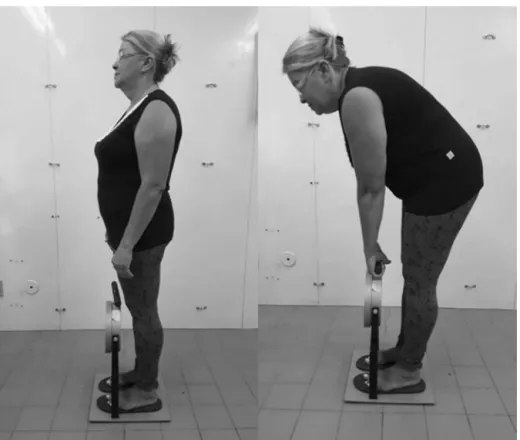
Thedependentvariable wastheMVICoftheback mus-cles,whichwasobtainedwiththeuseofadorsalCROWN® dynamometer(SãoPaulo,Brazil),performedafterthe inter-view (questionnaires) and HG measurement. The patients stood on the marked footprints ofthe dynamometer plat-formand were requested tomaintaina straight backwith armsextendedposteriorlybehindtheindividualand knees extended.Participantsthenperformedanteriorflexionofthe trunk;holdthehandleofthedynamometerwithbothhands and performed the isometric extension for the evaluation ofMVIC(Fig.1).Threemeasurementswereperformedwith standardizedverbalcommands,witharestintervalof1min betweenattempts.
Fig.1–Maximalvoluntaryisometriccontractionofthebackmuscles.Initial(left)andfinal(right)positionofthetest.
Statisticalanalysis
Datanormalitywastestedusingthe Shapiro–Wilktestand arepresentedbymeanandstandarddeviationormedianand quartiles(25–75%)whentheassumptionswerenotmet.The correlation between the dependent and independent vari-ableswasperformedusingthePearsoncorrelationcoefficient. Multivariateregressionanalysistestedthesingleprediction modelsetuptostudytherelationshipofthedependent vari-able(MVICofbackmuscles)withalltheindependentvariables (age,SLEDAI,diagnostictime,intensityoflowbackpain,ODI, TSK,FSSandHS).Thestepwiseregressionmodelwasusedto identifythehighestR2forthetestedmodel.Multicollinearity wasconsideredpresentintheoccurrenceoftolerancep<0.1 andVIFnear1.Forthemultiplelinearregressionthe assump-tions of residues with normal behavior in the graphical representationQ–Q Plot and inthe Shapiro–Wilk testwere met.Statisticalsignificancewas setat5%and all analyses wereperformedwithSPSSversion21.0(Armonk,NewYork).
Results
Fromatotalof96individualsinterviewed,37presentedwith CLBP,however,12wereexcludedduetotheexclusioncriteria. Therefore,25participantstookpartinthestudyandprovided dataforstatisticalanalysis,indicatingapointprevalenceof CLBPof26%.
FromTable1itcanbeseenthatthesamplewascomposed predominantlyofwomen(n=23;92%),withameanageof43 years(SD=13.9),mostparticipantswereemployedandhad highschoolorhighereducation.Table2demonstratesthat
Table1–Descriptiveanalysisofthecharacteristicsofthe sample(n=25).
Characteristics n(%)
Gender
Women 23(91.7)
Men 2(8.3)
Employed(yes) 15(60)
Levelofeducation
None 3(12)
Elementaryschool 3(12)
Highschool 13(52)
Highereducation 6(24)
Physicalactivity(over150min) 8(32)
Smokingstatus
Smoker 4(16)
Ex-smoker 5(20)
Non-smoker 16(64)
Currentcomorbidities
Hypertension 19(76)
Hypothyroidism 2(8)
Dyslipidemia 5(20)
Fibromyalgia 3(12)
Diabetesmellitus 1(4)
Self-evaluationofhealth
Good 7(28)
Regular 13(52)
Bad 5(20)
themediantimesinceSLEdiagnosiswas9years(5–11)with
amedianSLEDAIscoreof3.0(0–10).Themean durationof
Table2–Descriptiveanalysisofthedependentand independentvariables(n=25).
Characteristic Mean(SD)ormedian(25–75%)a 95%CI
Age 42.5(13.6) 36.9;48.7
SLEDAI 3(0–10)a –
DurationofSLE 9(5–11)a –
Pain 5.8(2.3) 4.7;6.6
ODI 20.2(14.2) 10.3;47.5
TSK 42(7.4) 38.6;45
FSS 37.4(14.2) 32.9;45
HS(N) 247.1(72.9) 215;274
MVIC(N) 367.7(159.4) 304;439
SLEDAI,SystemicLupusErythematosusDiseaseActivityIndex;ODI, OswestryDisabilityIndex;TSK,TampaScaleofKinesiophobia;FSS, FatigueSeverityScale;HS,ManualHandgripStrength;MVIC, Maxi-mumVoluntaryIsometricContraction;N,Newton.
a Resultspresentedasmedian(25–75%).
Table3–CorrelationbetweenMVICofbackmusclesand independentvariables.
Independentvariables Dependentvariable
(MVICofbackmuscles)
r 95%IC
Age −0.19 −0.53to0.21
SLEDAI −0.22 −0.55to0.18
DurationofSLE −0.18 −0.53to0.23
Intensityofpain(END) −0.17 −0.22to0.53
ODI −0.4 −0.68to−0.01
TSK −0.23 −0.56to0.17
FSS −0.14 −0.5to0.26
HS(N) 0.72 0.46to0.86
MVIC,MaximumVoluntary Isometric Contraction;SLEDAI, Sys-temicLupusErythematosusDiseaseActivityIndex;END,numerical painscale;ODI,OswestryDisability Index;TSK,TampaScaleof Kinesiophobia;FSS,FatigueSeverityScale;HS,ManualHandgrip Strength.
Table 3 presents the results ofthe correlation analysis betweenthedependentandindependentvariables.Thetwo correlationsselectedwere(1)ODIandMVICoftheback mus-cles(r=−0.4),andbetween(2)MVICofHGandMVICofthe backmuscles(r=0.72).
The model tested presented statistical significance, the highestvalueofR2 beingobservedwhenMVICoftheback muscles(dependentvariable)wastestedwithfive indepen-dentvariables(R2=0.63;R2adjusted=0.53).Inthismodelthe
MVICofHGwastheonlypredictivevariablewithstatistical significance(p=0.001;ˇ=0.61)(Table4).
Discussion
ThepresentstudyaimedtodeterminetheprevalenceofCLBP inpatientswithSLEandtherelationshipbetweentheMVIC ofthebackmusclesandclinical,physicalandfunctional vari-ables.Theresultsdemonstratedapointprevalenceof26%of CLBPinpeoplewithSLE.Theseresultscanbecomparedwith prevalencefiguresforpeoplewithrheumatoidarthritis,15,29–31 andindividualswithCLBP.6
Baykaraetal.15evaluatedtheprevalenceoflowbackpainin patientswithRAandfoundaprevalenceof64.5%.Nevaetal.29 reportedthattheprevalenceofCLBPwas19%inpatientswith RA,suggestingthat,althoughcommoninRA,isnothigher thaninhealthycontrols(25%).However,higherratesofCLBP havebeenreportedinRA,Kotheetal.,30forexample, stud-ied theimpactofCLBPinpatients withRAand reporteda prevalenceof53.4%.Sakaietal.31conductedastudyof radio-graphicimagesofthelumbarspineinpatientswithRAand determinedthattheprevalenceofdisklesionswas45.2%, sug-gestingthisastheoriginofpaininthepopulationdescribed. TheresultsfoundinthepresentstudysuggestthatCLBPin SLEissimilartoorisslightlylowerthanthatfoundinRA,but highlightstheneedforfurtherstudiesonCLBPinSLE.
Somestudieswhichevaluatedtheprevalenceandrisk fac-tors forthe developmentofCLBP inyoungadultsreported a prevalenceranging from15% to45%.6 Meuccietal.32 for example,inasystematicreviewfoundthattheprevalenceof CLBPmayvaryaccordingtoage.Inindividualsbetween24and 39yearstheprevalenceofCLBPwas4.2%,19.6%between20 and59yearsand25.4%intheelderly.Garciaetal.33reported a 10.5% prevalence ofCLBP inthe generalLatin American population,reachingupto65%formoreexposedtorisk fac-tors groupssuchas thoseinvolved inheavymanual labor, forexample,sawyers,truckloaders,homemakers,and assis-tantnurses.NascimentoandCosta.34performedasystematic reviewoftheprevalenceofCLBPinBrazil,andfoundhighrates (>50%)inadults,13.1%–19.5%inadolescentsand4.2%–14.7% forCLBPinthegeneralpopulation.Theresultsfromthe cur-rentstudydemonstratethattheprevalenceofCLBPinthose withSLEisgreaterthanthatfoundinthegeneralpopulation. From thecorrelationanalysisbetweenMVICoftheback musclesandtheindependentvariables,twostatistically sig-nificantcorrelationswereobservedbetweentheODIandMVIC
Table4–Multivariatelinearregression.
Dependentvariable Independentvariable R2 AdjustedR2 Standardizedˇ p
MVIC SLEDAI 0.63 0.53 0.27 0.13
ODI 0.26 0.11
TSK 0.27 0.12
FSS 0.21 0.20
HS 0.61 0.01
(r=−0.4)andbetweenHSandMVIC(r=0.72).Theresultsfound forODIandMVICpresentedamoderatenegativecorrelation, showingthat ahigher MVICofback musclesis associated withlowerfunctionaldisabilityrelatedtopain.Ruizetal.35 demonstratedtherelationshipbetweenthemovementofthe lumbarspine(rangeofmotionwithoutpainandfunctional rangeofmotion),painanddisability(evaluatedusingtheODI) inindividualswithCLBP.Theseauthorsfoundapositive cor-relationbetweentheODIandtheintensityoflowbackpain (thehigherthepain,thehigherthereportedfunctional dis-ability);decreasedrangeofmotionwasalsoassociatedwith greaterdisability.Grönbladetal.36evaluatedthecorrelation betweenthePainDisabilityIndexandtheODIinpatientswith CLBP.Theauthorsalsofoundamoderatepositivecorrelation betweenthe ODI andpain intensity. Our findings allowus tosuggestthatagreaterMVICofthebackmusclesinthose withSLEresultsinalowerimpactonactivitiesofdailyliving (ODI).Thefindingthattherewasastrongpositivecorrelation betweenMVICofHGandMVICofbackmusclessuggeststhat backmuscle strength isdirectly proportional to HG.These findingaresupportedbypreviouswork,forexampleSoares etal.37 analyzedthecorrelation betweenHG, scapularand lumbardynamometertestsinhealthysubjects.Theseauthors demonstrated a moderate positive correlation betweenHG andMVICoflumbarspine(r=0.58).
Regarding the regression analysis, HG was the only predictive variable with statistical significance (p=0.001;
ˇ=0.61). The regression equation can be described as fol-lows:MVIC=a+b*X,wherea=astraightinterceptionconstant on the vertical axis; b=a constant representing the slope ofthe line; X=the variablethat representstheexplanation factor in the equation. Thus, MVIC of the back mus-cles=25.5+1.3*247.1; MVIC=346.73N. Therefore, in clinical practice,HG canpredict MVIC ofbackmuscles inpatients withSLE.Thisfactisundoubtedly clinicallyrelevantsince, accordingto severalstudies,the HG isusedas apredictor ofthegeneralstateofglobalstrength.37,38 Balsamoetal.,16 todeterminetheassociationbetweenmuscularstrengthand dynamicfatigue,functionalperformanceandqualityoflifein patientswithSLE,demonstratedthatofalltheindependent predictivevariablesof52%ofdynamicmusclestrength,theHG wasoneofthepredictorvariableswithstatisticalsignificance (p=0.0027;R2=0.22;ˇ=2.09).
Demoulin et al.39 investigated the relationship between threevariablesoffearrelatedtopain(TSK,PhotographSeries of Daily Activities [PHODA] and Fear Visual Analog Scale) and threespecific testsoffunctional capacity ofthespine (FingerFloorDistance,MVICandtheSorensentest)in indi-vidualswithCLBP,and correlatedwithmeasuresofpain. It was foundthat genderwas the only predictive variable of MIVCwithstatisticalsignificance(p<0.001;ˇ=0.621),which wasnotverifiedinthepresentstudy.Kelleretal.40 investi-gatedthevariablesassociatedwithimprovementsinmuscle strength(pain,fearanddisabilitymeasuredbyODI)and quan-tifiedhowthesevariablescontributedtothechangeinback musclestrengthinpatientswithCLBP.Thechangeinpain, changeinfear-avoidancebeliefs,change inself-efficacyfor painandtreatmentexplained46%ofthechangeinmuscle strength,withchange inpain andtreatment assignificant predictors.
Thecurrentstudyhad somemethodologicallimitations: many participants refused to participate in the research, whichmayhaveresultedinanunderestimationofthe preva-lenceofCLBP,andinsomepatients,itwasalsonotpossible todeterminetheSLEDAI,whichalsogeneratedsampleloss. Finally,theresultsshouldbeinterpretedwithcaution,since the applicationofprediction inthis typeofstudy doesnot necessarilyimplyacauseandeffectrelationship.
TheprevalenceofCLBPinpatientswithSLEattendingthe RheumatologyClinicattheUniversityHospitalwas26%.The correlationanalysisbetweentheMVICandtheindependent variables indicatedtwo statisticallysignificant correlations. TherewasamoderatenegativecorrelationbetweenODIand MVICandastrongpositivecorrelationbetweenHSandMVIC. The MVIC was 63% predicted by five variables ofinterest, however,onlytheHGstrengthwasastatisticallysignificant predictivevariable.
Funding
NationalCounselofTechnologicalandScientificDevelopment (CNPQ).
Conflicts
of
interest
Theauthorsdeclarenoconflictsofinterest.
Acknowledgments
Wewouldlikethanktherheumatologistsandresidentsof Uni-versityHospitalforscreeningthepatientsandforalltheeffort duringtheclassificationofpatientsusingtheSystemicLupus ErythematosusDiseaseActivityIndex(SLEDAI).
r
e
f
e
r
e
n
c
e
s
1.AnderssonGBJ.Epidemiologicalfeaturesofchroniclow-back pain.Lancet.1999;354:581–5.
2.AiraksinenO,BroxJI,CedraschiC,HildebrandtJ,
Klaber-MoffettJ,KovacsF,etal.COSTB13Workinggroupon guidelinesforchroniclowbackpain.EurSpineJ.2006;15 Suppl.2:S192–300.
3.DagenaisS,CaroJ,HaldemanS.Asystematicreviewoflow backpaincostofillnessstudiesintheUnitedStatesand internationally.SpineJ.2008;8:8–20.
4.DeyoRA,CherkinD,ConradD,VolinnE.Cost,controversy, crisis:lowbackpainandthehealthofthepublic.AnnuRev PublHealth.1991;12:141–56.
5.IndrakantiSS,WeberMH,TakemotoSK,HuSS,PollyD, BervenSH.Valuebasedcareinthemanagementofspinal disorders:asystematicreviewofcostutilityanalysis.Clin Orthop.2012;470:1106–23.
6.FurtadoRNV,RibeiroLH,AbdoBA,DescioFJ,MartucciJunior CE,SerruyaDC.Nonspecificlowbackpaininyoungadults: qssociatedriskfactors.BrazJRheumatol.2014;54:371–7.
8. UngprasertP,SagarV,CrowsonCS,AminS,MakolA,Ernste FC,etal.Incidenceofsystemiclupuserythematosusina population-basedcohortusingrevised1997AmericanCollege ofRheumatologyandthe2012SystemicLupusInternational CollaboratingClinicsclassificationcriteria.Lupus.2016:2016.
9. BordaEF,LatorreLC,BrenoJCT,KayserC,SilvaNA, ZimmermannF,etal.Consensusofsystemiclupus erythematosus.BrazJRheumatol.2008;48:196–207.
10.VilarMJ,SatoEI.Estimatingtheincidenceofsystemiclupus erythematosusinatropicalregion(Natal,Brazil).Lupus. 2002;11:528–32.
11.BertsiasGK,IoannidisJPA,BoletisJ,BombardieriS,CerveraR, DostalC,etal.EULARrecommendationsforthemanagement ofsystemiclupuserythematosus.Reportofataskforceofthe EULARstandingcommitteeforinternationalclinicalstudies includingtherapeutics(ESCISIT).AnnRheumDis.
2008;67:195–205.
12.HochbergMC.UpdatingtheAmericanCollegeof Rheumatologyrevisedcriteriafortheclassificationof systemiclupuserythematosus.ArthritisRheum. 1997;40:1725.
13.CriswellLA.Thegeneticcontributiontosystemic
lupuserythematosus.BullNYUHospJtDis.2008;66:176–83.
14.JohnssonM,SandqvistG,NilssonJA,BengtssonAA,Sturfelt G,NivedO.Handfunctionandperformanceofdailyactivities insystemic.Lupus.2015;24:827–34.
15.BaykaraRA,ZulkifB,OzgurA,OzgocmenS.Lowbackpainin patientswithrheumatoidarthritis:clinicalcharacteristics andimpactoflowbackpainonfunctionalabilityandhealth relatedqualityoflife.JBackMusculoskeletRehabil. 2013;26:367–74.
16.BalsamoS,MotaLMH,CarvalhoJF,NascimentoDdaC, TibanaRA,deSantanaFS,etal.Lowdynamicmusclestrength anditsassociationswithfatigue,functionalperformance, andqualityoflifeinpremenopausalpatientswithsystemic lupuserythematosusandlowdiseaseactivity:acase–control study.BMCMusculoskeletalDisord.2013;14:263.
17.BalsamoS,NetoLS.Fatigueinsystemiclupuserythematosus: anassociationwithreducedphysicalfitness.Autoimmun Rev.2011;10:514–8.
18.BalsamoS,NascimentoDDC,TibanaRA,SantanaFSD, MotaLMH,Santos-NetoLLD.Thequalityoflifeofpatients withlupuserythematosusinfluencescardiovascularcapacity in6-minutewalktest.BrazJRheumatol.2013;53:81–7.
19.ChoiBK,VerbeekJH,TamWW,JiangJY.Exercisesfor preventionofrecurrencesoflow-backpain.Cochrane DatabaseSystRev.2010:CD006555.
20.BarbettaPA.Statisticsappliedtosocialsciences.1sted. Florianopolis:UFSC;1984.
21.SilvaC,CanhãoH,BarcelosA,MirandaL,PintoP.Protocolfor evaluationandmonitoringofsystemiclupuserythematosus (PAMLES).ActaReumatolPort.2008;33:210–8.
22.FreireEAM,SoutoLM,CiconelliRM.Assessmentmeasuresin systemiclupuserythematosus.BrazJRheumatol.
2011;51:75–80.
23.ChildsJD,PivaSR,FritzJM.Responsivenessofthenumeric painratingscaleinpatientswithlowbackpain.Spine (PhilaPa1976).2005;30:1331–4.
24.VigattoR,AlexandreNMC,FilhoHRC.Developmentofa BrazilianPortugueseversionoftheOswstryDisabilityIndex. Spine.2007;32:481–6.
25.RoelofsJ,GoubertL,PetrsML,VlaeyenJW,CrombezG.The TampaScaleforKinesiophobia:furtherexaminationof psychometricpropertiesinpatientswithchroniclowback painandfibromyalgia.EurJPain.2004;8:495–502.
26.KruppLB,LaRoccaNG,MuirJ,SteinbergAD.Astudyoffatigue insystemiclupuserythematosus.JRheumatol.
1990;17:1450–2.
27.RantanenT,VolpatoS,FerrucciL,HeikkinenE,FriedLP, GuralnikJM.Handgripstrengthandcause-specificandtotal mortalityinolderdisabledwomen:exploringthe
mechanism.JAmGeriatrSoc.2003;51:636–41.
28.FessEE.Documentation:essentialelementsofanupper extremityassessmentbattery.In:HunterJM,MackinEJ, CallahanAD,editors.Rehabilitationofthehandandupper extremity.5thed.SaintLouis:Mosby;2002.p.263–84.
29.NevaMH,HakkinenA,IsomakiP,SokkaT.Chronicbackpain inpatientswithrheumatoidarthritisandinacontrol population:prevalenceanddisability–a5-yearfollow-up. Rheumatology(Oxford).2011;50:1635–9.
30.KotheR,KohlmannT,KlinkT,RutherW,KlinglerR.Impactof lowbackpainonfunctionallimitations,depressedmoodand qualityoflifeinpatientswithrheumatoidarthritis.Pain. 2007;127:103–8.
31.SakaiT,SairyoK,HamadaD,HigashinoK,KatohS,TakataY, etal.Radiologicalfeaturesoflumbarspinallesionsinpatients withrheumatoidarthritiswithspecialreferencetothe changesaroundintervertebraldiscs.SpineJ.2008;8:605–11.
32.MeucciRD,FassaAG,FariaNMX.Prevalenceofchroniclow backpain:systematicreview.RevSaúdePública.2015;49:73.
33.GarciaJBS,Hernandez-CastroJJ,NunezRG,PazosMA,Aguirre JO,JreigeA,etal.PrevalenceoflowbackpaininLatin America:asystemicliteraturereview.PainPhysician. 2014;17:379–91.
34.NascimentoPRC,CostaLO.Lowbackpainprevalencein Brazil:asystematicreview.CadSaúdePública.
2015;31:1141–56.
35.RuizFK,BohlDD,WebbML,RussoGS,GrauerJN.Oswestry DisabilityIndexisabetterindicatoroflumbarmotionthan theVisualAnalogueScale.SpineJ.2014;14:1860–5.
36.GrönbladM,HupliM,WennerstrandP,JärvinenE,Lukinmaa A,KouriJP,etal.Intel-correlationandtest–retestreliabilityof thepaindisabilityindex(PDI)andtheOswestryDisability Questionnaire(ODQ)andtheircorrelationwithpainintensity inlowbackpainpatients.ClinJPain.1993;9:189–95.
37.SoaresAV,CarvalhoJuniorJM,FachiniJ,DomenechSC,Borges JuniorNG.Correlationbetweenhandgrip,scapularand lumbardynamometrytests.RevActaBrazMovHum. 2012;2:65–72.
38.BohannonRW.Hand-gripdynamometrypredictsfuture outcomesinagingadults.JGeriatrPhysTher.2008; 31:3–10.
39.DemoulinC,HuijnenIPJ,SomvillePR,GrosdentS,SalamunI, CrielaardJM,etal.Relationshipbetweendifferentmeasures ofpain-relatedfearandphysicalcapacityofthespinein patientswithchroniclowbackpain.SpineJ.2013; 13:1039–47.