Voice Disorder: case definition
and prevalence in teachers
Disfonia: definição de caso e
prevalência em professores
Renata Jardim
1Sandhi Maria Barreto
2Ada Ávila Assunção
21 Speech Therapist, master in Public Heath
2 School of Medicine. Universidade Federal de Minas Gerais
Correspondência: Renata Jardim. Rua Castelo de Abrantes, 424/203, Castelo. Cep 31330020 -Belo Horizonte/MG. E-mail: [email protected]
Abstract
Several studies have shown a high preva-lence of voice disorders among teachers. However, it is difficult to establish com-parisons among the results found given the great variability among criteria and symp-toms used to define the presence of vocal alteration, in addition to the variations in the composition of the populations stud-ied (age, gender, origin, working schedule, profession, among others).
This study aims to discuss the need for a standard definition of functional voice dis-order and possible implications of the lack of such a standard definition on estimat-ing the prevalence of functional voice dis-orders among teachers. A systematic bib-liographic review on voice disorders in teachers was carried out as of 1990 in the Medline, Scielo, Ovid, Pubmed and Lilacs databases.
Of the 3,186 citations, 15 fulfilled the inclu-sion criteria to discuss prevalence of vocal disorder in teachers. Nine articles defined vocal disorder based solely on the presence of vocal symptoms, which varied in relation to type, number, frequency, and reference period. Hoarseness and vocal tiredness were mentioned in all studies that evaluated vocal symptoms. Only three studies re-ported prevalence based on professional examination. Prevalence rates varied ac-cording to reference period and frequency of symptoms. The results ratified the impor-tance of standardizing the case definition of voice disorder in order to better study and understand its occurrence and to compare prevalence obtained from different popu-lations and along time in the same popula-tion. Standardized definitions should in-clude laryngeal alterations observed in later phases of voice disorder as well as signs and symptoms present in phases previous to organic alterations, when they are poten-tially reversible.
Keywords KeywordsKeywords Keywords
626 Rev Bras Epidemiol 2007; 10(4): 625-36
Voice Disorder: case definition and prevalence in teachers Jardim, R. et al.
Introduction
The voice is an important work tool. In fact, a job can be classified based on its demand regarding voice quality and vocal
load1. Actors and singers comprise the
group that needs high quality and high vo-cal load; radio and TV casters have high quality and moderate vocal load; school and kindergarten teachers need moderate quality and high vocal load.
Voice professionals make intensive use of their voice, frequently under
environ-mental and organizational constraints2-6.
In teachers’ work, the voice assumes an outstanding importance, influencing their relationship with students and among their partners. Teachers’ voice is an important resource to gain respect, attention and make work more interesting. Voice quality and teachers’ way of expression can influ-ence students’ receptivity to lessons. Yura
et al.7 found an association between
graphic mistakes in 2nd grade school
chil-dren and teachers’ voice alterations
dur-ing dictate exercises. Rogerson and Dodd8,
in a study with 107 children aged 9.8 years on average, came to the conclusion that any degree of vocal alteration (mild or se-vere) may interfere in children’s speaking process and, therefore, may have a nega-tive effect on their education.
Noise, the number of students in the classroom, working schedule, dust, chalk use, classroom lighting and ventilation, years of teaching, difficult relationship with colleagues, students and authorities, among other factors, tend to impose an
intense vocal load. According to Vilkman9,
vocal load is a combination of vocal load-ing time with additional factors such as size of groups, background noise, unsuitable environmental acoustics, and bad air qual-ity, which end up affecting the fundamen-tal frequency, type and loudness of pho-nation or the vibratory characteristics of the vocal folds as well as the external frame of the larynx.
A study by Martins et al.4 in a primary school in the city of São Paulo, Brazil,
mea-Resumo
Várias pesquisas têm mostrado elevada prevalência de disfonia em professores, porém não há uma definição padronizada de alteração vocal nos estudos realizados, o que dificulta a comparação dos resulta-dos obtiresulta-dos e o desenvolvimento da pes-quisa na área.
O objetivo deste estudo foi discutir a neces-sidade de padronizar a definição de disfonia funcional e discutir possíveis implicações da falta da padronização na estimação da prevalência da disfonia funcional em pro-fessores. Foi realizada uma revisão biblio-gráfica sistemática sobre disfonia em pro-fessores, por meio de consulta a diversas bases de dados, sendo considerados os ar-tigos publicados a partir de 1990.
De 3.186 citações, 15 artigos preencheram os critérios de inclusão para a discussão da prevalência da disfonia em professores. Nove artigos definiram disfonia baseados somente na presença de sintomas vocais, com variações em relação ao tipo, núme-ro, freqüência e período de referência. Rouquidão e cansaço vocal foram menci-onados em todos os estudos que avaliaram sintomas vocais. Somente três estudos analisaram a prevalência da disfonia ba-seada na avaliação profissional. As preva-lências variaram conforme o período de referência e a freqüência dos sintomas pesquisados.
Os resultados ratificaram a importância de padronizar a definição de disfonia para melhor estudar e compreender a sua ocor-rência e comparar a prevalência obtida em diferentes populações e através do tempo, em uma mesma população. A definição padronizada da disfonia deveria incluir al-terações laríngeas observadas em fases mais avançadas da disfonia, assim como sinais e sintomas presentes em fases que precedem as alterações orgânicas, poten-cialmente reversíveis.
Palavras-chave: Palavras-chave:Palavras-chave:
sured the relation between vocal signal and noise in different hours and places, and considered a suitable level for learn-ing as > 15 dB. They found environmental noise varying from 58 to 84 dB (A), reach-ing 110 dB (A) durreach-ing the school break, while teachers’ voice intensity varied from 79.5 to 90.5 dB (A), intensities only found in a screaming voice.
Voice disorders in teachers have been the object of several studies given their high prevalence. In a cross sectional study of
work and health conditions6 of 250 private
school teachers in Vitória da Conquista, Brazil, 93% of teachers reported intensive voice use, 62% felt tired when speaking and 57% had to make an effort to be heard.
Delcor et al.6 studied 573 private school
teachers in Salvador, Brazil, and found 23% of temporary voice loss and 12% of nodules in vocal folds.
Eighty seven percent of 772 teachers examined by an otolaryngology service in
Buenos Aires, Argentina5, from 1985 to
1998, had functional voice disorders. The most common symptom was decrease in voice strength, involving intensity (physi-cal aspect), sonority (physi(physi-cal-physiologi- (physical-physiologi-cal aspect) and the sensation of a foreign body in the larynx.
The voice may be characterized by its vocal quality according to vocal param-eters such as fundamental frequency, in-tensity, resonance, and vocal intonation. The perceptual correlates of frequency are called pitch or subjective frequency sen-sation adequate to age and sex and, the perceptual correlate of intensity, are called loudness, or subjective intensity sensation
adequate to the environment10.
An individual’s voice indicates charac-teristics such as gender, age, personality traits, emotional state and cultural heri-tage11. It expresses individual identity and allows distinguishing one individual from another. In different phases of life – child-hood, teenage, adulthood and old age – the voice reflects several aspects of the individual’s physical, social, cultural and
psychological development12.
A healthy voice is the one that fully meets the speaker’s professional and/or personal needs and is kept along a person’s life without difficulties. Hormonal alter-ations, allergies, flu, vascular problems, neurological and psycho-emotional disor-ders, surgeries as well as other factors re-lated to general health may influence vocal health10.
However, there are no standardized parameters to evaluate the patterns and limits of a normal voice and some changes in voice are expected and socially accept-able during vocalization. But, even taking these changes into account, some alter-ations cannot be considered as markers of social or emotional expression. These
changes are then regarded as dysphonia11.
According to Speech-language pathol-ogy, dysphonia is any alteration in the per-formance or production of the voice that
may interfere in communication14. In the
American Heritage® Stedman’s Medical Dictionary, dysphonia is defined as a diffi-culty in speaking, usually evidenced by hoarseness15.
Dysphonia or voice disorder is diag-nosed by speech therapists and otorhino-laryngologists, following a clinical evalua-tion based on subjective and objective fac-tors. They are classified as functional, or-ganic or oror-ganic-functional. Functional dys-phonia is caused by vocal misuse and oc-curs in the absence of an organic alteration. Organic dysphonia is not caused, but can be worsened, by vocal behavior. Organic-functional dysphonia results, in general, from a late diagnosis of functional dyspho-nia, being, thus, a consequence of voice
misuse14,16. The incidences of functional
and organic-functional disorders are, thus, of greater interest because they can be pre-vented, in contrast to organic dysphonia.
628 Rev Bras Epidemiol 2007; 10(4): 625-36
Voice Disorder: case definition and prevalence in teachers Jardim, R. et al.
be a causal factor of work related voice dis-orders.
The study of any health condition in population groups requires a clear defini-tion of the condidefini-tion under study, which allows the investigator to differentiate healthy from unhealthy individuals. As pointed out before, the definition of voice disorder is not standardized and assumes different forms and classifications in dif-ferent studies. It is a complex, multi-deter-mined phenomenon with different ways of expression and, consequently, of diagno-sis. As a result, it is difficult to establish comparisons among the results of studies on functional or organic-functional voice disorders, given the great variability in the criteria and symptoms used to define the presence of such alterations.
Because voice disorder results from an underlying alteration in the structures or in the work of the vocal trait: breathing, vocalization or resonance, it may be ex-pressed by several symptoms. The most common include tiredness or effort when speaking, throat clearing or persistent coughing, sensation of tightness or weight in the throat, voice breaks, breathlessness when speaking, aphonia, soreness or burn-ing in the throat, hoarseness17-21.
This study aims to discuss the need for a standard definition of functional voice disorder and to discuss possible implica-tions of the lack of such a standard defini-tion on epidemiological studies of the prevalence of these disorders among teachers.
Methods
A systematic bibliographic review on voice disorders in teachers was carried out in the Medline, Scielo, Ovid, Pubmed and Lilacs databases for the 1990-2005 period. Key-words used in the research were: voice disorder, vocal alterations/problems, teachers, vocal symptoms, voice profes-sionals and vocal health.
All abstracts were read by one of the authors (JR) and the full article was selected
only when all the following inclusion cri-teria were fulfilled:
• The article was published in
Portu-guese, English, French or Spanish;
• The article presented the results of an
observational epidemiological study on prevalence of voice disorder;
• The study population was public or
pri-vate school teachers at any educational level.
The quality of the study was not consid-ered nor judged. All the articles that met the inclusion criteria were then read and grouped according to characteristics of the study population, definition of voice disor-der employed and prevalence of the condi-tion. We also identified if voice alteration was based on a report of a previous diagno-sis of the condition by a health professional In each study, the number of symptoms, signs, frequency and period used to define voice disorders were identified. We also evaluated the consequence of a given case definition by its impact on the prevalence of the disorder in a given period. For in-stance, a definition based on presence of any vocal symptom with no regard to num-ber, frequency and period would necessar-ily tend to define as positive almost every-one in the study population, being very little informative. A definition based on presence of two or more vocal symptoms, such as everyday in the last 15 days, would be clearer and easier to interpret and compare. In order to identify positive and negative aspects of a given definition, we used a proxy to the concept of sensitivity and specificity22. Because there is not a ‘gold standard’
defi-nition of dysphonia to compare with23, we
Results
Using only ‘voice disorder’ as a key word, we found 3,186 citations in the Vir-tual Health Library, of which 333 were in Lilacs, 2,836 in Medline, 6 in ADOLEC, and 11 in BBO. Using ‘voice disorder’ and ‘teachers’ as descriptors, we found 31 ci-tations in Scielo and 23 in Medline, of which only 15 fulfilled the inclusion crite-ria to discuss prevalence of vocal disorder in teachers.
The different definitions of voice dis-order used in epidemiological studies and our comments are presented in Chart 1. Among the 15 selected epidemiological studies on voice disorder prevalence in teachers (Chart 1), only one study included the report of previous diagnosis of a laryn-geal problem21 as one of the criteria.
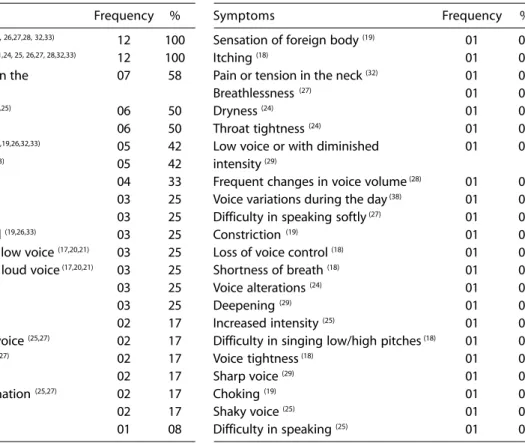
Nine articles17-21,24-27 defined vocal
dis-order based solely on the presence of vo-cal symptoms, but the list of symptoms varied slightly (Table 1). These nine stud-ies were all regarded as very sensitive, since they would capture most of the people with any actual problem. However, specificity varied in relation to inclusion of number, frequency of symptoms and reference pe-riod. Regarding the frequency of symptoms - continuous28, frequent17 and occasional29 – the prevalence of voice disorders was
lower for continuous symptoms. 28 The
ref-erence period of symptoms was not speci-fied in one article29 and three studies as-sessed lifelong prevalence18, 25, 30.
Hoarseness and vocal tiredness were mentioned in all studies that evaluated vocal symptoms. The other symptoms mentioned were, in decreasing order: pain when speaking, effort to speak, weak voice, aphonia and throat clearing (Table 1).
Table 1 - Frequency of vocal symptoms reported in 12 epidemiological studies on voice disorder in teachers that used
symptoms in your definitions.
Tabela 1 – Freqüência de sintomas vocais relatados em 12 estudos epidemiológicos sobre disfonia em professores que usaram sintomas em suas definições
Symptoms Frequency % Symptoms Frequency % Hoarseness (17,18,19,20,21,24,25, 26,27,28, 32,33) 12 100 Sensation of foreign body (19) 01 08
Vocal tiredness (17,18,19,20,21,24, 25, 26,27, 28,32,33) 12 100 Itching (18) 01 08
Pain when speaking or in the 07 58 Pain or tension in the neck (32) 01 08
throat (18,19,24,26, 28,32, 33) Breathlessness (27) 01 08
Effort to speak (17,20,21,19,27,25) 06 50 Dryness (24) 01 08
Weak voice (17,18,19,20,21) 06 50 Throat tightness (24) 01 08
Voice loss or Aphonia (18,19,26,32,33) 05 42 Low voice or with diminished 01 08
Throat clearing (18,19,24,25,33) 05 42 intensity (29)
Voice breaks (19,26,32,33) 04 33 Frequent changes in voice volume (28) 01 08
Throat soreness (25, 26,27) 03 25 Voice variations during the day (38) 01 08
Dry throat (25,27,32) 03 25 Difficulty in speaking softly (27) 01 08
Difficulty in being heard (19,26,33) 03 25 Constriction (19) 01 08
Difficulty in speaking in low voice (17,20,21) 03 25 Loss of voice control (18) 01 08
Difficulty in speaking in loud voice (17,20,21) 03 25 Shortness of breath (18) 01 08
Spasms in voice (17,20,21) 03 25 Voice alterations (24) 01 08
Hissing in voice (17,20,21) 03 25 Deepening (29) 01 08
Soreness (32,24) 02 17 Increased intensity (25) 01 08
Difficulty in projecting voice (25,27) 02 17 Difficulty in singing low/high pitches (18) 01 08
Loss of singing range (25,27) 02 17 Voice tightness (18) 01 08
Difficulty in singing (25,27) 02 17 Sharp voice (29) 01 08
Discomfort during phonation (25,27) 02 17 Choking (19) 01 08
Monotone voice (25,27) 02 17 Shaky voice (25) 01 08
6630 Rev Bras Epidemiol 2007; 10(4): 625-37
Voice Disorder: case definition and prevalence in teachers Jardim, R. et al.
Author, year and place of publication
Defi nition Comments
Urrutikoetxea et al. (1995), Spain(28)
1) Professional diagnosis of alterations in vocal folds and in voice quality.
2) Report of hoarseness, vocal tiredness, frequent changes in voice volume and pain when speaking: continuous, frequent and occasional.
1- Based on professional evaluation.
2- Based on individual’s subjectivity.
Smith et al. (1997). Philadelphia/ USA. (17)
Report of hoarseness, vocal tiredness, diffi culty in speaking low, weak voice, effort to speak, diffi culty in speaking loud, spasms and hissing in the voice. Frequency of symptoms not taken into account
Based on individual’s subjectivity.
Bacha et al. (1999), Campo Grande/MS/ Brazil. (32)
1 -Report of vocal symptoms: hoarseness, voice breaks and voice loss.
2- Report of sensorial symptoms: sore throat, pain in the nape, soreness in the throat tiredness when speaking and dry throat.
3- Report of frequent vocal and/or sensorial symptoms and of alterations in the laryngeal and in voice quality.
1- Based on individual’s subjectivity.
2- Based on individual’s subjectivity.
3- Based on professional evaluation.
Russell et al. (1998), South Australia(31)
Report of vocal problems in relation to the teacher’s career. Frequency of symptoms not taken into account.
Based on individual’s subjectivity.
Smith et al. (1998a) 20
and Smith et al. (1998b). Iowa/USA. (21)
Report of vocal symptoms associated to a teacher’s work: hoarseness, vocal tiredness, diffi culty in speaking low, weak voice, effort to speak, diffi culty in speaking loud, spasms and hissing in the voice. Take into account duration but not frequency of symptoms.
Based on individual’s subjectivity.
Pordeus et al. (1999), Fortaleza/CE/ Brazil(24)
Report of vocal symptoms: dryness, throat clearing, soreness, hoarseness, tightness sensation, pain, voice alterations and others. Different number of symptoms and frequency.
Based on individual’s subjectivity.
Sala et al. (2001). Hel-sinki/Finland. (33)
Report of two or more symptoms (throat clearing, vocal tiredness, hoarseness, sore throat, voice breaks, diffi culty in being heard, voice loss) at least once a week plus alteration of vocal quality or laryngeal alteration.
Based on individual’s subjectivity plus examination by specialist.
Yiu (2002). Hong Kong/ China(18)
Score based on frequency and presence of throat clearing, hoarseness, shortness of breath, inability to sing sharp pitches, vocal tiredness or fatigue, itchy throat, weak voice, sore throat, voice loss, voice tightness, inability to sing deep pitches and loss of voice control.
Based on individual’s subjectivity.
Fuess and Lorenz (2003). Mogi das Cruzes/SP/Brazil(25)
1- Report of voice disorder and vocal fatigue or pain when speaking.
2- Report of diagnosis of laryngeal problem.
3- Report of constant symptoms plus laryngeal alteration based on physical examination.
1-Based on individual’s subjectivity.
2-Based on previous diagnosis.
3-Based on professional examination.
Simberg et al. (2004) Turkey and Helsinki/ Finland. (19)
Report of throat clearing or coughing, weak voice or hoarseness, strain or tired voice, voice breaks, sensation of pain or foreign body in the throat, diffi culty in being heard and voice loss, according to frequency of symptoms.
Based on individual’s subjectivity.
Roy et al (2004a). Utah and Iowa/USA. (25)
Report of hoarseness, vocal fatigue, trouble in singing or speaking softly, loss of singing range, discomfort during phonation, monotone voice, effort when speaking, chronic sensation of dry or sore throat. Frequency not considered.
Based on individual’s subjectivity.
Thibeault et al. (2004), Utah and Iowa/USA (30)
Report of vocal problem defi ned as ‘voice that does not work’ or ‘does not sound as usual’ for at least 4 weeks.
Based on individual’s subjectivity.
Roy et al. (2004b). Iowa and Utah/USA (27)
Report of any voice disorder in relation to its performance or production that may interfere in communication. Vocal symptoms considered: hoarseness, vocal fatigue, trouble speaking or singing, diffi culty in projecting voice, loss of singing range, discomfort when speaking, effort when speaking, monotone voice, chronic dry throat, frequent throat clearing and shaky voice.
Based on individual’s subjectivity.
Simberg et al. (2005). Turkey/Finland. (26)
Report of voice tiredness, hoarseness, voice breaks, diffi culty in being heard, pain around larynx and aphonia, in the absence of cold.
Based on individual’s subjectivity, but excludes common cold.
Chart 1 - Different definitions of voice disorder used in epidemiological studies and comments on diagnosis criteria.
Two studies30,31 did not present a list of vocal symptoms, using the term ‘vocal problem’ in a teacher’s career to evaluate prevalence of vocal disorder. For this rea-son, we considered them as case defini-tions with low specificity.
Four studies based case definition on vocal or laryngeal evaluation by a qualified professional28,29,32,33, being thus, more spe-cific than the others. Three of them28,32,33 considered vocal qualities, laryngeal alter-ation and the report of audible perceptive and proprioceptive vocal symptoms. The study by Fuess & Lorenz (2003)29 is more specific than the others, since it includes that only those who reported constant problems had their larynx examined by a specialist.
Chart 2 presents the 15 studies and a summary of the prevalence of voice disor-ders among teachers. Twelve studies were carried out in developed countries and three in Brazil. Gender was only men-tioned in five studies17,19,20,30,31.
The prevalence varied from 4% to 93.7%, according to case definition, fre-quency of symptoms and period of refer-ence. The prevalence of vocal disorders
based on organic alterations was 20.84%28
and the one based on professional
exami-nation was 30.87%32. The prevalence based
on current report of symptoms varied from 11% 25 and 17%28. The report of occasional voice disorders was researched in two studies and, the prevalence varied from 57% 29 and 75%.28
Discussion
All studies included in this systematic review contribute to increase the knowl-edge on voice disorders in teachers and help to select the criteria to improve the definition of the condition in future obser-vational studies. Despite the lack of a stan-dard definition, studies included in this review show that the prevalence of voice disorders is high among teachers, reinforc-ing the importance of havreinforc-ing a common definition to determine and compare its
prevalence among different groups and to allow the investigation of possible work-related risk factors for this condition.
As voice disorder is a complex phenom-enon that is expressed in several ways and has different levels of severity, it would be interesting to have more than one stan-dardized case definition, reflecting differ-ent stages and severity of the disorder. For instance, in earlier phases of functional voice disorder, symptoms are present, but it is rare to find any organic sign. When it becomes chronic, then both, symptoms and organic alterations in the vocal tract, tend to be present. The type, number and frequency of symptoms help to determine the severity of the problem.
Symptom reports seem appropriate, for instance, for screening purposes, and should include only current symptoms, which could be appreciated in relation to their effect on individuals’ everyday lives, for instance. In prevalence studies, it is essential to adopt a clear definition, i.e., based on type, frequency, duration and number of symptoms. In studies aimed at assessing the severity of voice disorder, the inclusion of physical examination would allow a clearer description and classifica-tion of the problem.
The analysis of the studies also shows the use of different expressions to refer to the same symptom, as in the case of quent changes in voice volume’ or ‘fre-quent voice variations’. Other symptoms are too generic and bring little information, such as ‘discomfort during phonation’. Such diversity of vocal symptoms in the nomenclature increases the difficulties to interpret and compare different results on the prevalence of the disorder in teachers. Studies such as the one by Scott et al. 34, investigated vocal complaints of 133 dys-phonic patients by means of an open-ended questionnaire inquiry and adopted the
World Health Organization35 classification
6632
R
ev Bras Epidemiol
2007; 10(4): 625-37
V
o
ic
e Disorder
: case definition and prev
alence in t
eachers
Ja
rdim,
R.
et al.
Author, place and year
Defi nition of voice disorder and reference period Population study Voice disorder Prevalence
Urrutikoetxea et al. (1995), Guipuzcoa/ Spain. (28)
Alterations in voice quality, alterations in vocal folds and report of vocal symptoms. Reference period: problems in the past and/or actual, frequency and duration.
1,046 teachers. (63% women and 37% men) in public teaching. There were 1,130 teachers (100%), but 84 refused to undergo fi ber-laryngeal-stroboscopy.
20.84% (n=218) presented organic alteration in PPVV. 70% of teachers claimed they had had voice problems during their professional career; of these, 17.3% reported current vocal problems, 75% reported feeling occasional, 22% frequent and 4% continuous problems.
Smith et al. (1997). Philadelphia. (17)
Vocal symptoms and adverse effects of vocal disorders in career. Reference period: along all the career/ currently. 1symptom or 2 or + were considered.
242 teachers and random sample of 178 non-teachers adults.
14.6% of teachers and 5.6% of non-teachers reported current voice problems.
Bacha et al. (1999) Campo Grande/ MS/Brazil. (32)
Vocal symptoms and/or alteration in voice quality and/or in larynx. Reference period: before or after classes; considered as frequent: + of 2 once p/year, sometimes: 2 once p/year, and rarely: at least 1p/year.
311 pre-school teachers (64%) in 130 private schools (88%). 146 teachers were referred to an otolaryngologist (ORL), but only 47 showed up.
30.87% presented voice disorder in the audio-perceptive voice evaluation. 43.41% reported voice problems. All teachers who underwent ORL had at least one sign of organic or functional alteration was found.
Russell et al (1998), South Australia.(31)
Teachers who reported having vocal problems at least every six months, during the year and on the day of study in relation to the teacher’s career.
Random sample of 1,168 out of 9,205 South Australian school teachers of 480 out of the 1,060 registered schools in the 1996 census.
12.9% of teachers (men) and 22% of teachers (women) reported having voice problems at least every 6 months during their career; 14.3% of men and 22.5% of women reported having voice problems at least 2 or 3 m during their career and 11.9% of men and 18.2% of women reported voice problems on the day of study. Smith et al.
(1998a) Iowa/ USA. (20)
Vocal symptoms and voice problems associated with teacher’s work. Reference period: currently, in the past, acute or chronic and problem duration (0 to 5, 6 to 10, 11 to 15 and over 16 years).
554 teachers employed during 1994 according to data from the Iowa Education Ministry (60%), being 274 men and 280 women. Comparison group: 220 non-teachers
32% of teachers reported having had some voice problems vs. 1% of non-teachers. The reported vocal symptoms that had statistical signifi cance between groups were: Vocal tiredness (18.1% teachers vs. 10.5% teachers); weak voice (10.7% teachers vs. 4.6% non-teachers) and effort to speak (9.8 teachers vs. 3.2% non-teachers). Teachers had 3.8 times more chances to report symptoms of physical discomfort than non-teachers.
Smith et al. (1998b) Iowa/ USA. (21)
Vocal symptoms and voice problems associated to teacher’s work. Reference period: currently, in the past, acute or chronic and problem duration (0 to 5 , 6 to 10, 11 to 15 and over 16 years).
274 teachers (men) and 280 teachers (women). 462 questionnaires were sent to men and 462 to women. Random sample of public and private schools in Iowa.
Almost 60% of teachers reported having had voice problems in the last year, women with 13 days on average with this problems and men 8 days. Female teachers reported signifi cantly more acute (38% vs. 26%) and chronic voice problems than male teachers. Pordeus et al.
(1999), Fortaleza/ CE/Brazil (24)
Vocal symptoms. Reference period: frequent and after classes.
80.7% (489) of teachers of the University of
Fortaleza.
28% reported frequent hoarseness; 20.2% hoarseness after teaching day and 12.5% 3 or + symptoms. Most frequent complaints were those of primary school teachers. Sala et al. (2001).
Finland. (33)
Vocal symptoms or abnormality in voice quality. Individuals with 2 or + of the 7 vocal symptoms in the questionnaire at least once/week and/or alteration in voice quality (general degree of GRBAS scale = or > than 2) and/or laryngeal alterations. Reference period: last year or two last years.
Random sample of 262 teachers of 27 different day care centers in Finland, 98% of which were women. Control group: 108 nurses of a university hospital, with random selection.
Half of teachers and ¼ of nurses had vocal disorder according to defi nition. 13% of teachers presented alteration in voice quality in the past year; teachers had twice as many vocal disorders than nurses, including symptoms, voice quality and laryngeal alteration. Chart 2 - Summary of the prevalence of voice disorder among teachers
633
R
ev Bras Epidemiol
2007; 10(4): 625-36
V
o
ice Disor
der
: case definition and pr
e
valenc
e in t
eachers
Ja
rdim,
R.
et al.
Chart 2 - Summary of the prevalence of voice disorder among teachers. (continuation)
Quadro 2 – Resumo da prevalência de disfonia em professores. (continuação)
Author, place and year
Defi nition of voice disorder and reference period Population study Voice disorder Prevalence
Yiu (2002). Hong Kong/China. (18)
Diffi culties in phonation, deviations in voice quality and/or physical discomfort or symptom related to voice use. Reference period: Part 1 – last 12 months and in the career. Part 2 – last 6 months, in life and currently.
3 groups (161 people): 55 acting teachers participants of workshop on teacher’s voice (48 women and 7 men); 67 future teachers, senior year university students of the education course and 39 dysphonic non-teachers under therapy for 1 month in two Hong Kong hospitals.
The impact of voice problems on daily tasks and emotions (part1): Teachers had score 10.29 signifi cantly lower than dysphonic 14.13 and signifi cantly higher than group future teachers (6.72); Teachers reported vocal problems signifi cantly + severe or + frequent than group futures teachers. As for self-perception of voice problems (part2): teachers reported less symptoms than dysphonic (4.5 vs. 7.3), but more symptoms than future teachers (0.7).
Fuess and Lorenz (2003). Mogi das Cruzes/SP/Brazil.
(29)
Voice disorder reported by teachers, associated symptoms (vocal fatigue or pain when speaking) and referred diagnosis. Voice disorder was categorized by the teachers according to occurrence in constant, occasional or absent.
451 (99%) pre-school teachers and teachers of the 4 fi rst years of primary school of the 66 local municipal schools.
81%; 57% reported occasional voice disorder, 16% presented
frequent episodes of voice disorder and 8% reported being often hoarse. 56% reported vocal tiredness; of these, 28% constantly. Only 30 of 37 showed up to undergo laryngeal telescope. Main diagnosis was: 27% nodules and 24% normal morphology.
Simberg et al. (2004) Turkey and Helsinki, Finland.
(19)
Vocal symptoms. Reference period: last year up to the moment of study with frequency daily or most days, weekly or most weeks, monthly or most months, little frequency, periodical symptoms or no symptoms.
395 subjects: 175 participants studying to become teachers (student teachers) and 220 students of other professions (others).
Student teachers reported + symptoms (42% vs. 25%) than others. 58% of student teachers did not report symptoms vs. 76% of others; student teachers reported all the 7 symptoms + frequently, and the difference in the symptoms throat clearing or coughing was statistically signifi cant (30% vs. 18%); forced or hoarse voice (21% vs. 10%) and diffi culty in being heard (8% vs. 3%).
Roy et al. (2004a). Iowa and Utah/ USA. (25)
Vocal symptoms. Reference period: all life or at the moment. Difference between chronic (≥4 weeks) and acute (<4 weeks).
2531 participants: 1,243 (49.1%) teachers and 1,288 (50.9%) non-teachers.
58% of teachers reported voice disorder along life against 29% of non-teachers. 11% of teachers reported current voice disorder vs. 6.2%. Men: 8.6% of teachers vs. 5.1% reported voice disorder at the moment of study. Women: 12% of teachers vs. 7% of non-teachers. Thibeault et al.
(2004), Utah and Iowa/USA. (30)
Characterized by voice not working properly or sounding different from usual so as to interfere in communication. Reference period: any voice problem that has ever interfered in communication at any time in life.
1,243 elementary and secondary school teachers of Utah and Iowa, 31% male and 69% female.
58% had voice disorder along the career, being 52.8% men and 60% women. The more intense the vocal activity (frequency of speaking, singing, speaking loud or screaming), the greater the chance of reporting voice disorder.
Roy et al (2004b). Utah and Iowa/ USA.(27)
Problems in voice sound or bad sensations that interfere in communication. Reference period: current symptoms or in the previous year.
2,401 participants: 51.8% (n= 1243) teachers and 48.2% (n= 1158) non-teachers.
43% of teachers reported having to reduce activities or interactions at least once the previous year due to voice disorder compared to 16% of non-teachers. Teachers reported signifi cantly more vocal symptoms than non-teachers (93.7% vs. 88.7%).
Simberg et al. (2005). Turkey and Helsinki, Finland (26)
Vocal symptoms. Reference period: during the previous two years with daily, weekly, monthly or a few times a year frequency or no symptom.
Total sample of 719 teachers.
(A) 1988 study: random sample of 478 teachers (T) of 26 randomly selected schools.
(B) 2001 study: random sample of 241 (56% of 434) teachers of 19 randomly selected schools. Some teachers may have taken part in both
634 Rev Bras Epidemiol 2007; 10(4): 625-36
Voice Disorder: case definition and prevalence in teachers Jardim, R. et al.
throat, cough/clear throat and dry throat are the most frequent impairments; problems singing, inability to talk/be heard and diffi-culty to be understood were the most com-mon disabilities; employment related diffi-culties, frustration, low socialization and loss of confidence were the most common handicaps. This example shows that, more than identifying and measuring the occur-rence of voice disorders, it would be inter-esting to use the new WHO’s International Functionality, Incapability and Health Clas-sification36,which is even more comprehen-sive than the previous one, to estimate the whole impact of the disorder.
Gender was not mentioned by ten out of 15 studies17,18,21-29,33. However, voice dis-orders are not evenly distributed among men and women. They are more common
among women20,31.The higher frequency of
voice disorders among women seems to be explained by the smaller size of their larynx and their lower vocal power. In the case of female teachers, they need to raise their voice intensity because their fundamental frequency is very close to the children’s (sol 2 and re 3 versus si 2 and mi 3)37.Vilkman1 also noticed that a male voice produces 50% less vibrations in total than a female voice. As a result of such differences, it is essential that the prevalence of voice disorders be presented separately for men and women. In relation to sensitivity and specificity, it is interesting to note how different case definitions will impact on the prevalence of voice disorders. In the study in Porto Alegre,
Brazil40, voice disorder is defined as ‘the presence of vocal alterations acoustically perceptible by three speech doctors’ and ‘self-perception of vocal alterations or symptoms’. We regard the first case defini-tion as more specific than sensitive, given speech doctors are well trained to detect people with no vocal alteration and are less likely to miss a real case. The second defi-nition, on the other hand, is more sensitive than specific, because it is based solely on the individual’s self-perception of vocal al-teration. The use of these different defini-tions directly affected voice disorder preva-lence, which was lower (46%) using ‘acous-tically perceptible voice disorder’ and, much greater (80%), using frequent or oc-casional self-perceived vocal alteration.
Conclusion
Despite the complexity and inherent difficulties in defining voice problems, it is important to standardize case definitions of voice disorders that can be used in ob-servational studies. This is an important step that will allow better understanding of the problem. Moreover, it will be pos-sible to compare the results of studies from different populations and along time in the same population with greater certainty. Standardization of criteria for case defini-tion is also essential to assess the impact of interventions aiming at preventing or reducing the occurrence or severity of voice disorder in risk groups.
References
1. Vilkman E. Voice problems at work: a challenge for occupational safety and health arrangement. Folia Phoniat et Logop 2000;52:120-125.
2. Gonçalves GBB. Uso profissional da voz em sala de aula e organização do trabalho docente. Dissertação
(dissertação de mestrado). Belo Horizonte: Faculdade de Educação da Universidade Federal de Minas Gerais; 2003.
3. Silvany-Neto AM, Araújo TM, Alves RL, Azi GR, Dutra FRD, Kavalkievicz C., Reis EJFB. Condições de trabalho e saúde de professores da rede particular de ensino de Salvador, Bahia. Revista Baiana de Saúde Pública. Jan./ dez. 2000; 24: n.1/2; 42-56.
4. Martins MIM, Taú MC, Unzueta VMP, Momensohn-Santos TM. A interferência do ruído no reconhecimento da fala: análise do ambiente e da voz do professor. XX Encontro da Sociedade Brasileira de Acústica – Sobrac, II Simpósio Brasileiro de Metrologia em Acústica e Vibrações – Sibrama: Rio de Janeiro. Out.2002. p. 21-24.
6. Delcor NS, Araújo TM, Reis EJFB, Porto LA, Carvalho FM, Silva MO, Barbalho L, Andrade MA. Condições de trabalho e saúde dos professores da rede particular de ensino de Vitória da Conquista, Bahia, Brasil. Cad Saúde Pública 2004; 20(1):187-96.
7. Yiura LH, Miranda SM, Margall SAC. Comparação da produção gráfica de crianças a partir da emissão vocal de professores com e sem alterações de voz. In: Coleção Sociedade Brasileira de Fonoaudiologia. Atualização em Voz, Linguagem, Audição e Motricidade Oral. São Paulo: Frôntis Editorial; 1999: 95-110.
8. Rogerson J; Dodd B. Is there an effect of dysphonic teachers’ voices on children’s processing of spoken language? J Voice 2005; 19(1): 47-60.
9. Vilkman E. Ocupational safety and health aspects of voice and speech professions. Folia Phoniatrica et
Logopaedica. 2004; 56:220-53.
10. Behlau M. Dragone MLS; Nagano L. A voz que ensina: o professor e a comunicação oral em sala de aula. Rio de Janeiro: Revinter; 2004.
11. Aronson, AE. Clinical voice disorders. 3 ed., INC. New York: Thieme Medical Publishers; 1990. p. 3-11.
12. Spiegel JR, Sataloff RT, Emerich KA. The young adult voice. J Voice 1997; 11(2):138-43.
13. Gordis, L. Epidemiology. 2ª ed. Filadélfia: W.B. Saunders Company; 2000.
14. Behlau M, Azevedo R, Pontes P. Conceito de Voz Normal e Classificação das Disfonias. In: Behlau M (ed.), Voz: O Livro do Especialista. 1ª ed., Rio de Janeiro: Revinter; 2001b.
15. The American Heritage® Stedman’s Medical Dictionary. Retrieved July 04, 2007, from Dictionary.com website: http://dictionary.reference.com/browse/dysphonia.
16. Pinho SMP. Manual de higiene vocal para profissionais da voz. Revista Pró-Fono; 2003.
17. Smith E, Gray SD, Dove H, Kirchner L, Heras H.
Frequency and effects of teachers voice problems. J Voice 1997; 11(1): 81-7.
18. Yiu EM. Impact and prevention of voice problems in the teaching profession: embracing the consumers’ view. J Voice 2002; 16(2): 215-28.
19. Simberg S., Sala, E & Rönnemaa, A. A comparison of the prevalence of vocal symptoms among teacher students and other university students. J Voice 2004; 18(3): 363-8.
20. Smith E, Lemke J, Taylor M, Kircher HL, Hoffman H. Frequency of voice problems among teachers and other occupations. J Voice 1998(a); 12(4): 480-8.
21. Smith E, Kirchner LH, Taylor M, Hoffman H, Lemke JH. Voice problems among teachers: differences by gender and teaching characteristics. J Voice 1998(b);12(3): 328-34.
22. Rouquayrol MZ. Epidemiologia & Saúde. Rio de Janeiro: Medsi: Editora Médica e Científica Ltda.; 1994.
23. Gordis, L. Epidemiology. 2ª ed. Filadélfia: W.B. Saunders Company 2000.
24. Pordeus AMJ, Palmeira CT, Pinto VCV. Inquérito de prevalência de problemas da voz em teachers da universidade de Fortaleza. Revista Pró-Fono 1996; 8(2): 25-30.
25. Roy N, Merril RM, Thibeault S, Parsa RA, Gray SD, Smith EM. Prevalence of voice disorders in teachers and the general population. J Speech, Language, and Hear Res 2004(a); 47: 281-93.
26. Simberg S, Sala E, Vehmas K, Laine A. Changes in the prevalence of vocal symptoms among teachers during a twelve-year period. J Voice 2005; 19(1): 95-102.
27. Roy N, Merril RM, Thibeault S, Gray SD, Smith EM. Voice disorders in teachers and the general population: effects on work performance, attendance, and future career choices. J Speech, Language, and Hear Res 2004(b); 47: 542-51.
28. Urrutikoetxea A, Ispizua A, Matellanes F. Pathologie vocale chez les professeurs: une étude vidéo-laryngo-stroboscopique de 1.046 professeurs. Rev Laryngol Oto Rhino. 1995; 116(4): 255-62.
29. Fuess VLR, Lorenz MC. Disfonia em professores do ensino municipal: prevalência e fatores de risco. Revista Brasileira de Otorrinolaringologia. São Paulo: 2003; 69: 807-12.
30. Thibeault SL, Merril RM, Roy N, Gray SD, Smith EM. Occupational risk factors associated with voice disorders among teachers. Ann Epidemiol 2004; 14: 786-92.
31. Russell A, Oates J, Greenwood K M. Prevalence of voice problems in teachers. J Voice Philadelphia 1998; 12(4): 467-79.
32. Bacha SMC, Camargo AFFP, Brasil MLR et al. Incidência de disfonia em professores de pré-escola do ensino regular da rede particular de Campo Grande/MS. Carapicuíba: Revista Pró-Fono. 1999; 11(2): 8-14.
33. Sala E, Laine A, Simberg S, Pentti J, Suonpää J. The prevalence of voice disorders among day care center teachers compared with nurses: a questionnaire and clinical study. J Voice 2001;15(3): 413-23.
34. Scott S, Robinson K, Wilson JA, Mackenzie K. Patient-reported problems associated with voice disorder. Clin Otolaryngology 1997; 22: 37-40.
35. Organização Mundial da Saúde (OMS). Classificação internacional de doenças. São Paulo: Centro da OMS para Classificação de Doenças em Português; revisão 1975.
36. Organização Mundial da Saúde. Classificação
6636 Rev Bras Epidemiol 2007; 10(4): 625-37
Voice Disorder: case definition and prevalence in teachers Jardim, R. et al.
37. Calas M, Verhulst J, Lecoq M, Dalleas B, Seilhean M. La pathologie vocale chez l’ enseignant. Revue de Laryngologie 1989;110(4): 397-406.
38. Krischke, S. Weigelt, S., Ulrich, H., Köllner, V., Klotz, M., Eysholdt, U. & Rosanowski, F. Quality of life in dysphonic patients. J Voice 2005;19 (1):132-7.
39. Ma, Estella P_M & Yiu, Edwin M-L. Voice activity and participation profile: Assessing the impact of voice disorders on daily activities. J of Speech, Language, and Hear Res 2001; 44; 511-36.
40. Scalco MAG, Pimentel RM, Pilz W. A saúde vocal do professor: levantamento junto a escolas particulares de Porto Alegre, Revista Pró-Fono 1996; 8(2): 25-30.