Submitted on: 05/27/2010 Approved on: 07/08/2010
Correspondence to: Natália Fernandes. Universi-dade Federal de Juiz de Fora Rua Jamil Altaff, 132. Vale do Ipê – Juiz de Fora – Minas Gerais CEP-36035-380
E-mail: nataliafernandes02@ gmail.com
We declare no conflict of interest.
Authors
Natália Maria da Silva Fernandes1
Alfredo Chaoubah2
Kleyton Bastos3
Antônio Alberto Lopes4
José Carolino Divino-Filho5
Roberto Pecoits-Filho6
Marcus Gomes Bastos1
1Universidade Federal de Juiz de Fora – UFJF 2Department of Statistics of UFJF
3Universidade Federal de Sergipe – UFSE 4Universidade Federal da Bahia – UFBA 5Baxter Renal Division, Baxter Health Care, Belgium
6PUC do Paraná
Geography of peritoneal dialysis in Brazil: analysis of
a cohort of 5,819 patients (BRAZPD)
A
BSTRACTIntroduction: Brazil is a continental coun-try with great diversity of population, social and cultural. This factor may de-termine different demographic, clinical and outcome presented by patients with chronic kidney disease on peritoneal di-alysis (PD). Objective: To evaluate the clinical characteristics and outcomes pre-sented by PD patients in different regions of Brazil, analyzing a cohort of patients (BRAZPD) from December 2004 until October 2007. Patients and Methods: Data were collected monthly and patients were followed until the outcome (death, renal transplantation, renal function re-covery, transfer to hemodialysis or loss of follow-up). Results: We evaluated 5.819 patients incident and prevalent. Most pa-tients performed renal replacement ther-apy (RRT) in the Southeast, where the average follow up time was longer (12.3 months) and there is a higher percent-age of elderly (36.4%). The prevalence of diabetes is higher in Southeast and South (38.1% and 37%, respectively). Most pa-tients in the North region had previously hemodialysis (66.2%). The mortality was higher in the Northern region (30.1%), as well as failure of the technique (22.3%). Conclusion: The data shows different de-mographic, clinical, mortality and tech-nique failure of PD reflecting the demo-graphic and social peculiarities of Brazil. The geography of the DP in Brazil proves to be a mirror of the geography of Bra-zil. So health policies should take into ac-count the characteristics of each region so we can improve patient survival and tech-nique on peritoneal dialysis.
Keywords: peritoneal dialysis, geography, epidemiology, Brazil.
[J Bras Nefrol 2010;32(3):265-271 ]©Elsevier Editora Ltda.
I
NTRODUCTIONAccording to the Pesquisa Nacional de Amostras por Domicílio (National Research per Sample of Domicile) – PNAD/2006,1 Brazil has a land area of 8,514,215.3 km2 and 187 million inha-bitants. It is divided in five large regions (North, Northeast, South, Southeast and Midwest). A trend towards a change in the demographic pyramid has been ob-served in all regions of the country, being less evident in the North region, which also has a larger male elderly population (> 60 years) in relation to the female po-pulation, in contrast with the rest of the country, where women predominate at this age range. This region also has a hi-gher fertility rate and has a hihi-gher number of individuals per household.
The level of schooling varies according to the analyzed region, with the Northeast region presenting the highest rate of illi-teracy (18.9%), followed by the North region (10.3%). Regarding the mean in-come, the Northeast region presents the lowest mean monthly income, both for women (R$ 460.00) and men (R$ 519.00), followed by the North region (women: R$ 519.00; men: R$ 809.00).
Data from the Sociedade Brasileira de Nefrologia (Brazilian Society of Nephrology - SBN)3 show that there are 87,044 patients undergoing renal replace-ment therapy (RRT) in Brazil, of which 10.6% under-go peritoneal dialysis (PD).
Most of the patients undergoing RRT (57.4%) are in the Southeast region, the most populous one according to the Instituto Brasileiro de Geografia e Estatística (The Brazilian Institute of Geography and Statistics - IBGE). Only 19.1% of them are in the Northeast region, the second most populous region of the country, which demonstrates the differences re-garding access to RRT in this region. The aforemen-tioned data disclose a continental country with broad demographic, economic and cultural diversity.
Studies carried out in other countries, such as Canada, where native Canadians have lower access to PD4 and studies that show multiple difficulties re-lated to RRT access, vascular access procedures, ac-cess to medication and kidney transplantation due to ethnicity, economic status and geographic location5-9 demonstrate that differences can occur in clinical con-ditions and outcomes of patients undergoing dialysis according to the geographic area assessed, even wi-thin the same country.
With the objective of assessing the clinical charac-teristics and outcomes presented by patients under-going PD in different regions of Brazil, we evaluated a cohort of patients (BRAZPD) from December 2004 to October 2007.
P
ATIENTS ANDM
ETHODSThis analysis was performed with the data from BRAZPD,10 a multicentric, prospective, observatio-nal study of patients undergoing PD, from December 2004 to October 2007. A total of 5,819 prevalent and incident patients from Brazilian clinics were in-cluded, with more than ten patients using the Baxter peritoneal dialysis system. The study was approved by the Ethics Committee in National Research and the Ethics Committee in Local Researches. After ap-proval, the nurses and physicians were trained to fill out and send the data. Demographic, clinical and laboratory data were collected monthly, and the pa-tients were followed up to the outcome (death, kidney transplantation, kidney function recovery, transferen-ce to hemodialysis or loss of follow-up). The variable definitions are the ones described by Fernandes et al. in 2008.10
We evaluated patients undergoing PD in each one of the five regions of the country regarding the
described variables and outcomes. Initially, a des-criptive analysis was performed of the general cha-racteristics of the population undergoing PD in each region, and then, a survival analysis (Kaplan Meier) was carried out for each region. Subsequently, a Cox regression (corrected for age, sex, cardiovascular diseases and presence of diabetes mellitus) was per-formed. The outcome variables for survival analysis were: death (censoring the losses of follow-up due to other causes) and technique failure (censoring the los-ses of follow-up due to other caulos-ses). The data are presented as means ± standard deviation or percenta-ges. A p value ≤ 0.05 was considered significant. The software package SPSS 13.0 was used for the statisti-cal statisti-calculations.
R
ESULTSA total of 5,819 patients were assessed from December 2004 to October 2007. Most patients underwent RRT in the Southeast region, followed by the South, Northeast, Midwest and North regions. The mean follow-up period was shortest in the Midwest (8.9 months) and longest in the Southeast region (12.3 months). The mean age was higher in the Southeast (57 ± 19.9) and South (55.5 ± 19.5) regions. The Southeast region also had the highest percentage of elderly individuals (36.4%).
As for level of schooling, the Northeast region had the highest number of illiterate individuals (15.2%) and the highest percentage of patients with an income of up to 2 minimum wages (45.2%). In all regions, most of the patients (70%) lived up to 50 km away from the dialysis center. Regarding the prevalence of comorbidities, it is noteworthy the fact that the preva-lence of diabetes mellitus was higher in the Southeast and South regions (38.1% and 37%, respectively). The highest body mass index (BMI) is also seen in these regions (24.6 ± 5 and 25.5 ± 5, Southeast and South regions, respectively – Table 1). The main cause of CKD was diabetes mellitus (33.2%), followed by nephropathy associated to hypertension (21.4%).
Region / n Southeast3,451 Northeast809 South1,025 Midwest271 North163
Age (mean ± SD) 57 ± 19.9 51.3 ± 21.2 55.5 ± 19.5 50.8 ± 23 50.5 ± 18.5
> 65 years (%) 36.4% 26.3% 33.4% 30.6% 21.5%
Sex (Female, %) 49.3% 51.8% 48.3% 45.4% 54.2%
Ethnicity (Caucasian, %) 64.6% 38.3% 76.5% 57.6% 9%
Level of schooling (%) Illiterate
Elementary School High School College/University
11.7% 53.3% 22.7% 7.8%
15.2% 48.5% 23.6% 6.9%
10.4%
58% 19.9%
6.3%
12.9% 46.1% 26.1% 8.5%
9% 47% 29.5% 14.5%
Income up to 2 minimum wages (%) 30.7% 45.2% 32.8% 30.8% 35.5%
Distance from dialysis center
(up to 50 km, % 74.8% 57% 71.8% 56.6% 76.8%
Time of follow-up
(mounths) 12.13 ± 8.8 10,5 ± 7,4 10.3 ± 7.54 8.98 ± 6.4 12.67 ± 9.7 (mean ± SD) (1 a 34 m) (1 a 27 m) (1 a 28 m) (1 a 26 m) (1 a 31 m) Creatinine (mg/dL) (mean ± SD) 7.15 ± 5.9 7.1 ± 4 6.5 ± 4.9 8.11 ± 3.67 7.59 ± 4.47 Urea (mg/dL, mean ± SD) 95.07 ± 34 171 ± 43 108 ± 36 97.3 ± 30.2 104.17 ± 42.2
Potassium (mEq/L, mean ± SD) 4.36 ± 1 4.3 ± 1.6 4.25 ± 1.15 4.2 ± 0.9 4.13 ± 0.84 Calcium (mg/dL, mean ± SD) 7.95 ± 3.54 8.7 ± 2 8.18 ± 2.57 8.99 ± 1.2 8.68 ± 0.96 Phosphorus (mg/dL, mean ± SD) 4.96 ± 2.32 4.58 ± 1.89 4.61 ± 1.8 4.4 ± 1.64 4.65 ± 1.5 Glycemia (mg/dL, mean ± SD) 120.7 ± 75.5 103.7 ± 68 112 ± 92 113.3 ± 67.57 125.5 ± 96 Hemoglobin (g/L, mean ± SD) 11.5 ± 3.9 12.7 ± 5.28 11.2 ± 3.37 10.93 ± 2.72 12.4 ± 2.4 Hematocrit (%, mean ± SD) 37.7 ± 17 33.7 ± 14.6 33.9 ± 16 32.14 ± 6.58 37.6 ± 7.36 GPT (mg/dL, mean ± SD) 21.3 ± 49 21 ± 19 22 ± 16 18.8 ± 13 24.49 ± 20.7
BMI (mean ± SD) 24.6 ± 5 23.8 ± 5 25.5 ± 5 22.9 ± 4.5 23.5 ± 5.5
Comorbidities (%)
Neoplasia 3.3% 1.4% 1.9% 1.4% 0
Cardiovascular disease 25.6% 15,8% 24.8% 19% 1.2%
Vasculopathy 25.4% 20.1% 21.2% 14.6% 1.3%
Left ventricular hypertrophy 38.6% 42.6% 37% 29.2% 22%
Diabetes mellitus 38.1% 31.8% 37% 26.8% 31.3%
Collagenosis 1.4% 2.6% 2.1% 1.4% 1.8%
None 1.6% 3.5% 2.0% 5.4% 1.8%
Discharge (%) Death No
23.3% 16.6%
13.4% 16.8%
20.7% 17.7%
11.5% 10.8%
30.1% 22.3% Table 1 DEMOGRAPHIC, CLINICALANDLABORATORYCHARACTERISTICSOFTHEPATIENTSUNDERGOINGPERITONEALDIALYSISIN
SEVERALREGIONSOF BRAZIL
the Northeast (51.6%), Southeast (35.4%), South (34.9%) and Midwest (26.1%) regions. Regarding the laboratory profile, the level of hemoglobin was lowest in the Midwest region (10.9 ± 2.7), whereas the other data were comparable.
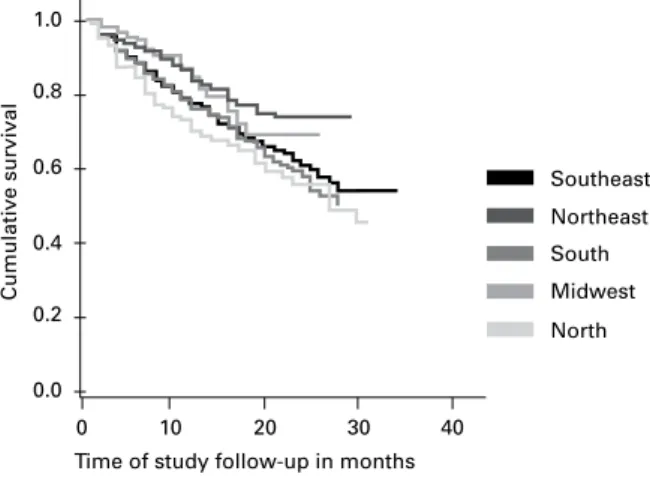
Patient mortality rate during the 34-month period was highest in the North region (30.1%), followed by the Southeast (23.3%), South (20.7%) and Northeast
failure rate was highest in the North region (22.3%), followed by the South (17.7%), Northeast (16.8%), Southeast (16.6%) and Midwest (10.8%) regions (Figure 2, log rank p = 0.02, respectively) and the me-an technique failure time was 8.3 ± 4 months, 9.1 ± 6.1 months, 9.5 ± 7 months, 9.7 ± 6 months and 10 ± 7.5 months, respectively, for the aforementioned regions. At the patient survival analysis (Cox propor-tional hazard, Table 3), when analyzing incident and prevalent patients in a same model, the variables that correlated with worse survival were the Midwest re-gion (HR = 1.66; CI = 1.2 to 2.3); age: 65 to 75 years (HR = 3.11, CI = 2.39 to 4.04), > 75 years (HR = 4.29; CI = 3.31 to 5.57), presence of diabetes mellitus (HR = 1.23; CI = 1.03 to 1.46) and cardiovascular disease (HR = 1.31; CI = 1.12 to 1.54). When eva-luating technique survival (Cox proportional hazard, Table 4), age from 65 to 75 years had a HR = 0.77, CI = 0.61 to 0.97 and age > 75 years HR = 0.55, CI = O.41 to 0.72 and female sex had a HR = 1.21, CI = 1.03 to 1.43.
D
ISCUSSIONThe demographic, clinical and laboratory characte-ristics of patients undergoing PD in Brazil reflect the characteristics of each geographic region. This infor-mation demonstrates that there is no bias selection regarding the geographic region; however, the bias of PD indication for patients with a higher prevalence of comorbidities persists.
Studies on RRT survival in general and on PD ha-ve shown that age, cardiovascular diseases and dia-betes mellitus are the main determinants of survival. The cardiovascular diseases are the main cause of de-ath in the general population; however, in the popu-lation with CKD, mainly those undergoing RRT, this mortality increases exponentially.11 This is due to the fact that patients with CKD, in addition to suffering the influence of traditional cardiovascular risk fac-tors (age, male sex, genetic predisposition, systemic arterial hypertension, obesity, hypercholesterolemia, diabetes mellitus, sedentary lifestyle), with the decline in kidney function also start to suffer the influence of new risk factors related to the CKD (anemia, hyper-volemia, calcium x phosphorus metabolism altera-tions, albuminuria, oxidative stress increase, chronic inflammation, accumulation of ADMA - in asymme-trical dimethylarginine, decrease in serum levels of fe-tuin A and adiponectin).12 Moreover, the alterations present in the CKD are considered risk factors for car-diovascular diseases.13
When evaluating the survival of patients during the period in the Southeast (76.7%), South (79.3%), Northeast (86.6%), Midwest (88.5%) and North (69.9%) regions, we can observe that it is similar and comparable to the studies published in develo-ped countries. The technique survival is also satisfac-tory in the period in the Southeast (83.4%), South (82.3%), Northeast (83.2%), Midwest (89.2%) and North (77.7%) regions and comparable to large stu-dies published in the literature14-18,19 (Table 1, Figures 1 and 2).
The distance to the nearest center of dialysis was up to 50 km for the Southeast, South and North re-gions for more than 70% of the patients. However, in the North region, as there were few dialysis cen-ters, which were concentrated in the great region of the capital city, Manaus, a high percentage of the pa-tients does not have access to RRT or change domi-cile so that they can have access to treatment. In the
Figure 1. Analysis of patient survival per region. Kaplan-Meier curve (Log rank p = 0.001).
Southeast
Northeast
South
Midwest
North
0 0.2
0.0 0.4 0.6 0.8 1.0
10 20 30 40
Time of study follow-up in months
Cumulative survival
Figure 2. Analysis of technique survival per region. Kaplan-Meier curve (Log rank p = 0.02).
Southeast
Northeast
South
Midwest
0 0.2
0.0 0.4 0.6 0.8 1.0
10 20 30 40
Time of study follow-up in months
Cumulative survival
Table 2 ANALYSISOFPATIENTSURVIVAL (COXPROPORTIONALHAZARD, CENSORINGLOSSOFFOLLOW-UPCAUSEDBYDEATH, KIDNEYFUNCTIONRECOVERYANDTRANSPLANTATION)
Confidence interval
p HR Lower limit Upper limit
Region Southeast Northeast South Midwest
0.076
0.22 0.50 0.002
0.80 1.13 0.85 1.66
0.64 0.92 0.54 1.20
1.22 1.37 1.35 2.3 Age < 65 years
65-75 years > 75 years
1 0.00 0.00
3.11 4.29
2.39 3.31
4.04 5.57
Female sex 0.51 0.95 0.82 1.10
Diabetes mellitus 0.007 1.23 1.03 1.46
Cardiovascular disease 0.001 1.31 1.12 1.54
Type of therapy APD: CAPD 0.68 1.03 0.88 1.19
APD, automated peritoneal dialysis; CAPD, continuous ambulatory peritoneal dialysis.
Northeast and Midwest regions, almost 40% of the patients live more than 50 km away from the nearest RRT center. PD is a therapy that is carried out in the patient’s domicile, even when the distance from the domicile to the RRT center is a long one and thus, it must be considered for patients with difficulty to have access to the dialysis centers. Ritt et al. (2007) carried out a study that evaluated the distance from the domi-cile to the RRT center in the state of Bahia, Brazil and concluded that most patients needed to leave their to-wns or cities and travel long distances to have access to hemodialysis (HD), which is excessively time-con-suming and has socioeconomic implications.20
A very similar demographic, economic and clini-cal profile can be observed between the South and Southeast regions, when the regions are evaluated separately. The largest number of patients under-going RRT in the two most developed regions of the country is in accordance with Sesso et al.3 who de-monstrated an estimated prevalence of 467/million inhabitants in the South and 583/million inhabitants in the Southeast with CKD undergoing RRT. These regions concentrate the largest number of clinics, as well as of nephrologists, which facilitates patients’ access to treatment. Therefore, we observe a larger number of patients undergoing pre-dialytic follow-up in the South (52.6%) and Southeast (48.5%) regions, which decreases the percentage of patients with late referral to specialized nephrology services. The lon-ger life expectancy (Southeast – 74.0 years, and South – 74.7 years)21 increases the prevalence of elderly in-dividuals with chronic-degenerative diseases, notably
cardiovascular diseases and diabetes mellitus. These are important causes of dialytic CKD and factors that correlate with worse survival in patients with CKD undergoing RRT.
The Northeast region presents some geographic peculiarities. The life expectancy is the lowest in the country, 69.7 years.21 The patients are younger and present fewer comorbidities, notably with a smaller number of diabetic patients. The region has the worst social indicators, RRT centers are concentrated in large cities, and therefore many patients have no ac-cess to this type of treatment. This fact becomes cle-ar when we observe that the Northeast is the second most populous region in the country and its popula-tion undergoing RRT is smaller than the populapopula-tion in the South region and that it presents an estimated prevalence of individuals with CKD undergoing RRT of 347/million.3
There is also a lower percentage of patients recei-ving pre-dialytic care (34.8%), which reflects a late referral to the nephrologist. The survival of the pa-tient undergoing PD in this region is higher than in the South and Southeast regions; however, the loss of follow-up rate due to other causes (such as technique failure) is higher.
Table 3 ANALYSISOFTECHNIQUESURVIVAL (COXPROPORTIONALHAZARD, CENSORINGLOSSOFFOLLOW-UPDUETODEATH, KIDNEYFUNCTIONRECOVERYANDTRANSPLANTATION)
Confidence interval
p HR Lower limit Upper limit
Region Southeast Northeast South Midwest
0.56 0.41 056 0.38
1.07 1.10 0.85 1.18
0.85 0.87 0.50 0.80
1.34 1.39 1.46 1.74 Age < 65 years
65-75 years > 75 years
1 0.004
0.02
0.77 0.55
0.61 0.41
0.97 0.72
Female sex 0.02 1.21 1.03 1.43
Diabetes mellitus 0.6 1.23 0.78 1.14
Cardiovascular disease 0.058 0.95 0.64 1.00
Type of therapy APD: CAPD 0.08 085 0.72 1.01
APD, automated peritoneal dialysis; CAPD, continuous ambulatory peritoneal dialysis.
regions. The estimated prevalence of individuals with CKD undergoing RRT is 236/million.3 In this region, we also observe a concentration of RRT centers in the capital and great difficulty in having access to spe-cialized services. The number of patients that receive pre-dialytic follow-up is low and there is a large num-ber of patients submitted to PD that used to undergo hemodialysis (66.2%) and that have PD as the only possibility of RRT (84.9%). The technique survival rate is also lower than in other regions, probably re-flecting the worse clinical condition of the patient wi-th CKD when admitted to undergo PD in wi-this region.
The Midwest region has characteristics that make it quite heterogeneous. It is the region with a propor-tionally larger number of inhabitants that come from other areas. And although its social indicators are, on average, better than those in the North and Northeast regions, its population is a heterogeneous one. For instance, its general illiteracy rate is not high, but it has the highest number of children out of school. The estimated prevalence of individuals with CKD under-going RRT is 455/million.3 The number of patients undergoing RRT is low and the number of patients undergoing PD is the lowest in the country. Life ex-pectancy is 73.3 years21. It has a good survival, both of the technique and the patient. The characteristics of patients undergoing PD in this region are of youn-ger patients, with the lowest number of patients with diabetes and cardiovascular diseases of the country and a higher number of patients without other co-morbidities in addition to CKD undergoing PD. The pre-dialytic follow-up was carried out in 39.3% of the
patients and the indication of PD in this region was mainly medical and the only option of RRT (41.3%). When evaluating the Cox proportional hazard model for survival of the patients, it is worth mentio-ning that this analysis included incident and prevalent patients. The variables that classically correlate with higher mortality, older age, presence of diabetes melli-tus and cardiovascular diseases also show significan-ce in the model. However, consignifican-cerning the technique survival, older age showed to be a protective factor and the female sex a risk factor for lower technique survival rates, findings that are not in accordance wi-th most studies. It is probable wi-that analyzing togewi-ther incident and prevalent patients was responsible for these findings
The study describes important clinical and outco-me differences in patients with CKD undergoing PD in different regions of Brazil. Some of the differences observed apparently reflect the sociodemographic di-versity of the country. These regional differences must be considered by health management professionals and the professionals that treat the patients, aiming at improving the technique survival and the survival of patients undergoing maintenance peritoneal dialysis in the country.
R
EFERENCES1. BGE IBdGeE- Pesquisa Nacional de Amostra por Domicílios. 2006.
3. Sesso R, Lopes AA, Thomé FS, Bevilacqua JL, Romão Junior JE, Lugon J. Relatório do Censo de Diálise de 2008. J Bras Nefrol 2008; 30:233-8.
4. Iliescu EA, Yeates KE, McComb J, Morton AR. Modality choice among Aboriginal incident dialysis pa-tients - influence of geographic location. Perit Dial Int 2006; 26:507-8.
5. Hopson S, Frankenfield D, Rocco M, McClellan W. Variability in reasons for hemodialysis catheter use by race, sex, and geography: findings from the ESRD Clinical Performance Measures Project. Am J Kidney Dis 2008; 52:753-60.
6. Boyle PJ, Kudlac H, Williams AJ. Geographical varia-tion in the referral of patients with chronic end stage renal failure for renal replacement therapy. QJM 1996; 89:151-7.
7. Reddan D, Szczech LA, Conlon PJ, Owen Jr WF. Contextual issues in comparing outcomes and care pro-cesses for ESRD patients around the world. Blood Purif 2001; 19:152-6.
8. Rodriguez RA, Sen S, Mehta K, Moody-Ayers S, Bacchetti P, OHare AM. Geography matters: rela-tionships among urban residential segregation, dialysis facilities, and patient outcomes. AnnIntern Med 2007; 146:493-501.
9. Tonelli M, Klarenbach S, Manns B et al. Residence lo-cation and likelihood of kidney transplantation. CMAJ 2006; 175:478-82.
10. Fernandes N, Bastos MG, Cassi HV et al. The Brazilian Peritoneal Dialysis Multicenter Study (BRAZPD): cha-racterization of the cohort. Kidney Int Suppl 2008; 108:S145-51.
11. Sarnak MJ, Coronado BE, Greene T et al. Cardiovascular disease risk factors in chronic renal insufficiency. Clin Nephrol 2002; 57:327-35.
12. Suassuna PG, Bastos MG. Intermittent doses of statin in hemodialysis patients with spontaneous low LDL cholesterol levels. Arq Bras Cardiol 2008; 90:104-11.
13. Sarnak MJ, Levey AS, Schoolwerth AC et al. Kidney disease as a risk factor for development of cardiovas-cular disease: a statement from the American Heart Association Councils on Kidney in Cardiovascular Disease, High Blood Pressure Research, Clinical Cardiology, and Epidemiology and Prevention. Hypertension 2003; 42:1050-65.
14. Hung CC, Chang CT, Lee CC et al. Prognostic pre-dictors of technique and patient survival in elderly Southeast Asian patients undergoing continuous am-bulatory peritoneal dialysis. Int J Clin Pract 2009; 63:254-60.
15. Ortiz AM, Fernandez MA, Troncoso PA, Guzman S, Del Campo F, Morales RA. Outcome of peritoneal dialysis: Tenckhoff catheter survival in a prospective study. Adv Perit Dial 2004; 20:145-9.
16. Prasad N, Gupta A, Sinha A et al. A comparison of outcomes between diabetic and nondiabetic CAPD pa-tients in India. Perit Dial Int 2008; 28:468-76.
17. Sanabria M, Munoz J, Trillos C et al. Dialysis outco-mes in Colombia (DOC) study: a comparison of pa-tient survival on peritoneal dialysis vs. hemodialysis in Colombia. Kidney Int Suppl 2008; 73:S165-72. 18. Sipahioglu MH, Aybal A, Unal A, Tokgoz B, Oymak
O, Utas C. Patient and technique survival and factors affecting mortality on peritoneal dialysis in Turkey: 12 years experience in a single center. Perit Dial Int 2008; 28:238-45.
19. Garcia-Garcia G, Monteon-Ramos JF, Garcia-Bejarano H et al. Renal replacement therapy among disadvanta-ged populations in Mexico: a report from the Jalisco Dialysis and Transplant Registry (REDTJAL). Kidney Int Suppl 2005; 68:S58-61.
20. Ritt GF, Braga PS, Guimarães EL et al. Terapia renal substitutiva em pacientes no interior da Bahia: avalia-ção da distância entre o município de moradia e a uni-dade de hemodiálise mais próxima. J Bras Nefrol 2007; 29:57-61.