ABSTRACT
www.scielo.br/jaos
http://dx.doi.org/10.1590/1678-775720140334
Exposure of periodontal ligament progenitor
cells to lipopolysaccharide from
Escherichia coli
changes osteoblast differentiation pattern
Mayra Laino ALBIERO, Bruna Rabelo AMORIM, Luciane MARTINS, Márcio Zaffalon CASATI, Enilson Antonio SALLUM, Francisco Humberto NOCITI JR., Karina Gonzales SILVÉRIO
Department of Prosthodontics and Periodontics, Division of Periodontics, Piracicaba Dental School, UNICAMP - State University of Campinas, Piracicaba, SP, Brazil.
Corresponding address: Karina Gonzales Silvério - Departamento de Prótese e Periodontia, Área de Periodontia, Faculdade de Odontologia de Piracicaba - Universidade de Campinas - UNICAMP - Av. Limeira, 901 - Areão - 13414-903 - Piracicaba - SP - Brazil - Phone/Fax: +55 19 2106 5301 - e-mail: kgsilverio@ fop.unicamp.br
Submitted: September 2, 2014 - Modiication: November 21, 2014 - Accepted: December 1, 2014
P
eriodontal ligament mesenchymal stem cells (PDLMSCs) are an important alternative source of adult stem cells and may be applied for periodontal tissue regeneration, neuroregenerative medicine, and heart valve tissue engineering. However, little is known about the impact of bacterial toxins on the biological properties of PDLSMSCs, including self-renewal, differentiation, and synthesis of extracellular matrix. Objective: This study investigated whether proliferation, expression of pro-inflammatory cytokines, and osteogenic differentiation of CD105-enriched PDL progenitor cell populations (PDL-CD105+ cells) would be affected by exposure to bacterial lipopolysaccharide from Escherichia coli (EcLPS). Material and Methods: Toll-like receptor 4 (TLR4) expression was assessed in PDL-CD105+ cells by the immunostaining technique and conirmed using Western blotting assay. Afterwards, these cells were exposed to EcLPS, and the following assays were carried out: (i) cell viability using MTS; (ii) expression of the interleukin-1 beta (IL-1β), interleukin-6 (IL-6), interleukin-8 (IL-8), and tumor necrosis factor alpha (TNF-α) genes; (iii) osteoblast differentiation assessed by mineralization in vitro, and by mRNA levels of run-related transcription factor-2 (RUNX2), alkaline phosphatase (ALP) and osteocalcin (OCN) determined by quantitative PCR. Results: PDL-CD105+ cells were identiied as positive for TLR4. EcLPS did not affect cell viability, but induced a signiicant increase of transcripts for IL-6 and IL-8. Under osteogenic condition, PDL-CD105+ cells exposed to EcLPS presented an increase of mineralized matrix deposition and higher RUNX2 and ALP mRNA levels when compared to the control group. Conclusions: These results provide evidence that CD105-enriched PDL progenitor cells are able to adapt to continuous Escherichia coli endotoxin challenge, leading to an upregulation of osteogenic activities.Keywords: Cell differentiation. Bacterial antigens. Periodontal ligament. Stem cells. Osteogenesis.
INTRODUCTION
The great differentiation capacity of mesenchymal stem cells (MSCs), the possibility of grafting, and its expansion in culture led to an increased interest in the clinical use of these cells through directed
administration on speciic sites in many pathological
situations. In this sense, regenerative therapy based on stem cells has gained attention since the
isolation of mesenchymal stem cells from various tissues.
The search for similar cells to mesenchymal stem
cells in speciic tissues has led to the discovery of a
variety of stem cells in almost all organs and tissues of the body in recent decades20. Dental tissue is a
potent reservoir of postnatal stem/progenitor cells isolated from dental pulp4, periodontal ligament
from permanent21 and deciduous teeth22, apical
populations cells have been characterized by the expression of specific surface markers to mesenchymal stem cells (CD105, CD166, CD73 e STRO1)21,22, and have stem cells-like properties,
including the capacity for self-renewal and multilineage differentiation potential6. Periodontal
ligament mesenchymal stem cells (PDLSCs) are an important alternative source of adult stem cells and may be applied in periodontal tissue regeneration21,25, neuroregenerative medicine3,
and heart valve tissue engineering14. Although
PDLSCs can be routinely isolated and cultivated from periodontal ligament, many issues have to be approached before these cells can be used for therapies, such as their growth and differentiation in the presence of bacterial toxins, which may be present in many clinical situations.
Lipopolysaccharide (LPS) is an endotoxin present in Gram-negative bacteria such as Escherichia coli. This endotoxin, when in contact with cells of the
host immune system, as well as gingival ibroblasts,
induces an immune-inflammatory response
characterized by the release of pro-inlammatory
cytokines, which are mediated by Toll-like receptors (TLR2 e TLR4)9. The feasibility of using PDLSCs in
regenerative procedures by virtue of their capacity to differentiate into multiple cell lines depends on whether the growth and osteogenic differentiation of PDLSCs are affected by bacterial stimuli. Some studies suggest that periodontal ligament cells may
alter their phenotype in response to inlammation
promoted by bacterial lipopolysaccharide23,27.
However, little is known about the interactions between bacteria and MSCs. Recently, it was observed16 that an in vitro change in osteogenic
differentiation pattern occurs when mesenchymal stem cells isolated from the bone marrow of healthy individuals were exposed to the Escherichia coli LPS.
Thus, this study investigated the effects of lipopolysaccharides from Escherichia coli (EcLPS)
on cell viability, expression of pro-inlammatory
cytokines, and osteogenic differentiation potential of CD105-enriched PDL progenitor cell populations.
MATERIAL AND METHODS
Cell culture
This study was approved by the Institutional Review Board (#022/2011). Five populations of mesenchymal progenitor cells (STRO1+ CD105+
CD166+ CD34- CD45- cells) from periodontal dental
ligament (PDL) of permanent teeth were obtained and characterized in a previous study22. Briely, teeth
extractions of completely erupted third molars of
ive subjects (aged 19 to 22 years) were performed
at the Dental Clinic of the School of Dentistry, State University of Campinas, Piracicaba, São Paulo, Brazil. Teeth were placed in biopsy media composed
of Dulbecco’s modiied Eagle’s medium (DMEM)
supplemented with 10% fetal bovine serum, 250 mg/ml gentamicin sulfate, 5 m/ml amphotericin B, and 1% penicillin/streptomycin (Gibco BRL, Life Technologies, Carlsbad, CA, USA), and transferred to the laboratory facilities. The PDL tissues from permanent teeth were gently scraped from the mid-portion of the root surface and enzymatically digested in a solution of 3 mg/ml collagenase type II (Gibco BRL) and 4 mg/ml dispase (Gibco BRL) for 1 hour at 37°C. Heterogeneous single-cell suspensions were obtained by passing the cells through a 70-mm cell strainer (Falcon, BD Labware, Franklin Lakes, NJ, USA). Samples were expanded in 25 cm2 culture lasks (Falcon) at 37°C, 5% CO2 in
DMEM supplemented with 10% fetal bovine serum, 1% L glutamine and 1% penicillin/streptomycin (Gibco BRL) (standard media). CD105+ enriched cell
subsets from PDL (PDL-CD105+ cells) were isolated
by magnetic cell sorting, and characterized by low
cytometry, and immunostaining. Flow cytometric analysis demonstrated a higher proportion of CD105+ cells co-expressing CD166 surface
antigen, whereas immunostaining demonstrated expression of STRO-1. These cell populations showed multipotential capabilities to differentiate in vitro into an osteoblast phenotype and adipocyte-like cells22. All ive PDL-CD105+ cell populations were
cultured in Dulbecco’s modiied Eagle’s minimal
essential medium (DMEM) supplemented with 10% fetal bovine serum, 1% L glutamine and 2% penicillin/streptomycin (standard media) (Gibco BRL), frozen with Recovery™ Cell Culture Freezing Medium (Gibco BRL) and kept in liquid nitrogen for subsequent experiments.
Preparation of LPS solution from Escherichia
coli
Bacterial LPS were suspended in 1 mL of sterile and endotoxin-free water as a stock solution (concentration 1 mg/mL) of Escherichia coli (Sigma-Aldrich, St Louis, MO, USA), and stored at -20°C. At the time of each experiment, the concentrations of 100 ng/mL, 1 µg/mL e 10 µg/mL10 were obtained by
diluting each LPS in DMEM from the stock solution.
Immunostaining for TLR4
To evaluate the expression pattern of Toll-like receptor 4 (TLR4), PDL-CD105+ cell populations
were seeded at 4×10⁴ cells/well on glass coverslips
(13 mm, Knittel® GmbH, Braunschweig, Germany),
placed in 24-well plates (Falcon), and cultured for 24 hours in standard media. Afterwards, cells were
ixed in 4% paraformaldehyde for 10 minutes,
were incubated with a secondary antibody Goat
anti-mouse IgG Alexa luor 488 (1:1000) (Invitrogen,
Carlsbad, CA, USA) for 1 hour. In order to identify nuclei, the samples were counterstained with TO-PRO®-3 iodide 642/661 (1:2000) (Invitrogen) for 15
minutes. As a negative control, cells were incubated only with the secondary antibody. Samples were then analyzed by confocal laser scanning microscopy (Leica TCS SP5AOBS, Mannheim, Germany).
Western Blot analysis for TLR4
Total cellular protein was extracted from cultured PDL-CD105+ cell populations using the RIPA buffer
(Thermo Scientiic, Rockford, IL, USA) supplemented
with protease inhibitor cocktail (Sigma, P2714),
following the manufacturer’s speciications. Protein
concentration was measured by the Bradford method (Bio-Rad Laboratories, Benicia, CA, USA) with bovine serum albumin (BSA) as a standard, and was measured spectrophotometrically at 595 nm. Equal amounts of protein per sample were separated by sodium dodecyl sulphate polyacrylamide gel electrophoresis (SDS–PAGE) 10% and transferred to a nitrocellulose membrane (Amersham™ Hybond ECL, Amersham BioSciences™, GE Healthcare, Little Chalfont, Buckinghamshire, UK). The membranes were blocked with 3% BSA in TBS for 1h at room temperature, incubated overnight with a 1:1000 dilution of primary antibody mouse anti-human TLR4 (Abcam), and then incubated with peroxidase-conjugated secondary antibodies (Anti-mouse 1:2500) (Santa Cruz Biotechnology, Dallas, TX, USA) for 2 h. The membrane was developed using
an ECL reagent (SuperSignal West Femto Substrate, Thermo Scientiic) and the signals were detected using radiographic ilms (Kodak, Rochester, NY,
USA).
Cell viability assay
The MTS assay was used to determine cell viability of PDL-CD105+ cells. Single-cell suspensions (1.5×10⁴ cells/well) were seeded on 96-well plates
with standard media for 24 h for cell attachment and spreading. Subsequently, media was changed to standard medium containing 0, 100 ng/mL, 1 µg/ mL or 10 µg/mL concentrations of EcLPS, and cells were cultured for 10 days. At time points of 1, 3, 7, and 10 days, MTS reagent (Promega Co., Madison,
WI, USA) was added, and cells were incubated for 2 h at 37°C in a humidiied CO2 incubator.
The absorbance of the formed formazan dye was measured photometrically at 490 nm.
Cytokines gene expression
Cells were seeded on a 60-mm dish (2×10⁵ cells/
dish) with standard media for 24 h. Subsequently, media was changed to standard media supplemented with 0, 100 ng/mL, 1 µg/mL or 10 µg/mL of EcLPS. After 24 hours, total RNA was obtained using TRIzol®
reagent (Invitrogen) to determine the expression of transcripts corresponding to interleukin-1 beta
(IL-1β), interleukin 6 (IL-6), interleukin 8 (IL-8),
and tumor necrosis factor alpha (TNF-α).
Osteogenic induction
PDL-CD105+ cells were seeded 2×10⁵ in
60-mm tissue culture dishes in standard media for gene expression analysis and in 24-well plates to assess the mineral nodule formation in vitro. After 24 hours, standard medium was changed to an osteogenic-inducing medium (DMEM 10% FBS, 50
µg/ml ascorbic acid, 10 mM β-glycerol-phosphate,
10-8 M dexamethasone). To evaluate the effect of
LPS on osteogenic differentiation, the differentiation medium was also supplemented with 1 µg/mL E. coli LPS. Total RNA was obtained using a reagent (TRIzol®, Invitrogen) at days 3, 7, and 14 for the
determination of the expression of transcripts corresponding to ALP, OCN, and RUNX2. In parallel,
in vitro mineral nodule formation was assessed at day 21 using the alizarin Red assay (Sigma-Aldrich). For that, after 21 days of differentiation, cells were
ixed with 70% ethanol and stained with alizarin
Red (Sigma-Aldrich) for calcium detection. For
Gene Foward Primer Reverse Primer Amplicon
ALP 5’-cgggcaccatgaaggaaa-3’ 5’-ggccagaccaaagatagagtt-3’ 184 OCN 5’-agctcaatccggactgt-3’ 5’-ggaagaggaaagaagggtgc-3’ 150 RUNX2 5’-ccgtccatccactctaccac-3’ 5’-atgaaatgcttgggaactgc-3’ 139
IL-1β 5’-cttcttcgacacatgggataac-3’ 5’-tttgggatctacactctccagc-3’ 283 IL-6 5’-ctagagtacctccagaacagatttga-3’ 5’-tcagcaggctggcattt-3’ 154 IL-8 5’-gccaagagaatatccgaactttaat-3’ 5’-ctggctagcagactaggg-3’ 172 TNF-α 5’-tccacccatgtactcctcac-3’ 5’-cctcccagatagatgggctcata-3’ 155 GAPDH 5’-acatcatccctgcctctac-3’ 5’-ccaccttcttgatgtcatcatatttg-3’ 171
ALP, alkaline phosphatase; OCN, osteocalcin; RUNX-2, runt-related transcription factor 2; IL-1β, interleukin-1 beta; IL-6,
interleukin 6; IL-8, interleukin 8; TNF-α, tumor necrosis factor alpha; GAPDH, glyceraldehyde-3-phosphate dehydrogenase
Figure 1- Primers sequence used for ampliication in real-time PCR
quantitative measurement, alizarin was solved in a 10% cetylpyridinium chloride monohydrate solution (PBS) for 15 min and samples were measured in a plate reader at 562 nm.
Gene expression analysis
Total RNA was DNase treated (Turbo DNA-free, Ambion, Foster City, CA, USA), and single-stranded complementary DNA (cDNA) was synthetized from 1 µg of total RNA using a kit (First Strand cDNA synthesis kit, Roche Diagnostics, Indianapolis, IN, USA) following the manufacturer’s recommendations. Primers sequences for ALP, OCN, RUNX2, IL-1β, IL-6, IL-8, TNF-αand glyceral-dehyde-3-phosphate dehydrogenase (GAPDH) are shown in Figure 1. qRT-PCR was performed with the LightCycler 2.0 and software (Roche Diagnostics GmbH, Mannheim, Germany), using the FastStart DNA Master plus SYBR Green Kit (Roche Diagnostics). Water (no template) was used as a negative control for all experiments. Relative quantiication of reaction products was accomplished using GAPDH as the reference gene.
Statistical analysis
All experiments were performed in triplicate and repeated on at least three separate occasions. Mean and standard deviation were obtained to establish statistical comparisons. Data comparison was performed using one-way analysis of variance test (α=0.05), and pairwise multiple-comparison test (Tukey test) was used to identify the difference among the groups. Additionally, non-parametric
Kruskal-Wallis test (α=0.05) followed by the
Student-Newman-Keuls was performed to assess the effect of LPS on cytokines gene expression (BioEstat 5.0, Belém, PA, Brazil).
RESULTS
PDL-CD105+ cells express LPS receptor
Immunofluorescence analysis revealed that PDL-CD105+ cells exhibited positive staining for
TLR4, which is a speciic molecule involved in E. coli LPS signaling pathways (Figures 2A and 2B). This positivity for TLR4 was confirmed by the
Western blotting analysis, showing that all ive
cell populations assessed expressed this receptor (Figure 2C).
E coli LPS induces PDL-CD105+ response
To verify whether PDL-CD105+ cells responded to
E. coli LPS, a metabolic activity as an indicator for
cell viability was irst measured using MTS assay. All
PDL-CD105+ populations from ive donors were able
to retain the capacity to form adherent colonies and
ibroblast spindle-shape after exposure to E. coli
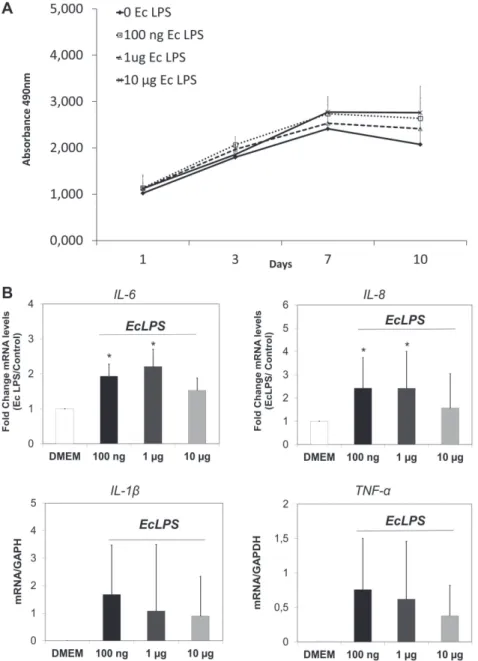
LPS (data not presented). As shown in Figure 3A, LPS did not affect the proliferation of PDL-CD105+
cells during the 10-day period, even after incubation with a relatively high concentration of endotoxin (1 µg and 10 µg/mL). In addition, MTS values showed a time-dependent increase of cell proliferation in all groups, with a higher number of cells after 3 and 7 days in the culture (Figure 3A).
Next, a qRT-PCR was performed to assess gene
expression changes on pro-inlammatory cytokines IL-1β, TNF-α, IL-6 and IL-8 in PDL-CD105+ cells. After
24 h of toxin challenge, EcLPS at concentrations of
100 ng and 1 µg/mL induced a signiicant increase
of the transcripts for IL-6 and IL-8 compared to the control group (Figure 3B). Despite the fact that PDL-CD105+ cells only expressed IL-1β and
TNF-α mRNA after LPS challenge, there were no
Figure 2- Highly puriied CD105+ subsets of periodontal ligament (PDL) cells express Toll-like receptor 4 (TLR4). (A) Positive immunoluorescence for the TLR4 with nuclear localization conirmed by TO-PRO®-3 staining. (B) Control are
represented by PDL-CD105+ cells incubated only with secondary antibody. (C) Western blotting analysis conirmed TLR4
signiicant differences between cell exposed versus
non-exposed, probably due to the greater variability
of IL-1β and TNF-α expression among the ive
populations (Figure 3B).
L P S c h a l l e n g e e n h a n c e s o s t e o g e n i c
differentiation of PDL-CD105+ cells
Having demonstrated that EcLPS (100 ng and 1 µg/mL) induced a pro-inflammatory cytokines response in PDL-CD105+ cells, next it
was investigated whether EcLPS could change the osteogenic properties of these cells. For this evaluation, cells were only exposed to EcLPS at
concentration of 1 µg/mL, and mineral nodule deposits (Alizarin Red staining) and gene expression of osteogenic markers (RUNX2, ALP, and OCN) were assessed.
After three weeks of osteogenic induction, mineral nodule formation could be observed in osteogenic differentiated cells of the positive
control, as demonstrated by the quantiication
of Alizarin Red crystals (Figure 4A). This mineral deposition was increased when cells were exposed to osteogenic medium and E. coli LPS (Figure 4A). No mineralized nodules were observed in cells cultured in the DMEM used as a control (Figure
Figure 3- Effect of E. coli lipopolysaccharide (LPS) on the viability and pro-inlammatory cytokines expression. (A)
PDL-CD105+ cells were cultured in the presence of EcLPS at concentrations of 0, 100 ng, 1 µg and 10 μg/ml. Metabolic activity
as an indicator for cell viability was measured with MTS assay at the following time points: 1, 3, 7 and 10 days. (B) Real-time PCR showed an increase of mRNA levels of IL-6, IL-8, IL-1β and TNF-α, respectively, in PDL-CD105+ cells after
24 hours of EcLPS exposure. Representative data of three independent experiments are shown. Statistical signiicance intergroup is indicated by * (p<0.05)
4A). qRT-PCR analysis further demonstrated an increased expression of a key osteoblast transcription factor, RUNX2, and two
osteoblast-speciic early/late differentiation transcripts (ALP
and OCN, respectively) in osteogenically-induced
cells compared to non-induced (Figure 4B). When
cells were cultured in an osteogenic medium supplemented with E. coli LPS, higher levels of transcripts for RUNX2, ALP, and OCN were found on day 7 after osteogenic induction (Figure 4B),
although there is no signiicant differences between
cells induced and non-induced with bacterial toxin. However, taken together, these data suggest that LPS challenge enhances osteogenic differentiation of PDL-CD105+ cells.
DISCUSSION
This study investigated the effects of LPS from enterobacteria Escherichia coli on CD105-enriched PDL progenitor cell populations (PDL-CD105+
cells). The surface marker CD105 was chosen for
sorting progenitor cells from PDL heterogeneous population, since it is the most frequently reported positive surface marker in MSCs22. In addition, the
expression of CD105 is one of the minimal criteria to
deine human MSCs according to the Mesenchymal
and Tissue Stem Cell Committee of the International Society for Cellular Therapy2. As part of cell
characterization, the present study showed that TLR4 was expressed by CD105-enriched PDL progenitor cell populations. This finding is in accordance with previous studies which have also reported that TLR4 are expressed by mesenchymal stem cells such as bone marrow mesenchymal stem cells7,13 and periodontal ligament stem cells13.
The family of the Toll-like receptors is involved in recognition of bacterial cell wall components15, and
it has been described that E. coli LPS trigger an
inlammatory environment by binding to TLR41,7,13.
To evaluate the inluence of E. coli-derived LPS on cell proliferation, CD105-enriched PDL progenitor cell populations were initially cultured in the presence of different concentrations of this
Figure 4- Osteoblast differentiation of PDL-CD105+ cells under EcLPS exposure. (A) Quantiication of Alizarin Red staining
showed that EcLPS at concentration of 1 μg/ml increased mineral nodule formation at 21 d. (B) PDL-CD105+ cells were
bacterial toxin. The indings showed that cells
remained viable and proliferative regardless of the LPS concentration. These data corroborate the
indings of other studies, which assessed the effect
of Escherichia coli endotoxins in pre-osteoblastic cells11, bone marrow mesenchymal stem cells14,
adipose-derived stromal cells8, and dental follicle
stem cells18.
Since LPS from E. coli did not change cell growth, it was determined whether this endotoxin had any
effect on cellular inlammatory response. It was found that EcLPS induced a signiicant expression of
IL-6 and IL-8 in PDL-CD105+ cells. In addition, this
bacterial toxin was able to induce the expression of
two pro-inlammatory cytokines, IL-1β and TNF-α. However, there were no signiicant differences
between PDL-CD105+ cells exposed to EcLPS
versus non-exposed, probably due to the greater
variability of IL-1β and TNF-α expression among the ive cell populations. Similar to our data, previous studies had already observed an inlammatory
response of oral cells exposed to LPS from E. coli.
The expression of IL-6 and IL-8 were induced in periodontal ligament cells26, while in dental follicle
stem cells (DFCs) the gene for IL-1β could also be
observed after exposure to EcLPS18.
Some evidences of the literature supports the
notion that inlammatory environment mediated
by lipopolysaccharides can inhibit osteoblast differentiation of human periodontal ligament stem cells12,13, mouse bone marrow mesenchymal
stem cells7, and osteoblastic precursor cell line
– MC3T3-E15. It has been suggested that LPS
decreases the osteogenic potential of mesenchymal stem cells through TLR4 regulated nuclear factor (NF)-kB pathway7,13. Further, in osteoblastic
precursor cells (MC3T3-E1), LPS seems to induce cell apoptosis and inhibit osteoblast differentiation via c-Jun N-terminal kinases (JNK) pathway5.
Our indings demonstrated that the inlammatory
response induced by E. coli LPS did not affect the osteoblast differentiation of CD105-enriched PDL progenitor cell populations. Unlike the studies cited above5,7,12,13, EcLPS challenge increased mineralized
nodules deposition through the osteogenic induction in PDL-CD105+ cells. Further, it is possible to
suggest that EcLPS exposure induces an early osteoblast differentiation of PDL-CD105+ cells as
demonstrated by increased expression of RUNX2 and ALP transcripts at day 7 of osteogenic induction. In agreement with our data, the prolonged exposure to EcLPS upregulated ALP activity and calcium deposition in human bone marrow mesenchymal stem cells16, and could also promote an increase
in osteogenic marker genes expression such as ALP, osteopontin and bone morphogenetic protein 2 (BMP-2) in adipose-derived stromal cells8.
In the present study, prolonged endotoxin
exposure was designed to mimic a situation in which mesenchymal stem cells interact continuously with
bacterial toxins during an inlammatory chronic
disease, and then to evaluate whether this bacterial challenge could affect the osteogenic properties of
periodontal ligament progenitor cells. Our indings
suggest that CD105-enriched periodontal ligament progenitor cell populations acquire an adaptive tolerance under continuous LPS exposure. Previous studies reported endotoxin tolerance in oral mucosa cells associated with chronic periodontitis19. Also,
transcripts for TLR2 and TLR4 were signiicantly
downregulated in the gingival tissue of patients with chronic periodontitis, suggesting that the oral mucosa develops endotoxin tolerance in chronic periodontitis19. Interestingly, we also observed a
downregulation of TLR4in PDL-CD105+ cells under
osteogenic induction associated to E. coli LPS exposure (data not shown).
However, further studies are required to elucidate the biological mechanism involved in the adaptive response by CD105-enriched periodontal ligament progenitor cells under continuous endotoxin exposure.
CONCLUSIONS
In conclusion, the results provide evidence that CD105-enriched PDL progenitor cells are able to adapt to continuous Escherichia coli endotoxin challenge, leading to an upregulation of osteogenic activities.
ACKNOWLEDGEMENT
The authors would like to thank São Paulo Research Foundation (FAPESP, São Paulo, SP, Brazil) for supporting author MLA. The authors report no
conlicts of interest related to this study.
REFERENCES
1- Akira S, Takeda K. Toll-like receptor signalling. Nat Rev Immunol. 2004;4(7):499-511.
2- Dominici M, Le Blanc K, Mueller I, Slaper-Cortenbach I, Marini
F, Krause D, et al. Minimal criteria for deining multipotent
mesenchymal stromal cells. The International Society for Cellular Therapy position statement. Cytotherapy. 2006;8(4):315-7. 3- Fortino VR, Chen RS, Pelaez D, Cheung HS. Neurogenesis of neural crest derived periodontal ligament stem cells by EGF and bFGF. J Cell Physiol. 2014;229(4):479-88.
4- Gronthos S, Mankani M, Brahim J, Robey PG, Shi S. Postnatal human dental pulp stem cells (DPSCs) in vitro and in vivo. Proc Natl Acad Sci U S A. 2000;97(25):13625-30.
5- Guo C, Yuan L, Wang JG, Wang F, Yang XK, Zhang FH, et
al. Lipopolysaccharide (LPS) induces the apoptosis and inhibits osteoblast differentiation through JNK pathway in MC3T3-E1 cells.
Inlammation. 2014;37(2):621-31.
6- Huang GT, Gronthos S, Shi S. Mesenchymal stem cells derived from dental tissues vs. those from other sources: their biology and role in regenerative medicine. J Dent Res. 2009;88(9):792-806.
7- Huang RL, Yuan Y, Zou GM, Liu G, Tu J, Li Q. LPS-stimulated inlammatory environment inhibits BMP-2 induced osteoblastic differentiation through crosstalk between TLR4/MyD88/NF-κB
and BMP/Smad signaling. Stem Cells Dev. 2014;23(3):277-89.
8- Hwa Cho H, Bae YC, Jung JS. Role of toll-like receptors on human
adipose-derived stromal cells. Stem Cells. 2006;24(12):2744-52. 9- Jones KJ, Ekhlassi S, Montufar-Solis D, Klein JR, Schaefer JS. Differential cytokine patterns in mouse macrophages and gingival fibroblasts after stimulation with Porphyromonas gingivalis or Escherichia coli lipopolysaccharide. J Periodontol. 2010;81(12):1850-7.
10- Jönsson D, Nebel D, Bratthall G, Nilsson BO. LPS-induced MCP-1 and IL-6 production is not reversed by oestrogen in human periodontal ligament cells. Arch Oral Biol. 2008;53(9):896-902.
11- Kadono H, Kido J, Kataoka M, Yamauchi N, Nagata T. Inhibition
of osteoblastic cell differentiation by lipopolysaccharide extract from Porphyromonas gingivalis. Infect Immun. 1999;67(6):2841-6.
12- Kato H, Taguchi Y, Tominaga K, Umeda M, Tanaka A.
Porphyromonas gingivalis LPS inhibits osteoblastic differentiation
and promotes pro-inlammatory cytokine production in human
periodontal ligament stem cells. Arch Oral Biol. 2014;59,167-75.
13- Li C, Li B, Dong Z, Gao L, He X, Liao L, et al. Lipopolysaccharide
differentially affects the osteogenic differentiation of periodontal ligament stem cells and bone marrow mesenchymal stem cells
through Toll-like receptor 4 mediated nuclear factor κB pathway.
Stem Cell Res Ther. 2014;5(3):67.
14- Martinez C, Rath S, Van Gulden S, Pelaez D, Alfonso A, Fernandez N, et al. Periodontal ligament cells cultured under
steady-low environments demonstrate potential for use in heart
valve tissue engineering. Tissue Eng Part A. 2013;19(3-4):458-66. 15- Medzhitov R, Preston-Hurlburt P, Janeway CA Jr. A human homologue of the Drosophila Toll protein signals activation of adaptive immunity. Nature. 1997;388(6640):394-7.
16- Mo IF, Yip KH, Chan WK, Law HK, Lau YL, Chan GC. Prolonged
exposure to bacterial toxins downregulated expression of Toll-like receptors in mesenchymal stromal cell-derived osteoprogenitors. BMC Cell Biol. 2008;9:52.
17- Morsczeck C, Götz W, Schierholz J, Zeilhofer F, Kühn U, Möhl C,
et al. Isolation of precursor cells (PCs) from human dental follicle of wisdom teeth. Matrix Biol. 2005;24(2):155-65.
18- Morsczeck CO, Drees J, Gosau M. Lipopolysaccharide from
Escherichia coli but not from Porphyromonas gingivalis induce
pro-inlammatory cytokines and alkaline phosphatase in dental
follicle cells. Arch Oral Biol. 2012;57(12):1595-601.
19- Muthukuru M, Jotwani R, Cutler CW. Oral mucosal endotoxin
tolerance induction in chronic periodontitis. Infect Immun. 2005;73(2):687-94.
20- Porada CD, Zanjani ED, Almeida-Porad G. Adult mesenchymal
stem cells: a pluripotent population with multiple applications. Curr Stem Cell Res Ther. 2006;1(3):365-9.
21- Seo BM, Miura M, Gronthos S, Bartold PM, Batouli S, Brahim J, et al. Investigation of multipotent postnatal stem cells from human periodontal ligament. Lancet. 2004;364(9429):149-55. 22- Silvério KG, Rodrigues TL, Coletta RD, Benevides L, Silva JS,
Casati MZ, et al. Mesenchymal stem cell properties of periodontal
ligament cells from deciduous and permanent teeth. J Periodontol. 2010;81(8):1207-15.
23- Somerman MJ, Young MF, Foster RA, Moehring JM, Imm G,
Sauk JJ. Characteristics of human periodontal ligament cells in vitro. Arch Oral Biol. 1990;35(3):241-7.
24- Sonoyama W, Liu Y, Yamaza T, Tuan RS, Wang S, Shi S, et al.
Characterization of the apical papilla and its residing stem cells from human immature permanent teeth: a pilot study. J Endod. 2008;34(2):166-71.
25- Suaid FF, Ribeiro FV, Gomes TR, Silvério KG, Carvalho MD, Nociti FH, et al. Autologous periodontal ligament cells in the treatment of Class III furcation defects: a study in dogs. J Clin Periodontol. 2012;39(4):377-84.
26- Yamaji Y, Kubota T, Sasaguri K, Sato S, Suzuki Y, Kumada H, et al. Inlammatory cytokine gene expression in human periodontal ligament ibroblasts stimulated with bacterial lipopolysaccharides.
Infect Immun. 1995;63(9):3576-81.
27- Yamamoto T, Kita M, Oseko F, Nakamura T, Imanishi J,