ABSTRACT
Primary headaches interfere with the eficacy of
temporomandibular disorders management
André Luís PORPORATTI1, Yuri Martins COSTA1, Paulo César Rodrigues CONTI1, Leonardo Rigoldi BONJARDIM2,
Patrícia dos Santos CALDERON3
1- Department of Prosthodontics, Bauru School of Dentistry, University of São Paulo, Bauru, SP, Brazil. 2- Department of Biological Sciences, Bauru School of Dentistry, University of São Paulo, Bauru, SP, Brazil. 3- Department of Dentistry, Federal University of Rio Grande do Norte, Natal, RN, Brazil.
Corresponding address: André Luís Porporatti - Departamento de Prótese - Faculdade de Odontologia de Bauru - Universidade de São Paulo - Al. Octávio Pinheiro Brizolla, 9-75 - Vila Universitária- 17012-901 - Bauru - SP - Brazil
e-mail: [email protected] / [email protected]
Submitted: October 29, 2013 - Modiication: February 10, 2014 - Accepted: March 31, 2014
O
bjectives: This cross-sectional study aimed to evaluate the inluence of Primary Headache (PH) on eficacy of a Temporomandibular Disorders (TMD) conservative therapy and its association with the presence of self-reported parafunctional habits. Sample and Methods: Sample was composed of 400 medical records, divided into four groups: I) Muscular TMD (n=64); II) Muscular TMD+PH (n=48); III) Muscular TMD+Articular TMD (n=173); IV) Muscular TMD+Articular TMD+PH (n=115). All groups had undergone a TMD therapy for three months with a stabilization appliance and counseling for habits and behavioral changes, with no speciic headache management. Current pain intensity and existence or not of self-reported bruxism were assessed. Repeated measures ANOVA and Chi-Square test followed by Odds were used for statistical analysis, with a signiicance level of 5%. Results: results of this study showed that: (1) A conservative therapy with stabilization appliance and counseling for habits and behavioral changes was effective in the TMD pain relief; (2) Groups with an additional diagnosis of PH had worsened the pain improvement signiicantly; and (3) no association between the presence of self-reported bruxism and PH was found. Conclusions: this study could elucidate the important effect that headache may have on the TMD management.Keywords: Facial pain. Temporomandibular joint disorders. Headache. Therapy.
INTRODUCTION
Primary headache (PH) and chronic orofacial pain are common symptoms in the general population8, and the presence of headache in
patients reporting temporomandibular disorders (TMD) have a high prevalence of 50 to 80%6,8,28,
whereas these numbers in patients without TMD are only 13 to 23%19,33.
Primary headache individuals could experience more severe and frequent symptoms of TMD, and vice-versa2,3. The relationship between these two
entities, however, is not well established in the literature yet5,19.
Some studies have shown that TMD therapy reduces the complaint of headache in both intensity and frequency30, nevertheless, to the best of our
knowledge, the impact of PH on TMD therapy eficacy has not been published yet.
Furthermore, some studies have confirmed that the presence of parafunctional habits, i.e., activities of the masticatory muscles, as clenching and grinding, has an important role in TMD pain, whereas patients with sleep bruxism have an increased risk for the occurrence of myofascial
pain15. This association with headache is not well
deined29.
SAMPLE AND METHODS
This study was approved by the Institutional Ethics Committee, under protocol #105/2010.
Sample
This cross-sectional study performed 1,200 evaluations in medical records from an Orofacial Pain Clinic, from 1996 to 2009. The sample was composed of 400 medical records, initially selected according to the following criteria:
Inclusion:
1. Medical records of adults aged 18 years or more with:
2. Presence of myofascial pain with or without the presence of muscular trigger points by manual palpation, according to the American Academy of Orofacial Pain (AAOP)11;
Exclusion:
1. Medical records of individuals with neurological diseases, ibromyalgia, systemic arthritis, secondary headache or paroxysmal hemicrania, menstrual and cluster headache.
Group establishment
After fulilling the initial criteria, the medical records were analyzed according to the presence or not of TMD through AAOP criteria11; and PH
based on International Headache Society (IHS)24,
fulilling the criteria for migraine and/or tension-type headache.
Patients could be allocated into one of the four groups below:
I) Only muscular TMD (with no headache complaint):
This group was composed of 64 medical records of subjects with muscular TMD only. Muscular TMD encompassed localized myalgia and masticatory myofascial pain according to AAOP11.
They had undergone a conservative therapy for three months with a rigid acrylic upper full coverage stabilization appliance, along with counseling for habits and behavioral changes, home care instructions, exercises and Physical therapy modalities9. Analgesics and anti-inlammatory drugs
could also be used.
II) Muscular TMD+primary headache:
This group was composed of 48 medical records of subjects with muscular TMD plus the presence of primary headache. They had undergone the same conservative therapy for group I, with no speciic headache management.
III) Only muscular TMD+articular TMD (with no headache complaint):
This group was composed of 173 medical records
from subjects with muscular and articular TMD. They had undergone the same conservative therapy for group I.
Articular TMD included arthralgia and disc displacement with or without reduction, with or without mouth opening limitation, fulilling the AAOP criteria11.
IV) Muscular TMD+articular TMD+primary headache:
This group was composed of 115 medical records of subjects with muscular and articular TMD plus the presence of primary headache. They had undergone the same conservative therapy for group I, with no speciic headache management.
Examiners and variables
Two examiners performed all the medical records evaluations. Current pain intensity was analyzed according to self-reported pain on Visual Analogue Scale (VAS) at baseline and after three months of TMD therapy. Moreover, the existence or not of self-reported clenching/bruxism parafunctional habits was analyzed at baseline. The pain experience duration, in months, was also recorded.
Data analysis
The results were analyzed with repeated measurements ANOVA (after Kolmogorov-Smirnov to test normal distribution) to assess within and between groups differences; Chi-Square test followed by Odds Ratio test, with 95% of Conidence Interval (CI), to test association between PH and bruxism; and Spearman Correlation to correlate pain duration and pain intensity variation between baseline and after therapy. The results were established with a signiicance level of 5%.
RESULTS
The mean age was 36.87 years for group I, 36.79 years for group II, 36.36 for group III, and 36.79 for group IV (p=0.55). Women were 81.25% of group I, 89.58%, 86.12%, and 94.78% of group II, III, and IV, respectively.
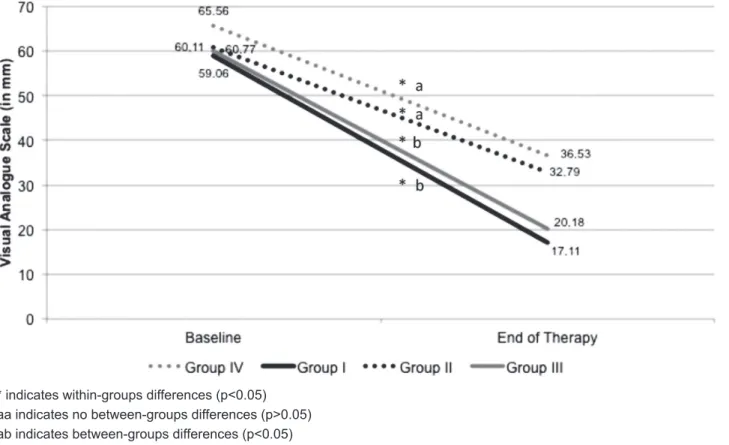
In the within groups analysis, there was a signiicant reduction in the reported pain for all groups (p<0.05) after three months of TMD therapy (Figure 1).
Pain improvement in VAS was 70.74% (SD 30.71) and 46.32% (SD 24.70) for group I and II, respectively, and 66.44% (SD 35.37) and 42.56% (SD 31.72) for group III and IV, respectively (Figure 1). Signiicant results revealed better pain improvement for group I compared to group II, and for group III, when compared to group IV (p<0.05%) (Figure 1).
self-Figure 1- Pain intensity according to Visual Analogue Scale (VAS) at baseline and in the end of the therapy * indicates within-groups differences (p<0.05)
aa indicates no between-groups differences (p>0.05) ab indicates between-groups differences (p<0.05)
GROUP TOTAL PRESENCE OF CLENCHING/BRUXISM PERCENTAGE
I 64 57 89.06%a
II 48 42 87.50%a
III 173 86 49.71%b
IV 115 59 51.30%b
Table 1- Percentage of clenching/bruxism parafunctional habits between groups
a indicates no between-groups differences (p>0.05)
b indicates between-groups differences (p<0.05)
HEADACHE WITHOUT HEADACHE TOTAL
BRUXISM 101 (41.4%) 143 (58.6%) 244
WITHOUT BRUXISM 62 (39.7%) 94 (60.3%) 156
TOTAL 163 237 400
Table 2- Chi-Square test (X2) and Odds Ratio (OR) of association between primary headache and clenching/bruxism parafunctional habits
p=0.743, OR=1.07 (0.71–1.61)
report of clenching/bruxism were perceived only between groups I and II with III and IV, which showed that subjects with muscular TMD had at baseline a higher percentage of clenching/bruxism parafunctional habits than subjects with muscular and articular TMD, without considering the presence or not of PH (Table 1). No differences were found on the association between PH and bruxism (Table 2).
DISCUSSION
This study evaluated 400 medical records regarding the eficacy of TMD management in patients with primary headache as a comorbid condition. The null hypothesis was rejected. The main indings were: (1) a conservative therapy with stabilization appliance and counseling for habits and behavioral changes was effective in the TMD pain relief; (2) the presence of concomitant primary headache negatively inluenced the eficacy of TMD therapy; (3) no association between the presence of self-reported bruxism and PH was found; and (4) no correlation was found between TMD management eficacy on pain severity and the duration of pain experience.
Our sample was mainly composed of women (88%), aged between 30–45 years (35.47±12.59), which is in agreement with epidemiological publications17,27. All groups had chronic craniofacial
pain, with mean duration of 63.72±74.30 months. After three months of therapy, management strategies as stabilization splint and counseling for behavioral changes used in the present study provided a signiicant improvement in the pain levels of articular and/or muscular TMD when judged by the VAS. This management approach is supported by the literature and is recommended as an effective therapy modality7,16,17,21,22,32.
A possible explanation on the use of this management approach is based on a decrease of the overload masticatory system2,23. Stabilization
splints provide proper occlusal relationship, reduction in muscular activity, stable physiologic mandibular posture; and with the potential cognitive and placebo effect20,31. The actual results
may have an essential correlation with all these mechanisms of action. Furthermore, the patient education about behavioral changes, the probable high impact of the patient’s initial reaction to a professional orientation, and also placebo effect, natural evolution of the disease and regression towards the mean9 may play a role in the pain
reduction for all groups observed in this study. After the TMD management, groups with additional diagnosis of primary headache did not have the same level of amelioration than groups with only TMD and without PH. It has been very well established that nociceptive impulses arising from masticatory muscles and temporomandibular joint, as well as cranial tissues and head area, may induce central sensitization mechanisms in the subnucleus caudalis of the trigeminal nerve system19. Since
both areas, TMD and head region, share similar ascendant pain pathways in the trigeminal system, the increase in pain transmission from peripheral tissues to the trigeminal system could explain the fact that the presence of comorbid PH, not treated,
could inluence negatively a TMD therapy, and the approach of both conditions should be stated.
The effectiveness of stabilization devices in the management of TMD pain is well documented and it is related to the re-establishment of proper occlusal relationship; the reduction in muscular activity; the cognitive effect, since the patients became aware of their oral parafunctional habits; and the placebo
effect7,9,17,22,32. However, the literature is vague
about this fact in headache improvement. Some studies report headache pain decrease, in both intensity and frequency, about 30 to 50% when TMD was treated with splint therapy, in short and long-term evaluations12,13,30.
The literature suggests that subjects with sleep bruxism have increased risk for myofascial and joint pain conditions15. In this study, the prevalence of
clenching/bruxism parafunctional habits was very high for all groups.
Some studies had showed that the post-exercise muscle soreness is associated with this overload mechanism of muscle pain in individuals with bruxism, which can be a risk factor to the installation of myofascial TMD3,10,15. Our results
show higher prevalence of bruxism in the muscular TMD groups only, and lower values in the articular TMD groups. It is possible that this outcome could be a result of a difference in the pathophysiology between the articular and the muscular TMD. In the group presenting with articular and muscular TMD, the muscle pain might be a consequence of the articular pain conditions, which, in turn, could lead to a muscle co-contraction. In this case, the occurrence of parafunctional habits could not be as important as in the case of only muscle pain. Furthermore, the prevalence of bruxism in articular TMD patients is lower25. Finally, considering that
muscle pain could be a symptom of bruxism4, in the
group of only muscular TMD, bruxism could be the primary source of pain, which explains the higher prevalence in the groups I and II.
The causal relationship between bruxism and TMD is controversial. A recent systematic review found that studies based on self-report or clinical diagnosis of bruxism have a positive association with TMD, while studies based on more speciic quantitative diagnostic methods revealed a weak association with symptoms of TMD26. Although
parafunctional habits increase the activation of masticatory muscles18, which sometimes may cause
pain1, bruxism is not always correlated with the
pain caused by TMD. In this sense, to establish a direct causal relationship between bruxism and TMD is dificult.
that in patients with painful TMD and SB, only the presence of sleep bruxism did not increase the risk for any kind of PH14.
No correlation between TMD improvement after three months and duration of pain experience was found. It was expected that the longer the pain experience, the higher the peripheral and central sensitization, associated to some sort of impairment of the descending inhibitory analgesic system, which could inluence the eficacy of pain management. However, this fact was not tested here. The non-administration of central acting medication and strategies devoted to revert such central alterations could explain this similarity between those with more time of pain experience and those with less time.
Another limitation of the present study is the relatively weak reliability of the data obtained from the medical records, usually handled by different professionals. Although extracted from records from the same treatment center, variations in diagnosis and management strategies are expected, jeopardizing the present results.
Based on the aforementioned, this study showed the potential and signiicant effect that headache has in the eficacy of TMD management. A combined approach to both pain conditions is suggested.
DISCLOSURE
The authors declare that they have no conlicts of interest.
REFERENCES
1- Ahlberg K, Ahlberg J, Könönen M, Alakuijala A, Partinen M, Savolainen A. Perceived orofacial pain and its associations with reported bruxism and insomnia symptoms in media personnel with or without irregular shift work. Acta Odontol Scand. 2005;63(4):213-7.
2- Alencar F Jr, Becker A. Evaluation of different occlusal splints and counselling in the management of myofascial pain dysfunction. J Oral Rehabil. 2009;36(2):79-85.
3- Arima T, Svensson P, Arendt-Nielsen L. Experimental grinding in healthy subjects: a model for postexercise jaw muscle soreness? J Orofac Pain. 1999;13(2):104-14.
4- Bader G, Lavigne G. Sleep bruxism; an overview of an oromandibular sleep movement disorder. REVIEW ARTICLE. Sleep Med Rev. 2000;4(1):27-43.
5- Ballegaard V, Thede-Schmidt-Hansen P, Svensson P, Jensen R. Are headache and temporomandibular disorders related? A blinded study. Cephalalgia. 2008;28(8):832-41.
6- Bendtsen L, Jensen R. Tension-type headache. Neurol Clin. 2009;27(2):525-35.
7- Bergstrom I, List T, Magnusson T. A follow-up study of subjective symptoms of temporomandibular disorders in patients who received acupuncture and/or interocclusal appliance therapy 18-20 years earlier. Acta Odontol Scand. 2008;66(2):88-92.
8- Ciancaglini R, Radaelli G. The relationship between headache and symptoms of temporomandibular disorder in the general population. J Dent. 2001;29(2):93-8.
9- Conti PC, Alencar EN, Mota Corrêa AS, Lauris JR, Porporatti AL, Costa YM. Behavioural changes and occlusal splints are effective in the management of masticatory myofascial pain: a short-term evaluation. J Oral Rehabil. 2012;39(10):754-60.
10- Dao TT, Lund JP, Lavigne GJ. Comparison of pain and quality of life in bruxers and patients with myofascial pain of the masticatory muscles. J Orofac Pain. 1994;8(4):350-6.
11- De Leeuw R, Klasser GD (editors). Orofacial pain: guidelines for assessment, diagnosis, and management. Chicago: Quintessence; 2008.
12- Doepel M, Nilner M, Ekberg E, Vahlberg T, Bell YI. Headache: short- and long-term effectiveness of a prefabricated appliance compared to a stabilization appliance. Acta Odontol Scand. 2011;69(3):129-36.
13- Ekberg EC, Nilner M. Treatment outcome of short- and long-term appliance therapy in patients with TMD of myogenous origin and tension-type headache. J Oral Rehabil. 2006;33(10):713-21. 14- Fernandes G, Franco AL, Goncalves DA, Speciali JG, Bigal ME, Camparis CM. Temporomandibular disorders, sleep bruxism, and primary headaches are mutually associated. J Orofac Pain. 2013;27(1):14-20.
15- Fernandes G, Franco AL, Siqueira JT, Goncalves DA, Camparis CM. Sleep bruxism increases the risk for painful temporomandibular disorder, depression and non-speciic physical symptoms. J Oral Rehabil. 2012;39(7):538-44.
16- Freitas RF, Ferreira MA, Barbosa GA, Calderon PS. Counselling and self-management therapies for temporomandibular disorders: a systematic review. J Oral Rehabil. 2013;40(11):864-74. 17- Fricton J. Myogenous temporomandibular disorders: diagnostic and management considerations. Dent Clin North Am. 2007;51(1):61-83.
18- Glaros AG, Burton E. Parafunctional clenching, pain, and effort in temporomandibular disorders. J Behav Med. 2004;27(1):91-100.
19- Gonçalves DA, Speciali JG, Jales LC, Camparis CM, Bigal ME. Temporomandibular symptoms, migraine, and chronic daily headaches in the population. Neurology. 2009;73(8):645-6. 20- Greene CS, Goddard G, Macaluso GM, Mauro G. Topical review: placebo responses and therapeutic responses. How are they related? J Orofac Pain. 2009;23(2):93-107.
21- Helkimo M. Request for expert statement regarding the use of NTI-splint. Stockholm: Socialstyrelesen; 2003.
22- Klasser GD, Greene CS. Oral appliances in the management of temporomandibular disorders. Oral Surg Oral Med Oral Pathol Oral Radiol Endod. 2009;107(2):212-23.
23- Kopp S. Short term evaluation of counselling and occlusal adjustment in patients with mandibular dysfunction involving the temporomandibular joint. J Oral Rehabil. 1979;6(2):101-9. 24- Lipton RB, Bigal ME, Steiner TJ, Silberstein SD, Olesen J. Classiication of primary headaches. Neurology. 2004;63(3):427-435.
25- Manfredini D, Cantini E, Romagnoli M, Bosco M. Prevalence of bruxism in patients with different research diagnostic criteria for temporomandibular disorders (RDC/TMD) diagnoses. Cranio. 2003;21(4):279-85.
26- Manfredini D, Lobbezoo F. Relationship between bruxism and temporomandibular disorders: a systematic review of literature from 1998 to 2008. Oral Surg Oral Med Oral Pathol Oral Radiol Endod. 2010;109(6):e26-50.
27- Manfredini D, Piccotti F, Ferronato G, Guarda-Nardini L. Age peaks of different RDC/TMD diagnoses in a patient population. J Dent. 2010;38(5):392-9.
30- Nilsson H, Vallon D, Ekberg EC. Long-term eficacy of resilient appliance therapy in TMD pain patients: a randomised, controlled trial. J Oral Rehabil. 2011;38(10):713-21.
31- Pollo A, Carlino E, Benedetti F. Placebo mechanisms across different conditions: from the clinical setting to physical performance. Philos Trans R Soc Lond B Biol Sci. 2011;366(1572):1790-8.
32- Stapelmann H, Türp JC. The NTI-tss device for the therapy of bruxism, temporomandibular disorders, and headache - where do we stand? A qualitative systematic review of the literature. BMC Oral Health. 2008;8:22.