ABSTRACT
http://dx.doi.org/10.1590/1678-775720150261
Effects of air abrasion with alumina or glass beads
on surface characteristics of CAD/CAM composite
materials and the bond strength of resin cements
Nobuaki ARAO1, Keiichi YOSHIDA2, Takashi SAWASE1
1- Nagasaki University, Graduate School of Biomedical Sciences, Department of Applied Prosthodontics, Nagasaki, Japan. 2- Nagasaki University Hospital, Clinic of Fixed Prosthodontics, Nagasaki, Japan.
Corresponding address: Keiichi Yoshida - Clinic of Fixed Prosthodontics, Nagasaki University Hospital, 1-7-1 - Sakamoto - Nagasaki 852-8588 - Japan -
Phone: +81-95-819-7688 - Fax: +81-95-819-7689 - e-mail: [email protected]
6XEPLWWHG-XQH0RGL¿FDWLRQ-XO\$FFHSWHG6HSWHPEHU
O
bjective: The study aimed to evaluate effects of air abrasion with alumina or glass beads on bond strengths of resin cements to CAD/CAM composite materials. Material and Methods: CAD/CAM composite block materials [Cerasmart (CS) and Block HC (BHC)] were pretreated as follows: (a) no treatment (None), (b) application of a ceramic primer (CP), (c) alumina-blasting at 0.2 MPa (AB), (d) AB followed by CP (AB+CP), and (e) glass-beads blasting at 0.4 MPa (GBB) followed by CP (GBB+CP). The composite specimens were bonded to resin composite disks using resin cements [G-CEM Cerasmart (GCCS) and ResiCem (RC)]. The bond strengths after 24 h (TC 0) and after thermal cycling (TC 10,000 at 4–60°C) were measured by shear tests. Three-way ANOVA and the Tukey compromisepost hoc tests were used to analy e statistically signi cant differences between groups (D=0.05). Results: For both CAD/CAM composite materials, the None group exhibited a signi cant decrease in bond strength after TC 10,000 (p 0.05). AB showed signi cantly higher bond strength after TC 10,000 than the None group, while CP did not (p<0.05). GBB exhibited smaller surface defects than did AB; however, their surface roughnesses were not signi cantly different (p 0.05). The AB+CP group showed a signi cantly higher bond strength after TC 10,000 than did the AB group for RC (p<0.05), but not for GCCS. The GBB+CP group showed the highest bond strength for both thermal cyclings (p<0.05). Conclusions: Air abrasion with glass beads was more effective in increasing bond durability between the resin cements and CAD/CAM composite materials than was using an alumina powder and a CP.
Ke y w or ds: Composite resins. Cementation. Shear strength.
I N TROD UCTI ON
In recent years, the demand for metal-free restorations has increased significantly owing to the changes in the aesthetic preferences of patients. Computer-aided design/computer-aided manufacturing (CAD/CAM) technologies have allowed the production of dental restorations through numerically controlled machining, resulting in uniform material quality, greater reproducibility, and a reduction in the production costs. These technologies have been used successfully with various ceramic materials. Further, composite blocks have recently been introduced as alternatives to
conventional indirect or direct resin composites for crown restorations, as the former are cheaper and faster to produce27. It was found that CAD/CAM
composite inlays exhibited signi cantly better color matching than did CAD/CAM ceramic inlays after 3 years of clinical service7. However, the long-term
clinical performance, color stability, coef cient of thermal expansion, and surface roughness of CAD/ CAM ceramics are better than those of CAD/CAM composite materials. On the other hand, CAD/CAM composite crowns exhibit better fracture resistance than do glass-ceramic crowns10,16. In addition,
materials, since resins result in lower degrees of wear in the antagonist enamel12,13. Therefore, the recently
introduced CAD/CAM composite blocks are considered suitable alternatives to glass-ceramic materials8,21.
In general, using industrial polymerization processes involving high temperatures and pressures, one can fabricate CAD/CAM composite blocks18 with
higher degrees of conversion and lower amounts of the residual monomer. As a result, the physical properties and color stability of these blocks are superior to those of conventionally polymerized resins2,5,9,24,29.
Resin cements are the materials of choice for the adhesive cementation of polymeric CAD/CAM composites14,25. For these materials, bonding can
result from a chemical reaction, through mechanical retention, or from a combination of the two, and is strongly related to the composition of the resin composite cement used and the pretreatment to which the polymeric CAD/CAM composite is subjected. One of the most common methods of improving the mechanical retention of materials is to subject them to air abrasion with alumina17. This,
in principle, cleans the surface of the polymeric CAD/ CAM composite and simultaneously increases its surface area23. Depending on the composition of the
polymeric material, it can be subjected to a chemical pretreatment involving silane coupling or the use of a bonding liquid4,11,26.
Alumina is the material used most commonly, in the form of airborne particles, for the primary abrasion of alloys1, zirconia20, and polymeric CAD/
CAM materials4,11,23,26. Glass beads are used only
for the air abrasion of enamel and dentin or nickel-chromium alloys6,19, since glass beads are softer
than alumina. However, air abrasion with glass beads is not an effective pretreatment for improving the mechanical retention of materials. On the other hand, air abrasion with alumina can cause signi cant damage to the surfaces of CAD/CAM composite materials. There is limited information available on the effects of air abrasion with glass beads on the strength of the bonds between industrially polymerized CAD/CAM composites and resin cements.
Since CAD/CAM composite materials are also employed for long-term restorations, their adhesion characteristics have a marked effect on their durability. Therefore, in this study, we investigated effective methods for pretreating CAD/CAM composite materials by evaluating the suitability of air abrasion treatments performed using glass beads and comparing them with air abrasion treatments performed using alumina. Further, the effects of silane coupling on the durability of the bonds formed between resin cements and CAD/CAM composite materials were also investigated. The rst hypothesis tested was that the use of glass beads for
air abrasion does not damage the surfaces of CAD/ CAM composite materials more than when alumina powder is used. The second hypothesis tested was that a pretreatment involving air abrasion with glass beads and subsequent silane coupling is effective in signi cantly improving the durability of bonds between resin cements and CAD/CAM composite materials.
M ATERI AL AN D M ETH OD S
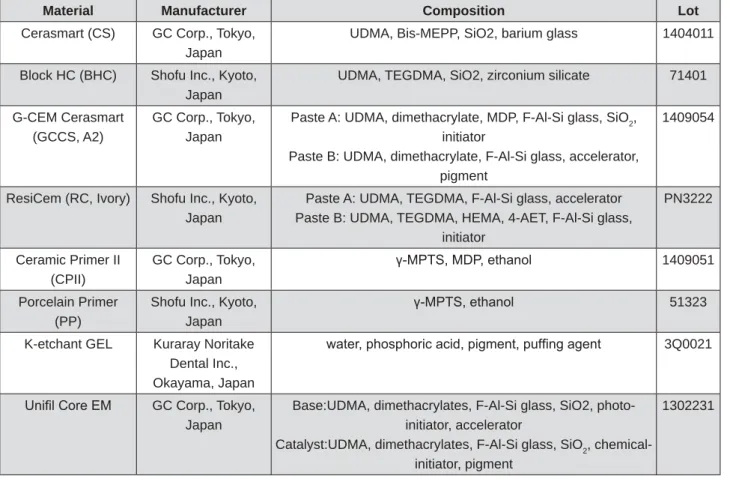
The following 2 CAD/CAM composite material systems were used in this study: 1) Cerasmart (CS), Ceramic Primer II (CPII), and G-CEM Cerasmart (GCCS); and 2) Block HC (BHC), Porcelain Primer (PP), and ResiCem (RC). Descriptions of the CAD/ CAM blocks, resin cements, and ceramic primers investigated in this study are given in Figure 1. The CAD/CAM composite materials, resin cements, and ceramic primer were obtained from the same manufacturer.
Blocks of the 2 CAD/CAM composite materials were cut into slices with dimensions of approximately 14×12×1.5 mm using a low-speed cutting saw with a diamond disk (Isomet, Buehler Ltd., Lake Bluff, IL, USA). The bonding surfaces of these plate-like specimens were ground using silicon carbide paper (#1,000, Struers, Ballerup, Denmark) under water cooling. They were then cleaned with phosphoric acid (K-etchant GEL) for 5 s, rinsed for 5 s, and dried with oil-free air for 5 s. Untreated specimens were used as controls.
A i r - p a r t i c l e a b r a s i o n p r o t o c o l s f o r de t e r m in a t ion of a ppr opr ia t e pr e ssu r e
To determine the appropriate pressure for air abrasion using alumina (Hi-alumina, Shofu, Inc., Kyoto, Japan, mean particle size: 50 μm) and for air abrasion using glass beads (Glass Beads, Shofu, Inc., mean particle size: 75 μm), the following pressures were investigated: 0.1, 0.2, 0.3, 0.4, and 0.5 MPa. Air abrasion was performed using a blasting machine (Jet Blast III, J. Morita Mfg. Corp., Osaka, Japan), which was placed perpendicular to the surfaces of the plate specimens of the CAD/CAM composites at a distance of 10 mm for 15 s while the speci ed pressure was applied. The plates were abraded in circular movements to achieve a uniformly blasted surface. After being abraded, the plate specimens were cleaned with K-etchant GEL for 5 s, rinsed, and dried with oil-free air for 5 s.
pressures for air abrasion for the 2 CAD/CAM composite materials were considered the ones for which the specimen surfaces did not exhibit damage at the ller, as determined from the SEM images.
Su r fa ce r ou gh n e ss a n a ly se s
After the appropriate pressures for performing air abrasion using alumina and glass beads had been determined, the surface roughnesses of three specimens from each group were measured using a laser scanning microscope (VK-8500, KEYENCE Co., Ltd, Osaka, Japan) equipped with a 20× objective. The CAD/CAM composite blocks were placed and oriented appropriately on the stage of the microscope, and a laser beam with a spot size of 1
μm was used to scan their surfaces. The system used had submicron resolution along all the axes. Each surface was measured ve times. The roughness values (Ra and Rz) were obtained using the Microsoft Windows-based Match software package.
Pr e pa r a t ion of bon din g spe cim e n s
The specimens of the CAD/CAM composite materials were divided into 5 test groups (n=14),
which were labeled as follows on the basis of the pretreatment method used:
Group None: Control group, which was cleaned with K-etchant GEL for 5 s, rinsed for 5 s, and dried with oil-free air for 5 s.
Group CP: A layer of a ceramic primer, obtained from the same manufacturer, was applied using a microbrush and dried in oil-free air for 5 s.
Group AB0.2: Air abrasion using alumina was performed at 0.2 MPa. This was followed by cleaning with K-etchant GEL for 5 s, rinsing, and drying in oil-free air for 5 s.
Group AB0.2+CP: The procedure for group AB0.2 was performed. This was followed by the procedure performed for group CP.
Group GBB0.4+CP: After the specimens had been subjected to air abrasion with glass beads at 0.4 MPa, their surfaces were cleaned with K-etchant GEL for 5 s, rinsed, and dried in oil-free air for 5 s. Subsequently, the procedure for group CP was performed.
A dual-polymerizing foundation composite resin (Uni l Core EM, GC Corp., Tokyo, Japan) was lled in acrylic plastic tubes (inner diameter of 6.0 mm
Material Manufacturer Composition Lot
Cerasmart (CS) GC Corp., Tokyo, Japan
UDMA, Bis-MEPP, SiO2, barium glass 1404011
Block HC (BHC) Shofu Inc., Kyoto, Japan
UDMA, TEGDMA, SiO2, zirconium silicate 71401
G-CEM Cerasmart (GCCS, A2)
GC Corp., Tokyo, Japan
Paste A: UDMA, dimethacrylate, MDP, F-Al-Si glass, SiO2, initiator
Paste B: UDMA, dimethacrylate, F-Al-Si glass, accelerator, pigment
1409054
ResiCem (RC, Ivory) Shofu Inc., Kyoto, Japan
Paste A: UDMA, TEGDMA, F-Al-Si glass, accelerator Paste B: UDMA, TEGDMA, HEMA, 4-AET, F-Al-Si glass,
initiator
PN3222
Ceramic Primer II (CPII)
GC Corp., Tokyo, Japan
Ȗ03760'3HWKDQRO 1409051
Porcelain Primer (PP)
Shofu Inc., Kyoto, Japan
Ȗ0376HWKDQRO 51323
K-etchant GEL Kuraray Noritake Dental Inc., Okayama, Japan
ZDWHUSKRVSKRULFDFLGSLJPHQWSXI¿QJDJHQW 3Q0021
8QL¿O&RUH(0 GC Corp., Tokyo, Japan
Base:UDMA, dimethacrylates, F-Al-Si glass, SiO2, photo-initiator, accelerator
Catalyst:UDMA, dimethacrylates, F-Al-Si glass, SiO2, chemical-initiator, pigment
1302231
UDMA: urethane dimethacrylate; Bis-MEPP: 2,2-bis(4-methacryloxypolyethoxyphenyl)propane; TEGDMA: triethylene glycol dimethacrylate; HEMA: hydroxyethylmethacrylate;
$(7DFU\OR[\HWK\OWULPHOOLWLFDFLGȖ0376ȖPHWKDFU\OR[\SURS\OWULPHWKR[\VLODQH MDP: 10-methacryloyloxydecyl dihydrogen phosphate
and height of 2.0 mm) and polymerized in the curing apparatus ( Light II, J. Morita Mfg. Corp.) from both sides for 3 min each. The bonding surfaces of the resin composites were ground using silicon carbide paper (#1,000) under water cooling. They were then cleaned with K-etchant GEL for 5 s, rinsed for 5 s, and dried with oil-free air for 5 s.
P ie c e s o f a p o lye t hy le n e a d h e s ive t a p e (approximately 50 μm in thickness) with a 4.0-mm-diameter circular hole were placed on the pretreated surfaces of the CAD/CAM composite plates to de ne the bonding area. The composite resin was bonded to every CAD/CAM composite plate with each of the resin cements by applying pressure using a nger. The excess cement was removed from the bonding margin using small disposable brushes.
Light irradiation was performed by placing the tip of the light-emitting diode unit (power density of 1,000 mW/cm2;Pencure; J. Morita Mfg. Corp.) on the
surface of the resin composite for 40 s. The bonded specimens were allowed to stand for 30 min at room temperature.
Each group was divided into 2 subgroups (n=7) corresponding to two different storage conditions. One subgroup was stored in distilled water at 37°C for 24 h. The other subgroup was subjected to 10,000 thermal cycles between water baths (Rika-Kogyo, Hachioji, Japan) kept at 4°C and 60°C; the dwelling time in each bath was 1 min.
Sh e a r t e st in g pr oce du r e
Each bonded specimen was embedded in an acrylic resin mold and placed in an ISO/TR 11405 shear testing jig. The shear bond strength was measured with a universal testing machine (DCS-500, Shimazu Corp., Kyoto, Japan). The load was applied at a crosshead speed of 0.5 mm/min, with the bonding surface being parallel to the loading direction. The shear bond strength was calculated by dividing the force at which bond failure occurred by the bonding area.
The debonded surfaces were examined under an optical microscope (SMZ-10, Nikon Corp., Tokyo, Japan) to evaluate the failure types of the debonded specimens. The failures modes were classi ed into the following types: (i) adhesive failure (no resin cement remained on the CAD/CAM composite surface), (ii) mixed failure (some resin cement remained on the CAD/CAM composite surface and cracks formed within the CAD/CAM composite), and (iii) cohesive failure (failure occurred within the resin cement and cracks formed within the CAD/CAM composite or fracturing occurred within the CAD/ CAM composite).
St a t ist ica l a n a ly sis
SPSS 17.0 (SPSS Inc., Chicago, IL, USA) was used to analyze the results of the surface roughness
and bond strength measurements. Two-way ANOVA tests and t-tests were performed on the surface roughness values in order to compare the differences corresponding to the air abrasion particles and CAD/ CAM composite materials used. Three-way ANOVA tests and t-tests were performed on the bond strength values in order to compare the effects of the resin cements and the pretreatment methods used, as well as those of the 2 thermal cyclings. Tukey compromise post hoc tests were performed at a signi cance level of D=0.05.
RESULTS
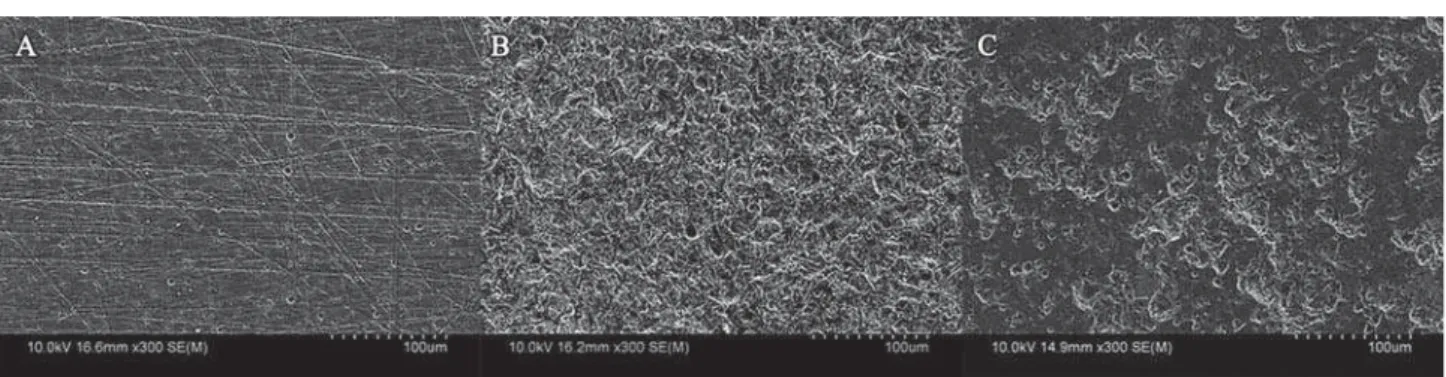
Images of the plate surfaces after they had been subjected to the different pretreatments are shown in Figures 2 and 3. The surfaces of the specimens of both CAD/CAM composite materials in group None (Figures 2A and 3A) exhibited small scratches; however, their structures were regular. Pretreatment AB0.1 resulted in a small number of defects (Figure 2B). Numerous concave and convex features formed on the surfaces of the CS specimens after pretreatment AB0.2 (Figure 2C). On the other hand, after the surfaces had been abraded with glass beads, the number of defects increased. Further, their depths increased with an increase in the air pressure from 0.1 to 0.4 MPa (Figures 2D-G). After the pretreatment of the GBB0.5 specimens (Figure 2H), their surfaces became irregular in a manner similar to those of the AB0.2 specimens; however, fewer irregular grooves were formed on their surfaces than on the surfaces of the specimens of the AB0.2 group. The surfaces of the BHC specimens pretreated with AB0.2 (Figure 3B) or GBB0.4 (Figure 3C) had morphologies similar to those of the surfaces of the CS specimens for AB0.1 and GBB0.1, 0.2, 0.3, and 0.5. However, the ller was observed falling out of the resin matrix in some of the specimens.
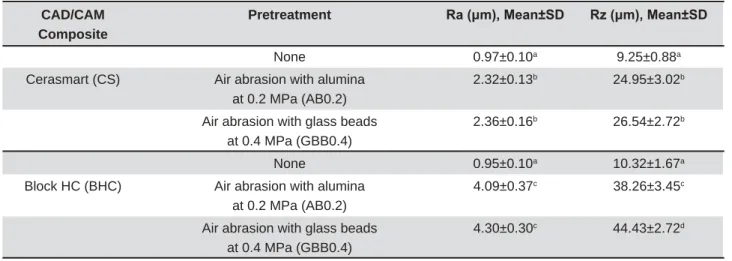
Table 1 lists the surface roughnesses of the specimens of the 2 CAD/CAM composite materials after the three pretreatments. The surface roughnesses of the specimens pretreated with AB0.2 or GBB0.4 were signi cantly higher than those of the None group (p<0.05). In contrast, no signi cant differences were found in the Ra values of the specimens of the CAD/CAM composite materials pretreated with AB0.2 and GBB0.4.
RC did not exhibit signi cant differences (p 0.05). The groups AB0.2, AB0.2+CP, and GBB0.4+CP corresponding to GCCS did not show signi cant differences in their shear bond strengths in the case of TC 0 and TC 10,000 (p>0.05). However, the GBB0.4+CP group showed the highest bond strength of all the groups for both thermal cyclings (p<0.05). The groups AB0.2+CP and GBB0.4+CP corresponding to RC did not show significant differences in their shear bond strengths after the 2
thermal cyclings (p>0.05). However, the AB0.2+CP group showed a signi cant decrease in shear bond strength after thermal cycling (p<0.05).
Table 3 shows the distribution of the failure types. All the specimens of the groups None and CP exhibited adhesive failures at the resin cement-CAD/CAM composite material interface for both resin cements. In contrast, no adhesive failures were observed in the groups AB, AB0.2+CP, and GBB0.4+CP, and only mixed and cohesive failures
Figure 2- Scanning electron micrographs of the surfaces of the Cerasmart (CS) specimens after different pretreatments; A) #1,000 SiC paper (None); B) air abrasion with alumina powder at 0.1 MPa (AB0.1); C) air abrasion with alumina powder at 0.2 MPa (AB0.2); D) air abrasion with glass beads at 0.1 MPa (GBB0.1); E) air abrasion with glass beads at 0.2 MPa (GBB0.2); F) air abrasion with glass beads at 0.3 MPa (GBB0.3); G) air abrasion with glass beads at 0.4 MPa (GBB0.4); H) air abrasion with glass beads at 0.5 MPa (GBB0.5)
CAD/CAM Composite
Pretreatment 5DȝP0HDQ6' 5]ȝP0HDQ6'
None 0.97±0.10a 9.25±0.88a
Cerasmart (CS) Air abrasion with alumina at 0.2 MPa (AB0.2)
2.32±0.13b 24.95±3.02b
Air abrasion with glass beads at 0.4 MPa (GBB0.4)
2.36±0.16b 26.54±2.72b
None 0.95±0.10a 10.32±1.67a
Block HC (BHC) Air abrasion with alumina at 0.2 MPa (AB0.2)
4.09±0.37c 38.26±3.45c
Air abrasion with glass beads at 0.4 MPa (GBB0.4)
4.30±0.30c 44.43±2.72d Table 1- Surface roughness of two CAD/CAM composite materials after different pretreatments
:LWKLQWKHVDPHFROXPQWKHVDPHVXSHUVFULSWOHWWHUVLQGLFDWHQRVLJQL¿FDQWGLIIHUHQFHVS!
Resin Cement
Pretreatment for CAD/CAM Composite
Mean Shear Bond Strength±SD (MPa)
TC 0 TC 10,000
None 25.6±2.9cd,B 13.9±1.6b,A
G-CEM CP (CPII) 23.9±2.5c,A 23.4±2.1c,A
Cerasmart AB0.2 28.4±3.2de, A 30.0±2.0de,A
(GCCS) AB0.2+CP (CPII) 36.1±2.5f,A 32.7±4.4ef,A
GBB0.4+CP (CPII) 41.0±3.6g,A 43.8±3.6g,A
None 11.3±1.7a,B 8.1±2.3a,A
ResiCem CP (PP) 19.6±2.0b,B 11.4±1.7ab,A
(RC) AB0.2 29.8±3.0e,A 27.5±3.1d,A
AB0.2+CP (PP) 40.3±1.4g,B 35.1±3.5f,A
GBB0.4+CP (PP) 38.0±1.8fg,A 36.8±2.8f,A
7KHVDPHVPDOOOHWWHUVDVVXSHUVFULSWLQGLFDWHQRVLJQL¿FDQWGLIIHUHQFHVZLWKLQWKHVDPHFROXPQVDPHWKHUPDOF\FOLQJ and capital letters within the same row (same combination of resin cement and pretreatment) (p>0.05)
Table 2- Shear bond strength of two resin cements to CAD/CAM composite materials with different pretreatments
Resin Cement
Pretreatment for CAD/CAM Composite
TC 0 TC 10,000
Adhesive Mix Cohesive Adhesive Mix Cohesive
None 7 0 0 7 0 0
G-CEM CP (CPII) 7 0 0 7 0 0
Cerasmart AB0.2 0 2 5 0 3 4
(GCCS) AB0.2+CP (CPII) 0 1 6 0 2 5
GBB0.4+CP (CPII) 0 0 7 0 0 7
None 7 0 0 7 0 0
ResiCem ACP (PP) 7 0 0 7 0 0
(RC) AB0.2 0 1 6 0 3 4
AB0.2+CP (PP) 0 0 7 0 2 5
GBB0.4+CP (PP) 0 0 7 0 1 6
were detected. For the groups AB0.2+CP and GBB0.4+CP, cohesive failures were observed in most of the specimens after both thermal cyclings.
D I SCUSSI ON
The strength of the bond between the cement and the restoration, which determines the outcome of fixed dental restorations, depends on many factors3,11,22. A prerequisite for ensuring the longevity
of industrially polymerized CAD/CAM composite materials, such as restorations, is to use a reliable pretreatment that allows for the long-term adhesion of the restoration to the cement. In this study, after the composite specimens had been subjected to pretreatment GBB0.4, they exhibited a lower degree of damage than that experienced by the specimens subjected to pretreatment AB0.2. With respect to the effects of the thermal cyclings, the specimens subjected to pretreatments GBB0.4 and CP exhibited signi cantly higher bond strengths than did those subjected to pretreatments AB0.2 and CP. On the basis of these results, the 2 tested hypotheses — that the use of glass beads for air abrasion results in a smaller degree of surface damage to CAD/CAM composite materials than that when alumina powder is used, and that pretreatments GBB0.4 and CP in combination are more effective in improving the bond durability of resin cements — were found to be true.
During the bonding process, the surface roughness of the material being bonded should be high enough to ensure adequate mechanical retention. In the present study, a number of pretreatments were used to improve the strength of the bonds between CAD/CAM composite materials and resin cements while ensuring that the surfaces of the materials experience the least amount of damage. Air abrasion with alumina powder is considered the most suitable pretreatment for cleaning and activating the restoration surface, as it thoroughly removes organic contaminants from the surface28.
Moreover, alumina blasting increases the roughness of the bonding area to create micromechanical interlocks with the luting cement17. This mechanical
retention is necessary for the bonding of industrially polymerized PMMA-based crowns23. Therefore, the
adhesion between the alumina-blasted polymeric CAD/CAM composites and the resin cements could be considered mechanical retention. Polymeric blocks are industrially polymerized and exhibit a higher degree of conversion than do manually polymerized ones14. Since the control group with the untreated
surfaces (group None) did not show durable bonding, it can be assumed that the free radicals were not suf cient for achieving adhesion between the resin cements and the surfaces of the polymeric CAD/ CAM composites.
The microhardnesses of the CAD/CAM composite
materials were much lower than those of the CAD/ CAM ceramic blocks14. However, air abrasion with
alumina powder has been used not only with metallic and ceramic materials1,20, but also with polymeric
CAD/CAM materials4,11,23,26. The use of alumina for
air abrasion may result in greater damage to the surfaces of CAD/CAM composite materials compared to that experienced by the surfaces of metals or ceramics. Therefore, we concluded that using glass beads instead of alumina powder is preferable for minimizing the damage to the surfaces of the materials. For both CAD/CAM composite materials, pretreatments AB0.2 and GBB0.4 increased the surface roughness to levels higher than that of the untreated group (None), with the composite materials exhibiting different surface morphologies, as determined using SEM. Pretreatment AB0.2 abraded the materials, creating a rugged surface over the entire specimen, while GBB0.4 resulted in smaller defects on the surface. Further, for both CAD/CAM composite materials, pretreatment AB0.2 resulted in greater damage to the surface than did GBB0.4, resulting in the falling out of the ller; this was particularly true for BHC. Damage to the cementation surface may lead to mechanical stress at the bonding area. As a result, cracks can form in the luting area. On the other hand, the surface roughnesses of both CAD/CAM composite materials when pretreated with GBB0.4 were not signi cantly different from those when they were pretreated with AB0.2. The high surface roughnesses of the CAD/ CAM composite materials improved micromechanical retention and/or increased the degree of physical interaction with the resin cement.
CP. Increasing wetting helps the luting cement effectively in ltrate the pores of the composite surface, thereby enhancing the bond strength15.
After being subjected to pretreatment GBB0.4, the surface morphologies of the CAD/CAM composite materials exhibited a greater degree of wettability, making them more suitable for silane coupling and the penetration of resin cements than was the case after pretreatment AB0.2. This is probably what resulted in more of the specimens subjected to GBB0.4+CP exhibiting cohesive failures after TC 10,000 than those subjected to AB0.2+CP.
CON CLUSI ON S
Within the limits of the study, it may be concluded that air abrasion with glass beads at 0.4 MPa was more effective in increasing bond durability between the resin cements and CAD/CAM composite materials than using an alumina powder at 0.2 MPa and the subsequently application of a ceramic primer. Thus, air abrasion with glass beads can result in more durable bond strength between the resin cements and CAD/CAM composite materials, and causes a lower degree of surface damage than does air abrasion using an alumina powder.
REFEREN CES
1- Abreu A, Loza MA, Elias A, Mukhopadhyay S, Looney S, Rueggeberg FA. Tensile bond strength of an adhesive resin cement to different alloys having various surface treatments. J Prosthet Dent. 2009;101:107-18.
2- Alt V, Hannig M, W stmann B, Balkenhol M. Fracture strength of temporary xed partial dentures: CAD/CAM versus directly fabricated restorations. Dent Mater. 2011;27:339-47.
3- Asmussen E, Attal J-P, Degrange M. Factors affecting the adherence energy of experimental resin cements bonded to a nickel-chromium alloy. J Dent Res. 1995;74:715-20.
4- Bähr N, Keul C, Edelhoff D, Eichberger M, Roos M, Gernet W, et al. Effect of different adhesives combined with two resin composite cements on shear bond strength to polymeric CAD/CAM materials. Dent Mater J. 2013;32:492-501.
5- Balkenhol M, Mautner MC, Ferger P, W stmann B. Mechanical properties of provisional crown and bridge materials: chemical-curing versus dual-chemical-curing systems. J Dent. 2008;36:15-20. 6- Coelho CM, Rubo JH, Pegoraro LF. Tensile bond strength of a resinous cement to a nickel-chromium alloy modi ed with ve surface treatments. J Prosthet Dent. 1996;76:246-9.
7- Fasbinder DJ, Dennison JB, Heys DR, Lampe K. The clinical performance of CAD/CAM-generated composite inlays. J Am Dent Assoc. 2005;136:1714-23.
8- Fischer J, Stawarczyk B, Hämmerle CH. Flexural strength of veneering ceramics for zirconia. J Dent. 2008;36:316-21. 9- G nc Ba aran E, Ayna E, Vallittu PK, Lassila LV. Load-bearing capacity of handmade and computer-aided design - computer-aided manufacturing-fabricated three-unit xed dental prostheses of particular ller composite. Acta Odontol Scand. 2011;69:144-50. 10- Kassem AS, Atta O, El-Mowafy O. Fatigue resistance and microleakage of CAD/CAM ceramic and composite molar crowns. J Prosthodont. 2012;21:28-32.
11- Keul C, Martin A, Wimmer T, Roos M, Gernet W, Stawarczyk B. Tensile bond strength of PMMA- and composite-based CAD/CAM materials to luting cements after different conditioning methods. Int J Adhesion Adhes. 2013;46:122-7.
12- Krämer N, Kunzelmann KH, Taschner M, Mehl A, Garcia-Godoy F, Frankenberger R. Antagonist enamel wears more than ceramic inlays. J Dent Res. 2006;85:1097-100.
13- Kunzelmann KH, Jelen B, Mehl A, Hickel R. Wear evaluation of MZ100 compared to ceramic CAD/CAM materials. J Comput Dent. 2001;4:171-84.
14- Lauvahutanon S, Takahashi H, Shiozawa M, Iwasaki N, Asakawa Y, Oki M, et al. Mechanical properties of composite resin blocks for CAD/CAM. Dent Mater J. 2014;33:705-10.
15- Lopes GC, Baratieri LN, Andrade MA, Vieira LC. Dental adhesion: present state of the art and future perspectives. Quintessence Int. 2002;33:213-24.
16- Magne P, Schlichting LH, Maia HP, Baratieri LN. I n vit ro fatigue resistance of CAD/CAM composite resin and ceramic posterior occlusal veneers. J Prosthet Dent. 2010;104:149-57.
17- Marshall SJ, Bayne SC, Baier R, Tomsia AP, Marshall GW. A review of adhesion science. Dent Mater. 2010;26:e11-6.
18- Nguyen JF, Migonney V, Ruse ND, Sadoun M. Resin composite blocks via high-pressure high-temperature polymerization. Dent Mater. 2012;28:529-34.
19- Nikaido T, Kataumi M, Burrow MF, Inokoshi S, Yamada T, Takatsu T. Bond strengths of resin to enamel and dentin treated with low-pressure air abrasion. Oper Dent. 1996;21:218-24.
20- zcan M. Air abrasion of zirconia resin-bonded xed dental prostheses prior to adhesive cementation: why and how? J Adhes Dent. 2013;15:394.
21- Rocca GT, Bonnafous F, Rizcalla N, Krejci I. A technique to improve the esthetic aspects of CAD/CAM composite resin restorations. J Prosthet Dent. 2010;104:273-5.
22- Santos VH, Griza S, Moraes RR, Faria-E-Silva AL. Bond strength of self-adhesive resin cements to composite submitted to different surface pretreatments. Restor Dent Endod. 2014;39:12-6. 23- Stawarczyk B, Basler T, Ender A, Roos M, Özcan M, Hämmerle CH. Effect of surface conditioning with airborne-particle abrasion on the tensile strength of polymeric CAD/CAM crowns luted with self-adhesive and conventional resin cements. J Prosthet Dent. 2012;107:94-101.
24- Stawarczyk B, Ender A, Trottmann A, Özcan M, Fischer J, Hämmerle CH. Load-bearing capacity of CAD/CAM milled polymeric three-unit xed dental prostheses: effect of aging regimens. Clin Oral Invest. 2012;16:1669-77.
25- Stawarczyk B, Sener B, Trottmann A, Roos M, Özcan M, Hämmerle CH. Discoloration of manually fabricated resins and industrically fabricated CAD/CAM blocks versus glass-ceramic: effect of storage media, duration, and subsequently polishing. Dent Mater J. 2012;31:377-83.
26- Stawarczyk B, Stich N, Eichberger M, Edelhoff D, Roos M, Gernet W, et al. Long-term tensile bond strength of differently cemented nanocomposite CAD/CAM crowns on dentin abutment. Dent Mater. 2014;30:334-42.
27- Vanoorbeek S, Vandamme K, Lijnen I, Naert I. Computer-aided designed/computer-assisted manufactured composite resin versus ceramic single-tooth restorations: a 3-year clinical study. Int J Prosthodont. 2010;23:223-30.
28- Yang B, Scharnberg M, Wolfart S, Quaas AC, Ludwig K, Adelung R, et al. In uence of contamination on bonding to zirconia ceramic. J Biomed Mater Res B Appl Biomater. 2007;81:283-90.