Arquivos Brasileiros de Cardiologia - Volume 85, Nº 4, October 2005 SEGURANÇA E EXEQÜIBILIDADE DO ECOCARDIOGRAMA SOB ESTRESSE COM DOBUTAMINA E ATROPINA EM PACIENTES OCTOGENÁRIOS.
Image
Image
Image
Image
Image
Image
M a i l i n g A d d r e s s : J o ã o M a n s u r F i l h o • R u a A l m i r a n t e G u i l l o b e l , 3 7 / 2 0 1 - 2 2 4 7 1 - 1 5 0 - R i o d e J a n e i r o , R J - B r a z i l
E-mail: [email protected] Received on 03/01/05 • Accepted on 03/17/05
Fat Pulmonary Embolism During Orthopedic
Surgery Monitored Through Transesophageal
Echocardiogram
João Mansur Filho, Gustavo Luiz Gouvêa de Almeida Júnior, José Kezen Camilo Jorge, Serafin Gomes Sá Júnior, João Renato, Alcino Affonseca Hospital Samaritano - Rio de Janeiro, RJ - Brazil
Fat embolism syndrome (FES) is a known clinical situation, especially secondary to long bone trauma conditions. Bone marrow embolism for pulmonary circulation may cause changes in pulmonary function and right ventricular dysfunction, either through the release of chemical mediators from fracture locations, which change blood lipid solubility, causing coalition and subsequent pulmonary embolization, or through direct access of fat to venous circulation and, then, to lungs. A 72-year old female patient was submitted to an orthopedic surgery for femur fracture correction with placement of intramedullary rod. As the patient was aged, with coronary artery disease history and without possibility of a proper
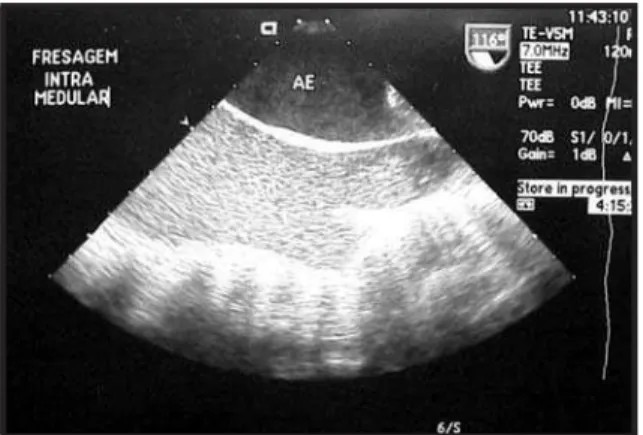
preoperative stratification, as it was an urgent surgery, she was submitted to preoperative monitoring with transesophageal echocardiogram for global and segmental ventricular function assessment. During intrabone preparation for rod receiving (milling), a great amount of hyperecogenic (fig. 1), often forming small pieces (fig. 2), was seen entering through the right heart and reaching out pulmonary circulation. As the interatrial septum was complete, an exuberant contrast difference could be seen between right and left atrial content. There was no change of pulmonary, cardiac or hemodynamic function after procedure completion, and the patient had good postoperative evolution, being discharged afterwards.
Fig. 1 - During intramedullary milling procedure, a great amount of hyperecogenic material fills out the whole right atrium