Arq Neuropsiquiatr 2010;68(6):878-881
878
Article
Relative frequency of headache types
A longitudinal study in the tertiary care
Ariovaldo Alberto da Silva-Júnior1, Bruno Engler Faleiros2,
Tales Michel dos Santos2, Rodrigo Santiago Gómez1,
Antônio Lúcio Teixeira1,3
ABSTRACT
In order to properly assess patients with primary headache, one needs to follow the cases up longitudinally. In Brazil, there were no studies using this methodology published after the publication of the latest issue of the International Classification of Headaches in 2004 – ICHD-2. This is especially important when we consider that it was only after such publication that we had the criteria used to classify some types of headaches which evolve with daily, or almost daily, spells, and which are very common in tertiary health care centers. Objective:
To assess the frequency of headache types in a tertiary health care center, in a longitudinal fashion. Method: We assessed 95 consecutive patients. These patients were diagnosed and classified according to the ICDH-2. The subjects were followed up for 18 months, they were treated and reassessed. Results: Most of the individuals had more than one type of headache. Among those with episodic migraine in 2007, 6 developed chronic migraine in 2008, producing an incidence rate of 7.2%. Among those with chronic migraine in 2007, 9 remitted, producing a remission rate of 75%. In 2007, 24 individuals abused analgesic agents and 17 no longer showed abuse criteria in 2008 – when 7 new cases were found.
Conclusion: The diagnosis of migraine remained stable. On the other hand, treatment brought about a reduction in the frequency of headaches caused by excessive use of analgesic, although the frequency of daily chronic headache was almost unaltered.
Key words: headache, migraine, diagnosis.
Avaliação longitudinal da frequência dos tipos de cefaléia em um centro terciário
RESUMO
Em casos de cefaléia primária é fundamental o acompanhamento longitudinal do paciente. No Brasil não há estudos que utilizaram essa metodologia após a publicação da Classificação Internacional de Cefaléias em 2004 (ICDH-2). Isso é especialmente importante quando consideramos que, apenas após tal publicação, obtivemos critérios para classificar cefaléias diárias, ou quase diárias, tão comuns em centros terciários.
Objetivo: Avaliar longitudinalmente a frequência dos tipos de cefaléia em um centro de cefaléias. Método: Foram avaliados 95 pacientes consecutivos. Estes pacientes foram diagnosticados e classificados conforme a ICDH-2. Os indivíduos foram acompanhados por 18 meses, tratados e reavaliados. Resultados: A maioria dos indivíduos recebeu mais de um diagnóstico. Entre aqueles com migrânea episódica em 2007, 6 desenvolveram migrânea crônica em 2008, com 7,2% de incidência; entre aqueles com migrânea crônica em 2007, 9 remitiram, sendo a taxa de remissão de 75%. Em 2007, o abuso de analgésicos foi encontrado em 24 indivíduos. Desses, 17 não apresentavam mais critérios de abuso em 2008, enquanto 7 novos casos foram encontrados. Conclusão:
Houve estabilidade diagnóstica da migrânea. Por outro lado, a intervenção terapêutica permitiu a redução da frequência dos casos de cefaléia por uso excessivo de analgésicos, embora a frequência de cefaléia crônica diária mostrou-se praticamente inalterada.
Palavras-chave: cefaléia, migrânea, diagnóstico.
Correspondence
Ariovaldo Alberto da Silva Rua Bernardo Guimarães 2154 / 401 30140-82 Belo Horizonte MG - Brasil E-mail: [email protected]
Support
Fundação de Assistência à Pesquisa do Estado de Minas Gerais (Fapemig) and Conselho Nacional de Desenvolvimento Científico e Tecnológico (CNPq)
Received 6 February 2010 Received in final form 30 April 2010 Accepted 7 May 2010
Arq Neuropsiquiatr 2010;68(6)
879 Headaches: tertiary care Silva-Júnior et al.
Headaches afect over 50% of the adults from the gen-eral population. In this setting, tension-type headache (TTH) is the most common headache type, followed by migraine1,2. In the tertiary care, however, migraine and
chronic daily headaches (CDH), are far more common than TTH3-8. CDHs do not represent a distinct
nosolog-ic entity, as per the second edition of the International Classiication of Headache Disorders (ICDH-II)9. Indeed,
CDHs describe primary or secondary headache happen-ing on 15 or more days per month, for at least 3 months, lasting at least 4 hours per day10.
Most studies conducted in the tertiary care are retro-spective or cross-sectional3-7. Few studies followed the
pa-tients longitudinally, using the ICDH-II to diagnose the headaches. his is of particular importance for the CDHs, since diagnosis requires following the patients for at least 3 months. Furthermore, because CDHs evolve from ep-isodic headaches, longitudinal studies are of importance in order to better understand the natural history of the primary episodic headaches. Finally, the clinical pheno-type of the CDHs often incorporates aspects of migraine and of TTH, making diferential diagnosis of CDH sub-types sometimes diicult.
Accordingly, the aim of this study was to longitudi-nally follow individuals with primary headache diagno-ses seen at a university-based clinic, in order to classify their headaches at diferent years.
METHOD
his study was conducted from June of 2007 to De-cember of 2008. Sample consists of 95 patients consec-utively seen.
At the irst interview, participants responded to a semi-structure interview where demographic characteristics as well as the phenotype of the headaches were collected. Patients were then diagnosed and headaches were classiied according to the ICDH-II criteria. CDHs were divided in chronic migraine (CM), probable CM, chron-ic TTH (CTTH), probable CTTH, chronchron-ic paroxysmal hemicrania (CPH), new daily persistent headache, chron-ic post-craniotomy headache, and medchron-ication overuse headache.
After the irst interview, individuals with CDHs were submitted to an extensive therapeutic protocol. he pro-tocol included starting preventive medications, detoxii-cation of ofending medidetoxii-cations when adequate, proper acute treatment, and non-pharmacological therapies.
Patients were then followed for 18 months and reas-sessed. Diferent than in the irst assessment (when only the ICDH-2 diagnosis was rendered), in addition of being rediagnosed, all types of headaches presented by the par-ticipants were classiied in the second assessment.
Date was entering and analyzed using software
Epi-Info®. he frequency of the headaches at the two assess-ments was compared.
RESULTS
Mean age of participants was 42.0 years, and 90.5% of them were women.
Migraine without aura was the most common diagno-sis both in 2007 and 2008. In 2007, the second most com-mon diagnosis was migraine with typical aura (29.5%); in 2008, it was idiopathic stabbing headache (ISH), 36.8%.
Most individuals had more than one diagnosis both in the irst and in the second assessments. In 2007, 47.3% of the participants had more than one diagnosis; in 2008, 60.0% of them had it. In 2007 a total of 147 diagnoses were rendered; in 2008, the number of diagnoses were 177. Established diagnoses are displayed in Table 1.
In the sample, 87.3% had any migraine subtype in 2007, for a total of 83 individuals, and 86.7% (n=82) in 2008. In 2007, 69 subjects had episodic migraine, and 11 had ISH. Other 12 individuals with migraine had chron-ic migraine, and one had ISH. Also, 2 individuals were di-agnosed with probable episodic migraine.
Among individuals with episodic migraine in 2007, 5 developed chronic migraines in 2008, for an incidence of 7.2%; of those with chronic migraine in 2007, 9 remitted to episodic migraine in 2008, for a remission rate of 75%. Accordingly, considering incident and remitted cases, in 2008, 72 patients had episodic migraine and 7 had chronic migraine. Among them, 36 also had IHS.
CDH was diagnosed in 46.3% of the patients in 2007, and 38.9% of the patients in 2008, although one patient in 2007 was diagnosed with two types of CDH and in 2008 four patients.
In 2007, medication overuse headache was diagnosed in 24 individuals. Of them, 17 did not ill criteria for med-ication overuse headache in 2008, while 7 new cases were diagnosed, for a total of 14 cases in 2008. All cases of medication overuse headache happened in individuals with some migraine type.
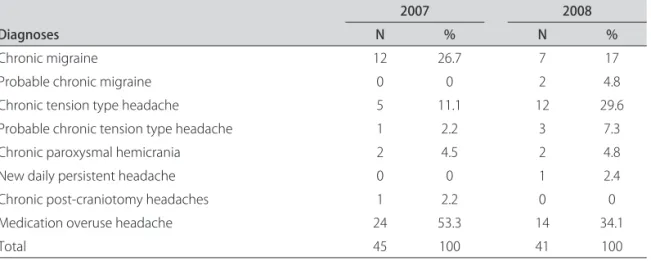
Diagnostic subtypes of the CDHs are displayed in Table 2.
DISCUSSION
he frequency of migraine remained stable over the 18 months of follow-up. Around 87% of the patients had some form of migraine both in the irst and second as-sessments. Other studies conducted at the tertiary care found that the prevalence of migraine at this setting rang-es from 33 to 80%3-6,8. A past study conducted in our
clin-ic diagnosed migraine in 79.2% of the patients3.
Arq Neuropsiquiatr 2010;68(6)
880
Headaches: tertiary care Silva-Júnior et al.
Table 1. Established diagnosis as per for the Second Edition of the International Classification of Headache Disorders.
Diagnosis
2007 2008
N % N %
Migraine without aura 41 43.2 43 45.3
Migraine with typical aura 28 29.5 29 30.5
Chronic migraine 12 12.6 7 7.4
Probable migraine without aura 2 2.1 1 1.1
Probable chronic migraine – – 2 2.1
Infrequent episodic tension type headache – – 3 3.2
Frequent episodic tension type headache 7 7.4 11 11.6
Chronic tension type headache 5 5.3 12 12.6
Probable frequent episodic tension type headache 1 1.1 1 1.1
Probable chronic tensional type headache 1 1.1 3 3.2
Episodic paroxysmal hemicrania – – 1 1.1
Chronic paroxysmal hemicrania 2 2.1 2 2.1
Idiopathic stabbing headaches 12 12.6 35 36.8
Headaches attributed to exercises 1 1.1 1 1.1
New daily persistent headache – – 1 1.1
Chronic post-craniotomy headaches 1 1.1 – –
Temporal arteritis 1 1.1 1 1.1
Headaches due to Idiopathic Intracranial Hypertension 3 3.2 3 3.2
Medication overuse headache 24 25.3 14 14.7
Other disorders of head and face 2 2.1 3 3.2
Trigeminal neuralgia 2 2.1 2 2.1
Not classiiable 2 2.1 2 2.1
Table 2. Number of cases and relative frequency of the chronic daily headaches subtypes.
Diagnoses
2007 2008
N % N %
Chronic migraine 12 26.7 7 17
Probable chronic migraine 0 0 2 4.8
Chronic tension type headache 5 11.1 12 29.6
Probable chronic tension type headache 1 2.2 3 7.3
Chronic paroxysmal hemicrania 2 4.5 2 4.8
New daily persistent headache 0 0 1 2.4
Chronic post-craniotomy headaches 1 2.2 0 0
Medication overuse headache 24 53.3 14 34.1
Total 45 100 41 100
formally established, relative frequency was 36.8%. In pa-tients with migraine, ISH happened in 42.6% of them. Piovesan and cols., following a population of 233 individ-uals with migraine, found a prevalence of 40.4%11. Raskin,
found that 42% of the individuals with migraine, and only 3% of those without migraine, had ISH12. hese indings
support our results.
CDH was similar to what has been reported in a pri-or study3. In studies from Europe, prevalence of CDH
ranged from 27% to 60% at the tertiary care5-7. he
Arq Neuropsiquiatr 2010;68(6)
881 Headaches: tertiary care Silva-Júnior et al.
of medication overuse headache decreased signiicantly, from 25.3% in 2007 to 14.7% in 2008. For this CDH sub-type the therapeutic protocol, which included detoxifying patients excessively using medication, was efective.
his is the irst Brazilian study conducted in the tertia-ry care which follows patients longitudinally, applying the ICDH-II. For CDH, assessing all headache types and fol-lowing patients longitudinally are of particular relevance. In cross-sectional studies it is diicult to assess all types of headache in a single patient, since these studies are often conducted with questionnaires. Furthermore, the quality of information is sometimes compromised when only one assessment is conducted. Because CDH lack biological markers, applying the ICDH-II with the support of head-ache diaries is necessary for formally assigning a diagnosis.
hese diiculties are exempliied by medication over-use headache, which require detoxiication for a deinitive diagnosis. his can only be done prospectively, and after establishment of therapeutic interventions. Accordingly, we decided to only diagnose the most important head-aches that patients had in 2007, to implement therapeu-tics, and then to diagnose all subtypes headaches.
he relative frequency of migraine diagnoses remains stable over time. herapeutics interventions are associated with decreased frequency of medication overuse headache. he relevant frequency of the CDHs remained almost
un-touched, suggesting that despite of all eforts, the thera-peutic management of CDHs continues to be challenging.
REFERENCES
1. Stovner LJ, Hagen K, Jensen R, et al. The global burden of headache: a doc-umentation of headache prevalence and disability worldwide. Cephalalgia 2007;27:193-210.
2. Queiroz LP, Peres MFP, Kowacs F, et al. Chronic daily headache in Brazil: a na-tionwide population-based study. Cephalalgia 2008;28:1264-1269. 3. Vasconcelos LPB, Stancioli FG, Leal JC, et al. Cefaléias em serviço
especializa-do. Migrâneas & Cefaléias 2006;9:4-7.
4. Felício AC, Bichuetti DB, Santos WA, Godeiro Junior CO, Marin LF, Carvalho DS. Epidemiology of primary and secondary headaches in a Brazilian tertia-ry-care center. Arq Neuropsiquiatr 2006;64:41-46.
5. Dowson AJ. Analysis of the patients attending a specialist UK headache clinic over a 3-year period. Headache 2003;43:14-18.
6. Gantenbein AR, Kozak S, Agosti F, Agosti R, Isler H. Headache patients in pri-mary care and a tertiary care unit in Zürich, Switzerland. Cephalalgia 2006,26: 1451-1457.
7. Vinding GR, Zeeberg P, Lyngberg A, Nielsen RT, Jensen R. The burden of headache in a patient population from a specialized headache center. Ce-phalalgia 2007;27:263-270.
8. Scalas C, Calistri L. Chronic daily headache in a paediatric headache centre. J Headache Pain. 2005 Sep;6:274-276.
9. Headache Classiication Committee of the International Headache Society. The International Classiication of Headache Disorders, 2nd Edition. Cephalalgia
2004;24(Suppl 1):S9-S160.
10. Silberstein SD, Lipton RB. Chronic daily headache. Curr Opin Neurol 2000; 13:277-283.
11. Piovesan EJ, Kowacs PA, Lange MC, Pacheco C, Piovesan LR, Werneck LC. Prevalence and semiologic aspects of the idiopathic stabbing headache in a migraine population. Arq Neuropsiquiatr 2001;59:201-205.