Evaluation of Prescription of Exercise, for Rehabilitation of Coronary
Artery Disease Patients by Myocardial Scintigraphy
Romeu S. Meneghelo, Hélio M. Magalhães, Paola E. P. Smanio, Angela R. C. N. Fuchs, Almir S. Ferraz, Rica D. D.
Buchler, Susimeire Buglia, Luiz E. Mastrocolla, Anneliese F. Thom
Instituto Dante Pazzanese de Cardiologia, São Paulo, SP - Brazil.
Summary
Background: It is advisable that the intensity of the exercises for rehabilitation of patients with coronary artery disease does not cause myocardial ischemia.
Objective:Compare the capacity of myocardial tomographic scintigraphy with the electrocardiogram capacity in ischemia detection during rehabilitation session.
Methods: Twenty six patients with coronary artery disease, undergoing the rehabilitation program and with previous scintigraphy, with transient hypo-uptake have been administered a new injection of MIBI-Tc-99m during a training session when they were also monitored with dynamic electrocardiography. The rest scintigraphies, after ergometric treadmill test and rehabilitation session, were assessed in a semi-quantitative way using scores from 0 to 4 to classify each one of the chosen segments (0 = normal; 1 = discrete hypo-uptake; 2 = moderate; 3 = intense; 4 = lack of uptake).
Results: The means of the total scores found were: at rest = 12.9; after treadmill test = 19.3; after rehabilitation session = 15.1. There were statistically significant differences among them. An individual assessment showed that in 14 cases (53.8 %) hypo-uptake to some degree was identified during rehabilitation and in 12 cases (46.6%) it was not. Monitoring with the Holter system didn’t show in any of the cases a ST segment depression equal or greater than 1mm.
Conclusion: The exercises prescribed for patients with coronary artery disease, according to recommendations found in the literature, may trigger myocardial ischemia, assessed by scintigraphy during a rehabilitation session. (AArq Bras Cardiol 2008;91(4):223-228)
Key words: Coronary disease/rehabilitation; exercise therapy / methods; radionuclide imaging; Technetium, myocardial ischemia.
Mailing address: Romeu Sérgio Meneghelo •
Rua Nicolau de Souza Queiroz, 194/161 Cep: 04105-000, São Paulo - SP, Brazil
E-mail: [email protected] / [email protected]
Manuscript received October 23, 2007; revised received January 29, 2008; accepted February 01, 2008.
Introduction
The concept of cardiovascular rehabilitation is currently confounded with that of secondary prevention, especially in the case of coronary arterial disease1. However, physical
exercise is the basic foundation of programs and, alone, is able to promote benefits such as symptom minimization or extinction2,3, and the peripheral adaptations4-6 which determine
increase in the physical capacity7-10 capable of reducing the
ischemic manifestations to sub maximum charges. It also has an important role as aid in the fight against diabetes risk factors, sedentariness, hypertension, dyslipidemia and obesity. In spite of the unquestionable benefits, to exercise patients with coronary heart disease can be potentially harmful. Acute coronary events can cause sudden death, despite their low
incidence11. The prescription of exercises that cause long
periods of myocardial ischemia can be the foundation for triggering ventricular fibrillation and could, in the long term, cause myocardial necrosis12, considering trials carried out with
animals13,14. Thus, the intensity of the prescribed exercises must
remain below the intensity capable of causing myocardial ischemia, which is generally assessed through symptoms or ST segment depression. Such proposition is recommended by current guidelines15. Our option, among the several ways
of prescribing these exercises, is to restrict them to the useful functional capacity16, which is the maximum effort level with
absence of symptoms or clinical, electrocardiographic and hemodynamic changes. In patients without these changes, the Borg scale17 between 13 and 15 is used, corresponding
electrocardiogram capacity in ischemia detection during a rehabilitation session. The study was approved by the ethical committee of the institution.
Case Report
Study populationOut of the 143 patients participating in the supervised rehabilitation program in our institution, 39 were selected presenting: period of permanence in the program higher than six months; diagnosis of coronary arterial disease made through previous cinecoronary arteriography with at least one obstructive lesion, equal or greater than 70%, ST segment depression in one of the main coronary arteries, triggered by effort of at least one millimeter in ergometric test done within one year before; lack of obstruction of the left branch and of pre-excitation to 12-derivation electrocardiogram. After signature of the respective informed consents, a myocardial scintigraphy was conducted with MIBI-Tc-99m, associated with ergometric treadmill test according to Bruce protocol. After a period not greater than a week, a rest scintigraphy was conducted. The cases presenting scintigraphic study compatible with transient myocardial ischemia in at least one segment of the left ventricle, were selected through visual assessment. In this initial scintigraphic analysis, 13 cases were excluded, where transient evident ischemia induced by exercise could not be diagnosed. Thus, the other 26 patients between 49 and 81 years of age (mean = 63,2 years) continued in the trial. A total of 13 patients (50%) were submitted to revascularization surgery. Myocardial infarction had occurred in 10 patients (38.5%), not submitted to subsequent surgery or angioplasty. An angioplasty during acute phase of myocardial infarction was conducted in two patients (7.7%) and elective angioplasty in one patient (3.8%). Among the 10 patients not submitted to revascularization, five (50%) had lesions in one artery, one (10%) in two arteries, and four (40%) in three vessels. The cinecoronary arteriography, before the revascularization, in the other 16 patients, showed that two (12.5 %) had lesions in one artery, eight (50%) in two arteries, and six (37.5 %) in three arteries.
Methods
All patients, after the initial scintigraphies, were connected to a dynamic ECG recorder, before the beginning of the rehabilitation session, in order to obtain a new scintigraphy associated with the prescribed exercise. The recording, in Cardios® cassette tape recorder, in the MC2 and MC5 derivations covered all session. Before the stage known as continuous aerobics, done during 20 minutes in an ergometric bicycle with a prescribed charge, a peripheral vessel of one of the upper limbs was catheterized. On the next to last minute of the exercise the MIBI-Tc-99m dose was administered and the event button was activated in order to precisely evaluate the electrocardiographic tracing of the moment. Around one hour later, a new stress scintigraphy was obtained. ECG tracings of five and ten seconds, in the beginning of recording and when MIBI-Tc-99m was injected, were identified and printed in paper for visual analysis of the ST segment in successive complexes, with stable baseline.
Bicycle ergometric test for exercise prescription
A previous test for exercise prescription, limited sign and/or symptom, and during use of the medication was previously conducted in mechanical ergometric bicycle, with initial charge of 25 watts and 25-watts increments at every five minutes, The rehabilitation exercise prescription was based on cardiac rate and frequency at the end of the test immediately previous to the stage that caused symptoms, and hemodynamic or electrocardiographic changes. In individuals not presenting symptoms or any clinical and electrocardiographic changes, the cardiac rate and frequency were those when the patient showed stress perception level, between 13 and 15 of the Borg scale, that is, somewhat hard - steady pace to hard.
Myocardial scintigraphy
Myocardial perfusion scintigraphies were conducted through Single-Photon Emission Computed Tomography (SPECT), using as perfusion marker 2-Methoxyisobutylisonitrile marked with Technetium-99m (MIBI Tc 99m).
The scintigraphies interpretations were done by consensus of the two observers, using a score system for each of the 20 segments of the four tomographic sections, chosen as follows: section of the minor apical axis, section of the minor medial axis, section of the minor basal axis, medial section of the vertical major axis. The highest intensity segment of radioactivity uptake, for each section, of each scintigraphy, was chosen as a reference. To this segment a value 0 (zero) was given. The adjacent segments of the same section received scores according to the following criteria:
• 0 = if they presented the same radioactivity reception intensity;
• 1 = if they showed a discrete hypo-uptake; • 2 = if they showed moderate hypo-uptake; • 3 = if they showed an intense hypo-uptake; and • 4 = in the absence of uptake.
The total of scores given to each segment of the four chosen sections was defined as the score of each scintigraphy, two of stress and one at rest. With this method, the scores of stress and at rest being equal indicate the absence of hypo-uptake induced by stress, and consequently the absence of ischemia induced by stress. If the score at stress is greater than at rest, this indicates the presence of hypo-uptake induced by stress, and consequently, ischemia induced by stress.
Supervised rehabilitation session
The rehabilitation session when the MIBI-Tc-99m dose was administered for a second stress scintigraphy was similar to all the sessions undergone by the patients, and was thus composed:
a) Warming: walking at normal pace for five minutes; b) Aerobic stage with active pause: two to three minutes walks, interspersed by small races of one to two minutes, for 15 minutes;
minutes;
d) Localized resistance exercises and stretching for 20 minutes.
Statistical analysis
The variables referring to ergometric tests in treadmill and bicycle, the prescribed charge and corresponding heart rate, the heart rate at the beginning of monitoring by the Holter system, and the heart rate during injection were summarized as means and standard deviations. The comparison between the prescribed heart rate and the observed heart rate when injecting MIBI-Tc-99m was made by paired Student’s t test. The scores obtained in the rest scintigraphy, after treadmill ergometric test and during the rehabilitation session were presented as means and 95% confidence intervals (CI95%). The comparisons between the scores in the three situations were made with the analysis of variance technique (ANOVA) with repeated measurements. To localize the differences, the Bonferroni method for multiple comparisons was used.
Results
Treadmill ergometric test for obtaining myocardial scintigraphy
The average exercise time on Bruce protocol was 7.4 minutes (SD=2.1). The heart rate mean varied from 73.6 bpm at rest to 137.1 bpm (SD=18.5) at stress peak. The blood pressure mean at rest was 141.3 (SD=21.3) / 83.4 (SD=8.9) mmHg, reaching 197.3 (SD=32)/82.6 (SD=7.2) mmHg at stress peak (tab. 1). All patients presented ST segment depression triggered by stress, but seven (27%) showed depression between 0.5 and 1mm. In 19 cases (73%) the depression was equal or higher than 1 mm. The mean value of the depression was 1.31 mm (SD = 0,74). Angina pectoris was the cause for exercise discontinuation in four patients (15.3%) and exhaustion in the others 22 (84,7%).
Bicycle ergometric test for exercise prescription.
The maximum average charge attained was 76 watts (SD = 14.9). The cardiac frequency mean varied from 71.3 bpm (SD = 12.8) at rest to 111.7 bpm (SD=22.9) at stress peak. Mean values of blood pressure varied from 129.8 (SD=17.5)/75.5 (SD = 10.1) (mmHg) on previous controls to 183.6 (SD = 22.5)/85.4 mmHg (SD = 15.4) at stress peak (tab. 1).
Results of prescription based on useful functional capacity
The average charge was 49 watts (SD = 8.6). The mean cardiac frequency for training was 104.7 bpm (SD = 15,7) representing, also in average, 66.7% (SD = 9.4) of the theoretical maximum cardiac frequency for the age (tab. 1).
Dynamic electrocardiographic monitoring
ST segment depression less than one millimeter or additional depression also less than one millimeter occurred in three cases only (11.5%) when MIBI-Tc-99m was injected during rehabilitation session. No patient had depression equal or greater than one millimeter. The mean cardiac frequency at
rest was 82.7 bpm (SD = 14.3) and on injection was 102.6 bpm (SD = 15.1). There was no statistically significant difference between the cardiac frequency observed during injection of MIBI-Tc-99m, and the prescribed cardiac frequency for this moment with a mean of 104.7 (SD = 15.6). (P = 0.45).
Myocardial scintigraphies
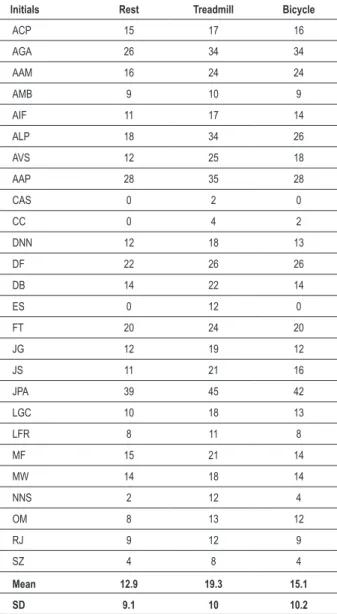
Table 2 shows the score values obtained with the interpretation of the scintigraphies images at rest, at stress in treadmill and when exercising in ergometric bicycle, during rehabilitation session. The mean of the scores observed at rest was 12.9 (SD = 9.1), at stress in treadmill was 19.3 (DP = 10), and during rehabilitation was 15.1 (SD = 10.2).
The mean difference between score at rest and score of scintigraphy associated with treadmill test was 6.3 CI (95%) [4.3; 8.3] (P<0.0001), and between the score at rest and the score of the scintigraphy executed during the rehabilitation session was 2.2 CI (95%) [0.8; 3.6] (P<0.001). The mean difference between the score of the scintigraphy executed during the rehabilitation session and the score of scintigraphy associated with treadmill test was 4.1 CI (95%) [2.3; 5.8] (P<0.0001). Analyzed alone, all the cases presented a higher score in the stress scintigraphy in treadmill than at rest, as this condition was determinant for inclusion of the case in the trial. However, during the rehabilitation session, 12 patients (46.2%) had the same score obtained at rest. In 11 (42.3%), the score obtained in the bicycle exercise was higher than the score at rest, but less than the score at the treadmill test. A total of three patients (11.5%) had the same score in the two tests. Thus, in 14 cases (53.8%), the score observed in the scintigraphy during rehabilitation session was higher than that obtained at rest, indicating the presence of transient hypo-uptake during the rehabilitation session. Suggestive myocardial ischemia has not occurred in 12 cases (46.6%), which presented the same score in myocardial scintigraphy during the rehabilitation session and at rest.
Discussion
Current guidelines determine that the prescription of exercise for patients with coronary heart disease must be made at levels that do not produce myocardial ischemia characterized by angina pectoris and/or ST segment depression15. The observance of this rule can be easily done
today through clinical and electrocardiographic monitoring in a rehabilitation session. However, under conditions such as: after acute myocardial infarction, ventricular hypertrophies, previous changes of the ST segment and others, the myocardial perfusion scintigraphy allow the precise evaluation of possible myocardial ischemia presence during cardiovascular rehabilitation. In this sense, the present investigation is original and extends the possible use of nuclear cardiology.
Table 1 – Mean and standard deviation values of the variables observed during procedure involving physical stress
A - Treadmill ergometric test for obtaining myocardial scintigraphy
T CF DE RESF DE RES DE RES CF FI�ALF FI�AL FI�AL SBP RES DBP RES SBP FI�AL PA FI�AL ST FI�AL
Mean 7 .4 73 .6 137 .1 141 .3 83 .4 197 .3 82 .6 -1 .31
SD 2 .1 13 18 .5 21 .3 8 .9 32 7 .2 -0 .74
B - Bicycle test for exercise prescription
T CF DE RES CF FI�AL SBP RESP DBP RES SBP FI�AL DBP FI�AL SEGM FI�AL
Mean 76 71 .3 111 .7 129 .8 77 .5 183 .6 85 .4 -SD 14 .9 12 .8 22 .9 17 .5 10 .1 22 .5 15 .4
-C - Rehabilitation exercise prescription
Charge in W prescribed CF prescribed Percentile of maximum CF
Mean 49 104 .7 66 .7
SD 8 .6 15 .7 9 .4
D - Electrocardiographic monitoring during rehabilitation session
ST Rest ST MIBI CF Rest CF MIBI % of CF maximum CF prescribed
Mean 0 .17 0 .21 82 .7 102 .6 65 .4 104 .7
SD 14 .3 15 .1 8 .9 15 .6
T - time in minutes; CF - cardiac frequency in heart beats by minute; RES - Rest; SBP - systolic blood pressure in millimeters of mercury; DBP - diastolic blood pressure in millimeters of mercury; ST - ST segment depression in millimeters; SD - Standard deviation; W - watts.
revascularized through surgery and/or angioplasty. Although, through clinical history, in 13 an episode of myocardial infarction was clearly identified, in 23 a score higher than zero was recognized in rest scintigraphy, showing that only three had not had previous myocardial infarction. Such characteristics make the group similar to the groups in rehabilitation, according to current indications for supervised rehabilitation.
To select the protocol used, we tried to change as little as possible the rehabilitation session so that the results would not suffer the interference of complex procedures likely to generate insecurity and anxiety in the patients. Unlike a usual session, a Holter recorder was installed, and a peripheral vessel catheterization was conducted at the beginning of the exercise with bicycle only. Also, the session environment should not present characteristics of a great trial. However, we cannot discard the hypothesis that some degree of anxiety may have interfered with the results.
The characteristics of the bicycle test for exercise prescription, used by our institution, and also in this investigation, have the scope of identifying cardiac frequency values and electrocardiographic changes, as close as possible to the stable state at a given charge. The errors made are thus minimized when the prescription is done from a test shorter than five minutes in each stage, used by the majority of conventional protocols. The mean advised values of cardiac frequency of 104.7 (SD 15.6) and the mean observed values at the 19th minute of exercise in bicycle during rehabilitation
session of 102.6 (SD=15.1) were not different from the statistical viewpoint (p<0.005). Such data show the good
accuracy of the prescription test to foresee the cardiac frequency values after 20 minutes of stress, with a prescribed charge for the same ergometer, in both situations.
The mean values of the prescribed charge of 49 watts (SD = 8.6) and cardiac frequency of 104.7 (SD = 15.6), corresponding to an average percentage of maximum cardiac frequency of 66.7% (SD = 9.4), are relatively modest for the normal individual training, but perfectly acceptable for the rehabilitation of patients with coronary heart disease, according to the prescription levels recommended by guidelines in use15.
The use of electrocardiographic monitoring in the present trial enabled in a simple and accurate way, obtaining the cardiac frequency and the ST segment evaluation during injection of MIBI-Tc-99m. The system used allowed a good correlation between these two variables, given that, at the time of the injection, an event button was activated, recording an electronic signal concurrent with the electrocardiographic tracing of that moment.
Table 2 - Values of the scores obtained through scintigraphy analyses at rest, by treadmill and bicycle during rehabilitation session.
Initials Rest Treadmill Bicycle
ACP 15 17 16
AGA 26 34 34
AAM 16 24 24
AMB 9 10 9
AIF 11 17 14
ALP 18 34 26
AVS 12 25 18
AAP 28 35 28
CAS 0 2 0
CC 0 4 2
DNN 12 18 13
DF 22 26 26
DB 14 22 14
ES 0 12 0
FT 20 24 20
JG 12 19 12
JS 11 21 16
JPA 39 45 42
LGC 10 18 13
LFR 8 11 8
MF 15 21 14
MW 14 18 14
NNS 2 12 4
OM 8 13 12
RJ 9 12 9
SZ 4 8 4
Mean 12.9 19.3 15.1
SD 9.1 10 10.2
the prescribed exercise (p<0.001). However, the mean value observed in that situation (15.07), less than the mean score of 19.3 observed during ergometric conventional test (p<0.0001), indicated that the hypo-uptake degree during the rehabilitation session was smaller.
Through individual evaluation of the patients it was possible to observe that during the rehabilitation session, 12 patients (46.2%) showed the same score obtained at rest, indicating that they did not present probable myocardial ischemia induced by the prescribed exercise. In 11 patients (42.3%), the score at the bicycle exercise was higher than the score at rest, but smaller than the score observed in the treadmill test, indicating probable myocardial ischemia induced by the prescribed exercise, but of a lesser degree than the one observed in a conventional test. A total of three patients
(11.5%) had the same score in both stress scintigraphies, indicating that those patients had, in both situations, the same degree of myocardial ischemia.
Considering all the cases with a score in the bicycle scintigraphy during the rehabilitation session higher than at rest, 14 cases (53.8%) presented probable ischemia and 12 (46.6%) did not. In this trial, the electrocardiogram monitored by the Holter system was unable to identify any of the 14 cases with transient hypo-uptake during rehabilitation, if the criteria of one millimeter depression are to be considered as indicative of ischemic answer. However, depression or additional depression equal or higher than 0.5 mm occurred in three cases (sensitivity of 21.4%). It must be noted that all these patients were using medication for coronary failure, and the medication in use may be the cause of absence of ischemic manifestations at the electrocardiogram.
Indeed, among the 12 patients without ischemia during the rehabilitation session, only two (16.6%) didn’t take antianginal agents, and 10 (83.4%) used beta blockers and/ or vasodilators. In the group of 16 patients with ischemia, five (35%) didn’t take antianginal agents and nine (64.2%) used beta blockers and/or vasodilators. Another possibility for the discrepancy between the results of the scintigraphy and electrocardiogram were the “warming”18 and ischemic
preconditioning19,20 phenomenons.
Kay e cols.18 showed that previous low intensity exercises
can reduce posterior ischemic manifestations, when more intense exercises are made, in patients with coronary arterial disease. All the patients of this investigation have done several warming exercises before the more intense exercises done in ergometric bicycle. On the other hand, the ischemic preconditioning phenomenon was an attenuated response of the anginal and electrocardiographic manifestations, up to two hours after an exercise that caused myocardial ischemia. However, after 24 hours of the ischemia setting in from the previous exercise, there is a second protection window that can last up to 72 hours20.
All our trial patients were, at least for six months, in a program and had at least three weekly sessions of physical exercises. If this mechanism occurred with our patients, the preconditioning can be a phenomenon with electrocardiographic manifestation only, but which does not interfere with the findings of myocardial perfusion detected by scintigraphy. Bogaty et al21, doing three successive
ergometric tests in 12 patients with coronary heart disease, found significant attenuation of the ST segment depression during the third test, which was not followed by concurrent reduction of myocardial hypo perfusion in scintigraphy with thallium 201.
Therefore, such degree of ischemia as documented here can perhaps be a stimulant for the manifestation of beneficial actions. The results obtained do not determine a change in behavior when evaluating patients with coronary heart disease in rehabilitation. Based on them, we cannot recommend the routine use of myocardial scintigraphy to evaluate the accuracy of the prescription in rehabilitation programs. However, the present study opens the possibility of using nuclear medicine in evaluating the degree of ischemia produced by regular rehabilitation exercises in some special patients.
Our trial is limited by the small number of patients included, for not considering the female gender, and because the possible clinical outcomes on the long run have not been reported. Neither can we extrapolate the data to other types of exercise prescription, among which the use of ventilatory anaerobic threshold that is on the rise in the country. New investigations can clarify these matters.
Conclusion
The results obtained in this investigation allow drawing the following conclusions:
1) The use of exercises, prescribed based on the useful
functional capacity, may cause myocardial ischemia in patients with coronary heart disease, during a usual session of supervised rehabilitation, identified by myocardial scintigraphy with MIBI-Tc-99m.
2) The electrocardiographic monitoring, with Holter system MC2 and MC5 derivations, was unable to identify patients with ischemia induced by the prescribed exercise, during a usual session of supervised rehabilitation, considering the presence of ST segment depression equal or higher than 0.1 mV as positivity criteria.
Potential Conflict of Interest
No potential conflict of interest relevant to this article was reported.
Sources of Funding
There were no external funding sources for this study.
Study Association
This article is part of the thesis of Doctoral submitted by Romeu S. Meneghelo, from Faculdade de Medicina da Universidade de São Paulo.
References
1. Balady GJ, Williams MA, Ades PA, Bittner V, Comoss P, Foody JA, et al. Core components of cardiac rehabilitation/secondary prevention programs: a scientific statement from the American Heart Association Exercise, cardiac rehabilitation and prevention Committee, the Council on clinical cardiology; the councils on Cardiovascular Nursing, epidemiology and prevention and nutrition, physical activity, and metabolism; and the American Association of Cardiovascular and pulmonary rehabilitation. 2007 update. J Cardiopulm Rehabil Prev. 2007; 27: 121-9.
2. Bloch A, Maeder JP, Haissly JC, Felix J, Blackburn H. Early mobilization after myocardial infarction. Am J Cardiol. 1974; 34: 152-7.
3. Abraham AS, Sever Y, Weinstein M, Dollber M, Menczel J. Value of early ambulation in patients with and without complications after acute myocardial infarction. N Engl J Med. 1975; 292: 719-22.
4. Detry JMR, Rousseau M, Vandenbroecke G, Kusumi F, Brasseur LA, Bruce L. Increased arteriovenous oxygen difference after physical training in coronary heart disease. Circulation. 1971; 44: 109-18.
5. Ferguson RJ, Taylor AW, Cote P, Charlebois J, Dinelle Y, Peronnet F, et al Skeletal muscle and cardiac changes with training in patients with angina pectoris. Am J Physiol. 1982; 12: H830-H836.
6 Snell PG, Martin WH, Buckey JC, Blomqvist CG. Maximal vascular leg conductance in trained and untrained men. J Appl Physiol. 1987; 62: 606-10.
7. Ades PA, Grunvald MH, Weiss RM, Hanson JS. Usefulness of myocardial ischemia as predictor of training effect in cardiac rehabilitation after acute myocardial infarction or coronary artery bypass grafting. Am J Cardiol. 1989; 63: 1032-6.
8. Arvan S. Exercise performance of the high risk acute myocardial infarction patient after cardiac rehabilitation. Am J Cardiol. 1988; 62: 197-201.
9. Ridocci F, Velasco JA, Echanove I, Soriano G, Torregrosa M, Paya R, et al.Effects of a 1-year exercise training program on myocardial ischemia in patients after myocardial infarction. Cardiology. 1992; 80: 406-12.
10. Ferguson RJ, Petitclerc R, Choquette G, Chaniotis L, Gauthier P, Huot R, et al. Effect of physical training of coronary disease. Am J Cardiol. 1974; 34: 764-72.
11. Van Camp SP, Peterson RA. Cardiovascular complications of outpatient cardiac rehabilitation programs. JAMA. 1986; 256: 1160-3.
12. Ellestad MH. Is exercise harmful in ischemic heart disease? Am J Noninvas Cardiol. 1987; 1: 15-7.
13. Ninomiya L, Hashid J, Geft I, Chaux E, Shell W, Fishbein MC, et al. Brief repeat episodes of ischemia have a cumulative effect and may cause myocardial necrosis. Am J Cardiol. 1981; 47: 445.
14. Braunwald E, Kloner RA. The stunned myocardium: prolonged postischemic ventricular dysfunction. Circulation. 1982; 66: 1146-9.
15. American College of Sports Medicine. Guidelines for exercise testing and prescription. 6th ed. Philadelphia: Lea & Febiger; 1999.
16. Boskis B, Lerman J, Perosio AMA, Scattini MC (eds). Manual de ergometria y rehabilitacion en cardiologia. Buenos Aires: Ediciones Cientifico-Técnicas; 1974. p. 95-114.
17. Borg GA. Perceived exertion: a note on “history” and methods. Med Sci Sports. 1973; 5: 90-3.
18. Kay P, Kittelson J, Stewart RA. Relation between duration and intensity of first exercise and “warm up” in ischaemic heart disease. Heart. 2000; 83: 17-21.
19. Murry CE, Jennings RB, Reimer KA.Preconditioning with ischemia: a delay of lethal cell injury in ischemic myocardium. Circulation. 1986; 74: 1124-36.
20. Bolli R. The late phase of preconditioning. Circ Res. 2000; 87: 972-83.