i
Retail forecasting under the influence of
promotional discounts
André Neves de Almeida Roque Carreira
ii NOVA Information Management School
Instituto Superior de Estatística e Gestão de Informação Universidade Nova de Lisboa
RETAIL FORECASTING UNDER THE INFLUENCE OF
PROMOTIONAL DISCOUNTS
por
ANDRÉ NEVES DE ALMEIDA ROQUE CARREIRA
Dissertação como requisito parcial para a obtenção do grau de Mestre em Gestão de Informação, Especialização em Gestão do conhecimento e Business Intelligence
Orientador:PROF.DR.LEONARDO VANNESCHI
iv
A
GRADECIMENTOSAo Departamento de Sistemas de Informação da Jerónimo Martins, pelo suporte oferecido durante o curso.
Aos meus pais que incessantemente me apoiam e incentivam a ser melhor. À minha família, tios, avós e primas que tanto me alegram.
v
RESUMO
Temos observado um aumento substancial da competitividade no negócio do retalho,onde as maiores empresas controlam o Mercado usando promoções para atrair e aumentar a fidelidade de clientes. Estas promoções causam um decréscimo significativo dos lucros, forçando um maior foco na otimização dos processos logísticos
Forçados a utilizar métodos estocásticos de modo a melhor alocar os recursos para eventos futuros, os responsáveis pela gestão de stock frequentemente recorrem a algoritmos de análise temporal ou simples extrapolações de dados históricos sob a assunção que as vendas podem ser consideradas séries estáveis e periódicas. Embora computacionalmente leves, estes algoritmos produzem resultados que estão sujeitos a uma maior incerteza devido à abordagem simplista.
Entretanto, o continuo aumento dedados disponíveis causado pelo desenvolvimento de sistemas automáticos de recolha de dados, permite a utilização de novas e mais complexas abordagens. Estas lidam com problemasde dimensionalidade, focadas em extrair conhecimento de potenciais valiosas fontes de informação.
Esta tese visa o desenvolvimento de uma solução escalável e compreensível utilizando algoritmos de machine learning para efetuar previsões das vendas diárias de artigos numa loja de retalho, sob a influencia de ações promocionais, de modo a suportar operações logísticas de gestão de stock. Este método preditivo tem como objetivo diminuir os custos de manutenção de stock e simultaneamente evitar falta de artigos, que impacta diretamente a satisfação do cliente com a marca.
O desenvolvimento de um sistema que modele automaticamente as vendas permitiria também aos retalhistas otimizar as suas estratégias promocionais com base dos resultados esperados de diferentes simulações.
Usando dados de uma das maiores companhias de retalho de Portugal, este projeto cai na definição de um problema de Big Data devido ao extenso histórico de vendas e aoelevado número de relações entre artigos que podem ser consideradas. A existência de discrepâncias entre a quantidade de artigos registada no sistema e a quantidade de artigos realmente disponível – phantom stock- será tida em conta tal como agentes externos relevantes que condicionam as vendas.
PALAVRAS-CHAVES
vi
ABSTRACT
As we observe a rise of competitive pressure in retail business, major players control the market using promotions to attract and increase the fidelity of customers. These promotions cause a significant decrease in profit margin hence forcing a stronger focus on logistic processes efficiency. Forced to make use of stochastic tools in order to better allocate resources for the future events, those responsible for assortment strategy frequently choose time series based algorithms and simple extrapolation of historical data, under the assumption that these events can be considered continuous, smooth and possibly periodic. While computationally light, these algorithms are subject to greater uncertainty due to the simplistic approach.
Meanwhile, the explosive growth of information and availability of data brought by improved automatic collection systems allow new and more complex approaches.These tackle the high dimensionality problem, focused on retrieving knowledge from potentially rich sources of information.
The work developed in this thesis aims to develop a comprehensive and scalable solution using machine learning algorithms to forecast daily sales of articles in a retail store, under the influence of discounts, as to support logistic storage allocation operations. This is done with the purpose of decreasing costs related to stock warehousing while simultaneously decreasing stock-outs as they directly influence client satisfaction with the brand.
The development of a successful automatic modelling system would simultaneously allow retailers to optimize their promotional schedules based on the expected results of different simulations. Using real data from one of the biggest retailers in Portugal, this project’s falls into the definition of Big Data due to extensive historical databases which cannot be simultaneously processed. The presence of discrepancies between registered stock and physical availability - Phantom stock - will be considered as well as relevant external events which affect the sales.
KEYWORDS
vii
LIST
OF
FIGURES
Figure 1 Predictive model creation schema ... 10
Figure 2 Sales variation with discounts in two articles ... 14
Figure 3 Article discount variables and respective amount sold ... 22
Figure 4 Histogram of prices of a category and visualization of quantiles ... 24
Figure 5 Examples of time dimension variables taken into account ... 25
Figure 6 Variable representative of the daily strength of the wind ... 26
Figure 7 Variable representative of the daily strength of the sun's radiation ... 26
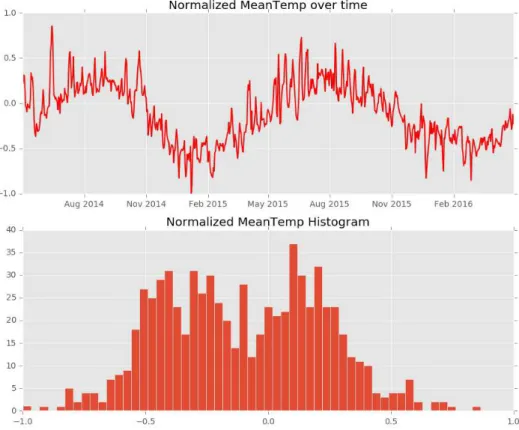
Figure 8 Variable representative of the daily mean temperature ... 27
Figure 9 Variable representative of the daily amount of rain ... 27
Figure 10 Variable representative of the number of football games per day ... 28
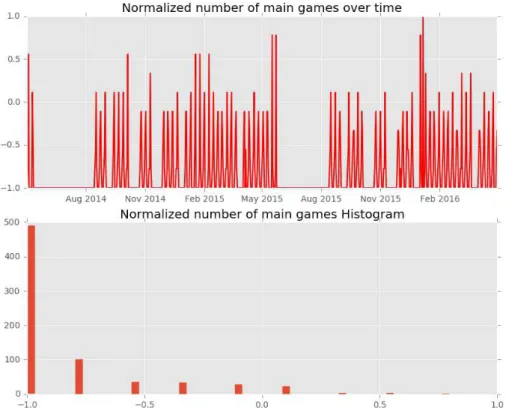
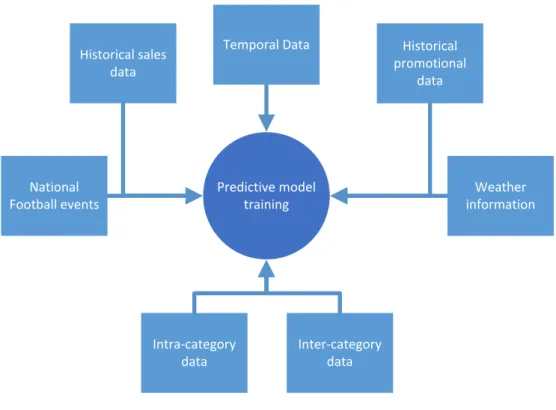
Figure 11 Variable representative of the number of football games of main teams per day . 29 Figure 12 schema of input sources of data for training ... 30
Figure 13 Example of a linear regression ... 33
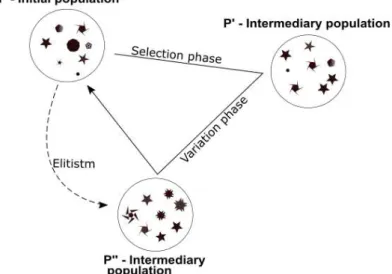
Figure 14 Genetic algorithm schema... 38
Figure 15 Example of an individual / solution vector ... 39
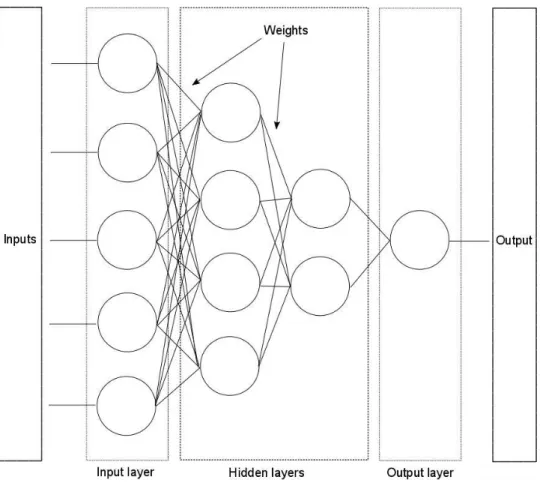
Figure 16 The ANN node ... 44
Figure 17 Traditional network schema ... 45
Figure 18 Error as a function of an individual weight ... 46
Figure 19 Model result dashboard ... 49
Figure 20 Model result dashboard – difference between forecast and the real sales ... 50
Figure 21 Model result dashboard – Influence of discounts on sales ... 50
Figure 22 Model result dashboard – Daily cumulative error ... 51
Figure 23 Model result dashboard – weekly analysis ... 51
Figure 24 Histogram of the ARIMA weekly MPE ... 53
Figure 25 Histogram of the MLR weekly MPE ... 53
Figure 26 Histogram of the Neural Network weekly MPE ... 53
Figure 27 Histogram of the ARIMA weekly MAPE ... 54
viii
Figure 29 Histogram of the Neural Network weekly MAPE ... 55
Figure 30 Box plot of the ARIMA MAPE by Area ... 56
Figure 31 Box plot of the MLR MAPE by Area ... 56
Figure 32 Box plot of the Neural Network MAPE by Area ... 57
Figure 33 Models MAPE by average quantity ... 58
Figure 34 Histogram of the ARIMA MAPE by article promotional strategy ... 59
Figure 35 Histogram of the MLR MAPE by article promotional strategy ... 59
Figure 36 Histogram of the Neural Network MAPE by article promotional strategy ... 59
Figure 37 Histogram of the MPE of the pre-selected model ... 61
Figure 38 Histogram of the MAPE of the pre-selected model ... 62
ix
LIST
OF
TABLES
Table 1 Example of used sales data ... 13
Table 2 Filtered entry ... 15
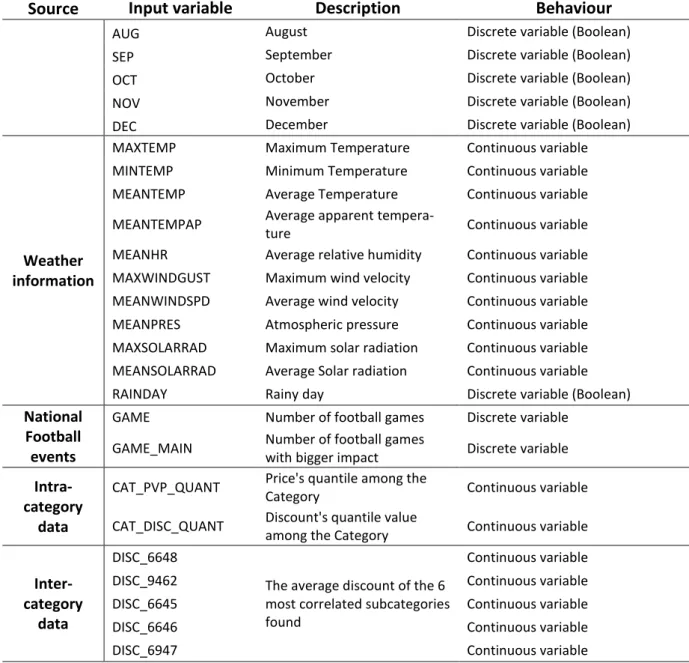
Table 3 List of input variables ... 32
Table 4 Models MPE - expected value and standard deviation ... 54
Table 5 Models MAPE - expected value and standard deviation ... 55
Table 6 Models MAPE by area - expected value and standard deviation ... 57
Table 7 Models MAPE by Article promotional strategy - expected value and standard deviation... 60
Table 8 MPE of the pre-selected model - expected value and standard deviation ... 62
Table 9 MAPE of the pre-selected model - expected value and standard deviation ... 62
x
LIST
OF
ABBREVIATIONS
AND
ACRONYMS
ANN Artificial Neural Network
MLP Multilayer perceptron
AR Autoregressive model
MA Moving average model
ARIMA Autoregressive integrated moving average
OSA On shelf availability
SKU Stock-keeping unit
xi
CONTENTS
1. INTRODUCTION ... 1
1.1. Background and Problem Identification ... 1
1.3. Theoretical Framework ... 4
1.4. Study Relevance and Importance ... 6
1.5. Methodology ... 7
1.6. Thesis Outline ... 8
2. PRE-PROCESSING ... 9
2.1 Predictive Modelling concepts ... 9
2.2 Retail Idiosyncrasies ... 11
2.3 Aggregated data ... 13
2.4 Missing Data ... 14
2.5 Incorrect Data ... 15
Phantom Stock ... 16
Incorrect Data ... 16
2.6 Dimensionality ... 17
2.7 Outliers ... 19
2.8 Normalization ... 19
3. INPUT DATA ... 21
3.1 Market Discount Strategy ... 21
3.2 Temporal data ... 24
3.3 Weather ... 25
3.4 Football matches ... 28
3.5 Model input data summary ... 29
4. MODELS... 33
4.1 Multiple Linear Regression ... 33
MLR notation ... 34
MLR considerations ... 37
GA Input variable selection ... 37
4.2 ARIMA ... 40
4.3 Neural Network ... 43
Training Phase ... 45
Considerations ... 48
xii
5.1 Visualization tools ... 49
5.2 Errors considered ... 51
5.3 Global MPE and MAPE ... 53
5.4 MAPE by Area ... 56
5.5 MAPE by discount fluctuation ... 58
5.6 Combining Best model by article ... 60
6. CONCLUSIONS ... 65
7. FUTURE WORK ... 67
1
1.
INTRODUCTION
1.1.
Background and Problem Identification
In the latest years promotional discounts have emerged into retail businessencouraged by
fierce competition. According to the Portuguese Association forDistribution Companies
(APED - Associação Portuguesa de Empresas de Distribuição), promotions are getting more
frequent. In 2014 more than a third of the sales in food retail business were associated with
a promotional discounts.
These promotions are analysed, considered and renewed on a weekly, and even daily, basis
in order to increase visibility and customer loyalty to the brand. Numerous studies have
been developed in the field of marketresearch focused on promotions, their strategic
impli-cations and impact (Levy et al., 2004, Zhang et al., 2008).
However,beyond all strategic and planning decisions, a logistic demand planning framework
must be implemented as to support the impact of such strategies(Trusov et al., 2006).
Is crucial to create an accurate demand forecasting of thousands of products, each one with
its own specificity, in order to organize and plan production, purchase, transportation and
labour force. Even though this aspect of promotion planning has received relatively little
attention in marketing literature, possibly due to the more applied nature of process, the
importance of accurate sales forecasts to efficient inventory management has long been
recognized. Here, the precision of the implemented method can greatly contribute to lower
storage costs and increase client satisfaction. However, a wrong estimative can cause losses
either by excess or disruption.
While there are costs and losses in operational efficiency associated with stock holding,
lower OSA levels caused by depletion of the product, not only decreases the sales amount
2 costumers abandon the service in favour of a competitor's, progressively jeopardizing a
firm’s competitive position.
The impact of the improvement of these forecasts can be observed especially in big
retail-ers, where optimization ROI (return of investment) can be more easily noticed.
Up until the last few decades, the use of the “last like” rule for ordering inventory for u
p-coming promotion events has been a common practice. Here, the quantity of goods ordered
is the same as the quantity of goods sold during a similar past promotion (Cooper et al.,
1999). However, recent advancements offered better ways for managers to handle the
planning process.
Due to the strong trend and nonstationary seasonal patterns exhibited by Retail sales (Alon
et al.l,2001), the most widespread methods have been Winters exponential smoothing,
sea-sonal autoregressive integrated moving average (ARIMA) model and multiple regression
which have the ability to model trend and seasonal fluctuations presented by aggregate
retail sales.
These Linear time based models and regression algorithms have long supported logistic
op-erations requirements with acceptable accuracy. However, the linearity in which these
algo-rithms most effectively perform has been compromised. Due to economic instability and
more fierce competition (Geurts, 1986 and Gür et al. 2009), recent retail sales time-series
data show a higher degree of variability and nonlinearity, which decreases the accuracy of
these models, hence justifying the use of nonlinear models such as the Artificial neural
net-works which have consistently showed to be more precise (Zhang et al., 2003 and Alon et
al., 2001).
Regardless of the innovation brought from the mentioned works, external factors, frequent
and irregular promotional discounts at the article level have not been thoroughly
consid-ered.
This work will focus on the analysis of some of the most relevant algorithms used for
fore-casting demand, comparing their performance.
Market tendency, external events and the discounts of not only the products analysed but
3 estimating the consumption of customers. By using real data from the industry, the
pres-ence of Phantom Stock, Big Data, meaningful external influpres-ences and a wide range of
pro-motions will characterize the challenge.
1.2.
Study Objectives
The objective of this study is the creation of a scalable front end tool to improve on shelf
availability (OSA). This will be achieved by creating models which allow an automatic and
more accurate prediction to preventively avoid OOS and therefore, the loss of sales.
This approach will take into consideration several internal and external factors which affect
demand. We will consider events which are not controlled by the business, such as the
weather and main sport events, as well as variables which describe used marketing strategy.
The precision of different Machine Learning Algorithms will be tested in the interest of
as-serting the best model for this problem, their performance will be validated upon a training
set of four weeks of daily data using nearly two hundred individual SKU (stock-keeping
units).
This projects has also a strong visualization component where we intent to transmit
com-plex results in a simple way. Graphics must be designed to support the user and allow easy
comprehension of the reasons behind erratic results of the model.
Therefore, alongside the research development, the following objectives should be fulfilled:
Literature review of previous works in Demand Forecasting using machine learning algorithms.
Identify the external factors that should be considered and develop methods to ex-tract them automatically.
Identify empirically the level of aggregation that should be considered given the computational requirements and logistic characteristics.
4
Creation of a visual user interface which can analyse historical data and a promo-tional discount strategy and deliver a report on expected demand.
1.3.
Theoretical Framework
The level of sophistication of the methods used by the retailers can greatly differ, being the
most basic SKU sales forecasting methods, univariate forecasting models based on time
se-ries which analyse past sales history in order to extract a demand pattern that is projected
into the future.
SinceRetail Sales data is rich in trends and seasonal patterns, the failure to account for these
patterns may result in poor precision.
These time series techniques range from simpler moving averages and exponential
smooth-ing to the more complicated box-jenkins ARIMA approach (Box and Jenkins 1974).
However these methods do not take external factors such as price changes and promotions
into account (Alon et al., 2001).
(Gür et al. 2009) found that simple time series techniques perform well for periods without
promotions. However, for periods with promotions, models with more inputs improve
accu-racy substantially. Therefore, univariate forecasting methods are usually adopted as a
benchmark model in many studies (Gür et al. 2009, Huang at al 2015).
Numerous studies, in order to improve SKU sales forecasting in the presence of promotions,
have integrated the focal product’s promotional variables into their forecasting models. In
practice, many retailers use a base-times-lift approach to forecast product sales at the SKU
level (Cooper et al. 1999, Huang et al 2015). The approach is a two-step procedure which
initially generates a baseline forecast from a simple time series models and then adjusts for
any incoming promotional events. The adjustments are estimated based on the lift effect of
the most recent price reduction and/or promotion (Ma et al. 2014). the limitation of these
studies is that they overlook the potential importance of price reductions and promotions of
5 Another stream of studies uses a model-based forecasting system to forecast product sales
by directly considering the promotional information. A possible choice is to use multiple
linear regression, but other methods capable of predicting a continuous target can be
ap-plied - including powerful non-linear methods such as support vector machines for
regres-sion, model trees (decision trees with linear regression functions at the leaves) and Neural
Networks.
Often the most popular methods, both the ARIMA model (Box & Jenkins, 1974) and ANN
have shown advantages forecasting trend and seasonal data, hence the motivation focused
on these methods by the latest studies (Thiesing & Vornberger, 1997). (Zhang and QI 2005)
concluded that the overall out-of-sample forecasting performance of ANNs in predicting
retail sales is not better than ARIMA models without appropriate data pre-processing
namely deseasonalization and detrending. Hence, the use of seasonal dummy variables as
auxiliary inputs in the ANN (Zhang et al., 2003, Zhang, 2009 and Alon et al., 2001). Using this
method, (Pan et al. 2014) demonstrates the potential of applying empirical mode
decompo-sition (EMD) in forecasting aggregate retail sales. Here, he integrates EMD in neural
net-works showing how the new hybrid outperforms both the classical ANN model and seasonal
ARIMA during the periods in which macroeconomic conditions are more volatile. Other
Hy-brids have been considered.(Aburto and Weber 2007) developed a hybrid intelligent system
combining ARIMA type approaches and MLP-type neural networks for demand forecasting
that showed improvements in forecasting accuracy. Their results led to fewer sales failures
and lower inventory levels in a Chilean supermarket. (Au et al. 2008) studied the use of
evo-lutionary neural networks (ENNs) for sales forecasting in fashion retailing, obtaining this way
a faster convergence and more accurate forecasting than the fully connected neural
net-work.
The collective results indicate that on average ANNs fare favourably in relation to the more
traditional statistical methods, mainly due to their ability to capture the dynamic non-linear
trend and seasonal patterns, as well as the interactions between them. However, despite its
simplicity, the ARIMA model was shown to be a viable method for forecasting under
rela-tively stable economic conditions, performing consistently well.
By using real data from the industry, the current work will analyse the performance of these
6
1.4.
Study Relevance and Importance
The replenishment system is crucial to maintaining competitive advantage in Retail business
and it can strongly be affected by forecasting models as they directly affect early order
commitments (Zhao et al., 2001). Still, Out-of-stocks remain a large problem for retailers in
the consumer goods industry. According to ECR Europe (2003), the latest advances in supply
chain management, category management and investments in inventory-tracking
technol-ogy have not reduced the overall level of out-of-stocks on store shelves from what was
re-ported in previous studies. The Retail Chains are still far from delivering near-perfect
fulfil-ment. Out-of-stock rates vary wildly among retailers but the majority tends to fall in the
range of 5-10 percent.
Out-of-stock items relate to a waste of time and money, but more importantly, stock-outs
largely contribute to consumers switching to other retail stores to fulfil their demands.
As to decrease costs related to stock warehousing while simultaneously decreasing stock
outs as they directly influence client satisfaction with the brand, the proposed work will
fo-cus on the creation and performance evaluation of an adaptive models. This model will be
used in the implementation of a front-end user interface which will allow the user to get an
estimative of future demand given the specified promotional marketing strategy.
This project will take into account the market tendency, external events as well as discounts,
7
1.5.
Methodology
This work will initially rely on an exhaustive literature review of the state of the art of Retail
Demand forecastingand the most widespread predictive algorithms – Multivariate linear
regression, ANN and ARIMA.
The following milestones werefollowedto complete the work:
Extraction of data to local database (historical sales and Article dimension data) si-multaneously masking it (due to legal obligations);
Extraction of external relevant data (holidays, football games, weather data);
Pre-processing the available data:
o Extract raw data from the local database;
o Structure input sales data, article information and promotional historical
data;
o Standardization and uniformization of data;
o Identify and handle missing data;
o Filter outliers;
o Identify and handle Phantom stock.
Development of the multivariate linear regressionalgorithm;
Development of the Neural Network model;
Development of the ARIMA model;
Analysis of each of the models performance and limitations given out of sample data
– Test Data;
Development of profiling tools so that the behaviours and registered errors can be easily interpreted by visualization.
8 The pre-processing steps are executed whenever there is a call to get data, either for
train-ing or testtrain-ing. The data resides in its original state upon extraction. Permanently assumtrain-ing
the possibility of corrections and updates from the original source.
1.6.
Thesis Outline
The rest of the document is organized as follows:
Chapter 2 presents a project overview of predictive modelling andfocused on the pre-processing of the input variables required to improve data quality and secure
vi-ability of the trained models;
Chapter 3 tackles the different input variables considered, listing the sources and the types of variables used;
Chapter 4 presents and describes the used predictive models: Multiple linear regres-sion, ARIMA and neural networks;
Chapter 5 discusses the obtain results of the project through different perspectives including the results of a combined model;
Chapter 6 contains the conclusions of this thesis;
9
2.
PRE-PROCESSING
2.1
Predictive Modelling concepts
As we intend to estimate the value of an unavailable variable, based on experience, we
en-ter the field of predictive modelling.
There are two main types based on the characteristics of the target variable:
Classification – The intent is to predict a discrete variable/assign a label;
Regression – Once the problem implies the prediction of a continuous variable as
the daily amount of sales.
In order to achieve our goal, a descriptive model must be created.
The construction of this model will have into account passed history with known results.
Hence this is classified as a supervised learning problem, we know the true value of each
daily sales in the training dataset and a feedback for each training prediction exists.
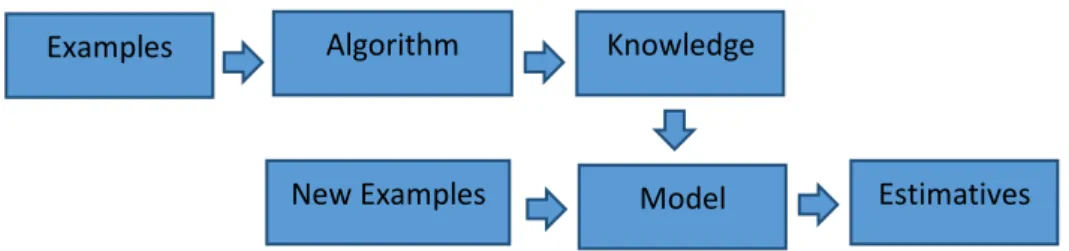
As seen in the Figure 1, in order to create the model, initially we must gather training
exam-ples. Reliable data can be hard to gather and, atthis step, the assumptions we chose can
derail the model, thus, a pre-processing is generally necessary in order to secure the quality
of the input data.
The used attributes must be chosen carefully, generally through an iterative process.
Choosing a reduced number of attributes can result in insufficient descriptive power over
the behaviour of the dependent variable. Choosing an abundant number of variables
gener-ally in the inclusion of spurious relations - relations with not translate any causality - which
lead to mistakes in the future.
The choice of input space is often limited by the performance of the training step. The larger
the input space the more data and computing power we need. This can be tackled with
10
Examples Algorithm Knowledge
New Examples Model Estimatives
When applied to the reality, the training data can define the viability of the model, not only
the choice of attributes but also the considered data points can have severe impacts on its
performance.
Real data suffers from several problems, such as, outliers, incorrect data, variables with
dif-ferent scales and omitted values, which can easily compromise the accuracy of the
devel-oped learning algorithm. The methods used to expose data in the best conditions are
de-tailed in the following chapter.
Afterthe attainment of the input data set, we proceed to feed the training data to a choose
an algorithm with intention of extracting the descriptive relations (knowledge) between the
independent variables and the target, assumedly dependent variable.
One of the focus during the training phase is assuring that the model has generalization
properties.
Since the complexity of the training phase is not being limited, the model can memorize the
training data, over focusing on its specific properties and idiosyncrasies. A phenomenon
known as over-fitting occurs as it will base the forecast on unique particularities of the
train-ing set.
As a solution, a split of the original data is executed and the secondary disconnected set –
validation set – is used to monitor the evolution error of the model across time. By testing
the evolution of the error on this set, while using exclusively the training set to develop the
model, we can realize when the model is becoming too complex and stop the training at
that point in time. By doing so, we secure generalization.
11 A common practice is to divide the data to allow the creation of a third dataset, the testing
set. The former will be used to produce an estimative of the expected error, providing the
expected precision of the model when applied to new data.Unlikely the former sets, the
estimative of the error given by the testing set will not suffer favourable skews since it was
not used directly nor indirectly on the training phase.The sets are disjoint, random selection
without reposition and the configuration of the partitioning by the three groups has an
im-pact on the results.
Increasing the size of the training dataset ensures a better regression while decreasing it
may increase the probability of finding properties which are not transportable to a bigger
set.The enlargement of the validating set allows a better estimative of when to stop the
training whereas the enlargement of the test set allows a better estimative of the expected
error once applying the model to new instances.
There are no concrete answers to the optimized split of the data as it is dependent on the
problem in hand. Still, many distributions are commonly choosen as rule of thumb as the
80-10-10 split. (80% of your data for training data, 10% for validation, 10% for tests) or the split
50-25-25.
The training step can be divided into two categories: Incremental (e.g. Neural networks) and
batch (e.g. Multivariate linear regression). The former training method processes the input
entries individually, provoking transformations sequentially while the latter simultaneously
uses all available data points simultaneously.
2.2
Retail Idiosyncrasies
A particularity of retail data is the heterogeneity of the forecasting targets, the individual
product sales. Products can have short or long expiry dates (e.g. meat and honey), they can
present a higher seasonal component in sales (e.g. ice creams) and can exist solely during
short periods of time where they will possess big discounts in the interest of attracting new
12 Furthermore, the data is often unreliable mainly due to the human factor in the stores.
Products can be transformed and sold under other labels (eg. fruits can be cut and sold in
more convenient packages upon ripening), can be stolen or suffer damages which skew
their stock values from reality and can be a target of promotions at store level if
approach-ing the technical expiration date.
In orderto prepare the data and expose it in the best conditions to the model,
pre-processing steps are required. This chapter will present the problems which have been
13
2.3
Aggregated data
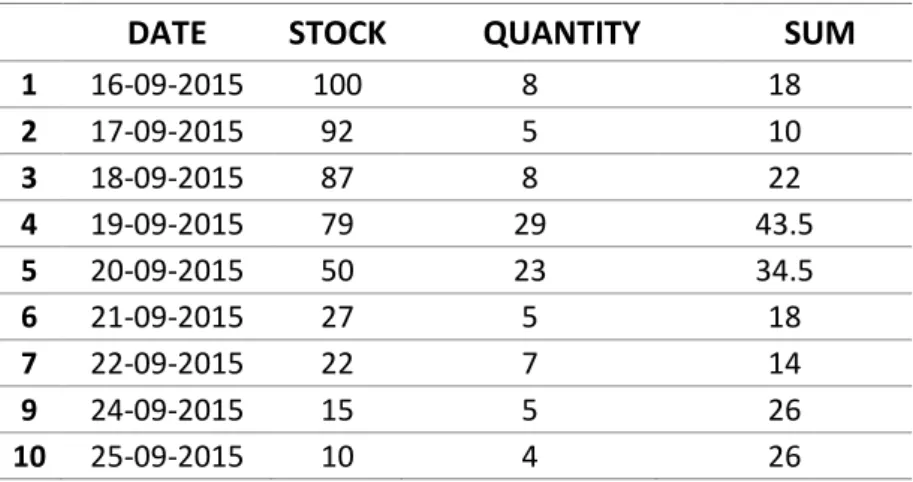
The used data consists of an aggregation of daily sales. It is the result of an SQL querry
di-rected to a Stock fact table. Here the data is aggregated into the total values of the store per
day per article, as seen in Table 1.
DATE STOCK QUANTITY SUM
1 16-09-2015 100 8 18
2 17-09-2015 92 5 10
3 18-09-2015 87 8 22
4 19-09-2015 79 29 43.5
5 20-09-2015 50 23 34.5
6 21-09-2015 27 5 18
7 22-09-2015 22 7 14
9 24-09-2015 15 5 26
10 25-09-2015 10 4 26
Table 1 Example of used sales data
The “STOCK” field indicates the theoretical stock in the store at the beginning of a given day.
As discussed later, this information is not reliable, its error grows daily and is rectified by
manual stock audits. The fields “QUANTITY” and “SUM” describe the daily totals of the sales
quantity and the sum of the recommended retail price sales (RRP).
As a direct consequence of the aggregationinformation is lost. No precise identification of
the promotional discount is known and as such it must be computationally estimated. We
can estimate the daily 𝑅𝑅𝑃 by dividing the sum by the quantity, as presented on expression
[1]:
𝑅𝑅 𝑃𝑖 =𝑄𝑈𝐴𝑁𝑇𝐼𝑇𝑌𝑆𝑈𝑀𝑖 𝑖
[1]
Taking Table 1 as an example, we observe that the individual RRP generated by the first
three lines is 2, whereas the line 4 and 5 present an estimated RRP of 1.5. We can therefore
14 Figure 2 Sales variation with discounts in two articles
𝐷𝐸𝑆 𝐶𝑖 =𝑅𝑅𝑃𝑅𝑅𝑃𝑚𝑎𝑥 − 𝑅𝑅 𝑃𝑖 𝑚𝑎𝑥
[2]
𝑅𝑅𝑃𝑚𝑎𝑥 is the maximum individual price registered for the given article across the whole
dataset. It is worth noting that this computation brings an additional disadvantage as the
computation is vulnerable to outliers in 𝑅𝑅𝑃𝑚𝑎𝑥.
Keeping in mind that the discount we compute is an estimative, which intuitively becomes
one of the most meaningful predictors we consider. Unfortunately, there is plenty of
infor-mation loss in this computation. We cannot distinguish promotional pack sales as a “take 2
pay 1” from a daily 50% discount,neither can we individualize the portion of sales which
were caused due to promotions fomented by approaching expiration date. Nevertheless,
the sales grow unidirectionally as the computed discount grows (Figure 2), making it a viable
input for forecast prediction.
2.4
Missing Data
One of the characteristics of the used data is the lack of entries of days without sales as
15 filtering when extracting the data. Without the filter, the day 23 would present the
follow-ing values:
DATE STOCK QUANTITY SUM
23/09/2015 15 0 0
Table 2Filtered entry
Whichwould prevent the estimation of the daily RRP.
One solution to handle the missing data problem is by simply eliminating these entries. In
the current paradigm, this solution cannot be considered as it would skew our dataset and
lead to the loss of information of days without sales, severely compromising the viability of
the model once applied to reality. Another reason of why these days cannot be omitted is
due to the constructions of predictors, such as the previous month sales, which demand a
continuous history.
Another solution is to fill the omittedRRP values with a measure of central tendency, such as
the mean. This solution cannot be considered since it would imply setting a discount in each
of these entries. We can, nevertheless, fill the missing values with the ones of similar
indi-viduals, or more precisely, by filling missing entries with values corresponding to linear
re-gression of the values of individuals in both extremities – closest neighbours. Following the
given example, we assign 2 to the RRP of the day 23. These estimated entries will be
consid-ered when rendering variables for future data points (such as weekly price variation) but,
since no true sales value is known, the points themselves will not be considered as valid
training or validation dataset.
2.5
Incorrect Data
When results suffer forced deviation by external variables, we should not consider all the
dataset for training. Such is the effect of the stock uponthis project since the estimator is
16 Phantom Stock
Building a reliable OSA performance indicator is hard to measure without a considerable
human effort or auxiliary sensors to accurately identify its decreases.
Either due to logistic limitation or human error, articles have their sales reduced by not
be-ing available in good conditions in their shelfs at a given point in time. This contributes to
faulty input data as the conditions described by its marketing strategy are disconnected
from the sales result. Even if there is stock of a product in the store, it can be currently in
the warehouse and not on the shelf. In fact, through the eyes of the HQ there is always
un-certainty regarding the availability products in the shelf, as well as their conditions instore,
the proper pricing, labelling and placement.
Either due to theft, damages or human error, stock reported to exist in the store, while in
fact does not, is designated by Phantom Stock. This discrepancy between the theoretical
stock and the real one can be seen as an error which gets periodically corrected by the store
personal upon systematic inventory audits.
Incorrect Data
Independently of all other variables, the stock majorizes the sales. It forces the sales to zero
when it simultaneously is zero and it limits the maximum sales amount at all times. Both this
situations, caused by human errors or logistic constrains, temporarily disconnect the input
configuration of all the remaining variables and the obtained result.
In order to protect the models from the skew effect caused by examples which are
com-promised due to stock limitation, we classify four different causes of deviated results which
should be filtered:
17
Sales limitationby stock – Although the degree of limitation cannot be verified (as the last product sold could have been the last to be sold even if there were more
units to sell), these entries are identified when the sales amount reaches the stock
amount. They will also be filtered.
Low shelf availability – In the case not all the units are in the shelf and the ones that have been were sold. While not forcing the sales to zero, this will contribute to a
decrease of the daily sales. These entries can easily be indistinguishable from usual
entries, especially in the case of slow movers.
Phantom Stock – In these situations the sales, just as in the previous case, are
diminished by the lack of product in the shelf. Here the sales amount is little or
inexistent due to the lack of product in the store when, theoretically, stock should be
available. A supervised classification model needs to be created in order to label
historical data as phantom stock, so that these entries can be filtered accordingly.
It is worth to notice that the implementation of a forecasting tool could easily identify
punc-tual cases of low OSA and phantom stock on the go by creating stochastic alarms
accord-ingly with the daily or hourly sales deviation from the estimative.
When considering historical data, the removal of these entries will most likely remove
cor-rect entries in which the null sales were caused by other agents.
2.6
Dimensionality
The problem of dimensionality is in fact a good problem since its opposite would imply lack
of information to model the system.
The direction of this project assumes that the relevant data has been captured and
distrib-uted among a vast number of variables. It focuses in the sales of SKU level and, by doing so,
18 We consider that the sales of an article are potentially affected by the promotions and stock
of other products (e.g. the amount of fish sold is affected by the price of meat) and these
inter and intra category effects need to have be taken into account when producing
opera-tional forecasts. Ma’s empirical study (Ma et al., 2014) show that the models integrating
more information perform significantly better than the baseline models which focus solely
on the SKU’s own predictors. Nevertheless, the identification of potentially influential
cate-gories from such a large set of possibilities(and further analysis of these effects) pose a
seri-ous modelling challenge. As (Ma et al., 2014) points out, the main challenge to be faced is
that the dimensionality of promotional explanatory variables grows very rapidly when
cross-product promotional information is considered, potentially much larger than the length of
SKU sales.Even with the latest improvements in the standard computer performance,
di-mensionality can still lead to systems too complex to satisfy the maximum accepted time
thresholds.
Product sales history, intra and inter category promotional schedules are all potential rich
sources of information which may influence forecasting accuracy. The larger the input space
the more data and computing power we need. A sub selection method is necessary in order
to limit the size of the input space. So, which sources of information should be used as input
into the forecasting model? As (Fan and Lv, 2008)pointed, the correlation between
impor-tant predictors and unimporimpor-tant ones grows with dimensionality, as does the maximum
spurious correlations.
Trying to find the most influential variables is not an easy task. In the retail context, the
simi-lar products tend to be promoted simultaneously (e.g. several tastes of the same brand of
yogurts) which will generate strong correlations, a spurious relation would be identified as
an important predictive variable. Despite that, our decision, due to performance restrains,
shall be a sub selection of aggregated indicators of the vast number of variables involved
19
2.7
Outliers
Given a dataset, observations beyond normal amplitudes are classified as outliers. If
consid-ered in the training process, these observations, similarly to those containing phantom
stock, can skew the model. An example of outlier are the observations obtained during rare
promotional events which cover all the stores (a universal discount throughout the first days
of the store opening would classify as such). If no descriptive variables have been created to
allow the model to treat these examples, then the model would consider them as one of the
expected behaviours towards the given predictors and be significantly moved. We perform
an outlier treatment, avoiding their significant weights.
Commonly the outliers are filtered from the data set, being treated individual, if a study of
such situations is required, or just excluded. In the current work, for each article a top
per-centile of 1% in sales sum amount is established for a given training set. Any example
con-taining a result of sales superior to that amount is automatically excluded, protecting the
model from outliers.
2.8
Normalization
Among the predictors, scales of great amplitude tend to dominate and have higher weight
onto the final classification.If one input has a range of 0 to 100.000 while a second input has
a range from 0 to 10, the second input will be swapped by the first. Thus.A common practice
in machine learning implementations is feature normalization, standardizing the range of
independent variables. By putting all variables under the same scale and implicitly ensuring
that all features will possess equally weighted representations, we protect our models from
saturations and optimize their performance. One of the most common normalization
20
𝑌′= ( 𝑌 − 𝑀𝑖𝑛1
𝑀𝑎𝑥1 − 𝑀𝑖𝑛1
. 𝑀𝑎𝑥2 − 𝑀𝑖𝑛2 +𝑀𝑖𝑛2
[3]
where a normalized vector 𝑌′ is computed from a previous vector 𝑌, given the maximum
and minimum values of the original vector ( 𝑀𝑎𝑥1 and 𝑀𝑖𝑛1 respectively) and the desired minimum and maximum boundaries of the newly normalized vector ( 𝑀𝑎𝑥2 and 𝑀𝑖𝑛2). The Max-Min applied in the training uses as parameters the limit values of this initial set. All
fur-ther normalization applied to new examples will use the same pre-established parameters,
as to maintain coherency in the used data. In the current project, all the input variables have
been normalized using the Max-Min and their values have been limited to the
21
3.
INPUT DATA
3.1
Market Discount Strategy
The daily discount associated with each article is intuitively the biggest influencer of sales.
As such, the daily discount has been taken into account (as explained in page 13). But the
influence of the discount is not constant. One article which is presents the same discount
throughout the week will probably have its impact progressively decreasing. In order to
in-sert this information into the model, two auxiliary variables have been created:
Week_desc_var reflects the difference of the discount once compared with the average of
the previous week while Short_desc_var points out the variation of the discount when
com-pared to the average of the last three days.
𝑊𝑒𝑒𝑘𝐷𝑒𝑠𝑐𝑉𝑎𝑟t =𝐷𝐸𝑆 𝐶𝑡−1−
𝐷𝐸𝑆 𝐶𝑖 𝑡−1
𝑖=𝑡−7
7
[4]
𝑆ℎ𝑜𝑟𝑡𝐷𝑒𝑠𝑐𝑉𝑎𝑟t =𝐷𝐸𝑆 𝐶𝑡−1−
𝐷𝐸𝑆 𝐶𝑖 𝑡−1
𝑖=𝑡−3
3
[5]
An example of these variables over time can be observed in Figure 3. Here the decline of the
impact of the discount can be observed during the month of May, where the sales
22 Figure 3 Article discount variables and respective amount sold
The influence of the discount strategy over the sales of an article is not restrained to the
discount this article has. The discount of other articles within the store also have can have a
considerable impact. When analysing consumer purchasing patterns, the relationships
be-tween articles can be classified as substitutability and complementarity. A relation of
substi-tutability describes an inversely proportional impact in each other’s sales, as the discount of
a certain brand of yogurts negatively affect the sales of the similar yogurts of distinct
brands. Whereas a complementary relationship describes a positive variation of one article
once the price of the second article decreases, such is the case of pizza due and tomatoes or
tortilla and taco sauce (Berman and Evans, 1989 andWalters et al.,1988). These
23 In practice we can hardly identify the nature of the relations between articles since often
these can become complex and change according to the situation, for example, the discount
in a fruit can influence the buying to take it instead of another fruit but at the same time can
influence another buyer to take them both.
In the following work, due to the exponential increase in the number of variables when
hav-ing into account combinatory influences of discounts, composite variables have been
cre-ated. Although they imply loss of information, these aggregated indicators empower the
model with relevant information concerning the discount strategy at both intra-category
level and inter-category level.
Intra Category information
At the inter-Category level two variables have been developed. Both focus on the rate of the
article promotion when comparing with the others in the same category: the quantile of the
Article’s price (Cat_Price_Quantile) and the quantile of the Article’s discount
(Cat_Desc_Quantile). Quantiles are used in probability to divide observations into ranges of
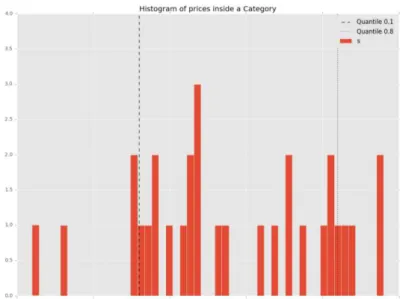
equal probabilities) are here applied as a comparison of the quality of the promotion when
compared with similar articles. Figure 4 shows the prices of articles inside a category for a
given day, here we can observe the information given by the quantile: the article sold at
3.60€ has a quantile value of 0.1 which indicates that 10% of the articles of the same
cate-gory were cheaper in that day while the article at the quantile 0.8 was more expensive than
24 Figure 4 Histogram of prices of a category and visualization of quantiles
Inter Category information
Due to the sheer amount of information which can be used when exploring the impact of
inter category discounts, aggregated variables were created. For each article, the correlation
between its sales and the average discounts of all other subcategories was analysed and the
most significant correspondences (the ones with the biggest correlation absolute value)
were identified. The average discount of the chosen subcategories were then taken into
account while producing the model.
3.2
Temporal data
In order to have into account information concerning the temporal effects, multiple
tempo-ral variables were taken into consideration.These Boolean variables help describing the time
dimension of the sales and allow their impact to be taken into consideration by the model.
Figure 5 show the variables which allow the identification of weekdays, weekends and
weeks of relevant holidays. Many others Boolean variables were taken into account as to
identify and allow the model to distinguish between the days of the week, months and
25 Figure 5 Examples of time dimension variables taken into account
3.3
Weather
Several weather attributes were considered and studies, from the intensity of the wind to
the amount of rain and the temperature itself. These attributes have an influence in the
consumption as they reflect cultural behaviours to the weather.
Although correct data is available during the training and testing of the models, in a real
world implementation these attributes would be estimative in the shape of weather
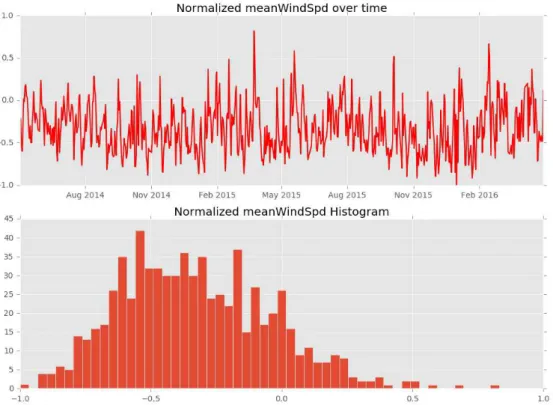
fore-casts. The figures below present the variation over time of some of these variables as well as
26 Figure 6 Variable representative of the daily strength of the wind
27 Figure 8 Variable representative of the daily mean temperature
28
3.4
Football matches
Football has become a sport of meaningful influence, it is closely followed by a great
per-centage of people who remotely watch these games. It isthen an important influencer in the
behaviour of the client as it increases substantially sales in certain products as snacks and
beer.
These games also can diminish the consumption of goods due the impact they have in the
schedule of clients. In this project two attributes were considered based on these events
Game - the number of football games of national teams which occur per day.
Figure 10 Variable representative of the number of football games per day
29 Figure 11 Variable representative of the number of football games of main teams per day
3.5
Model input data summary
30 Historical
promotional data
Predictive model training
Weather information National
Football events
Historical sales data
Intra-category data
Inter-category data Temporal Data
Figure 12 schema of input sources of data for training
In order to be processed by the models, Categorical variables (ordinal variables and nominal
variables have been turned into Numeric variables by means of multiple discrete Boolean
flags.
The list of variables is shown in Table 3.
For the evaluation of the performance of each algorithm per article, the training set
corresponded to the temporal interval of 01.01.2012 until 11.10.2015 which roughly
corresponds to 994 training data points (variant with daily data availability). Once trained,
the models produced four weeks of forecast for daily sales (28 days). Nearly 200 articles
31
Source Input variable Description Behaviour
Historical sales data
QTY Daily sales Discrete variable
QTY_PREV_YEAR Sales of corresponding day of
the month in previous year Discrete variable
QTY_PREV_YEAR_H Sales of corresponding weekly
day in previous year Discrete variable
QTY_PREV_MONTH_H Sales of corresponding weekly
day in previous month Discrete variable STK Theoretical Inventory amount Discrete variable
Historical promotional
data
DISC Discount Continuous variable
(relative change)
DISC_SEM_VAR Weekly discount variation Continuous variable (relative change)
DISC_SHORT_VAR Discount variation of the last 3 days
Continuous variable (relative change)
Temporal data
WEEKEND Is weekend Discrete variable (Boolean)
YEAR Year counter Discrete Incremental variable (starts in 2012)
MONTH Month counter Discrete Incremental variable (restarts yearly)
FORTNIGHT Fortnight counter Discrete Incremental variable (restarts yearly)
QUARTER Quarter counter Discrete Incremental variable (restarts yearly)
QUADMONTH Four months counter Discrete Incremental variable (restarts yearly)
SEMESTRE Semester counter Discrete Incremental variable (restarts yearly)
HOLIDAY Holiday Discrete variable (Boolean) WORKDAY Working day Discrete variable (Boolean)
SIN_WEEKEND Sinusoidal function with
maximum value on Saturdays Continuous variable WEEK_HALLOWEEN Halloween Week Discrete variable (Boolean) WEEK_CHRISTMAS Christmas Week Discrete variable (Boolean) WEEK_NEWYEAR New year's Week Discrete variable (Boolean)
MON Monday Discrete variable (Boolean)
TUE Tuesday Discrete variable (Boolean)
WED Wednesday Discrete variable (Boolean)
THU Thursday Discrete variable (Boolean)
FRI Friday Discrete variable (Boolean)
SAT Saturday Discrete variable (Boolean)
SUN Sunday Discrete variable (Boolean)
JAN January Discrete variable (Boolean)
FEB February Discrete variable (Boolean)
MAR March Discrete variable (Boolean)
APR April Discrete variable (Boolean)
MAY May Discrete variable (Boolean)
JUN June Discrete variable (Boolean)
32
Source Input variable Description Behaviour
AUG August Discrete variable (Boolean)
SEP September Discrete variable (Boolean)
OCT October Discrete variable (Boolean)
NOV November Discrete variable (Boolean)
DEC December Discrete variable (Boolean)
Weather information
MAXTEMP Maximum Temperature Continuous variable MINTEMP Minimum Temperature Continuous variable MEANTEMP Average Temperature Continuous variable
MEANTEMPAP Average apparent
tempera-ture Continuous variable
MEANHR Average relative humidity Continuous variable MAXWINDGUST Maximum wind velocity Continuous variable MEANWINDSPD Average wind velocity Continuous variable MEANPRES Atmospheric pressure Continuous variable MAXSOLARRAD Maximum solar radiation Continuous variable MEANSOLARRAD Average Solar radiation Continuous variable RAINDAY Rainy day Discrete variable (Boolean)
National Football events
GAME Number of football games Discrete variable
GAME_MAIN Number of football games
with bigger impact Discrete variable
Intra-category
data
CAT_PVP_QUANT Price's quantile among the
Category Continuous variable
CAT_DISC_QUANT Discount's quantile value
among the Category Continuous variable
Inter-category
data
DISC_6648
The average discount of the 6 most correlated subcategories found
Continuous variable
DISC_9462 Continuous variable
DISC_6645 Continuous variable
DISC_6646 Continuous variable
DISC_6947 Continuous variable
33 Figure 13 Example of a linear regression
4.
MODELS
4.1
Multiple Linear Regression
Years of development of the field allowed statisticians to develop more complex and
ad-vanced methods for numeric target prediction. Nevertheless, linear regression analysis
con-tinues to be the most widely used of all statistics techniques, mainly due to its simplicity and
computational performance.
Linear regression attempts to establish a linear relationship between one independent
vari-able 𝑋and a continuous outcome variable Y.Thus, fitting a line through a scatter plot (as seen inFigure 13).
On the other hand, multiple linear
regres-sion is a more complex and widely used
form of linear regression. MLR can be
de-scribed as fitting a line through a
multi-dimensional cloud of data points
It is used to explain the relation between a continuous dependent variable and multiple
in-dependent variables. Here, the objective variable is the result of a straight-line function of
34 MLR notation
Given a data set of p data points yt, xt1, xt2,…, xtn pt=1 Let Y denote the dependent
out-come whose values we intend to predict and let X1, X2,…, Xn denote the n independent variables from with we wish to base our prediction. The equation of the general form of the
multiple linear regression is given by the following expression:
Yt = b0+ b1Xt1+ b2Xt2+ b3Xt3+⋯+ bnXtn +εi [6]
Where:
t represents the number of the data point,
εiis called the error term or noise,
b1, b2,…, bn represent the individual slopes coefficients of the Xi variables, that is,
the change in the predicted value Y per unit change in Xi, everything else remaining
con-stant.
b0 defines an additional constant intercept coefficient, represents the value the
pre-diction would take if all the independent variables Xi were to be zero.
We can therefore pack all response values or the given observation into a t-dimensional
vector – Response vector.
Y = Y1
Y2 Y3
… … …
Yt
35 In order to represent the MLP in a matrix form we need to remove the intercept. Instead of
doing so by centring the data, we can consider an extra column of 1’s when packing the
predictors into the matrix X– Design matrix (t × n + 1). Hence,
X =
1 X11 X12 ⋯ X1n
1 X21 X22 … X2n
⋮ ⋮ ⋮ ⋮ ⋮
1 Xt1 Xt2 ⋯ Xtn
[8]
The intercepts are packed into a n + 1 dimensional vector, the slope vector.
b = b0 b1 b2 … … … bn [9]
Finally, the errors are packed into the error vector, a t-dimensional vector.
ϵ= ϵ0 ϵ1 ϵ2 … … … ϵt [10]
We can then compact the generalized expression into the matrix form:
36 The coefficients and intercept contained in the slope vector can then be estimated by least
squares. Here intend to obtain the unique values which minimize the sum of the squared
errors,
eTe = Y−Xb T Y−Xb = YTY−2YTXb + bXTXb
[12]
We can minimize this function by setting the partial derivative, with respect to the search
variables (b0, b1, b2,… , bn) to 0.
This will give us n + 1 equations with n + 1 unkowns where n is the number of variables in the model.
The solution in compact form is given by
b = XTX −1XTY [13]
Where XTX −1 is a symmetric n + 1 × n + 1 matrix and XTY is a n + 1 dimensional vec-tor.
We can therefore describe the fitted values
Y= Xb [14]
As
37 MLR considerations
Although this method assumes a strong linear relationship between the inputs and the
de-pendent variable, the simplicity of the acquisition of the parameters 𝑏𝑖 by computations in
the matrix form allow great performances.
Multiple linear regression, by considering multiple input variables must have into account
degenerations to the model caused by poor judgement in the selection of these variables.
Adding more independent variables to a multiple regression procedure does not imply that
the model will perform better, in fact it can make things worse. This phenomenon is called
overfitting.
In addition, the consideration of a bigger number of independent variables will also create
more relationships between them. Not only the predictors will have relations with the
out-come but they will also be correlated between themselves – multicollinearity.
The ideal is for all independent variables to be correlated with the dependent variable but
not among each other.
Due to these phenomenon, which contributes to a decay in the MLR precision, a prior
vari-able-selection step must be executed as to allow the model to assess the true relationship
and descriptive power of each used variable.
Some independent variables, or sets of independent variables, are better at predicting the
outcome than others, some of which can have no contribution at all.
We must decide which variables to include in our model and which ones to exclude.
Many subset selection methods have been studied for this purpose.
On this work, due to the large scale combinatorial problem, the genetic algorithms(GA)
(Me-lab et all. 2006) have been used to identify the general subset of variables which will be
con-sidered on the individual MLR models.
GA Input variable selection
When developing a predictive model, the search of an optimal subset of relevant input
38 Specially in problems with high volume of data, the collection of the ideal set can both
time-consuming and computationally expensive. Numerous predictive variables can however be
involved, not being possible to omit many of these without a significant loss of information.
The use of genetic algorithms is here explored as to automatically select the most relevant
input variables set.
Inspired from Charles Darwin’s theory of evolution, genetic algorithms are used to solve
elaborate optimisation problems (Melanie, 1995, Holland, 1975 and Goldberg, 1989) by
finding the best solution in a very large space.
In a Genetic algorithm, the solutions are viewed as individuals, represented by vectors and
characterized by their fitness, a value which describes their performance. These solutions
compete and evolve over time, as to find an optimal solution.
Initially, the 𝑁 individuals are randomly generated in the initial Population 𝑃. Their fitness is
computed while an iterative selection (with reposition) phase executes until the
intermedi-ary population𝑃’(which is initialized empty) has 𝑁 individuals as well. The selection phase
will give preference to the individuals with the highest fitness.
Once the intermediary population 𝑃′ contains 𝑁 individuals, the variation phase takes place
(Figure 14). The individual will be selected in pairs and will be crossover with probability 𝑅𝑐
(crossover rate). Once the crossover occurs, the vectors corresponding to the new
individu-als will detach and switch content.
39 Once the crossover phase ends, the mutation phase begins. Here, each position of each
result-ing vector will then mutate with a probability 𝑅𝑚(mutation rate).
The resulting duo will then be inserted into the new population 𝑃′′.
Once 𝑃′′ contains 𝑁 individuals, it replaces the initial population 𝑃 and the process iterates.
One complete iteration is called generation. GA will stop either by a condition which infers
the progressive improvement of the maximum fitness detected or by a pre specified number
of generations. In the end, the solution will be the individual with the maximum fitness value.
As to secure that the maximum fitness of a generation is always the same or bigger than the
maximum fitness or the former, it is common to copy, without modification, the best
individ-ual of 𝑃 to 𝑃′′, this operator is called elitism.
Although widely used, these algorithms do not visit all of the solution space and therefore, do
not guarantee the global optimum. Nevertheless, the use of wide populations and the use of
the mutation phase, which introduces noise to the procedure, helps in avoiding local
maxi-mums.
The GA implemented in this project is defined as a search algorithm to find the best
combina-tion of input variables to be considered in the MLR. Here, an individual represents a set,
de-fined as a vector 𝑉 where each position represents an input variable with a binary encoding
(Figure 15). Each position express if a variable was used (represented by “1”) or not (repre-sented by “0”).
Figure 15 Example of an individual / solution vector
corresponding input variable is not included in
40 The fitness function which assesses the quality of a set, is using a subset of 10 articles. It is
given by the inverse of the average absolute error of the MLR using the subset of articles:
𝐹𝑖𝑡𝑛𝑒𝑠𝑠 𝑉 =− 𝐸𝑟𝑟𝑜𝑟𝑀𝐿𝑅𝑉 𝐴𝑟𝑡𝑖𝑐𝑙𝑒𝑖
10
𝑖=1
10 [16]
Although some preconceived notion about which of the predictors matter the most can be
used, this method generally determines which predictors have the strongest impact on the
outcome. Highly Correlated variables, which grouped do not bring a surplus of knowledge
over their individual representation, can disappear here, without damaging the precision of
the model.
4.2
ARIMA
Sometimes mentioned as Box-Jenkins after the original authors (Box and Jenkins, 1974),
ARIMA stands for Autoregressive Integrated Moving Average and is a forecasting technique
which belongs to the field of time series analysis.
Time series are set of observations on a particular value taken at different times (eg. Stock
prices) over regular time intervals such as daily,monthly, weekly, quarterly or annually. Their
analysis focus on the extrapolation of knowledge of patterns in the data.
Used in field such as statistics econometrics, mathematic finance, weather forecasting,
earthquake prediction, ARIMA works as an alternative for multivariate analysis (such as the
multivariate regression) once independent variables (x) are not available or are subject to
restrictions.