Pollen and seed flow patterns of
Carapa guianensis
Aublet.
(Meliaceae) in two types of Amazonian forest
Karina Martins
1, Andréa Raposo
2, Christie A. Klimas
3, Elizabeth A. Veasey
4, Karen Kainer
3,5and Lúcia Helena O. Wadt
21
Departamento de Biologia, Universidade Federal de São Carlos, Sorocaba, SP, Brazil.
2
Embrapa Acre, Rio Branco, AC, Brazil.
3
School of Forest Resources and Conservation, University of Florida, Gainesville, FL, USA.
4
Departamento de Genética, Escola Superior de Agricultura ‘Luiz de Queiroz’, Universidade de São Paulo,
Piracicaba, SP, Brazil.
5
Center for Latin American Studies, Tropical Conservation and Development Program,
University of Florida, Gainesville, FL, USA.
Abstract
Various factors affect spatial genetic structure in plant populations, including adult density and primary and second-ary seed dispersal mechanisms. We evaluated pollen and seed dispersal distances and spatial genetic structure of Carapa guianensis Aublet. (Meliaceae) in occasionally inundated and terra firme forest environments that differed in tree densities and secondary seed dispersal agents. We used parentage analysis to obtain contemporary gene flow estimates and assessed the spatial genetic structure of adults and juveniles. Despite the higher density of adults (di-ameter at breast height³25 cm) and spatial aggregation in occasionally inundated forest, the average pollen dis-persal distance was similar in both types of forest (195± 106 m interra firme and 175± 87 m in occasionally inundated plots). Higher seed flow rates (36.7% of juveniles were from outside the plot) and distances (155±84 m) were found interra firme compared to the occasionally inundated plot (25.4% and 114±69 m). There was a weak spatial genetic structure in juveniles and interra firme adults. These results indicate that inundation may not have had a significant role in seed dispersal in the occasionally inundated plot, probably because of the higher levels of seedling mortality.
Key words:gene flow, parentage analysis, scatterhoarding, seed dispersal, spatial genetic structure.
Received: January 18, 2012; Accepted: May 21, 2012.
Introduction
Adult density and spatial distribution of plant popula-tions, in particular the distance between flowering individ-uals, affect outcrossing rates (Murawski and Hamrick, 1991) and pollen flow distances (Dicket al., 2008). As a consequence, these factors cause spatial genetic structure (SGS) (Hamrick et al., 1993). Although various studies have shown a negative relationship between population density and pollen dispersal (Degenet al., 2004; Hardyet al., 2006; Carneiroet al., 2007; Lacerdaet al., 2008), two high-density species (Carapa guianensis and Sextonia rubra) have been found to have pollen flow distances simi-lar to those of low density species (Cloutieret al., 2007a), indicating that density is not always the predominant factor
in determining pollen flow and SGS (Doligez and Joly, 1997). Asynchronous flowering, variation in pollen pro-duction among trees and variation in the behavior of animal pollinators can have a significant influence on the mating system (Cloutieret al., 2007a) and pollen flow (Dicket al., 2008).Carapa guianensis, a species occurring at high den-sities in inundated forests and at lower denden-sities interra firmeforests (Klimaset al., 2007), provides an excellent opportunity to examine the dissimilarity between pollen flow and seed flow in relation to tree densities.
Seed flow also affects SGS. The primary seed dis-persal mechanism directly influences seed flow. Species with primarily short-distance seed dispersal mechanisms, such as gravity or animals with limited mobility, are more likely to show restricted seed flow and considerable SGS (Hardyet al., 2006). Secondary seed dispersal mechanisms may also exist and can complicate hypotheses about seed flow patterns. Dispersal distances greater than those ex-pected for primary seed dispersers are regularly attributed
Send correspondence to Karina Martins. Departamento de Biolo-gia, Universidade Federal de São Carlos, Rod. João Leme dos Santos km 110, 18052-780 Sorocaba, SP, Brazil. E-mail: [email protected].
to secondary dispersal agents (Schnabelet al., 1998; Naka-nishiet al., 2008) but without specifically testing this hy-pothesis.
Pollen flow studies generally use paternity analysis to evaluate the biological factors that determine pollen dis-persal distances (Wardet al., 2005; Dicket al., 2008 and references therein). In contrast, in seed flow studies, pollen and seed flow are estimated directly and compared to the observed pattern of SGS (Schnabelet al., 1998; Satoet al., 2006; Nakanishiet al., 2008) withouta priorihypotheses of biotic or abiotic factors that may affect seed dispersal distances.
Paternity analysis is one of the most direct and reli-able methods for assessing contemporary pollen flow and uses genotype progeny from selected seed trees (Sorket al., 1999). Parentage analysis, a related method, is used to as-sign parent pairs of seedlings, saplings or dispersed seeds and estimates the actual pollen and seed gene flow (Mea-gher and Thompson, 1987). Hi(Mea-gher exclusionary power is necessary in parentage analysis since the seed tree and pol-len donor are both unknown. Distances between the seed-ling/sapling and its seed tree are used to estimate seed flow and distances between pollen donor and seed trees are used to estimate pollen flow (Bittencourt and Sebbenn, 2007). In dioecious species, assignment is relatively simple since it is possible to differentiate between male and female trees (see Schnabelet al., 1998; Sato et al., 2006; Bittencourt and Sebbenn, 2007); however, this approach is more compli-cated for monoecious and hermaphroditic species, which include the majority of tropical tree species.
Seed dispersal is more limited than pollen dispersal for the majority of species studied by parentage analysis (Burczyket al., 2006; Satoet al., 2006; Bittencourt and Sebbenn, 2007; Nakanishi et al., 2008). In species in which seed dispersal is spatially restricted,e.g., by grav-ity, it is possible to overcome some methodological diffi-culties of parentage analysis by considering the closest parent as the seed tree. If only one adult is assigned, it is considered the seed tree (Dow and Ashley, 1996; Bacleset al., 2006; Nakanishi et al., 2008; Oddou-Muratorio and Klein, 2008; Sebbennet al., 2010). However, no similar studies have been published for Amazonian trees. The ma-jority of recent studies on gene flow in Amazonian species have focused on pollen flow using the Two-Gener ap-proach (Degenet al., 2004; Azevedoet al., 2007; Carneiro et al., 2007; Cloutieret al., 2007a,b; Silvaet al., 2008), paternity analysis of progeny of known seed trees (Car-neiroet al., 2009) or a combination of these two strategies (Lacerdaet al., 2008).
Carapa guianensisis an Amazonian insect-pollinated tree that preferentially occurs in occasionally inundated forests (McHargue and Hartshorn, 1983), although it is also found in high densities in drier forests (Klimaset al., 2007). This species exhibits prolonged moderately synchronous
flowering (Hallet al., 1994; Maués M.M., 2006, PhD the-sis, Universidade de Brasília, Brasília, DF, Brazil; Klimas C.A., 2010, PhD thesis, University of Florida, FL, USA) al-though the timing and length of this phenological phase varies among regions. In the Brazilian state of Acre, a four-month flowering peak is followed by a second, smaller peak for a subset of trees (Klimas C.A., 2010, PhD thesis, University of Florida, FL, USA). Carapa guianensis is monoecious and pollinated by small butterflies (Riodinidae and Lycaenidae) and bees (Meliponina) (Maués M.M., 2006, PhD thesis, Universidade de Brasília, Brasília, DF, Brazil). The species is a predominant outcrosser (tm> 90%)
but is able to self-fertilize; biparental inbreeding is uncom-mon (Hallet al., 1994; Cloutieret al., 2007a). Gravity is the primary seed dispersal mechanism. Mature fruits are dehiscent capsules that break open upon ground impact, re-leasing 4-16 seeds (McHargue and Hartshorn, 1983). The seeds tend to germinate below the canopy of the seed tree but mortality rates are high. There are also two mechanisms of secondary seed dispersal: buoyant seeds can be dis-persed by water or can be carried and buried by scatter-hoarding rodents (McHargue and Hartshorn, 1983). Seed removal experiments with C. guianensis (Silva A.C.C., 2009, MSc dissertation, Universidade Federal do Acre, Rio Branco, AC, Brazil) andCarapa procera (Jansenet al., 2004) have shown that dispersal via scatterhoarding ro-dents is spatially restricted. This restricted dispersal is cor-roborated by the high aggregation of C. guianensis individuals, particularly juveniles (Klimas et al., 2007). Nonetheless, becauseC. guianensisseedfall occurs during the rainy season, trees in inundated areas are possibly better-situated for long distance seed dispersal than those in drierterra firmeforests. Even so, the weak but significant SGS observed for this species has been attributed to high pollen dispersal distances (Cloutieret al., 2007b).
Materials and Methods
Study area and sample collection
The study was done in an unlogged area of the Forest Reserve of the Brazilian Agricultural Research Corporation (Embrapa Acre) in the State of Acre, Brazil (latitude 10°01’28” S, longitude 67°42’19” W). Although this area is an ecological reserve used for research it is easily ac-cessed by neighboring communities. The average annual temperature is 24.5 °C with a dry season from June to Au-gust (Klimaset al., 2007), and the dominant vegetation is classified as humid tropical forest. The region has a slightly hilly topography that includes upland habitat (terra firme) and occasionally inundated areas.
Two 16-hectare plots (400 m x 400 m) were estab-lished, one in an upland forest (terra firme) and the other in an occasionally inundated forest, the latter 500 m from the former. All C. guianensisindividuals with a diameter at breast height (dbh)³15 cm were mapped and marked (see Figure S1, Supplementary Material). Leaf samples were collected from all marked individuals (203 in the terra firmeforest and 294 in the occasionally inundated forest). Immediately after collection, leaf samples were dried in containers with silica gel and sent to the laboratory for ge-netic analysis. Sampled individuals were grouped into two size classes based on their reproductive potential: plants with 15 cm£dbh < 25 cm were considered juveniles and those with dbh³25 cm were considered adults. While indi-viduals with a dbh ³ 15 cm are potentially reproductive (Klimaset al., 2007), those with 15 £dbh < 25 cm fre-quently produce small numbers of seeds or suspend repro-duction (Klimas C.A., 2010, PhD thesis, University of Florida, FL, USA). Based on a radiocarbon date of 785 years for aC. guianensisindividual with a dbh of 17 cm (Vieiraet al., 2005) coupled with our data that relate stem diameter to growth (Klimaset al., 2011), we suspected that many of the smaller stems in the understory were sup-pressed adults and not juveniles awaiting release. We re-corded 89 adults and 114 juveniles in theterra firmeplot and 164 adults and 130 juveniles in the occasionally inun-dated plot. Although the number of juveniles was higher in the occasionally inundated plot, the relative number of ju-veniles per adult was higher in theterra firmeplot (1.3 compared to 0.8 in the occasionally inundated plot).
Microsatellite genotyping
Genomic DNA was extracted from leaf samples using the 2% CTAB (cetyltrimethylammonium bromide) proce-dure (Doyle and Doyle, 1990). We used seven pairs of SSR (Simple Sequence Repeats) primers forC. guianensis; five were developed by Vinsonet al.(2005) and two by Daya-nandanet al.(1999). The forward primers were marked for fluorescent detection. Polymerase chain reactions (PCR) were done in a final volume of 6mL containing 1 ng of
genomic DNA, 1X of PCR reaction buffer (10 mM Tris-HCl, pH 8.3, 50 mM KCl, 1.5 mM MgCl2,pH 8.3), 0.25mM
of each primer, 0.27 ng of BSA/mL (New England Biolabs, Ipswich, MA), 0.27 mM dNTP and 0.125 U ofTaq poly-merase (Phoneutria, Belo Horizonte, Brazil) and autoclaved ultrapure water. DNA amplifications were done using ABI 9600 and ABI 9700 thermal cyclers (Applied Biosystems, Crescent City, CA, USA) under the following conditions: 94 °C for 5 min, 30 cycles of 94 °C for 1 min, the locus-specific annealing temperature for 1 min, 72 °C for 1 min and, after 30 cycles, a final extension of 72 °C for 7 min.
Capillary electrophoresis was done using a Perkin Elmer ABI 3700 sequencer. The base-pair alleles were de-tected and their size estimated using the programs GeneScan v.3.7 (Applied Biosystems) and Genotyper ver. 2 (Applied Biosystems), respectively. Alleles with an estimated size between the defined classes were classified into either the nearest upper or lower size class based on the closest class. To avoid overestimating the number of al-leles, in addition to the method cited above we graphed allelic histograms using the program Genotyper and over-laid all alleles on the same plate in which they were de-tected by PCR.
Genetic diversity and parentage analysis
The average number of alleles per locus (A), allelic richness (RS) (Petitet al., 1998), gene diversity (He) and
number of five typed loci was considered and the genotyp-ing error was set at zero, followgenotyp-ing Hoebeeet al.(2007); no mismatching between juveniles and candidate parents was allowed.
In view of our assumption of limited seed dispersal distance for this species, when a juvenile had a parent pair within the plot then the closest parent was considered the seed tree. Although our strategy of considering the closest parent as the seed tree may underestimate seed dispersal distances, this assumption, which was introduced by Dow and Ashley (1996), has been used for monoecious and her-maphroditic species in conjunction with prior knowledge of seed and pollen dispersal vectors (Bacleset al., 2006; Nakanishiet al., 2008; Oddou-Muratorio and Klein, 2008; Sebbennet al., 2010). This strategy provides conservative estimates of seed dispersal distances (Bacleset al., 2006; Nakanishiet al., 2008; Sebbennet al., 2010). Distances be-tween the two parents of a given juvenile were used to cal-culate the pollen dispersal curve and the distance between the juvenile and the seed tree was used to obtain a seed persal curve. Differences between pollen and seed flow dis-tances, as well as differences in the pollen flow distances and seed flow distances between forest types, were tested with the Mann-Whitney test using SPSS ver. 15.0 (SPSS, Chicago, IL, USA) since the data had a normal distribution but the variances were not homogeneous. The cryptic gene flow, which is the probability that foreign seeds (from out-side the plot) have a multilocus genotype that matches local parents (in the plot), was estimated as described by Dow and Ashley (1996) using the equation 1-Pex
np
, wherePexis
the combined exclusionary power for the parental pair (in this study) andnpis the number of putative pollen donors in the plot.
Finally, we compared the distribution of pollen flow distances with the distribution of distances between each seed tree and all the potential parents in each plot to deter-mine whether gene flow distances were a function of the average distance between pollen donors and seed trees. We
tested for significance with the Kolmogorov-Smirnov test in SPSS ver. 15.0.
Spatial genetic structure analysis
We characterized the spatial genetic structure (SGS) in each forest type and within size classes (juveniles and adults) using spatial autocorrelation procedures and calcu-lated the mean kinship coefficients (Fij) from Loiselleet al.
(1995) for ten distance classes of constant intervals. For each distance interval, 95% confidence intervals (CIs) for the null hypothesis of no genetic structure (Fij= 0) were
ob-tained using the permutation of individuals among distance classes (Loiselleet al., 1995; Vekemans and Hardy, 2004).
Average pairwiseFij estimates were plotted against
the logarithm of the pairwise spatial distances to test the overall pattern of SGS in adults and juveniles of each forest type. Under isolation by distance in a two dimensional space, kinship is expected to decrease approximately lin-early with the logarithm of the spatial distance (Hardy and Vekemans, 1999). The regression slope (bF) was used to
quantify the extent of spatial genetic structure based on the Spstatistic described in Vekemans and Hardy (2004). The Spstatistic was obtained by the ratio –bF/(1 –F(1)), where
F(1)is the averageFijbetween adjacent individuals,i.e., the
first distance interval included trees < 25 m apart. The sig-nificance ofbFwas tested by 10,000 permutations of
indi-viduals among spatial positions. All computations were done using the SPAGeDi 1.2 program (Hardy and Veke-mans, 2002).
Results
The density of adults (dbh³25 cm) in occasionally inundated forest was double that observed interra firme forest (Table 1) whereas the density of juveniles (15 cm£
dbh < 25 cm) was similar in both environments; juveniles accounted for 56% of individuals interra firmeand 45% in occasionally inundated forest. The maximum dbh was 65 cm and 58.4 cm interra firmeand occasionally
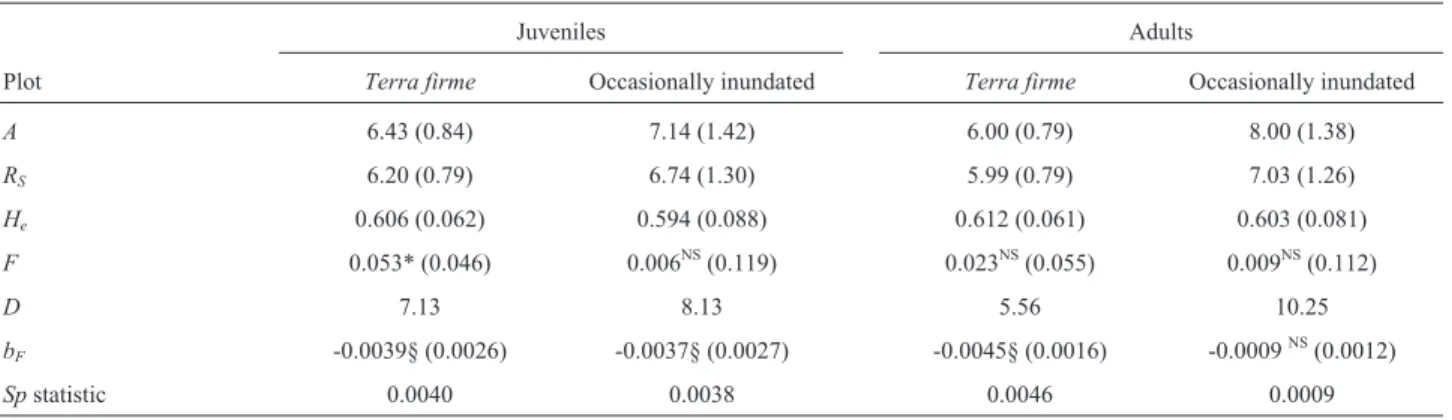
inun-Table 1- Genetic diversity and spatial genetic structure estimates forCarapa guianensisbased on seven microsatellite loci.
Juveniles Adults
Plot Terra firme Occasionally inundated Terra firme Occasionally inundated
A 6.43 (0.84) 7.14 (1.42) 6.00 (0.79) 8.00 (1.38)
RS 6.20 (0.79) 6.74 (1.30) 5.99 (0.79) 7.03 (1.26)
He 0.606 (0.062) 0.594 (0.088) 0.612 (0.061) 0.603 (0.081)
F 0.053* (0.046) 0.006NS(0.119) 0.023NS(0.055) 0.009NS(0.112)
D 7.13 8.13 5.56 10.25
bF -0.0039§ (0.0026) -0.0037§ (0.0027) -0.0045§ (0.0016) -0.0009NS(0.0012)
Spstatistic 0.0040 0.0038 0.0046 0.0009
A, average number of alleles/locus;bF, regression slope;D, number of individuals per hectare;F, fixation index;He, gene diversity (Nei, 1987)RS, allelic
dated plots, respectively, and both forest types showed sim-ilar diameter distribution patterns (data not shown).
Juveniles and adults in both forest types had high lev-els of genetic diversity (Table 1). Allelic richness (RS) and
gene diversity (He) were not significantly different between
juveniles and adults in the same plot nor between plots (p > 0.05 in all comparisons after 500 permutations). For all estimates of genetic diversity, variation among loci was highest for individuals in the occasionally inundated plot. The fixation index (F) was small and significantly different from zero only for juveniles interra firme(Table 1).
The total exclusionary probability (parent pair) con-sidering seven loci was 0.9979 and 0.9985 in adults from terra firmeand occasionally inundated plots, respectively. The total exclusionary probability for identity was 0.99999 and neither plot had candidate parents with identical geno-types. Identity analysis done with CERVUS ver. 3.0 showed that for the total set of genotypes compared only two juveniles from the occasionally inundated plot shared the same multilocus genotype.
A parent pair was assigned for 80 (70.2%) and 108 (81.7%) juveniles interra firmeand occasionally inundated forests, respectively. In no case was a juvenile was assigned only one parent. Since we genotyped all individuals and found only one identical genotype we concluded that seed flow from outside the plot was higher in terra firme (29.8%) than in the occasionally inundated plot (18.3%). The high total exclusionary power meant that the probabil-ity of cryptic gene flow was nearly 10%, i.e., 0.094 (1-0.997947) and 0.099 (1-0.998570) interra firmeand oc-casionally inundated plots, respectively. The number of ju-veniles that matched unrelated trees by chance was 7.5 (80 x 0.094) and 10.7 (108 x 0.099) in theterra firmeand occa-sionally inundated plots, respectively. The percentage of juveniles with both parents outside the plots corrected for cryptic gene flow was 36.7% interra firmeand 25.4% in the occasionally inundated plot.
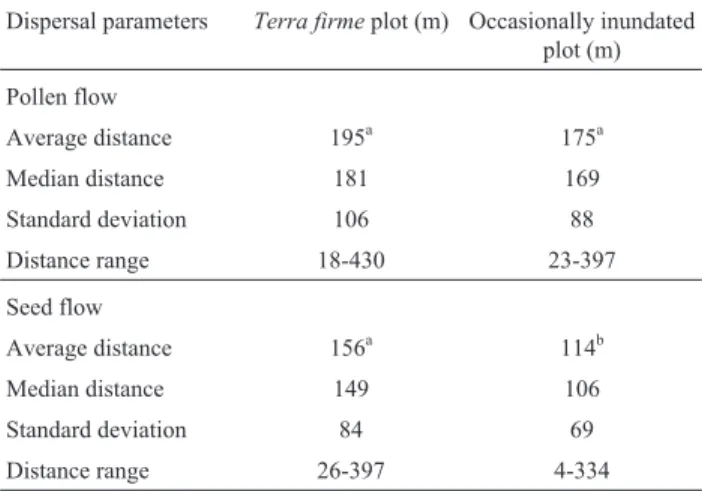
Approximately 53% of adults sampled interra firme and 43% of adults in occasionally inundated forest were identified as pollen parents of the genotyped juveniles. Similar proportions were observed for the number of seed parents (56% and 44% of adults interra firmeand occa-sionally inundated forest, respectively). In both plots, less than 20% of the pollen dispersal events occurred at tances of less than 100 m and almost 70% involved dis-tances of 100-300 m (Figure 1). In both plots, the average pollen dispersal distance was similar (p = 0.286; Table 2) and closely followed the average distance between each seed parent and all other adults in the plot. Interra firme forest, the average distance between seed trees and all adults in the plot was 159 m while in occasionally inun-dated forest this distance was 124 m. The frequencies of calculated pollen flow events in each distance class were similar to the frequency of potential pollen donors in almost all distance classes (Figure 1). There was no significant
dif-ference between the pollen flow distribution and the dis-tances between each seed tree and all potential parents in each plot (Kolmogorov-Smirnov Z = 0.826, p = 0.502 for the terra firme plot; Kolmogorov-Smirnov Z = 0.691, p = 0.726 for the occasionally inundated forest plot).
The mean seed dispersal distance was significantly higher (p = 0.001) in theterra firmeplot than in the occa-sionally inundated plot (Table 2). Comparison of the fre-quency distribution of seed dispersal distances (Figure 2)
Figure 1- Frequency histograms of pollen dispersal distances determined by parentage analysis for all juveniles interra firme(A) and occasionally inundated (B) forests. The average frequency of definite pollen donors was calculated for 50 m distance classes from the maternal trees (black bars) and plotted together with the frequency of adult trees within each dis-tance class (white bars). Adult trees in each plot were used to calculate the frequency of potential pollen donors in each distance interval.
Table 2- Pollen and seed dispersal distances estimated for juveniles in
terra firmeand occasionally inundated plots.
Dispersal parameters Terra firmeplot (m) Occasionally inundated plot (m)
Pollen flow
Average distance 195a 175a
Median distance 181 169
Standard deviation 106 88
Distance range 18-430 23-397
Seed flow
Average distance 156a 114b
Median distance 149 106
Standard deviation 84 69
Distance range 26-397 4-334
showed that 50% and 27% of the seed flow events in the terra firmeand occasionally inundated plots, respectively, occurred in the furthest distance classes (> 150 m). As ex-pected, the average pollen dispersal distance was signifi-cantly higher than the seed dispersal distance in both plots (Mann-Whitney test; p = 0.02 interra firmeand p = 0.000 in occasionally inundated forest).
The correlograms for juveniles in the two plots and adults interra firmeshowed an expected tendency of di-minishing kinship with increasing distance between indi-viduals (Figure 3). Although the decrease in kinship began at distances of 25-50 m the values observed in these dis-tance classes were not significant. Kinship values were high and significant only in the 175 m distance class for
ju-veniles interra firmeforest (Figure 3A). Consequently, no SGS was observed forC. guianensis, probably because of the small scale of this study. The regression slope (bF), a
measure of SGS, was low and nearly significant for juve-niles in both blots (p = 0.052) and in adults interra firme forest (p = 0.060) (Table 1). Since the estimates ofF(1)were
almost zero,Spstatistics were numerically similar to bF.
Regression slopes were not different between juveniles and adults or between populations in the two forest types, pri-marily because of the high standard error for estimates, in-dicating that local densities did not affect SGS (Table 1).
Discussion
Pollen dispersal patterns
Large pollen dispersal distances were observed in both forest types. The average pollen dispersal distances were similar even though the density of reproductive indi-viduals interra firmewas almost half of that observed in occasionally inundated forest (Table 2). Pollen flow dis-tances were slightly larger than estimates obtained by Cloutieret al.(2007b) – 75-265 m depending on the disper-sion kernel used – for a population ofC. guianensisin the Western Amazon with a lower density of reproductive adults (2.5 trees with a dbh³30 per ha). These differences may reflect the methods used to infer contemporary pollen flow. Our study used parentage analysis, a direct method that normally gives the most accurate results. In contrast, Two-Gener is an indirect method based on assumptions from distribution models and can result in underestimates of pollen dispersal (Smouse and Sork, 2004). The extensive pollen dispersal distances observed forC. guianensiswere more similar to those for species that occur at lower densi-ties (< 1 tree/ha) than for species that occur at high densidensi-ties (Cloutieret al., 2007a), although these authors suggest that the influence of density is most important in populations with more than 5 trees/ha.
The density in our study was higher than 5 trees/ha, but flowering phenology and pollinator behavior may have influenced the pollen dispersal distances. A four-year phe-nological monitoring of reproductive trees at our study site showed that the percentage of individuals that flowered in each reproductive period was highly variable; in addition, there was only moderate flowering synchrony, with the per-centage of flowering ranging from 21% to 91% in different years (Klimas C.A., 2010, PhD thesis, University of Flo-rida, FL, USA). Although we did not study the spatial dy-namics of flowering for all trees in the two plots studied, if individuals close to each other differed in the onset of flow-ering by even a few days this could be enough to encourage longer-distance pollen dispersal. Pollen carryover may also account for high pollen dispersal distances (Dick et al., 2008). Evidence for this can be seen in our results from par-entage analysis. Despite the high population density and aggregation of individuals in both forest types,
approxi-Figure 2- Frequency histogram of seed dispersal distances determined by parentage analysis for all juveniles interra firmeand occasionally inun-dated forest plots.
Figure 3- Correlograms of kinship coefficients (Fij) over distance
mately 70% of pollen flow events occurred at distances of 100-300 m. Since the flowering period lasts for months, the variability within these flowering periods may confer an evolutionary benefit to this species by promoting genetic mixing in these populations. In addition to potential tempo-ral differences in flowering between neighboring trees, not all trees flowered in all years.
Seed dispersal patterns
The seed dispersal distance interra firme(156 m) was significantly higher than in occasionally inundated for-est (114 m). We suspect that larger animals were not re-sponsible for seed dispersal since nearby residents stated that hunting has locally eliminated some of the larger fauna, including deer, peccaries and tapirs, from these forests. Carapa guianensisseeds that fall below the seed tree can-opy can experience secondary dispersal by scatterhoarding rodents and water, but would also experience higher mor-tality rates (Rigamonte-Azevedo V., 2010, MSc disserta-tion, Universidade Federal do Acre, Rio Branco, AC, Bra-zil). Ecological studies withC. procera, a closely related species, have shown short average seed dispersal distances by scatterhoarding rodents (mean±SD = 18.5±0.9 m; me-dian±SD = 12.5±0.7 m; Jansenet al., 2004). The same study, however, also documented one seed that was carried 124 m from the seed tree. Our study differs from that of Jansenet al.(2004) since we estimated seed flow from es-tablished saplings while they assessed the location of dis-persed seeds. Since most seedlings die within the first year and the establishment of new individuals is preferentially away from the parent tree it is possible that the seed dis-persal distance assessed by parentage analysis was higher than that found by Jansenet al.(2004). Nonetheless, con-sidering that (1) candidate parents in our study were re-stricted to a 16-ha area, (2) the method used to estimate seed dispersal provides conservative estimates and (3) par-entage was undetermined in 18.3% and 29.8% of juveniles in occasionally inundated andterra firme forest, respec-tively, we believe that our average dispersal distances are underestimates of the true dispersal distances.
An investigation ofC. guianensisseed removal done at our study site concluded that because seed removal was rare the fauna was unlikely to be the main cause of second-ary seed dispersal; rather, rainfall was considered to be the most important cause of secondary seed dispersal (Silva A.C.C., 2009, MSc dissertation, Universidade Federal do Acre, Rio Branco, AC, Brazil). If this is the case, we could assume that dispersal distances would be greater in occa-sionally inundated forest, which was an initial hypothesis. However, our results indicate that inundation may not have had a significant role in seed dispersal in this area.
Alternately, significantly higher levels of seedling mortality in occasionally inundated forest, as observed by Rigamonte-Azevedo (Rigamonte-Azevedo V., 2010, MSc dissertation, Universidade Federal do Acre, Rio Branco,
AC, Brazil) in the same area, may counteract the higher supposed dispersal in such forest. Wet soil conditions are conducive to fungal growth that is either a symptom or cause of seedling death. Although water dispersal may in-deed be higher, as hypothesized by Silva (Silva A.C.C., 2009, MSc dissertation, Universidade Federal do Acre, Rio Branco, AC, Brazil), this may be counteracted by higher seedling death at flooded dispersal sites, even though these forests were not considered floodplain forests and did not have consistent yearly flooding. While inundation may play a role in determining seed fate, this may be outweighed by the different densities between plots that can in turn af-fect dispersal by fauna.
A study ofC. proceraseed removal (Jansenet al., 2004) found a direct relationship between fruit availability and removal by rodents. The percentage of seeds removed and seed dispersal distances were higher during periods of seed scarcity. Jansenet al.(2004) argued that, when seed availability is high, rodents prefer to eat seeds as they en-counter them. In contrast, when food is scarce, rodents pre-fer to carry and bury seeds for later consumption. We observed a higher density of reproductive adults and higher mean seed production per hectare in occasionally inundated forest. The percentage of individuals producing seeds was also higher in occasionally inundated forest based on phe-nological observations begun in September 2005 (Klimas C.A., 2010, PhD thesis, University of Florida, FL, USA), although this difference decreased in high seed production years. The shorter seed dispersal distance in the occasion-ally inundated plot may be partly a consequence of both the higher plant density and the experimental design: we mea-sured seed dispersal within a restricted plot area that ex-cluded long-distance seed dispersal. In occasionally inundated forest, seeds may be concentrated in patches af-ter waaf-ter dispersal, leading to high levels of competition and seedling mortality. Some of these patches may have been caused by dispersal obstacles (felled trees or dense un-dergrowth) and reduced seed dispersal distance in this for-est type. Seed dispersal by humans is also a possible explanation for the observed dispersal distances. Both for-ests are accessible to hunters, Brazil nut collectors and farmers, despite the reserve status of this forest. While we know of no seed harvesting for oil extraction in this area, there is a small local market forC. guianensisseed oil that may encourage small-scale collection efforts.
have artificially inflated seed dispersal estimates since only live individuals were genotyped.
Spatial genetic structure (SGS)
Although ecological studies have shown that the dis-persal distance of C. guianensis seeds is limited, which contributes to SGS on small scales, we believe that the high population density, the species mating system and the high average pollen dispersal distances contributed to the ab-sence of SGS in this population. A study of 47 plant species (Vekemans and Hardy, 2004) showed that the SGS of tree species is significantly related to the mating system and population density, with lower SGS in outcrossing species and in populations with high densities.Carapa guianensis predominantly outcrosses (Hallet al., 1994; Cloutieret al., 2007a) with a large effective number of pollen donors (9.3 to 11.3, Cloutieret al., 2007a). Weak SGS was observed for a population of C. guianensis in the Western Amazon (Sp= 0.0045 for adults andSp= 0.0047 for juveniles); SGS was significant, but low, for adults (Cloutieret al., 2007b). An absence of SGS was also observed in a population of the closely related speciesC. procera, in French Guiana (Do-ligez and Joli, 1997).
Our study shows the plasticity ofC. guianensis, an Amazonian tree species with a similar genetic structure in two distinct forest types that have different tree densities. Our results reinforce the importance of evaluating various aspects of reproductive biology, including phenology, seed production and regeneration dynamics in different environ-ments to understand the factors that influence pollen and seed flow and, consequently, SGS. Our results support the hypothesis that flowering patterns are more important in determining pollen flow than distances between conspe-cific reproductive adults; they also reiterate the need for studies that evaluate the effects of secondary seed dispersal and the behavior of animal dispersers on seed flow.
Acknowledgments
We thank Empresa Brasileira de Pesquisa Agrope-cuária (EMBRAPA) for providing field staff and labora-tory support during this work. We also thank Alexandre M. Sebbenn for helpful comments on this manuscript and two reviewers and the associate editor for critical and construc-tive comments. A.R. was supported by a PhD scholarship from Conselho Nacional de Desenvolvimento Científico e Tecnológico (CNPq). This study was supported by Instituto Internacional de Educação do Brazil (IIEB) and the Ka-mukaia Project (EMBRAPA).
References
Azevedo VCR, Kanashiro M, Ciampi AY and Grattapaglia D (2007) Genetic structure and mating system ofManilkara huberi(Ducke) A. Chev., a heavily logged Amazonian tim-ber species. J Hered 98:646-654.
Bacles CFE, Lowe AJ and Ennos RA (2006) Effective seed dis-persal across a fragmented landscape. Science 311:628. Bittencourt JVM and Sebbenn AM (2007) Patterns of pollen and
seed dispersal in a small, fragmented population of the wind-pollinated tree Araucaria angustifolia in southern Brazil. Heredity 99:580-591.
Burczyk J, Adams WT, Birkes DS and Chybicki IJ (2006) Using genetic markers to directly estimate gene flow and reproduc-tive success parameters in plants on the basis of naturally re-generated seedlings. Genetics 173:363-372.
Carneiro FS, Sebbenn AM, Kanashiro M and Degen B (2007) Low interannual variation of mating system and gene flow of Symphonia globulifera in the Brazilian Amazon. Bio-tropica 39:628-636.
Carneiro FS, Degen B, Kanashiro M, Lacerda AEB and Sebbenn AM (2009) High levels of pollen dispersal detected through paternity analysis from a continuousSymphonia globulifera
population in the Brazilian Amazon. For Ecol Manage 258:1260-1266.
Cloutier D, Hardy OJ, Caron H, Ciampi AY, Degen B, Kanashiro M and Schoen DJ (2007a) Low inbreeding and high pollen dispersal distances in populations of two Amazonian forest tree species. Biotropica 39:406-415.
Cloutier D, Kanashiro M, Ciampi AY and Schoen DJ (2007b) Im-pact of selective logging on inbreeding and gene dispersal in an Amazonian tree population ofCarapa guianensisAubl. Mol Ecol 16:797-809.
Dayanandan S, Dole J, Bawa K and Kesseli R (1999) Population structure delineated with microsatellite markers in frag-mented populations of tropical tree, Carapa guianensis
(Meliaceae). Mol Ecol 8:1585-1592.
Degen B, Bandou E and Caron H (2004) Limited pollen dispersal and biparental inbreeding in Symphonia globulifera in French Guiana. Heredity 93:585-591.
Dick CW, Hardy OJ, Jones FA and Petit RJ (2008) Spatial scales of pollen and seed-mediated gene flow in tropical rain forest trees. Trop Plant Biol 1:20-33.
Doligez A and Joli HI (1997) Genetic diversity and spatial struc-ture within a natural stand of a tropical forest tree species,
Carapa procera (Meliaceae), in French Guiana. Heredity 79:72-82.
Dow BD and Ashley MV (1996) Microsatellite analysis of seed dispersal and parentage of saplings in bur oak, Quercus macrocarpa. Mol Ecol 5:615-627.
Doyle JJ and Doyle JS (1990) Isolation of plant DNA from fresh tissue. Focus 12:13-15.
Goudet J (1995) FSTAT, ver. 2.9.3.2: A computer program to cal-culate F-statistics. J Hered 86:485-486.
Hall P, Orrell LC and Bawa KS (1994) Genetic diversity and mat-ing system in a tropical tree, Carapa guianensis (Melia-ceae). Am J Bot 81:1104-1111.
Hamrick JL, Murawski DA and Nason JD (1993) The influence of seed dispersal mechanisms on the genetic structure of tropi-cal tree populations. Plant Ecol 107/108:281-297.
Hardy OJ and Vekemans X (1999) Isolation by distance in a con-tinuous population: Reconciliation between spatial auto-correlation and population genetic models. Heredity 83:145-154.
Hardy OJ, Maggia L, Bandou E, Breyne P, Caron H, Chevallier M-H, Doligez A, Dutech X, Kremer A, Latouche-Hallé C,et al.(2006) Fine-scale genetic structure and gene dispersal in-ferences in 10 Neotropical tree species. Mol Ecol 15:559-571.
Hoebee SE, Arnold U, Düggelin C, Brodbeck S, Rotach P and Holderegger R (2007) Mating patterns and contemporary gene flow by pollen in a large continuous and a small iso-lated population of the scattered forest tree Sorbus torminalis. Heredity 99:47-55.
Jansen PA, Bongers F and Hemerik L (2004) Seed mass and mast seeding enhance dispersal by a neotropical scatter-hoarding rodent. Ecol Monogr 74:569-589.
Kalinowski ST, Taper ML and Marshall TC (2007) Revising how the computer program CERVUS accommodates genotyping error increases success in paternity assignment. Mol Ecol 16:1099-1106.
Kameyama Y, Isagi Y and Nakagoshi N (2001) Patterns and lev-els of gene flow in Rhododendron metternichii var.
hondoense revealed by microsatellite analysis. Mol Ecol 10:204-216.
Klimas CA, Kainer KA and Wadt LHO (2007) Population struc-ture ofCarapa guianensisin two forest types in the south-western Brazilian Amazon. For Ecol Manage 250:256-265. Klimas CA, Kainer KA and Wadt LHO (2011) The economic value of sustainable seed and timber harvests of multiuse species: An example using Carapa guianensis. For Ecol Manage 268:81-91.
Lacerda AEB, Kanashiro M and Sebbenn AM (2008) Long-pollen movement and deviation of random mating in a low-density continuous population of a tropical treeHymenaea courbaril
in the Brazilian Amazon. Biotropica 40:462-470.
Loiselle BA, Sork VL, Nason J and Graham C (1995) Spatial ge-netic structure of a tropical understory shrub, Psychotria officinalis(Rubiaceae). Am J Bot 82:1420-1425.
McHargue LA and Hartshorn GS (1983) Seed and seedling ecol-ogy ofCarapa guianensis. Turrialba 33:399-404.
Meagher TR and Thompson E (1987) Analysis of parentage for naturally establishes seedlings of Chamaelirium luteum
(Liliaceae). Ecology 68:803-812.
Murawski DA and Hamrick JL (1991) The effect of the density of flowering individuals on the mating systems of 9 tropical tree species. Heredity 67:167-174.
Nakanishi A, Tomaru N, Yoshimaru H, Manabe T and Yamamoto S (2008) Effects of seed and pollen mediated gene dispersal on genetic structure amongQuercus salicinasaplings. He-redity 102:182-189.
Nei M (1987) Molecular Evolutionary Genetics. Columbia Uni-versity Press, New York, 512 pp.
Oddou-Muratorio S and Klein EK (2008) Comparing directvs. in-direct estimates of gene flow within a population of a scat-tered tree species. Mol Ecol 17:2743-2754.
Petit RJ, El Mousadik A and Pons O (1998) Identifying popula-tions for conservation on the basis of genetic markers. Conserv Biol 12:844-855.
Sato T, Isagi Y, Sakio H, Osumi K and Goto S (2006) Effect of gene flow on spatial genetic structure in the riparian canopy tree Cercidiphyllum japonicum revealed by microsatellite analysis. Heredity 96:79-84.
Schnabel A, Nason JD and Hamrick JL (1998) Understanding the population genetic structure of Gleditsia triacanthos L.: Seed dispersal and variation in female reproductive success. Mol Ecol 7:819-832.
Sebbenn AM, Carvalho ACM, Freitas MLM, Moraes SMB, Gai-no APSC, da Silva JM, Jolivet C and Moraes MLT (2010) Low levels of realized seed and pollen gene flow and strong spatial genetic structure in a small, isolated and fragmented population of the tropical treeCopaifera langsdorffiiDesf. Heredity 106:134-145.
Silva MB, Kanashiro M, Ciampi AY, Thompson I and Sebbenn AM (2008) Genetic effects of selective logging and pollen flow in a low-density population of the dioecious tropical treeBagassa guianensisin the Brazilian Amazon. For Ecol Manage 255:1548-1558.
Smouse PE and Sork VL (2004) Measuring pollen flow in forest trees: A comparison of alternative approaches. For Ecol Manage 197:21-38.
Sork VL, Nason J, Campbell DR and Fernández-Manjarrés JF (1999) Landscape approaches to historical and contempo-rary gene flow in plants. Trends Ecol Evol 142:219-224. Vekemans X and Hardy OJ (2004) New insights from fine-scale
spatial genetic structure analyses in plant populations. Mol Ecol 13:921-935.
Vieira S, Trumbore S and Camargo PB (2005) Slow growth rates of Amazonian trees: Consequences for carbon cycling. Proc Natl Acad Sci USA 102:18502-18507.
Vinson CC, Azevedo VCR, Sampaio I and Ciampi AY (2005) De-velopment of microsattelite markers forCarapa guianensis
(Aublet), a tree species from the Amazon forest. Mol Ecol Notes 5:33-34.
Wang H, Sork VL, Wu J and Ge J (2010) Effect of patch size and isolation on mating patterns and seed production in an urban population of Chinese pine (Pinus tabulaeformisCarr.). For Ecol Manage 260:965-974.
Ward M, Dick CW, Gribel R and Lowe AJ (2005) To self, or not to self A review of outcrossing and pollen-mediated gene flow in neotropical trees. Heredity 95:246-254.
Internet Resources
Raposo A (2007) Estrutura genética e fluxo gênico de populações naturais de andiroba (Carapa guianensisAubl., Meliaceae) visando o manejo e a conservação da espécie. PhD Thesis, Universidade de São Paulo, Piracicaba, Brazil. http://www.teses.usp.br/teses/disponiveis/11/11137/tde-07 082007-114235/publico/AndreaRaposo.pdf (accessed 5 june 2012).
Supplementary Material
The following online material is available for this article: Figure S1 - Location ofCarapa guianensistrees in the two 16-ha study plots in Rio Branco, Acre, Brazil.
This material is available as part of the online article from http://www.scielo.br/gmb.
Associate Editor: Adriana Hemerly