of Chemical
Engineering
www.scielo.br/bjcePrinted in BrazilVol. 35, No. 01, pp. 131 – 139, January – March, 2018
*Corresponding author: Arshdeep Kaur. E-mail: [email protected] dx.doi.org/10.1590/0104-6632.20180351s20150782
CATALYTIC HYDROGEN GENERATION FROM
NABH
4
/H
2
O SYSTEM: EFFECTS OF CATALYST
AND PROMOTERS
Arshdeep Kaur
1,*, D. Gangacharyulu
1and Pramod K. Bajpai
11 Department of Chemical Engineering, Thapar University, Patiala, India
(Submitted: December 8, 2015; Revised: July 11, 2016; Accepted: September 30, 2016)
Abstract – A hydrogen generation system based on NaBH4 hydrolysis is affected by the nature of the catalyst and catalyst promoter. Various catalyst promoters such as Al2O3 nanoparticles, Al2O3 particles, ZrO2 sand, SiO2, MMT clay, CNT and zeolite are compared with respect to hydrogen generation (HG) and hydrogen generation rate (HGR). The highest HG and HGR are observed with alumina nanoparticles as compared to other promoters. Cobalt chloride is
found to be most efficient catalyst among the other cobalt based salts (CoCl2.6H2O, CoSO4.7H2O, (CH3COO)2Co.4H2O, Co(NO3)2.H2O), cadmium based salt (CdSO4) and copper based salt (CuSO4.5H2O). Maximum HGR obtained is 19.47 moles/L.sec for NaBH4 (1.26 moles/L)/Al2O3 nanoparticles (0.12 moles/L)/H2O and CoCl2.6H2O (0.02 moles/L) as catalyst at room temperature and atmospheric pressure. NaBH4 and alumina hydrolysis reactions, hydrophilic and
amphoteric nature of alumina, affinity of Co+2 towards BH 4
– ions and formation of aluminates are the factors that
promote HGR, as illustrated in this work. Residue obtained from hydrolysis reaction is characterized for its elemental
composition by the EDS technique, which confirmed a maximum percentage of boron in the residue. XRD and FTIR
results concluded that adsorption of Na+ and Co+ ions occurred on the alumina surface and resulted in the formation of sodium aluminates and cobalt aluminates in the solution.
Keywords: Hydrogen generation, nanoparticles, alumina, sodium borohydride, cobalt chloride
INTRODUCTION
A major scientific and technical challenge to realize a
hydrogen economy on a national or universal scale is wholly
dependent on proficient hydrogen storage and delivery
systems. Since a decade, chemical hydrogen storage has proved
to be a competent approach for developing efficient hydrogen
storage systems as compared to conventional storage. Sodium borohydride (NaBH4) stands out as preeminent among chemical hydrides owing to its high hydrogen storage capacity (10.8 wt%) and potentially safe operational uses (Marrero et al., 2009). Similar to other hydrides, sodium borohydride undergoes a hydrolysis reaction as shown in reaction 1 and
this reaction can be further activated with a suitable catalyst (Muir and Yao, 2011).
Millennium cell demonstrated the first portable
hydrogen storage system based on NaBH4 aqueous solutions (Amendola et al., 2000). This achievement
accelerated the research in the field of NaBH4-based
hydrogen generation (HG) systems. The hydrolysis reaction of NaBH4 is exothermic in nature, half of the hydrogen is provided by water, the generated hydrogen is highly pure and the byproduct (hydrated sodium metaborate) is environmentally safe. However, this system
also suffers from some major drawbacks: variance between
capacities (GHSC), excess water requirements, NaBO2 solubility and the cost of NaBH4 (Muir and Yao, 2011). US Department of Energy (US-DOE) in 2007 issued a No-Go recommendation for NaBH4 for on-board hydrogen storage considering all the above disadvantages.
As NaBH4 is a potential hydrogen storage material and considering all the drawbacks of NaBH4-based hydrogen storage systems, a dual solid system is proposed combining NaBH4 with other probable hydrogen storage materials that increases the overall GHSC of the system. For example, (a) Al/Li/Co/NaBH4 with the water HG system gives 100% hydrogen yield at 50oC with Al (7.5 wt%) and Li (25 wt%)
(Wang et al., 2013), (b) Al/NaBH4 activated by lanthanum (La) metal HG system shows excellent stability with high La content (Jianbo et al., 2012), (c) Al/Li/NaBH4 mixture in water activated by nickel HG system, at an optimized ratio
of Al (10 wt%) and Li (10 wt%), gives 96% efficiency at
60oC (Shu et al., 2012), (d) Al/NaBH
4 in water with CoCl2
as catalyst HG system, with an optimized composition, can achieve 90% fuel conversion within 5 min with GHSC of 5.4 wt% (Dai et al., 2011). In all the above HG systems,
hydrogen storage efficiency is higher when compared to a
conventional aqueous NaBH4-based HG system.
Development towards NaBH4-based on-board HG
systems has resulted in significant research in synthesizing
active catalyst. Many non-noble catalyst systems have been investigated, such as cobalt(II) chloride, nickel(II) chloride, iron(II) chloride, copper(II) chloride, and manganese(II) chloride for NaBH4 hydrolysis. Cobalt(II) chloride is found to be the best active catalyst of all the above non-noble catalysts. Noble metal catalysts like
platinum and ruthenium are used with different supporting
materials like Pt loaded on LiCoO2 or Ru loaded on TiO2. Owing to the cost factors, it is not feasible to use noble metal catalysts for extensive applications in hydrogen storage systems (Muir and Yao, 2011).
Cobalt chloride is also investigated along with NiCl2 and CuCl2 and is found to be more reactive (Schlesinger et al., 1953). Comparing with other Co(II) salts like Co(CH3COO)2, CoSO4, CoF2, Co(NO3)2, CoCl2 is found to be 4 times more reactive (Demirci et al., 2010; Liu et al., 2006 and Liu et al., 2008). This is essentially due to the electrophilic and strong positive charge of Co+2 that attract BH
4
– ions (Akdim et al.,
2009 a). To increase the activity of catalyst and to gain high
reactivity, catalysts are supported with different materials,
for example Co or CoCl2 supported with aluminium oxide (Al2O3) (Cakanyildirim and Guru, 2010), zeolite (Rakap and Ozkar, 2009) and carbon nanotubes etc. (Huang et al., 2008). Co-B catalyst is also doped with metal additives like Ni, Fe, Cu, Cr, and Mo (Muir and Yao, 2011).
Based on the above literature study and the problems related to NaBH4-based hydrolysis systems, the present study gives the novel concept of addition of alumina (Al2O3)nanoparticles with NaBH4 and CoCl2 as catalyst. In this paper, a comparative study is performed among
CoCl2 and other cobalt based salts and among different promoters for NaBH4 hydrolysis. Residual material left
after the hydrolysis reaction is characterized using different
analytical methods.
EXPERIMENTAL
Materials
Sodium borohydride (NaBH4) (97% purity) and cobalt chloride hexahydrate (CoCl2.6H2O) (98% purity) were procured from M/s Loba Chemie Ltd., sodium hydroxide pellets (NaOH) (97% purity) and cobalt acetate tetrahydrate ((CH3COO)2Co.4H2O) were purchased from
Central Drug House Pvt. Ltd., γ-alumina (Al2O3) (20nm, 99% purity), γ-alumina (Al2O3) (100-200µm, 99% purity)
and montmorillonite (MMT) clay were obtained from M/s Sigma Aldrich Chemicals Pvt. Ltd., copper sulphate pentahydrate (CuSO4.5H2O) (99% purity) and zeolite
13X (99% purity) were obtained from Merck Ltd., carbon
nanotubes (CNT) were purchased from Nanoshell Ltd. Chemicals like cobalt sulphate heptahydrate (CoSO4.7H2O) (99% purity), silicon oxide (SiO2) (99% purity), cobalt trinitrate (Co(NO3)2.3H2O) (97% purity), cadmium sulphate (CdSO4) (99% purity) and zirconium sand (ZrO2 66.90 %, SiO2 32.54 %, Al2O3 1.15 %, TiO2 0.27 %, Fe2O3 0.04 %) were purchased from SD Fine Chemicals Ltd.
Methods
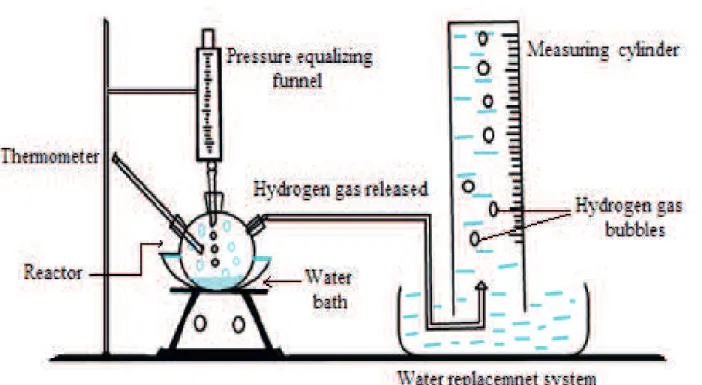
The equipment used in the H2 generation experiments is described in Figure 1. Reagents were added to the 250 mL three neck glass reactor in predetermined amounts in powdered form. The concentration of NaBH4 and
NaOH added is fixed as 1.26 moles/L and 0.93 moles/L,
respectively. Concentrations of chemicals selected as
catalysts and promoters were fixed as 0.02 moles/L and
0.12 moles/L, respectively while performing comparative studies. 10 mL solution of NaOH was added by a pressure equalizing funnel connected to the middle port of the reactor. H2 was collected in an inverted cylinder through a plastic tube attached to the right hand port of reactor.
The amount of hydrogen generation was measured (at 298 K and 1 atm) by the change in water level by the downward displacement of water in cylinder. This system is described as water replacement system. The left hand port is attached to a thermowell to observe the change in reaction temperature. To maintain the system in isothermal conditions a water bath is used. All the experiments were carried out in similar conditions as described above.
Residue analysis
Black colored residue left after the reaction finished
70oC. The dried residue was crushed and prepared for
characterization. To know the elemental composition of the residue it was characterized by EDS (Energy dispersive electron microscopy). FTIR (Fourier transform infrared spectroscopy) could further predict the functional groups
present in the residue and XRD (X-Ray diffraction) gives the estimated final products formed in the residue. Residue
was observed on a scanning electron microscope (JEOL JSM 6510 LV) equipped with integrated silicon drift detector (SDD) technology to carry out EDS analysis. The
specimen was coated with 50 μm thick gold film in an
automatic sputter coater (Polaron) to avoid charging under the electron beam prior to EDS. Fourier transform infrared (FTIR) spectra of the residue was recorded on an Agilent
Cary 6610 FTIR spectrometer fitted with universal ATR
sampling accessories. The spectra were recorded in the range of 4000-500 cm-1 with a resolution of 4 cm-1. XRD was carried out by recording X-ray diffraction patterns using a PANalytical X’Pert Pro Diffractometer, operated at 45 kV and 40 mA with monochromatic Cu-Kα radiation (λ=1.5406 Å), in the 2θ range of 20-80°.
RESULTS AND DISCUSSION
Comparison among different promoters
Different promoters such as γ-Al2O3 nanoparticles,
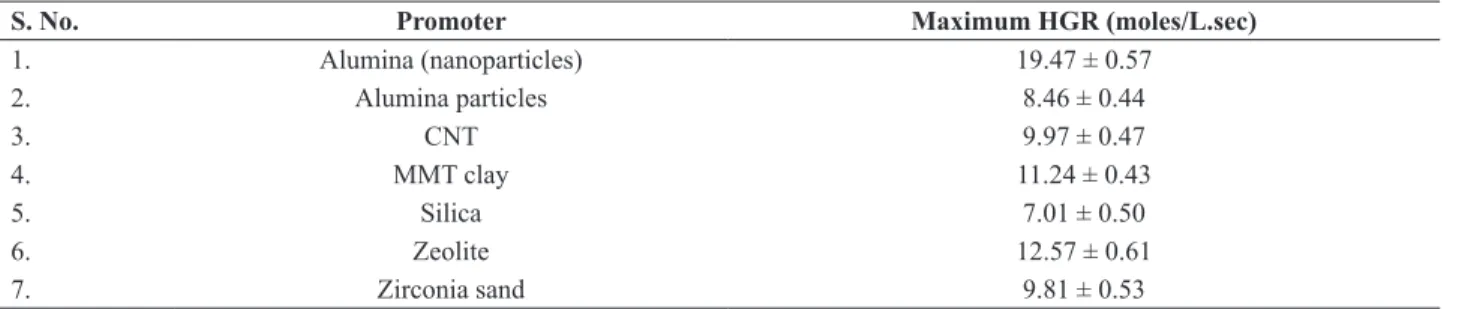
γ-Al2O3 particles, ZrO2 sand, SiO2, MMT clay, CNT and zeolite were evaluated for HG using CoCl2 as catalyst as shown in Figure 2. It is observed that Al2O3 nanoparticles give higher HG than other promoters. Comparison among
different promoters with respect to maximum HGR is
shown in Table 1. With respect to maximum HGR the
following order is observed for promoters: γ-Al2O3 nanoparticles > zeolite > MMT clay > CNT > zirconia sand
> γ-Al2O3 particles > silica.
The promoter increases the catalytic sites on catalyst surface that helps in decreasing its cost. As shown in Figure
2, HG is maximum for γ-Al2O3 nanoparticles that could be due to better reactivity of reactants, which in turn is caused by the high surface area and hydrophilic and amorphous
nature of γ-Al2O3 nanoparticles.
According to Demirci et al. (2010), although γ-Al2O3
and active carbon have high surface area, Al2O3 is reported to exhibit higher HGR than active carbon on account of its hydrophilic character as compared to the hydrophobic nature of carbon. Due to the hydrophilic nature of Al2O3, the top oxide layer of the Al2O3 surfaceforms hydroxide after chemisorption of H2O molecules, as shown in reaction 2. These hydroxyl groups adsorb cations and result in the formation of aluminates (Sposito, 1996; Soler et al., 2009). (2) Additionally, as alumina is amphoteric in nature, the surface hydroxyl groups show either acidic or basic behavior depending on the pH of the solution (Marx et al., 2010). The pH of the present system is greater than 9. This could cause the adsorption of metal ions on the alumina surface and cationic adsorption of Co+2 or Na+ could occur
on the hydroxide layer of alumina according to reaction 3 (Fan et al., 2013; Brunelle, 1978; Grenmam et al., 2010).
Figure 1. Experimental set up (Kaur et al., 2015)
2 3
3
22
(
)
3(3) The presence of the hydroxide layer also causes passivation on the aluminum surface and prevents interaction of H2O molecules with Al. Sodium aluminate (NaAlO2) ions or polymeric aluminate ions act as crystallization nuclei for the aluminium hydroxide layer and cause direct interaction of water molecules with metal (Al) and help in the release of protons in the solution. This process promotes reaction 4,
which affects the HGR of the system (Li et al., 2005; Buchner
et al., 1999; Kanturk et al., 2008).
(4) Furthermore, aluminate concentration boosts the deposition process of Al(OH)3 on Co particles and speed
up the formation of a highly activated Co/Al complex. This complex enhances HGR by promoting reaction 5. Hence, Al(OH)3 acts as a catalyst carrier and promotes the catalytic activity of CoxB species formed during the NaBH4 hydrolysis reaction with CoCl2 as catalyst, as shown
in reaction 6. There exists a synergistic catalytic effect
between Co and Al for NaBH4 hydrolysis that improves the overall HGR (Fan et al., 2013; Soler et al., 2007),
(5) Formation of byproduct (NaBO2.2H2O) in reaction 5
significantly affects Al hydrolysis due to its alkaline nature,
as the increase in alkalinity increases NaOH based reactions (reaction 7 and 8). This leads to the promotion of reaction 3 and eventually reaction 4 (Liu et al., 2006; Soler et al., 2009).
Table1. HGR using different promoters
S. No. Promoter Maximum HGR (moles/L.sec)
1. Alumina (nanoparticles) 19.47 ± 0.57
2. Alumina particles 8.46 ± 0.44
3. CNT 9.97 ± 0.47
4. MMT clay 11.24 ± 0.43
5. Silica 7.01 ± 0.50
6. Zeolite 12.57 ± 0.61
7. Zirconia sand 9.81 ± 0.53
Figure 2. HG using different promoters with CoCl2.6H2O as catalyst
3 4
(
)
(
)
Al OH
+
NaOH
ƒ
NaAl OH
2 3 2
2
Al
+
6
H O
2
→
Al OH
(
)
+
3
H
4
4
2 2.2
24
2Catalyst
2
.2
2(
)
4NaBO
H O
ƒ
NaB OH
(7)4 3 3
(
)
NaB OH
ƒ
H BO
+
NaOH
(8)The above chemical reactions describe that Al2O3 (nanoparticles) enhances the kinetics of the NaBH4 hydrolysis reaction. The presence of Al2O3 nanoparticles in the solution improves the catalytic activity of CoCl2 as
a catalyst and significantly promotes the overall HGR of
the system.
Comparison among different catalysts
After the selection of the catalyst promoter,
different catalysts, namely CoCl2.6H2O, CoSO4.7H2O,
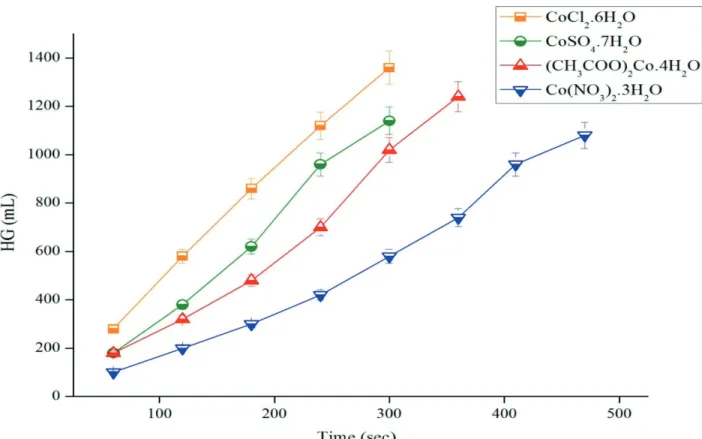
(CH3COO)2Co.4H2O, Co(NO3)2.H2O, CdSO4, and CuSO4.5H2O, were evaluated. As shown in Figure 3, CoCl2.6H2O shows maximum HG. Not much hydrogen is evolved with CdSO4 and CuSO4.5H2O. Comparison of
the HGR using different cobalt-based salts as catalyst with
alumina nanoparticles as promoter is given in Table 2. The following order for maximum and overall HGR is observed: CoCl2.6H2O > CoSO4.7H2O > (CH3COO)2Co.4H2O> Co(NO3)2.H2O. Catalytic activity of Co-based metal salts is dependent on Co+2 cation due to its
electrophilic nature that is strongly attracted towards BH4
-ionsfrom NaBH4, thus enhancing the hydrolysis of NaBH4 (Demirci et al., 2010).
As the cation Co+2 is similar among all salts studied in
the present work and CoCl2 exhibits high HGR, the anions CH3COO–, Cl–, SO
4 2–, NO
3
– could be another factor that affects the catalytic activity of metal catalysts. Maximum solubility of anions in solution, defined by coefficient of diffusivity, is higher for Cl– ions as compared with anions of
other salts (Akdim et al., 2009 b). This could be the reason behind high HGR with CoCl2. Similar results were observed by Akdim et al. (2009 c), where Co was tested among
different cobalt based salts; it was reported that CoCl2 is 4
times more reactive than Co(CH3COO)2, CoSO4, CoF2 and Co(NO3)2 in catalyzing the NaBH4 hydrolysis reaction.
Additionally, CoCl2 was also compared with CdSO4 and CuSO4 salts and it was observed that no hydrogen was released with CdSO4, while the reaction terminated with CuSO4 after 10 seconds only. The reason could be the
lower affinity of Cu+2, Cd+3 towards BH 4
– ions. The present
system is studied in detail by performing analysis of the residue, to predict the possible reactions that could occur
between different reactants. The residue, formed after the
reaction terminated, could explain the reactivity among all the reactants in the system.
Analysis of the residue
The residue obtained from the optimum system consisting of NaBH4 (1.26 moles/L), Al2O3 (0.12 moles/L), NaOH (0.93 moles/L), and CoCl2 (0.02 moles/L) was analyzed. The residue was a grey coloured solid powder and was characterized using
EDS, XRD and FTIR. Elemental composition is determined
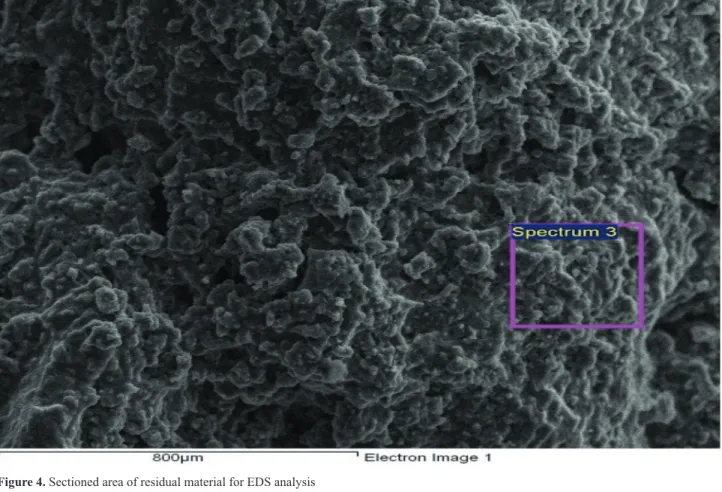
by the quantitative analysis of the surface by EDS. The elemental composition of one section (Figure 4) is estimated as B (72.19 wt%), Na (4.47 wt%), Al (0.07 wt%), Cl (0.06 wt%), O (23.14 wt%) and Co (0.07 wt%).
Similar results were observed earlier for a section of the EDS as B (74.24 wt%), Na (4.26 wt%), Al (0.12 wt%), Cl (0.09 wt%), O (21 wt%) and Co (0.04 wt%) (Kaur et al., 2015). As shown in Table 3, the residue consists of boron in maximum percentage followed by oxygen and aluminium and with the least percentage of cobalt and chlorine.
The XRD pattern of the residue is shown in Figure 5. The major components of the residue from XRD are
polymeric sodium aluminates; NaAl11O17 (Ref. code 01-079-2288) and Na2Al22O34 (Ref. code 072-1406). This
is in confirmation with chemical reaction 4 as formation
of sodium aluminates enhances hydrolysis of Al in the solution and eventually increases overall HGR of the system. Prediction of CoAl2O4 (Ref. code 082-2251) in the
solution signifies the formation of activated Co/Al complex that could promote reaction 5. It is confirmed from XRD
that Na/Al and Co/Al species are formed, which play additional roles in hydrogen generation in the solution as discussed in the previous section.
The XRD pattern also shows the presence of
Na2BO2(OH) (Ref. code 037-0173) which is formed as a result of formation of NaBH4 hydrolysis byproduct NaBO2. H2O (Soler et al., 2009). This observation indicates that NaOH-based reactions (7 and 8) occur in the solution that enhance Al and NaBH4 hydrolysis.
NaCl (Ref. code 01-071-3742) is formed due to the reaction of cobalt chloride with borohydride ions as shown in reaction
2
2
43
20.5
22NaCl 1.5HBO
26.25H
2CoCl
+
NaBH
+
H O
→
Co B
↓ +
+
+
↑
(6)Table 2. HGR using different cobalt-based salts as catalyst (with alumina nanoparticles as promoter)
S. No. Catalyst Maximum HGR (moles/L.sec) Overall HGR (moles/L.sec)
1. (CH3COO)2Co.4H2O 15.49 ± 0.54 14.54 ± 0.50
2. CoCl2.6H2O 19.47 ± 0.57 17.89 ± 0.59
3. Co(NO3)2.6H2O 11.27 ± 0.57 9.66 ± 0.52
Figure 3. HG using different cobalt based salts as catalysts
Table 3. EDS analysis of residual material
Element Analysis of residue in sectioned area in Figure 4 Analysis of residue (reported by Kaur et al., 2015)
Weight (%) Atomic (wt%) Weight (%) Atomic (wt%)
B 72.19 80.22 74.24 81.8
Na 4.47 2.34 4.26 2.21
Al 0.07 0.03 0.12 0.05
Cl 0.06 0.02 0.09 0.03
Co 0.07 0.01 0.04 0.01
O 23.14 17.32 21.25 15.82
6 and formation of Co3BO5 (Ref. code 085-1736) is the result of Co2+ ions reacting with NaBO
2 (George et al., 1993). Inset graph in Figure 5 gives the peak around 2θ = 45⁰; the diffracted
peaks indicate the amorphous structure of the material and presence of CoxB compounds (Demirci and Miele, 2010).
The residue analysis by FTIR (Figure 6) shows B-O deformation (669, 735 and 846 cm-1) of Co
3BO5 as also indicated by XRD. Peaks due to Al-O stretching (914
cm-1), B-O stretching (1084 cm-1) and B-O-H (1169 and
1282 cm-1) are indicative of the formation of aluminates
and sodium metaborate based byproducts (Hannauer et al., 2011). Deformation and adsorption bands in the range of 3200-3700 cm-1 are related to O-H stretching that reveals the formation of aluminium hydroxides (Xuelian et al.,
2009). Therefore, FTIR analysis indicates the formation of aluminates and sodium metaborate based byproducts and
the same is predicted by XRD analysis.
The B-H stretching band region of 2000-2300 cm-1
has almost completely disappeared; it can be inferred that complete conversion of NaBH4 occurs due to the presence of Al2O3 nanoparticles in the system (Dai et al., 2011).
Thus, results from XRD and FTIR are in agreement with
the chemical reactions reported.
Figure 4. Sectioned area of residual material for EDS analysis
CONCLUSIONS
From these experiments it can be concluded that
• γ-Al2O3 nanoparticles are the best catalyst promoter
and CoCl2.5H2O is the best catalyst found among all the promoters and catalysts studied in this system with maximum HGR of 19.47 moles/L.sec.
• Boron is present in maximum percentage in the residue as expected. Aluminates like NaAl11O17, Na2Al22O34 and CoAl2O4 are formed during hydrolysis of NaBH4 in the present system.
• The factors that promote HGR are (a) hydrophilic,
amphoteric nature and large specific surface area of γ-Al2O3 nanoparticles, (b) strong affinity of Co+2 towards BH
4 – ions
and (c) formation of aluminates and sodium metaborate based byproducts.
• NaBH4/γ-Al2O3 nanoparticles/H2O with CoCl2 as catalyst are a potential source of hydrogen generation and this system can be applied to fuel cell applications due to its high hydrogen storage density when compared with other conventional NaBH4/H2O based hydrogen storage systems.
ACKNOWLEDGEMENTS
The authors gratefully acknowledge the support provided by the management of Thapar University, Patiala for providing the necessary facilities to carry out this
research work and financial help rendered by Rajiv Gandhi
Fellowship sponsored by UGC.
REFERENCES
Akdim, O., Demirci, U.B., Muller, D. and Miele, P., Cobalt(II) salts, performing materials for generating hydrogen from sodium borohyride, Int. J. of Hydrogen Energy, 34, 2631 (2009 a).
Akdim, O., Demirci, U.B., and Miele, P., Highly efficient
acid-treated cobalt catalyst for hydrogen generation from NaBH4 hydrolysis, Int. J. of Hydrogen Energy 34, 4780 (2009 b).
Akdim, O., Demirci, U.B. and Miele, P., More reactive cobalt chloride in the hydrolysis of sodium borohydride, Int. J. of Hydrogen Energy, 34, 9444 (2009 c).
Amendola, S.C., Sharp, G.S.L., Saleem, J.M., Kelly, M.T., Petillo, P.J. and Binder, M., An ultrasafe hydrogen generator: aqueous, alkaline borohydride solutions and Ru catalyst, J. Power Sources, 85, 186 (2000).
Brunelle, J.P., Preparation of catalysts by metallic complex adsorption on mineral oxides, Pure and Appl. Chem., 50, 1211 (1978).
Buchner, R. Hefter, G. May, P.M. and Sipos, P., Dielectric relaxation of dilute aqueous NaOH, NaB(OH)4, NaAl(OH)4, Journal of Physical Chemistry B, 103, 11186(1999).
Cakanyildirim, C. and Guru, M., Supported CoCl2 catalyst for NaBH4 dehydrogenation. Renewable Energy, 35, 839 (2010).
Dai, H.B., Guang, L.M., Kang, X.D. and Wang, P., Hydrogen
generation from coupling reactions of sodium borohydride and aluminum powder with aqueous solution of cobalt chloride, Catalysis Today, 170, 55 (2011).
Demirci, U.B., Akdim, O., Hannauer, J., Chamoun, R. and Miele, P., Cobalt, a reactive metal releasing hydrogen from sodium borohydride: A short review and research perspective, Sci. China. Chem., 53, 1870 (2010).
Demirci, U.B. and Miele, P., Cobalt in NaBH4 hydrolysis, Physical Chemistry Chemical Physics, 12, 14651 (2010).
Fan, M.Q., Wang, Y., Tang, R., Chen, D., Liu, W., Tian, G.L., Lv, C.J. and Shu, K.Y., Hydrogen generation from Al/NaBH4 hydrolysis promoted by Co nanoparticles and NaAlO2 solution, Renewable Energy, 60, 637 (2013).
Grenman, H., Salmi, T., Murzin, D.Y. and Mensah J.A., The dissolution kinetics of gibbsite in sodium hydroxide at ambient pressure, Ind. Eng. Chem. Res., 49, 2600(2010).
George, N.G., Kenneth, J.K., Christopher, M.S. and George, C.H., Borohydride reduction of cobalt ions in water, chemistry leading to nanoscale metal, boride or borate particles, Langmuir, 9, 162 (1993).
Hannauer, J., Demirci, U.B., Geantet, C., Herrmann, J.M. and Miele, P., Enhanced hydrogen release by catalyzed hydrolysis of sodium borohydride-ammonia borane mixtures: a solution-state 11B NMR study, Phys. Chem. Chem. Phys., 13, 3809 (2011).
Huang, Y., Wang, Y., Zhao, R., Shen, K. and Wei, Z., Accurately measuring the hydrogen generation rate for hydrolysis of sodium borohydride on multiwalled carbon nanotubes/Co-B catalysts, Int. J. Hydrogen Energy, 33, 7110 (2008).
Jianbo, L., Yong, F., Hua, P., Meiqiang, F., Liangliang, W. and Jun, Y., Controllable hydrogen generation performance from Al/NaBH4 composite activated by La metal and CoCl2 salt in pure water, Journal of Rare Earths, 530, 548 (2012).
Kanturk, A., Sari, M. and Poskin, S., Synthesis, crystal structure and dehydration kinetics of NaB(OH)4.2H2O, Korean Journal of Chemical Engineering, 25, 1331(2008).
Kaur, A., Gangacharyulu, D. and Bajpai, P.K., Hydrogen generation from NaBH4/Al2O3 nanoparticles/H2O with CoCl2 as catalyst, 10th IEEE conference on Industrial Electronics and Applications (ICIEA 2015), 757(2015).
Li, X.B., Liu, Z.J. and Xu, X.H., Mode of apparent crystal
growth rate and kinetics of seeded precipitation from sodium aluminate solution, Journal of Central South University of Technology, 12, 662 (2005).
Liu, B.H., Li, Z.P. and Suda, S., Alkaline sodium borohydride gel as a hydrogen source for PEMFC or an energy carrier for NaBH4-air battery, J. Power Sources, 180, 530 (2008).
Liu, B.H., Li, Z.P. and Suda, S., Nickel-and cobalt-based catalysts
for hydrogen generation by hydrolysis of borohydride, J. Alloys. Compd., 415, 293 (2006).
Marrero, A.E.Y., Beaird, A.M., Davis, T.A. and Matthews, M.A., Hydrogen generation from chemical hydrides, Ind. Engg. Chem. Res., 48, 3703 (2009).
Marx, D., Chandra, A. and Tuckerman, M.E., Aqueous basic
solutions: Hydroxide salvation, structural diffusion and
comparison to the hydrated proton, Chem. Rev. 110, 74 (2010).
Muir, S.S., and Yao, X., Progress in sodium borohydride as
a hydrogen storage material: Development of hydrolysis catalysts and reaction systems, Int. J. of Hydrogen energy, 36, 598 (2011).
Rakap, M. and Ozkar, S., Intrazeolite cobalt(0) nanoclusters as low-cost nand reusable catalyst for hydrogen generation from the hydrolysis of sodium borohydride, Appl. Catalyst B: Environ, 91, 21 (2009).
Schlesinger, H.I., Brown, H.C., Finholt, A.E., Gilbreath, J.R., Hoekstra, H.R. and Hyde, E.K., Sodium borohydride, its hydrolysis and its use as a reducing agent and in the generation of hydrogen, J. Am. Chem. Soc., 75, 215 (1953).
Shu, L., Liang, W.L., Jun, Y., Qiang, S.W. and Qiang, F.M., Hydrogen generation from coupling reactions of Al Li / NaBH4 mixture in water activated by Ni powder, Trans. Nonferrous Met. Soc., 22, 1140 (2012).
Soler, L., Candela, A.M., Macanas, J., Munoz, M. and Casado, J., In situ generation of hydrogen from water by aluminium corrosion in solutions of sodium aluminate, J. Power Sources, 192, 21 (2009).
Soler, L., Macanas, J., Munoz, M. and Casado, J., Synergistic hydrogen generation from aluminum, aluminum alloys and sodium borohydride in aqueous solutions, Int. J. Hydrogen Energy, 32, 4702 (2007).
Sposito, G., The environmental chemistry of alumnium, Lewis publishers (1996).
U.S. Department of Energy Hydrogen Program, Go/no-go recommendation for sodium borohydride for on-board vehicular hydrogen storage, Independent review, 150 (2007). Wang, Y., Zhou, L.T., Yuan, H., Shen, W.H., Tan, R., Fan, M.Q.
and Shu, K.Y., Hydrogen generation from the reaction of Al-7.5 wt% Li-25 wt% Co/NaBH4 powder and pure water, Int. J. Electrochemical Sci., 8, 9764 (2013).
Xuelian, D.U., Yanqin, W., Xinghua, S. and Jiangong, Li., Influences of pH value on the microstructure and phase