Short Communication
Effect of halophyte
Salicornia bigelovii
Torr and graded levels of dietary
crude protein on feed performance and carcass traits of camels
Ahmed H. Mahmoud1, Saeid M. Basmaeil2, Yassen El-Shaikh2, Ayman A. Swelum2,3, Mohamed
A. Abouheif2
1 King Saud University, College of Science, Zoology Department, Riyadh, Saudi Arabia.
2 King Saud University, College of Food and Agriculture Sciences, Animal Production Department, Riyadh, Saudi Arabia. 3 Zagazig University, Department of Theriogenology, Zagazig, Sharkia Province, Egypt.
ABSTRACT - The objective of this study was to evaluate the effect of source of roughage and crude protein level on feeding performance and carcass traits of Majaheem camels (Camelus dromedarius). Forty-eight male calf-camels weighing 203.3±5.1 kg were equally assigned to a 2 × 3 factorial arrangement of two sources of roughage (Rhodes grass hay and dry salicornia biomass) and three dietary crude protein levels (12, 14.5, and 17%); the feeding trial lasted for 18 weeks. The results showed that slaughter and hot carcass weights, average daily gain, dry matter intake, feed efficiency, and separable fat from 9th-11th rib joint increased as the crude protein in the diets increased from 12 to 14.5%, whereas increasing crude protein to 17% resulted in no further changes. Slaughter weight, average daily gain, hot carcass weight, rib eye area, and separable lean did not differ between Rhodes grass and salicornia diets, but salicornia-fed camels had higher dry matter intake and produced heavier kidney fat and separable fat weights than camels fed Rhodes grass diets. It is suggested that the inclusion of salicornia biomass as a roughage ingredient up to 25% in the diet containing not greater than 14.5% crude protein can be utilized without adverse effect on feeding performance of calf-camels.
Key Words: body growth, meat composition, salt plants
ISSN 1806-9290
www.sbz.org.br R. Bras. Zootec., 45(11):704-708, 2016
Received January 3, 2016 and accepted September 4, 2016. Corresponding author: [email protected]
http://dx.doi.org/10.1590/S1806-92902016001100009
Copyright © 2016 Sociedade Brasileira de Zootecnia. This is an Open Access article distributed under the terms of the Creative Commons Attribution License (http://creativecommons.org/licenses/by/4.0/), which permits unrestricted use, distribution, and reproduction in any medium, provided the original work is properly cited.
Introduction
Utilizing halophytes and other salt-tolerant plants in the ration of ruminants is a feasible solution to minimize the problems of feed and water shortage in desert, saline coastal, and subcoastal areas (Al-Shorepy et al., 2010; Moreno et al., 2015). Salicornia (Salicornia bigelovii Torr) has been considered as one of the most salt-tolerant species among the halophytes and has been shown to maintain normal growth even when soil NaCl concentration exceeds 1.3 M, two times greater than full-strength seawater salinity (Kong and Zheng, 2014). In Saudi Arabia, the dried salicornia biomass residues that remain after the harvest of seeds for oil production have potential as livestock feed (Abouheif et al., 2000). This plant is characterized by its
high ash content, of which NaCl is the principal constituent (Zhang et al., 2015). High dietary levels of Na increase water intake and the flow of undegraded digesta from the rumen, which results in depressed fiber fermentation and improved protein digestion (Kraidees et al., 1998; Abouheif et al., 2000; Basmaeil et al., 2004).
Material and Methods
A total of 48 Majaheem male calf-camels (Camelus
dromedarius) with an average body weight of 203.3± 5.1 kg
and approximately 8-10 months old were utilized for this study. The experimental protocol regarding the care and handling of camels was approved by the Ethics Committee of the King Saud University, Riyadh, Kingdom of Saudi Arabia. Upon arrival to the experimental farm, calves were individually weighed, identified, vaccinated against endemic infectious diseases, and given a prophylactic dose of Ivermectin and vitamin AD3E injections. After allowing a two-week adaptation period, calves were randomly allotted to one of six dietary treatment groups in a 2 × 3 factorial arrangement of two roughage sources (Rhodes grass hay and dried salicornia biomass) and three levels of dietary CP (12, 14.5, and 17%). Each treatment group contained four replicates (yards) with two camels per yard; yards were 4 × 4 m, constructed of metal gates and compact sand floors, and were located under a roof in an open-sided barn with an average ambient temperature of 25.1 ºC (32.1 ºC max. and 18.2 ºC min.) during the study.
The salicornia biomass was obtained from mature plants, which had been cultivated in Saudi Arabia under seawater irrigation. The biomass was sun-dried and shipped to the Arabian Agricultural Services Company (ARASCO)
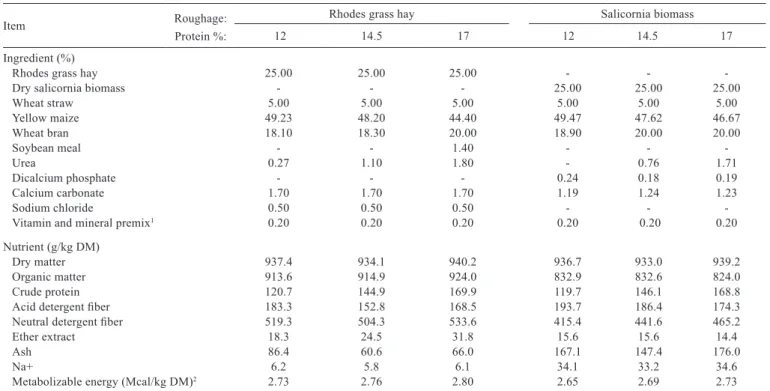
for diet preparations. The chemical composition (DM) of the dry salicornia biomass was: CP, 59 g/kg; ether extract (EE), 26 g/kg; neutral detergent fiber (NDF), 468 g/kg; acid detergent fiber (ADF), 234 g/kg; ash, 392 g/kg; and Na+, 118 g/kg. The chemical composition (DM basis) of the Rhodes grass (Chloris gayana) hay was: CP, 91 g/kg; EE, 22 g/kg; NDF, 652 g/kg; ADF, 433 g/kg; ash, 90 g/kg; and Na+, 3.1 g/kg. The diets were prepared as pelleted total-mixed rations composed of 70% concentrate ingredients, 5% wheat straw, and 25% of either Rhodes grass hay or dry salicornia biomass (Table 1). The contents of the concentrate ingredients in each experimental diet were slightly modified to achieve the designated CP level; all experimental diets were also formulated to be isocaloric. Camels were fed ad libitum at 8.00 h after discarding the leftovers from the previous day. Leftovers were removed, weighed, sampled for DM determination, and then discarded. Feeding and management practices were applied equally to all treatment groups. The feeding period lasted 18 weeks, during which DM intakes were recorded weekly, whereas the weights of calves were recorded fortnightly after 12 h of fasting and before feeding in the morning. Fresh drinking water was available at all times.
Camels were slaughtered after 12 h of fasting. Hot carcass and kidney fat weights were recorded immediately after dressing. Carcasses were then refrigerated at 4 ºC for
Item Roughage:
Protein %:
Rhodes grass hay Salicornia biomass
12 14.5 17 12 14.5 17
Ingredient (%)
Rhodes grass hay 25.00 25.00 25.00 - -
-Dry salicornia biomass - - - 25.00 25.00 25.00
Wheat straw 5.00 5.00 5.00 5.00 5.00 5.00
Yellow maize 49.23 48.20 44.40 49.47 47.62 46.67
Wheat bran 18.10 18.30 20.00 18.90 20.00 20.00
Soybean meal - - 1.40 - -
-Urea 0.27 1.10 1.80 - 0.76 1.71
Dicalcium phosphate - - - 0.24 0.18 0.19
Calcium carbonate 1.70 1.70 1.70 1.19 1.24 1.23
Sodium chloride 0.50 0.50 0.50 - -
-Vitamin and mineral premix1 0.20 0.20 0.20 0.20 0.20 0.20
Nutrient (g/kg DM)
Dry matter 937.4 934.1 940.2 936.7 933.0 939.2
Organic matter 913.6 914.9 924.0 832.9 832.6 824.0 Crude protein 120.7 144.9 169.9 119.7 146.1 168.8 Acid detergent fiber 183.3 152.8 168.5 193.7 186.4 174.3 Neutral detergent fiber 519.3 504.3 533.6 415.4 441.6 465.2
Ether extract 18.3 24.5 31.8 15.6 15.6 14.4
Ash 86.4 60.6 66.0 167.1 147.4 176.0
Na+ 6.2 5.8 6.1 34.1 33.2 34.6
Metabolizable energy (Mcal/kg DM)2 2.73 2.76 2.80 2.65 2.69 2.73 Table 1 - Ingredient and nutrient composition (DM basis, %) of the Rhodes grass and salicornia diets offered to calf-camels
DM - dry matter.
1 Vitamin and mineral premix contains, per kg: CoSO
4, 0.30 g; CuSO4, 20.1 g; FeSO4, 10.0 g; ZnO, 50.0 g; MnSO4, 40.2 g; KI, 0.75 g; NaCl, 2.81 g; vitamin A, 500,000 IU; vitamin D, 500,000 IU; and vitamin E, 10,000 IU.
24 h; thereafter, the carcasses were carefully divided into two equal halves along the midline and the right side was ribbed between the 11th and 12th ribs. After ribbing, rib eye muscle (longissimus dorsi) area was measured by direct grid reading. Then the 9th-11th rib joint was separated from the right side of each carcass and physically dissected into bone, fat, and lean. The lean tissue was ground twice through a 4-mm plate, mixed thoroughly and a representative sample was taken and stored at –20 ºC, pending chemical analysis. Samples from the longissimus dorsi muscle between the 5th-8th ribs from the right side of each carcass were removed and shear force values were determined using Warner-Bratzler shear device (Pena et al., 2009).
Samples of dried salicornia biomass, Rhodes grass hay, experimental diets, and ground lean tissues were analyzed for DM, ash, EE, and CP according to AOAC (1995). Neutral detergent fiber and ADF in diets were determined according to Van Soest et al. (1991). Data for growth performance, chemical composition, and carcass traits were statistically conducted using PROC MIXED procedures of SAS (Statistical Analysis System, version 8.0) using the following statistical model:
Yijkl = µ + ρi + ωj + nijk + ρωij + eijkl ,
in which Yijkl is the l-thcamel in the k-th replicate receiving
i-th protein level (ρ) of j-th source (ω) of roughage (l = 1, 2; k = 1, 2, 3, 4); µ is the general mean; ρi is the fixed effect of i-th protein level (12, 14.5, and 17%); ωj is the fixed effect j-th source of roughage (salicornia biomass and Rhodes grass hay); nijk is the random effect of k-th replicate in i-th protein level and j-th source of roughage; ρωij is the interaction between protein level and source of roughage; and eijkl is the random error associated with the Yijklobservation. Because few interactions were detected, data are presented only for main effects. Cases in which interactions occurred were discussed in the text. The sum of squares was partitioned into linear, quadratic, and cubic effects of dietary protein levels using orthogonal polynomials.
Results
Increased CP in the diets from 12 to 17% improved (P<0.01) slaughter weight, ADG, and daily DMI quadratically, but changed (P<0.05) feed efficiency cubically (Table 2). Interaction results revealed that increased CP in Rhodes grass diets from 14.5 to 17% level was associated with 6.8, 19.5, and 14.4% decreases (P<0.05) in slaughter weight, ADG, and feed efficiency, respectively, whereas increased CP to 17% level in salicornia diet resulted in no further changes. Slaughter weight and ADG did not differ between Rhodes grass and salicornia diets. Despite the similarity in ADG, camels fed salicornia diets consumed 11% higher amounts of daily DM (P<0.01) and grew 14% less efficiently (P<0.01) than camels fed Rhodes grass diets.
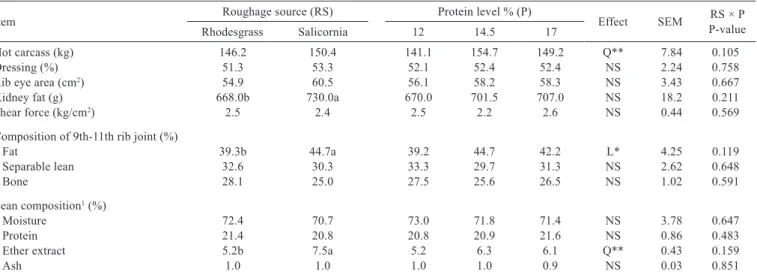
Increasing dietary CP level was associated with a quadratic (P<0.01) increase in hot carcass weight; hot carcass weight changes parallel to slaughter weight changes because CP levels did not affect dressing percentage (Table 3). The increased CP level in diets did not affect rib eye area, kidney fat weight, and shear force value; however, there was a tendency for the meat to be slightly tender at 14.5% CP compared with 12 or 17% CP levels. In addition, increased level of CP in the diets did not alter the percentages of separable lean and bone from the 9th-11th rib joint. Likewise, the percentages of moisture, protein, and ash in the separable lean from the physically separated 9th-11th rib joint did not differ with increased CP in diets. On the other hand, the percentage of separable fat (subcutaneous and intermuscular fat) and ether extract (intramuscular fat) increased linearly (P<0.05) and quadratically (P<0.01) as the CP increased in the diet, respectively. Carcasses from camels fed the salicornia diets had 9.3% higher (P<0.01) kidney fat weight, 13.7% higher (P<0.01) separable fat percentage, and 44.2% greater (P<0.01) ether extract percentage than those fed the Rhodes grass diets.
Item Roughage source (RS) Protein level % (P) Effect SEM P-valueRS × P Rhodesgrass Salicornia 12 14.5 17
Initial weight (kg) 201.7 204.9 205.0 202.6 202.5 NS 8.44 0.845 Slaughter weight (kg) 285.0 285.3 270.7 295.2 289.6 Q** 7.87 0.043 Average daily gain (g) 661.0 637.0 521.0 736.0 691.0 Q** 57.1 0.033 Dry matter intake (kg.d–1) 3.91b 4.34a 3.52 4.45 4.42 Q** 0.28 0.462
Dry matter intake (kg.100 kg–1.d–1) 1.59b 1.76a 1.48 1.78 1.76 Q** 0.06 0.715
Feed efficiency (g.kg–1) 170.0a 146.0b 150.0 167.0 157.0 C* 6.32 0.029 Table 2 - Effect of increasing levels of crude protein and source of dietary roughage on feeding performance of calf-camels
Q - quadratic effect; C - cubic effect; SEM - standard error of the mean.
a,b - means in the same row within roughage source effect followed by different letters differ (P<0.01). NS - not significantly different (P>0.05).
Discussion
Results suggested that 14.5% CP level in Rhodes grass or salicornia diet was apparently able to provide adequate digestible protein to the intestine for the gains attained and there was no increase in growth when increasing the protein content beyond this level. It might be hypothesized that camels fed the 14.5% protein level may have reached a stage of physiological maturity in which their protein needs were met sufficiently. However, the reason for the apparent reversal in response to dietary 17% CP level in Rhodes grass diet was not obvious. Similar findings were reported by Beever and Siddons (1986), who stated that growth in bull calves could be inhibited with higher levels of dietary protein because excess dietary protein is usually broken down into ammonia and may cause ammonia toxicity. In this trial, it seems that the ammonia toxicity in the 17% CP salicornia diet was partially alleviated because of the increased ruminal dilution rate resulted from increased water intake. Basmaeil et al. (2004) found that the average water intake per kg DM consumed were 35% higher for the camels fed salicornia diets than those fed Rhodes grass diets; the increased daily water intake reflected the amount of NaCl in the salicornia biomass diets (Kraidees et al., 1998; Abouheif et al., 2000).
Daily DMI did not respond positively to increased CP over the 14.5% level in both studied diets. Similar results were reported by DelCurto et al. (1990), who found that DM intakes in beef steers responded in a quadratic fashion with increased level of CP in diets; the variability in responses
may have been related to the dietary protein-energy interaction effects. In this experiment, feed ingredients were chosen to formulate isocaloric diets. However, increasing the level of dietary protein to 17% without increasing the level of energy, probably altered the dietary protein:energy ratio to a status that may not support microbial actions in the rumen. Moreover, the high amounts of urea-N compound contained in the 17% CP diets (1.71-1.8% DM) could have limited DM intake. Milton et al. (1997) similarly reported that supplementation with urea above 0.9% of the dietary DM is of little value and does not improve daily DMI due to its higher solubility in the rumen. Feed efficiency in salicornia diet at 17% CP level did not change compared with 14.5% CP, whereas it decreased by 14.4% (P<0.01) in Rhodes grass diet. However, the resulting feed efficiency trends in the 17% CP camels were probably a reflection of the differences in ADG.
The difference in DM intakes between diets can be attributed to the high amounts of ash contained in the salicornia diets in comparison with Rhodes grass diets (14.7-17.6 vs. 6.1-8.6 %), which agreed with the results of Kraidees et al. (1998), Basmaeil et al. (2004), and Al-Shorepy et al. (2010). This, however, could explain how the experimental camels were able to increase their DMI to compensate for the lower OM content of the salicornia diets compared with Rhodes grass diets. On the other hand, camels fed Rhodes grass diets converted feed more efficiently (P<0.01) than those in the salicornia diets; the changes in feed efficiency being presumably a direct consequence of the higher DMI on the salicornia diets.
Item Roughage source (RS) Protein level % (P) Effect SEM P-valueRS × P Rhodesgrass Salicornia 12 14.5 17
Hot carcass (kg) 146.2 150.4 141.1 154.7 149.2 Q** 7.84 0.105 Dressing (%) 51.3 53.3 52.1 52.4 52.4 NS 2.24 0.758 Rib eye area (cm2) 54.9 60.5 56.1 58.2 58.3 NS 3.43 0.667
Kidney fat (g) 668.0b 730.0a 670.0 701.5 707.0 NS 18.2 0.211 Shear force (kg/cm2) 2.5 2.4 2.5 2.2 2.6 NS 0.44 0.569
Composition of 9th-11th rib joint (%)
Fat 39.3b 44.7a 39.2 44.7 42.2 L* 4.25 0.119
Separable lean 32.6 30.3 33.3 29.7 31.3 NS 2.62 0.648
Bone 28.1 25.0 27.5 25.6 26.5 NS 1.02 0.591
Lean composition1 (%)
Moisture 72.4 70.7 73.0 71.8 71.4 NS 3.78 0.647 Protein 21.4 20.8 20.8 20.9 21.6 NS 0.86 0.483 Ether extract 5.2b 7.5a 5.2 6.3 6.1 Q** 0.43 0.159
Ash 1.0 1.0 1.0 1.0 0.9 NS 0.03 0.851
Table 3 - Effect of increasing levels of crude protein and source of dietary roughage on carcass traits of calf-camels
a,b - means in the same row within roughage source effect followed by different letters differ (P<0.01). Q - quadratic effect; L - linear effect; SEM - standard error of the mean.
NS - not significantly different (P>0.05). * P<0.05.
** P<0.01.
The increased fat deposition in camels fed the 14.5% CP diets compared with camels fed the 12% CP diets could be explained by their higher rates of gain. Simoes and Mira (2002) and Mendoza et al. (2007) found that the deposition of fat is a direct consequence of ADG and carcass weight changes. Carcass adiposity measures from salicornia-fed camels were noticeably higher than those measures from Rhodes grass-fed camels. This was in contrast with the results reported by Al-Owaimer et al. (2008) and Moreno et al. (2015), who reported that animals fed halophytes had a tendency to have a higher lean and a lower fat content. The discrepancy in results may be related to the differences in halophyte species, stage of animal maturity, animal species, halophyte concentration in diet, and concentration of energy intake.
Conclusions
These results suggested that, under the conditions of this experiment, 14.5% crude protein level was adequate to sustain maximal feeding performance and carcass adiposity of young Majaheem male camels and that dietary crude protein concentration greater than 14.5% did not enhance feeding performance or carcass fatness. The inclusion of dry salicornia biomass at 25% in the diet does not have an adverse effect on growth performance, but is generally associated with greater carcass fatness than the Rhodes grass hay diet.
Acknowledgments
The authors extend their appreciation to the Deanship of Scientific Research at King Saud University for funding this work through the research group project RGP-VPP-282.
References
Abouheif, M. A.; Al-Saiady, M.; Kraidees, M. S.; Tag Eldin, A. and Metwally, H. 2000. Influence of inclusion of Salicornia biomass in diets for rams on digestion and mineral balance. Asian-Australasian Journal of Animal Science 13:967-973.
Al-Owaimer, A. N.; Zahran, S. M. and Al-Bassam, B. A. 2008. Effect of feeding with some Atriplex species in complete diet on meat quality and carcass characteristics of Najdi ram lambs. International Journal of Agriculture and Biology 10:105-108. Al-Shorepy, S. A.; Alhadrami, G. A. and Al-Dakheel, A. J. 2010.
Growth performances and carcass characteristics of indigenous
lambs fed halophyte Sporobolus virginicus grass hay. Asian-Australasian Journal of Animal Science 23:556-562.
AOAC - Association of Official Analytical Chemists. 1995. Official methods of analysis. 16th ed. Washington, DC, USA.
Basmaeil, S.; Al-Saiady, M.; Abouheif, M. A.; Zahran, S. and El-Shaikh, Y. A. 2004. Effect of graded levels of crude protein on nutrient digestibility of Rhodesgrass hay or dried Salicornia biomass diets in camels. Journal of King Saud University, Agriculture Sciences 16:117-125.
Beever, D. E. and Siddons, R. C. 1986. Digestion and metabolism in the grazing ruminant. p.479-497. In: Control of digestion and metabolism in ruminants. Milligan, L. P.; Grovum, W. L. and Dobson, A., eds. Prentice-Hall, USA.
DelCurto, T.; Cochran, R. C.; Harmon, D. L.; Beharka, A. A.; Jacques, K. A.; Towne, G. and Vanzant, E. S. 1990. Supplementation of dormant tallgrass-prairie forage: I- Influence of varying supplemental protein and (or) energy levels on forage utilization characteristics of beef steers in confinement. Journal of Animal Science 68:515-531.
Kertz, A. F.; Prewitt, R. L. and Ballam, J. M. 1987. Increased weight gain and effects on growth parameters of Holstein heifers calved from 3 to 12 months of age. Journal of Dairy Science 70:1612-1622.
Kong, Y. and Zheng, Y. 2014. Potential of producing salicornia bigelovii hydroponically as a vegetable at moderate NaCl salinity. Horticultural Science 49:1154-1157.
Kraidees, M. S.; Abouheif, M. A.; Al-Saiady, M.; Tag Eldin, A. and Metwally, H. 1998. The effect of dietary inclusion of halophyte
Salicornia bigelovii Torr on growth performance and carcass characteristics of lambs. Animal Feed Science and Technology 76:149-159.
Mendoza, N.; May, B.; Salisbury, M. W. and Engdahl, G. R. 2007. The effect of protein level on feedlot performance and carcass characteristics of Texas Rambouillet ewes. Texas Journal of Agriculture and National Research 20:75-81.
Milton, C. T.; Brandt, R. T. and Titgemeyer, E. C. 1997. Effects of dietary nitrogen source and concentration in high-grain diets on finishing steer performance and nutrient digestion. Journal of Animal Science 75:2813-2823.
Moreno, G. M. B.; Borba, H.; Araujo, G. G. L.; Sanudo, C.; Silva Sobrinho, A. G.; Buzanskas, M. E.; Lima Junior, D. M.; Almeida, V. V. S. and Neto, O. B. 2015. Meat quality of lambs fed different saltbush hay (Atriplex nummularia) levels. Italian Journal of Animal Science 14:251-259.
Pena, F.; Bonvillani, A.; Freire, B.; Juarez, M.; Perea, J. and Gomez, G. 2009. Effects of genotype and slaughter weight on the meat quality of Criollo Cordobes and Anglo Nubian kids produced under extensive feeding conditions. Meat Science 83:417-422. Simoes, J. A. and Mira, J. F. 2002. Age, empty body weight and
carcass composition at the same proportion of total carcass fat in Portuguese cattle breeds. Livestock Production Science 74:159-164.
Van Soest, P. J.; Robertson, J. B. and Lewis, B. A. 1991. Methods for dietary fiber, neutral detergent fiber and nonstarch polysaccharides in relation to animal nutrition. Journal of Dairy Science 74:3583-3597.