Pedro Miguel de Sousa Santos
Licenciado em Ciências de Engenharia Mecânica
Development of FSW to manufacture tailor
welded blanks for lightweight transport
applications
Dissertação para obtenção do Grau de Mestre em
Mestrado Integrado em Engenharia Mecânica
Orientador: Professora Doutora Rosa Maria Mendes Miranda,
Professora Associada com Agregação, FCT-UNL
Co-orientador: Doutor João Pedro Machado da Gandra,
Senior Project Leader, TWI, Ltd.
Development of FSW to manufacture tailor
welded blanks for lightweight transport
applications
Dissertação apresentada à Faculdade de Ciências e Tecnologia da Universidade Nova de Lisboa para a obtenção do grau de
Mestre em Engenharia Mecânica
Orientador:
Professora Doutora Rosa Maria Mendes Miranda
Co-orientador:
Doutor João Pedro Machado da Gandra
Development of FSW to manufacture tailor welded blanks for lightweight transport applications
Copyright © 2016 Pedro Miguel de Sousa Santos
Faculdade de Ciências e Tecnologia, Universidade Nova de Lisboa
Agradecimentos
Este trabalho conclui um dos mais desafiantes e gratificantes capítulos da minha vida académica até à data. No entanto, não teria chegado a esta etapa sem a ajuda, apoio e confiança de pessoas importantíssimas.
Em primeiro lugar, quero expressar a minha profunda gratidão à minha orientadora, Professora Rosa Miranda, por me ter convidado para integrar um projeto tão interessante que me permitiu trabalhar com um grupo de profissionais experientes numa instituição de prestígio. Agradeço em especial toda a paciência, orientação e compromisso.
Ao meu co-orientador, Doutor João Gandra, agradeço os seus ensinamentos fundamentais, pelo seu entusiasmo e pelo constante apoio e paciência durante o meu estágio no TWI, Ltd. Quero agradecer também a sua amizade e os seus conselhos preciosos.
Esta tese foi realizada no âmbito de um projeto de investigação intitulado “LightBlank – make it lighter, with less”. O autor reconhece a importância do financiamento concedido pela organização Innovate UK. Gostaria de agradecer também ao Doutor Mike Russell por me ter aceitado no TWI, Ltd e por me ter dado a oportunidade de aprofundar o conhecimento sobre FSW onde o processo foi criado. Agradeço também a todos os trabalhadores da secção de Friction and Forge Processes por todo o apoio prestado e por me terem recebido no seu grupo. Em particular, um especial agradecimento ao Chris Glazebrook e ao Bertrand Flipo pela amizade e pelas conversas, ao Stuart Page pelas lições que me transmitiu, à Helen Everson por todo o seu apoio e ao Doutor Steve Dodds por me convidar a participar noutros projetos interessantes que me permitiram contactar com outras tecnologias. Gostaria de agradecer também aos restantes trabalhadores do TWI, Ltd, com quem tive contacto durante o meu estágio e pelas suas contribuições importantes para este trabalho e para uma incrível experiência.
É com grande gosto que expresso a minha eterna gratidão a toda a minha família, por me terem ajudado a chegar onde estou hoje e por todo o apoio e carinho. Um agradecimento especial à minha mãe, ao meu pai, à minha irmã, aos meus avós e aos meus tios que conseguiram arranjar tempo para me visitar enquanto estive fora, à minha prima Mariana pelos bons tempos passados em Londres e à Amélia por, agora mais do que nunca, ser um pilar para a família e pelo seu carinho desde a minha infância. À minha namorada Carolina Ribeiro, quero agradecer-lhe pelo constante apoio, dedicação e amor ao longo dos anos. Obrigado por sempre acreditares em mim, por fazeres de mim uma pessoa melhor e mais feliz e por todos os bons momentos que vivemos e que estão para vir.
Aos meus melhores amigos, João Costa e Rita Valentim e aos amigos que fui fazendo ao longo dos anos, agradeço a amizade, apoio e todos os momentos marcantes que partilhámos.
Quero agradecer à Ana Simões, pela grande amizade, pelo apoio prestado nas alturas mais difíceis do curso e da vida e por todos os momentos divertidos qua passamos ao longo dos anos. Agradeço também à sua família pela sua hospitalidade. Sem dúvida uma amiga para a vida.
Acknowledgements
This work concludes one of the most challenging and rewarding chapters in my academic life so far. However, I couldn’t have achieved this stage without the help, support and faith from crucial people.
First and foremost, I would like to express my deepest gratitude to my supervisor, Professor Rosa Miranda, for inviting me to join such an interesting project which gave me the opportunity to work with a group of experienced professionals in a remarkable institution. A special thanks for all the patience, guidance and commitment.
To my co-supervisor, Dr. João Gandra, to who I am thankful for his cornerstone teachings, for his enthusiasm and constant support and patience during my time at TWI, Ltd. I would also like to thank for his friendship and valuable advices.
This thesis was conducted in the framework of a research project entitled “LightBlank – make it lighter, with less”. The author acknowledges the importance of the granted funding by Innovate UK organisation.
I would also like to thank Dr. Mike Russell for accepting me at TWI, Ltd and for giving me the opportunity to get a better understanding about FSW where it all began. I sincerely acknowledge all the staff members of the Friction and Forge Processes section for their support and for welcoming me into their group. In particular, a special thanks to Chris Glazebrook and Bertrand Flipo for their close friendship and pep talks, Stuart Page for his teachings, Helen Everson for her support and Dr. Steve Dodds for inviting me to participate in other interesting projects that exposed me to different technologies. I would also like to thank all TWI, Ltd staff members, with whom I had contact during my internship and for their significant contributions for this work and for an incredible experience.
It is with great deal of appreciation that I express my indebtedness to my family, for helping me to arrive where I am today and for all their support and affection. Honest thanks to my mother, father, sister, grandparents and uncles for finding the time to visit me abroad, to my cousin Mariana for the good times spent in London and to Amélia for being a pillar for the family now more than ever and her affection since my early years.
To my girlfriend Carolina Ribeiro, I would like to express my sincere gratitude for her constant support, dedication and love throughout the years. Thank you for always believing in me, for making me a better and happier person and for the good times we had and that are yet to come.
A special thanks goes to my best friends João Costa and Rita Valentim and to the friends I’ve made throughout the years for their friendship, support and the remarkable moments we have shared. I would like to thank Ana Simões, for her close friendship, for her support in the hard times throughout the course and in life and for all the good times. Also to her family, for their hospitality. Without any doubt a friend for life.
To my classmates and future MSc, I wish to thank you all for your support and friendship.
Sumário
A redução do peso dos veículos constitui uma das soluções mais eficazes para a redução do consumo de energia e das emissões de CO2 no sector dos transportes. Com os recentes avanços nas novas tecnologias de fabrico, a produção de Tailor welded blanks (TWBs) em ligas de baixa densidade como o alumínio tornou-se uma solução viável e económica.
O presente trabalho de investigação foi realizado no âmbito do projeto “LightBlank – make it lighter, with less”, em curso no The Welding Institute (TWI), que tem como objetivo o desenvolvimento do processo de soldadura por fricção linear (SFL) para a produção de TWBs em alumínio AA 6082-T6 de espessuras dissimilares para a indústria automóvel, ferroviária e aeroespacial. Foram estudadas duas combinações de espessuras: 3 com 5 mm e 2 com 2,5 mm.
Numa primeira fase, foram realizadas diversas soldaduras com combinações distintas de parâmetros operatórios com o objetivo de identificar a janela de parâmetros mais adequada para cada ligação dissimilar. Utilizando técnicas de análise metalográfica e ensaios mecânicos, foi possível caracterizar a influência dos vários parâmetros nos cordões produzidos definindo assim a gama de parâmetros operatórios que produziam cordões com maior resistência e velocidades de avanço maiores.
Para a combinação de espessuras de 3 com 5 mm, foi avaliada a influência na qualidade da soldadura quando existe variação no alinhamento da ferramenta com a linha de soldadura e quando se coloca a chapa mais espessa no lado em avanço, i.e. quando se altera a posição das chapas relativamente à direção de avanço;
Abstract
Vehicle light-weighting has been identified as the most effective way of addressing the reduction of energy consumption and CO2 emissions in the transportation industry. With recent advances in manufacturing technologies, the production of tailor welded blanks (TWBs) from lightweight metal alloy such as aluminium has become a viable and low cost solution.
The present research work was conducted in the framework of the ongoing project “LightBlank – make
it lighter, with less”, at The Welding Institute (TWI) aiming at the development of the friction stir welding
(FSW) process for the production of TWBs in aluminium AA 6082-T6 with dissimilar thickness for the automotive, rail and aerospace industries. Two thickness combinations were addressed: 3 to 5 mm and 2 to 2.5 mm.
At first stage, multiple weld beads with different welding parameter combinations were produced in order to determine the process window for each dissimilar joint. Using metallographic analysis techniques and mechanical testing, the influence of the parameter combinations on the welded joints was characterized which allowed to determine the parameter combination that produced the weld beads with the best quality while maximizing the welding speed.
On the 3 to 5 mm thickness combination, extra tests were conducted to determine the influence in the quality of the weld of a horizontal offset in the alignment of the tool with the joint line and the thicker plate in the advancing side, i.e, a change in the plate positioning in relation to the welding direction.
Palavras-chave
Soldadura dissimilar
Soldadura por fricção linear (SFL)
Tailor welded blanks (TWBs) AA 6082-T6
Propriedades mecânicas
Keywords
Dissimilar welding
Friction stir welding (FSW)
Tailor welded blanks (TWBs)
AA 6082-T6
List of Contents
Agradecimentos ...v
Acknowledgements ... vii
Sumário ... ix
Abstract... xi
Palavras-chave ... xiii
Keywords ... xiii
List of Contents ... xv
List of Figures ... xvii
List of Tables ... xix
Abbreviations ... xxi
Symbols ... xxi
Chapter 1 -Introduction ... 1
1.1 Motivation ... 1
1.2 Objectives ... 2
1.3 Structure ... 3
Chapter 2 -Literature review ... 5
2.1 Tailor welded blanks ... 5
2.1.1 Applications ... 6
2.1.2 Production processes: ... 7
2.1.3 Strengths and weaknesses of TWBs technology ... 8
2.1.4 Joining processes ... 9
2.1.5 Lightweight materials to produce TWBs: ... 10
2.2 Friction Stir Welding ... 12
2.2.1 Processed zone ... 14
2.2.2 Process operating parameters ... 15
2.2.3 FSW Tools ... 17
2.2.4 Tool materials ... 21
2.2.5 Defects ... 21
2.2.6 Applications ... 23
2.2.7 Feasibility of FSW to join TWBs ... 24
2.2.8 Conclusion ... 25
Chapter 3 -Experimental Setup ... 27
3.1 Base material ... 27
3.2 FSW Equipment ... 28
3.2.1 FW-28 ESAB SuperStirTM ... 28
3.2.2 FW-36 AWEA LP 4025Z ... 29
3.3 Tool materials and design ... 29
3.4 Fixturing system ... 31
xvi
3.6 Pre-weld procedure ... 33
3.7 FSW Parameter optimization ... 33
3.8 Characterization techniques ... 36
3.8.1 Visual inspection ... 36
3.8.2 Metallographic analysis ... 36
3.8.3 EBSD Mapping ... 37
3.8.4 Hardness measurement ... 37
3.8.5 Bending tests ... 37
3.8.6 Tensile testing ... 38
3.8.7 SEM Fractography ... 38
3.8.8 X-Ray inspection... 38
3.9 Other tests ... 38
3.9.1 Offset study ... 39
3.9.2 Inverted setup study ... 39
Chapter 4 -Results and discussion ... 41
4.1 TWBs 3-5 mm ... 41
4.1.1 Visual inspection ... 41
4.1.2 Metallographic analysis ... 43
4.1.3 EBSD Mapping ... 47
4.1.4 Hardness measurement ... 50
4.1.5 Bending tests ... 54
4.1.6 Tensile tests ... 56
4.1.7 SEM Fractography ... 57
4.1.8 X-Ray inspection... 57
4.2 TWBs 2-2.5 mm ... 58
4.2.1 Visual inspection ... 59
4.2.2 Metallographic analysis ... 61
4.2.3 Hardness measurement ... 64
4.2.4 Bending tests ... 67
4.2.5 Tensile tests ... 69
4.2.6 SEM Fractography ... 70
4.2.7 X-Ray inspection... 70
4.3 Offset study... 71
4.3.1 Metallographic analysis ... 71
4.4 Inverted setup ... 73
Chapter 5 -Conclusions and proposals for future work ... 77
References ... 79
List of Figures
Figure 2.1 - Tailored Blanks schematic chart ... 5
Figure 2.2 - Automotive applications for TWBs [1] ... 7
Figure 2.3 - Comparison between the conventional process and TWBs process for the production of formed components ... 8
Figure 2.4 - Schematic representation FSW process phases. [22] ... 13
Figure 2.5 - Typical macrograph of a FSW joint [25]. ... 14
Figure 2.6 - (a) Fixed pin, (b) Adjustable pin and (c) Bobbin tool types [32] ... 17
Figure 2.7 - Shouder shapes and features [32] ... 18
Figure 2.8 - FSW tool pins [32] ... 19
Figure 2.9 - (a) worlTM and (b) MX triflutetm tool [32]... 20
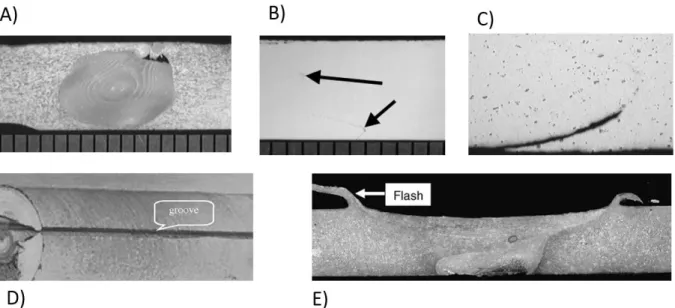
Figure 2.10 - FSW deffects: A) Void; B) Joint line remnant; C) Root flaw; D) Surface grove; E) Excessive flash ... 22
Figure 3.1 - FW-28 ESAB SuperStirTM Friction Stir Welding machine. ... 28
Figure 3.2 - FW-36 AWEA LP 4025Z Friction Stir Welding machine. ... 29
Figure 3.3 - FSW Tools used for the 3 to 5 mm thickness combination. ... 30
Figure 3.4 - FSW Tools used for the 2 to 2.5 mm thickness combination . ... 30
Figure 3.5 - Fixturing system (Courtesy of TWI,Ltd). ... 31
Figure 3.6 - Tilting system used on the FW-28 ESAB SuperStirTM . ... 32
Figure 3.7 - Tilting system developed for the FW-36 AWEA LP 4025Z . ... 32
Figure 3.8 - Stages of the pre-weld procedure: ... 33
Figure 3.9 - Schematic drawing of the weld sample production... 35
Figure 3.10 - Welding setup for the 3 to 5 mm thickness combination. ... 35
Figure 3.11 - Welding setup for the 2 to 2.5 mm thickness combination. ... 35
Figure 3.12 - Sample extraction plan. ... 36
Figure 3.13 - Schematic drawing of the microhardness indentation lines for the 3 to 5 mm . ... 37
Figure 3.14 - Schematic drawing of the microhardness indentation lines for the 2 to 2.5 mm . ... 37
Figure 3.15 - Schematic drawing of a wrap-around guided bend test machine [Site TWI] ... 38
Figure 4.1 - Base material macrograph perpendicular to the rolling direction: A) 5 mm and B) 3 mm. 43 Figure 4.2 - Cross section macrograph of sample W5 (𝑣 = 600 mm/min; 𝜔 = 1000 rev/min) with detailed micrographs ... 43
Figure 4.3 - Cross section macrograph of sample W7 (𝑣 = 480 mm/min; 𝜔 = 800 rev/min) with detailed micrographs ... 44
Figure 4.4 - Cross section macrograph of sample W8 (𝑣 = 640 mm/min; 𝜔 = 800 rev/min) with detailed micrographs ... 44
Figure 4.5 - Cross section macrograph of sample W11 (𝑣 = 720 mm/min; 𝜔 = 1200 rev/min) with detailed micrographs ... 44
Figure 4.6 - Cross section macrograph of sample W14 (𝑣 = 700 mm/min; 𝜔 = 1000 rev/min) with detailed micrographs ... 45
Figure 4.7 - Cross section macrograph of sample W15 (𝑣 = 560 mm/min; 𝜔 = 800 rev/min) with detailed micrographs ... 45
Figure 4.8 - Cross section macrograph of sample W17 (𝑣 = 500 mm/min; 𝜔 = 1000 rev/min) with detailed micrographs ... 45
Figure 4.9 - Cross section macrograph of sample W18 (𝑣 = 600 mm/min; 𝜔 = 1200 rev/min) with detailed micrographs ... 46
Figure 4.10 - Cross section macrograph of sample W19 (𝑣 = 400 mm/min; 𝜔 = 800 rev/min) with detailed micrographs ... 46
Figure 4.11 - Cross section macrograph of sample W14 (𝑣 = 700 mm/min; 𝜔 = 1000 rev/min) with EBSD mapping regions . ... 47
xviii
List of Tables
Abbreviations
AA - Aluminium alloy
APR - Tool advance per revolutions AS - Advancing side
BIW - Body in white BM - Base Material CCW - Counterclockwise CW - Clockwise
EBSD - Electron backscatter diffraction FSW - Friction stir welding
HAZ - Heat affected zone HFQ - Hot form quench IPF - Inverse Pole Figure IQI - Image quality indicator MIG - Metal inert gas RD - Rolling direction RS - Retreating side
TEM - Transmission electron microscopy TIG - Tungsten inert gas
TMAZ - Thermomechanically affected zone TWBs - Tailor welded blanks
TWI - The welding institute YAG - Yttrium aluminium garnet
Symbols
rev/min - Revolutions per minute 𝐹𝑟 - Tool feed per revolution [mm/rev]
Chapter 1 -
Introduction
1.1
Motivation
Climate changes as a result of human activity might be the most important challenge for society in the twenty-first century. These environmental concerns have forced governments to impose regulations to try to revert the trend. In 2009, a new EU regulation on CO2 emission was issued which committed European car manufacturers to cut the average CO2 emissions for new cars from 130 in 2015 to 95 g/km by 2020. This compelled the automotive manufacturers to research and develop new technologies to reduce fuel consumption and CO2 emissions to meet new regulations while delivering improved fuel economy for their customers. Vehicle light-weighting has been identified as one of the most effective ways to address this challenge.
Tailor welded blanks (TWBs) are semi-finished parts typically produced by joining sheets with different thicknesses that are subjected to forming processes like drawing or stamping. TWBs can also be produced by joining dissimilar alloys or materials with different properties and surface coatings. Its use in the automotive industry in the last decade has increased significantly as a method of minimizing part weight without compromising the vehicle’s structural integrity and crashworthiness and also improving its performance and functionality. Amongst the main advantages of using TWBs, manufacturers are interested in the reduction of vehicle weight and gross raw material costs as well as the ability to tailor the component to meet the functional requirements more efficiently. The use of structural aluminium alloys for the production of TWBs is a good alternative to the conventional high strength steel alloys due to higher strength to density ratio of aluminium and good corrosion resistance, increasing weight savings per part.
Fusion welding of aluminium alloys can involve numerous challenges in some applications. Hot cracking, porosity, loss of alloying elements, grain boundary melting in the HAZ and thermal distortions are some of the main problems that make conventional fusion welding processes of aluminium an unattractive solution. The inherent properties of aluminium like low melting temperature, surface oxide formation, high reflectivity, high thermal conductivity and low surface tension when in a molten state also contribute to other flaws. Laser welding has been developed as a potential solution but the cost of implementing the technology often limits its application and does not solve the problems mentioned.
Chapter 1 – Introduction
2
1.2
Objectives
The present thesis was developed within the framework of a 3 year project called “LightBlank – Make It
Lighter with Less” funded by the Innovate UK funding body. The aim of this project is to develop and
fully implement the manufacturing route for the next generation of lighter aluminium alloy sheet metal panels by combining FSW with a novel forming technology called Heat treatment Forming and in-die Quenching (HFQ). The “LightBlank” project envisages the development of the HFQ/FSW manufacturing route mainly with a focus on the auto, rail and aerospace applications.
Within this broad topic, the present thesis focused on developing a FSW procedure to join TWBs made from: AA 6082-T6, combining sheets with a thickness of 2 to 2.5 mm and 3 to 5 mm. The main objectives of this study were:
1. To design and test FSW tools for the two case studies under consideration.
2. To design and manufacture panel fixturing systems that allow to demonstrate various approaches and thicknesses.
3. To investigate the effect of process parameters on joint quality through metallographic analysis and mechanical testing.
4. To determine the set of parameters for each addressed thickness combination that produced the joint with the best mechanical properties.
1.3
Structure
The present thesis was structured as follows:
Chapter 2 provides an overview of the state of the art, summarizing the most relevant findings and breakthroughs reported in literature as far as FSW is concerned. This chapter aims to establish both a theoretical basis and a framework for result analysis and discussion throughout the present thesis. Chapter 3 depicts the experimental methodology and characterization techniques adopted. A brief description of the base materials is included, as well as, the characterization of the welding equipment, tool design and clamping system developed. The tested range of process parameters is presented. Finally, the techniques used to perform metallographic analysis and mechanical testing are described. Chapter 4 reports discusses the results achieved. This chapter was divided into two main sections, addressing the results obtained for each thickness combination separately.
Main conclusions are presented in Chapter 5.
Chapter 2 -
Literature review
2.1
Tailor welded blanks
Tailored blanks are a collective of semi-finished sheet products that are optimized for the forming process or the final application [1]. Based on their manufacturing process, tailored blanks are divided into four subgroups as shown in Figure 2.1.
Figure 2.1 - Tailored Blanks schematic chart
Patchwork blanks works by reinforcing the main sheet by adding one or more blanks called “patch”. The patch is joined to the main blank prior to forming in an overlap configuration, using welding processes such as resistance spot welding and laser welding. The main disadvantage for this solution is associated with the high stress concentration on the weld joints, during subsequent forming operations and in service [1].
Tailor rolled blanks are produced by adjusting the rolling gap during the rolling process. This allows to create a continuous transition between the thickness changes. The thickness transition can be performed along the longitudinal direction by adjusting the gap between the rollers and along the latitudinal direction by using thin discs to gradually reduce the thickness. Main advantages include better surface quality and a wide range of possible thickness transitions [1].
Chapter 2 – Literature review
6
Tailor welded blanks (TWBs) are semi-finished parts that consist of at least two single sheets which are characterized by different thicknesses, materials, coatings or material properties. These sheets are welded together prior to the forming process that brings the assembly to its final structural shape. Tailor made blanks use the same principle as TWBs but uses other joining methods than welding, e.g. adhesive bonding [1, 2]. This manufacturing solution allows engineers to make optimal use of the different mechanical properties of the blank material by applying the suitable material at the location where it is necessary and to develop more efficient component designs that reduce the weight of the component and the raw material used for production [3, 4]. In industry sectors where weight saving is a priority, such as automotive, rail and aerospace manufacturers, this solution has been adopted to reduce the vehicle kerb weight, reducing its energy consumption without compromising its performance or crashworthiness [5].
The concept of TWBs was patented in the USA in 1968 by the Budd Company, an automotive parts manufacturer. In Europe, the first automotive application for TWBs was introduced by the Swedish automotive manufacturer Volvo in 1979. TWBs were produced by resistance mash seam welding and later by induction butt-welding process to enhance the design possibilities and the efficiency of production [6]. In 1983, Thyssen Stahl partnered with Audi to produce an oversized galvanized floor panels for the Audi 100 using laser welding. The first Japanese car manufacturer to use TWBs technology in their designs was Toyota to produce sunroof pressings using laser welding in 1986. In the USA, General motors was an early user and in 1993 acquired a line for producing four- and five piece body sides. Since then, the use of TWBs in the automotive sector has increased significantly as a solution to satisfy the demand for more efficient vehicles. In 1998, TWI started a study on aluminium tailored welded blanks for door panels and demonstrated new concepts for FSW drive shafts and space frames for BMW, Chrysler, EWI, Ford, General Motors Rover, Tower automotive and Volvo [7]. In 2000 the European market exceeded 50 million TWBs produced followed by the USA and Japanese market with a production of 30 million TWBs [8]. Current production rates worldwide are estimated to be between 200 and 250 million laser welded blanks per year [5].
2.1.1
Applications
Figure 2.2 - Automotive applications for TWBs [1].
2.1.2
Production processes:
TWBs production comprises of three major stages:
Blanking - In this stage, coiled sheet material is de-coiled, straightened and cut into shapes suited for forming. This equipment can be integrated in the forming equipment into a continuous process line.
Welding - The blanks are joined together using a fusion or friction welding process. Forming - The joined blanks are then formed to the final configuration of the part.
Chapter 2 – Literature review
8
Figure 2.3 - Comparison between the conventional process and TWBs process for the production of formed components [5].
2.1.3
Strengths and weaknesses of TWBs technology
The main advantage of using TWBs technology is the reduction of the component weight which will lead to a reduction in the final assembly, in this case the vehicle. This is achieved by allocating the correct amount of material where it is required, eliminating the need to over design and reinforce the component. The Ultralight Steel Auto Body (ULSAB) was the first lightweight steel body project from 1994 to 1998 with the purpose of reducing the weight of midsized four-door sedans using new manufacturing methods such as TWBs among others. A weight reduction of 25% compared with the benchmark cars was achieved [12]. A significant cost saving by reducing the manufacturing costs and improve raw material usage is also one of the advantages of TWBs technology, as mentioned in the previous section [5]. Improved crashworthiness and part stiffness can be obtained. By allocating the right amount of material where is required, engineers can design each component to meet the required loading and resistance standards without overdesigning the component. As was described in the previous section, the dimensional accuracy and consistency is improved by welding the blanks together prior to the forming stage [5].
As part of every solution there are trade-offs with several obstacles to overcome when implementing TWBs.
forming stage if the strain direction is transverse to the weld line, concentrating the material deformation in the thinner/weaker material. This causes premature failure due to excessive strain and potential elongation reductions in the HAZ. Weld line movement also limits the possibilities for the automotive designer to position the material properties in the stamping where desired [5].
2.1.4
Joining processes
The structural integrity of the tailor welded blank is entirely dependent on the integrity of the joint between the two materials. Nowadays, laser and electron beam welding are the most frequently used fusion welding process for production of TWBs due to high welding speeds and small HAZ which contribute for a smaller impact on the material properties. Due to the increasing demand for joining materials that are not easily welded by fusion processes, FSW has become an attractive solution and one of the most used processes for the production of TWBs. However other processes such as tungsten inert gas (TIG), metal inert gas (MIG), resistance spot and mash seam welding have also been used for joining TWBs [13]. Historically, European automakers seem to prefer solid state welding while the Japanese and United States automakers use laser welding more frequently [5].
Mash seam welding was one of the first methods used for the production of TWBs, as described previously, which is gradually becoming obsolete in the automotive industry due to the high productivity and microstructural qualities of other processes. However, the joints from this process are made at lower temperatures compared to laser which provides better formability to the blanks. Resistance spot welding is widely applied in automotive industry and is a process with high productivity. This process is suitable for joining automotive structural members and for production of TWBs by conventional production methods as described in Figure 2.3 since it produces a non-continuous joint. However this is not a suitable joint for subsequent forming and is a prone site for corrosion due to the coating removal during weld. Arc welding processes, such as TIG and MIG, are quite popular in industry for being flexible processes, readily available, easily adaptable to robotic automation and the production of low cost welds. Yet this process is prone to catastrophically defects such as porosity, lack of fusion, undercutting and material inclusions in the weld bead. [5, 14].
Chapter 2 – Literature review
10
which affects the formability of the TWBs. Common defects from fusion joining processes such as hot cracking, porosity and grain boundary melting in the HAZ also arise from laser welding. [5, 14-16]. FSW is a solid state joining process that will be addressed later in this thesis.
2.1.5
Lightweight materials to produce TWBs:
In any product, the greatest weight reduction is achieved by a decrease in density of the used materials. That said, the use of lightweight materials in the transport industry has increased due to government regulations, consumer demand and environmental concerns. The term Lightweight materials has traditionally been given to both aluminium and magnesium since they are frequently used to reduce the weight of component and structures. Titanium and beryllium are also lightweight materials but its use is limited to specific applications such as aerospace. These metals have a considerably lower density compared to steel, which is still the predominantly used metal for the production of automotive body parts and structural members [17, 18].
Besides the lower density, aluminium has interesting properties for the transport industry such as superior corrosion resistance due to the presence of surface oxides (Al2O3), natural and chemical inertness, flexibility both in design and machining, high fracture toughness and energy absorption capacity. In addition to these properties, aluminium also has high thermal and electrical conductivity, emissivity, cryogenic toughness and fatigue strength. Aluminium is also highly recyclable and the remelting of scrap aluminium requires only 5% of the energy needed to extract the same weight of primary metal from its ore bauxite. Aluminium alloys are widely present in our day-to-day life as thin foils, beverage cans, structural members in public transport systems, aircraft parts among others [13, 18].
Chapter 2 – Literature review
12
2.2
Friction Stir Welding
Friction stir welding (FSW) is a solid-state joining process that was invented and patented at The Welding Institute (TWI, Ltd) in 1991 by Wayne Thomas [20] and represents a significant breakthrough in the metal joining technology by producing high integrity joints in materials that are difficult or even deemed non-weldable by conventional fusion joining processes, particularly the 2XXX and 7XXX series aluminium alloys. Since its invention and rapid adoption it is fast becoming the technique of choice for manufacturing lightweight transport vehiclesand other structures where high strength, low weight, good toughness and excellent fatigue life are required [21].
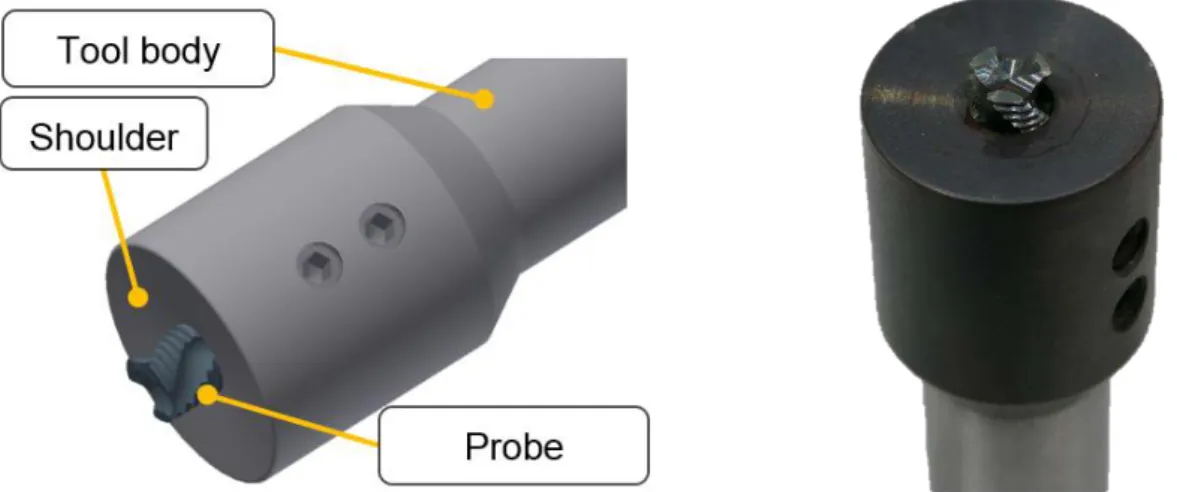
The functioning principle of FSW consists of a non-consumable rotating tool, composed of a large cylindrical body called shoulder and a profiled pin or probe that is plunged into the weld joint and traversed at a constant rate along the joint between two clamped pieces of butted material. This process includes four phases [22]:
1. The plunging phase, where the rotating tool is thrusted onto the workpiece material by a
constant axial force enabling the generation of heat by friction and adiabatic shear between the tool and the work piece causing the workpiece material to soften, plasticize and lose its strength. This phase ends with the contact of the rotating shoulder with the work material surface.
2. The dwelling phase, where the tool is allowed to dwell for a period of time so that additional heat
is generated in the workpiece to soften the material and induce severe material deformation which will produce the amalgamated joint.
3. The welding phase, where the tool is traversed along the welding line, subjecting the soft
plasticized material to displacement, extrusion and shearing mechanisms under cyclic heat generation along the welding line and finally consolidating welding nugget in the trailing side by forging.
4. The exit phase, where the rotating tool is removed from the workpiece.
Figure 2.4 – Schematic representation FSW process phases. [22]
FSW is considered as a “green” technology due to the energy efficiency and the absence of cover gas or flux as well as filler material which allows any aluminium alloy to be join without the concern for the compatibility of compositions. Further benefits of FSW are summarized in Table 2.1.
Table 2.1 - Key benefits of FSW [21, 23].
Metallurgical benefits Economic benefits Environmental benefits
Solid-state joining process Minimal edge
preparation required No shielding gas required Low distortion and
shrinkage of workpiece
Only 2,5% of the energy needed for laser welding
No surface cleaning required
Good dimensional stability and repeatability
Machine tool
technology, simple to use with good appearance
Eliminate grinding wastes
No loss of alloying
elements Suitable for automation
Eliminate solvents required for degreasing
Excellent metallurgical properties in the joint area
Continuous - unlimited length
fine microstructure (hot forged)
Improved materials use, allows reduction of weight
Absence of cracking, porosity or filler wire
Some tolerance to imperfect weld preparations Replace multiple parts
joined by fasteners Low residual tress levels
Chapter 2 – Literature review
14
FSW, like other processes, is not exempt from limitations and disadvantages. Current limitations of the FSW process are [23, 24]:
Backing anvil required (except bobbin stir); Low traverse speed;
Tool wear as a limiting factor in high-strength alloys
Application not as flexible as certain arc welding processes.
2.2.1
Processed zone
In a FSW joint, due to the solid-state nature of the process and the use of a mechanical tool, a highly characteristic and asymmetric microstructure is produced. Through the analysis of macrographs and micrographs, three distinct zones, based on microstructural characterization of grains and precipitates, can be identified: the nugget (stirred) zone, the thermo-mechanically affected zone (TMAZ) and the heat-affected zone (HAZ). The choosing of the process parameters, has a great influence in the microstructural evolution which determines the postweld mechanical properties [21]. Figure 2.5 shows a cross section of a FSW joint evidencing the distinct zones of the weld.
Figure 2.5 - Typical macrograph of a FSW joint [25].
advancing side are not symetrical, as seen on Figure 2.5. The advancing side has an extended recrystallized zone that terminates close to the surface of the weld bead and a sharp transition between the nugget zone and the TMAZ. The explanation for this phenomenon is that in this zone the plastic deformation is more intense due to a higher relative shear stress between the tool and the workpiece [21].
The thermo-mechanicaly affected zone (TMAZ) is a transition zone inherent to the FSW process between the base material and the nugget zone. Characterized by the severe deformation of the grain struture at high temperatures, the grains tend to elongate in an upward flowing pattern around the nugget zone on the retreating side. Due to insufficient deformation strain and lower temperatures than the ones experienced in the nugget zone, recrystallization in the TMAZ does not occur. Since the temperature of the TMAZ is very high, but lower than the temperature of the nugget, dissolution of some precipitates can be observed depending on the thermal cycle experienced by the TMAZ [21].
The heat-affected zone (HAZ) is the zone between the base material and the TMAZ. This region has a similar grain structure as the parent material, since there is no plastic deformation. However, the thermal cycle in this zone increases the size of the grain and can exert a significant effect on the precipitate structure for heat-treatable aluminium alloys resulting in the coarsening of the strengthening precipitates and the increase of the precipitate-free zone (PFZ) [21]. This change in the microstructure produces a region of reduced hardness with a minimum value at the interface between the TMAZ and the HAZ. Depending on the welding parameters, this minimum can be found closer or further from the weld nugget [30].
2.2.2
Process operating parameters
The main FSW process parameters that can be adjusted according to the workpiece material are [23]:
Tool geometry;
Tool rotational speed and direction of spindle; Tool welding speed along the joint line; Axial load;
Tilt angle (α);
Work angle (β) for dissimilar thicknesses;
Plunge speed and depth of probe in workpieces; Preheating or cooling the workpiece;
Clamping systems;
Control during plunge, dwell and weld periods: Force control (Fz ) versus position control; Weld pitch ratio;
Chapter 2 – Literature review
16
by Lakshminarayanan et al. [31], an attempt to determine the effect of the process parameter on tensile strength of FSW RDE-40 aluminium using the Taguchi method was performed. The results obtained indicated that the tool rotational speed has 41% contribution, traverse speed has 33% contribution and axial force has 21% contribution to tensile strength of welded joints.
The weld pitch ratio is empirically related to the heat input from the internal friction and interfacial energy. This allows to predict some effects and failures in the weld region. Depending on the value of the weld pitch obtained in Equation 2.1, the weld condition can be considered hot, intermediate or cold. For aluminium alloys a value of 4 is usually considered an intermediate value. Higher weld pitch values means that the weld would be produced in a hot condition while lower weld pitch values means that the weld would be performed in a cold condition. Hot welds are characterized by high rotation speeds and low welding speeds which leads to a larger HAZ and a smaller TMAZ. The opposite is true for cold conditions.
𝑊𝑒𝑙𝑑 𝑝𝑖𝑡𝑐ℎ 𝑟𝑎𝑡𝑖𝑜 (rev/mm) =𝑣 (mm/min)𝜔 (rev/min) [2.1]
Heat generation rate and the stirring and mixing of the material around the pin are greatly influenced by the tool rotation speed. In general, high rotation speeds lead to more heat generated and thus greater degree of plasticisation of the metal. The heat generated is only proportional to the rotation speed up until a certain point at which the material over-softens and friction couple reduces [21, 28].
The welding speed has great influence on the exposure time to higher temperatures and material viscoplasticity. Higher welding speeds reduces the heat input, peak temperature and exposure time at high temperatures, which produces a fine grain structure with good tensile properties as showed by Dong et al. [26]. However, by increasing the welding speed the heat build-up around the tool is reduced, as is the amount of plasticisation that occurs ahead of the tool. This could lead to tool failure due to high bending forces.
Axial force affects the quality of the weld by controlling the heat generation and the forging pressure. High axial forces causes to overheating and thinning of the joint which leads to grain growth and coarsening during cooling [28]. It also results in excessive plunging in the workpiece creating excessive flash [21]. Low axial forces leads to insufficient heating and low forging forces which causes the creation of voids [28].
A suitable tilt of the tool during FSW promotes the contact between the shoulder and the stirred material from the pin, which results in more efficient stirring and forging on the trailing side of the weld [21]. This is often performed in tools with simple flat or concave shoulders to reduce the traverse force and to assist the consolidation of the weld.
the workpiece creating excessive flash, local thinning of the welded plates, material from the backing bar incorporated in the weld and damage to the backing bar [21].
Tool geometry influences heat generation, plastic flow of the material, the required power for the FSW, the welding speed and the uniformity of the welded joint. The tool consists on a shoulder that generates most of the heat and confines the plasticized material and a pin or probe that governs the material stirring and mixing flow [21, 28]. Also the swept rate is a critical FSW tool design parameter, which is defined as the ratio between the volume swept by the pin during rotation and the volume of the pin. Higher swept rate leads to the reduction of voids and the disruption of surface oxides [32].
2.2.3
FSW Tools
FSW tools serve two main purposes: localized heating and induce material flow contained beneath the shoulder. Due to various geometrical configurations of the tools, the material movement can be extremely complex and different from one tool to another [32].
The most popular configurations of FSW tools are [32]:
Fixed pin: A tool that has a fixed pin height. It is suitable for production of welds with a constant pin height.
Adjustable pin: Consisting on a separate shoulder and pin, the pin height can be adjusted according to the workpiece thickness and can be replaced if broken. Also, the shoulder and pin can be manufactured from different materials.
Bobbin tool: The bobbin tool consists on a top shoulder, pin and bottom shoulder requiring no backing anvil. Multiple thicknesses can be welded due to the adjustable height of the pin but can only be performed perpendicular to the workpiece.
Figure 2.6 shows the types of FSW tools summarized above.
Chapter 2 – Literature review
18
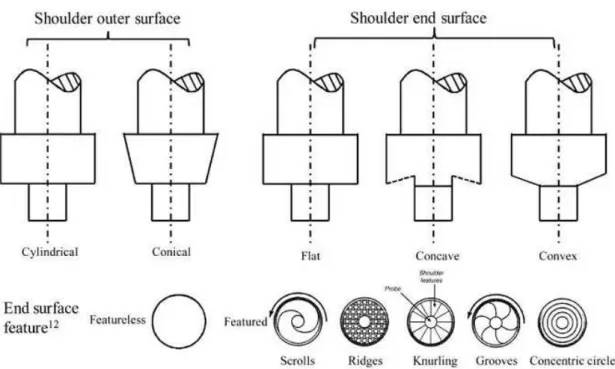
Shoulders are design to generate friction heat, produce forging pressure for the weld consolidation and constrain the heated material beneath it. Shoulders can be divided in three areas [32]:
The outer surface: Cylindrical shape is the most commonly used but a conical shape can also be used.
The end surface: The flat shoulder in the simplest but doesn’t contain the material beneath the shoulder so effectively, which leads to the production of excessive flash. The convex shoulder prevents the escape of material from beneath the shoulder and has gain popularity because of it. This also leads to an increase of the forging pressure that promotes material stirring and improve the integrity of the nugget. The convex profile has the advantage of maintaining contact during the weld at any location accommodating differences in flatness or thickness between the workpieces.
The end surface feature: The end surface features can improve material friction, shear, and deformation which leads to a better weld quality. Scroll shoulders consist of a flat end surface with a spiral channel from the edge towards the centre and are the most common since the channels promote the material flow and eliminates the need to tilt the tool.
Figure 2.7 shows the various shoulders of FSW tools summarized above.
Figure 2.7 - Shouder shapes and features [32]
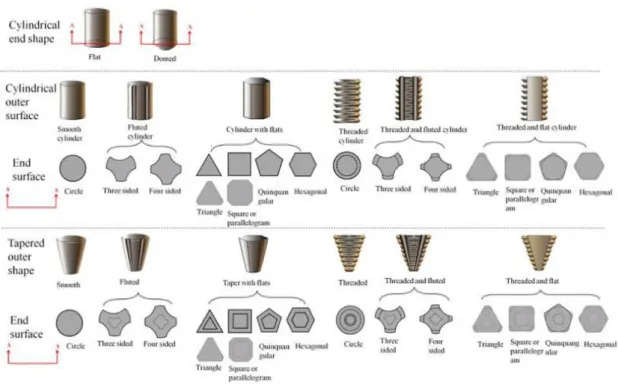
The pin is responsible for the deformational and frictional heating as well as the disruption of the contacting surfaces of the workpiece. The pin can also be divided three areas [32]:
The outer surface: The most common outer surface shape is the cylindrical for plates up to 12 mm thick. Tapered pins generate more frictional heat and increases the plastic deformation of the material due to the larger contact area between the pin and the workpiece. It also increases the forging pressure in the weld zone which enhances the stirring of the material and the nugget integrity.
The outer surface feature: Among the various features such as threads, flats and flutes, the threadless pins are chosen for FSW of high strength or abrasive alloys since threads would be easily worn. Hasan et al. [33] studied the effect of unworn and worn tools in the flow behaviour of FSW on AA 7020. They observed that the nugget zone is 2.5 mm smaller using a worn tool but also a lower mixing action potentially leading to defective weld joints. Threaded pins are usually used for softer material due to the recirculation of the material around the tool before deposition. This promotes material stirring, void closure and oxide breakdown. Flats act like cutting edges, trapping the material and then releasing it behind the tool improving mixing and increase in temperature in the nugget area. Flutes function in a similar way.
Figure 2.8 shows the various pins of FSW tools summarized above.
Figure 2.8 - FSW tool pins [32]
Chapter 2 – Literature review
20
Figure 2.9 – (a) worlTM and (b) MX triflutetm tool [32]
Table 2.2 - FSW tools designed by TWI for butt joint [32]
Table 2.3 - FSW tools designed by TWI for lap joint [32]
The energy input for the FSW process and the forging pressure strongly depend on the radius of the shoulder [32]. Malarvizhi et al. [34] studied the Influences of tool shoulder diameter to plate thickness
2.2.4
Tool materials
The tool material depends on the workpiece material as well as the user’s experience and preferences. The ideal tool material should possess the following properties [32]:
High compressive yield strength at elevated temperatures;
Good strength, dimensional stability and creep resistance;
Good thermal fatigue strength and fracture toughness;
No harmful reaction with the workpiece material
Low thermal expansion coefficient between the pin and the shoulder (e.g. Polycrystalline cubic boron nitride (PCBN) coating as a thermal barrier between the shoulder and pin);
Good machinability;
Low cost;
Table 2.4 summarizes the characteristics of the materials used to manufacture FSW tools.
Table 2.4 - FSW tool materials [35]
2.2.5
Defects
Using FSW for the production of aluminium welded joints avoids the appearance of typical flaws produced in fusion welding processes. Nevertheless, FSW has its own characteristic flaws that appear when the operating conditions aren’t suitable or are pushed beyond their limits to achieve better productivity and improve joint properties [36].
Chapter 2 – Literature review
22
transition zones between the shoulder and the pin dominated deformation regions. An example of a void on the advancing side of the weld is shown in Figure 2.10-A [36].
The joint line remnant, sometimes called a lazy S, is a curving line sometimes visible in all or part of the weld when viewed in cross section. It is comprise of oxide particles from the original material surfaces, drawn into and distributed throughout the weld, during material flow around the tool. Small and dispersed particles have little to no influence on the weld strength. Machining the butting faces of the plates to reduce the quantity of oxide prior to welding and controlling the welding speed minimizes the probability of the appearance of this flaw. Figure 2.10-B presents a macrograph of a weld with this defect. [36]. Root flaws or lack of penetration appear due to poor mixing and stirring action of the pin. A shortened pin, an inadequate target depth or a poor alignment of the tool relative to the joint line produces insufficient plasticisation and a lack of flow of metal at the root of the weld leading to incomplete welding. Root flaws do not necessarily represent an absence of any bond, although a weaker bond is formed. In some cases this will be manifested as a weak bond, often referred to as “Kissing Bond”, where the material is in intimate contact but not completely joined. Nevertheless, this can be a potential source of fatigue cracks and a pathway for the onset of corrosion. Machining the weld root may be an effective measure to remove this defect [36]. Figure 2.10-C depicts a weld with a root flaw defect [37]
Groove flaws are usually formed by insufficient tool plunge which leads to poor mixing in the surface of the welded joint and low heat input. An example of a welded joint with a surface groove flaw is shown in Figure 2.10-D. [38].
Excessive material, extruded from under the tool shoulder during welding is referred to as flash. It is a result of high pressure at the weld tool combined with a high local temperature, producing excessive material flow that cannot be contained by the tool shoulder. A degree of flash at the start of the weld is quite usual as the tool most displace its own volume of material upon entry to the metal. An example of a welded joint with excessive flash is shown in Figure 2.10 E [38, 39].
2.2.6
Applications
The intense investigation around FSW, due to its results and possibilities, allowed the application of this process in various industries with special interest in the transportation industry [21, 40, 41].
In the aerospace business, issues like excessive weight and poor quality of joints, are major concerns for any aerospace company. High-strength aluminium alloys such as 2XXX and 7XXX series, are widely used in the aerospace industry. Using convectional fusion welding processes, these alloys are difficult to joint without the occurrence of hot cracking. The first application was in 1998, when NASA began developing FSW for the production of the space shuttle external tank. Due to its repeatability and reliability on joining lightweight alloys, FSW was viewed as a very attractive and more robust process than the previously used (variable polarity plasma arc) enabling a significant reduction of weight. With this success, it is anticipated that the next-generation of heavy-launch vehicles developed by NASA will include an extensive use of FSW. Other private companies such as United Launch Alliance (ULA) have adopted FSW for the manufacture of their own products. The use of FSW as an alternative to riveting has also gain acceptance, which allows the reduction of weight, parts and costs while improving joint strength [40]. More recently, Space Exploration Technologies Corporation (SpaceX) in Hawthorne, California (USA) uses FSW for the production of fuel tanks of their partially reusable launch vehicles Falcon 1 and Falcon 9 [7].
Eclipse Aviation, a private aviation company based in Albuquerque, New Mexico (USA) decided to use FSW process due to its high productivity compared to the traditional automated or manual riveting on the production of the Eclipse 500. This allowed a significant reduction of fasteners and stringers while improving the mechanical properties such as joint strength and fatigue life of the joint. Commercial aviation manufactures have also adopted or evaluated the use FSW on their models. Airbus models A340, A350 and A380 use FSW as replacement for rivets on the longitudinal fuselage. Embraer and Bombardier also tested the feasibility of FSW [40, 41]. Boing uses FSW to produce the toe nails for the cargo ramp of their C-17 model mad from AA 7050-T7451. A zero scrap rate had been reported in February 2006, after all the first produced components had successfully passed non-destructive inspection [7].
FSW has been used in the shipbuilding and offshore industry for the production of large aluminium panels, which are made from aluminium extrusions. The first commercial application of FSW was to manufacture hollow aluminium panels for deep freezing of fish on fishing boats in 1996 at Sapa in Finspång (Sweden). Minimal distortion and high repeatability made FSW an economic a reliable option. Sapa reported that more than 3000 km of friction stir welds had been produced by 2010. Pre-fabricated wide aluminium panels for high-speed ferry boats, cruise ships and patrol vessels have also been produced using FSW [5].
Chapter 2 – Literature review
24
processes. The improved quality of the joint, the wider gauge of thicknesses that are possible to weld and the elimination of pre-weld operations required for MIG such as pre-heating and grinding of intermediate steps led to significant economic benefits. Sapa in Finspång (Sweden) supplies all the major European train manufacturers such as Alstom, Bombardier, CAF and Siemens. For the upgrade of the Victoria line, London Underground ordered 376 Friction stir welded vehicles from Bombardier. Hitachi in Japan uses FSW to join aluminium extrusions to assemble in their double-skin design car. The exceptionally low distortion of the process is the main driver for its success [7].
FSW and its variants like Friction stir spot welding (FSSW) are becoming a widely implemented methods due to the possibilities in the reduction of the car’s body weight by producing aluminium tailored blanks. Companies like BMW, Daimler-Chrysler, Ford, Volvo, and Audi among others use FSW tailored blanks to produce structural components to reduce the weight of the vehicle and improve crashworthiness. The use of FSW led to an improvement in the dimensional accuracy of the assembly and a 30% increase in strength when compared to the conventional fusion processes [40]. FSW has also been used for the production of other automotive components such as suspension links and arms, wheels, trailers, doors and bonnets. With the increasing use of aluminium in this sector, FSW has become a more viable solution than other fusion based welding processes [7].
2.2.7 Feasibility of FSW to join TWBs
FSW was initially developed to join aluminium alloys. However, due to the increase research and development on this process the application of FSW to join other materials is growing and good results can be obtained on welds with dissimilar metals, metal alloys and thicknesses.
Regarding the joining of dissimilar materials and alloys, Chen and Nakata [42] performed lap joints of Al-Si alloy and pure titanium using FSW and achieved a successful joint with considerable mechanical properties. Scalpi et al [43] performed FSW on thin plates of AA 2024-T3, AA 6082-T6 and dissimilar joint with both alloys and produced weds with good mechanical properties and fatigue resistant. Kwon et al. [44] performed dissimilar FSW between magnesium and aluminium alloy plates with thicknesses of 2 mm. After microstructure analysis and tensile testing, they observed defect-free welds with tensile strengths of 66% of the aluminium alloy.
Manufacturing TWBs from lightweight materials using FSW can increase even further the weight saving on each produced component. Table 2.5 presents the economic and weight saving benefits by using high strength aluminium alloy TWBs for the production of door inners by comparing the weight of the standard component and the weight of a component using TWBs technology joined by FSW. This comparison reveals significant weight saving, reduction of gross material usage and improved cost competitiveness [48].
Table 2.5 - Fuel and CO2 emissions saving by using FS-TWBs
Front door inner example
Production rate: 600 000 parts/year Al-Assembly FS-TWBs
Gross weight 9.0 kg 7.4 kg
Net weight 6.8 kg 6.6 kg
Lost material (Scrap) 2.2 kg 0.8 kg
Gross weight saving per part --- 1.6 kg
Gross weight saving per year --- 960 tonne
Net weight saving per part --- 0.2 kg
Net weight saving per year --- 120 tonne Annual CO2 emissions reduction
assuming average mileage --- 384 800 kg CO2
Annual fuel saving --- 14 480 litres fuel
Staud et al. [49] compared the mechanical properties and formability of aluminium tailor welded blanks manufactured by laser welding and FSW. They carried out tensile tests and cup deep drawing tests on the base materials and the tailored blank with loading direction perpendicular to the weld line. FSW turned out to be slightly better for welding of aluminium blanks. However, the obtained results show reduced formability due to the loss of elongation.
2.2.8
Conclusion
TWBs are blanks that consist of two or more sheets of different materials, alloys, thicknesses or coatings that are joined together as an end product or prior to a forming process. This technology on its own already has several economic advantages for the producer such as the reduction of forming operations and the cost of acquiring and maintaining several dies as well as better dimensional accuracy and more efficient design of the final component. The production of lightweight components for the transport industry using TWBs technology has become one of the best solution to address the vehicle weight reduction challenge.
Chapter 2 – Literature review
26
Chapter 3 -
Experimental Setup
In this chapter, the experimental methodology and characterization techniques used to assess the quality of the welds are addressed. The base material, plate preparation and equipment used for both welding and testing is described.
3.1
Base material
The base material used on the FSW trials was AA 6082-T6 supplied in rolled rectangular plate form with approximate dimensions of 600 x 150 mm and thicknesses of 2, 2.5, 3 and 5 mm. This is a heat-treatable alloy with the main alloying elements Si, Mg and Mn and the T6 condition denotes solution heat treatment, quenching and artificial ageing. This alloy has the highest strength of the 6XXX series and it has been replacing the widely used AA 6061 in structural applications [50, 51]. It is also an alloy with excellent corrosion resistance, machinability and forming which makes it ideal for structural automotive components.
The following tables show the chemical composition and mechanical properties of this alloy that were obtained, respectively, from material certificates provided by the supplier and mechanical testing performed at TWI, Ltd. To evaluate the effect of the rolling process in the material hardness, Vickers hardness was measured under a load of 2 N along and perpendicular to the rolling directions.
Table 3.1 – Chemical composition of the base material.
Chemical composition ( wt. % )
Si Mg Mn Fe Cr Zn Cu Ti Min. 0.7 0.6 0.4 - - - - -
Max. 1.3 1.2 1.0 0.5 0.25 0.2 0.1 0.1
Table 3.2 – Mechanical properties of the base material.
Mechanical properties Thickness (mm) σ0.2% (MPa) σUTS (MPa) Elongation at Break (%) 2 282 334 16 2.5 274 331 17 3 305 343 14
5 298 346 10
Table 3.3 – Base material hardness measurement for different sections.
Hardness measurement Thickness
(mm)
HV 0.2 kg Section X.1
HV 0.2 kg Section X.2
HV 0.2 kg Section X.3
2 110 ± 3 109 ± 2 108 ± 1
2.5 110 ± 1 106 ± 2 110 ± 2
3 114 ± 2 116 ± 3 113 ± 2
Chapter 3 – Experimental setup
28
3.2
FSW Equipment
The welds were performed using TWI’s numeric control friction stir welding machines. Due to availability reasons, two different FSW machines were used to perform the parameter optimization on each thickness combination.
The welding cycle on both machines can be controlled by tool vertical position control or by tool force control. During the welding trials, both machines were set to perform each weld segment in tool vertical position control mode in order to maintain a constant distance from the backing bar and thus preventing the formation of root defects such as lack of penetration. Both machines were instrumented to monitor process parameters, such as: force, machine spindle torque, rotation and traversed speed. This information was monitored in real time and recorded with a dedicated data acquisition system.
3.2.1 FW-28 ESAB SuperStir
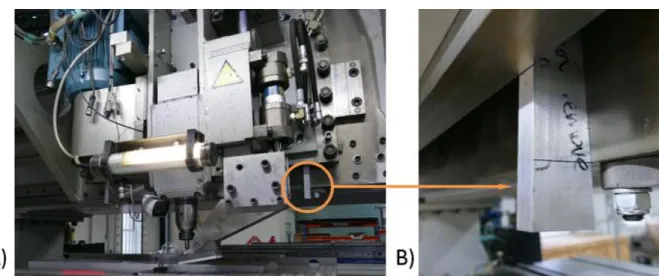
TMThe FW-28 ESAB SuperStirTM is a gantry type FSW welding machine, meaning that this machine has a fixed work table and a travelling welding head with (X, Y, Z) axis movement. The translation of the gantry system on the (X, Y) axis is entrusted to a pair of gear motors in a pinion-rack system while the height of the spindle is adjusted by a hydraulic cylinder actuator. This machine has both high and low rotation speed welding heads, which are fixed on the same gantry as shown in Figure 3.1.The tilt angle (α) can be manually set from 0 to 5º, by rotating the welding head along the X rotation axis. This machine was used for the first tests in the 3 to 5 mm thick plate combination
3.2.2 FW-36 AWEA LP 4025Z
The FW-36 AWEA LP 4025Z FSW machine shown in Figure 3.2 is a bridge type machine meaning that the machine’s welding head is restricted to (Y, Z) axis movement due to the fixed gantry. The work table travels in the X direction by means of built-in guides and servomotors, while the welding head travels, in the Y and Z axis by means of high rigidity roller type linear guides. The tilt angle (α) can be manually set from 0 to 90º, by rotating the welding head along the X rotation axis. This machine was used for the 2 to 2.5 m thickness combination.
Figure 3.2 - FW-36 AWEA LP 4025Z Friction Stir Welding machine (Courtesy of TWI,Ltd).
3.3
Tool materials and design
For both thickness combinations, a separate part tool with an adjustable FSW probe was used. Based on results obtained from previous experience at TWI, a 7 ⁰ concave shoulder with a cylindrical TriFlutetm probe was selected for the thicker plates. Due to the good results observed, the tool design was resized for the thinner plates keeping the same features. Figure 3.3 and Figure 3.4 display, respectively, the tools used in this work. Tool drawings and dimensions are presented, respectively, in Appendix A1 and A2 and Table 3.4.
Chapter 3 – Experimental setup
30
The FSW tool probes were manufactured in a cobalt-nickel-chromium aerospace fastener alloy, MP159, produced by Timken Latrobe Steel, in the USA. This alloy is increasingly used for FSW probes due to its high strength and moderate ductility at temperatures of approximately 500 ºC.
Figure 3.3 - FSW Tools used for the 3 to 5 mm thickness combination (Courtesy of TWI,Ltd).
Figure 3.4 - FSW Tools used for the 2 to 2.5 mm thickness combination (Courtesy of TWI,Ltd).
Table 3.4 – FSW Tool geometries for the adressed thickness combinations.
2 to 2.5 mm 3 to 5 mm
Shoulder design & Dimension
Ø 15 mm concave
shoulder Ø 28 mm concave shoulder.
Probe design & Dimension
Ø 5 mm cylindrical
3.4
Fixturing system
The fixturing system used on both case studies consists of two grid type vacuum chucks, a steel base plate with a backing bar at the centre, two lateral bars on each side and a backstop. The two grid type vacuum chucks are bolted to the steel base with the backing bar between them. Vertical movement from the welding plates is constrained by the action of the vacuum chucks. Two steel bars are bolted lengthwise to the side of the vacuum chucks. Lateral movement constrain is provided by 9 screws on each side (Figure 3.5-A) that press the aluminium plates to ensure an evenly distributed pressure along the welding plates. The backstop is placed on the vacuum chucks by the end of the welding plates, counteracting the lateral force from the tool and preventing the welding plates to slip. The fixturing system is then bolted to the worktable as shown in Figure 3.5.
Figure 3.5 – Fixturing system (Courtesy of TWI,Ltd).
3.5
Tilting systems
Chapter 3 – Experimental setup
32
Figure 3.6 – Tilting system used on the FW-28 ESAB SuperStirTM A) general view and B) detail of previous (Courtesy of TWI,Ltd).
TWBs in thinner plates (2 and 2.5 mm), as previously mentioned, were produced using the FW-36 AWEA LP 4025Z welding machine and in this case, a new solution for tilting was proposed. The concept was the same as for the previous, but instead of tilting the welding head, the angle was achieved by an adjustable device that was mounted between the welding bed and the fixturing system. This device will be referred to as the “Tilting Table”.
For this system the fundamental requirements were:
Enable a range of different angles;
Withstand the loads associated with the FSW process;
Compatibility with existing machine and table;
Support the most stressed area (backing bar region);
Absorb system vibrations while maintaining a set angle.
A prototype was developed and manufactured. The manufacturing drawings of the tilting table are presented in Appendix A3. Figure 3.7 shows the tilting table as built (a) and combined with the fixturing system developed (b).
![Figure 2.3 - Comparison between the conventional process and TWBs process for the production of formed components [5]](https://thumb-eu.123doks.com/thumbv2/123dok_br/16563346.737685/36.892.186.698.108.473/figure-comparison-conventional-process-process-production-formed-components.webp)