AGENDA-SETTING AND FRAMING IN FOREIGN POLICY: THE CASE OF RUSSIAN AND UKRAINIAN TELEVISED COVERAGE OF THE CRIMEA CASE
Yuliia Krutikova
[email protected] Holder of a Bachelor and Master Degrees in International Relations, specializing in EuropeanStudies (University of Coimbra, Portugal). She carried out professional internships at the Embassy of Portugal in Bulgaria, at the Navigator Company, and at the National System Limited Inter TV in Kiev.
Maria Raquel Freire
[email protected] Researcher at the Centre for Social Studies and Associate Professor of International Relations atthe School of Economics (University of Coimbra, Portugal). She holds a Jean Monnet Chair, received her PhD in International Relations from the University of Kent. She is currently director of the PhD Programme in International Politics and Conflict Resolution, CES|FEUC. She is also a member of the Governing Board of the European International Studies Association. Her research interests focus on peace studies, peacekeeping and peacebuilding, foreign policy, international security, Russia and the post-Soviet space. Her work has been published in peer-reviewed journals such as European Politics and Society, European Review of International Studies, Journal of Balkan and Near Eastern Studies, East European Politics, European Security, International Peacekeeping, International Politics, Asian Perspective, Global Society, La Revue Internationale et Stratégique, Journal of Conflict, Security and Development, Relações Internacionais.
Sofia José Santos
[email protected] Centre for Social Studies (University of Coimbra, Portugal). She is an associate researcher atOBSERVARE (Universidade Autónoma de Lisboa). She holds a postgraduate diploma in Communication Sciences from ISCTE-IUL, a PhD. and Master Degree in International Politics and Conflict Resolution from the Faculty of Economics of the University of Coimbra and a Bachelor degree in International Relations. Previously, she was a postdoctoral researcher at OBSERVARE/ UAL and at CES and researcher and coordinator of media and communication at Promundo-Europa. She was part of the research team of the Flemish Peace Institute while a visiting scholar
and she was visiting fellow at the Universiteit Utrecht. She was co-coordinator and co-editor of the Bulletin P@x, a periodical publication of the Group of Studies for Peace of the NHUMEP. Her current research interests are centred on issues related to the media and masculinities; digital rights and contentious politics; media literacy; international politics and media representations.
Abstract
This article seeks to explore the role Russian and Ukrainian conventional media played as agenda-setters and producers of subjective framings within the context of the Crimean crisis, exploring at the same time the relationship between state and media and the impact of media representations on national public opinions. The analysis shows that agenda-setting and framing at the level of states’ policies have a fundamental role in decision-shaping and perception-building, highlighting that the manipulation of information through narrative-construction is a powerful tool at the service of politics. This study contributes to validate the idea that media can be perceived as key influencers of the public agenda as they emerge as the most relevant agents in mediatising politics, becoming hence a functional gatekeeper that might either facilitate the official discourse or instead obstruct it.
Keywords
Agenda-setting; framing; foreign policy; Russia; Crimea How to cite this article
Kutikova, Y; Freire, MR; Santos, SJ (2019). "Agenda-setting and framing in foreign policy: The case of Russian and Ukrainian televised coverage of the Crimea Case". JANUS.NET e-journal of International Relations, Vol. 10, N.º 1, May-October 2019. Consulted [online] on the date of the last visit, https://doi.org/10.26619/1647-7251.10.1.4
45
AGENDA-SETTING AND FRAMING IN FOREIGN POLICY: THE CASE OF RUSSIAN AND UKRAINIAN TELEVISED COVERAGE OF THE CRIMEA CASE
Yuliia Krutikova
Maria Raquel Freire
1Sofia José Santos
Introduction
In the context of both decision-making processes and foreign policy management, particularly at times of crisis, the media have a crucial role in the treatment and interpretation of information (Gilboa, 2002) as among the discursive actors society entails, the media are the most efficient in the dissemination of a specific narrative (Kuusik, 2010). Agenda-setting (Shaw, 1979; McCombs and Shaw, 1993; Traquina, 1995) and framing theories (Gofman, 1974) assist in explaining the power of media to determine the current agenda in every moment, i.e. the power to shape what should be discussed and what should be dismissed, as well as the power to validate a particular vision about an issue or an actor. Media are, hence, not just an information channel, but rather an active “communication network” (Naveh, 2002: 3) where specific understandings and representations of actors, intentions and events are (re)produced, either intentionally or unintentionally, affecting media’s coverage, decision-makers’ political decisions, and public opinion’s preferences.
While most studies point to the recurrent politicization of the media (Craig, 1976; Herman, 2003; Herman and Chomsky, 1988; Eilders, 2002; Kishan and Freedman, 2003), particularly in times of political crisis, fewer analyses look at how – from a
processual illustrative perspective2 – the process of mediatisation of politics takes place.
In this way, this article looks at how framing is conducted, i.e. how media-related choices are made and framed, and how they evolve. Using agenda-setting and framing applied to foreign policy as theoretical and analytical approaches, this article analyses the role of media in contexts of crisis through the study of the stiffening of relations between Russia and Ukraine from 2013 to 2015, with the Russian annexation/re-integration3 of the peninsula in March 2014 marking the height of tension. This study maps and critically analyses media discourse comparing the different readings and interpretations of the Crimean crisis as portrayed by Russian and Ukrainian televised media (TV). According to
1 Maria Raquel Freire holds a Jean Monnet Chair (574780-EPP-1-2016-1-PT-EPPJMO-CHAIR - EU External
Relations Towards the East), co-funded by the Erasmus+ programme of the European Union.
2 “Processual illustrative perspective” means highlighting specific processes by means of concrete examples. 3 The choice between “annexation” or “re-integration” of Crimea depends on specific interpretations of
political or mediatic actors. The wording sheds light on distinct narratives, intentions and course of events. The Russians use the word “re-integration”, framing the issue as Crimea’s right to “self-determination”; Ukrainians frame the issue as a violation of Ukrainian territorial integrity and sovereignty.
46
opinion polls from 2014, most of the Russian and Ukrainian population receive information mainly from traditional media (KIIS, 2014a; Levada Centre, 2014a).
Aiming to understand what image of the crisis was transmitted in these countries, this study analysed the news of the national television channels in Russia and Ukraine. This allows a better understanding about local coverage of the events, bringing additional information to the Western-based accounts that were privileged at the time. Moreover, most of the studies published on media coverage of the events in Ukraine focused on the use of social networks, leaving more traditional means, such as television, understudied (eg. Onuch, 2015a, 2015b; Surzhko-Harned and Zahuranec, 2017). For the analysis, a one-month time span – from February 24 to March 23, 2014 – was selected. Nevertheless, intending to demonstrate that the Crimea question has appeared in Russian media agenda in the period of EuroMaidan, the article also analysed several Russian broadcasts from December 2013 and January 2014. For the analysis of media discourse and its evolution during the Crimea’s events, a sample of ten news reports from the four channels registering broader audience (two Ukrainian – 1+1 and Inter, and two Russians – 1TV and Rossiya) was selected. For methodological purposes, this study analysed the news from the night broadcasts once they have a deeper focus on the conflict issues and cover a broader audience.
In the process of selecting the channels, two main criteria guided the choice: the most significant share of visualisations in the year 2014; and the close relationship of the channels with state authorities or financial elites. Within the Russian TV channels, we chose Perviy Nacionalniy (1TV) and Rossiya, both state-owned. In the case of Ukraine, two public channels were chosen, governed by two Ukrainian oligarchs, 1+1 of Ihor Kolomoyskyi and Inter of Dmytro Firtash, with 1+1 having an audience that primarily speaks Ukrainian, whereas Inter broadcasted in Russian language, directing information towards the Russian speaking population. We also looked for the opinion polls in both countries with the aim to understand public opinion during Crimean events which was – as agenda-setting and framing theories allow us to understand – greatly informed by broadcasted media representations. This selection of news-feeds, in combination with opinion polls, allows us to understand how the process of mediatisation of politics became evident in the Crimean case.
Structure-wise, this article is divided into four main parts. The first one maps and explores the theoretical and analytical framework which informs the study. The second part presents media landscapes in both countries – Russia and Ukraine – in order to better understand the media contexts in which specific narratives on the Crimean Crisis are produced and disseminated. The third one explores the different representations and interpretations that are promoted and disseminated across both countries and respective public opinion. Finally, the fourth part discusses collected data taking into account the theoretical and analytical frameworks, exploring as well how audiences engaged with representations conveyed in the media.
Betwixt and between: from agenda-setting and framing to
policy-making
Amidst the different elements that influence the lenses upon which we perceive the world and (re)act towards it, discourse is a fundamental one. By providing a specific logic of representation based on a system of thought (Foucault, 1994 [1970]), discourse allows
47
to (re)construct approaches to reality, create narratives and labels which set the boundaries within which a specific topic, event or actor will be considered ([Ibidem]; Hall, 1997).
Among discursive actors, the media are central and efficient in diffusing certain narratives framed in certain discourses (Kuusik, 2010), affecting the representation of reality with implications in public opinion, particularly regarding the attribution of meaning. In this way, it is possible to understand the news as participants in the process of construction of the world and the creation of meaning (Weber, 2010; Robinson, 2002). This dynamic gains expression in two particularly relevant moments: the definition of the agenda (McCombs and Shaw, 1972) and the way media frame events and actors in this agenda. Crosscutting and on the basis of both these processes lie gatekeeping dynamics (Shoemaker et al., 2013).
According to the agenda-setting theory (McCombs and Shaw, 1972), it is the topics and events selected by the media that set the agenda in societies. The more attention news stories give to specific issues, the more likely it is that public opinion will perceive those issues as important (Shaw, 1979). However, the media end up not necessarily just merely setting the agenda, but also telling audiences how they should think about it since media stories are filtered through frames that are established by particular (subjective) news media command chains (McCombs and Shaw, 1993). How something is presented to media’s audience (“the frame”) influences the choices people make about how to interpret and react upon that information and towards the reality it describes (Gofman, 1974). At the basis of agenda-setting, framing theory and practice is the theory of gatekeeping coined by Lewin (1943). By deciding which stories are told and which ones are kept out, the gatekeeper decides and hence controls which information and narratives may enter both public knowledge and public opinion realms. This has consequences regarding the validation of specific policies addressing the events, issues or actors of those stories (Hovland et al., 1953; Shoemaker and Reese, 2014). In scenarios of tension the weight of information and narratives that the media produce is such that many authors assume the media as an actor in the conflict or as an agent for peace (Rahman, 2014). By selecting information, repeating specific words and using certain cultural symbols the media influence the perception of the audience regarding a specific situation and the actors involved (Entman, 1993, 2004).
All three theories (agenda-setting, framing and gatekeeping) are useful for understanding the communication dynamics and subsequent political effects within matured democratic contexts, as well as within less democratic, hybrid or even authoritarian regimes. In fact, although these processes might be increasingly more complex within democratic contexts as more actors, agendas and unexpectedness is at play, they are key to explain communication processes as well as hegemonic and counter-hegemonic forces in all political regimes. The following sections apply these theoretical models to the case of Ukraine shedding light on the interconnections between media, audiences and politics.
48
The media landscape in Russia and Ukraine
According to data from the World Press Freedom Index 2017, Russia sits in the 148th place out of 178 states in the world (RSF, 2017).4 Despite similarities to Soviet times, today’s media “neo-Soviet model” (Oates, 2007) is less monolithic concerning structure, more selective regarding censorship, prefers propaganda to direct control, and places emphasis on legal and economic methods to eliminate independent voices (Snegovaya, 2014). Currently, the state does not control the entire media market but controls the one that allows to reinforce its positive image in the society and legitimise its actions in the conversations between citizens (Arutunyan, 2009). Regarding printed press and internet, although the Kremlin has less influence in these sectors (Dunn, 2014), “the most popular titles support Kremlin policy, and several influential dailies have been bought by companies with close links to the Kremlin” (BBC, 2017). As for TV, which “is the most powerful sector of the Russian media industry (…) [,] the main national networks are either run directly by the state or owned by companies with close links to the Kremlin” (BBC, 2017). The channels 1TV and Rossiya have the biggest reach regarding audience rates, with 14,5% and 13,2%, respectively (Oshkalo, 2015) and are both controlled by the state. Since the Ukrainian crisis, Russian state media are said to have intensified the pro-Kremlin and nationalistic tone of their broadcasts, “pumping out a regular diet of adulation for Mr Putin, nationalistic pathos, fierce rejection of Western influence and attacks on the Kremlin’s enemies” (BBC, 2017). An ex-officer of the All-Russia State Television and Radio Broadcasting Company (VGTRK) in an interview to the Russian newspaper “Colta” (s.d.) described how the media agenda was constructed and influenced by the Kremlin during the Ukrainian crisis:
Each week the board of directors met in the Kremlin to get the plan informing what should be diffused and how the information should be presented. (...) On Ukraine instructions clearly pointed to wide coverage, including complete reporting on Crimea, and news from Kiev and Donetsk. After the referendum, the channel got as an ‘additional task’ from the Kremlin to broadcast on a daily basis coverage of Crimea’s development, from science to handcrafts, and how the population life is joyful with the return home. No one discussed the framing for the news, nor the need to present other
perspectives not so satisfied with the status quo. (Interview with
ex-officer VGTRK, Colta, s.d. a)
Ukraine sits in the 102nd place out of 178 states in the World Press Freedom Index (RSF, 2017). Conversely to Russia, most Ukrainian media outlets have private owners (Rozvadovskyy, 2010), mainly from the most prominent financial groups. For these groups, media are a way of influencing politics and a tool to protect their financial and commercial interests (Dutsyk, 2015: 10). Even though in 2014 the media were forced to make public information on their owners, the property structures are still opaque (RSF, 2016). However, it is acknowledged that most of the media sector is controlled by a small
49
group of businessmen with interests in politics, economics and other areas, namely Dmytro Firtash and Serhiy Lyovochkin (Inter), Ihor Kolomoyskyi (1+1), Victor Pinchuk (StarLightMedia) and Rinat Akhmetov (Ukraine).
Table 1 - Independent media in transit ratings and averaged scores. 1 corresponds to “Most Independent” and 7 corresponds to “Least independent”
1999
-2000 2001 2002 2003 2004 2005 2006 2007 2008 2009 2010 2011 2012 2013 2014 2015 2016 2017 2018
RUSSIA 4.75 5.25 5.50 5.50 5.75 6.00 6.00 6.25 6.25 6.25 6.25 6.25 6.25 6.25 6.25 6.50 6.50 6.50 6.5 UKRAINE 5.00 5.25 5.50 5.50 5.50 4.75 3.75 3.75 3.50 3.50 3.50 3.75 4.00 4.00 4.25 4.00 4.00 4.00 4.25
Source: Freedom House, 20185
All significant shareholders have personal and political interests that continuously adjust to political conditions and which are reflected in the editorial policy of the media (Dutsyk, 2015). The permanent wars between oligarchs as Ihor Kolomoyskyi and Dmytro Firtash are visible on the news coverage in their channels. This justified the choice of channels such as Inter and 1+1 for the analysis of the news transmitted in the crisis period in Ukraine. Besides, during the protests in central Kiev, the channels interpreted the events differently. Like Russia, Ukrainian TV is the primary source of daily news for most of the Ukrainian population (KIIS, 2014a).
The group 1+1 was one of the few Ukrainian channels that defended a pro-Maidan position and supported demonstrators. During EuroMaidan events this channel actively gave voice to the Maidan leaders and representatives of the manifestations. In 2012 when the country started to prepare for greater integration with the European Union (EU), the channel considered changes in Ukrainian foreign policy and positioned itself as “the company with European values which creates content that changes the way of people thinking about the world and themselves” (1 +1). According to the director-general of 1+1, “[o]ur owner shares the same values that we defend” (Mediasat, 2014), showing clear linkages between the content of the media agendas and its owner’s orientation. The owner of 1+1 looked at Maidan as an opportunity for the redistribution of powers in the spheres of influence of Ukrainian politics that allowed him to escape from the “shadow” and dependency of the established powers in the country (Vasil Interview, 2016).
The final point that demonstrates the interest of Kolomoyskyi in the fall of the Yanukovych regime during EuroMaidan events was his appointment as President of the Regional Administration of the Dnipropetrovsk city by the new Ukrainian government in March 2014 with the aim of ending separatism in Eastern Ukraine and providing support to the Ukrainian military. The principal assets of the oligarch were in this region and were
5 “Independent media: Addresses the current state of press freedom, including libel laws, harassment of
journalists, and editorial independence; the emergence of a financially viable private press; and internet access for private citizens” (Freedom House, 2018).
50
under high risk of destabilisation. He was thus able to influence the situation and protect his business (Kononczuk, 2015).
Regarding the Inter channel, the orientation of the Ukrainian crisis’ coverage changed entirely in several moments – at times even contradicting itself. In July 2013 the channel actively promoted European integration, whereas from October onwards, and in line with the country’s politics, it promoted the idea that no one in the EU wanted the integration of Ukraine and that the country should maintain friendly relations with Russia. One of the owners of the channel, Sergiy Leovochkin, was head of President Yanukovych’s administration until January 2014 and supported the government position. However, after the former Ukrainian president fled from the country, Inter channel, which from the beginning of the EuroMaidan protests called the demonstrators “radicals ruled by extremists”, changed the discourse and started to call them “Ukrainian people and citizens”. Besides, the channel started to strongly criticise the former Ukrainian authorities who were previously considered as defenders of the regime and order in the country. Under the Yanukovych regime, Firtash (Inter channel’s owner) was among the oligarchs whose assets increased during this period of governance. Firtash is also seen as a businessman who had connections with Russia, engaged in selling Russian gas in cooperation with Gazprom, Ukraine and the EU for many years (Kononczuk, 2015).
In the media: (re)presentations and (re)interpretations of Crimea
The referendum that took place in Ukraine on March 16, 2014 (Putin, 2014),6 was the culmination of a series of tensions, both in Ukrainian politics and regarding the involvement of external actors, namely Russia and western powers. The context of increasing tension and political differences soon escalated to violence, which has persisted till today, echoing also the profound division Ukraine had been facing and highlighting the lack of a cohesive national identity.
The demonstrations in the centre of Kiev were very much present in the agendas of Russian and Ukrainian TV news, but the events were broadcasted in distinct ways. The subjective appropriation of reality in the media became critical with the rise in tension. From the very beginning of the protests at Independence Square, Russian coverage of Crimea was taking place. The special correspondents from 1TV and Rossiya in the period between January and February highlighted that the support of Yanukovych to the population in that area reflected the desire for Crimea to keep and deepen its ties with Russia, which was clearly under threat with the anti-government protests taking place. From December 2013 the main Russian TV channels started talking about the possibility of a division of Ukraine and the consequent separation of Crimea. Moreover, the representation of Crimea in the media agenda as a special issue in the face of the crisis in Ukraine was tailored to broadcast an image of the protesters of Maidan as “the other” (Mezhygirsky, 2014). The news programme Vremya clearly showed this trend:
6 For more details on the referendum and the events leading to it and following it, see for example Sakwa
51
Ukraine is currently divided into two parts. One seeks to overthrow the government and wishes for integration with the European Union,
whereas the other prefers to preserve stability. (1TV, 04.12.2013)
In this same line, Vesty stated that “the crisis is getting deeper and it is becoming clearer that Ukraine is divided by regional borders” (Rossiya, 12.12.2013).
With the aggravation of the EuroMaidan protests, the Russian channels started to talk openly about the fact that the Maidan events would lead to the division of Ukraine. In Ukraine, Inter followed the same broadcasting line. In this tense period, the Russian channels made it clear that Ukraine was facing chaos and the country was splitting up, and highlighting that only the intervention of Russia could at least keep a part of the country united. When the former Ukrainian president fled from Ukraine, Crimea became one of the main topics in Russian TV (Mezhygirsky, 2014). From the end of February, the Russian channels reported with all certainty about the separation of Crimea shortly, though not yet talking about “self-determination”. The turning point was the decision by the new government in Kiev regarding the abolition of the law on the regional status of the Russian language. Briefly after, Russian deputies started to discuss how to protect the rights of the Russian population in Crimea. The Russian media started to broadcast the message that the inhabitants of Crimea were under threat, stating that
the approved law leads to the destruction of the rights of the Russian language population, to the abandonment of the rights regarding the native language, to the destruction of the right to an
independent history. (Rossiya, 26.02.2014)
The news became focused on the need to safeguard Russian minorities or those speaking the Russian language from “Ukrainian fascists”. The same narrative was used by the Kremlin to justify its actions in Crimea and was broadcasted by all state-owned media outlets (Dougherty, 2014: 4). However, the Ukrainian channel 1+1 reported the situation from a different perspective, defining the protesters against the new regime in Kiev as “pro-Russian activists” and “separatists”. In this way, 1+1 in its broadcasts was pointing to the fact that the new government in Crimea was under Russian influence, which was illegal according to Ukrainian law, referring to “the entering of the region in separatist hysteria” (1+1, 25.02.2014). The other Ukrainian channel, Inter, which previously supported Yanukovych’s regime, broadcasted only one news piece with the information that “Russia will issue the passports of Crimea inhabitants”, including a statement by a Duma deputy about Crimea’s ‘re-integration’ in Russia (Inter, 25.02.2014). Considering the uncertainty in the Ukrainian political situation and the close relationship of the previous government with Russia, at the beginning of Crimean events Inter was broadcasting a more neutral discourse.
On February 26, in Simferopol, two demonstrations took place, one mainly composed by Tatars, insisting that Crimea should be kept within Ukraine, and other mainly led by ethnic Russians, with leader Sergiy Aksenov demanding the independence of Crimea and asking for Russian support (Expert, 2014). The Russian channels opted for broadcasting the demands of the second group.
52
Demonstrations in Crimea gather millions of people. At the Supreme Council building, the Russian flag was raised. People state they want protection against the imposed will of Kiev and demand the
organisation of a referendum about the region’s status. (1TV,
26.02.2014)
On these protests, 1+1 broadcasted opinions from both sides, however, it introduced information regarding the “unknown instigators of violence”.
Close to Parliament Tatars and local Maidanivci7 got together. Also,
those supporting Russian forces joined. Between them is the police. Suddenly, among the crowd, unknown people show up provoking both sides, demanding that both Ukrainian and Russian flags are
removed. (1+1, 26.02.2014)
Inter also mentioned the defenders of Ukraine territoriality and those that want Crimea’s
separation from Ukraine but called the organisers of the protests “Russian activists” (Inter, 26.02.2014). In the Russian news, there was information about the massive support of Ukrainian Military Forces to Crimea, with military forces joining the Crimeans against the central government in Kiev. The Ukrainian channels did not doubt that in Crimea a big scale Russian military operation was in course and that there was increasingly lack of trust in the region about the new central government in Kiev.
The airport in Simferopol is under the control of camouflaged men. The soldiers admitted they are Russian. However, in the Crimean parliament, it is stated that these are voluntary self-defence units.
(1+1, 28.02.2014)
However, on the Russian side, the channels broadcasted official statements about the Russian position of non-interference in Ukrainian matters and that there was no evidence regarding the involvement of Russian military in Crimea. There was nevertheless clear support to Sergiy Aksenov, who became the new prime minister of Crimea. According to Russian sources, he had the required power to “stop the waves of disorder and provocation arising from the Maidan” in the region. The swift organisation of the referendum on Crimea’s autonomy initially foreseen for May 25, 2014, that because of the “complex situation of the conflict which is beyond reasonable” was anticipated, was actively supported by the Russian channels (Rossiya, 1.03.2014). When on March 1, the Russian Federation Council adopted a decision on the mobilization of Russian armed forces in Ukrainian territory, the Russian channels interpreted the decision as necessary to protect the inhabitants of the autonomous region from violence (1TV, 1.03.2014;
53
Rossiya, 1.03.2014). However, such decision was considered by both Ukrainian channels
as a “military invasion of Ukraine” (1+1, 1.03.2014; Inter, 1.03.2014).
On March 6, one more extraordinary session of the Supreme Council of Crimea took place, which decided the referendum should take place ten days earlier. The anticipation of the ballot was broadcasted as a natural consequence of the nationalist movement at
Maidan that “Ukraine is only for the Ukrainians” (Rossiya, 6.03.2014). The Ukrainian
channels contested the decision stating it was illegal and under the pressure of Russian guns, representing an attack on the country’s sovereignty. Moreover, the channels affirmed that the new governing authorities in Crimea were preparing falsified results of the referendum, referring to the Tatar community vote which would be disregarded (Inter, 6.03.2014; 1+1, 6.03.2014). Nevertheless, Inter also showed the opinions of Crimean inhabitants in favour of the referendum and their re-integration in Russia. At the same time, TV journalists stopped referring to the population of Crimea as part of the Ukrainian people, and started calling them “compatriots in Ukraine”, “inhabitants of Crimea” or “Russian speakers”. Those that arrived in power in Kiev continued to be called “banderas”, “nazis” and “fascists”.
In this way, the main idea broadcasted was that Russia should safeguard all Ukrainians that spoke the Russian language from the powers ruling the country. Regarding Ukrainian channels, mainly the news broadcasted by 1+1 journalists spoke openly about the presence of Russian soldiers and even started to call them “invaders” and “occupiers” of the region, with Russian being considered the “aggressor”, while the voluntary self-defence forces in Crimea were directly linked to the Kremlin. At this time, Inter opted for a different narrative, and it was the only channel to do so since journalists describing events in Crimea refrained from mentioning the presence of Russian military, though in February this was openly mentioned. This turn in course was mainly linked to the new political situation in the country after Yanukovych was gone, particularly in the face of the close connections between the channel’s owner and the former president.
The most turbulent day became March 16 – the referendum day. In Ukrainian media there was a negative feeling about the referendum, insisting on its illegality, highlighting its ten days’ preparation, and stating results would be falsified since the list of voters included people with Russian citizenship and individuals that had passed away, and did not list all Ukrainian inhabitants (Inter, 16.03.2016). That same day, 1+1 opened its news broadcast in the following way:
The referendum is artificial and under Russian guns. The voting is not internationally recognised, not recognised by the authorities in Kiev, and also not recognised by part of the peninsula’s inhabitants […] The illegitimate prime-minister Aksenov decided the destiny of Crimea before the opening of the votes, tweeting that Crimea is
going to be part of Russia. (1+1, 16.03.2014)
The Russian media reported the referendum as taking place according to democratic principles and international standards. Both Russian channels mentioned that international observers from 23 different countries monitored the process, and Rossiya broadcasted a comment by a Serbian representative, supporting the ballot. Voting
54
reports referred to people queuing to vote before the opening of the poll stations, showing how the referendum constituted a dream of the population. It was also stated that there was a high participation of the population in the vote, including from Tatars (1TV, 16.03.2014; Rossiya, 16.03.2014).
When results were published, the Russian media became euphoric, showing how the Crimean inhabitants and the Russian population gathered to celebrate “the return home”, which, accordingly, “was expected for twenty-three years” (Rossiya, 23.03.2014). The ‘re-integration’ of Crimea in Russia was considered as the only possible scenario where the referendum became the pacific option, saving lives and assuring the right to “self-determination”. Also, it was stated that “if the west is not happy with the results that does not mean they are illegitimate” (1TV, 17.03.2014). The bottom-line of Russian media agenda after the referendum is well-summarised in the expression “Crimea is ours!”. Also, media actively promoted the idea that the “victory in Crimea became possible only because Russia is governed by Vladimir Putin” (Rossiya, 23.03.2014).
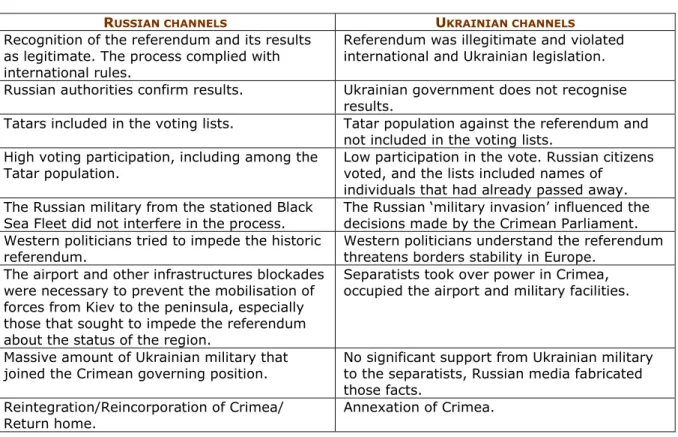
Table 2 - Main media comments on the referendum
RUSSIAN CHANNELS UKRAINIAN CHANNELS
Recognition of the referendum and its results as legitimate. The process complied with international rules.
Referendum was illegitimate and violated international and Ukrainian legislation. Russian authorities confirm results. Ukrainian government does not recognise
results.
Tatars included in the voting lists. Tatar population against the referendum and not included in the voting lists.
High voting participation, including among the
Tatar population. Low participation in the vote. Russian citizens voted, and the lists included names of individuals that had already passed away. The Russian military from the stationed Black
Sea Fleet did not interfere in the process. The Russian ‘military invasion’ influenced the decisions made by the Crimean Parliament. Western politicians tried to impede the historic
referendum.
Western politicians understand the referendum threatens borders stability in Europe.
The airport and other infrastructures blockades were necessary to prevent the mobilisation of forces from Kiev to the peninsula, especially those that sought to impede the referendum about the status of the region.
Separatists took over power in Crimea, occupied the airport and military facilities.
Massive amount of Ukrainian military that
joined the Crimean governing position. No significant support from Ukrainian military to the separatists, Russian media fabricated those facts.
Reintegration/Reincorporation of Crimea/
Return home. Annexation of Crimea.
The Ukrainian channels, after the referendum, supported the official view of the
government in Kiev: the referendum did not comply with democratic principles nor with international law. Three main ideas/narratives were made clear: first, a part of Ukraine “was stolen”; second, Crimea was now under Russian government responsibility; and third, annexation was temporary, and that at some point Crimea would be again part of Ukraine. The referendum was described by both Ukrainian channels as an illegal act of occupation of part of the territory of a sovereign state. 1+1 went further to compare the annexation of Crimea to the annexation of territories by the fascist regimes that led to the Second World War. The EU was described as an ally of Ukraine in seeking to
55
revert Russian aggression. This coincidence in narrative is interesting in face of the different reporting styles of the Ukrainian channels.
What do these contradictory reports tell us about framing and
agenda-setting?
With the fall of Yanukovych’s regime and the formation of the new government in Kiev, media attention refocused on Crimea. Most broadcasts in Ukrainian media about the peninsula had a negative tone, whereas in Russia the coverage highlighted the positive consequences of “Crimea’s reintegration” into Russia. In Russian media, the tone only changed when referring to the new government in Kiev, with coverage being critical about it. The only framing that was neutral in all news was related to the referendum date, including its anticipation to March 16. The abolition of the law on regional languages was covered by the Ukrainian news briefly, just mentioning the decision (neutral). In the Russian news, this was broadcasted as a threat to the Russophone population and a violation of human rights, requiring an intervention to safeguard the “rights of compatriots”. Demonstrations taking place were described as pacifist and for the autonomy of the region. However, in Ukraine, these same demonstrations were described as being promoted by ‘pro-Russians’ and ‘separatists’ with the support of the Kremlin, with the goal to destabilise the situation in that area and advance with the division of the country.
The framing ‘referendum’ was another issue treated differently in Ukrainian and Russian media. In Russia, the referendum was described as representing the willingness of the people to return to Russia and correct a mistake from history. It was stressed the democratic nature of the act and its legitimacy, including international monitoring of the voting. The results were always framed in the people’s willingness to be part of Russia. Quite on a different tone, the Ukrainian media underlined the illegitimate character of the vote and how the referendum violated international law. There were no words of support for the act, underlining how results were falsified and thus not recognising or validating the results announced.
Broadly put, the negative tone coming from Russian media is directed at the Ukrainian authorities described as ‘fascist’ and having taken over power through an illegitimate
coup d’état. The negative tone coming from Ukrainian media was directly connected to
issues of sovereignty and the violation of the territorial integrity of the country with Russian military manoeuvres and the change in power in Crimea being described as an invasion by separatists and takeover of power under the Russian flag and command. However, what is most noticeable is the change within Ukrainian coverage of the events, as the two channels with time became closer in their reporting tone. Whereas Inter at the time of the EuroMaidan protests broadcasted in a more Russian-friendly way, after the change in power in Ukraine and the political shifts this implied, changed the approach and became more critical of Russia. This is also reinforced by the opinion polls as analysed in the next section, and that also followed this same trend of great diversion at the beginning of the events, but increasingly united in the narrative with time.
In a nutshell, the analysis of the coverage of Crimea shows that despite addressing the same topic, the focus of the broadcasting diverged, not only between Ukraine and Russia (which was expected), but also within Ukraine itself, which was unexpected given the
56
channel’s alignment with the Russian position). There was also an increase in the amount of time dedicated to Crimea, to the exception of the period when the Winter Olympic Games in Sochi (Russia) took place when the topic ‘Ukraine’ almost disappeared from the media agenda in Russia. Nevertheless, most of the broadcasted time during this period was dedicated to Crimea, with use of symbols and strong language, leaving clear the relevance of the issue for both countries and how it is so differently presented in Ukraine and Russia, and mostly serving political purposes.
Opinion polls and media influence over opinion-shaping
All analysed channels had a powerful impact on the entry of specific issues and perceptions about the Ukrainian crisis on the public agenda. The public agenda can be characterised as the hierarchy of issues during a determined period and is usually mediated by the public opinion polls about a particular event (Dearing & Rogers, 1996: 40-41).
According to data from the Levada Centre in Russia, the polls that were conducted among the Russian population show the number of Russians who followed the developments in Ukraine since December 2013 had tripled in 2014 (Levada, 2014). In early January 2014 the opinion polls conducted about “Overall, what is your current perception about Ukraine?” pointed to a favourable opinion with 66% perceiving Ukraine as “good/generally good” and 26% expressing their perception of the country as “bad/generally bad” (Levada, 2014a). After four months a new poll was conducted but the results changed: the “good/generally good” answer was chosen only by 35% of the respondents, whereas the perception of Ukraine as “bad/generally bad” increased to 49% (Levada, 2014b).
Chart 1 - Russian overall perception about Ukraine (%)
When the Yanukovich regime failed, and the new government came to power, 37% of Russians agreed that power in Ukraine was captured by the radical nationalists, 36% of respondents believed that in Ukraine there was no a single government at that time. 62% stated that Ukraine was in anarchy and had no legitimate government, 15% supported Yanukovych as the legitimate president of the country (Levada, 2014c).
57
The poll after the referendum in Crimea shows that 88% of the respondents were in favour of the Crimean referendum result, which led to positive emotions related to feelings of justice, country pride and joy. 62% of the Russian population recognised the need to protect Russian minorities from Ukrainian radical nationalists and 38% favoured restoring historical justice. Responsibility for deteriorating relations between Russia and Ukraine was attributed by 37% of Russians to Western countries and by 35% to the non-constructive policy of the Ukrainian authorities. Only 8% of respondents agreed that the Crimean accession was in effect an annexation (Levada, 2014c). During the post-Soviet time in Russia, the public agenda always presented the conviction that Crimea should be returned, 84% believed that the region was unfairly given to Ukraine (ibidem). Therefore, all the events in Ukraine were perceived by the Russian population as the restoration of the high and robust Russian power, protector of its population (Gudkov, 2015).
The Ukrainian opinion polls provided by the International Sociological Centre of Kiev between January and February 2014 showed that the Ukrainians’ opinions about the EuroMaidan protests had split almost equally. The number of respondents who supported the protests was 47%, while those who did not support 46% (KIIS, 2014a). These results could be bound with a different representation of EuroMaidan events by Ukrainian channels, where 1+1 was pro-Maidan, and Inter was pro-Yanukovich regime. However, during the Crimean events, the channels aligned their positions and the Ukrainian perception about Russia considerably changed.
With the increase in tension, and in particular after Russia’s annexation, relations and perceptions deteriorated. In February 2014 a positive attitude towards Russia was gathered among 78% of the respondents; and negative attitudes totalled only 13% of the respondents (KIIS, 2014b). In comparison to the February poll, by May 2014 there was a decrease of 52% regarding the positive attitude towards Russia, and inversely the negative tone increased, in fact, it almost tripled, reaching 38%. This inversion in perceptions is justified by the course of events and the overall deterioration of relations between Russia and Ukraine (KIIS, 2014c).
Chart 2. Ukrainian overall perception about Russia (%)
Regarding Crimea, 78% of the Ukrainian respondents agreed it was an act of ‘annexation’, 11% disagreed and 12% did not answer (KIIS, 2015). Differently, 86% of the Russian respondents perceived accession of Crimea as the realisation of the right of people to self-determination, and just 8% agreed it was an act of ‘annexation’.
When looking at these opinion polls and the broadcasting in Russian and Ukrainian media, we can clearly see a parallel evolution in tendencies. Somehow the results of the opinion polls coincide with the information broadcasted and how it was conveying a political
58
message – the media from both countries replicated the official discourse of the respective governments, not really bringing to debate different perspectives over the events.
Chart 3. Accession of Crimea to Russia (%)
Interestingly, the pro-Russian channel in Ukraine at first replicated Russian-support, but with time shifted the narrative to align with the Ukrainian main political discourse. With the beginning of pro-Russian demonstrations and the active measures approved by the Russian authorities, such as authorising the entry of Russian military in Crimea, the Ukrainian media agenda (1+1 e Inter) aligned their positions, with Russia becoming broadcasted as the external aggressor that threatens the territorial integrity of Ukraine, leading to an increase of Ukrainian willingness to get closer to the EU.
Conclusion
This article sought to compare the Russian and Ukrainian television media agendas in the period of the Crimean crisis, with the objective of understanding the local point of view about the events; the role of media as agenda-setters and producers of subjective framings in context of inter-state conflict; the relationship between state authorities and media; and the impact that media have on public opinion shaping in this particular matter.
In both countries – Russia and Ukraine –, media face an unfavourable situation in terms of their capacity to act independently, facing constant pressure from state authorities or from the financial groups sustaining them. In the case of Russia this results from the fact that the television media system continues to follow the “neo-Soviet model”, while in the case of Ukraine, the channels follow the interests of their owners because they cannot survive without the financial support of the oligarchs. This has clearly affected the broadcasting agenda and framing options, revealing an increasingly politicised media discourse.
59
Despite analysing the same events, the media broadcasts were quite different, in terms of the narratives and their interpretation, influencing and shaping contradictory understandings and perceptions in the two countries. In the case of Ukraine, the information that was transmitted by channel 1+1 was distinct from the facts provided by the Inter channel: when the 1+1 presented clear anti-Russian discourse, the Inter channel chose more careful narratives to characterise the events in Crimea. By selecting certain aspects to be broadcasted, rendering some events more visible than others, and by defining and interpreting events, the media ended up as political actors, conveying the political message of the respective governments and economic elites, even if at times changing the narrative. Moreover, as the privileged means of informing the population, and thus with great potential for influencing and shaping policy opinion, the media undoubtedly contributed to moulding national identity in both countries and to feed opinions legitimising and de-legitimising state authorities and decisions. This article concludes that the media discourse contributed to shape and form public opinion concerning the Crimean reintegration/annexation by presenting specific facts, omitting events, reinterpreting discourses, and reflecting the very own interests of both sides political and economic elites. The analysis made shows the shift in relations between the two countries with the course of events, highlighting the change in narrative also within Ukrainian media, and how this was reflected also in public opinion polls. The crystallisation of perspectives in political interests became clear, as well as the role of the media in constructing a ‘certain’ reality.
References
Arutunyan. A. (2009). The Media in Russia. Open University Press: Berkshire.
Averre, Derek (2016). ‘The EU and Russia: managing the new security environment in the wider Europe’. European Policy Analysis, Swedish Institute for European Policy Studies, http://www.sieps.se/sites/default/files/2016_5_epa_eng_0.pdf [24.09.2018]. BBC (2015). Ukraine Profile – media, http://www.bbc.com/news/world-europe-18006248 [24.09.2018].
BBC (2017). Russia Profile – media, http://www.bbc.com/news/world-europe-17840134 [24.09.2018].
Colta (s.d.). ‘Как делают ТВ пропаганду: четыре свидетельства’ [How they make propaganda on TV: four evidence], http://www.colta.ru/articles/society/8163 [24.09.2018].
Craig, Alexander (1976). ‘Media and Foreign Policy’. International Journal, 31(2), 319-336.
Dougherty, Jill (2014). ‘Everyone lies: the Ukrainian conflict and Russian’s media transformations’, http://shorensteincenter.org/everyone-lies-ukraine-conflict-russias-media-transformation/ [24.09.2018].
Dunn, John (2014). ‘Lottizzazione Russian Style: Russia’s Two-tier Media System’.
Europe-Asia Studies, 6(9), 1425-1451.
Dutsyk, Diana (2015). ‘Ukrainian media during war: 2014 – 2015’. KAS Policy Paper, http://www.kas.de/wf/doc/kas_43639-1522-1-30.pdf?151209163730, [24.09.2018].
60
Eilders, Christiane (2002). ‘Conflict and Consonance in Media Opinion: Political Positions of Five German Quality Newspapers’. European Journal of Communication, 17(1), 25-63. Entman, Robert (1993). ‘Framing: toward clarification of a fractured paradigm’. Journal
of Communication, 43(4), 51-58.
Entman, Robert (2004). Projections of Power: Framing News, Public Opinion, and US
Foreign Policy. Chicago: University of Chicago Press.
Expert (2014). ‘Правительство Крыма отправили в отставку’ [Crimea’s government is fired], 27 February, http://expert.ru/2014/02/27/majdan-peremestilsya-v-kryim/ [24.09.2018].
Foucault, Michael (1994 [1970]). The Order of Things: An Archaeology of the Human
Sciences. New York: Vintage Books.
Freedom House (2018). “Nations in Transit Methodology: Independent Media”. Available at: https://freedomhouse.org/report/nations-transit-methodology.
Freire, Maria Raquel (2017). ‘Ukraine and the Restructuring of East-West Relations’, in: Kanet, Roger E. (ed.) The Russian Challenge to the European Security Environment. London: Palgrave Macmillan.
Gilboa, Eytan (2002). ‘Global Communication and foreign policy’. Journal of
Communication, 54(4), 731-748.
Hall, Stuart (1997). ‘The West and the Rest: Discourse and Power’, in: Hall, Stuart et al. (eds.) Modernity: An Introduction to Modern Societies. Maiden, Oxford: Blackwell Publishing.
Herman, Edward (2003). ‘The Propaganda Model: A Retrospective. Propaganda, Politics’.
Power, 1, 1-14.
Herman, Edward; Chomsky, Noam (1988). Manufacturing consent. The Political Economy
of the Mass Media. New York: Pantheon Books.
Hovland, Carl I., Irving L. Janis, and Harold H. Kelley (1953). Communication and
Persuasion. New Haven, CT: Yale University Press.
Katchanovski, Ivan (2015). ‘Crimea: people and territory before and after annexation’, in: Pikulicka-Wilczewska, Agnieszka; Sakwa, Richard (eds.) Ukraine and Russia: People,
Politics, Propaganda and Perspectives. Bristol: E-international Relations.
Khvostunova, Olga (2013). ‘A brief history of Russian media’. The Interpreter, http://www.interpretermag.com/a-brief-history-of-the-russian-media/ [24.09.2018]. KIIS (2015). ‘Думки і погляди населення україни стосовно методів опору інтервентам / окупантам: вересень 2015 року’ [The views and opinions of the population of Ukraine concerning the methods of resistance to the invaders/occupiers: September 2015], http://www.kiis.com.ua/?lang=rus&cat=reports&id=546&page=8 [24.09.2018].
KIIS (2014a). ‘Cми и доверие к украинским и российским СМИ’ [The media and trust
in Ukrainian and Russian media],
http://www.kiis.com.ua/?lang=rus&cat=reports&id=425 [24.09.2018].
KIIS (2014b). ‘Динамика отношения населения украины к россии и населения россии к украине’ [How relations between Ukraine and Russia should look like? Public opinion
61
polls’ results], http://www.kiis.com.ua/?lang=rus&cat=reports&id=236&page=21 [24.09.2018]
KIIS (2014c). ‘Как изменилось отношение населения украины к россии и населения россии к украине’ [Сhanges in the attitude of Ukrainians towards Russia and the attitude
of Russians towards Ukraine],
http://www.kiis.com.ua/?lang=rus&cat=reports&id=347&page=16 [24.09.2018]. Kishan, D. and Freedman, D. (2003). ‘Introduction’, in: D. Kishan, D. Freedman (Eds.),
War and the Media. London: Sage.
Kononczuk, Wojciech (2015). ‘Oligarchs after the Maidan: the old system in a “new”
Ukraine’, Centre for Eastern Studies, 162, 1-8,
http://www.osw.waw.pl/en/publikacje/osw-commentary/2015-02-16/oligarchs-aftermaidan-old-system-a-new-ukraine [24.09.2018].
Kuusik, Nora (2010). ‘The Role of the Media in Peace Building, Conflict Management, and Prevention’, http://www.e-ir.info/2010/08/28/the-role-of-media-in-peace-building-conflict-management-and-prevention/ [24.09.2018].
Levada Centre (2014a). ‘События в Украине.Майдан’ [Events in Ukraine. Maidan], http://www.levada.ru/2014/01/29/sobytiya-v-ukraine-majdan/ [24.09.2018].
Levada Centre (2014b). ‘Отношения России к другим странам’ [The attitude of the Russians toward other countries], http://www.levada.ru/2014/06/05/otnoshenie-rossiyan-k-drugim-stranam-6/ [24.09.2018].
Levada Centre (2014c). ‘Происходящее в Украине, Крыму и реакция России’ [Events
in Ukraine, Crimea and the reaction of Russia],
http://www.levada.ru/2014/03/26/proishodyashhee-v-ukraine-krymu-i-reaktsiya-rossii [24.09.2018].
Lewin, Kurt (1943). ‘Forces behind food habits and methods of change’. Bulletin of the National Research Council, 108, 35-65.
McCombs, Maxwell; Shaw, Donald (1972). ‘The agenda-setting function of mass media’.
The public Opinion Quarterly, 36(2), 176-187.
McCombs, Maxwell; Shaw, Donald (1993). ‘The Evolution of Agenda-Setting Research: Twenty-Five Years in the Marketplace of Ideas’. Journal of Communication, 43(2), 58-67.
Mediasat (2014). ‘Российские СМИ создают не новости, а другую реальность — Ткаченко’ [Russian media doesn’t create news, but they create another reality – interview with Tkachenko], 28 April, http://mediasat.info/2014/04/28/rossijskie-smi-sozdajut-ne-novosti-a-druguju-realnosttkachenko/ [24.09.2018].
Mezhygirsky, Andriy (2014). ‘Как российские СМИ поошряли сепаратизм в Крыму’ [How the Russian media encouraged separatism in the Crimea], http://osvita.mediasapiens.ua/monitoring/ru_zmi/kak_rossiyskie_smi_pooschryali_sep aratizm_v_krymu/ [24.09.2018].
Naveh, Chanan (2002). ‘The Role of the Media in Foreign Policy Decision-Making: A Theoretical Framework’. Conflict & Communication Online, 1(2), http://www.cco.regener-online.de/2002_2/pdf_2002_2/naveh.pdf [24.09.2018].
62
Onuch, Olga (2015a). ‘EuroMaidan Protests in Ukraine Social Media versus Social Networks’. Problems of Post-Communism, 62, 217-235.
Onuch, Olga (2015b). ‘“Facebook Helped Me Do It”: Understanding the EuroMaidan Protester “Tool-Kit”’. Studies in Ethnicity and Nationalism, 15(1), 170-184.
Oshkalo, Anna (2015). ‘Posted top 10 Russia’s largest media in 2014’, http://www.russiansearchtips.com/2015/01/top-10-russias-largest-media-2014/
[24.09.2018].
Oates, Sarah (2007). ‘The neo-Soviet model of the media’. Europe-Asia Studies, 59(8), 1279-1297.
Putin (2014). Address by President of the Russian Federation, President of Russia website, The Kremlin, 18 March, http://en.kremlin.ru/events/president/news/20603 [24.09.2018].
Rahman, Bushra Hameedur (2014). ‘Pakistani Media as an Agent of Conflict or Conflict Resolution: A Case of Lal Masjid in Urdu and English Dailies’. Pakistan Vision, 15(2). Robinson, Piers (2002). THE CNN EFFECT The myth of news, foreign policy and
intervention. London and New York: Routledge.
RFS (2017). World Press Freedom Index map, https://rsf.org/en/ranking [24.09.2018]. Rozvadovskyy, Oleh (2010). ‘Media Landscapes: Ukraine’, European Journalism Centre, http://ejc.net/media_landscapes/ukraine [24.09.2018].
RSF (2016). ‘Facing reality after the EuroMaidan’
https://rsf.org/sites/default/files/journalists_and_media_in_ukraine_-_rsf_2016.pdf [24.09.2018].
Sakwa, Richard (2015). Frontline Ukraine: Crisis in the Borderlands. London: I. B. Tauris. Shaw, Eugene (1979). ‘Agenda-Setting and Mass Communication Theory’. Gazette
(International Journal of Mass Communication Studies), XXV(2).
Shoemaker, Pamela; Riccio, Jaime; Johnson, Philip (2013). ‘Gatekeeping’, Oxford Bibliographies, DOI: 10.1093/OBO/9780199756841-0011.
Shoemaker, Pamela J. and Reese, Stephen D. (2014). Mediating the Message in the 21st
Century: A Media Sociology Perspective. New York and London: Routledge.
Snegovaya, Maria (2014). ‘Stifling the public sphere: media and civil society in Russia’, http://www.ned.org/wp-content/uploads/2015/10/Stifling-the-Public-Sphere-Media-Civil-Society-Russia-Forum-NED.pdf [24.09.2018].
Surzhko-Harned, Lena and Zahuranec, Andrew J. (2017). ‘Framing the revolution: the role of social media in Ukraine’s Euromaidan movement’. Nationalities Papers: The
Journal of Nationalism and Ethnicity, 45(5), 758-779.
Traquina, Nelson (1995). ‘O paradigma do agenda-setting: Redescoberta do poder do jornalismo’. Revista Comunicação e Linguagens, 21/22.
Vasil, Vladislav (2016). Journalist, Member of the Central Executive Body of the Party “Right sector” from 2014 to 2015. Kiev: 15 March.
63 Televised news selected for this study 1+1 (2014) - TSN 24.02 https://www.youtube.com/watch?v=XcCwju8KrDk 25.02 https://www.youtube.com/watch?v=d1MFTxSsl1s 26.02 https://www.youtube.com/watch?v=DRb9Nv1aAS0 27.02 https://www.youtube.com/watch?v=bLkcvumqv_4 28.02 https://www.youtube.com/watch?v=zk1Ca748xAg 1.03 https://www.youtube.com/watch?v=b6UDesMzQ9s 6.03 https://www.youtube.com/watch?v=6fRvoQJ2_hk 16.03 https://www.youtube.com/watch?v=p9rLpbpRHWs 18.03 https://www.youtube.com/watch?v=F0CR0_9xFRY 23.03 https://www.youtube.com/watch?v=zugsrDHEe2s Inter (2014) - Podrobnosti 24.02 http://podrobnosti.ua/news-release-list/2014/2/24/20/0/ 25.02 http://podrobnosti.ua/news-release-list/2014/2/25/20/0/ 26.02 http://podrobnosti.ua/news-release-list/2014/2/26/20/0/ 27.02 http://podrobnosti.ua/news-release-list/2014/2/27/20/0/ 01.03 http://podrobnosti.ua/news-release-list/2014/3/1/20/0/ 06.03 http://podrobnosti.ua/news-release-list/2014/3/6/20/0/ 10.03 http://podrobnosti.ua/news-release-list/2014/3/10/20/0/ 16.03 http://podrobnosti.ua/news-release-list/2014/3/16/20/0/ 18.03 http://podrobnosti.ua/news-release-list/2014/3/18/20/0/ 23.03 http://podrobnosti.ua/news-release-list/2014/3/23/20/0/ 1TV (2013) - Vremya 04.12 http://www.1tv.ru/news/2013/12/04/ Rossiya (2013) - Vesty 12.12 https://russia.tv/video/show/brand_id/5402/episode_id/939149/ 1TV (2014) - Vremya 26. 01 http://www.1tv.ru/news/2014/01/26/ 25.02 http://www.1tv.ru/news/2014/02/25/ 26.02 http://www.1tv.ru/news/2014/02/26/ 28.02 http://www.1tv.ru/news/2014/02/28/ 01.03 http://www.1tv.ru/news/2014/03/01/ 07.03 http://www.1tv.ru/news/2014/03/07/
64 16.03 http://www.1tv.ru/news/2014/03/16/ 17.03 http://www.1tv.ru/news/2014/03/17/ 23.03 http://www.1tv.ru/news/2014/03/23/ Rossiya (2014) - Vesty 24.02 http://tv-novosti.ru/date/2014-02-24/rossiya/17-00 26.02 https://russia.tv/video/show/brand_id/5402/episode_id/970186/ 28.02 https://russia.tv/video/show/brand_id/5402/episode_id/970741/video_id/976060/ 02.03 https://www.youtube.com/watch?v=sIqnkd-EkeY 06.03 https://russia.tv/video/show/brand_id/5402/episode_id/972264/ 10.03 https://www.youtube.com/watch?v=pOn0t4QQvAc 16.03 https://www.youtube.com/watch?v=a5Ym9VmHUiA 18.03http://tv-news-online.com/vechernie-novosti-bolshie-vesti-na-telekanale-rossiya-18-03-2015/ 23.03 https://russia.tv/video/show/brand_id/5206/episode_id/976156/
Televised news selected for this study
1+1 (2014) - TSN 24.02 https://www.youtube.com/watch?v=XcCwju8KrDk 25.02 https://www.youtube.com/watch?v=d1MFTxSsl1s 26.02 https://www.youtube.com/watch?v=DRb9Nv1aAS0 27.02 https://www.youtube.com/watch?v=bLkcvumqv_4 28.02 https://www.youtube.com/watch?v=zk1Ca748xAg 1.03 https://www.youtube.com/watch?v=b6UDesMzQ9s 6.03 https://www.youtube.com/watch?v=6fRvoQJ2_hk 16.03 https://www.youtube.com/watch?v=p9rLpbpRHWs 18.03 https://www.youtube.com/watch?v=F0CR0_9xFRY 23.03 https://www.youtube.com/watch?v=zugsrDHEe2s Inter (2014) - Podrobnosti 24.02 http://podrobnosti.ua/news-release-list/2014/2/24/20/0/ 25.02 http://podrobnosti.ua/news-release-list/2014/2/25/20/0/ 26.02 http://podrobnosti.ua/news-release-list/2014/2/26/20/0/ 27.02 http://podrobnosti.ua/news-release-list/2014/2/27/20/0/ 01.03 http://podrobnosti.ua/news-release-list/2014/3/1/20/0/ 06.03 http://podrobnosti.ua/news-release-list/2014/3/6/20/0/ 10.03 http://podrobnosti.ua/news-release-list/2014/3/10/20/0/
65 16.03 http://podrobnosti.ua/news-release-list/2014/3/16/20/0/ 18.03 http://podrobnosti.ua/news-release-list/2014/3/18/20/0/ 23.03 http://podrobnosti.ua/news-release-list/2014/3/23/20/0/ 1TV (2013) - Vremya 04.12 http://www.1tv.ru/news/2013/12/04/ Rossiya (2013) - Vesty 12.12 https://russia.tv/video/show/brand_id/5402/episode_id/939149/ 1TV (2014) - Vremya 26. 01 http://www.1tv.ru/news/2014/01/26/ 25.02 http://www.1tv.ru/news/2014/02/25/ 26.02 http://www.1tv.ru/news/2014/02/26/ 28.02 http://www.1tv.ru/news/2014/02/28/ 01.03 http://www.1tv.ru/news/2014/03/01/ 07.03 http://www.1tv.ru/news/2014/03/07/ 16.03 http://www.1tv.ru/news/2014/03/16/ 17.03 http://www.1tv.ru/news/2014/03/17/ 23.03 http://www.1tv.ru/news/2014/03/23/ Rossiya (2014) - Vesty 24.02 http://tv-novosti.ru/date/2014-02-24/rossiya/17-00 26.02 https://russia.tv/video/show/brand_id/5402/episode_id/970186/ 28.02 https://russia.tv/video/show/brand_id/5402/episode_id/970741/video_id/976060/ 02.03 https://www.youtube.com/watch?v=sIqnkd-EkeY 06.03 https://russia.tv/video/show/brand_id/5402/episode_id/972264/ 10.03 https://www.youtube.com/watch?v=pOn0t4QQvAc 16.03 https://www.youtube.com/watch?v=a5Ym9VmHUiA 18.03http://tv-news-online.com/vechernie-novosti-bolshie-vesti-na-telekanale-rossiya-18-03-2015/ 23.03 https://russia.tv/video/show/brand_id/5206/episode_id/976156/