278 Brazilian Journal of Physics, vol. 36, no. 2A, June, 2006
Photoquenching Indications of a Thermally Triggered Transition Between
Two Different EL2 Metastable States in GaAs
P. P. F´avero and J. M. R. Cruz
N´ucleo de F´ısica Aplicada, Instituto de F´ısica, Universidade de Bras´ılia, Caixa Postal 04455, 70910-900, Bras´ılia, DF, Brazil
Received on 4 April, 2005
In this work we report the observation of two differentEL2 metastable states in GaAs and the effect of the optical/thermal history of the sample on the behavior of the photoquenching kinetics. In one thermal/optical preparation, the photoquenching curve presented two time constants that have already been interpreted as an indication of two different metastable states. With another preparation, the initial rise in transmittance displayed only one time constant, and we observed that a temperature increase to 83K triggered a second photoquenching process. We associated this new photoquenching with a transition from the first to the second metastable state. The experimental data is explained in terms of a new proposal for the microscopic structure of the EL2 complex.
Keywords: EL2; GaAs; Photoquenching
I. INTRODUCTION
TheEL2 is a natural growth defect which has a typical con-centration of about 1×1016cm−3in undoped Liquid
Encap-sulated Czochralski (LEC) grown gallium arsenide samples. Besides being a donor center, the EL2 presents a metastable state that results from a lattice relaxation induced by a transi-tion with 1.0 - 1.3 eV photons to an excited state of the center (EL2∗). After the relaxation, the metastable state becomes
optically inactive to photons that have induced the transfor-mation, a phenomenon called photoquenching [1, 2]. A per-sistent metastable state can only be achieved when the sample is cooled below 90K.[3] The reverse path, i.e., the total recov-ery of theEL2 from the metastable state back to the normal state, is achieved when the sample is heated above 120K.[4] This reverse path is also known as thermal recovery.
At first, the EL2 had been associated to a substitutional oxy-gen due to the proximity of the photoionization energy lev-els of these two centers.[5]. This model was discarded when the experiments revealed that the EL2 concentration increases when the GaAs is grown on As-rich conditions.[6] Therefore, subsequent proposals included gallium vacancies (VGa),
ar-senic antisites (AsGa) or arsenic interstitials Asi.[5] During
the 1980’s, experimental and theoretical results indicated that the EL2 could be the isolated AsGa, like the model proposed
by Chadi and Chang[7], or an association of an arsenic an-tisite with an arsenic interstitials[8]. Later, evidences were accumulating that the center was more complex and required the presence of an actuator center, responsible for triggering the transition to the metastable configuration of the center.[9] Recently, a three-center complex model has been proposed by Fukuyama et al. [10] that seems to incorporate the neces-sary features, like the actuator level as well as the metastable state and photoquenching characteristics, but the matter is still open for investigation. In a recent work we presented indica-tions of the existence of two metastable configuraindica-tions, which seem to be accessed sequentially during the photoquenching process.[11] Furthermore, we showed that, differently from the final metastable state, the intermediate metastable state has a temperature dependent optical absorption cross-section.
In this work we bring an experimental result that shows a thermally triggered transition from the intermediate to the fi-nal metastable state (EL2∗
(a)→EL2∗(b)). This process seems
to imply a strong correlation among the centers in this transi-tion through some kind of cooperative effect. In this respect the mechanism behaves in similar way to the auto-catalytic thermal recovery process recently proposed by Fukuyama and colleagues, except for the fact that it happens in the opposite direction.[10]
II. EXPERIMENT
The sample investigated in this work consisted of a nom-inally undoped 1×1×2 cm3 GaAs block containing 1.45×
1016cm−3EL2 centers, as determined by optical absorption spectroscopy[12], and a carbon concentration of the order of 1×1016 cm−3, estimated from FFT-IR absorption.[13] The
spectral analysis revealed that essentially allEL2 were in the normal state at room temperature. The lack of an appreciable concentration ofEL2+, together with a resistivity of 6.2×10⁶
dis-P. dis-P. F´avero and J. M. R. Cruz 279
0 200 400 600 800 1000 1200
5 10 15 20 25
t1 = 27s t2 = 334s
Signal (arb.units)
Time (s)
FIG. 1: Photoquenching curve obtained after the first sample prepa-ration (see text). The transmittance increases due to transition to the metastable state and displays two time constants.
plays two time constants (compare with the first rise in Fig. 2). After the complete photoquenching process the temperature was increased up to 300K.
In the second optical/thermal sample preparation proce-dure, the sample was maintained at 300K for 5 minutes after the first experiment was completed, and cooled down again in the dark to 77K with a very high cooling rate (1-2 K s−1). Next, it was subjected to the laser beam. The new photo-quenching curve obtained can be seen in Fig. 2. The initial transmittance rise, differently from the behavior displayed in Fig. 1, seems to have only one time constant. After over 1000s of strong illumination, the temperature was increased up to 83K and brought down to 71K, as shown in the lower curve of Fig. 2. The curve shows a sudden increase in transmittance which was apparently triggered by the heating of the sample under illumination. Despite the immediate reduction in tem-perature, after the second photoquenching started, the increase in transmittance continued up to a higher stable value.
0 500 1000 1500 2000 2500
5 10 15 20 25
Signal (arb.units)
Time (s)
60 70 80 90 100
t
1= 34 s
Temperature (K)
FIG. 2. Photoquenching curve obtained after the second sample preparation (see text). Differently from Fig. 1, the initial rise in trans-mittance displays only one time constant. The lower curve shows the applied temperature changes. A momentary rise in temperature up to 83K triggered a transition to another metastable phase.
III. ANALYSIS AND DISCUSSION
In the absence of EL2+ and other absorbing defects, the transmittance is essentially related to the population ofEL2 in the normal state (EL20), and can be expressed by
T =(1−R) 2e−αL
1−R2e−2αL , (1)
whereRis the sample surface reflectivity andαis the absorp-tion coefficient. If there is more than one absorbing defect, the absorption coefficient is a sum of their individual absorp-tion coefficients. Therefore it depends on the product of their concentration and their absorption cross-sections. The shapes of the photoquenching curves in Figs 1 and 2, reveal two time constants and one time constant, respectively. For this reason, we have fitted the transmittance curves with the following ex-pression:
T=Cexp−a1e−
t
t1−a2e−
t
t2, (2)
whereC,a1,a2,t1, andt2, are the fitting constants for the case of Fig. 1, anda2andt2were neglected in the case of Fig. 2.
In a recent work we suggested that the two time constants, which are present at the first photoquenching curve, are asso-ciated with two sequential EL2 transitions, from the normal to an intermediate metastable state (EL20→EL2∗(a)), and from
this to a final metastable state (EL2∗
(a)→EL2∗(b)). This
hy-pothesis was based on the different temperature dependence of the absorption cross-section presented by the intermedi-ate stintermedi-ate that differs from the behavior of the final metastable state.
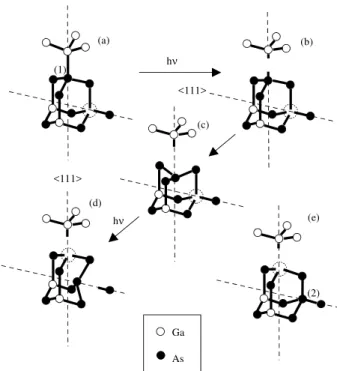
The basic EL20 state in our proposal is shown in Fig. 3. The AsGa, initially in the position labeled as (1), is
responsi-ble for the metastability, whereas the GaAscontrols the
tran-sition to the metastable state via the coulomb interaction with the neighboring AsGa[10]. Instead of a VAs, as proposed by
Fukuyamaet al[10], our structure incorporates a VGa, which
is more easily justified considering that it leads to an As-rich structure. In the following, we have labeled this state asEL20(1)to differentiate it from the similar stateEL20(2) de-picted in Fig.3e, where the AsGais in the position labeled as
(2). As already proposed[10], the transition to the metastable state begins with a photoexcitation of the AsGawith a charge
transfer from the GaAs, resulting in the breaking of the AsGa
-GaAs bond (Fig. 4b). This effect loosens the AsGaatom and
the excited states relaxes via an Jahn-Teller effect to the con-figuration shown in Fig. 3c.[7, 14]. Next, we propose that, under a new photoexcitation, a further migration of the As atom is possible. It moves to a position along another<111>
direction, towards the VGa. The bonds are then reestablished
with the nearest neighbor atoms of this site and the released ones constitute a new VGasite, located where the AsGawas
280 Brazilian Journal of Physics, vol. 36, no. 2A, June, 2006
(e) (EL20(2)) in Fig. 3. The energy barriers for the two paths should be slightly different since their electronic environments are not equal.
(d)
Ga
As hν
(c)
hν
(b)
<111>
<111> (a)
(1)
(e)
(2)
FIG. 3. Different stages of theEL2 center. (a) The normalEL20; (b) After photoexcitation there is a charge transfer between theGa−
Asand
theAs+Gathat leads to theGaAs-AsGa; (c) The structure relaxes with
the motion of theAsatom and the flipping down of the three remain-ing bonds; (d) After a new photoexcitation, the atom migrates to an equivalent site along a different<111>direction towards theVGa,
and rearranges the bonds with the nearest neighbor atoms of this site. This corresponds to the motion of the vacancy to the originalAsGa;
(e) This configuration may be one of the possibilities of a thermal recovery.(see text).
The two possibilities for the AsGain this structure can lead
to two final states during the recovery in a non-adiabatic heat-ing process. This may explain why the properties of system are so dependent on its thermal history. The initial conditions can be reestablished by heating the system up to 300K for a prolonged time. Therefore we expect the final configuration (e) (EL20(2)) to have a higher energy than the configuration (a) (EL20(1)) to where the system relaxes at high temperatures. These conclusions are summarized in the proposed configura-tional coordinate diagram in Fig. 4.
The fitting of the data in Fig. 1 reveals two time constants (t1= 27s andt2= 334s), whereas the first rise shown in Fig. 2 has only one (t1= 34s). Based on our proposal for the micro-scopic structure, the first sample preparation seems to have lead the sample to the EL20(1) state (see Fig. 3a). The first time constant (t1) is related to the transition to the intermediate metastable stateEL20
(1)→EL2∗(a)and the longer time constant
(t2) is related to the second transition to the final metastable state (EL2∗
(a)→EL2∗(b)).
The data in Fig. 2 can be explained in terms of our micro-scopic model by considering that, during the second prepara-tion, a charge gets trapped in the gallium vacancy (VGa) (see
Fig. 3a). The assumption is that this charge impedes the mo-tion of the As atom in the transimo-tion from the metastable con-figuration (a) to (b). Therefore, the first time constant corre-sponds to the transitionEL20(1)→EL2∗(a). The system would
remain locked in the meatastable configuration (a) while the VGasite is charged. The second rise in the transmission would
only happen after the charge from the VGasite is released by
the heating to 83K, allowing the transitionEL2∗
(a)→EL2∗(b)
to occur.
FIG. 4. Configurational coordinate diagram proposed for theEL2 system, incorporating an intermediate state. The system can pass from the intermediateEL2∗
a to the final EL2∗b state by optical
ab-sorption. There are two different configurations for the normal state, labeledEL20(1)andEL20(2). The first one is considered to be the low-est energy state. The curves corresponding to the conduction and valence bands were omitted for clarity.(see text).
During the heating process to 300K, a fraction of theEL2 might have ended in the configuration EL20(2) and, without giving enough time for the system to find the equilibrium con-figuration, the non-adiabatic fast cooling process may have locked some of theEL2 centers in this alternative state. There-fore, the first transmittance rise in Fig. 2 may contain a contri-bution from the optical photoquenching transition from this state directly to the final EL2∗
(b) state. The superposition
of the two fast transitions, i.e., from EL20(1)→EL2∗(a) and
EL20(2)→EL2∗(b)may explain the small differences observed
in the time constantt1in Figs. 1 and 2.
IV. CONCLUSION
P. P. F´avero and J. M. R. Cruz 281
in a separate work with a different set of data and tempera-ture [11], this work indicates the possibility of the locking of the intermediate metastable state with, what we believe to be, a possible charge state. The triggering of this intermeditate transition with a small temperature increase, and the fact that it keeps proceeding despite a subsequent temperature reduc-tion, seems to indicate a cooperative interaction mechanism
between centers, similarly to what have been recently sug-gested in the case of the thermal recovery.[10]. It can also be infered from the measured time constant that the cross-section for the transition from the fundamental to the metastable state is about ten times larger than that for transition from the inter-mediate to the final metastable state.
[1] G. M. Martin, Appl. Phys. Lett.39, 747 (1981). [2] D. Bois and G. Vincent, J. Phys. Lett.38, 351 (1977).
[3] G. Vincent, D. Bois, and A. Chantre, J. Appl. Phys.53, 3643 (1982).
[4] I. K. Kristensen and S. Moller, Solid State Comm.99, 751 (1996).
[5] G. A. Baraff, inDeep Centers in Semiconductorsed. S. Pan-telides (Gordon and Breach Sci.Pub., New York, 1986). [6] D. E. Holmes, R. T. Chen, K. R. Elliott, and C. G. Krkpatrick,
Appl. Phys. Lett.40, 46, (1982).
[7] D. J. Chadi and C. Chang, Phys. Rev. Lett.60, 2187 (1988). [8] B. K. Meyer, D. M. Hofmann, J. R. Niklas, and J.-M. Spaeth,
Phys. Rev. B36, 1332 (1987).
[9] J. Jimenez, A. Alvarez, and M. Chafai, Phys. Rev. B50, 14112, (1994).
[10] A. Fukuyama, T. Ikari, Y. Akashi, and M. Suemitsu, Phys. Rev. B.67, 113202 (2003).
[11] P. P. F´avero and J. M. R. Cruz, Eur. Phys. J.B.47, 363 (2005). [12] P. Silveberg, P. Omling, and L. Samuelson, Appl. Phys. Lett.
52, 1689 (1988).
[13] M. R. Brozel, E. J. Foulkes, R. W. Series, and D. T. J. Hurle, Appl. Phys. Lett.49, 11 (1986).