810 Brazilian Journal of Physics, vol. 29, no. 4, December, 1999
Theoretical Study of Surfactant Action of
Te on Si(001)/Ge Surfaces
R.H. Miwa and E.K. Takahashi
Departamento de Ci^encias Fsicas, Universidade Federal de Uberl^andia, C.P. 593, 38400-902, Uberl^andia, MG. Brazil
Received February 8, 1999
We have performed rst-principles total energy calculations to investigate the adsorption process of Ge on Si(001)/Te, and the surfactant action of Te during the epitaxial deposition of Ge on Si(001)/Te, based on an atomic exchange process, Ge$Te. The total energy calculation indicates that the adsorption of Ge atom in \vacancy" site is energetically more favourable than its adsorption in \bridge" site. The adsorption of Ge in \on-top" and \anti-bridge" sites can be ruled out. The segregation process of Te atoms, based on an atomic exchange mechanism, reduces the total energy of the surface, conrming the surfactant eect of Te atoms.
I Introduction
The epitaxial deposition of Ge on a Si substrate has attracted many experimental and theoretical studies. However, the growth process of Ge on a Si substrate obeys the Stranski-Krastanov model, giving rise to the formation of Ge 3D islands after deposition of about three monolayers of Ge. Recently, Bennett et al. [1], and Higushi and Nakanishi [2] veried the surfactant ef-fect of Te during epitaxial deposition of Ge on Si(001). The 2D ( layer-by-layer ) growth regime of Ge on Si was extended to about 200 A. Bennett [1] proposed an atomic exchange process between the deposited Ge and the surface Te atom, for the segregation process of Te towards the growth surface, reducing the surface total energy of the system.
In the present work we investigate the adsorption process of Ge on Si(001)/Te, and the surfactant ac-tion of Te during the epitaxial deposiac-tion of Ge on Si(001)/Te.
II Method of Calculation
Our calculations were performed in the framework of the density functional theory (DFT) [8], within the local density approximation (LDA), and using the Ceperley-Alder correlation [9], as parametrized by Perdew and Zunger [10] . The electron-ion interaction
was treated by using norm-conserving, ab initio fully separable pseudopotentials [11]. The wave functions were expanded in a plane wave basis set with a kinetic energy cuto of 8 Ry. The theoretical equilibrium lat-tice constant of 5.40 A was used for the Si substrate, which is very close to the experimental value (5.43 A), since we are studying the deposition of Ge atoms on Si(001) surface. We also adopted the Car-Parrinello approach [12] for the electronic structure calculations with a modied computational code due to Stumpf and Scheer [13].
R.H.MiwaandE.K.Takahashi 811
III Results and Discussion
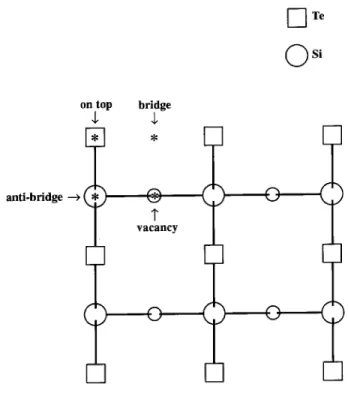
Initially, we have studied the adsorption process of Ge atom on Si(001)/Te - 11 surface with coverage of one monolayer of Te atoms, whose occurrence was veried experimentally [3, 4, 5, 6, 7]. We have considered four possible adsorption sites: "bridge", "vacancy", "anti-bridge", and "on-top", as indicated in Fig. 1. The calculated adsorption energy is dened as the total en-ergy dierence between Si(001)/Te surface, adsorbed by a single Ge atom, and the clean Si(001)/Te - 11 surface, with a Ge atom in a faraway position from the surface. Our results indicate that the adsorption of Ge atom in "vacancy" site is energetically more favourable than the adsorption of Ge in "bridge" site. The adsorp-tion energy dierence is equal to 0.20 eV/atom. The Ge adsorption in "on-top", and "anti-bridge" sites are energetically less favourable. A summary of the ad-sorption energy, and the respective minimum energy Te-Ge bond length are indicated in Table I. Although the adsorption of Ge in the "bridge" site is not the en-ergetically optimum conguration, in this site the bond length between Ge and Te atomsis very close to the sum of the respective covalent radii, 2.59 A, which indicates a covalent character of the bonds. On the other hand, in the "vacancy" site, the Ge atom is fourfold coordi-nated, and the Ge-Te bond length is 0.35 A greather than the sum of the covalent radii.
Figure 1. Adsorption sites of Te on Si(001) - 21, clean surface, "cave" - C, "bridge" -B, "anti-bridge" - A, and "vacancy"-V.
Table 1. Adsorption energy of Ge atom on Si(001)/Te - 11 surface, adsorption energy dierence (relatively to "vacancy" site), and the bond length between adsorbed Ge atom and Te.
Site EAds: ( eV/atom ) EAds:( eV/atom ) d Te,Ge
vacancy -3.65 0.00 2.94
bridge -3.45 0.20 2.61
on-top -2.09 1.55 2.40
anti-bridge -2.66 0.99 2.65
In order to study the surfactant eect of Te atoms, we have considered an atomic exchange process between adsorbed Ge atom in "vacancy" site ( "bridge" site ), and the substrate Te atom, as proposed in the experi-mental study of Bennett et al. [1] (see gure 1e). For this atomic exchange process we obtained a reduction of the total energy by 1.12 eV/atom ( 1.32 eV/atom ), indicating an exothermical process, and conrming the surfactant eect of Te, in agreement with the model proposed by Bennett et al. [5]. The exchanged Te atom occupies a surface \bridge" site, twofold coordinated,
and the bond length between Te and Ge atom is equal to 2.55 A, increasing the covalent character of the bond. The exchanged Ge atom occupies the Te site, and the bond length between Ge and sublayer Si atom is equal to 2.37 A, which also indicates a covalent character of the bond. The sum of the respective covalent radii is equal to 2.39 A.
812 Brazilian Journal of Physics, vol. 29, no. 4, December, 1999 of the formation of Ge dimers on Si(001)/Te. Our
re-sults indicate that the formation of Ge dimers is an exothermical process, where the cohesion energy of the dimers is 0.81 eV/dimer, with a bond length of 2.52 A. The buckling process of Ge dimers on Si(001) - without a coverage of Te monolayer - has been veried experi-mentally by Fontes et al. [15], and conrmed theoret-ically [16, 17]. We have also veried the possibility of the buckling process of Ge dimer on Si(001)/Te. Our results have shown that the buckling of the Ge dimer represents a metastable conguration, with a buckling angle of 16o and d
Ge,Ge = 2.39 A. The total energy increases by 0.31 eV/dimer, relatively to the Ge sym-metric dimer. Therefore, we can infer that the presence of the Te monolayer on Si(001) avoid the buckling of the Ge dimer. The Te monolayer acts as a buer layer against the deformation of Si sublayers. To verify the surfactant eect of Te atoms for Ge dimer, we have sim-ulated a dimer exchange process, between Te atoms and Ge dimer. Our results showed that this exchange pro-cess reduces the total energy by 0.67 eV/dimer, also conrming the surfactant eect of Te. After Te$Ge exchange, the surface Te atoms do not dimerize.
Finally we have considered a full monolayer of Ge on Si(001)/Te. In this case, the surface Ge atoms are dimerized, with dGe,Ge = 2.51 A, and the buckling of the dimers is not energetically expected. The bond length between Te(sublayer) and Ge(surface) atoms, is equal to dGe,Te = 2.74 A. The complete exchange between Te and Ge layers is an exothermical process, being the total energy reduced by 0.97 eV/atom, in agreement with the surfactant eect of Te. The surface Te atoms present a 11 reconstruction, and the bond length between Te(surface) and Ge(sublayer) atoms was reduced by 0.11 A, dTe,Ge = 2.63 A. The surface Te dangling bonds are dubly occupied, which avoid the formation of the Te dimers, giving rise to 11 recon-struction.
IV Conclusion
We have performed a theoretical investigation of ad-sorption process of Ge on Si(001)/Te surface, and the surfactant action of Te atoms. Our results indicate that the adsorption of Ge atom in "vacancy" site is energet-ically more favourable than the adsorption in "bridge" site. The adsorption of Ge in "on-top" and "anti-bridge" sites can be ruled out. The surfactant eect of Te atoms was veried based on an atomic exchange
process between adsorbed Ge atom and the surface Te atom. Our total energy calculation showed that this atomic exchange is an exothermical process, conrming the surfactant eect of Te atoms. Next, we have con-sidered the formation of Ge dimer on Si(001)/Te. The dimerization of Ge is energetically favourable, form-ing symmetric Ge dimer, and the Te monolayer acts as a buer layer, avoiding a buckling process of the Ge dimer. The subsequent dimer exchange process be-tween Ge and Te atoms is also an exothermical pro-cess, in agreement with the surfactant eect of Te. Fi-nally, we have considered a full monolayer of Ge on Si(001)/Te, Si(001)/Te/Ge - 21 reconstructed. The complete ( layer ) exchange between Te and Ge atoms, Si(001)/Ge/Te - 11 reconstructed, is also energetically favourable, reducing the total energy by 0.97 eV atom, also conrming the surfactant eect of Te atoms.
Acknowledgments
The authors would like to thank the Brazilian agencies FAPEMIG and CNPq for nancial support, and CENAPAD MG-CO, and CENAPAD-Unicamp for computational facilities.
References
[1] M.R. Bennett, C.J. Dunscombe, A.A. Cafolla, J.W. Cairns, J.E. MAcdonald, R.H. Willians,Surf.Sci.380, (1997) 178.
[2] S. Higushi, Y. Nakanishi, J. Appl. Phys. 71, (1992) 4277.
[3] S.A. Yoshikawa, J. Nogami, C.F. Quate, P. Pianetta, Surf.Sci.321, (1994) L183.
[4] S. Di Nardo, L. Lozzi, M. Passacantando, P. Picozzi, S. Santucci,Surf.Sci.331/333, (1995) 569.
[5] M.R. Bennet, A.A. CAfolla, J.W. Cairns, C.J. Dun-scombe, R.H. Willians,Surf.Sci.360, (1996) 187. [6] S. Santucci, S. Di Nardo, L. Lozzi, M. Passacantando,
P. Picozzi, Surf.Sci.352/354, (1996) 1027.
[7] S.R. Burges, B.C.C. Cowie, S.P. Wiks,P.R. Dun-stan, C.J Dunscombe, R.H. Willians, Appl.Surf.Sci. 104/105, (1996) 152.
[8] P. Hohenberg and W. Kohn,Phys.Rev. B864, (1964) 136.
[9] D. M. Ceperley and B. I. Alder, Phys.Rev. Lett. 45, (1980) 566.
[10] J.P. Perdew and A. Zunger, Phys. Rev.B23, (1981) 5048.
[12] R. Car and M. Parrinello, Phys. Rev. Lett.55, (1985) 2471.
[13] R. Stumpf and M. Scheer,Comput. Phys. Comm.79, (1994) 447.
[14] J. Neugebauer and M. Scheer, Phys. Rev. B 46, (1992) 16067.
[15] E. Fontes, J. R. Patel, F. Comin,Phys. Rev. Lett.70, (1993) 2790.
[16] J.-H. Cho, S. Jeong, M.-H. Kang, Phys. Rev. B 50, (1994) 17139.