J. Braz. Chem. Soc., Vol. 18, No. 3, 622-627, 2007.
Printed in Brazil - ©2007 Sociedade Brasileira de Química 0103 - 5053 $6.00+0.00
Article
*e-mail: [email protected]
New Oxidized
ent
-Kaurane and
ent
-Norkaurane Derivatives from Kaurenoic Acid
Ronan Batista,*,a,c Pablo A. García,b Maria A. Castro,b José M. Miguel del Corral,b
Arturo San Felicianob and Alaíde B. de Oliveirac
a
Departamento de Estudos Básicos e Instrumentais, Universidade Estadual do Sudoeste da Bahia, BR 415, km 03, 45.700-000 Itapetinga-BA, Brazil
b
Departamento de Química Farmacéutica, Facultad de Farmacia, Universidad de Salamanca, 37007 Salamanca, Spain
c
Departamento de Produtos Farmacêuticos, Faculdade de Farmácia, Universidade Federal de Minas Gerais, Av. Antônio Carlos, 6.627, 31.270-901 Belo Horizonte-MG, Brazil
Novos derivados oxidados ent-caurânicos e ent-norcaurânicos foram sintetizados a partir
do ácido caurenóico. Todos os produtos obtidos foram caracterizados espectroscopicamente.
New oxidized ent-kaurane and ent-norkaurane derivatives were synthezised starting from
kaurenoic acid. The spectroscopic characterization of all compounds is reported.
Keywords: diterpenes, kaurenoic acid, ent-kaurane and ent-norkaurane derivatives, PDC
oxidation
Introduction
Kauranes are an important class of diterpenes containing a rigid tetracyclic skeleton and exhibiting a wide variety of biological activities such as antitumor,
anti-HIV, trypanocidal and antimicrobial, among others.1
For this reason, the development of new strategies for the synthesis of novel kaurane derivatives may be considered as one of the interesting challenges in Chemistry of Natural Products. Indeed, many naturally occurring bioactive kauranes have been transformed using chemical and microbial methods in order to improve their bioactivity.2,3
Kaurenoic acid (ent-kaur-16-en-19-oic acid, 1) is an
intermediate in the biosynthesis of numerous plants and fungal secondary metabolites, including gibberellins, the phytohormones involved in the regulation of growth and
development of higher plants,1 found abundantly in some
Brazilian species as Wedelia paludosa D.C. (Asteraceae), Xylopia frutescens and Annona glabra (Annonaceae).4
We have reported, in a previous phytochemical study of Wedelia paludosa D.C., the isolation of kaurenoic acid
(1) as the main ent-kaurane diterpene in this species,
besides other related diterpenes and triterpenes as minor constituents.4,5 Among more recently biological activities
reported for 1, we can stand out the antimicrobial,6
antiplatelet aggregation,7 analgesic,8 antifungal,3,9 smooth
muscle relaxant,10 hypoglycemic,11 cytotoxic and
embryotoxic12 effects.
Considering these biological effects, along with our special interest on novel kaurane derivatives, we carried
on the synthesis of ent-kaurane aldehydes methyl ent
-17-oxokauran-19-oate (4) and methyl ent-17-oxo-16β
-kauran-19-oate (5), important as semisynthetic coupling
intermediates, starting from kaurenoic acid (1). In
addition, we describe here, for the first time, the synthesis
of methyl ent-17-oxokauran-19-oate (4), ent
-19-methoxy-19-oxokauran-17-oic acid (7), methyl ent-16β
-hydroxy-17-norkauran-19-oate (8) and methyl ent
-16-oxo-17-norkauran-19-oate (9), from the usual PDC
oxidation of methyl ent-17-hydroxykauran-19-oate (6).
The nomenclature and numbering of ent-kaurane
derivatives obtained in this work follow the IUPAC
recomendations.13
Results and Discussion
Kaurenoic acid (1), isolated from aerial parts of Wedelia paludosa D.C.,4,5 was esterified with diazomethane to the
corresponding methyl ester 2, which was subjected to two
623 Batista et al.
Vol. 18, No. 3, 2007
The first one was the epoxidation of 2 with MCPBA
taking place stereoselectively at the more accesible side of the double bond, to yield exclusively the ent-16β
,17-epoxide 3, what was confirmed by X-ray
crystallo-graphy.14 Further rearrangement of 3 employing Lewis
acids such as InCl3 or BF3 afforded a 1:1 mixture of
epimer aldehydes 4 and 5, in moderate to quantitative
yields (43% and 100%, respectively), that could not be separated by column chromatography. A mixture of products is usually obtained from rearrangement of epoxides to carbonyl compounds, due to lack of regioselectivity in the ring opening step.15
Moreover, methyl ester 2 was subjected to
hydro-boration reaction with NaBH4 and BF3•Et2O, followed
by NaOH and H2O2 oxidation, giving exclusively the
hydroxymethyl group at the ent-α side of the derivative
6. These results, affording stereoselectively the alcohol 6 with an ent-16α configuration, are in agreement with
literature data16 and are justified by the regio- and
stereoselectivity of the hydroboration-oxidation reaction, with a syn-addition taking place at the less hindered face
of the double bond. Next, the PDC oxidation of 6 yielded
the aldehyde 4 as the major product, together with the
ent-kaurane 7 and ent-norkauranes 8 and 9 as minor
products. The isomerization of 4 into its more stable
epimer 5 was satisfactoriously performed by hydrochloric
and acetic acids condition.
At the best of our knowledge, this is the first report of the kaurane and norkaurane derivatives 4, 7, 8 and 9 by
the oxidation of methyl ent-17-hydroxykauran-19-oate (6)
under PDC conditions. These products may be considered
as subsequent oxidized compounds from alcohol 6. The
initial oxidation of 6 afforded the expected aldehyde 4,
which in the presence of the chromate underwent further oxidation to the acid 7. This acid can be considered the
precursor of the norkauranes 8 and 9 according to the
mechanism proposed in Scheme 2. As seen in this scheme, the key step of this mechanism is pointed to be the nucleofilic addition between HCrO3– (1 mol) and the acid
7, followed by intra-SN2 rearrangement of this
intermediate and finally a decarboxylation-oxidation step, respectively. So, it is possible to explain the synthesis of the norkaurane alcohol 8, bearing an ent-β configuration at C-16, in opposite to the other kaurane derivatives 4, 6
and 7, that stand an ent-16α configuration.
All products were characterized by mass, NMR and IR spectroscopies. Known compounds 1, 2, 3, 6, 7 and 9
were identified by comparison of their spectral properties
(MS, 1H NMR and, except for 3, 13C NMR) with those
624 New Oxidized ent-Kaurane and ent-Norkaurane Derivatives from Kaurenoic Acid J. Braz. Chem. Soc.
with 13C NMR data for compound 3, are reported here
for the first time as far as the authors know.
Structures of compounds 4 and 5 were established on
the basis of their IR, NMR (1H NMR, 13C NMR) and mass
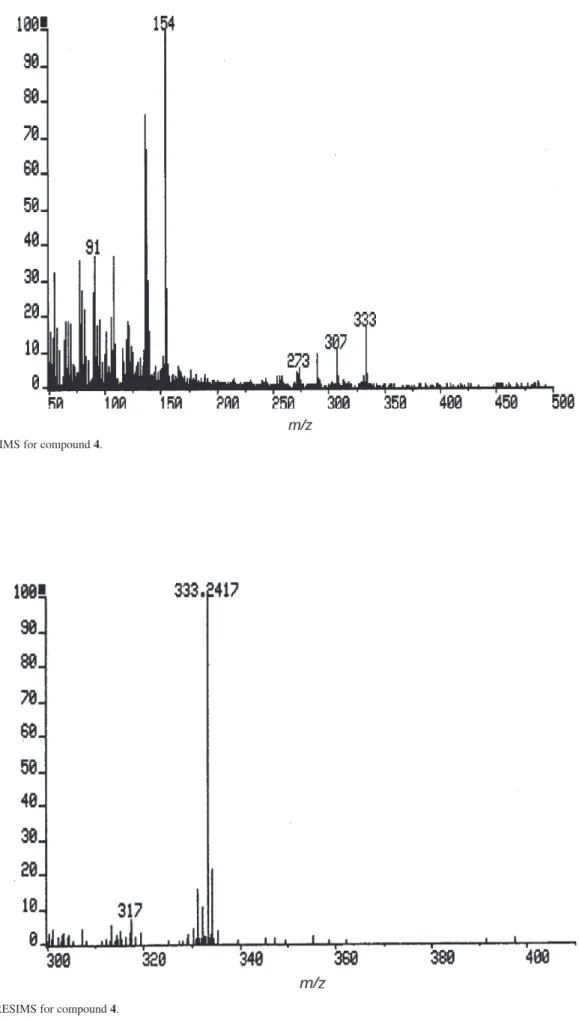
spectral data. FAB-HRMS data indicated molecular masses for 4 (333.2417) and for 5 (333.2428), both in agreement
with the molecular formula C21H32O3 (calculated =
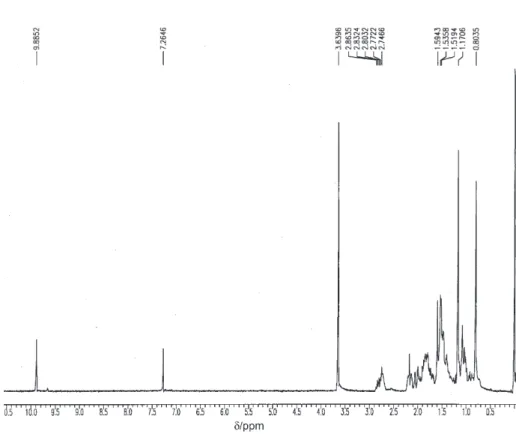
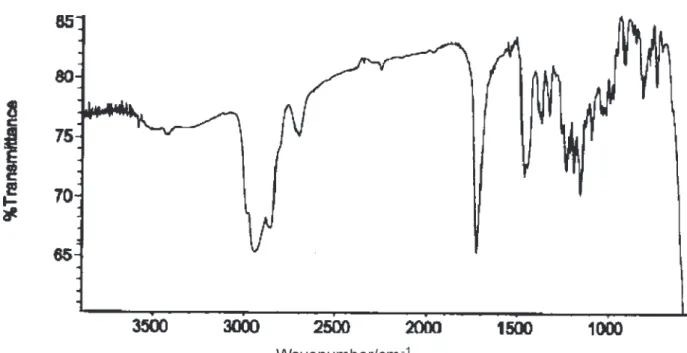
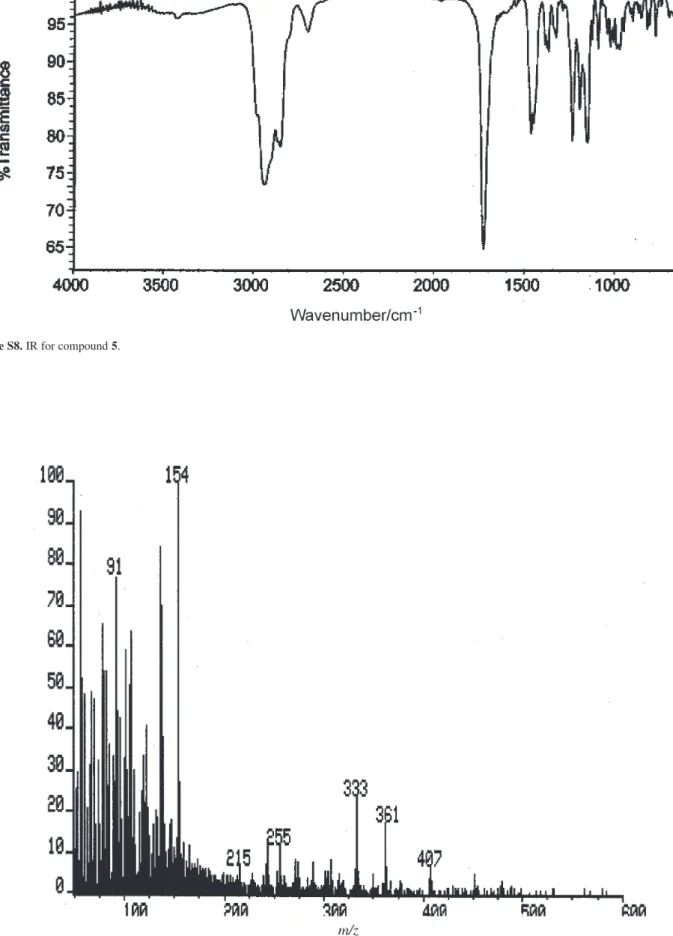
333.2430). Aldehyde functions of 4 and 5 were evident in
their IR spectra, with a C–H stretching band of –CHO group at 2701 cm-1 and in their 1H NMR spectra, by characteristic
signals at δ 9.89 and δ 9.65 (1H each), respectively (Table 1). The ent-α and ent-β orientations of aldehydes 4 and 5,
respectively,were deduced from the chemical shifts and
multiplicity of H-17, which was deshielded as a singlet at
δ 9.89 (4) or shielded as a 2J 1.8 doublet at δ 9.65 (5)by the
carbonyl group, according to literature data.21 The shielded
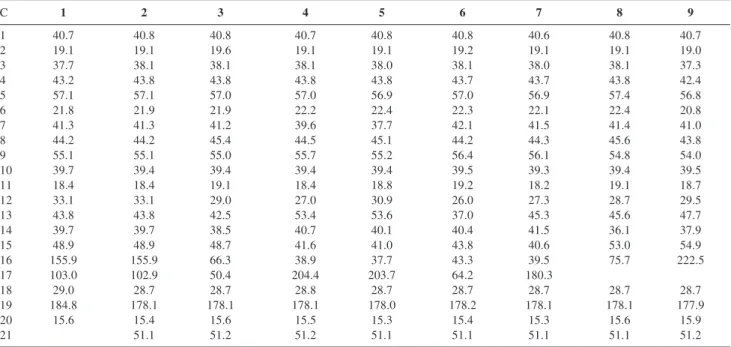
chemical shift of C-12 observed for 4 (δ 27.0), in
comparison to that for 5 (δ 30.9), indeed ensure this assignement (Table 2).
The norkaurane pattern of methyl esters 8 and 9
was confirmed by both 13C NMR (20 signals each
compound) and FAB-HRMS (C20H32O3 and C20H30O3, respectively) methods. There is a close similarity
between 1H NMR and 13C NMR (Tables 1 and 2) data
of these compounds, the differences being those related
to the alcohol (8) and ketone (9) functions at C-16.
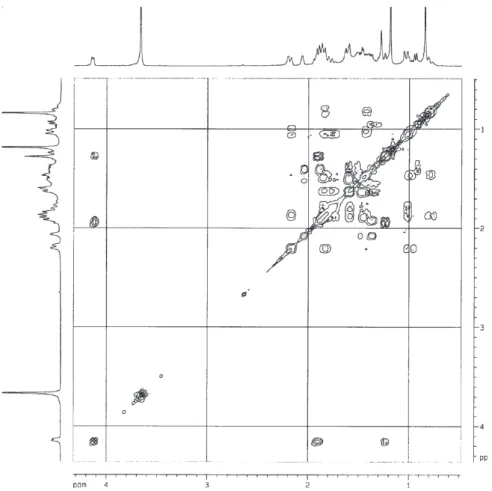
The location of the –OH group at C-16 in structure 8
was confirmed by the correlations in the COSY
spectrum between H-16 (δ 4.14, d, J 6.0), H-15α
(δ 1.90, m) and H-15β (δ 1.20, m), in addition to the
helpfull HMQC spectrum data. The ent-β configuration
of the –OH group at C-16 position was assigned in terms of gauche interactions, by comparison of its C-12
(δ 28.7) and C-14 (δ 36.1) chemical shifts with those
(δ 29.0 and δ 38.5, respectively) from the epoxide 3
(Table 2). This assignement is also corroborated by the multiplicity observed for the H-16 signal (Table 1), since the doublet format is understandable if there is a
Scheme 2. Mechanism proposed for the synthesis of ent-kaurane and ent-norkaurane derivatives 4, 7, 8 and 9, from the oxidation of ent-kaurane alcohol
625 Batista et al.
Vol. 18, No. 3, 2007
90º diedral angle of H-16 simultaneosly with H-13 and
H-15α, that ocurrs just when H-16 is at ent-α
configuration.
Conclusions
This work reports the synthesis of new oxidized ent
-kaurane (4 and 5) and ent-norkaurane (8) derivatives
starting from kaurenoic acid (1). In addition, we describe
here, for the first time, the synthesis of compounds 4, 7, 8
and 9 by the oxidation of methyl ent
-17-hydroxykauran-19-oate (6) under PDC conditions.
Experimental
General experimental procedures
Melting points were taken with a Microquímica apparatus APF-301 and were uncorrected. Optical
rotations were measured with a Perkin-Elmer 241 digital polarimeter. IR spectra were obtained on a Shimadzu IR-400 and Nicolet Impact 410 spectrophotometer. NMR
spectra were recorded at 200 MHz for 1H and 50 MHz
for 13C in deuterochloroform, added of TMS as internal
reference, on a Bruker AC 200. The assignments of carbon signals were made by comparison with literature
data and by means of 2D NMR 1H and 13C single bond
correlation studies, on a Bruker Advance DRX400 (400
MHz for 1H and 100 MHz for 13C in deuterochloroform).
Chemical shift values are expressed in ppm and coupling
constants (J) in Hz. Column chromatography (CC) and
flash column chromatography (FCC) were performed on silica gel Merck 60 (0.063-0.200 and 0.040-0.063 mm, respectively). HRMS were run in a VG TS-250 spectrometer working at 70 eV. TLC were carried out
on silica gel Merck 60 F254 (0.25 mm thick). Solvents
and reagents were purified by standard procedures as necessary.
Table 2. 13C NMR (δ/ppm) data for compounds 1-9
C 1 2 3 4 5 6 7 8 9
1 40.7 40.8 40.8 40.7 40.8 40.8 40.6 40.8 40.7
2 19.1 19.1 19.6 19.1 19.1 19.2 19.1 19.1 19.0
3 37.7 38.1 38.1 38.1 38.0 38.1 38.0 38.1 37.3
4 43.2 43.8 43.8 43.8 43.8 43.7 43.7 43.8 42.4
5 57.1 57.1 57.0 57.0 56.9 57.0 56.9 57.4 56.8
6 21.8 21.9 21.9 22.2 22.4 22.3 22.1 22.4 20.8
7 41.3 41.3 41.2 39.6 37.7 42.1 41.5 41.4 41.0
8 44.2 44.2 45.4 44.5 45.1 44.2 44.3 45.6 43.8
9 55.1 55.1 55.0 55.7 55.2 56.4 56.1 54.8 54.0
10 39.7 39.4 39.4 39.4 39.4 39.5 39.3 39.4 39.5
11 18.4 18.4 19.1 18.4 18.8 19.2 18.2 19.1 18.7
12 33.1 33.1 29.0 27.0 30.9 26.0 27.3 28.7 29.5
13 43.8 43.8 42.5 53.4 53.6 37.0 45.3 45.6 47.7
14 39.7 39.7 38.5 40.7 40.1 40.4 41.5 36.1 37.9
15 48.9 48.9 48.7 41.6 41.0 43.8 40.6 53.0 54.9
16 155.9 155.9 66.3 38.9 37.7 43.3 39.5 75.7 222.5
17 103.0 102.9 50.4 204.4 203.7 64.2 180.3
18 29.0 28.7 28.7 28.8 28.7 28.7 28.7 28.7 28.7
19 184.8 178.1 178.1 178.1 178.0 178.2 178.1 178.1 177.9
20 15.6 15.4 15.6 15.5 15.3 15.4 15.3 15.6 15.9
21 51.1 51.2 51.2 51.1 51.1 51.1 51.1 51.2
Table 1. 1H NMR data δ/ppm; (J/Hz) for compounds 1-9
H 1 2 3 4 5 6 7 8 9
13 2.64 bs 2.64 bs 2.30-2.00 m 2.72 bs 2.54 m 2.13 bs 2.57 bs 2.07 bs 2.40 bs
15a/b 2.05 m 2.05 m 2.00-1.50 m 2.00-1.50 m 2.00-1.50 m 2.20-1.50 m 2.20-1.50 m 1.90 m/1.20 m 2.50-2.00 m
16 2.80 dd (6.2/12.1) 2.54 m 2.28 m 2.95 q (6.1) 4.14 d (6.0)
17a 4.79 bs 4.79 bs 2.88 d (4.8) 9.89 s 9.65 d (1.8) 3.70 d (6.9) 17b 4.73 bs 4.74 bs 2.80 d (4.8)
18 1.24 s 1.17 s 1.17 s 1.17 s 1.17 s 1.16 s 1.17 s 1.17 s 1.20 s
20 0.95 s 0.83 s 0.84 s 0.80 s 0.81 s 0.81 s 0.81 s 0.82 s 0.90 s
626 New Oxidized ent-Kaurane and ent-Norkaurane Derivatives from Kaurenoic Acid J. Braz. Chem. Soc.
ent-Kaur-16-en-19-oic acid (kaurenoic acid) (1)
Obtained from Wedelia paludosa ethanol extract, as
described previously.5 1H NMR data, Table 1. 13C NMR
data, Table 2.
Methyl ent-kaur-16-en-19-oate (2)
Obtained from kaurenoic acid (1) (500 mg) by usual
procedure with an ethereal solution (100 mL) of diazomethane giving the ester 2 (527 mg) in quantitative
yield. mp 80-82 ºC (Lit.22 72-75 ºC); [α]2
D5 – 82.8º, CH2Cl2, c 1.08 (Lit.22 - 91.9º, CHCl3, c 7.93). IR (film) νmax/cm-1:
3064, 1724, 1656. 1H NMR data, Table 1. 13C NMR data,
Table 2.
Methyl ent-kauran-16β,17-epoxy-19-oate (3)
The methyl ester 2 (266 mg, 0.84 mmol) in dry CH2Cl2
(15 mL) was treated with MCPBA (55%, 298 mg, 0.96 mmol), and the mixture was stirred at room temperature,
in the presence of NaHCO3 excess (500 mg). After 30
minutes, the solution was washed with aq. satd. Na2S2O3, water and brine, and dried (Na2SO4). The organic solvent was evaporated and the product was purified by FCC on
silica-gel, eluting with n-hexane-EtOAc (95:5) to give
compound 3 (217 mg, 78 %), mp 129-131 ºC (Lit.18
colourless gum); [α]2
D5 – 108.8º, CHCl3, c 0.93 (Lit.18 – 84º,
CHCl3, c 1.16). IR(film) νmax/cm-1: 2986, 1724. 1H NMR
data, Table 1. 13C NMR data, Table 2. HRMS (FAB-POSI,
M+1) Calc. 333.2430; Found 333.2407.
Methyl ent-17-hydroxykauran-19-oate (6)
The methyl ester 2 (302 mg, 0.96 mmol) in dry THF (20
mL) was treated with diborane generated in situ by adding
NaBH4 (364 mg, 9.62 mmol) followed by BF3.Et2O
(dropwise, 1.2 mL, 9.55 mmol). After stirring for 2 h at room temperature under argon atmosphere, EtOH (10 mL),
5 mol L-1 NaOH (10 mL) and 30% H
2O2 (5 mL) were added
at 0 ºC and stirring continued for 1 h, at 50 ºC. The THF was evaporated and the residue was dissolved in EtOAc and washed with brine (2×100 mL). The organic layer was dried
(Na2SO4) and concentrated under reduced pressure. The
recovered product was purified by FCC eluting with
n-hexane-EtOAc (9:1) to yield 6 (276 mg, 86%). Gum (Lit.19
gum), [α] – 68.1º (CH2Cl2, c 0.99). IR(film) νmax/cm-1: 3379,
2983, 1726, 1032. 1H NMR data, Table 1. 13C NMR data,
Table 2. HRMS (FAB-POSI, M+1) Calc. 335.2586; Found 335.2588.
Procedures for preparation of compounds 4, 5, 7, 8 and 9
Step c, Scheme 1
A solution of epoxide 3 (40 mg, 0.12 mmol) in THF
(3 mL) was added to a stirred suspension of InCl3 (16 mg, 0.07 mmol) in THF (2 mL) at room temperature and stirring was continued for 1 h for reaction completion (TLC). The mixture was concentrated under reduced pressure. The recovered product was purified by FCC eluting with n-hexane-EtOAc (93:7) to afford a 1:1 mixture
of aldehydes 4 and 5 (17 mg, 43%).
Step d, Scheme 1
The BF3·Et2O complex (10 µL, 0.08 mmol) was added to a solution of epoxide 3 (41 mg, 0.12 mmol) in benzene
(5 mL), and the system was stirred at room temperature under nitrogen by 30 min. The mixture was concentrated under reduced pressure, affording a 1:1 mixture of aldehydes 4 and 5 (42 mg, 100%).
Step f, Scheme 1
A solution of alcohol 6 (144 mg, 0.43 mmol) in CH2Cl2 (5
mL) was added to a stirred suspension of PDC (280 mg, 0.74 mmol) and molecular sieves (4 Å) in CH2Cl2 (10 mL). This system was stirred at room temperature under argon for 7.5 h till the reaction was complete (TLC). The mixture was concentrated under reduced pressure and the recovered product was purified by CC eluting with CH2Cl2 to give 4 (72 mg,
50%) and 9 (23 mg, 17%), and then eluted with CH2Cl2-EtOAc
(96:4) to give 8 (4 mg, 3%) and 7 (18 mg, 17%).
Step g, Scheme 1
HCl 12 mol L-1 (0.5 mL, 6 mmol) was added to a
solution of aldehyde 4 (23 mg, 0.07 mmol) in HOAc (3
mL) and the solution was stirred under reflux (80-100 ºC) by 60 h. The mixture was diluted with water (100 mL)
and extracted with CH2Cl2 (100 mL). The organic layer
was dried (Na2SO4) and concentrated under reduced
pressure. The residue was purified by FCC eluting with
n-hexane-CH2Cl2 (1:1) to yield 5 (16 mg, 70%).
Methyl ent-17-oxokauran-19-oate (4)
Colourless oil; [α]2
D5 - 57.0 º, CDCl3, c 1.00; IR (film) νmax/cm-1: 2984, 2701, 1723. 1H NMR data, Table 1. 13C
NMR data, Table 2. HRMS (FAB-POSI, M+1) Calc. 333.2430; Found 333.2417.
Methyl ent-17-oxo-16β-kauran-19-oate (5)
Colourless oil; [α]2
D5 - 105.6 º, CHCl3, c 0.80; IR (film) νmax/cm-1: 2943, 2701, 1724. 1H NMR data, Table 1. 13C
NMR data, Table 2. HRMS (FAB-POSI, M+1) Calc. 333.2430; Found 333.2428.
ent-19-Methoxy-19-oxokauran-17-oic acid (7)
[α]2
627 Batista et al.
Vol. 18, No. 3, 2007
0.86). IR (film) νmax/cm-1: 3400, 1725, 1699, 1234. 1H
NMR data, Table 1. 13C NMR data, Table 2. HRMS
(FAB-POSI, M+1) Calc. 349.2379; Found 349.2398.
Methyl ent-16β-hydroxy-17-norkauran-19-oate (8)
mp 126-128 ºC; [α]2
D5 - 85.0 º, CHCl3, c 0.20; IR (film) νmax/cm-1: 3400, 1725, 1234, 1032. 1H NMR data, Table 1.
13C NMR data, Table 2. HRMS (FAB-POSI, M+1) Calc.
321.2430; Found 321.2466.
Methyl ent-16-oxo-17-norkauran-19-oate (9)
[α]2
D5 – 62.9º, CHCl3, c 0.77 (Lit.17 – 55.2º, CHCl3, c
0.77); IR (film) νmax/cm-1: 2986, 1742, 1724, 1235, 1011.
1H NMR data, Table 1. 13C NMR data, Table 2. HRMS
(FAB-POSI, M+1) Calc. 319.2273; Found 319.2245.
Acknowledgments
We are grateful to UESB, CAPES and CYTED (sub-program X) for grants and financial support.
Supplementary Information
1H, 13C NMR and other data is avaliable free of charge
at http://jbcs.sbq.org.br, as PDF file.
References
1. Ghisalberti, E. L.; Fitoterapia1997, 68, 303.
2. Bruno, M.; Rosselli, S.; Pibiri, S.; Piozzi, F.; Bondi, M. L.; Simmonds, M. S. J.; Phytochemistry2001, 58, 463.
3. Boeck, P.; Sá, M. M.; Souza, B. S.; Cercená, R.; Escalante, A. M.; Zachino, S. A.; Cechinel-Filho, V.; Yunes, R. A.; J. Braz. Chem. Soc. 2005, 16, 1360.
4. Batista, R.; Braga, F. C.; Oliveira, A. B.; Rev. Bras. Farmacogn. (Braz. J. Pharmacogn.) 2005, 15, 119.
5. Batista, R.; Chiari, E.; Oliveira, A. B.; Planta Med.1999,65, 283.
6. Zgoda-Pols, J. R.; Freyer, A. J.; Killmer, L. B.; Porter, J. R.; Fitoterapia2002, 73, 434.
7. Yang, Y. L.; Chang, F. R.; Wu, C. C.; Wang, W. Y.; Wu, Y. C.; J. Nat. Prod. 2002, 65, 1462.
8. Block, L. C., Santos, A. R. S.; Souza, M. M.; Scheidt, C.; Yunes, R. A.; Santos, M. A.; Monache, F. D.; Cechinel-Filho, V.; J. Ethnopharmacol. 1998, 61, 85.
9. Sartori, M. R. K.; Pretto, J. B.; Cruz, A. B.; Bresciani, L. F. V.; Yunes, R. A.; Sortino, M.; Zacchino, S. A.; Cechinel-Filho, V.; Pharmazie2003, 58, 567.
10. Cunha, K. M. A.; Paiva, L. A.; Santos, F. A.; Gramosa, N. V.; Silveira, E. R.; Rao, V. S.; Phytother. Res.2003, 17, 320. 11. Bresciani, L. F. V.; Yunes, R. A.; Burger, C.; Oliveira, L. E.;
Bóf, K. L.; Cechinel-Filho, V.; Z. Naturforsch., C: J. Biosci.
2004, 59C, 229.
12. Costa-Lotufo, L.V.; Cunha, G. M. A.; Farias, P. A. M.; Viana, G. S. B.; Cunha, K. M. A.; Pessoa, C.; Moraes, M. O.; Silveira, E. R.; Gramosa, N. V.; Rao, V. S. N.; Toxicon2002, 40, 1231. 13. Giles, P. M. Jr.; Pure Appl. Chem.1999, 71, 587.
14. Batista, R.; García, P. A.; Castro, M. A.; Miguel del Corral, J. M.; Sanz, F.; Speziali, N. L.; Oliveira, A. B.; Acta Crystallogr., Sect. E: Struct. Rep. Online2007, E63, o932.
15. Ranu, B. C.; Jana, U.; J. Org. Chem. 1998, 63, 8212. 16. Vieira, H. S.; Takahashi, J. A.; Boaventura, M. A. D.; Appl.
Microbiol. Biotechnol. 2000, 53, 601.
17. Vieira, H. S.; Takahashi, J. A.; Oliveira, A. B.; Chiari, E.; Boaventura, M. A. D.; J. Braz. Chem. Soc. 2002, 13, 151. 18. Bohlman, F.; Adler, A.; Schuster, A.; Gupta, R. K.; King, R.
M.; Robinson, H.; Phytochemistry1981, 20, 1899.
19. Etse, J. T.; Gray, A. I.; Waterman, P. G.; J. Nat. Prod. 1987, 50, 979.
20. Fatope, M. O.; Audu, O.T.; J. Nat. Prod. 1996, 59, 301. 21. Bohlman, F.; Kramp, W.; Jakupovic, J.; Robinson, H.; King,
R. M.; Phytochemistry1982, 21, 399.
22. Costa, F. B.; Albuquerque, S.; Vichnewski, W.; Planta Med.
1996, 62, 557.
Received: August 27, 2006
J. Braz. Chem. Soc., Vol. 18, No. 3, S1-S9, 2007.
Printed in Brazil - ©2007 Sociedade Brasileira de Química 0103 - 5053 $6.00+0.00
Supplementary Information
*e-mail: [email protected]
New Oxidized
ent
-Kaurane and
ent
-Norkaurane Derivatives from Kaurenoic Acid
Ronan Batista,*,a,c Pablo A. García,b Maria A. Castro,b José M. Miguel del Corral,b
Arturo San Felicianob and Alaíde B. de Oliveirac
a
Departamento de Estudos Básicos e Instrumentais, Universidade Estadual do Sudoeste da Bahia, BR 415, km 03, 45.700-000 Itapetinga-BA, Brazil
b
Departamento de Química Farmacéutica, Facultad de Farmacia, Universidad de Salamanca, 37007 Salamanca, Spain
c
Departamento de Produtos Farmacêuticos, Faculdade de Farmácia, Universidade Federal de Minas Gerais, Av. Antônio Carlos, 6.627, 31.270-901 Belo Horizonte-MG, Brazil
S2 New Oxidized ent-Kaurane and ent-Norkaurane Derivatives from Kaurenoic Acid J. Braz. Chem. Soc.
Figure S2. 13C NMR, DEPT90 and DEPT135 for compound 4 (50 MHz, CDCl 3).
S3 Batista et al.
Vol. 18, No. 3, 2007
Figure S4. ESIMS for compound 4.
S4 New Oxidized ent-Kaurane and ent-Norkaurane Derivatives from Kaurenoic Acid J. Braz. Chem. Soc.
Figure S6. 1H NMR for compound 5 (200 MHz, CDCl 3).
S5 Batista et al.
Vol. 18, No. 3, 2007
Figure S8. IR for compound 5.
S6 New Oxidized ent-Kaurane and ent-Norkaurane Derivatives from Kaurenoic Acid J. Braz. Chem. Soc.
Figure S10. HRESIMS for compound 5.
S7 Batista et al.
Vol. 18, No. 3, 2007
Figure S12. 13C NMR, DEPT90 and DEPT135 for compound 8 (50 MHz, CDCl 3).
S8 New Oxidized ent-Kaurane and ent-Norkaurane Derivatives from Kaurenoic Acid J. Braz. Chem. Soc.
Figure S14. HMQC for compound 8 (1H/13C NMR 200 MHz/50 MHz, CDCl 3).
S9 Batista et al.
Vol. 18, No. 3, 2007
Figure S16. ESIMS for compound 8.