Revista de Saúde Pública
I SSN 0034- 8910 versão im pressaRev Saúde Pública 2003; 37(5)
Factors related to sickness absenteeism among nursing personnel
Ricardo José dos Reisa, Poliana de Freit as La Roccaa, Andréa Maria Silveirab, I ndiana Mercedez Lopez
Bonillac, Albert Navarro i Ginéc and Miguel Martín
aHospital das Clínicas da Universidade Federal de Minas Gerais. Belo Horizonte, MG, Brasil. bFaculdade
de Medicina da Universidade Federal de Minas Gerais. Belo Horizonte, MG, Brasil. cLaborat ori de
Estadistica i Epidem iologia. Facult at de Medicina. Universidad Autonom a de Barcelona. Barcelona, Spain
ABSTRACT
Objective
To analyze short - term leaves am ong the nursing personnel of a university hospital.
Methods
St udy populat ion included 965 nursing professionals active on 1 January 2000. Leaves up to 30 days in one year were analyzed. Sickness leaves ( one- year aggregat e) , service dem and, and diagnoses were described. Relative risk was estim ated through m ultivariate analysis, using negative binomial distribution.
About 65% of workers generated 1,988 appointm ents, of which 68,6% lead to absence from work. The great est dem and occurred am ong nursing t echnicians, wom en, and st at ut ory workers ( OR= 1.61; 1.47; 1.53 respect ively) . Over half t he st udied populat ion ( 57.6% ) had at least one absence. This corresponds t o 87.8% of workers who had physician appoint m ent s. These workers generat ed a t ot al 1,364 leaves of absence – 1.41 per worker – and 5,279 workdays were m issed. Multivariate analysis w as carried out considering each gender separat ely. An effect was found only for work regim e (RR= 1,45 e RR= 2,43) for both m en and wom en.
Conclusions
A relat ionship exist s bet ween absent eeism and work regim e. I t is necessary t o include ot her variables, such as tim e working for the com pany, shift, and num ber of children.
Keywords
Absenteeism . Nursing, m anpower. Regression analysis. Hospitals, university. Relative risk ( public health). Negative binom inal distribution.
I N TRODUCTION
Nursing professionals have a num ber of unique charact erist ics. These include gender dist ribut ion, hierarchy, and a high load of both physical and em otional stress.3 , 6 , 1 4 , 2 1 , 2 2 , 2 4 , 2 5 St udies invest igat ing t he charact erist ics re lated to sickness am ong these professionals are rare in Brazil. There is not enough adequat e research in t his field, t he profile of m orbidit ies associat ed wit h work absent eeism am ong nursing professionals being hardly known. At the sam e tim e, there is a growing concern about t his cat egory, which includes roughly 780 t housand professionals count rywide.1 0
A num ber of st udies indicat e t hat short - term leaves m ay provide inform ation concerning the health st at us of any given group of workers. I n addit ion, such leaves m ay also be relat ed t o fact ors connected to work organization, such as num ber of hours of work, shift, and autonom y, am ong ot hers.4 , 5 , 1 2 , 1 5- 1 7 , 1 9
There is no consensus as t o how t o define short - t erm sickness leaves. Such definit ion depends on each c ount ry’s labor legislat ion, as well as on norm s specific t o each inst it ut ion.
The aim of t he present st udy is t o analyze short - term leaves am ong the nursing personnel of a universit y hospit al. Subj ect s included pat ient s seen at t he Ser viço de At enção à Sa úde dos Tr abalhador es ( Worker Healt hcare Service – WHS) . I n t his Service, m edical appoint m ent s are
Sim ult aneously t o t he st udy of leaves of absence, t he frequency and reason for which t he professionals sought m edical care were analyzed. This inform ation, in addition to explaining the reasons, m ore or less frequent , t hat lead t o worker absent eeism , reflect s t he act ual m orbidit y perceived by t hese professionals.
The present st udy represent s an init ial descript ive analysis of case records correspondent t o one year of study am ong nursing professionals. I t will serve as a rehearsal for a cohort st udy of t he ent ire healt hcare st aff of a public universit y.
From t he m et hodological point of view, t he present st udy em ploys approach m et hods designed for clearly int erdependent recurrent event s, am ong which leaves of absence generat ed by a single worker m ay be included. Event recurrence im plies sit uat ions in which som e subj ect s have a great er probabilit y of repeat ing t he st udied event t han ot hers, in such cases, t he event cannot be charact erized as an independent one. Populat ion- wide com parison of recurrent event s poses a challenge,1 3 since t he t radit ional approaches, such as Poisson regression, which t reat event s as
independent , are not valid. I f t reat ed inadequat ely, analysis m ay lead t o m ist aken conclusions, in bot h st at ist ics int erpret at ion and interval estim ation.1 , 1 8 With this in m ind, a num ber of authors have
considered negat ive binom ial dist ribut ion as m ore adequat e for t he analysis of recurrent event s, since it allows, at least part ially, for variance est im at ion, which Poisson regression is unable t o do.1 8
Methodology
Study population included all 965 nursing professionals active on 1 January 2000 at the university hospit al. WHS’s assist ance dem and dat abase was used as a source of inform at ion. This dat abase includes t he records of all m edical appoint m ent s t aken place at t he Service, and is precisely st ruct ured, eit her by appoint m ent or by m edical procedure. Dat a on nursing professionals t hat did not seek m edical assist ance during t he present st udy were obt ained direct ly from t he hospital’s Hum an Resource depart m ent files. Observat ion period in t he present st udy was t he ent ire year 2000. Variables invest igat ed included “ seeking for m edical assist ance” ( classified as “ yes” or “ no” ) , “ num ber of appointm ents” , and “ num ber of short - term leaves” .
I n accordance t o t he norm at ive and legal cont ext of t he present st udy, short - t erm leaves were defined as those which, accounted for a m axim um of 30 m issed days, alone or com bined, in one fiscal year. I f this num ber is exceeded, the professional m ust be subm it t ed t o special m edical invest igat ion in order to determ ine the need for leave prorogation or for further leaves.7
“ Leave durat ion” in days and “ associat ed diagnoses” , regist ered according t o t he Chapt ers of I nt ernat ional St at ist ical Classificat io n of Diseases and Related Health Problem s - I CD1O, were analyzed as secondary variables. The final group of variables, classified as “ adm inist rat ive causes” , included appoint m ent s carried out solely for work inept it ude assessm ent purposes. I n t his case, t he diagnosis of t he disease which originat ed t he sickness leave was not classified; inst ead, it was considered as an “ adm inist rat ive procedure” . Variables considered as pot ent ially associat ed wit h sickness leaves were also evaluat ed; t hese included gender, age, and occupat ion ( nurse, nursing t echnician, or nursing assist ant ) . Work regim e was also considered, professionals being classified as “ public servant s” or “ privat e em ployees” ( hired according t o Brazilian privat e sect or labor regulat ions) .
RESULT S
Six hundred twenty - t hree professionals ( 65.5% of t he sam ple) sought m edical assist ance at least once, m ean rate being 5 per 100 workers/ m ont h. Of t he t ot al populat ion, 139 were nurses, 590 were nursing t echnicians, and 236 were nursing assist ant s. As t o gender, 837 subj ect s were fem ale. Mean age was 39 years (SD= 8.46); m inim um age was 20, and m axim um , 69.7 years. Concerning work regim e, 71.4% of t he populat ion were “ st at ut ory” workers. Table1 present s t he charact erist ics ( occupat ion, gender, and work regim e) of workers who sought WHS, in com parison t o t hose who did not .
Ta ble 1 – Charact erist ics of workers who sought m edical assist ance.
Variable T
N % S
OR 95% CI NA Mean NA
(SD)
Occupat ion Mi
n Ma x
Nurse 13
9 56 .8
1 208 1.5 ( 1.8)
Nursing t echnician 59 0 67 .9 1.6 1* 1. 10 2. 35 1,26 4 2.1 (2.5)* Nursing assist ant 23 6 64 .8 1.4 0 0. 91 2. 15
516 2.2 (2.6)* Gender
Male 12
8 57 .8
1 206 1.6 ( 2.4)
Female 83
7 66 .8 1.4 7* 1. 00 2. 14 1,78 2 2.1 (2.4)* Work regime Privat e em ployees 27 8 58 .6
1 422 1.5 ( 1.8)
“ St at ut ory” workers 68 7 68 .4 1.5 3* 1. 15 2. 04 1,56 6 2.3 (2.6)*
TN: Tot al populat ion per group.
% S: Percent age of t he t ot al populat ion who sought t he Worker Healt hcare Service in 2000.
NA: Num ber of Appointm ents.
Mean NA ( SD) : Mean num ber of appointm ents in relation to total population ( Standard deviation) .
* p< 0.05.
39.1 years ( SD= 8.4) for wom en, no significant difference being observed. Mean age was 39.8 years (SD= 7.3) for nurses, 38.1 years (SD= 8.6) for nursing technicians, and 40.7 years (SD= 8.2) for nursing assist ant s. There was a significant difference bet ween nursing t echnicians and assist ant s ( Scheffé’s t est ; p= 0.001)
Appointments
WHS provided 1,988 m edical appointm ents for nursing professionals, an average 3.14 appointm ents per worker who sought assist ance; 28.4% of workers had one appoint m ent , 22,3% t wo appointm ents, and the rem ainder – 49.3% – t hree or m ore appoint m ent s. Table 1 shows t hat 1,782 appointm ents were for wom en, an average 3.2 ( SD= 2.4) appointm ents per wom an, com pared to 2.8 (SD= 2.5) per m an. For the whole 965 - worker population, m ean num ber of appointm ents per worker was 2.06 (SD= 2.4); this rate was 2.13 (SD= 2.4) for wom en and 1.61 (SD= 2.4) for m en, this difference being a significant one ( t= 2.25; p= 0.025) . Most appointm ents were for nursing technicians – 63.5% ( 1,264) . The m ean num ber of appointm ents per worker was 2.6 (SD= 1.7) for nurses, 3.1 ( SD= 2.4) for nursing t echnicians, and 3.4 ( SD= 2.1) for nursing assist ant s. There was a significant difference bet ween nurses and nursing t echnicians ( Scheffé’s t est ; p= 0.030) . As t o work regim e, t he mean num ber of appointm ents per worker was 2.3 ( SD= 2.6) for “ statutory” workers and 1.5 ( SD= 1.8) for private em ployees, generating another significant difference ( t= 1.44, p= 0.000) .
Sickness leaves
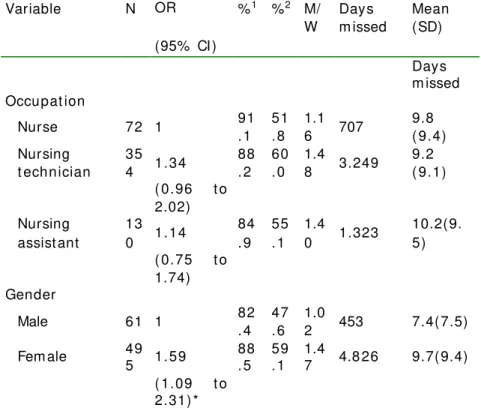
Table 2 present s sickness leave dist ribut ion and com parison according t o occupat ion, gender, and work regim e.
Ta ble 2 – Dist ribut ion of sickness leaves according st udied variables.
Variable N OR
(95% CI)
%1 %2 M/
W Days m issed Mean (SD) Days m issed Occupat ion
Nurse 72 1 91
.1 51 .8
1.1
6 707
9.8 ( 9.4) Nursing
t echnician 35 4 1.34
88 .2
60 .0
1.4
8 3.249
9.2 ( 9.1)
( 0.96 t o
2.02) Nursing
assistant
13 0 1.14
84 .9
55 .1
1.4
0 1.323
10.2(9. 5)
( 0.75 t o
1.74) Gender
Male 61 1 82
.4 47 .6
1.0
2 453 7.4(7.5)
Fem ale 49
5 1.59
88 .5
59 .1
1.4
7 4.8 26 9.7(9.4)
( 1.09 t o
Privat e em ployees
13 4 1
82 .2
48 .6
1.0
0 965
7.2(7.3) * “ St at ut ory”
workers
42 2 1.67
89 .8
61 .4
1.5
8 4.314
10.2(9. 7)*
( 1.26 t o 2.22) *
%1: Percent age of workers t hat sought WHS assist ance who were grant ed sickness leaves.
%2: Percent age of t he t ot al populat ion who were grant ed sickness leaves.
M/ W: Mean num ber of sickness leaves per worker over the entire population.
Mean ( Standard Deviation) : Mean num ber of days m issed per worker on leave.
* p< 0.05.
A total of 1,364 sickness leaves were granted, a m ean 2.15 (SD= 1.8) and m axim um 12 per worker who sought WHS assist ance. The figure shows sickness leave frequency according t o recurrence. Thirt y - six percent of workers were grant ed m ore t han one sickness leave. These leaves account ed for 5,279 m issed workdays, a m ean 8.3 (SD= 9.2) days, and a m axim um 30 days per worker.
0 5 10 15 20 25 30 35 40 45
0 1 2 3 4 5 6 7 8 9 10 11 12
Number of sickness leaves
Percenage of workers
The m ean num ber of leaves population - wide was 1.4 (SD= 1.8) per worker; m ean leave duration was 5.5 ( SD= 8.4) days, m edian 1.0 day, and third quartile 7 days. Of the 633 workers who sought WHS assist ance, 556 ( 87.8% ) were grant ed at least one sickness leave, represent ing 57.6% of t ot al st udy populat ion. Of t hese 556 workers, 37.6% were grant ed one leave, 26.3% , t wo leaves, 14.7% t hree leaves, 10.4% four leaves, and the rem ainder ( 11% ) were granted five or m ore leaves. Concerning leave durat ion, 16% of subj ect s were grant ed one day, 12.9% t wo days, 8.3% , t hree days, 8.1% , four days, and 54,7% were grant ed five or m ore days sickness leave; 68.6% of appoint m ent s result ed in sickness leaves, and m ean leave duration was 2.7 (SD= 4.5) days, with a m axim um 30 days, per appoint m ent . In 46.6% of t he appoint m ent s t hat yielded leaves of absence a single day was grant ed, in 13.5% , two days, and in the rem aining 39.9% , three or m ore days. Significant differences were det ect ed in t he proport ion of sickness leaves bet ween m en and wom en – t h e latter being 1.59 tim es m ore likely to be granted sickness leaves than the form er ( 95% CI : 1.09- 2.31) . The odds of a “ st at ut ory” worker being grant ed a leave of absence were 1.67 t im es great er t han t hose of a privat e em ployee (95% CI : 1.26- 2.22) . There was a significant difference in m ean leave durat ion bet ween work regim es ( t= 3.4, p= 0.001) ; m ean duration was greater am ong statutory workers. The difference in leave duration between m en and wom en is borderline significant (t= 1.85, p= 0.065). No differences in age were found bet ween workers t hat were grant ed leaves of absence during t he year and t hose who were not . There was a significant difference in m ean age bet ween st at ut ory workers who received leaves ( 41.9 years, SD= 7.8) , and privat e em ployees who received leaves ( 35.3 years, SD= 7.4), the form er being older (t= 8.5, p= 0.000).
M o rbidities
Diagnoses t hat generat ed t he great est num ber of sickness leaves included group X ( Diseases of t he respirat ory syst em ) , wit h 18.2% of t ot al leaves, followed by group XI I I ( Diseases of t he m usculoskelet al syst em and connect ive t issue) , wit h 13.4% , and group I ( Cert ain infect ious and parasit ic diseases) wit h 8.7%
Ta ble 3 – Dist ribut ion of appoint m ent s and leaves of absence according t o t he great disease groups.
ICD- 10 Chapters General Gender
Fem ale Male NA %
A % A SL
% L A
% A SL
%L A
%A SL
%L A
I Certain infectious and parasitic diseases 15
0 7, 5
78,
7 8,7
80, 7 8,8
60,
0 6,9
I I Neoplasms 4 0,
2 75,
0 0,2
75,
0 0,2 0 0
III Diseases of the blood & blood forming organs &...
immune system 14
0, 7
42,
9 0,4
46,
2 0,5 0 0
IV Endocrine, nutritional and metabolic diseases 14 0,7 50,0 0,5 75,0 0,5 16,7 ,8
V Mental and behavioral disorders 99 5,0 63,6 4,6 62,9 4,5 70,0 5,4
VI Diseases of the nervous system 76 3,8 77,6 4,3 80,0 4,5 50,0 2,3
VII Diseases of the eye and adnexa 70 3,5 81,4 4,2 80,0 3,9 90,0 6,9
VIII Diseases of the ear and mastoid process 27 1,
4 59,
3 1,2
58, 3 1,1
66,
IX Diseases of the circulatory system 95 4,8 67,4 4,7 69,7 5,0 33,3 1,5
X Diseases of the respiratory system 35
0 17 ,6 70, 9 18, 2 71, 3 18, 2 66, 7 18, 5
XI Diseases of the digestive system 38 1,9 84,2 2,3 85,3 2,4 75,0 2,3
XII Diseases of the skin and subcutaneous tissue 78 3,9 59,0 3,4 62,5 3,2 42,9 4,6
XIII Diseases of the musculoskeletal system and connec tive tissue
27 9 14 ,0 65, 6 13, 4 66, 0 13, 2 62, 5 15, 4
XIV Diseases of the genitourinary system 66 3,
3 75,
8 3,7 78,0 3,7 57,1 3,1
XV Pregnancy, childbirth and pueperium 40 2,
0 95,
0 2,8 95,0 3,1 0 0 XVI I
I
Symptoms, signs and abnormal clinical & laboratory findings 11 5 5, 8 73,
0 6,2 75,5 6,5 44,4 3,1
XIX Injury, poisoning and certain other consequences of
external causes 10 2 5, 1 78,
4 5,9 78,8 5,4 76,5 10, 0
XX External causes of morbidity and mortality 78 3,
9 14,
1 0,8 13,3 0,8 33,3 ,8
XXI Adm inist rat ive cause s 29
3 14 ,7 67, 9 14, 6 66, 5 14, 3 81, 5 16, 9
Tot al 19
88 10 0 68, 6 10 0 69, 2 10 0 63, 1 10 0
NA: Num ber of appointm ents.
% C: Percent age of all appoint m ent s.
% ASL: Percent age of appoint m ent s leading t o sickness leaves per diagnosis group.
% LA: Percent age of sickness leaves over t he t ot al num ber of leaves of absence.
I CD – I nt ernat ional Classificat ion of Diseases, 10t h revision.
I t is also evident t hat t he dist ribut ion of sickness leaves according t o diagnost ic group was sim ilar t o t he num ber of appoint m ent s. Leaves were granted in 84.2% and 81.4% of appointm ents related to groups XI ( Diseases of t he digest ive syst em ) and VI I ( Diseases of t he eye and adnexa) respect ively. For groups I ( Cert ain infect ious and parasit ic diseases) , XI X ( I nj ury, poisoning and cert ain ot her consequences of ext ernal causes) , VI ( Diseases of t he nervous syst em ) , XI V ( Diseases of t he genitourinary system ), XVI I I (Sym ptom s, signs and abnorm al clinical & laboratory findings), and X ( Diseases of t he respirat ory syst em ) , 70%- 80% of appointm ents produced sickness leaves.
Factors associated with sickness leaves
Ta ble 4 – Negative Binom ial Regression m odel estim ates for m en and wom en.
Coefficient Gender
Fem ale Male
Val ue
SE RR 95% CI Val
ue
SE RR 95% CI
( Const ant ) -5.9 7
0.1 5
1
-5.8 4 0. 51 Nursing assist ant 0.2 2 0.1 5 1.2 4 0.92 to 1.66 -0.5 2 0. 51 0. 59 0.22 to 1.61 Nursing
t echnician 0.25 0.13 1.28 0.99 to 1.67 -0.0 4
0.
48 0.96 0.37 to 2.46
Regim e: “ st at ut ory”
0.3 5
0.1 1
1 . 4 2
1 .1 4 t o 1 .7 6
0.7 8 0. 29 2 . 1 9
1 .2 3 t o 3 .9 1 Age: m edian 0.0
99 0.0 92 1.1 04 0.92 to 1.32 -1.0 1 0. 30 0 . 3 6
0 .2 0 t o 0 .6 6
φ = 1.111; EE= 0.116
φ = 1.190; EE= 0.413
m edian for wom en = 38 years, for m en = 36 years.
Work regim e was significant am ong wom en. Fem ale statutory workers were 1.42 tim es m ore likely to be granted leaves than fem ale private em ployees ( 95% CI : 1.14- 1.76) . Male st at ut ory workers had a 1.42 tim es greater chance of being granted leaves than m ale private em ployees ( 95% CI : 1.23- 3.91) . The chance of a m an older than 36 years being grant ed a leave was about 0.36 ( 36% ) t hat of a younger m an, which m eans t hat younger m en have great er levels of absent eeism . Occupat ion, for both m en and wom en, had no influence on absenteeism after adj ustm ent for work regim e and age.
D ISCUSSION
( healt hcare professionals, which can cont ribut e t owards t he great er valorizat ion of cert ain sym pt om s and signs t hat , for t he general populat ion, m ight not have j ust ified consult ing a physician) . Physical disability p er se is oft en not t he direct reason for t aking leave; inst ead, sickness leaves im pose
them selves as a preventive m easure. This is the case with herpes sim plex and m ild respiratory infect ions, or wit h professionals wit h skin lesions, which m ay lead t o infect ion by germ s present in t he hospital environm ent.
The different appoint m ent rat es for t he different occupat ions m ay be explained, init ially, by t he sm aller num ber of nurses, which could discourage these professionals from taking leave. Likewise, hierarchically, t he nurse m ay feel great er responsibilit y t owards t he t eam , which would also encourage t hem t o cont inue work, even under adverse circum st ances. As t heir act ivit y is m ore an adm inist rat ive one, t he pot ent ial for pat ient cont am inat ion is not as large. On t he ot her hand, int ernal arrangem ents am ong hierarchically superior occupations are m ore frequent, which could contribute towards a sm aller dem and for m edical attention. For som e authors, predom inantly adm inistrative occupat ions – as is t he case wit h nurses if com pared t o nursing assist ant s and t echnicians – have sm aller m orbidity and m ortality rates, and therefore a sm aller am ount of sickness leaves.1 1 , 1 5 , 1 7 , 1 9
I t has been widely dem onstrated that young m en are m ore prone to sickness leaves than older m en.2 , 8 , 9 , 2 3 Likewise, sev eral authors have dem onstrated that, generally speaking, wom en are m ore
likely t o be grant ed sickness leaves t han m en.2 , 8 , 9 , 1 1 Other authors,1 4 however, have shown t hat short
-t erm sickness leaves – up -t o seven days, in -t his case – were more common among me n, whereas long- term leaves – longer t han seven days – were m ore frequent am ong wom en. There is a relation bet ween leaves of absence and work regim e. I t would be int erest ing, however, t o st udy t he role of other variables, such as tim e working for the com pany, shift , and num ber of children, so t hat t he influence of ot her fact ors m ay also be det erm ined.
The present st udy invest igat es a recurrent event – work absenteeism , which involves the sam e subj ect repeat edly – through relative risk determ ination. With this in m ind, a negative binom ial regression m odel was em ployed – an alt ernat ive for dealing wit h non- independent event s – aim ing at obt aining a precise est im at e. Am ong t he professionals who sought WHS assist ance, a m ean 2.15 leaves per worker was obt ained for the year 2000, the m axim um being 12 leaves for a single worker. Dat a dem onst rat ed t hat t he event “ sickness leave” repeat ed it self for a sam e subj ect , and t hat t he probabilit y of having ot her appoint m ent s was not equal t o t hat of having only t he first one, t herefore not charact erizing an independent event .
REFEREN CES
1. Benavides FG, Sáez M, Barceló MA, Serra C, Mira M. I ncapacidad t em poral: est rat egias de análisis. Gac Sanit 1999; 13: 185- 90.
2. Blank N, Diderichsen F. Short- term and long - t erm sick- leave in Sweden: relationships with social circum st ances, working condit ions and gender. Scand J Soc Med 1995; 23: 265- 72.
4. Bourbonnais R, Vinet R, Meyer F, Goldberg M. Cert ified sick leave and work load. A case referent study am ong nurses. JOM 1992: 69- 74.
5. Bourbonnais R, Vinet R, Vézina M, Suzanne G. Cert ified sick leave as a non- specific m orbidit y indicat or: a case- referent study am ong nurses. Br J I nd Med 1992; 49: 673 - 8.
6. Brage S, Nygard J, Tellnes G. The gender gap in m usculoskeletal- related long term sickness absence in Norway. Scand J Soc Med 1998; 26: 34 - 43.
7. Brasil. Lei n.o 8.112 de 11 de dezem bro de 1990. Regim e Jurídico Único dos Servidores Civis da União. Belo Horizonte: . Associação Sindical dos Servidores da UFMG; 1991.
8. Brenner H, Ahern W. Sickness absence and early retirem ent on health grounds in the
const r uct ion industry in I reland. Occup Env ir on Med 2000; 57: 615- 20.
9. Chevalier A, Luce D, Blanc C, Goldberg M. Sickness absence at t he French Nat ional Elet ric and Gas Com pany. Br J I nd Med 1987; 44: 101- 10.
10. Conselho Federal de Enferm agem . Enferm agem : term ôm etro da econom ia da saúde. Disponível em URL: ht t p: / / www.port alcofen.gov.br Acesso [ abr 2002] .
11. Feeney A, Nort h F, Head J, Canner R, Marm ot M. Socioeconom ic and sex different ials in reason for sickness absence from the Whitehall I I study. Occup Envir on Med 1998; 55: 91- 8.
12. Fischer JE, Calam e A, Det t ling AC. Obj ect ifying psychom ent al st ress in t he workplace - an exam ple. I nt Ar ch Occup Env ir on Healt h 2000; 73(Suppl): S46- S52.
13. Glynn RJ, Buring JE. Ways of m easuring rat es of recurrent event s. Br Med J
1996; 312(7027): 364 - 7.
14. Knibbe JJ, Friele D. Prevalence of back pain and charact erist ics of t he physical workload of com m unity nurses. Er gon om ics 1996; 39: 186 - 98.
15. Marm ot M, Feeney A, Shipley M, Nort h F, Sym e SL. Sickness absence as a m easure ak healt h st at us and funct ioning: from t he UK Whit ehall I I st udy. J Epidem iol Com m unit y Healt h 1995; 49: 124
-30.
16. Mira JJ, Vitaller J, Buil JA, Aranaz JM, Herrero JF. Absenteism as a sym ptom of occupational ill healt h in hospit als and it s repercussion on qualit y assurance. Qual Assur Healt h Care 1992; 4: 273- 87.
17. Moncada S. Cont ingut s del t reball I incapacit at t em poral en la cohort "Casa Gran" de treballadors de l'ayuntam ent de Barcelona, 1985 [ tesis doctoral] . Barcelona: Universidad Autónom a de Barcelona; 2000.
18. Navarro A, Utzet F, Puig P, Cam inal J, Martín M. La distribución binom ial negativa frente a la de Poisson en el análisis de fenóm enos recurrentes. Gac Sanit 2001; 15: 447- 52.
20. Organização Mundial de Saúde. Cent ro Colaborador da OMS para a Classificação de Doenças em Port uguês. Classificação est at íst ica int ernacional de doenças e problem as relacionados à saúde. Décim a revisão. São Paulo: EDUSP; 1995.
21. Pines A, Skulkeo K, Pollak E, Peritz E, Steif J. Rates of sickness absenteeism am ong em ployees of a m odern hospit al: t he role of dem ographic and occupat ional fact ors. Br J I nd Med 1985; 42: 326
-35.
22. Pit t a A. Hospit al, dor e m ort e com o ofício. São Paulo: Hucit ec; 1990.
23. Prins R, De Graaf A. Comparison of sickness absence in Belgian, Germ an and Dutch firm s. Br J I nd Méd 1986; 43: 529 - 36.
24. Rit chie KA, Macdonald EB, Gilm our WH, Murray KJ. Analysis of sickness absence am ong em ployess of four NHS trusts. Occup Envir on Med 1999; 56: 702- 8.
25. Sm edley J, Egger P, Cooper C, Coggon D. Manual handling activities and risk of low back pain in nurses. Occup Env ir on Med 1995; 52: 160- 3.
26. St ansfeld S, Feeney A, Head J, Canner R, Nort h F, Marm ot M. Sickness absence for psychiat ric illness: the whitehall I I study. Soc Med 1995; 40: 189- 97.
Address to correspondence
Ricardo José dos Reis Alam eda Álvaro Celso, 55
CEP 3015 260 - Belo Horizonte, MG, Brasil Em ail: [email protected] .br ou
ricardoj [email protected] .br
The st udy was carried out in t he Serviço de At enção à Saúde do Trabalhador da Universidade Federal de Minas Gerais.
Present ed at 16t h Congress on Epidem iology in Occupational Health. Barcelona, Spain, 2002.
Received on 3/ 6/ 2002. Reviewed on10/ 6/ 2003. Approved on 16/ 6/ 2003.
© 2 0 0 3 Fa cu lda de de Sa ú d e Pú blica da U n iv e r sida de de Sã o Pa u lo
0 1 2 4 6 - 9 0 4 Sã o Pa ulo SP Br a zil Te l./ Fa x : + 5 5 1 1 3 0 6 8 - 0 5 3 9