MEDI CATI ON DI SPENSI NG ERRORS AT A PUBLI C PEDI ATRI C HOSPI TAL
Lin dem ber g Assu n ção Cost a1 Cleidenet e Valli2 An gr a Pim en t el Alv ar en ga3
Cost a LA, Valli C, Alvar enga AP. Medicat ion dispensing er r or s at a public pediat r ic hospit al. Rev Lat ino- am Enferm agem 2008 set em bro- out ubro; 16( 5) : 812- 7.
Obj ect iv e: assess t he safet y of m edicat ion dispensing pr ocesses t hr ough t he dispensing er r or r at e. Met hod: Cr oss- sect ional st udy car r ied out at a phar m aceut ical ser v ice of a pediat r ic hospit al in Espír it o Sant o, Br azil. Dat a collect ion w as per f or m ed bet w een Au gu st an d Sept em ber 2 0 0 6 , t ot alin g 2 6 2 0 pr escr ibed m edicat ion d oses. An y d ev iat ion f r om t h e m ed ical p r escr ip t ion in d isp en sin g m ed icat ion w as con sid er ed a d isp en sin g er r or . The cat egor ies of m edicat ion er r or s w er e: cont ent , labeling, and docum ent at ion er r or s. The dispensing er r or r at e w as com put ed by dividing t he num ber of er r or s by t he t ot al of dispensed doses. Result s: Fr om t he 300 ident ified er r or s, 262 ( 87.3 % ) w er e cont ent er r or s. The r at e of er r or s in t he labeling and docum ent at ion cat egor ies w as 33 ( 11% ) and 5 ( 1. 7% ) , r espect iv ely . Conclusion: The t ot al dispensing er r or r at e w as higher t han r at es r epor t ed in int er nat ional st udies. The m ost fr equent cat egor y w as “ cont ent er r or ” .
DESCRI PTORS: m edicat ion er r or s; ph ar m acy ; m edicat ion sy st em ; ph ar m aceu t ical car e
ERRORES DE DESPACHO DE MEDI CAMENTOS EN UN HOSPI TAL PÚBLI CO PEDI ÁTRI CO
Obj et iv o: Ev aluar la segur idad en el despacho de m edicam ent os a t r av és de la det er m inación de la t asa de er r or es d e d esp ach o. Mét od os: Est u d io t r an sv er sal q u e ev alu ó 2 6 2 0 d osis d e m ed icam en t os d esp ach ad os ent re agost o y sept iem bre de 2006 en un servicio de farm acia de un hospit al pediát rico del Est ado de Espírit u Sant o, Br asil. Los er r or es de despacho fuer on definidos com o cualquier desvío ocur r ido ent r e lo despachado y lo pr escr it o en la r ecet a m édica. Los er r or es fuer on cat egor izados en cont enido, r ót ulo y docum ent ación. La t asa de er r or de despacho fue calculada div idiendo el núm er o de er r or es t ot al por el núm er o t ot al de dosis despachadas. Result ados: de los 300 errores ident ificados, 262 ( 87,3 % ) fueron de cont enido. En las cat egorías errores de rót ulo la t asa fue de 33 ( 11% ) y 5 ( 1.7% ) en la de errores de docum ent ación. Conclusión: la t asa t ot al de er r or es de despacho fue elev ada cuando se com par a con la descr it a en est udios int er nacionales. La cat egor ía de er r or m ás fr ecuent e fue la de “ er r or de cont enido” .
DESCRI PTORES: er r or es de m edicación; far m acia; sist em as de m edicación, at ención far m acéut ica
ERROS DE DI SPENSAÇÃO DE MEDI CAMENTOS EM UM HOSPI TAL PÚBLI CO PEDI ÁTRI CO
Avaliar a segurança na dispensação de m edicam ent os at ravés da det erm inação da t axa de erros de dispensação const it uiu o obj et iv o dest e t r abalho. O m ét odo ut ilizado foi o est udo t r ansv er sal que av aliou 2 620 doses de m edicam en t os dispen sados en t r e agost o e set em br o de 2 0 0 6 , em u m ser v iço de f ar m ácia de u m h ospit al pediát rico do Espírit o Sant o. Os erros de dispensação foram definidos com o qualquer desvio ent re o dispensado e o pr escr it o n a r eceit a m édica. Os er r os for am cat egor izados em con t eú do, r ot u lagem e docu m en t ação. A t ax a de er r o de dispensação foi calculada div idindo o núm er o de er r os t ot al/ t ot al de doses dispensadas. Os r esult ados m ost r ar am que, dos 300 er r os ident ificados, 262 ( 87,3% ) for am de cont eúdo. Nas cat egor ias er r os de rot ulagem a t axa foi de 33 ( 11% ) e 5 ( 1,7% ) na de erros de docum ent ação. Concluiu- se que a t axa t ot al de er r os de dispensação foi elevada quando com par ada à descr it a em est udos int er nacionais. A cat egor ia de er r o m ais fr eqüent e foi a de er r o de cont eúdo.
DESCRI TORES: er r os de m edicação; far m ácia; sist em as de m edicação, assist ência far m acêut ica
1 M.Sc. in Medicine and Health, Professor at Bahia Federal University Faculty of Pharm acy, Brazil, e- m ail: lindem [email protected]; 2 Pharm acist , Hospit al I nfant il
Alzir Bernadino, e- m ail: cleident e@gm ail.com ; 3 Pharm acy St udent , Universidade Brasileira, UNI VI X, Brasil.
I NTRODUCTI ON
M
edication error is a difficult topic to address. Discussions about it are generally directed at seeking t he culprit and do not provide syst em im provem ent opportunities with a view to preventing failures( 1). Som e au t h or s su g g est t h at t h e occu r r en ce of er r or s in d i f f er en t so ci a l a n d p r o f essi o n a l sy st em s m i g h t o r i g i n a t e i n sy st e m f a i l u r e s ( sy st e m i c e r r o r s) . Medicat ion errors are considered hum an errors and, t h u s, can b e cau sed b y t h ese f ai l u r es( 2 - 4 ). Th eyr epr esent a sev er e social and healt h pr oblem w it h im portant econom ic repercussions( 3) and are classified
a s m e d i ca t i o n p r e scr i p t i o n , d i sp e n si n g a n d adm inist rat ion errors. Dispensing errors occur during t he m edicat ion dispensing process( 4- 6).
Lit er at u r e su g g est s t h at t h e in cid en ce of m edication errors in pediatrics is twice or three tim es as high as in adult s, and also t hat pediat ric pat ient s are at higher risk of death when com pared to adults( 7-1 7-1 )
. Th e se e r r o r s a l so r e p r e se n t a n i m p o r t a n t econom ic cost and m easures t o reduce and prevent t hem are necessary( 2,10). Discovering t heir frequency
and defining w ays t o prevent t hem is an im port ant st r a t e g y t o r e d u ce r i sk s, e sp e ci a l l y i n sp e ci a l p o p u l a t i o n s l i k e ch i l d r e n . Th e Br a zi l i a n He a l t h Su r v ei l l an ce Ag en cy ( ANVI SA) r ecen t l y i n cl u d ed m e d i ca t i o n e r r o r s i n i t s p h a r m a co su r v e i l l a n ce program as a st rat egic area for pat ient safet y in t he process of m edicat ion use( 4).
The pharm acy service is responsible for t he safe and efficient use of m edicat ion in hospit als and plays an essential role in integrating the prescription, dispensing and adm inist rat ion processes and should have policies and procedures t o prevent errors( 4- 5,8).
Th e r at e of er r or s is con sid er ed on e of t h e b est indicators of quality of m edication distribution system s an d is st ill u sed t o ev alu at e t h e saf et y of t h ese syst em s( 4,6,9).
Som e studies, published in the United States and England, showed an incidence of dispensing errors o f ab o u t 1 0 % , ev en i n h o sp i t al s w i t h ad v an ced m e d i ca t i o n d i st r i b u t i o n sy st e m s, su ch a s u n i t doses( 7,11).
A f ew st u d ies w er e car r ied ou t in Br azil, specifically on m edicat ion dispensing processes, and presented high rates of errors, above 10%( 5,8). I n the
pediatric area, especially in Brazil, no study was found on dispensing er r or s and, t o dat e, t heir cause and epidem iology ar e unknow n.
Ther efor e, t his st udy aim s t o ev aluat e t he dispensing process of the pharm acy service at a public pediat ric hospit al. I m port ant indicat ors were used t o m easure the dispensing process and the rate of total dispensing errors was the global indicator of its quality.
MATERI AL AND METHODS
St udy design
Cross- sectional, descriptive study, carried out in the dispensing sector of the Pharm acy service at a public pediat ric hospit al in Espírit o Sant o, Brazil from August 25 t o Sept em ber 20, 2005.
Charact erist ics of t he st udy sit e
Pu b l i c p e d i a t r i c h o sp i t a l w i t h 9 6 b e d s dist r ibut ed in t hr ee hospit alizat ion unit s; pediat r ic out pat ient , neonat al and pediat ric int ensive t herapy u n i t , su r g i ca l ce n t e r a n d e m e r g e n cy ca r e . Th e Pharm acy service is divided in t he following sect ors: m at er ial and m edicat ion st or age, dispensing, t ot al parent eral feeding, and m edicat ion split t ing.
Descript ion of t he m edicat ion dist ribut ion syst em
Dispensing m edicat ion is perform ed t hrough a m ixed dist ribut ion syst em ( collect ive and individual d o se s) f o r a p e r i o d o f 2 4 h o u r s. Me d i ca t i o n i s d i sp e n se d t h r o u g h ca r b o n a t e d co p y o f m e d i ca l prescript ions t o t he nursing wards. The prescript ion copies are collect ed by t he pharm acy t echnicians in the hospitalization units until 11am , and are forwarded t o pharm acist s for int erpret at ion and evaluat ion. I n t his st age, t he pharm acist , when possible, evaluat es d o sa g e , a d m i n i st r a t i o n r o u t e , f r e q u e n cy o f ad m in ist r at ion , d u r at ion of t r eat m en t , et c. Af t er evaluat ing t he prescript ion, t he pharm acy auxiliaries separat e m edicat ion dosages and put t hem in plast ic bags. The plastic bags are put in the dispensing sector and t hen forwarded t o pharm acist s for checking.
After identification and correction of potential e r r o r s i n t h e p r e p a r a t i o n o f d o sa g e s b y t h e pharm acist s, m edicat ions are separat ed for each unit and t he nursing auxiliaries go t o t he pharm acy and check, for t he second t im e ( cont rol) , aft er which t he m edicat ion is forwarded t o t he unit s unt il 3pm .
i-solid, etc) , put in plastic bags and identified with the d r u g n a m e a cco r d i n g t o t h e Br a zi l i a n Co m m o n D e n o m i n a t i o n ( D CB) , d o sa g e , l o t n u m b e r a n d expiration date. These m edications are usually bought f r o m t h e i n d u st r y i n b l i st e r s, g l a ss o r p l a st i c co n t a i n e r s. Or a l so l u t i o n s, e l i x i r s, sy r u p s, o r a l su sp en si o n s, cr eam s, o i n t m en t s an d l o t i o n s ar e dispensed by t he dist r ibut ion sy st em by unit dose, w h ile p ar en t er al m ed icat ion s an d st er ile liq u id s, supposit or ies, opht halm ic, aur icular, nasal and oral preparat ions, aerosols and inhalant s are collect ively dispensed in t heir original packages.
I nclusion crit eria
All dispensed m edication in solid presentation f o r o r al u se, o r al so l u t i o n s, el i x i r s, sy r u p s, o r al suspensions, cream s, oint m ent s, lot ions, opht halm ic, au r i cu l ar, n asal an d o r al p r ep ar at i o n s, aer o so l s, par ent er al solut ions of sm all volum e, inhalant s and m ed icat ion n ot st an d ar d ized in t h e h osp it al, b u t available at it s pharm acy.
Exclusion crit eria
- prescribed m edicat ion t hat was out of st ock in t he hospit al during t he period of dat a collect ion;
- m edicat ion illegibly prescribed;
- m edicat ion t hat was dispensed but t he researcher did n ot obser v e it s pr epar at ion or separ at ion an d dispensing.
Sam p le
Th e sa m p l e w a s co m p o se d o f 2 3 9 p r escr ip t ion s t h at m et t h e in clu sion cr it er ia. Th e select ion and dispensing of 655 m edicat ions, t ot aling 2620 doses, w er e follow ed bet w een August 25 and Septem ber 20, 2005 at a pediatric hospital in Espírito Sant o, Brazil.
Pilot Test
To estim ate the sam ple and validate the data collection form , 10 m edical prescriptions per day were random ly selected for five days ( 10 prescriptions were r an dom ly dr aw n fr om each 3 0 t h at ar r iv ed at t h e pharm acy) , t ot aling 50 prescript ions during t he pilot t est . A t ot al dispensing error rat e of 10% was found in t he pilot sam ple, considering approxim at ely 5% of precision, 95% of confidence interval, and prevalence of 10% . The sam ple size was 139 prescriptions + 10% of losses = 153 prescript ions.
Dat a collect ion
D at a co l l ect i o n w as car r i ed o u t b et w een August and Sept em ber 2005 in t w o st ages: befor e and after the pharm acist’s inspection, when inspection was perform ed. Thus, errors of pharm acy t echnicians when preparing m edications and errors of pharm acists w hen dispensing w er e ident ified. The pr escr ipt ions were random ly selected during the study period. Each day, 20 prescript ions were random ly drawn, t ot aling 2 3 9 p r e scr i p t i o n s d u r i n g d a t a co l l e ct i o n . Af t e r selection, prescriptions were identified with a num ber for post er ior ev alu at ion of er r or s. Aft er ph ar m acy t ech n ician s pr epar ed m edicat ion s, t h e m edicat ion n am e, co n cen t r at i o n , d o sag e f o r m an d q u an t i t y pr epar ed w er e r ecor ded in a dat a collect ion for m . Th e sa m e p r o ce d u r e w a s p e r f o r m e d a f t e r t h e pharm acist’s inspection, before m edications were sent t o t h e u n it s. Becau se t h er e w as n o access t o t h e pr escr ipt ions at t he m om ent of dat a collect ion, t he researchers had no previous knowledge of dispensing errors. Medicat ions wit h quest ionable qualit y ( alt ered color, v iolat ed cont ainer, no label, disint egrat ed or fissured solid oral) or with expired date were reported t o t he pharm acist and were not considered errors. A pharm acist , wit h m ore t han t wo years of experience in h osp it al p h ar m acies, an d a p h ar m acy st u d en t collected data; the m ain researcher previously trained bot h.
Var iables Operat ionalizat ion
Errors were classified according to the criteria used in a previous study( 10) in:
Cont ent er r or s
I n cor r ect m edicat ion – Dr ug dispensed differ s fr om the one prescribed. Excluding therapeutic substitution of m edication due to hospital standards or procedures; I ncorrect concent rat ion – dispensing drug with correct quant it y of m edicat ion ( Mg or m L) but wit h incorrect adj ust m ent of dosing inst ruct ions;
I ncorrect dosage form – Dispensing correct m edication but in a dosage form different from t hat prescribed. I t includes providing a m odified release form ulat ion when a st andard form ulat ion was prescribed; D o s e a d d e d – D i sp e n si n g a l a r g e r q u a n t i t y o f m edicat ion ( in num ber, unit s, or t im es a day) t han t hat prescribed.
O m i s s i o n o f m e d i c a t i o n – n o t d i sp e n si n g t h e pr escr ibed m edicat ion;
D e t e r i o r a t e d M e d i c a t i o n – D i sp e n si n g e x p i r e d m ed icat ion or m ed icat ion st or ed in in ap p r op r iat e t em perat ure ( not com plying wit h t he m anufact urer’s specificat ions) or m edicat ion whose prim ary package w as dam aged;
Ot her errors of cont ent – All other errors not included in previous cat egories.
Labeling er r or s
I ncorrect pat ient ’s nam e – Om itting the patient’s nam e o r n a m e d i f f e r e n t f r o m t h e o n e i n t h e m e d i ca l pr escr ipt ion.
I n co r r ect n am e o f m ed i cat i o n – Th e n am e of t h e m e d i ca t i o n o n t h e l a b e l i s d i f f e r e n t f r o m t h a t prescribed, except when observat ions are necessary to com ply with the hospital standards ( e.g. prescription with brand nam e and dispensation by generic nam e) ; I ncorrect dosage of m edicat ion – dosage of m edication on the label is different from the one prescribed, when m ore t han a dose is available on t he m arket , except when observat ions are necessary t o com ply wit h t he hospit al st andards;
I n c o r r e c t q u a n t i t y o f m e d i c a t i o n – Qu a n t i t y o f m edicat ion on t he label is different from prescribed, ex pect w hen adj ust m ent s ar e necessar y t o com ply wit h t he hospit al st andards;
I ncorrect dosage form – the dosage form on the label is d if f er en t f r om t h e on e p r escr ib ed ( e. g . t ab let s dispensed as capsules) ;
I ncorrect dat e – om ission of dispensing date or wrong dispensing dat e;
I n cor r ect in st r u ct ion s – I nst r uct ions differ ent fr om t h o se p r escr i b ed , ex cep t w h en a d j u st m en t s a r e necessary to com ply with the hospital standards ( e.g. t ake t he m edicat ion aft er m eals) ;
Ad d it ion al w ar n in g – Om ission or in cor r ect u se of warnings according t o t he bibliographic references. Ph a r m a c y a d d r e s s – Fa i l t o i n cl u d e t h e co r r e ct pharm acy address on t he label;
O t h e r l a b e l i n g e r r o r s – An y l a b e l i n g e r r o r n o t in clu ded in t h e pr ev iou s cat egor ies; f or in st an ce, illegible n am e or n u m ber.
Docum ent at ion er r or s
A b s e n t o r i n c o r r e c t c o n t r o l l e d m e d i c a t i o n docum ent at ion – Absent or incorrect docum ent at ion of cont rolled drug regist rat ion according t o law;
Ot h er d o cu m en t at i o n er r o r s – an y docu m en t at ion errors not included in t he cat egory above.
St at ist ical analysis
St at i st i cal Pack ag e f o r t h e So ci al Sci en ces ( SPSS Chicago - I L, version 9.0, 1998) was used to build the database and m ake statistical calculations. Categorical v ar iables w er e ex pr essed as pr opor t ion s ( r elat iv e fr equ en cy ) .
Et hical aspect s
Th is st u d y w as ap p r ov ed b y t h e h osp it al direct ion. The pharm acist s and pharm acy t echnicians filled out t he infor m ed consent t er m , allow ing t he o b se r v a t i o n o f d i sp e n si n g a ct i v i t i e s, a n d w e r e i n f o r m ed a b o u t t h e st u d y a i m s t o ev a l u a t e t h e d i sp en si n g sy st em . Th ey w er e n o t aw ar e o f t h e obj ectives and m ethod used; these aspects were kept blind t o t he pharm acy t eam t o avoid known biases( 6-7 ). All er r or s t h at occu r r ed du r in g t h e st u dy w er e
codified and kept confident ial. They w er e cor r ect ed o n l y a f t e r t h e l a st co n t r o l p e r f o r m e d b y t h e phar m acist - r esear cher( 7).
RESULTS
Du r in g t h e st u d y, 2 3 9 p r escr ip t ion s w er e evaluat ed and included 655 prescribed m edicat ions, t ot aling 2620 dispensed doses.
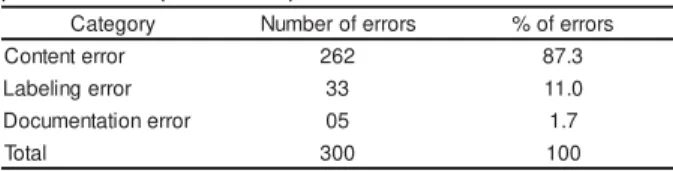
The t ot al r at e of er r or s including t he t hr ee crit eria ( cont ent , labeling and docum ent at ion errors) was 11.5% ( 300 errors/ 2620 doses) . Table 1 shows t h e f r equ en cy of dispen sin g er r or s in each of t h e ca t eg o r i es. Th e co n t en t ca t eg o r y p r esen t ed t h e h i g h e st r a t e o f e r r o r, f o l l o w e d b y l a b e l i n g a n d docum ent at ion er r or s.
Tab le 1 – Dist r ib u t ion of er r or s b y cat eg or y at a pediat ric hospit al in Espírit o Sant o, Brazil - 2005
y r o g e t a
C Numberoferrors %oferrors r
o r r e t n e t n o
C 262 87.3
r o r r e g n il e b a
L 33 11.0
r o r r e n o it a t n e m u c o
D 05 1.7
l a t o
T 300 100
om ission er r or s; in cor r ect dosage an d det er ior at e m edicat ion errors were not regist ered. On t he ot her hand, t he m ost com m on er r or s in “ labeling er r or s” w er e t h e su b cat eg or y “ ot h er lab elin g er r or s” an d “ incorrect dosage”, as show n in Table 3. There was n o o ccu r r en ce f o r t h e i t em s: m ed i ca t i o n n a m e, q u a n t i t y, p h a r m a ce u t i ca l p r e se n t a t i o n , d a t e , i n st r u ct i o n s, w a r n i n g , a n d i n co r r e ct p h a r m a cy addr ess.
Tab le 2 – Dist r ib u t ion of er r or s accor d in g t o t h e cat egor y “ cont ent er r or s” at a pediat r ic hospit al in Espírit o Sant o, Brazil – 2005
r o r r E f o e p y
T Numberof
s r o r r E f o y c n e u q e r F ) % ( s r o r r E n o it a c i d e m t c e r r o c n
I 01 0.38
n o it a t n e s e r p l a c it u e c a m r a h p t c e r r o c n
I 03 1.15
d e d d A e s o
D 75 28.62
s e s o d g n i s s i
M 130 49.62
n o i s s i m
O 40 15.27
s r o r r e t n e t n o c r e h t
O 13 4.96
l a t o
T 262 100
The total error rate of the category “ labeling er r or ” w as 1. 7% . The m ost fr equent er r or s in t his cat egory were: “ ot her labeling errors” wit h 75% and “ incorrect dosage” wit h 21.2% . ( Table 3) .
Tab le 3 – Dist r ib u t ion of er r or s accor d in g t o t h e cat egor y “ labeling er r or s” at a pediat r ic hospit al in Espírit o Sant o, Brazil – 2005
r o r r e f o e p y
T Numberoferrors Frequencyoferrors(%)
s 't n e it a p t c e r r o c n I e m a
n 1 3.03
e g a s o d t c e r r o c n
I 7 21.21
s r o r r e g n il e b a l r e h t
O 25 75.76
l a t o
T 33 100
Th e o ccu r r e n ce o f e r r o r s i n t h e “ d o cu m e n t a t i o n e r r o r s” ca t e g o r y w a s cl a ssi f i e d according t o crit eria included in Table 4. There were errors of absent or incorrect docum entation of control in t wo cases, which represent s 40% of errors in t his cat egor y.
Tab le 4 – Dist r ib u t ion of er r or s accor d in g t o t h e category “ docum entation errors” at a pediatric hospital in Espírito Santo, Brazil – 2005
r o r r e f o e p y
T Numberoferrors Frequency(%)
l o r t n o c t c e r r o c n i r o t n e s b A n o it a t n e m u c o
d 02 40%
s r o r r e n o it a t n e m u c o d r e h t
O 03 60%
l a t o
T 5 100%
DI SCUSSI ON
The t ot al dispensing error rat e, according t o t he adopt ed classificat ion syst em ( cont ent , labeling, and docum ent at ion errors) , was 11.5% for t he t ot al of dispen sed doses in t h e st u dy per iod. Th is r at e represents one error for approxim ately nine dispensed doses. Data analysis showed a m uch higher frequency in t he crit erion “ cont ent errors” 87.3% ( 262/ 2620) . This higher predom inance is due to the fact that errors occur m ore oft en during t he dispensing process it self t han dur ing t he labeling and docum ent at ion of t his act ivit y( 3).
W h e n t h e cr i t e r i o n “ co n t e n t e r r o r s” i s separat ely analyzed, t he m ost frequent errors w ere “ too high doses” and “ m issing doses” with 49.6% and 28. 6% , r espect iv ely. These dat a ar e in accor dance with other studies that appoint that dosage errors are t he m ost frequent in pediat rics. Considering only t he cont ribut ion of t his cat egory ( cont ent errors) in t he t ot al error rat e by dispensed doses, an error rat e of 10% is found, that is, alm ost the total error rate found in t he sam ple.
Th e ca t e g o r i e s ‘ l a b e l i n g e r r o r s’ a n d ‘docum ent at ion er r or s’ r epr esent ed 11% and 1. 7% o f t h e e r r o r s, r e sp e ct i v e l y. I n t h e ca t e g o r y ‘docum entation errors’, the absence of docum entation w as t h e m ost com m on er r or. Th er e ar e d if f er en t m et hods t o evaluat e dispensing errors, which m akes i t d i f f i cu l t t o co m p ar e r esu l t s b et w een d i f f er en t st udies( 14). I n t he st udy sam ple, t he t ot al error rat e
was considered high when com pared with other studies using a sim ilar m et hod( 4- 5, 10). The causes of er r or s
presented in this study can be of several origins, which require a deeper evaluat ion wit h qualit at ive st udies, t hough som e crit ical point s can be raised as possible causes. An im port ant point observed is t hat , m ost of the tim es, the pharm acist did not check doses prepared by pharm acy t echnicians. Despit e t he adequat e rat e of phar m acist s per num ber of beds ( 30: 1) , it w as verified t hat t he pharm acist ’s act ions are focused on t he adm inist rat ive aspect of t he dispensing process, and not on its care. There is strong evidence that the distribution system of unit doses can reduce the error r a t e a n d i n cr e a se sa f e t y i n t h e m e d i ca t i o n u se process( 4- 8).
im provem ent. However, the adopted system does not allow for a r educt ion in dispensing er r or s because t her e ar e no r igid cont r ols. The m aj or it y of er r or s can be avoided if a dist ribut ion syst em concent rat ing t he process of dosage preparat ion in t he pharm acy ser v ice is in place an d t h e ph ar m acist ch eck s t h e prescript ion before it is dispensed( 4- 5). On t he ot her
hand, effect ive int eract ion bet ween t he nursing and t h e ph ar m acy ser v ices is essen t ial becau se m an y errors t hat occur during t he dispensing process can b e a v o i d e d a t t h e m o m e n t t h e m e d i ca t i o n i s ad m i n i st er ed b y t h e n u r se. A m u l t i cen t er st u d y inv olv ing four hospit als in differ ent r egions of t he count ry ident ified high error rat es during m edicat ion preparation and adm inistration. Authors suggest that, t o im prove safet y of m edicat ion dist ribut ion syst em s, changes need to be adopted in the institutional culture wit h a view t o solid im provem ent s( 9).
Results of two Brazilian studies on dispensing errors in adult hospitals showed very high error rates ( 13.8% and 17% ) , alt hough phar m acist s inspect ed t he doses prepared by auxiliaries in bot h st udies( 5,8).
However, one has to be careful in m aking com parisons b et w een t h ese t w o st u d i es b eca u se t h er e i s a n
i m p o r t a n t m e t h o d o l o g i ca l d i f f e r e n ce i n e r r o r classificat ion( 7,10).
Th is st u dy pr esen t s som e lim it at ion s, t h e m ain of which is that one cannot generalize its results t o ot h er h ospit als of t h e sam e size an d specialt y, because t here are ot her im port ant variables t hat can influence t he dispensing error rat e. Anot her issue is t h at a r ep r esen t at i v e sam p l e o f Br azi l i an p u b l i c hospitals was not used, considering num ber and type of clinical unit s as well as t heir com plexit y level( 4).
CONCLUSI ON
The t ot al dispensing error rat e in t he st udy sa m p l e i s h i g h w h en co m p a r ed t o i n t er n a t i o n a l studies( 12- 13,15). The m ost frequent error category was
the “ content error”, while “ m issing doses” and “ wrong dose” were t he m ost prevalent in t his cat egory. The cat egories “ labeling error” and “ docum ent at ion error” represent ed a sm all influence on t he t ot al error rat e. Furt her research is necessary t o evaluat e t his issue, n o t o n l y o n m e d i ca t i o n d i sp e n si n g b u t a l so o n adm inist rat ion and prescript ion.
REFERENCES
1. Reason J. hum an errors: m odels and m anagem ent . BMJ 2 0 0 0 m ar ço; 3 2 0 ( 1 8 ) : 7 6 8 - 7 0 .
2. Manasse HRJr. Medicat ion use in an im perfect world: drug m isadv ent ur ing as an issue of public policy, par t 1. Am J Hosp Phar m 1 9 8 9 May ; 4 6 ( 5 ) : 9 2 9 - 4 4 .
3. Barber N, Dean B. The incidence of m edicat ion errors and ways t o reduce t hem . Clin Risk 1984 June; 18( 2) : 103- 6. 4. Cost a LA. Av aliação da adm inist r ação de m edicam ent os em h osp it al p ú b lico e pr ivado de salv ad or. [ disser t ação] Salvador ( BA) : Faculdade de Medicina / UFBA; 2005. 5. Oliveira MGG. Erros de m edicação; um a experiência em dispensação de m edicam ent os [ Monografia] . Salvador ( BA) : Faculdade de Far m ácia/ UFBA; 2004.
6. Fly n EA, Bar k er KN, Car nahan BJ. Nat ional obser v at ion st udy of prescript ion accuracy and safet y in 50 pharm acies. Am J Phar m Assoc 2003 Mar ch; 43( 2) : 191- 200.
7 . Allan E, Bar k er K. Fu n d am en t als of Med icat ion Er r or Resear ch. Am J Hosp Phar m 1990; 47( 3) : 555- 71. 8. Anaclet o TA, Per ini E, Rosa, MB, Cesar CC. m edicat ion errors and drug- dispensing syst em s in a hospit al pharm acy. Clin ics 2 0 0 5 Au g u st ; 4 : 3 2 5 - 3 2 .
9. Miasso AI , Silva AEBC, Cassiani SHB, Grou CR, de Oliveira RC, Fak ih FT. O pr ocesso de pr epar o e adm in ist r ação de m ed i cam en t os: i d en t i f i cação d e p r ob l em as p ar a p r op or m elhor ias e pr ev enir er r os de m edicação. Rev. Lat ino- am . enfer m agem 2006 m aio/ j unho; 14( 3) : 354- 63.
10. Beso A, Franklin BD, Barber N. The frequency and pot ent ial causes of dispensing errors in a hospit al pharm acy. Pharm acy Wld Sci 2005 June; 27( 3) : 182- 90.
11. Hughes RG, Edger t o EA. Fir st do no har m . AJN 2005 May ; 5 : 7 9 - 8 4 .
12. Miller MR, Pr onov ost PJ, Bur st in HR. Pediat r ic pat ient safet y in t he am bulat ory set t ing. Am bul Pediat r 2004 January; ( 4 ) 1 : 4 7 - 5 4 .
13. Schneider MP, Cot t ing J, Pannat ier A. Evaluat ion of nurses er r or s associat ed in t he pr epar at ion and adm inist r at ion of m edicat ion in a pediat ric int ensive care unit . Pharm Wld Sci 1 9 9 8 ; 2 0 : 1 7 8 - 9 2 .
14. Blasco PME, Salient e M, Yanguas E, Alm iñana M, Molina M, Ál v a r e z M. D e sa r r o l l o d e u n m é t o d o o b se r v a ci o n a l pr ospect iv o de est udio de er r or es de m edicación par a su aplicación en hospit ales. Far m Hosp 2001; 5: 253- 73. 15. DWong I CK, Ghaleb MA, Franklin BD, Barber N. I ncidence an d n at u r e of dosin g er r or s in paediat r ic m edicat ion s: a sy st em at ic r ev iew. Dr ug Safet y. 2004; 9: 661- 70.